
Holender Tułacz. Ballada Senty z II aktu [partytura]

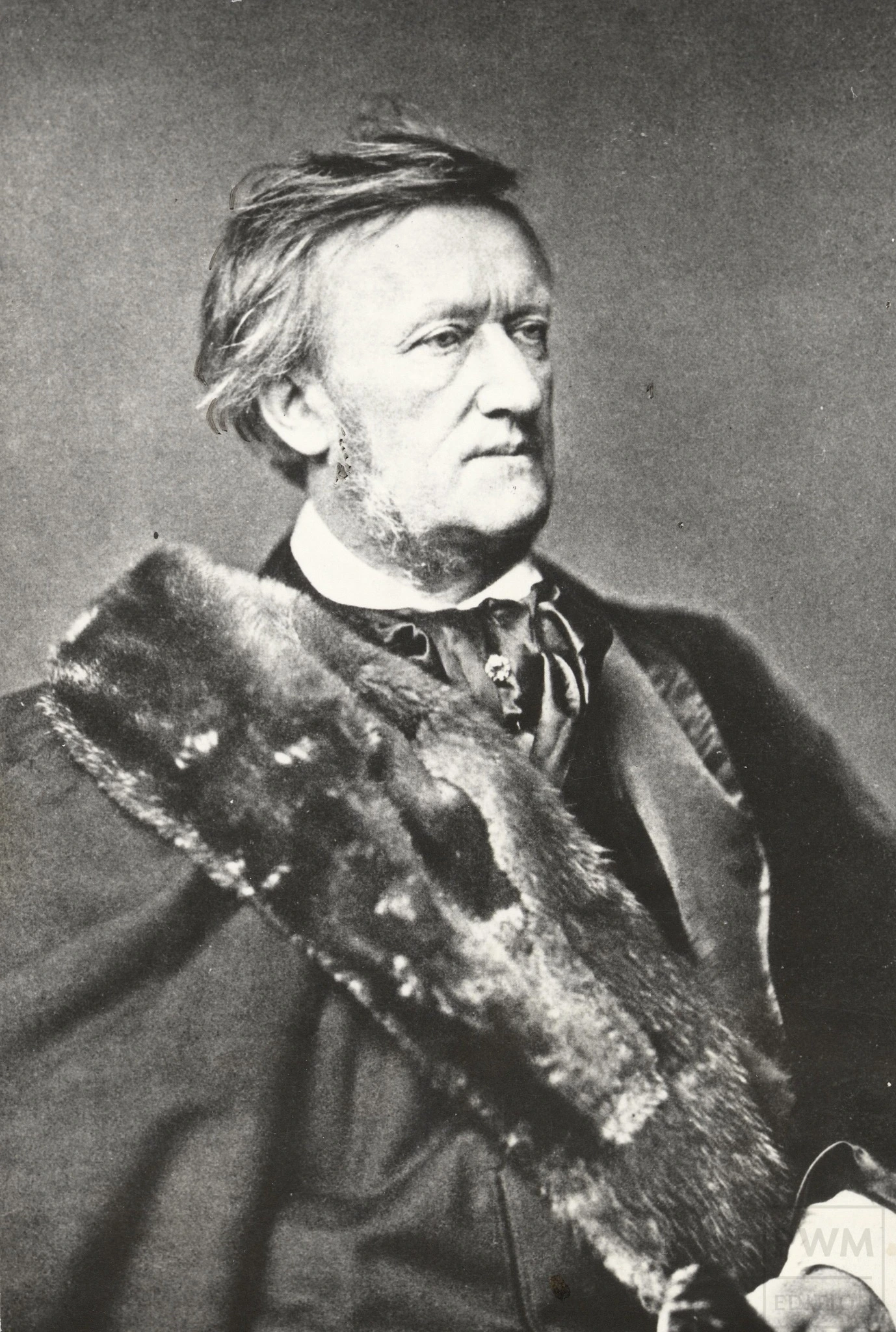
Wagner Wilhelm Richard, *22 May 1813 Leipzig, †13 February 1883 Venice, German composer, poet, playwright, publicist, and music theorist. Wagner’s mother, Johanna Rosina née Patz, after the death of her first husband, police archivist Carl Friedrich Wilhelm Wagner, remarried (and had eight children) to a family friend, Ludwig Geyer, a painter, poet, and actor of Jewish descent, of the Protestant faith. In 1814, Wagner’s family moved with him to Dresden, where Geyer became involved in the local theatre. Until the end of his life (30 September 1821), he carefully cared for Wagner and raised him under his own surname; it is even assumed that he was his father. This issue was a source of severe trauma for Wagner. After Geyer’s death, his brother, the goldsmith Carl Geyer, briefly took care of Wagner’s upbringing and education. Until the summer of 1822, Wagner lived in his home in Eisleben and attended a private school run by a local pastor. He then returned to Dresden under his mother’s care, where he was accepted into the grammar school. He grew up among people interested in theatre and music, professionally engaged in various artistic endeavours. Wagner’s eldest brother, Albert, was a singer, actor, and director; his uncle Adolf was a writer, literary scholar, and translator; his sisters, Luise, Rosalie, and Clara, performed as actresses. Music was played at home, and they maintained contacts with many artists, including C.M. von Weber, then director of the Dresden Opera. Initially, however, Wagner did not focus on his musical studies. At school, where he was particularly passionate about Greek mythology and history, his philological and literary talents were appreciated. In 1826, Wagner was cared for by the Böhme brothers – his schoolmates, as Wagner’s entire family had moved to Dresden. In the spring of 1827, the composer reverted to the surname Wagner and made his first solo journey on foot – to Prague, where they lived with his sister’s mother. During this time, he had the opportunity to become acquainted with the stories of E.Th.A. Hoffmann. Wagner wrote a five-act tragedy, Leubald und Adelaide, when he was 15, which he intended to set to music in the future. He initially acquired his basic musical knowledge and skills independently, studying the works of W.A. Mozart (operas), Beethoven (symphonies, string quartets), and Weber, as well as from the textbook System der Musik-Wissenschaft und der praktischen Komposition mit Inbegriff… by J.B. Logier. In 1828, he moved to Leipzig, where he again lived with his mother and was accepted into the Nikolaigymnasium. During the years 1828–31, he received harmony lessons and probably the basics of conducting from Ch. G. Müller, a Gewandhaus orchestra musician, but until 1831 Wagner remained primarily an autodidact. He gained compositional skill by transcribing musical pieces and preparing piano reductions of overtures and symphonies (e.g., Egmont and Beethoven’s Ninth Symphony), and dramatic experience through frequent visits to the theatre (plays by W. Shakespeare, F. Schiller, and E. Raupach, operas by Weber, H. Marschner, L. Spohr, G. Rossini, G. Spontini, and D. Auber), arranging home performances, and working as an extra – from an early age – in professional theatre. However, Wagner never intended to become an actor, singer, or instrumentalist. He wrote down his first compositions, the Sonata in D minor for piano and the String Quartet in D major (lost), in secret from his family. Due to poor grades, he was transferred to the Thomasschule in June 1830.
The events of the July Revolution of 1830 in France ignited the 17-year-old’s interest in politics and the idea of radical social upheaval. He also joined a significant portion of the academic community who declared their support for the Polish nation’s aspirations for freedom: “Poland quickly filled me with growing enthusiasm. The victories that the Poles achieved in a short time in May led me to admiration and ecstasy: it seemed to me that by some miracle the world had been recreated. However, the impression evoked by the news of the Battle of Ostrołęka was as if the world had vanished again…” – he wrote years later in his autobiography, Mein Leben. In Leipzig, he encountered Polish emigrants fleeing to France after the defeat of the November Uprising (in 1831, he met Count W.T. Tyszkiewicz, among others), and listened to their accounts from the battlefields, as well as Polish insurgent songs.
In February 1831, Wagner began his music studies at the University of Leipzig. Having already composed several piano works, two overtures – to Schiller’s play Die Braut von Messina and the Overture in C major (both lost), and seven vocal-instrumental pieces set to texts from Goethe’s Faust, he began studying composition with the cantor of St. Thomas’s Church in Leipzig, Th. Weinlig, who placed primary emphasis on the study of counterpoint and fugue. The skills he developed at that time resulted in the 1832 publication by Breitkopf & Hard of the Piano Sonata in B-flat major Op. 1, and the Polonaise in D major for piano. Wagner also composed, following Beethoven’s early works, the Fantasie in F-sharp minor for piano and the Sonata in A major Op. 4, with a fugue in the final movement, and in Mozart’s Jupiter Symphony KV 551, Overture No. 2 in C major with a fugue in the final section. It was publicly performed at a concert organised by the Musikgesellschaft Euterpe under the direction of Ch.G. Müller and is considered Wagner’s debut as a composer. From this period, there are also the Symphony in C major, Wagner’s only completed work in this genre (performed in Prague 1832), the overture and theatrical music for E. Raupach’s play König Enzio (staged in Leipzig 1832), the Overture No. 1 in D minor (performed in 1831 in Leipzig by the Gewandhaus Orchestra), and the draft of the overture Polonia. Wagner spent six summer weeks in 1832 in Vienna, where he encountered F. Hérold’s Zampa opera, and several more in Bohemia – initially with the family of Count Jan Pachta of Rájov in Pravonín (75 km from Prague). He then created his first opera libretto, Die Hochzeit, based on J.G.G. Büsching’s Ritterzeit und Ritterwesen. However, the dark mood of the text did not meet with the approval of Wagner’s sister, Rosalie, and he abandoned work on his first opera. He also did not proceed with the libretto for an opera about Kościuszko, provided to him by H. Laube. However, he soon wrote his own libretto (based on C. Gozzi’s La donna serpente) for a Romantic opera entitled Die Feen. Thanks to the efforts of his brother Albert, he took a position as chorus repetiteur at the theatre in Würzburg in 1833. During this time, he composed the opera Die Feen; in December 1833, several fragments of it were performed in concert form. In 1834, Wagner made his debut as a journalist with the article Die deutsche Oper in the Leipzig magazine “Zeitung für die elegante Welt,” and soon, under the pseudonym Canto Spianato, he published an enthusiastic article Pasticcio about the Italian singing school in the “Neue Zeitschrift für Musik.” He also accepted the position of musical director of H. Bethmann’s theatre troupe from Magdeburg, which had been invited to Bad Lauchstädt for the summer season; there he met the actress Christine Wilhelmine (Minna) Planer, his future wife. During the summer, he wrote the text for a new opera entitled Das Liebesverbot based on Shakespeare’s Measure for Measure. Despite initial difficulties, he overcame the theatre’s financial crisis and successfully launched the 1835/36 season. In March 1836, he staged the world premiere of Das Liebesverbot, but the production was a disgraceful failure; not even a second performance took place. The score for the Polonia overture was also completed during the summer. Due to Minna Planer’s engagement at the Königsberg Theatre, Wagner did not renew his contract in Magdeburg and left following his fiancée, whom he married on 24 November 1836. Due to the bankruptcy of the Königsberg Theatre in August 1837, Wagner (who was also engaged there as a conductor) moved to Riga, where he took up the position of Kapellmeister, while simultaneously working on his next work, the “grand opera of freedom,” Rienzi, der Letzte der Tribunen. It was then that he managed to overcome his first marital crisis.
Work in provincial theatres in Riga and Mitau did not fulfil the dreams and ambitions of the dynamically developing composer. In July 1839, pursued by creditors, he and his wife embarked on a dangerous and arduous sea voyage from Riga via Königsberg, Tilsit, Norway, and England to France. Experiences related to a storm in the Skagerrak Strait and later in the Norwegian Sea, alongside stories told by sailors, gave him the idea to write the opera Der fliegende Holländer. On 20 August, Wagner arrived in Boulogne-sur-Mer, where he met G. Meyerbeer, who, having familiarised himself with two acts of the opera Rienzi and two of Wagner’s overtures, Columbus and Rule Britannia, provided him with letters of recommendation to the director of the Opéra de Paris, H. Duponchel, the director of the conservatory orchestra, F.A. Habeneck and the publisher M. Schlesinger. However, his stay in Paris (from 17 September) did not fulfill Wagner’s hopes of having his new opera performed. Financial difficulties forced him to live in modest circumstances and accept unsatisfactory commissions for compositions and arrangements of popular and applied music, as well as songs set to French texts. Wagner later harboured a lifelong resentment and dislike for the creator of Les Huguenots, even making him the target of indiscriminate and unfair criticism. In this, he shared the views, style of expression, and ethics of Heine, whom he met personally in late 1839 and began working with, drawing inspiration from his poetic works in the creation of librettos. Influenced by his experiences watching the Paris Conservatory Orchestra perform Berlioz’s Romeo and Juliet and Beethoven’s Ninth Symphony, and encouraged by Berlioz, he planned to compose a four-movement symphony, Faust, of which only the movement entitled “Faust in der Einsamkeit,” later called the Faust Overture, was composed. After moving to Meudon near Paris in July 1841, Wagner completed the first version of the libretto and score for the opera Der fliegende Holländer, which was accepted for production by the director of the Hoftheater in Berlin in 1842. He also gathered material for further operas and music dramas, drawing on the Brothers Grimms’ Deutsche Sagen and Deutsche Mythologie, as well as E.Th.A. Hoffmann’s Die Serapionsbrüder, among others. On 20 October 1842, the world premiere of the opera Rienzi took place in Dresden, receiving a standing ovation from the audience; it was Wagner’s first triumph as a composer. While it was not a financial success, it earned Wagner the position of royal Kapellmeister, which he assumed in February 1843. He then moved into an elegant apartment on Osterallee opposite the Zwinger. The world premiere of Der fliegende Holländer took place in Dresden at the beginning of that year, and in June, subsequent productions took place in Riga and Kassel. A significant influence on Wagner’s imagination and his awareness of the possibilities inherent in combining drama with music was exerted by the first interpreter of the role of Senta, the soprano of the Dresden Opera, W. Schröder-Devrient, with whom he maintained close contact until 1847. At the request of the director of the Dresden Liedertafel in April 1843, he composed the biblical scene Das Liebesmahl der Apostel, modelled on Mendelssohn’s Paulus, for a 200-piece male choir and a 100-piece orchestra. In the autumn of 1844, he composed a work for the funeral services accompanying the return of C.M. von Weber’s body from London to Dresden. The premiere of Der fliegende Holländer took place in Berlin in early 1844. Mendelssohn, who attended the performance, expressed his warmest regards and highest praise to Wagner, but the critics, however, treated the work unfavourably. In 1845, Wagner completed the opera Tannhäuser und der Sängerkrieg auf der Wartburg, while simultaneously gathering material for further stage works, studying Germanic culture and literature, and drafting a poem about Lohengrin. The world premiere of the first version of Tannhäuser (Dresden, 19 October 1845, with Schröder-Devrient as Venus) was received lukewarmly. Just a week after the premiere, Wagner made the first of what would be numerous subsequent revisions to the score. In 1847, during the work’s revival in Dresden, he thoroughly altered the final scene (the so-called Dresden score). However, the work’s recognition came largely thanks to the 1849 Weimar production conducted by F. Liszt. As part of his conducting career, in 1846 Wagner composed the score for the opera Iphigenia in Aulis by Ch.W. Gluck, which was performed under his baton in Dresden in 1847. During this time, he incorporated classical tragedy into his studies, and later the philosophy of G.W.F. Hegel (The Phenomenology of Spirit, Lectures on the Philosophy of History) and L. Feuerbach (The Essence of Christianity).
From 1846, Wagner began to become increasingly involved in public life, as well as in politics. Initially, he intended to reform the royal orchestra, and then the entire Königliches Hoftheater in Dresden; he proposed granting it autonomy and granting it the status of a national theatre. The rejection of the project by the theatre’s administrator, Count W.A. von Lüttichau, prompted Wagner to collaborate with a radical faction of the republican opposition and to espouse views in the spirit of utopian socialism. His very first actions in this area resulted in the cancellation of the planned premiere of Lohengrin and criticism of his conducting by the court. The composer responded by anonymously publishing subversive articles directed against the aristocracy and the court. Around this time, he also published a pamphlet entitled Die Wibelungen. Weltgeschichte aus der Sage, based on the drama Friedrich I, and Der Nibelungen–Mythos, the first draft of the libretto for the tetralogy Der Ring des Nibelungen. In March 1848, Wagner began working with M. Bakunin, later the leader of the uprising that broke out in Dresden on 3 May 1849, following the rejection by Frederick Augustus II of Saxony of the democratic constitution drafted by the Frankfurt Parliament. Wagner leaned toward the slogans and demands of the revolutionaries, participating in the clandestine meetings of the revolt’s instigators, but he limited himself to the role of observer (he served as a sentry in the tower of the Church of the Holy Cross) or, at most, liaison in the insurgent activities. On the 12th day of the revolution, after the fire at the Old Opera House (6 May), Wagner, fearing arrest, withdrew from any further participation in the Dresden events and, equipped with a Swiss passport under a false name, travelled to Paris (on the way, he stopped for a few days with Liszt in Weimar), and from there a month later to Zurich, where he was entrusted with the position of opera conductor and where, within a few days, he wrote a treatise entitled Die Kunst und die Revolution. He developed the utopian aesthetic concept of Gesamtkunstwerk outlined in it in November 1849 in another theoretical work, Das Kunstwerk der Zukunft. By April 1850, Wagner was back in Paris. This time, too, he failed to secure any major contracts, despite the preparations already made in the form of dramatic sketches for Jesus von Nazareth and Wieland der Schmied. During this time, he was supported financially and spiritually by Liszt, and later by Jessie Taylor from Bordeaux, an admirer of his talent. The affair that ensued between the patroness and Wagner became the cause of another marital crisis; soon, at the urging of the Taylor family, all previously declared financial obligations were broken. In September 1850, Wagner published an article in the “Neue Zeitschrift fur Musik” under the pseudonym K. Freigedank titled Das Judentum in der Musik. Its anti-Semitic arguments, directed primarily against Mendelssohn and Meyerbeer, caused a stir in the European press and deepened the antipathy of a significant portion of the artistic community towards its author (Wagner soon revealed his authorship). Wagner’s previously expressed views, both aesthetic, historiosophical, and political, were summarised in the work Oper und Drama, written at the turn of 1850/51.
For a period of five years (1848–53), Wagner ceased composing. Wanted on an arrest warrant for his involvement in the revolution, he could not count on collaboration with theatres. The long “silence” in the sphere of composition was also due to health problems, which Wagner managed to overcome by the end of 1853. Beginning on 1 November 1853, he worked on the music for his life’s masterpiece – a musical drama in three parts with a prologue, Der Ring des Nibelungen. In 1848–51, the first drafts of the texts for the tetralogy (titled Siegfrieds Tod) were created, concerning its final part, Götterdämmerung. This was followed by a draft of the libretto entitled Der junge Siegfried, and later the idea arose to precede it with parts Die Walküre and Das Rheingold (originally titled Der Raub des Rheingoldes). While working on the tetralogy, Wagner lived on Lake Zurich; in the summer of 1852, he travelled the Alpine trails and visited picturesque towns in the canton of Ticino (Locarno, Lugano) and the Italian border town of Domodossola, and in 1853 he travelled to Genoa. By the end of 1852, the libretto for the entire tetralogy was ready; Wagner presented it publicly during four evenings (February 16–19, 1853) at the Hotel Baur-au-Lac in Zurich and published 50 copies at his own expense. Three concerts (18, 20, and 22 May 1853) in Zurich, conducted by Wagner, were also a success, featuring overtures and excerpts from his earlier operas. Considering the scale and scope of the planned tetralogy, the composer had already begun to develop plans for the construction of a new theatre suitable for the production of the work in progress. In April 1853, he found suitable conditions for creative work in a new, luxuriously furnished apartment at Zeltweg 13. In July, Wagner met Liszt in Zurich, who was the only conductor after 1849 to have the courage to perform Wagner’s works in Germany (stagings in Weimar, concert performances, and piano transcriptions of opera excerpts); he also sought amnesty for him, and even honour and a pension, providing him with unwavering financial support. Wagner also maintained contacts with H. von Bülow and his wife Cosima, K. Ritter, H. Berlioz, and representatives of the literary world (the poet G. Herwegh, the writer E. Wille). From 1853, Wagner became acquainted with the wealthy Zurich businessman Otto Wesendonck and his wife Mathilde. The Wesendoncks supported the composer spiritually and materially, while the emotional bond between Wagner and Mathilde had a significant influence on his creative inventiveness in the following years. The Piano Sonata in A flat major (Wagner’s first completed composition after a five-year break) and a revised version of the Faust Overture were dedicated to Mathilde.
The music for Das Rheingold, which Wagner had been composing since 1 November 1853, was completed on 26 September 1854; he worked on Die Walküre for another two years, until 23 March 1856. He experienced many difficult times, moments of doubt, health crises, and pessimistic moods. During this time, Wagner was strongly influenced by his reading of A. Schopenhauer’s The World as Will and Representation.
From 1852, Wagner’s works began to be reintroduced to the repertoires of European theatres, first in Zurich (The Flying Dutchman), then in Leipzig (Tannhäuser 1853, Lohengrin 1854), Berlin, Vienna, Geneva, Munich, Cologne, and elsewhere. In March 1855, Wagner travelled to London, where, invited by the Old Philharmonie Society, he conducted eight concerts (including works by J. Haydn, W.A. Mozart, Beethoven, Meyerbeer, F. Paer, F. Lachner, Weber, L. Cherubini, Mendelssohn, and excerpts from Lohengrin). The royal couple, present at one of the concerts, expressed their appreciation for Wagner’s conducting, but it did not receive high praise from English critics. Apart from Wagner’s eccentricity, his anti-Jewish publications and the unfavourable attitude they expressed towards Mendelssohn’s work, highly regarded in England, contributed to this disapproval. Living for several months from the summer of 1857 in Zurich at the Villa Azyl, which belonged to the Wesendonck estate, Wagner simultaneously composed music for Acts 1 and 2 of Siegfried (after completing the orchestral sketch for Act 2, work on the score was suspended for seven years), for Act 1 of Tristan und Isolde, dedicated to Mathilde, and five songs based on her texts. After the dramatic separation from the Wesendoncks in August 1858, Wagner moved to Venice, where he lived alone in the Palazzo Giustiniani on the Grand Canal. Rejecting the pessimistic concept of sexual love embodied in Schopenhauer’s philosophy (he expressed his stance in a diary addressed to Mathilde), he continued working on Tristan und Isolde. On 9 September 1859, he returned to Zurich and spent three days at the Wesendonck house again. The conflict between Wagner and his benefactors eased, and Otto once again supported him, purchasing from him some of the publishing rights to Part 3 of The Ring of the Nibelung. However, the agreement was only pro forma, as Wagner never accounted for the resulting income within the partnership he had formed. By September 1859, Wagner had rented and set up his own headquarters on the rue Newton in Paris. In the winter of 1860, he organised three concerts at his own expense, featuring excerpts from his works; however, this did not bring the expected profits and even deepened the composer’s debt (the 11,000-franc shortfall was covered by a donation from M. Kalergis). His stay in Paris brought Wagner new enthusiasts (including C. Saint-Saëns, Ch. Gounod, J. Champfleury, C. Mendès), created the opportunity to meet Rossini, and changed the image of his work in the eyes of critics, especially the younger generation (Th. de Banville, Ch.P. Baudelaire). At the beginning of May 1860, a working performance (with piano accompaniment) of Act 2 of Tristan und Isolde took place at the home of P. Viardot-García. The unprecedented difficulties this work posed for singers meant that the first attempts to produce it on opera stages (in Karlsruhe, Paris, and Vienna) ended in failure, despite enormous effort and numerous rehearsals. At the behest of Emperor Napoleon III (who acted under pressure from the Austrian ambassador’s wife, Princess P. von Metternich), the management of the Opéra de Paris accepted Tannhäuser for production, and Wagner therefore adapted his work, albeit only partially, to the requirements of that theatre (the so-called Parisian score); he introduced the anticipated ballet scene at the beginning of Act 1 (the Bacchanalia scene in the goddess Venus’s grotto attacca after the overture), rather than, as tradition dictated, in Act 2. In mid-July 1860, Wagner received news of a partial amnesty; after 11 years, he was now able to safely visit German cities (with the exception of Dresden). In August, he took a ship from Mainz to Cologne and then returned to Paris to participate in preparations for the staging of Tannhäuser. The premiere took place after 164 rehearsals, significantly exceeding its budget, and caused one of the greatest scandals in the history of the opera house. The work became the subject of ridicule and loud demonstrations by provocateurs, who caused performances to be interrupted despite the imperial couple’s support; after the third evening, the opera was withdrawn, and Wagner left Paris. He experienced days of triumph in May 1861 in Vienna, where he had the opportunity to see and hear Lohengrin in its entirety for the first time. That summer, Wagner, accompanied by Blandine (Liszt’s daughter) and Emile Ollivier, travelled through Nuremberg to Bad Reichenhall, where he visited Cosima von Bülow, and then, traveling via Salzburg, returned to Vienna.
The difficulties associated with the production of Tristan und Isolde prompted Wagner to quickly begin work on another work, one with a cheerful mood and more accessible performance – the opera Die Meistersinger von Nürnberg. The immediate impetus for composing this work – as Wagner recounted in Mein Leben – came from the impressions he experienced while contemplating Titian’s painting Assunta in the Gallerie dell’Accademia in Venice; he then noticed a striking resemblance between the facial features of Mathilde Wesendonck and the Virgin Mary in the painting. The first reading of the libretto took place on 5 February 1862, at the home of publisher F. Ph. Schott in Mainz. Wagner began composing the music for the new work in late March 1862, while living in Biebrich am Rhein. It was during this time that he first revealed his plans for the Parsifal legend. Having already been granted a full amnesty for six months, he arrived in Leipzig in October 1862, where on 1 November the prelude to Die Meistersinger von Nürnberg (the premiere) and the overture to Tannhäuser were presented at the Gewandhaus. However, this concert went almost unnoticed by the local audience, and critics were divided. Wagner then travelled to Vienna, where on 23 November, at a meeting at J. Standthartner’s home, he once again presented the libretto of his latest opera (the audience included E. Hanslick), and excerpts from various works during three concerts: on 26 December 1862, and on 1 and 11 January 1863 at the Theatre an der Wien, in the presence of Empress Elisabeth, among others (Wagner employed J. Brahms, K. Tausig, P. Cornelius, and W. Weissheimer to prepare the orchestral material). The enthusiastic response from the audience at these concerts did not affect the progress of preparations for the world premiere of Tristan und Isolde. In February 1863, thanks to the patronage of M. Kalergis, Wagner undertook a two-month concert tour to St. Petersburg and Moscow, which included a reading of the libretto from Der Ring des Nibelungen in the apartments of Grand Duchess Elena Pavlovna. Financially encouraged, Wagner returned to Vienna, where he rented another luxurious apartment (in the Penzing district, near Schönbrunn Palace); there he continued working on the orchestration of Die Meistersinger von Nürnberg. The character of Eva was modelled on Mathilde Maier, who maintained close contacts with Wagner; among the women close to Wagner at this time was the actress Friederike Meyer. In the summer, Wagner travelled to Budapest, where he conducted two concerts featuring his works; in late autumn, he conducted in Prague, Karlsruhe, and Wrocław; these events did not improve Wagner’s persistently difficult financial situation or create new prospects. On 21 November, he met in Zurich for the last time with the Wesendoncks; however, this time he was unable to obtain further support. On 23 March 1864, exceedingly in debt, he fled from his creditors from Vienna to Munich, and on 29 April, he arrived in Stuttgart. On 3 May, just before leaving that city (the day after Meyerbeer’s death), Wagner received news of the enthusiasm with which the then 19-year-old Bavarian King Ludwig II, a lover of fairy tales and legends, had for his dramas and the concept of the Gesamtkunstwerk. This expression of respect was confirmed by a royal ring and an invitation to the monarch’s residence. The first meeting took place on 4 May in Munich; the King encouraged Wagner to complete the tetralogy and promised to finance its production. He was given exclusive use of a house in Kempfenhausen on Lake Starnberg, near the royal residence at Berg Castle. Wagner’s financial crisis was averted once and for all thanks to immediate, substantial support. Wagner also received a fee for transferring ownership of six manuscripts of opera scores to the king, reimbursement for the costs of moving and furnishing the new residence, and a fixed annual subsidy (over the next dozen or so years, according to J. Köhler’s calculations, the royal treasury paid out the equivalent of two million euros today to cover Wagner’s private expenses, and a similar amount to finance the staging of his works). In 1864, significant changes also occurred in Wagner’s private life; The person closest to him became Cosima von Bülow, who, being the mother of two daughters (Daniela and Blandine), broke off her marital ties with H. von Bülow and devoted herself to Wagner, initially serving officially as his proxy and secretary; after Minna’s death and divorce from her husband in 1870, she became Wagner’s second wife (marriage August 1870 in a Protestant church in Lucerne). Cosima organised his archive, noted down his memories (Mein Leben), kept a diary (from 1869) and correspondence, but gave her own stamp to the documents she created and presented Wagner’s figure and personality in an arbitrarily revised form.
Wagner’s inner circle at this time included K. Klindworth, a conductor, music editor, and composer, who authored piano reductions of the tetralogy in the late 1860s. Wagner also renewed his acquaintance with the architect G. Semper, with whom he had been friends until the revolution in Dresden and during his years in Zurich. Semper was recommended by Wagner to the king to design a festival theatre in Munich (the design, completed in 1866, was never commissioned). The city became the capital of Wagnerism at this time. The local opera house was commissioned to prepare model productions of all Wagner’s previous works, including the previously unstaged Tristan und Isolde (premiered on 10 June 1865) and the then-commissioned Die Meistersinger von Nürnberg; a music school was also established to teach Wagner’s ideas and provide trained performers of his works. At the same time, a wave of resentment against Wagner was growing in court circles, concerned about his growing influence on the king. In the autumn of 1865, a conflict arose between Wagner and Ludwig II, caused by the composer and Cosima’s attempts to interfere in state affairs, Wagner’s anti-Semitic views, and indiscriminate intrigues aimed at the king. On 6 December, Wagner was ordered to leave Bavaria immediately. With the scores of Acts 1 and 2 of Siegfried already completed, he moved back to Switzerland, where he rented a house in Geneva and then in Tribschen near Lucerne. Cosima, who had already left Munich with her three daughters (the youngest, Isolde, *10 April 1865, was Wagner’s child), assumed the role of correspondence between the king and Wagner. She managed to rebuild friendly relations with the monarch, who even visited the composer in Tribschen on his 53rd birthday. On 17 February 1867, Wagner and Cosima’s second daughter, Eva, was born. Wagner completed the score of Die Meistersinger von Nürnberg on 24 October 1867, but not before the opera had been presented privately by Liszt (piano) and Wagner (vocals) in Tribschen on 9 October; the work’s world premiere in the presence of the king took place in Munich on 21 June 1868, under the direction of H. von Bülow. At the end of 1868, Wagner had his first meeting in Leipzig with F. Nietzsche, then still a student but the following year a professor of classical philology at the University of Basel. Until 1877, Nietzsche was part of Wagner’s inner circle (the philosopher’s stays in Tribschen date from 1869), declared himself an apologist and exegete of his views on art and society (The Birth of Tragedy from the Spirit of Music), and adopted from him his pathetic-preachy style and preference for the pamphlet form. Wagner’s home also hosted French enthusiasts at this time: Th. Gautier’s daughter, Judith Gautier-Mendès, her husband, the writer C. Mendès, and the poet A. de Villiers de L’Isle-Adam; his associates included P. Cornelius, K. Tausig, and K. Ritter. In 1869, Wagner began work on Act 3 of Siegfried (one of the first people to whom he presented the work’s finale was his former donor, M. Kalergis) and prepared the first musical sketches for Götterdämmerung. On 6 June 1869, Wagner’s third child, a son, Siegfried, was born. The composer celebrated Cosima’s birthday (25 December 1870) with a piece titled Siegfried-Idyll, based on motifs from Siegfried and the melody of the lullaby Schlafe Kindlein, schlafe, composed two years earlier (premiered as a so-called Treppenmusik at home in Tribschen).
Wagner resumed his journalistic work at this time, publishing a revised version of the pamphlet Jewishness in Music and a treatise entitled Über das Dirigieren in 1869, and a commemorative text entitled Beethoven in 1870 (on the occasion of the composer’s centenary). On the orders of the Bavarian monarch, the premieres of the first two parts of the tetralogy – Das Rheingold (22 September 1869) and Die Walküre (26 June 1870) – took place in Munich under the direction of F. Wüllner, both unsuccessful and in Wagner’s absence, as he refused to be identified with the unsatisfactory staging. This accelerated the construction of a dedicated festival theatre. The original idea of a democratic celebration of art, with a temporary stage and an audience accessible to everyone without tickets, evolved into a project for an elite festival, housed in a solid structure with an amphitheatrical auditorium and orchestra pit. In 1871, the so-called Green Hill in the Bavarian city of Bayreuth, then with a population of 17,000, was chosen as its venue. The cornerstone was laid on Wagner’s 59th birthday. The building’s architectural form was created according to his instructions, based on Semper’s design for Munich. The project was initially to be financed by contributions from members of the Wagner-Verein in various cities of the newly established German Empire. Wagner failed to gain official support from O. von Bismarck for the festival, but the Chancellor joined the group of patrons, purchasing 25 certificates of patronage. The construction of the theatre and the organisation of the festival would not have been possible without the enormous subsidy of Ludwig II, who allocated 100,000 thalers for the theatre alone.
Wagner began work on the music for Götterdämmerung in 1870; from 24 June to 19 November 1871, he composed Act 2, and from 4 January 1872, Act 3. However, the score of the longest section of the tetralogy was not completed until 21 November 1874 (and the entire tetralogy 26 years and three months after its inception). Increasingly involved in the organisation of the festival, Wagner moved with his family to Bayreuth in April 1872, where he initially lived in the Hotel Fantaisie. He personally supervised the construction, solicited funds (the purpose of Wagner’s three tours of the Reich’s cities in 1871–73 was to encourage Germans to acquire patronage certificates and theatre managements to participate in the festival), and engaged in all problems related to the productions already in preparation; he commissioned the first set designs from J. Hoffmann in 1873 (this became the source of many misunderstandings), and the costume designs from C.E. Doepler in Berlin in 1874. In April 1874, Wagner’s family moved into his final residence – the exclusive Villa Wahnfried in Bayreuth, where the first studio rehearsals of the tetralogy also took place.
In August 1874, the already escalating conflict between Wagner and Nietzsche erupted. The disagreement sparked by differences in the evaluation of Brahms’s Triumphlied, a work competing with Wagner’s Kaisermarsch. One of the reasons for the rupture of the friendship was Wagner’s reaction to Nietzsche’s works, which amounted to accusations of musical dilettantism. From around 1877, Nietzsche transformed from an apologist into the fiercest critic of Wagner’s achievements, his autocratic stance, and the atmosphere of majesty created around him by Cosima, the first symptoms of which could already be found in the festival panegyric “Richard Wagner” in Bayreuth. Wagner’s first years in Bayreuth were marked by intense work and intense stress related to preparations for the festival, whose fate, due to a lack of funds, fluctuated until 1875. The tetralogy’s world premiere was preceded by three new productions: Tannhäuser (Paris version, 22 November 1875) and Lohengrin (early March 1877) under the direction of H. Richter in Vienna, and Tristan und Isolde (20 March 1877) under the direction of K. Eckert in Berlin. It was during this time that Wagner’s health problems became apparent, including a heart condition from which he suffered for the rest of his life.
In the presence of many representatives of the ruling elites (including Ludwig II, whom Wagner had not seen for eight years, and Emperor Wilhelm I), economic, and artistic elites – including both Wagner’s supporters and opponents – three festival performances of the Ring of the Nibelung tetralogy (each in a four-day cycle) took place from 13 to 30 August 1876, under the direction of H. Richter and Wagner. The festival orchestra was composed of musicians of 20 nationalities; the leading roles were performed by F. Betz (Wotan), A. Materna (Brünnhilde), G. Unger (Siegfried), K. Hill (Alberich), A. Niemann (Siegmund), M. Schlosser (Mime), and H. Vogl (Loge). This undertaking, although aspiring to be a record-breaking operatic event due to its scope, scale, and budget, did not fully realise Wagner’s dreams of a Gesamtkunstwerk. The visual side of the production, in particular, could not compete with the audience’s imagination, fuelled by Wagner’s brilliant music; sonic expression prevailed over visuals, although some of the technical solutions became part of theatrical history. The first Bayreuth Festival did not bring Wagner an unequivocal success; the press published negative reviews alongside praise, and the entire undertaking ended with a significant deficit (approximately 150,000 marks). Wagner himself was aware of this only partial success. In a letter to the director of the Leipzig Theatre, A. Förster, he summed up the festival as follows: “Mein Werk ist noch nicht fertig: erst die Aufführungen haben mich über vieles dabei unfertig Gebliebene noch belehrt” (“My work is not yet finished: only the performances have drawn my attention to many things that need finishing”); he intended to eliminate the shortcomings in the future. In 1877–79, individual parts of the tetralogy were performed outside Bayreuth – in Munich (Siegfried and Götterdämmerung, and then the entire tetralogy), Leipzig (successively all parts), and Vienna. To streamline efforts to raise funds for subsequent editions of the festival, Wagner established the Patronatsverein in 1877 and also intended to establish the Hochschule für Dramatisch-Musikalische Darstellung, which, however, was never realised. The autumn of 1876 and all of 1877 were marked by travel for Wagner – first for leisure and tourism in Italy (Verona, Venice, Bologna, Naples, Rome, Florence), then to London, where he conducted eight concerts (an audience with Queen Victoria on 17 May 1877), and to cities in Germany and Switzerland. From 14 March to 19 April 1877, he worked on the poetic libretto for his next and final theatrical work, Parsifal (initially Parzival). Baron H. von Wolzogen, author of a catalogue of leitmotifs used by Wagner in Der Ring des Nibelungen, and from 1877 editor of the journal “Bayreuther Blätter,” published at Wagner’s initiative, became Wagner’s new collaborator. The composer also established a close personal relationship with the French writer Judith Gautier, wife of C. Mendès, who was already separated from him. Wagner’s final affair had little impact on his family life. After 1878, this relationship continued only through social correspondence, and J. Gautier published a book in Paris in 1882 entitled Richard Wagner et son œuvre poétique. From October 1879, Wagner’s inner circle welcomed the young poet and philosopher H. von Stein, an enthusiast of E. Dühring’s mechanistic positivism, also as a teacher for his son Siegfried. Wagner also maintained contact with Count J.-A. de Gobineau, the creator of the doctrine of racism.
While working on the score of Parsifal, Wagner continued his journalistic work. In 1879, he wrote three texts: Über das Dichten und Komponieren (On Poetry and Composition), Über das Opem-Dichten und Komponieren im Besonderen (On Poetry and Operatic Composition in Particular), and Über die Anwendung der Musik auf das Drama (On the Application of Music to Drama), and in 1880, Religion und Kunst (Religion and Art), a text based on Schopenhauer’s ideas and a kind of commentary on the then-composing Parsifal, expanded a year later by a treatise entitled “Heldentum und Christentum” (Heroism and Christianity). Following doctor’s recommendations, Wagner spent almost all of 1880 in Italy with his family. From 4 January, he lived at Villa d’Angri in the Posillipo district of Naples. He then befriended the nearby Russian painter P. von Joukowsky, who later designed the sets for Parsifal, and E. Humperdinck, who from 1881 served as Wagner’s personal assistant in Bayreuth and coordinated the copying of musical scores. Among the closest circle of people surrounding the Wagner family at that time was the Jewish pianist from Russia, J. Rubinstein, to whom Wagner entrusted the preparation of a piano reduction of Parsifal. On 26 May, Wagner visited the picturesue garden of Palazzo Rufolo in Ravello, which inspired him to sketch the scene in the garden of deceptive magic at Klingsor’s castle (Act 2 of Parsifal). During his stay in Italy, Wagner considered emigrating to the United States but in August, he left Naples via Rome and Florence to Siena (the local Gothic cathedral became the model for the Grail Temple in the world premiere production), and then to Venice and Munich, where on 12 November 1880, he met Ludwig II for the last time and, in his presence, led the introduction to Parsifal. After returning to Bayreuth, he continued working on the score of his last work, with a break at the turn of April and May 1881 to attend the first Berlin production of Der Ring des Nibelungen at the Victoria-Theatre (5, 6, 8, and 9 May). Performances took place in a solemn atmosphere, in the presence of almost the entire Prussian government elite (except for the emperor, who was ill at the time). While composing the music for Parsifal, Wagner studied intensively the works of the Viennese classics and J.S. Bach (cantatas, motets, preludes, and fugues), in which he saw the foundation for every musical structure. In the second half of 1881, he travelled to Italy again, this time to Palermo, where he stayed at the Grand Hotel et des Palmes; there, on 13 January 1882, he completed the score of Parsifal. A few days later, he became acquainted with Renoir, who portrayed him en face. On 27 March, he met Garibaldi and took an official tour of the city with him. On 1 April, he set off on a return trip via Catania, Messina, Naples, and Venice to Bayreuth. The production of Parsifal being prepared at that time was reserved by Wagner exclusively for the Bayreuth Theatre (until the copyright expired in 1913, it was not performed anywhere else, except at the Central Opera House in New York in 1903 and at a theatre in Amsterdam in 1905). The world premiere took place on 26 July in the presence of members of the Patronatsverein and friends of Wagner. The performance was attended by the Munich Opera Orchestra, and Wagner entrusted the direction to the Jewish musician H. Levi. The leading roles were performed by A. Materna (Kundry), K. Hill (Klingsor), Th. Reichmann (Amfortas), E. Scaria (Gurnemanz), and H. Winkelmann (Parsifal). During the festival, Wagner met Liszt, and the premiere performances were also attended by C. Saint-Saëns, L. Delibes, R. Strauss, A. Bruckner, H. Wolf, G. Mahler, and E. Hanslick, among others. Among the invited guests, there were Mathilde Wesendonck and Malvina von Meysenbug. After the 16th performance, in which he conducted the second part of Act 3, Wagner went on vacation to Italy. In the autumn of 1882, the travelling Wagner Theatre, directed by A. Neumann, began operations, and within the next year, it performed Der Ring des Nibelungen in 24 cities. On 13 February 1883, Wagner died suddenly of a heart attack while staying at the Vendramin Palace in Venice. The composer’s body was brought to Bayreuth and laid to rest, in accordance with his wishes, in the garden of the Villa Wahnfried.
Poet and author of libretti
Wagner’s literary talent, especially his dramatic one, was evident during his school years. Later discovering his calling as a musician-dramaturge, he almost from the outset distrusted professional librettists. As a writer of lyrics for his works, he remained close to the aesthetics of Romanticism, with its fantasy, awe-inspiring depictions of the supersensible world, and tales of pilgrimage and wandering. Toward the end of his life, he revealed a tendency toward symbolism. Wagner was fascinated by themes of religious worship, sacred symbolism, the opposition of paganism to Christianity, the conflict between sensual and spiritual love, and the concept of fertility as the source of life. Through the philosophy of Schopenhauer and the influence of the works of E. Burnouf, he even drew on Buddhism, for example in his unrealised projection entitled The Sieger, whose ideas later permeated Parsifal. In each of his works, Wagner developed impulses stemming from his personal experiences, creating metaphorical and autobiographical plots in which he identified with the characters he created: a wandering traveller (Dutchman), a poet cursed by his surroundings (Tannhäuser), an unhappy lover tormented by ethical dilemmas (Tristan), a husband and family man struggling with the weaknesses of human nature – the lust for power, wealth, and pleasure (Wotan), a mentor to young talents, an enemy of petty criticism, and a sage renouncing love (Sachs). He based his texts on myths (with the exception of Die Meistersinger von Nürnberg), medieval legends, and epics, strongly emphasising their mysteriousness and eroticism, sometimes bordering on lasciviousness and perversion, but tempered by the art’s religion and readiness for penance (e.g., the characters of Tannhäuser and Kundry). Adapting classical themes to his own visions, he drew directly on medieval literary monuments, such as the anonymous 13th-century poem Lohengrin, Konrad von Würzburg’s novel Der Schwannritter, Chrétien de Troyes’s 12th-century chivalric romance Perceval, and Wolfram von Eschenbach’s epic Parzival (both from the turn of the 12th and 13th centuries), as well as on more contemporary artistic adaptations, such as H. Heine’s satirical story Aus den Memoiren des Herrn Schnabelewopski in The Flying Dutchman, L. Tieck’s fairy tales, E.Th.A. Hoffmann’s stories, Novalis’s novel in Tannhäuser, and philological ones, such as the work of Ch.Th.L. Lucas’s Der Krieg von Wartburg (Königsberg 1838) or G.G. Gervinus’s Geschichte der poetischen National-Literatur der Deutschen (Leipzig 1835–42). He also drew on historical sources, such as J.Ch. Wagenseil’s Nuremberg Chronicles. Wagner himself does not mention the genesis of some ideas or the prototypes of the characters in Mein Leben, but similarities exist, for example, between Tannhäuser’s libretto and the librettos of the operas Hans Heiling by H. Marschner and Robert Leif by Meyerbeer, or between the libretto of Die Meistersinger von Nürnberg and Hans Sachs’s libretto by A. Lortzing. Die Meistersinger von Nürnberg also includes scenes and details of the action that arose through self-parody, in reference to Tannhäuser, Lohengrin, and Tristan und Isolde. Wagner also borrowed and adapted some plot ideas and literary motifs into his own texts from many other sources, including the works of Goethe and Shakespeare, Greek mythology, the Bible, Catholic liturgy, and Hans Christian Andersen’s fairy tales (The Wild Swans). Each of Wagner’s works was created in multiple stages. First, a prose outline of the plot was prepared based on various sources, and only then the dramatic text in poetic form. The sound layer also developed gradually – first the musical substance, drawings of motifs and themes in their appropriate relationships to each other, then an orchestral sketch, incorporating only the most important ideas (the so-called Particel), then the vocal line (Vertonung), and only finally the complete score with all the details. However, much indicates that Wagner’s idea of musical form accompanied him even as he was developing the text, suggesting the length of the lines, the distribution of climaxes, and so on.
1833–1848. Modification of existing patterns and conventions
Wagner initially built his vision of musical theatre on his experience staging operas by German composers of the Classical period (Gluck, Mozart, Beethoven) and early Romanticism (Weber, Marschner). Among French composers, he valued F. Auber for his opera La Muette de Portici (in which Wagner’s sister Rosalie played the main role), Berlioz for his symphonic works and orchestration, and Meyerbeer, whom he disliked, even hated, from around 1842 onward and scathingly criticised. However, his opera Robert le diable made a profound impression on Wagner and became a source of many ideas and means of expression. Wagner’s first dramatic works – Die Feen, in the style of German Romantic operas, primarily Weber, and Das Liebesverbot, with elements of the style of Donizetti, Auber, and Hérold – are still immature works, in many places derivative of existing models, yet testifying to the young composer’s great potential. Rienzi, a five-act monumental work in the style of Spontini or Halévy, is weak on the dramatic side, but instead, in accordance with grand opera convention, abounds with spectacular crowd scenes (demonstrations, street riots, battles, court ceremonies) culminating in the final scene of a fire on Rome’s Capitoline Hill.
The first work in which Wagner clearly adapted the existing operatic style to his own dramatic ideas was Der fliegende Holländer. Alongside these, and also within many of the still traditional “pieces” (arias, songs – the sailor and the girls at the reels, Senta’s ballad, Erik’s cavatina), he developed a symphonic style in this opera, based on the active participation of the orchestra, motivic work, the use of leitmotifs and instrumental timbres, which in an unparalleled way built dramatic tension, mood, and characterisation. Here, the dynamics of the natural elements are confronted with the equally violent emotional turmoil experienced by the characters (e.g., the image of a sea storm in the overture, with the Dutchman’s monologue from Act 1 and Senta’s ballad from Act 2). Wagner first developed a new type of musical declamation, internally tense and subject to the demands of expressive stage speech, in the vocal parts of characters who represent or enter the world of fantasy. He also applied this principle in his next work in the convention of Romantic opera, Tannhäuser, where the goddess Venus, ruling the sphere of the senses and erotic love, sings in phrases with irregular outlines and a wide ambitus. Here, the composer avoided songlike repetition and tonal stability, the phrases being based on dissonant harmony and having an orchestral setting of particularly colourful and sophisticated colour (this scene was refined in the Paris version in the 1860s). Wagner developed a similar style in Tannhäuser’s grand monologue in Act 3 (the story of the visit to Rome). In characterising the real world, Wagner drew on operatic conventions (e.g., in Elizabeth’s aria from Act 2), song forms (in Tannhäuser’s hymn to Venus, the tournament songs, the shepherd’s song, Wolfram’s hymn to a star), Protestant chorale (the pilgrims’ chorus), a pathetic march in the style of Meyerbeer (the guests’ entrance to the Wartburg), and arias with a prayerful character. Unlike The Flying Dutchman and Rienzi, however, the basic elements of the work are no longer formally distinct “pieces,” but extensively developed “scenes,” which also incorporate extensive dialogues and ensemble and choral fragments, including the gigantic, 20-minute finale in Act 2. In Lohengrin, early operatic forms (e.g., Elsa’s cantabile and cabaletta in Act 1, the “revenge duet” between Ortrude and Count Friedrich von Telramund in Act 2) are also integrated into the fluid flow of scenes, blurring the “seams” between agitated recitative and arias, and into an even more compact and regularly constructed musical form. Wagner assigned a significant role in this opera to the choral parts, which—most often in the form of short, commentary fragments using polychoral technique—serve to achieve a dramatic climax and build a mood of extraordinariness. In many respects, Lohengrin, the culmination of Wagner’s first period of creativity, clearly foreshadows his later musical dramas. This applies particularly to the role of the orchestra as a means of dramatic characterization and musical symbolism. Wagner attached increasing importance to the colour of sound, leading to polarisation in this respect and a clear semantics of extreme qualities: the high register of the violins and woodwinds, associated with the diatonic scale, is a musical symbol of light, goodness, innocence, the Grail, the presence of God (e.g. in the prelude replacing the overture, as an announcement of Lohengrin’s arrival); the low, chromatic register of the cellos and double basses and wind instruments signifies darkness, evil, and nefarious intentions (the beginning of Act 2, preceding the dialogue between Ortrud and Count Friedrich von Telramund).
1850–1882. Implementation of the Gesamtkunstwerk assumptions
The complex work of art (Gesamtkunstwerk), described in Das Kunstwerk der Zukunft and Oper und Drama, is Wagner’s concept of a new musical drama. It posits that speech, stage image, and music should enter into a synergistic relationship, thus creating a new quality, mutually supporting and inspiring one another. Accordingly, the dramatic texts, constructed by Wagner with vocal performance in mind, abound with emotions, a constantly shifting dynamic, and a scale never before seen in the history of musical theatre. The technique of alliteration, modelled on German folk poetry, was also intended to strengthen the connection between the verbal text and the music. It involved juxtaposing words that sound similar (e.g., Mächt’ger Müh’ müde nie, stauten starke Stein’ wir auf; steiler Turm, Tür und Tor, deckt und schliesst im schlanken Schloss den Saal), replacing rhymes at the ends of lines. In this way, Wagner placed sound values in the verbal text itself, simultaneously emphasizing its clarity and emphatic power.
For Wagner, a return to the ideals of ancient drama, as well as to the aesthetics of C. Monteverdi and Gluck, did not mean a reduction or limitation of musical resources. In creating a new theatrical genre, Wagner sought to fuse the musical expression and technique of Beethoven’s symphonic works (Wagner saw them as a precursor to his musical dramas) and Liszt’s symphonic poems with Shakespearean dramaturgy (a drama unfolding verbally, with characteristic relationships and tension between characters, based on a dark intrigue leading to a crime and its fatal consequences). The musical continuum was harnessed to the course of the dramatic action and integrated with it down to the smallest detail. In this arrangement, however, despite the theoretically assumed balance, the orchestral part remained a sovereign, even at many moments dominant, factor, the proper medium in which the drama unfolds, the carrier of meaning, the creator of tension and mood. Its timing determines the action, both psychological and internal, unfolding within the emotional and mental spheres of the characters, as well as the actual action on stage. It is within this context that the main themes and motifs are born, including those that, later taken up by the singers, seem fundamentally vocal. The colour scheme, rhythm, and dynamics of the music govern the lighting, stage movement, the gestures of the actors and singers, and even their facial expressions; they largely direct the action and ultimately also determine its imaginable “continuation” (e.g., during the music with the curtain down, when the stagehands have time to change the scenery).
A turning point in the production of the musical drama came in 1851, when the first prose draft of the prologue to the tetralogy Der Ring des Nibelungen – Das Rheingold was written. The libretto was constructed in a new way, different from the operatic tradition. Wagner not only rejected traditional, formally identifiable “pieces” but even eschewed more extended monologues. The only longer “statement” in the entire 2.5-hour drama is Loge’s epic monologue from the second scene, recounting the theft of the gold. The libretto consists primarily of dialogues, closely linked to the action. In the tetralogy, Wagner used simultaneous singing very rarely (ensemble and choral parts), only in the Rhine Daughters’ Trio (the first scene in Das Rheingold and the final act of Götterdämmerung), the Quartet of eight Walküre (Act 3 of Die Walküre), the love duet between Siegfried and Brünnhilde (the final scene in Siegfried), and the Norn Trio, which opens Götterdämmerung. With clarity in mind, Wagner arranged the text syllabically. He created the vocal line as his melodious, dynamically variable and rhythmically expressive declamation, with asymmetrical phrasing, sometimes akin to the singing later referred to as Sprechgesang, but more often agitated by the emotion expressed, strongly exuberant in melodic design, with considerable ambiguity within the phrase (even reaching a third tenth), saturated with chromaticism and expressive leaps (e.g., Kundry’s monologue from Act 2 of Parsifal). The display factor was eliminated from the vocal part, and the human voice simultaneously lost the hegemony it had enjoyed in opera for over 200 years and was treated on a par with individual groups of instruments; it had to cooperate with the orchestra, cutting through its often massive and dense sound. Therefore, the cast requires singers with dynamic, supple, and enduring voices characterised by a wide tessitura, but also capable of expressing strong emotional tension and a wide range of emotional states, including ecstasy and the desire for death. Wagner most often entrusted the main female roles to dramatic sopranos of above-average strength (later known as Wagnerian sopranos with a prominent middle and low register – the German hochdramatischer Soprano, e.g., Brünnhilde, Isolde, Kundry). In earlier works, he also entrusted lyric-dramatic sopranos (e.g., Elsa, Elizabeth), and less frequently to youthful dramatic sopranos (the German jugendlich dramatischer Soprano, e.g., Sieglinde). Leading male roles are most often addressed to heroic tenors (Tannhäuser, Siegfried, Tristan, Walter, Parsifal), with variations in the form of a youthful heroic tenor (Lohengrin) and a tenor gravitating towards the baritone (Sigismund). Wagner also appreciated the dramatic qualities of baritone-bass voices (Dutchman, Wotan, Klingsor).
Wagner, however, was less concerned with the visual aspects, the details of the drama’s staging (set design, costumes, lighting, special effects). He entrusted these to specialists, following the realistic or naturalistic conventions commonly used during his lifetime (Parsifal being an exception). In this group of issues, Wagner focused most on the singers as the direct sources (alongside the orchestra) of musical and dramatic expression. He demanded from them acting, movement, and stage gesture, which in the mid-19th century was not a natural expectation of opera singers. Unlike the musical sphere, the issues of staging remain a field open to many interpretations in Wagner’s works and still provide an opportunity today to explore and articulate the less-than-clear, fundamental meaning of his dramas.
Leitmotifs play a constructive role in Wagner’s works – sound structures with a distinct melodic, harmonic, and coloristic shape, burdened with extra-musical meaning, assigned to them as signs – sometimes iconic (e.g., the spear motif associated with a sunbeam in the form of a series of descending notes, the rainbow motif in the shape of a melodic arc), but generally symbolic, with references to characters, states and elements of nature, important props, and feelings. Wagner used leitmotifs already in his early works, which he still called operas – The Flying Dutchman (the motif of eternal wandering, the motif of salvation, associated with Senta), Tannhäuser (the motifs of Venus and the pilgrims); he significantly increased their number and role in Lohengrin (the motifs of the Grail, Elsa, Lohengrin, the swan, the forbidden question, revenge, and others). They play a significant role in the dramaturgy, but generally do not yet have structural significance. It was only in his subsequent works, defined as musical dramas, that Wagner consistently employed leitmotifs as the building blocks of a sonic continuum, subjecting them to processing typical of symphonic development. The shape of the motif remembered by the listener undergoes a transformation, but within limits that preserve its identity. Leitmotifs help to comment on the action more intensely than before, recall its prehistory (e.g., from the previous part of the tetralogy), suggest the characters’ unexpressed thoughts, subtexts, feelings, and predict consequences. The extra-musical meaning of many of them develops throughout the work, thus creating entire complexes of interconnected meanings, allusions, and reminiscences. The meaning of the action often stems from the configuration of motifs and the musical context in which they are presented or juxtaposed. At particularly important moments, Wagner employed polyphonic leitmotifs; for example, Tristan’s before-death reflections are at one point accompanied by as many as three leitmotifs simultaneously. In Wagner’s late dramas (in Act 3 of Siegfried and Götterdämmerung), the motivic work is sometimes so intense, including through the use of polyphony, that the connection between the motif as an element of musical structure and its meaning is loosened; the music regains its independent existence.
Der Ring des Nibelungen
Considered Wagner’s life’s work, it is a testament to years of research, reading, and investigation into issues related to beliefs, legends, and meanings. Wagner sought in them parallels to the history of the German nation, the present, and predictions for the future. Already in the 1830s, he was fascinated by the history of the Hohenstaufen dynasty and Emperor Frederick I Barbarossa. In 1848–50, likely already familiar with Hegel’s Lectures on the Philosophy of History, he wrote about the Wibelungen – the mythical ancestors of the Hohenstaufen dynasty, driven from the Himalayas, fighting in Europe against the Guelphs (supporters of papal rule) and ultimately exterminated by their opponents. The interest in Barbarossa was an expression of the Germans’ (and Wagner’s) longing for their lost importance and their former hegemony over the world, as well as the hope of regaining it. The motif of the magic ring, a symbol of power and love spell, matured in Wagner’s abandoned project, Wieland der Schmiedt. In creating the tetralogy, Wagner drew on both Norse and Germanic sources. The former include the 13th-century sagas – Niflunga and Völsunga, both based on Norse mythology known as the Edda – in an older poetic version (7th–8th centuries) and a more recent prose version. The second group comprises the anonymous 13th-century epic Der Nibelungen Lied, published by 1807 in Berlin, translated into contemporary German by F. von der Hagen, works by W. Grimm, Die deutsche Heldensagen (Göttingen 1829) and J. Grimm, Deutsche Mythologie (Göttingen 1835). In his research and investigations, Wagner demonstrated the passion of a true researcher and bibliophile, while not distancing himself from his Romantic roots – myths and fairy tales became for him the key to the mystery of the world and human existence.
Over the course of the tetralogy’s more than 100-year history of performances, many interpretations have emerged: a “revolutionary” interpretation, linked to the Dresden Uprising (a vision of the struggle between social classes and the prospect of a classless society, as a consequence of excessive lust and greed); a racist interpretation, popular during the Nazi era in Germany (initiated by H.S. Chamberlaine); a psychological interpretation, popular in the post-war period, associated with depth psychology (described in R. Donington’s “Wagner’s Ring” and Its Symbols); or an ecological interpretation (an awareness of the drama and danger stemming from the desire for possession, including absolute knowledge, and the violence inflicted on man and all of nature). According to J. Köhler, The Ring of the Nibelung contains an image of the “beginning and end of the world” created in the spirit of Hegel’s philosophy; it describes the history of the world’s creation, gradual degeneration, and finally the fall of humanity as a logical necessity of history and its (humanity’s) redemption. It occurs through rebirth in self-awareness, in the true, “new man” who takes the place once held by God.
The dramatic action in Der Ring des Nibelungen unfolds according to a precisely defined concept of time. It begins in mythical time (the Prologue), to which it later repeatedly alludes, but gradually shifts into historical time. In Part 1, only gods appear; in Die Walküre, the Wälsungs, Wotan’s daughters and sons, born of mortal women, and therefore demigods, appear, sent to Earth on a specific mission; in Siegfried, the protagonist becomes a “new man” (free from superstition, fear, and conscience); in Götterdämmerung, the action takes place entirely in the human world (Wagner even included a collective hero in the form of Hagen’s company and the mob erecting the pyre), while the kingdom of the gods collapses in the aftermath of Wotan’s sacrilegious deeds. In Der Ring des Nibelungen, Wagner’s leitmotif technique is perfected. Most of the most dramatic motifs (there are approximately 100 in the entire tetralogy) appear already in Das Rheingold. Some of them even anticipate the action. For example, the sword motif accompanying Wotan’s thoughts in the final scene of Das Rheingold serves as a musical premonition of a prop-symbol that will only appear in Die Walküre, while Siegfried’s motif in Die Walküre foreshadows the hero’s appearance in the next part of the tetralogy. From Siegfried onward, the number of new motifs clearly diminishes, reaching a peak in the technique of transforming, developing, and mutating them, with a significant contribution to colour quality alongside harmony. In Das Rheingold, Wagner placed great importance on flashbacks, recalling events from the previous parts of the tetralogy, and presenting “current” events as determined by the past. The technique of using leitmotifs becomes the main means of realising this type of dramaturgy (for example, in Siegfried’s death-day story in Act 3, leitmotifs evoke, as if recreated from memory, all the most important moments of his life), which is important insofar as memory, its erasure and restoration, is the core of the plot on which the drama’s action is based. The tetralogy, like Wagner’s other works, has been meticulously researched and “catalogued” in terms of its motivic material; this was first done by Hans von Wolzogen, during the composer’s lifetime, although Wagner himself did not theorise on this subject.
The orchestra plays a particularly important role in Der Ring des Nibelungen, expanding both wind instrument groups to a quadruple ensemble (Wagner first used a triple ensemble in Lohengrin and later also in Tristan und Isolde); for each of these instruments, Wagner included at least one instrument in either the bass or alto variety, including the bass trumpet and the contrabass tuba. In addition to the eight French horns, he included four tubas (two tenor, two bass), later called Wagnerian tubas. He assigned a significant role to trombones, also as instruments exposing important leitmotifs, such as the spear motif. Wagner also used seven harps, eighteen anvils in the tetralogy’s prologue, and cowbells in Die Walküre and Götterdämmerung. He expanded the string quintet to 16–16–12–12–8. The inventiveness, imagination, and technical mastery with which he used the orchestra as a tool to create theatrical illusion – fantastical scenery, states of nature, the workings of the elements, symbolic props, and so on – achieved a level and artistry previously unheard of. In many moments, especially climaxes, Wagner employed multi-layered sound, polyphonic orchestral colours, and grouped instruments to create a multicoloured backdrop. In others, conversely, he pursued a distinctive monochromatic sound or emphasised the effects of light or darkness through extreme registers. He also employed da lontano effects and the instrument as a stage prop (e.g., Siegfried’s hunting horn). The most spectacular and, at the same time, innovative in terms of instrumentation are the musical images of: the water element in the form of a harmonic ostinato (figuration of the E-flat major chord), gradually spreading in all the instrumental parts of the orchestra to convey the effect of light movement, mass, depth (the beginning of the first part of Das Rheingold), the image of the Nibelungen slaves working underground (the anvils take over the function of the orchestra for a moment – the beginning of the third part of Das Rheingold), the entry of the gods to Valhalla (figuration in the strings with the use of multiple divisi to convey the effect of spatiality – the finale of Das Rheingold), the image of a storm (introduction to Act 1 of Die Walküre), the ride of the Valkyries (tremolo in the strings and wood, and against its background motifs imitating a gallop in the brass instruments – the beginning of Act 3), the image of magic fire surrounding the sleeping Brunhild (with the participation of six harps and harp figurations in the strings and flutes – the end of Act 3 of Die Walküre), the image of work in the forge while forging a sword (dramatic tension connected with the impression of heat – end of Act 1 of Siegfried), the image of the dragon Fafner (only low-register instruments with the double bass tuba at the forefront – introduction to Act 2 of Siegfried), the image of a forest in the rays of sunshine with the delicate rustle of leaves and birdsong (tremolo of divided strings with mutes and “bird motifs” in the woodwind instruments – Act 2, climax of Siegfried), the image of the goddess Erda (elastic figuration in the low register of strings, woodwinds and brass – introduction to Act 3 of Siegfried), the awakening of Brunhild and the hymn to the sun (densification of the shimmering sound in the high register – finale of Siegfried), the dawn and Siegfried’s journey on the Rhine (introduction to Act 1 of Götterdämmerung), Siegfried’s death and funeral music (shockingly aggressive – Act 3, Scene 2 of Götterdämmerung), the fire of Valhalla (conclusion of the tetralogy).
Tristan und Isolde
Tristan und Isolde is an artistic projection of Wagner’s philosophy of love, perceiving the world through its prism. This work most fully expresses the composer’s worldview, based on Schopenhauer’s pessimistic philosophy, with its themes such as the will to live, nirvana, compassion, and his metaphysics of art. However, the very concept of supreme love, aiming at the renunciation of one’s own self and annihilation in the beloved, and consequently, the destruction of the lovers, develops Schopenhauer’s doctrine in an unorthodox manner and points to inspirations also stemming from the reflections of Feuerbach (Gedanken über Tod und Unsterblichkeit, Nuremberg 1830). The source of the presented plot is Godfrey of Strasbourg’s epic from c. 1200 (translated from Old German into modern German by H. Kurz, Stuttgart 1847) – a story of tragic, unrequited love, in conflict with the ethos and honour of knighthood, and therefore in contradiction with the will to live. Tristan was one of the characters with whom Wagner identified – the drama resonated with his personal experiences and feelings related to his love for Mathilde Wesendonck. The composer developed the motifs and emotional and sonic atmosphere of the five songs to her poems, composed simultaneously with Tristan (the only instance of writing music to someone else’s text in Wagner’s mature work), in Acts 2 (the song entitled “Träume)” and 3 (the song entitled “Im Treibhaus”) of the drama.
The way of experiencing love, both erotically and spiritually and metaphysically, became the driving force of musical development in Tristan und Isolde. Its seed and axis are the so-called “Tristan motif,” a chromatised melodic-harmonic substance, devoid of a point of reference, symbolising unfulfilled longing. Wagner exposes it from the very first bars of the work, then develops it as a constantly wandering theme (deceptive cadences), seeking solace (resolution), purpose (the tonic). Related to it is a whole complex of leitmotifs, concerning the main characters’ feelings (sadness, love, anguish), as well as fate and death, and the supposed cause of their experiences – the love potion. The most important motifs are presented as inextricably intertwined in the Prelude to Act 2, and subsequently in Acts 2 and 3.
Wagner kept stage movement to a minimum in this work; the dramatic action, focused on the characters’ experiences, was developed primarily in the orchestral part, which conveys a subtle interplay of feelings, moods, and hidden thoughts in a symphonic manner through the constant development of motivic material and carefully selected tonal colour. The work’s climax is the grand, over 40-minute love scene in Act 2, unfolding in darkness and with almost complete stillness in the action. Wagner himself (in a letter to M. Wesendonck dated 20 October 1859) described it as a gradual transition from the most vehement will to live to the desire for death. Much of it unfolds in the form of an ecstatic duet and brings a musical recapitulation of the main motivic material, summed up by a “hymn to the night” with the motif of love’s death and the recalled “Tristan motif” in its final phase. The entire Act 2 scene exemplifies the melodic maximum saturation with chromaticism, harmonic alterations, and kaleidoscopic variations of the tonal centre. In Tristan und Isolde, Wagner pushed the functional system to its limits (E. Kurth described Wagner’s achievements as a crisis of Romantic harmony), and at times even exceeded this limit, for example in the prelude to Act 3 (parallel movements in thirds and fourths) and in the subsequent solo English horn part.
Wagner expanded the wounded and dying Tristan’s monologue (Act 3) to unprecedented lengths, employing devices such as the morendo, a short, breathy phrase with violent bursts and a largely weakening voice. The drama’s final scene, Isolde’s death in love (Liebestod), is also considered phenomenal. Its mood, its expression bordering on nirvana, and its calm complement the work’s philosophical meaning. Isolde, in a state of amorous rapture, absorbed by the sight of the dead Tristan, “detaches” from the reality surrounding her and her natural state toward the mystery of death. “In dem wogenden Schwall, in dem tönenden Schall, in des Welt Athems, wehendem All ertrinken, versinken, unbewusst, höchste Lust!” (“In this rippling stream, in this resounding voice, in this breath of the universe, to sink, to drown unconsciously is the highest delight!”) Once again, the “Tristan motif” is evoked here in a simplified, yet long-delayed, stable harmonic form, in connection with the final key of B major, becoming a clear sign of the desire for death, and in connection with the Prelude – a clasp that holds the entire work together.
Die Meistersinger von Nürnberg
In many respects, this sole comedy by Wagner is the antithesis of Tristan und Isolde, a kind of antidote to his pessimism. The libretto is based on the history of the customs and culture of the German bourgeoisie during the Renaissance, but it contains many allusions and metaphorical images referring to the reality surrounding the composer. The historical realities presented in the opera are based on E.Th.A. Hoffmann’s short stories “Der Kampf der Sänger” and “Meister Martin der Küfner und seine Gesellen” from volume 2 of Die Serapionsbrüder (1819–21), on J.Ch. Wagenseil’s work Book of Meister-Singers heldeligen Kunst (Altdorf 1697), containing the rules of guild singing, quoted by Wagner in Act 1, and on G.G. Gervinus’s Geschichte der poetischen Nationalliteratur der Deutschen (Leipzig 1835–42) and J. Grimm’s Über den altdeutschen Meistergesang (Göttingen 1811), A. Lortzing’s opera Hans Sachs (from which Wagner even adopted certain motifs, e.g., the David motif), J.L. Deinhardstein’s drama Hans Sachs, and the works of H. Sachs himself, a representative of German literature of the Renaissance. The work is set in Nuremberg; he recalled his experiences from his youth in the city (the fight scene in Act 2). The undoubted achievement of Die Meistersinger von Nürnberg is the realism in the presentation of both the physiognomy and the psychology of the characters, striving for a multidimensional depiction of their spiritual and emotional lives, taking into account the subtle relationships between the characters, mood swings, hidden thoughts, and imaginations. To this end, Wagner employed an exceptional wealth of artistic devices, including musical irony, caricature, and even self-parody (e.g., Walter’s “examination” in Act 1 is a parody of the interrogation scene in Lohengrin; in Sachs’s dialogue with Eva in Act 3, there is a quotation of the “Tristan motif”). The meistersinger tournament also shares a common thread with the knights’ singing tournament in Tannhäuser (the morality play convention is replaced by a comedy of manners). The link between the two plots is the minnesinger Walter von Vogelweide, who for Walter von Stolzing in Die Meistersinger von Nürnberg is an unparalleled, spiritual model. Hans Sachs, the poet-shoemaker, despite his historical origins, expresses Wagner’s own feelings and views, expressed from the position of a mature sage and a great, respected artist (at this time, Wagner even signed himself “Hans Sachs”). In the opera’s action, he serves as a mediator, respected by all. In the final scene, Wagner reconciles in him the opposing attitudes – scholarship and the pursuit of craftsmanship with submission to poetic inspiration born of divine inspiration. Wagner also expressed his views through the character of Walter, a bold innovator who, in a nod to the Minnesingers, battles artistic ossification. Walter’s adversary, Sixtus Beckmesser, is a scathing caricature of the leading Viennese critic E. Hanslick, whom Wagner disliked, probably because of his expressed enthusiasm for Meyerbeer’s work. Wagner portrays him as a ridiculous pedant, a malicious censor, and a thief of ideas, devoid of his own inventiveness. Sachs’s final monologue, about the sublimation of the nation’s soul in art, which, especially in times of danger, brings salvation, hope, and spiritual support, was suggested by Cosima with the intention of gaining Ludwig II’s renewed approval for Wagner’s projects. This relegated the romantic and aesthetic themes to the background and brought to the forefront the issues of state, society, and the “German spirit,” in a tone favourable to the then-promoted idea of German unification. Wagner, on the other hand, is the motif of renunciation of love attributed to Sachs (a reference to the pessimistic philosophy of Schopenhauer) and his recipe for creating a noble work through the free exercise of creative madness (Wahn).
The musical and architectural concept of Die Meistersinger von Nürnberg differs from Wagner’s other dramas. It represents a transitional genre between mid-19th-century opera and musical drama. The vocal parts emphasise melodic qualities of a song-like quality, sometimes approaching arias. Wagner sometimes resorted to stylisation, employing chorales modelled on the religious works of J.S. Bach, as well as the technique of Baroque motivic weaving and arias based on a single motif (typical of German cantatas of the first half of the 18th century), for example in Pogner’s monologue from Act 1 (Das schöne Fest, Johannistag – the main vocal motif of this aria gradually permeates all the melodic instrumental parts). Without completely abandoning his previously developed harmonic language and unendliche Melodie, Wagner rediscovered the dramatic power of diatonicism, tonal harmonisation, and regularly spaced cadences. He more frequently employed classical periodic structure, especially in characterising the master singers. In the musical narrative, he drew on dance elements, marching rhythms, and motoric figuration typical of the Baroque prelude (especially in the festive guild parade scene in Act 3), as well as the tradition of German opera (occasionally resorting to pastiche), and the local singing culture, which, due to its excessive dogmatisation and adherence to established rules, was treated here as the subject of parody. Wagner contrasted this learned musical craft with Walter’s songs, which did not adhere to the rules of the tablature, although he did not abandon the Barform – a form typical of German song (AAB), especially in the second song, sung at the audition (Fanget an!), with bold content, strongly underpinned by emotion, and linked to a theatrical-solicific gesture, with a free, “avant-garde” melodic outline.
The entire work employs a full range of contrapuntal devices and techniques: canon, vocal polyphony with cantus firmus (a Protestant chorale during vespers alternating with the love theme and its quotation in the prelude to Act 3), contrapuntal variations, free vocal-instrumental counterpoint (e.g., in Sachs’s final monologue and the chorus, the finale of Act 3), and fugue (e.g., in the introduction to Act 3 and in the quintet – the only one in Wagner’s entire oeuvre). Wagner used polyphonic texture to characterise the meistersingers, who, though constituting a unified feature, expressed diverse views (e.g., Act 1, Scene 3). In the finale of Act 2, a double fugue based on a fragment of Beckmesser’s serenade (the beating motif – Prügelmotiv) augmented into a cantus firmus, conveying the din and tumult of a street brawl in musical form, is used in a parodic manner. The harp, which Wagner added to the symphony orchestra in the overture and the tournament’s victory song, alludes to the figure of King David from Dürer’s painting, mentioned in the opera.
Parsifal
Many interpretations, some of them radically different (as in the case of The Ring of the Nibelung), have been generated by Wagner’s last completed work, Parsifal, which complemented and culminated his earlier artistic visions, embodied in Lohengrin, Tristan und Isolde, and Siegfried. Most often described, at Wagner’s own suggestion, as a solemn stage mystery, it was reserved for Bayreuth until 1913. Numerous revivals of the production, created for the Theatre on Green Gables (which, even in its early years, gained the reputation of Wagner’s temple of art), have fostered the understanding of the work as religious theatre. Opponents of this interpretation see Parsifal as a profanation of the Christian sacred, a removal from the context of the true Catholic faith (Wagner was not a doctrinal religious man), and an application in the spirit of Romantic philosophy of art, with a strong emphasis on love as a sphere of eroticism and fertility. From a psychoanalytic point of view, Wagner presented the tragedy of his life and his existential suffering in Parsifal.
The work’s fundamental idea, which intertwines myth with religion, is connected to the drama Jesus von Nazareth, sketched in 1848 but never produced. The plot alludes to the Good Friday liturgy, which had become an object of fascination for Wagner during his stay in Zurich (at the villa Azyl near the Wesendonck house). According to information provided in Mein Leben (disputed by biographers regarding the date), Wagner conceived the idea for the drama of Parsifal on Good Friday 1857, inspired by a vision of nature reborn on a sunny spring day, a phenomenon he associated with the salvation of humanity achieved on the Cross. Also thinking of his own rebirth and influenced by his love for M. Wesendonck, he used the term Karfreitags-Zauber (the magic of Good Friday) and associated his idea with Wolfram von Eschenbach’s epic poem Parzival. The stage situation presented in Acts 1 and 3 is modelled on the Last Supper, and the title character, here, sacrifices himself for Christ by renouncing sensual pleasures. Under the weight of his mission, Parsifal, the embodiment of restored purity, discovers mercy and selfless “compassion,” which becomes the only salvation, redemption for the Grail community. Here, continuing the concepts contained in The Flying Dutchman and Tannhäuser, Wagner explored the idea of salvation, equivalent to purification from sin through the process of transforming erotic, earthly love into pure, “heavenly” love (the character of Kundra is modelled on Mary Magdalene). Wagner also attributed symbolic meaning to the other characters in the work. Amfortas is the embodiment of sin, guilt, suffering, and the torment of love; Amfortas’s father, Titurel, symbolises the patriarch’s authority and steadfastness; and the sorcerer Klingsor, the embodiment of the dark forces of destruction rooted in the sensual realm. Symbolic categories encompass the time and place of the action (the Grail’s surroundings – a sacred place where life is reborn; Klingsor’s garden – a realm of temptation to evil and the weakening of the will) and its main props (the Grail, the holy chalice – a symbol of rebirth, and the spear – a symbol of healing power and redemption).
The musical concept of Parsifal relies on maintaining a slow tempo and the drama of contemplation in symmetrical outer acts, in order to emphasise the work’s key idea – the transformation of time into space, its fixation around a sacred object, in a holy place. Act 2 provides a contrast to the “mysterious” flow of time, beginning with an exalted prelude foreshadowing Klingsor’s satanic power, through Parsifal’s dialogue with Klingsor and the temptation scene involving the flower girls (a sextet of sopranos in a waltz rhythm), and ending with the act-ending scene of the madness of the harlot Kundra. Throughout the work, Wagner abandoned the division into scenes; he based the underdeveloped dramatic action on dialogues with a significant epic element (Gurnemanz’s stories in Act 1 and Kundra’s in Act 2). The introduction to Act 3, symbolising Parsifal’s wanderings through the wilderness of the world, is an example of the most advanced harmony, transcending the boundaries of the tonal system through total chromatisation and the rhythmic autonomy of the instrumental voices. The catalogue of leitmotifs, appended by K. Klindworth to the piano reduction, contains 38 items, including the most important ones – motifs relating to the sacred (the Last Supper, Communion, faith, the Grail, and the spear), motifs for the main character, and motifs of emotions and states. Wagner employed them in a highly methodical and precise manner, drawing into their semantic function not only melics, rhythm, but also harmonics and timbre. In Parsifal, Wagner placed less emphasis on the transformation of motifs, but more on their recollection and confrontation.
Non-stage works
A relatively small number of Wagner’s works not intended for the theatre were composed in his early period. Both the Symphony in C major and the Faust Overture are marginal pieces in the repertoire, but they demonstrate Wagner’s assimilation of the technical achievements of the Viennese classics, particularly Beethoven (Symphony No. 9), and the early Romantics, especially Berlioz (Romeo and Juliet). The Polonia Overture, completed in 1836, was based on melodies of Polish patriotic songs (the refrain of the national anthem, the anthem of the Lithuanian Legions, the popular Litwinka, and Mazurek 3 Maja). The symphonic repertoire retained Siegfried-Idyll for orchestra, an occasional piece from 1870, based on themes from Acts 2 and 3 of Siegfried. An important place in the development of neo-romantic song is occupied by five songs to words by M. Wesendonck, of which Wagner orchestrated only one (Träume), the rest by F. Mottl.
Wagner’s influence on the development of music
Wagner’s work and work exerted a profound and multifaceted influence on subsequent generations, both in the spheres of compositional technique and musical aesthetics, as well as in relation to the subsequent history of opera and musical drama, and on a general cultural level. Wagner maximised the potential inherent in the major minor system, at times exceeding its limits. He revealed to subsequent generations the need for a reorientation in this area, undertaken by, among others, A. Schönberg and representatives of the Viennese School. In the field of musical syntax, Wagner rejected the dominance of regular periodic structure, employed asymmetrical phrasing and overcomposed form, and closely linked the shape of the vocal melodic line to the structure of the poetic sentence and declamation, determined by the properties of the German language. He also controlled the tension of the melody through chromaticism and harmonic evolution (unendliche Melodie). This vocal style later became a model not only for many opera composers but also for the creators of neo-Romantic German song, such as R. Strauss and H. Wolf. Wagner developed new standards, popularised at the turn of the 20th century and still relevant today, relating to the symphony orchestra, its numerical and qualitative composition, and its functioning, both in the theatre (as the basic instrument of musical drama) and in philharmonic institutions. He perfected a symphonic technique based on motivic work, orchestral polyphony, and a richness of tonal colour, which was developed particularly in German-speaking culture (A. Bruckner, G. Mahler, R. Strauss, M. Reger), Scandinavia (J. Sibelius), Czech (the late works of A. Dvořák), and Russia (A. Serov, A. Scriabin). In the years before World War I, K. Szymanowski also composed under the strong influence of Wagner.
On a scale never before seen, Wagner expanded the possibilities of music as an art form for expressing feelings and emotions, for conveying dramatic tension and mood, and for musical imagery, commentary, and symbolism. In the field of opera, his influence was felt in the works of many composers, primarily German ones. Among them were both imitators of Wagner’s stage works, especially the earlier ones, such as F. von Holstein (Der Haidenschacht after E.Th.A. Hoffmann), C. Kistler, M. Zenger, F. von Weingartner (Orestes trilogy) and A. Bungert (Homerische Welt tetralogy), as well as creators who, based on Wagner’s models, developed a more individual style: H. Pfitzner (Der arme Heinrich), R. Strauss (Guntram, Feuersnot, Salome, Elektra), E. d’Albert (Kain), H. Wolf (Corregidor), E. Humperdinck (Hänsel und Gretel), S. Wagner (Wagner’s son, the creator of, among others, the opera Der Bärenhäuter). Many French composers or those working in France were also impressed and influenced by Wagner, including: C. Franck (Hulda), V. d’Indy (Fervaal and L’étranger), E. Chausson (Le roi Arthus), J. Massenet (Esclarmonde), E. Chabrier (Gwendoline), G. Fauré (despite striving to renew French music), and C. Debussy (in his youth, he referred to Wagner’s late style, but later became an opponent of his aesthetic). The influence of Wagner’s work was also marked by a greater appreciation than before of the artistic importance of the libretto for the ultimate value of musical drama, for example in the texts of H. von Hofmannsthal and A. Boito. Increasingly, following Wagner’s example, composers began to write their own libretti for their operas, for example E. Chabrier and S. Prokofiev.
After Wagner’s death, the artistic legacy of the composer of Parsifal was disseminated by a group of his former associates, centred around the Wagner family’s Bayreuth residence – Villa Wahnfried – led by H. von Wolzogen, editor of the “Bayreuther Blätter;” K. Klindworth, author of the Mainz edition of Wagner’s piano reductions; and C.F. Glasenapp, his first biographer. The Wagner cult was based, thanks to Cosima Wagner, on a distorted image of his personality. Wagner’s image, as well as the revivals of Parsifal productions, was tainted by bourgeois hypocrisy and Cosima’s ostentatious religiosity. Her diaries are also written in this spirit, and the autobiography dictated to her by Wagner, entitled Mein Leben, was subject to arbitrary revisions. Wanting to conceal facts inconvenient to her plans and views, Cosima also destroyed a considerable portion of her second husband’s correspondence. H.S. Chamberlain, the creator of the Nazi interpretation of Wagner’s works, also played a role in the censorship of Wagner’s letters. The pro-Wagnerian movement also developed in Paris, where many poets and essayists, including E. Dujardin, P. Verlaine, C. Baudelaire, S. Mallarmé, J.-K. Huysmans, Th. de Wyzewa, and C. Mendès, published their writings on Wagner in the periodicals “Revue Wagnérienne” and its sequel “Revue Indépendante” published between 1885 and 1889.
Wagner also had his opponents, initially in the form of ardent supporters of the music of J. Brahms. The leader of this group was considered primarily E. Hanslick, who expressed his views from a formalist perspective, recognising the autonomy of music and thus questioning the connections between music and literature, the emotional sphere, and metaphysics. In the direction set by the author of the treatise Vom Musikalisch-Schönen, an anti-Wagnerian opposition developed, clearly growing in the first half of the 20th century. Wagner’s erstwhile apologist, F. Nietzsche, criticised him from a different perspective. As early as 1876, in his panegyric text Richard Wagner in Bayreuth, he included an unflattering assessment of Wagner’s character, his pompous theatricality, his emotional exhibitionism, and his aggressive temperament. Later, Parsifal and Wagner’s adoption of the Christian idea of liberation through self-sacrifice became the object of criticism (in the essays Der Fali Wagner and Nietzsche contra Wagner). Nietzsche saw this work as a humbling of moralising Christianity (considered a sign of Wagner’s weakness) and a distortion of Schopenhauer’s thought.
Heritage and meaning
For over 130 years, the Bayreuth Festspielhaus has played a leading role in popularising Wagner’s work and ideas. Built at the composer’s initiative as a technically optimal venue (excellent acoustics, a double proscenium, a large orchestra pit, an amphitheatrical auditorium, invisible to the audience) for staging his works, it functions as a “temple” of art and a centre of Wagner devotion. Since the premiere of Der Ring des Nibelungen in 1876, annual summer festivals have become a tradition, drawing musicians from all over Germany and now from many countries around the world to join the orchestra. Since its inception, the Bayreuth Festival has remained in the hands of Wagner’s heirs. After his death, Cosima Wagner assumed management, passing it on to her son, Siegfried, in 1908. In 1930, after Siegfried’s death, his wife Winifred (28 years younger than her husband and the adopted daughter of K. Klindworth, Wagner’s colleague and friend) took over as festival director. The National Socialist direction given to the festival after 1933, and Winifred’s long-standing personal contact with Hitler, cast a shadow over Wagner’s legacy cultivated at Bayreuth. During the Nazi era, performances were conducted by R. Strauss, W. Furtwängler, H. Tietjen, K. Elmendorff, and H. Abendroth. After a several-year hiatus during the denazification of Germany, a new chapter in the Theatre on Green Gables’s activities began in 1951 with Wagner’s grandsons, Wieland and Wolfgang Wagner. They modernised Wagner’s productions in the spirit and aesthetics of A. Appia (a departure from realism and literalism in staging in favour of ascetic-symbolic scenography, emphasising the role of line, shape, space, light and colour as means of expression), collaborating with leading German conductors: J. Keilberth, C. Krauss, H. Knappertsbusch, K. Böhm, W. Sawallisch, and H. von Karajan. A whole galaxy of outstanding singers also performed in Bayreuth, including: W. Windgassen, R. Kollo, P. Hofmann, M. Mödl, B. Nilsson, L. Rysanek, G. Jones. Another innovation was the staging of Der Ring des Nibelungen (negatively assessed by the festival audience), produced for the 100th anniversary of the theatre, directed by P. Chéreau and conducted by P. Boulez. Among the most distinguished Bayreuth Festival productions are the 1981 production of Tristan und Isolde, directed by J.-P. Ponnelle and conducted by D. Barenboim, starring J. Meier and R. Kollo, and the 1985 production of The Flying Dutchman, directed by H. Kupfer and starring S. Estes. A Wagner archive and museum were established in the Wahnfried villa, rebuilt after the war, and in 1973 the Richard-Wagner-Stiftung was established, which manages the composer’s legacy, raises funds, and organises festivals. Since 2008, the Bayreuth Festspiele has been managed by two of Wagner’s great-granddaughters, Wolfgang’s daughters and half-sisters – Eva Wagner-Pasquier and Katharina Wagner. Every year, approximately 58,000 viewers attend 30 performances.
Wagner’s works, despite the enormous difficulties posed by their production, have also become permanent fixtures in the repertoires of the world’s most distinguished opera houses. Initially, Lohengrin and The Flying Dutchman were the most popular; the production of Tannhäuser encountered numerous problems, and its score was revised by Wagner many times (the Dresden and Paris versions, and the final one – the Munich-Berlin version). Shortly after the first Bayreuth Festival, Der Ring des Nibelungen was performed at the most important German stages (Munich, Leipzig, Berlin, Hamburg) and in Vienna. The Leipzig production, directed by A. Neumann, toured 24 foreign theatres under the Richard Wagner Theatre banner, including numerous Italian and Russian venues. The London premiere was conducted by G. Mahler in 1890. At the turn of the 20th century, individual parts of the tetralogy were also performed at the Metropolitan Opera House, including Götterdämmerung conducted by A. Toscanini.
Polish audiences first encountered Wagner’s works in Lviv, where Tannhäuser was presented in its original version in 1867. Ten years later, Lohengrin appeared at the same theatre (in Italian). In Warsaw, both works were performed in Polish language versions – Lohengrin in 1879 and Tannhäuser in 1883 (103 performances). Performers included S. Kruszelnicka, E. Rzebiczkowa, J. Reszke, and A. Bandrowski-Sas. The presentation of The Ring of the Nibelung in Warsaw began with Die Walküre (1903). In 1908, two Wagner’s works were performed on the Warsaw stage – The Flying Dutchman (2 performances) and Die Meistersinger von Nürnberg. The entire tetralogy was staged in Lviv: Die Walküre in 1903, Siegfried in 1907, Das Rheingold in 1908, Götterdämmerung in 1911 (the libretto in the Polish language version was prepared by A. Bandrowski-Sas), and in the following years until the present day only twice more: in 1986–88 at the Grand Theatre in Warsaw, directed by A. Everding (musical direction by R. Satanowski), and in 2003–05 at the Hala Ludowa in Wrocław, directed by H.P. Lehmann (musical direction by E. Michnik).
Theoretical and aesthetic views
Wagner’s aesthetics, alien to the notion of artistic autonomy, are closely linked to his philosophical and political views. He adopted a dialectical and historical style of philosophising from German idealism, especially G.W.F. Hegel. From the Hegelian left and French communist theorists, primarily P.J. Proudhon (“I felt happy only in the company of political writers,” Autobiographische Skizze, published 1843), he borrowed a critique of capitalism and Christianity, as well as a pragmatic-eschatological attitude (the “communism of love” predicted by Jesus). The turning point came in 1854, when he became acquainted with the work of A. Schopenhauer, whose pessimism, ethics of compassion, musical metaphysics, and the idea of the negation of the will and liberation through art he treated as a religious revelation. On the level of socio-political reflection, Wagner was initially an anarchist. He believed (under the influence of M. Bakunin) that the condition for the advent of a better world is the “creative destruction of the existing state of affairs” (art. Die Revolution, “Volksblätter” 1849 no. 14). This view found its artistic expression in the final catastrophe of Götterdämmerung. Wagner softened this judgment (Über Staat und Religion, 1864) when he gained a patron in the person of King Ludwig II. Wagner’s worldview found expression in various literary forms (the complete list of his writings has 214 items), in letters, Cosima Wagner’s diary, and in the compositions themselves, which Wagner sometimes subjected to philosophical interpretations (Eine Mitteilung an meine Freunde, published in 1852). Wagner’s writings range from extensive treatises, autobiographies, essays, to humorous short stories in the style of E.Th.A. Hoffmann, press articles, occasional speeches, and program notes. Wagner’s style is intricate, emphatic, and authoritative, yet his thought can be subtle and original, especially in his greatest theoretical work, Oper und Drama. Wagner’s very first article, Die deutsche Oper (published in 1834), posed a fundamental problem: the reform of German opera, which should combine the best features of French opera (dramatic action) and Italian opera (naturalness and the “human warmth” of bel canto). According to Wagner, only Mozart in The Magic Flute came close to this ideal. During Wagner’s stay in Paris (1839–42), his assessment of German opera softened. Wagner explained its historical entanglements to the French—for example, he attributed its artistic weaknesses to the political fragmentation of Germany. Increasingly enriched by personal experience, Wagner placed artistic problems in a social context. In Ein Ende in Paris (published 1841), he ironically discussed the decline of aesthetic taste and laid the foundations for a religious cult of art (“I believe in God, Mozart, and Beethoven”). In Eine Pilgerfahrt zu Beethoven (published 1840), a pilgrimage made by a certain “R… from L…” to Vienna to meet Beethoven is described, who then proposed that the finale of the Ninth Symphony was the germ of a new genre—a “true musical drama” in which supra-individual “elementary feelings” (in the instrumental layer) and “individual emotions” (in the vocal layer) would unite. After returning to Germany in 1842, Wagner focused on composition. A sudden surge in literary activity followed the revolution of 1848–49. In the essay Die Wibelungen (1848–49, published 1850), revolutionary events are placed within a historical-mythical framework. The text demonstrates Wagner’s natural connection between political analysis, mythical imagination, and artistic vision. The revolution brings hope for the return of a golden age, situated around the time of Emperor Frederick I Barbarossa, who is identified with Siegfried from the Nibelungenlied. After the revolutionary renewal, treasure (money) will regain its spiritual significance, and people will be free from the suffering caused by capitalist greed. This can be seen as a mythopolitical interpretation of the tetralogy.
The three major treatises from his Swiss emigration – Die Kunst und die Revolution (published 1849), Das Kunstwerk der Zukunft (published 1850), and Oper und Drama (published 1852) – achieved an unprecedented degree of complexity and systematicity. They were written during the peak phase of Wagner’s theoretical career (between the completion of Lohengrin in 1848 and the commencement of work on Das Rheingold in 1853), when he was not undertaking any major compositional work. Die Kunst und die Revolution and Das Kunstwerk der Zukunft (a response to Feuerbach’s Grundsätze der Philosophie der Zukunft, Zurich 1843) present a historiosophical vision based on complex dialectical patterns. The basic triad is: state of nature – state of culture – state of freedom. The state of nature (as in Schiller’s Über die ästhetische Erziehung des Menschen in einer Reihe von Briefen) was realised in ancient Greece, where social harmony reigned, guaranteed by myth and religion. The state of culture corresponds to bourgeois society, which had lost its sense of community. The state of freedom will be realised in a future in which the state disappears and (unlike in Greece) slavery also ceases to exist. This process is inscribed with the triadic development of the arts. In the state of nature, the arts were united in Greek drama, emotion and intuition prevailed over intellect; the nature of art was public and conservative, and mass scale did not diminish its artistic value. In the state of culture, the arts are separated, or “absolute,” meaning subject to the selfish aspirations of capitalism; they reflect the fragmentation of society and the dominance of intellect. Wagner explained the difference between the public type of Greek art and the non-public nature of (valuable) contemporary art by the revolutionary nature of the latter – it had to stand in opposition to degenerate social practices (in Greece, artistic values prevailed, while in Wagner’s times – the art market). Against the backdrop of a critique of commercialisation and alienation, Wagner’s anti-Semitism arose (Das Judentum in der Musik, published 1850). The revolution was therefore to take place both in art and politics. Art of the state of freedom – Gesamtkunstwerk (an idea also borrowed from Schiller) represents the unified nature of man (i.e., the dialectical fusion of emotion and intellect); it is also a symbol of love, and therefore it will not be the work of an individual, but of a community. According to this theory, presented in Das Kunstwerk der Zukunft, artists of the future would operate within free associations; an architect would design a public theatre, a painter the decorations, and a sculptor would help create a mime dance; a symphony orchestra would join in, transforming the individual into the universal. This division of tasks finds its justification in the philosophical system of the arts; Wagner divided the arts into purely human, meaning those that interact directly (dance, music, poetry), and visual arts, in which the artist uses natural (non-human) materials (architecture, sculpture, painting). The former are more important – they were unified in Greek tragedy. According to Wagner, music strives to recreate this unity; to achieve it, the musician must know that the most important thing is rhythm (common to all three purely human arts), then melody (common to music and poetry), and only then harmony (occurring only in music). Wagner projects the evolution of the symphony onto this framework. It is a “harmonised dance”; it involves the dance-like movement of the three-dimensional body. In Haydn we find “a rhythmic dance melody,” and Mozart “introduces to the instruments the yearning breath of the human voice.” Beethoven’s Seventh Symphony is “the apotheosis of dance,” “the happiest act of physical movement embodied in sound.” A breakthrough occurs in the Ninth Symphony, which restores the poetic word to music and thus constitutes “a human gospel of the art of the future.” The danger of losing content arises when music fails to follow the dialectical impulse toward the integration of the arts. Already in the operatic aria, the sense of community is lost, although the connection with the individual is preserved. Wagner’s judgments on harmony are ambivalent. According to his concept, the primacy of harmony threatens the complete “absolutisation” of music. This is seen primarily in “egoistic” contrapuntal techniques (“art playing with itself, the mathematics of feeling”), which are an expression of Christian hostility toward the senses and life. However, Wagner, a master of harmony, wanted to do it justice. He used the metaphor of the sea, whose shores correspond to rhythm and melody (dependent on language), while the vastness of waters spreading between them is a harmony that “has no beginning and no end.” It is “desire, turmoil, longing, death without death, that is, a constant return to itself.” Like Hegel, Wagner interpreted absolute music as the purest manifestation of Christian art. Like the Romantics (W.H. Wackenroder, L. Tieck), he revelled in” the “presentiment of infinity” evoked by “immersion” in the “sea of harmony,” whose “eyes of a dove can never measure.” However, this Christian solitary bath must end with landing on the pagan shore of words and a sense of community, because “in nature all immensity demands measure.”
Wagner’s greatest treatise, Oper und Drama, is a theory of musical drama, which he realised in Der Ring des Nibelungen and Tristan und Isolde. Here, a dialectical hermeneutic focuses on aesthetic issues, though still framed within a historiosophical perspective. In the introduction, Wagner stated that the fundamental error of opera had thus far been that “the means of expression (music) had been made the end, and the end of expression (drama) the means.” Wagner presented a dialectic of the development of opera (since the 18th century) and drama (since antiquity). Two traditions clash in the history of opera: the French (Gluck, Cherubini, Méhul, Spontini) – intellectual, consciously experimental, ensuring that “the singer becomes the instrument of the composer’s intentions,” and the Italian (Mozart the only outstanding representative) – naive, finding “the truth of dramatic expression” through “the simplicity of musical instinct.” Both traditions accept the artificial division between librettist and composer. The dialectical impulse, however, leads toward a musical drama, authored by a single “poet married to sounds.” Standing in the way of this synthesis are Rossini (whose pleasant melodies are “absolute,” i.e., devoid of drama or significance), Weber (who seeks salvation in folk song, but this is also a dramatic dead end), and French grand opera, in which theatrical and musical effects completely engulfed the flimsy librettos (hence Wagner’s description of Meyerbeer’s works as “effect without cause”). Thus, the dialectical starting point for musical drama is not any form of 19th-century opera, but Beethoven’s symphonies, especially the Ninth. Wagner summarises the word-music relationship with a metaphor: music is the woman who gives birth, and the word is the man who fertilises.
In the dialectic of musical drama, the second element is modern drama. It, too, has a dialectical origin: it is a synthesis of classical drama and the novel. It emerges in three stages: Shakespeare (novelistic amorphousness, open form, realism with political references), Racine (closed form, mythicity free from current associations), and Schiller (unnatural, hermaphroditic modern drama). In the future, musical drama will draw on mythical themes, because myth is a “higher reality.” It does not negate the ordinary world but makes it accessible on a supra-individual plane, representing a new form of community, free from the egoism of the bourgeoisie. In myth, the novel’s external conditioning (centripetal motion) and “narrative mechanism” are replaced by internal conditioning (centrifugal motion) and the “organism of humanity,” which becomes the “essence of form.” The novel represents the alienation and estrangement of the capitalist citizen, while myth represents the fully human person. Wagner also considered the poetics of musical drama. He first presented an original theory of alliteration and rhyme. He considered rhymed line endings an artificial, intellectual construct. In the drama of the future, poetry would be based on alliteration – a symbol of the unity of dance, song, and word. Alliteration is “proto-melody” and “proto-poetry” (a reference to the 18th-century theories of J.J. Rousseau and J.G. Herder on the common origins of language and music). It involves the juxtaposition of “etymological roots so that, while sounding similar to the ear, they simultaneously unite similar objects into a superordinate image from which emotion seeks to draw a conclusion.” Alliteration “combines in the sense of hearing elements of speech with opposite emotional expressions (Lust–Leid, Wohl–Weh) and presents them to the feeling as generically related.” In this way, the unity of opposites can be felt. Wagner postulated the elimination of divisions into recitatives, arias, ensembles, and so on; the poetic-musical period should be the smallest formal unit. There would be no chorus (Wagner himself abandoned this idea in Die Meistersinger von Nürnberg and Parsifal), whose role would be assumed by the orchestra. Its task was to “express the inexpressible.” The unity of music and words would be strengthened through the use of leitmotif (a term Wagner himself did not use).
After writing Oper und Drama, Wagner believed his theoretical work had come to an end. Schopenhauer’s philosophy provided the impetus for its continuation. The most important manifestation of its reception are two of Wagner’s works: Beethoven (published 1870) and Religion und Kunst (published 1880). The former praises the cosmopolitan universality of music. Music owes this distinguished position to the fact that, unlike other arts, it does not deal with the world of objects, but with the inner world of will. The introduction of the metaphysics of will lead Wagner to recognise that – contrary to his belief in Oper und Drama – all relationships between poetry and music are illusory. Musical drama transcends poetry. Music does not, like drama, represent situationally specific feelings, but rather general feelings “on their own.” Just as movements of the will occupy a higher place in the order of reality than their objectification in the world, so too music ontologically “precedes” the stage action (“Drama is a musical act made visible,” Über die Benennung “Musikdrama,” published 1872). In Religion and Art, this extraordinary position of music is made special use. It is intended to enable us to recognise the need for salvation – “in the holy hour when all external images dissolve into dreams full of foreboding, and we hear only the sound, pure and yearning for peace, the sound of nature’s lament, the sound without fear, full of hope, all-soothing, world-saving.” The artist takes on the role of priest, for “where religion becomes artificial, the task of saving the seed of religion falls to art, for art embraces mythical symbols, whose truthfulness in the proper sense first compels belief, according to their pictorial value, so that through their ideal representation we may know the profound truth hidden within them.” The transformation of socialist optimism into pessimism can be observed in the shaping of the tetralogy’s ending. In the first version of the libretto (1852), Brünnhilde throws herself onto Siegfried’s pyre and frees herself from the illusion of possession, singing of love and the hope of world renewal. In the second version (1856), her eyes are opened by “a sorrowful love and the deepest suffering”; now “knowing, liberated from rebirth,” she strives for “a chosen land, free from desire and madness, the goal of this world’s journey.” In the third version (1872), a kind of compromise between Feuerbach and Schopenhauer, Brünnhilde cries out, “Siegfried, your woman greets you blissfully,” and throws herself into the fire; love is indeed strong, but we do not know whether the human race will one day be reborn from its power. This is a trace of Wagner’s resistance to Schopenhauer. Tristan and Isolde also proves that the motif of saving love was more important to Wagner than cosmic, impersonal compassion, although the opposition of day and night, central to this drama, is analogous to the opposition of the world of objects and its disappearance in the nirvana of “divine, eternal primordial oblivion” (Tristan’s monologue, act 3).
Buddhist motifs became an important element of Wagner’s philosophy in his later period, particularly evident in Parsifal: the negation of will as the cause of suffering, universal compassion, and the theme of reincarnation (in a monologue from Act 2, Kundry claims that in previous incarnations she was, among others, Herodias and Gundryggia); there are many situational analogies with the legendary life of Buddha (for example, the scene with the flower girls, Klingsor’s daughters, corresponds to the scene of the Buddha being tempted by Mara, the god of illusion, with the sight of his alluring daughters). These themes were not included in Wagner’s theoretical writings. The motif of salvation (of a man) through selfless love (of a woman) also appears infrequently; these themes belong to mythical truths, yet they constitute the foundations of Wagner’s worldview.
The thematic depth of Wagner’s operas and dramas is evidenced by their philosophical (e.g., F. Nietzsche, E. Bloch), religious (e.g., C. Lévi-Strauss), psychological (e.g., O. Rank, J. Jacobi, R. Donington), and literary (e.g., M. Proust, Th. Mann) interpretations. Wagner’s aesthetic can be seen as an element permeating his work, contributing to the creation of a gigantic work of complex art (Gesamtkunstwerk). His futuristic thought paradoxically constitutes a summary of the Romantic philosophy of music. Although its value is primarily historical, it attests to the author’s outstanding theoretical mind, which expressed his philosophy most fully in the form of musical-dramatic myths.
Literature
Documentation: E. Kastner Chronolgisches Verzeichnis der ersten Aufführungen von Richard Wagners dramatischen Werken, Leipzig 1897, extended 2nd ed. 1899, e-book 2020; J. Deathridge, M. Geck, E. Voss Wagner Werk-Verzeichnis (WWV). Verzeichnis der musikalischen Werke Richard Wagners und ihrer Quellen, Mainz 1986; W. Breig, M. Dürrer, A. Mielke Wagner-Briefe-Verzeichnis (WBV). Chronologisches Verzeichnis der Briefe von Richard Wagner, Wiesbaden 1998; Internationale Wagner-Bibliographie, 4 volumes, ed. H. Barth, vol. 1: 1945–1955, vol. 2: 1956–1960, vol. 3: 1961– 1966, vol. 4: 1967–1978, Bayreuth 1956, 1961, 1968, 1979; H.-M. Plesske Richard Wagner in der Dichtung. Bibliographie deutschsprachiger Veröffentlichungen, Bayreuth 1971; H. F. G. Klein Erst- und Frühdrucke der Textbücher von Richard Wagner. Bibliographie, Tutzing 1979; H. F. G. Klein Erstdrucke der musikalischen Werke von Richard Wagner. Bibliographie, Tutzing 1983; M. Saffle Richard Wagner. A Research and Information Guide, New York 2002, 2nd ed. and e-book 2010; P. Bouteldja, J. Barioz Bibliographie wagnérienne française (1850–2007), Paris 2008; F. Schőnenborn Wagneruniversum auf Schellack, Vinyl, CD, DVD, Radio, TV, Internet, vol. 1 Der Fliegende Holländer – Tannhäuser – Lohengrin, vol. 2 Der Ring des Nibelungen, vol. 3 Tristan und Isolde – Die Meistersinger von Nürnberg – Parsifal, Würzburg 2018; S. Prignitz Richard Wagner. Bibliographie zu Leben und Werk 1833–2013, 2 volumes, Würzburg 2019.
Iconography: E. W. Engel Richard Wagners Leben und Werke im Bilde, Leizpig 1913; J. Kapp Richard Wagner: sein Leben, sein Werk, seine Welt in 260 Bildern, Berlin 1933; R. Bory La vie et l’oeuvre de Richard Wagner par l’image, Lausanne 1938; H. Mayer Richard Wagner in Selbstzeugnissen und Bilddokumenten, Hamburg 1959; W. Schuh: Renoir und Wagner, Zurich 1959; M.E. Tralbaut Richard Wagner im Blickwinkel fünf grosser Maler, Dortmund 1965; M. Geck Die Bildnisse Richard Wagners, Munich 1970; Richard Wagner. Leben und Werk in zeitgenössischen Bildern und Dokumenten, ed. H. Barth et al., Vienna 1975, extended and revised E. Voss, Mainz 2nd ed. 1982, 3rd ed. 1998, English ed. London 1975; Richard Wagner. Ein Lebens- und Charakterbild in Dokumenten und zeitgenössischen Darstellungen, ed. W. Otto, Berlin 1990; S. Weber Das Bild Richard Wagners. Ikonographische Bestandaufnahme eines Künstlerkultes, 2 volumes, Mainz 1993; Gold macht Lust. Richard Wagners Welt in Bildern, ed. M. Fath et al., Mannheim 2000; W. Hansen Richard Wagner. Sein Leben in Bildern, Munich 200
Reminiscence: A. Lesimple Richard Wagner Erinnerungen, Dresden 1884, reprint Norderstedt 2016; H. von Wolzogen Erinnerungen an Richard Wagner, Leipzig 1891; reprint Bremen 2019; L. Schemann Meine Erinnerungen an Richard Wagner, Stuttgart 1902, reprint Bremen 2019; M. Kietz Richard Wagner in den Jahren 1842–1849 und 1873–1875. Erinnerungen von Gustav Adolph Kietz, Dresden 1905, e-book 2014; H. Zumpe Persönliche Erinnerungen nebst Mitteilungen aus seinen Tagebuchblättern und Briefen, Munich 1905; E. Michotte La visite de Richard Wagner à Rossini, Paris 1906, reprint 2011; R. Fricke Bayreuth vor dreissig Jahren: Erinnerungen an Wahnfried und aus dem Festspielhause, Dresden 1906, reprint London 2018; A. Neumann Erinnerungen an Richard Wagner, Leipzig 1907, reprint Padeborn 2011; Richard Wagner in Bayreuth. Erinnerungen, ed. H. Schmidt and U. Hartmann, Leipzig 1909; H. E. Hey Richard Wagner als Vortragsmeister, 1864–1876. Erinnerungen von Julius Hey, Leipzig 1911, reprint Hard-Press Publishing 2019; J. Gautier Wagner at home, transl. E. Dunreith Massie, New York 1911, reprint 2001, Cambridge 2014; Siegfried Wagner Erinnerungen, Stuttgart 1923, reprint Berlin 2011; E. Humperdinck Parsifal-Skizzen: persönliche Erinnerungen an R. Wagner und an die erste Aufführung des Bühnenweihfestspieles am 25. Juli 1882, Siegburg 1949; R. Strauss Betrachtungen und Erinnerungen, ed. W. Schuh, Zurich 1949; R. Rolland Vier Tage in Bayreuth, „Sinn und Form” VII, book 1 (1955), reprint Nőrdlingen 1988; Cosima Wagner Die Tagebücher, ed. and commentary M. Gregor-Delin and D. Mack, volumes 1–4, Munich and Zurich 1982; Wagner: im Spiegel seiner Zeit, ed. S. Friedrich, Bayreuth 2013.
Correspondance: Franz Liszt – Richard Wagner Briefwechsel, 2 volumes, Leipzig 1887, reprint archiv-org 2013, new ed. ed. H. Kesting, Frankfurt am Main 1988, English ed., transl. F. Hueffer, 2 volumes, Cambridge 1897, reprint 2009; Letters of Richard Wagner to Emil Heckel. With a Brief History of the Bayreuth Festivals, ed. K. Heckel, transl. into English by W. A. Ellis, 1899, reprint Whitefish (Montana) 2009, Cambridge 2010; Richard Wagner an Mathilde Wesendonck: Tagebuchblätter und Briefe 1853–1871, Berlin 1904, ed. W. Golther, Leipzig 1920; Richard Wagner to Mathilde Wesendonck, ed. and transl. W. A. Ellis, 1905, reprint 2008; Richard Wagner an Mathilde und Otto Wesendonck: Tagebuchblätter und Briefe, ed. J. Kapp, Leipzig 1915, e-book 2013, reprint 2022; Richard Wagner an Minna Wagner, 2 volumes, 3rd ed., Berlin, Leipzig 1908, French ed. Paris 1943; Richard to Minna Wagner – letters to his first wife, ed. and transl. W. A. Ellis, London 1909, reprint Cambridge 2014; Richard Wagner. Briefe an Hans von Bülow, Jena 1916; Richard Wagners Briefe an Frau Julie Ritter, ed. F. Bruckmann, Munich 1920; König Ludwig II. und Richard Wagner. Briefwechsel, mit vielen anderen Urkunden, ed. O. Strobel, vol. 1–4, Karlsruhe 1936, vol. 5, 1939; Richard Wagner: ausgewählte Schriften und Briefe, ed. A. Lorenz, Berlin, 1938; Letters of Richard Wagner: the Burrell collection, presented by the Curtis Institute of Music by its founder Mrs. Efrem Zimbalist, ed. J. N. Burk, New York 1950, reprint 1972; Richard Wagner Sämtliche Briefe (published together with Richard-Wagner-Stiftung Bayreuth), 35 volumes, ed. G. Strobel and W. Wolf (vol. 1–5), H.-J. Bauer and J. Forner (vol. 6–8), K. Burmeister and J. Forner (vol. 9), A. Mielke (vol. 10, 14, 15, 18, 21, 23), M. Dürrer (vol. 11–13, 16–17, 24, 26, 27), M. Jestremski (vol. 19–20), A. Steinsiek (vol. 25), Leipzig 1967-99, Wiesbaden, Leipzig and Paris 2000–, (vol. 27 2023); Cosima Wagner: Das zweite Leben: Briefe und Aufzeichnungen 1883–1930, ed. D. Mack, Munich 1980; Richard Wagner Briefe 1830–1883, ed. W. Otto, Berlin 1986; Selected Letters of Richard Wagner, ed. S. Spencer and B. Millington, London 1987, New York 1988 (English transl. of 500 letters); … und über allem schwebt Richard: Minna Wagner und Cäcilie Avenarius: zwei Schwägerinnen im Briefwechsel, ed. M. Geck, Hildesheim 2019; “Meine alte, treue Liebe”, Richard und Minna Wagner: Briefwechsel, ed. E. Rieger, Hildesheim 2023;
Essays and autobiographical writings: Richard Wagner Autobiographische Skizze, “Zeitung für die elegante Welt” books 1 and 8 February 1843, entitled Autobiographische Skizze und „Zukunftsmusik”, Leipzig 1988; Der junge Wagner: Dichtungen, Aufsätze, Entwürfe 1832–1849, ed. J. Kapp, Berlin, 1910; Richard Wagner. Mein Leben, ed. M. Gregor-Dellin, Munich 1963, 2nd ed. 1976, English ed. M. Whittall, Cambridge 1983, reprint Middlesex 2006, vol. 1 Berkshire 2015, French ed. with an introduction by J-F. Candoni, Paris 2013; Richard Wagner. Das braune Buch. Tagebuchaufzeichnungen 1865–1882, ed. J. Bergfeld, Zurich 1975, Munich 2nd ed. 1988, English ed. entitled The Diary of Richard Wagner, 1865–1882, London 1980, Italian ed. entitled Il libro bruno. Note di diario (1865–1882), Bagno a Ripoli (near Florence) 1998; Richard Wagner – Ich schreibe keine Symphonien mehr. Richard Wagners Lehrjahre nach den erhaltenen Dokumenten, ed. O. Daube, Cologne 1960; Wagner on music and drama: a compendium of Richard Wagner’s prose works, ed. and commentary A. Goldman, E. Sprinchorn, transl. W. A. Ellis, New York 1964, reprint 1988; Wagner Writes from Paris: Stories, Essays and Articles by the Young Composer ed. and transl. R. L. Jacobs, G. Skelton, London and New York 1973; Richard Wagner: Stories and Essays, ed. C. Osborn, transl. W. A. Ellis, London 1973, reprint 1991; Schriften eines revolutionären Genies, ed. E. Voss, Munich 1976; Schriften: ein Schlüssel zu Leben, Werk und Zeit, ed. E. Voss, Frankfurt am Main 1978; Richard Wagner’s Lehr- und Wanderjahre: Autobiographisches, Los Angeles 2016;
Monographs of life and work: C. E. Glasenapp Richard Wagners Leben und Wirken, 2 volumes, Kassel 1876–77, revised and extended 3rd ed. entitled Das Leben Richard Wagners, 6 volumes Leipzig 1894–1911, English ed., 6 volumes, London 1900–08, e-book Berlin 2007; É. Schuré Le drame musical: Richard Wagner, son oeuvre et son idée, 2 volumes, Paris 1875, Polish transl. E. Węsławska entitled Ryszard Wagner, jego twórczość i ideały, Warsaw 1904, reprint 1999; J. Gautier Richard Wagner et son oeuvre poétique depuis Rienzi jusqu’à Parsifal, Paris 1882, reprint London 2018; C. Mendès Richard Wagner, Paris 1886, reprint Rungis 2015, English ed. Paris 1905, abridged Polish ed., transl. A. Lange entitled Ryszard Wagner i jego dramaty muzyczne, Warsaw 1902; A. Jullien Richard Wagner: sa vie et ses oeuvres, Paris 1886, English ed. 1892, reprint London 2018; F. Bylicki Ryszard Wagner, Kraków 1887; H. S. Chamberlain Richard Wagner. Eine Biographie, Munich 1896, 9th ed. 1936, reprint Bremen 2010, English ed., transl. A. Hight, London, Philadelphia 1897; E. Newman Wagner as man and artist, New York 1900, 2nd ed. London 1924, reprint 2014; H. Lichtenberger Richard Wagner der Dichter und Denker: Ein Handbuch seines Lebens und Schaffen, Dresden 1904, reprint 2014; O. Bournot Ludwig Heinrich Christian Geyer, der Stiefvater Richard Wagners, Leipzig 1913; Z. Jachimecki Wagner. Życie i twórczość, Warsaw 1922, reprint Kraków 1958, 3rd ed. 1983; H. von Wolzogen Wagner und seine Werke, Regensburg 1924; G. A. Hight Richard Wagner: A Critical Biographie, 2 volumes, London 1925; J. Kapp Richard Wagner, Berlin 1929; reprint Bremen 2019; G. de Pourtalès Wagner. Histoire d’un artiste, Paris 1932, extended 2nd ed. 1942, English ed. New York 1932, Polish ed. entitled Wagner. Historia artysty, transl. J. Korniłowiczowa and M. Korniłowiczówna, Warsaw 1962; E. Newman The Life of Richard Wagner, 4 volumes, New York 1933–46, 2nd ed. Cambridge 1976, reprint 2014; E. Stemplinger Richard Wagner in München (1864–1870): Legende und Wirklichkeit, Munich 1933; J. von Kürenberg Carneval der Einsamen. Richard Wagners Tod in Venedig, Hamburg 1947; M. Fehr Richard Wagners Schweizer Zeit, vol. 1 (1849–1855) Aarau 1934, vol. 2 (1855–1872) Aarau 1954; C. von Westernhagen Richard Wagner. Sein Werk, sein Wesen, seine Welt, Zurich 1956, 2nd supplemented ed. 1979, e-book 2019; I. Keszi A végtelen dallam. Wagner életregénye, Budapest 1963, 4th ed. 1972, Polish ed. entitled Nie kończąca się melodia. Powieść o Wagnerze, transl. A. Brosz, Kraków 1977, 2nd ed. 1984; G. Skelton Wagner at Bayreuth. Experiment and Tradition, London 1965, 2nd ed. 1976; R. W. Gutman Richard Wagner. The Man, His Mind, and His Music, New York and London 1968, German ed. Munich 1970, 7th ed. 1989; C. von Westernhagen Wagner, Zurich 1968, 2nd extended ed. 1978, English ed. Cambridge 1978; R. Raphael Wagner, New York 1969; M. Gregor-Dellin Wagner. Chronik. Daten zu Leben und Werk, Munich 1972; H. Mayer Richard Wagner Mitwelt und Nachwelt, Stuttgart 1978, Frankfurt am Main 1998; Richard Wagner: life and work in dates and pictures, ed. D. Mack, E. Voss, Frankfurt am Main 1978; B. Lewik Richard Wagner, Moscow 1978; J. Culshaw Wagner. The Man and his Music, New York 1978; R. Taylor Richard Wagner. His Life, Art and Thought, London 1979; D. Watson Richard Wagner. A Biography, London 1979, New York 1981; M. Gregor-Dellin Richard Wagner. Sein Leben. Sein Werk. Sein Jahrhundert, Munich 1980, 5th ed. 2005, English abridged ed. London 1983, French ed. Paris 1991; K. Musioł Wagner und Polen. Wagner a Polska, Bayreuth 1980; M. Gregor-Dellin Richard Wagner. Eine Biographie in Bildern, Munich 1982; E. Drusche Richard Wagner, Leipzig 1983, 2nd ed. 1987; G. Skelton Richard and Cosima Wagner: Biography of a Marriage, London 1982; E. Drusche Richard Wagner, Leipzig 1983, 2nd ed. 1987; M. Gregor-Dellin, M. von Soden Richard Wagner: Leben, Werk, Wirkung, Düsseldorf 1983; J. Deathridge, C. Dahlhaus The New Grove Wagner, London 1984, reprint Oxford 2003, German ed. Stuttgart 1994; B. Millington Wagner, London 1984, 2nd revised ed. Princeton (New Jersey) 1992; E. Werner Jews around Richard and Cosima Wagner, “The Musical Quarterly” LXXI no. 2 (1985), pp. 172–199; R. Gutmann Richard Wagner. Der Mensch, sein Werk, seine Zeit, Munich 1985, English ed. Boston 1990; W. Breig Wagner und Chopin, in: Deutsch-polnische Musikbeziehungen, Nuremberg congress book 1982, ed. W. Konold, Munich 1987; W. Beck Richard Wagner. Neue Dokumente zur Biographie. Die Spiritualität im Drama seines Lebens, Tutzing 1988; E. Krőplin Richard Wagner. Theatralisches Leben und lebendiges Theater, Leipzig 1989; H. Kestling Das Pump-Genie: Richard Wagner & das Geld, Frankfurt am Main 1988; Richard Wagner. Ein Lebens- und Charakterbild in Dokumenten und zeitgenössischen Darstellungen, ed. W. Otto, Berlin 1990; Nietzsche und Wagner. Stationen einer epochalen Begegnung, 2 volumes, ed. D. Borchmeyer and J. Salaquarda, Frankfurt am Main 1994; V. Naegele Parsifals Mission: der Einfluss Richard Wagners auf Ludwig II und seine Politik, Cologne 1995; H.-J. Bauer Wagner. Sein Leben und Wirken oder die Gefühlwerdung der Vernunft, Frankfurt am Main 1995; M. White, K. Scott, R. Appignanesi Wagner for Beginners, Cambridge 1995; W. Berger Wagner Without Fear, New York 1998; J. Köhler Der letzte der Titanen. Richard Wagners Leben und Werk, Munich 2001, Polish ed. entitled Richard Wagner. Ostatni tytan, transl. R. Reszke, Warsaw 2004; Richard Wagner und seine Zeit, ed. E. Kiem and L. Holtmeier, Laaber 2003; D. Borchmeyer Drama and the World of Richard Wagner, Princeton 2003; M. Geck Richard Wagner, Biographie, Reinbek 2004, 2nd ed. Munich 2015, English ed. entitled Richard Wagner: A Life in Music, transl. S. Spenser, Chicago 2013; B. Pociej Wagner, Kraków 2004, 3rd ed. 2005; U. Bermbach Richard Wagner. Stationen eines unruhigen Lebens, Hamburg 2006; W. Hansen Richard Wagner Biographie, Munich 2006; D. D. Scholz Richard Wagner. Eine europäische Biographie, Berlin 2006; E. M. Hanke Wagner in Zürich. Individuum und Lebenswelt, Kassel 2007; J. Carr The Wagner Clan. The Saga of Germany’s Most Illustrions and Infamous Family, New York 2007, German ed. Hamburg 2008; Das Richard Wagner Festspielhaus Bayreuth / The Richard Wagner Festival Theatre Bayreuth, ed. M. Kiesel, Cologne 2007; J. Aufenanger Richard Wagner und Mathilde Wesendonck. Eine Künstlerliebe, Düsseldorf 2007; J.W. Barker Wagner and Venice, Rochester 2008; E. Rieger, H. Schröder Ein Platz für Götter. Richard Wagners Wanderungen in der Schweiz, Cologne 2009; Richard Wagner and His World, ed. Th.S. Grey, Princeton 2009; N. Vazsonyi Richard Wagner: self-promotion and the making of a brand, Cambridge 2010, German ed. entitled Richard Wagner Die Entstehung einer Marke, Würzburg 2012; J. De Decker Wagner, Paris 2010, Polish ed., transl. M. Szelichowska, Warsaw 2012; E. Voss Richard Wagner, Munich 2012; S. Johnson Wagner. His Life and Music, Naperville (Illinois) 2008, e-book, Naxos 2012; B. Millington The Sorcerer of Bayreuth. Richard Wagner, his Work and his World, London, New York 2012, German ed. entitled Der Magier von Bayreuth: Richard Wagner – sein Werk und seine Welt, Darmstadt 2012; R. Cresti Richard Wagner: the poetics of the pure human, Italian and English ed., Lukka 2012; R. Furness Wagner, London 2013; G. Wagner Du sollst keine anderen Götter haben neben mir. Richard Wagner, ein Minenfeld, Berlin 2013, Polish ed. entitled pt. Nie będziesz miał bogów cudzych przede mną. Ryszard Wagner – pole minowe, transl. A. Gadzała, Kraków 2014; J. L. DiGaetani Richard Wagner: new light on a musical life, Jefferson (North Carolina) 2014; E. Kröplin Richard Wagner – Chronik, Heidelberg, Berlin 2016; U. Drüner Richard Wagner: die Inszenierung eines Lebens: Biographie, Munich 2016; S. Callow Being Wagner: Triumph of the Will, New York 2017; S. Callow Being Wagner: The Story of the Most Provocative Composer Who Ever Lived, London 2017, New York 2018; J. Coleman Richard Wagner in Paris: translation, identity, modernity, Suffolk 2019; e-book 2019.
Studies and analytical discussions: F. Nietzsche Richard Wagner in Bayreuth, in: Unzeitgemässe Betrachtungen, vol. 4, Chemnitz 1876, Stuttgart 1991, e-book wolnelektury.pl; English ed. London 1910, Polish ed. transl. M. Łukasiewicz, Kraków 1996; F. Nietzsche Der Fall Wagner, Leipzig 1888, English ed. New York 1967, Polish ed. entitled Przypadek Wagnera, transl. M. Cumft-Pieńkowska et al., Toruń 2004; H. von Wolzogen Wagneriana. Gesammelte Aufsätze über Richard Wagners Werke vom Ring bis zum Gral, Leipzig 1888, reprint Walluf-Nendeln 1977; A. Appia La mise en scène du théâtre wagnérien, Paris 1891, reprint Vanves (Paris) 2021, Polish ed. entitled Reżyseria dramatu wagnerowskiego, transl. J. Hera, in: A. Appia Dzieło sztuki żywej, Warsaw 1974; M. Hébert Das religiöse Gefühl im Werke Richard Wagners: Jesus von Nazareth, Tetralogie, Tristan und Isolde, Parsifal, Munich 1895, French ed. Paris 1895, English ed., transl. C. J. Talar, Washington 2015; J. I. Weston The Legends of the Wagner Drama, London 1896, reprint Whitefish (MT) 2014, London 2017; A. Appia Die Musik und die Inszenierung, Munich 1899; reprint Norderstedt 2019, Treutchlingen 2023; E. Newman A Study of Wagner, New York 1899, reprint Cambridge 2009; G. Adler Richard Wagner, lectures made at the University of Vienna, Munich 1904, revised 2nd ed. 1923; W. Golther: Richard Wagner als Dichter, Berlin 1904, English ed. 1905, reprint 2013; C. F. Glasenapp Siegfried Wagner und seine Kunst, vol. 1–3 , Leipzig 1911–1919; A. Lorenz Das Geheimnis der Form bei Richard Wagner, vol. 1–4, Berlin 1924–1933, reprint Tutzing 1966; G. Woolley Richard Wagner et le symbolisme français, Paris 1931; S. Kołaczkowski Richard Wagner jako twórca i teoretyk dramatu, Warsaw 1931; Th. Mann Leiden und Größe Richard Wagners, “Neuen Rundschau“ (Berlin) 1933 No. 4, reprint in Wagner und unsere Zeit: Aufsätze, Betrachtungen, Briefe, ed. Erika Mann, Frankfurt am Main 1963 and in: Meine Zeit. Essays, vol. 4, Frankfurt am Main 1995, English ed. in: Pro and Contra Wagner, transl. A. Blunden, London 1985, Polish ed. entitled Cierpienie i wielkość Richarda Wagnera in: Moje czasy. Eseje, transl. W. Kunicki, selection and introduction by H. Orłowski, Poznań 2002, pp. 250–310; E. Newman The Wagner Operas, New York 1949, 2nd ed. Princeton 1991; Th. W. Adorno Versuch über Wagner, Berlin 1952, Munich 2nd ed. 1964, English ed. entitled In Search of Wagner, transl. R. Livingstone, London 1981, reprint 2009; H. Mayer: Richard Wagners geistige Entwicklung, Düsseldorf, 1954; M. Gregor-Dellin Wagner und kein Ende: Richard Wagner im Spiegel von Thomas Manns Prosawerk, Bayreuth 1958; J. M. Stein Richard Wagner and the Synthesis of the Arts, Detroit 1960; C. von Westernhagen Vom Holländer zum Parsifal. Neue Wagner-Studien, Freiburg im Breisgau 1962; Wagner on music and drama: a compendium of Richard Wagner’s prose works, ed. and commentary A. Goldman, E. Sprinchorn, transl. W. A. Ellis, New York 1964, reprint 1988; C. Dahlhaus Wagners Begriff der „dichterisch-musikalischen Periode”, in: Beiträge zur Geschichte der Musikanschauung im 19. Jahrhundert, ed. W. Salmen, Regensburg 1965; K. Overhoff Die Musikdramen Richard Wagners. Eine thematisch-musikalische Interpretation, Salzburg 1967, 2nd ed. 1984; S. Lazarow Chopin – Wagner – Mahler, “Rocznik Chopinowski” VII (1965–1968); B. Magee Aspects of Wagner, London 1968, revised 2nd ed. Oxford 1988; C. Dahlhaus Die Bedeutung des Gestischen in Wagners Musikdramen, Munich 1970; C. Dahlhaus Wagner and Program Music, “Studies in Romanticism” IX, 1970, German ed. in “Jahrbuch des Staatlichen Instituts für Musikforschung Preussischer Kulturbesitz” 1973; Das Drama Richard Wagners als musikalisches Kunstwerk, ed. C. Dahlhaus, Regensburg 1970; C. Dahlhaus Soziologische Dechiffrierung von Musik. Zu Th. W. Adornos Wagnerkritik, “International Review of Music Aesthetics and Sociology” I (1970); E. Voss Studien zur Instrumentation Richard Wagners, Regensburg 1970; Richard Wagner Werk und Wirkung, ed. C. Dahlhaus, Regensburg 1971; C. Dahlhaus Richard Wagners Musikdramen, Velber near Hanover 1971, revised 2nd ed. Zurich 1985, English ed. Cambridge 1979, 2nd ed. 1992; C. Dahlhaus Wagners Konzeption des musikalischen Dramas, Regensburg 1971, 2nd ed. Munich, Kassel 1990; M. Gregor-Dellin Richard Wagner: die Revolution als Oper, Munich 1973; L. Lucas Die Festspiel-Idee Richard Wagners, Regensburg 1973; C. Dahlhaus Die doppelte Wahrheit in Wagners Ästhetik, in: Zwischen Romantik und Moderne. Vier Studien zur Musikgeschichte des späteren 19. Jahrhunderts, Munich 1974; T. Malecka Rimski-Korsakow a dramat muzyczny Wagnera, “Muzyka” 1974 no. 1; K. Kropfinger Wagner und Beethoven. Untersuchungen zur Beethoven-Rezeption Richard Wagners, Regensburg 1975, English ed. Cambridge 1991; D. Mack Der Bayreuther Inszenierungsstil, Munich 1976; E. Voss Richard Wagner und die Instrumentalmusik. Wagners symphonischer Ehrgeiz, Wilhelmshaven 1977; H. F. Garten Wagner the dramatist, London 1977, ebook 2012; Richard Wagner. Von der Oper zum Musikdrama. Fünf Vorträge (S. Kunze Über den Kunstcharakter des Wagnerschen Musikdramas, R. Brinkmann Mythos – Geschichte – Natur. Zeitkonstelation im Ring, L. Finscher Wagner als Opernkomponist, K. G. Just Richard Wagner – ein Dichter?, P. Wapnewski Parzival und Parsifal oder Wolframs Held und Wagners Erlöser), ed. S. Kunze, Berno–Munich 1978, e-book 2007; P. Wapnewski Richard Wagner. Die Szene und ihr Meister, Munich 1978, revised and extended 2nd ed. 1983; B. Pociej Szkice z późnego romantyzmu. Eseje, Kraków 1978; P. Wapnewski Der traurige Gott. Richard Wagner in seinen Helden, Munich 1978; Richard Wagner: wie antisemitisch darf ein Künstler sein? ed. H.-K. Metzger and R. Riehn, «Musikkonzepte» V, Munich 1978; 3rd ed. 1999; E. Tarasti Myth and Music. A Semiotic Approach to the Aesthetic of Myth in Music, Especially that of Wagner, Sibelius and Stravinsky, Helsinki 1978, Berlin 1979; The Wagner Companion, ed. P. Burbidge and R. Sutton, London 1979; L. J. Rather The Dream of Self-Destruction: Wagner’s “Ring” and the Modern World, Baton Rouge (Louisiana) 1979; O. G. Bauer Richard Wagner. Die Bühnenwerke von der Uraufführung bis heute, introduction Wolfgang Wagner, Frankfurt am Main 1982, English ed. New York 1983; D. Borchmeyer Das Theater Richard Wagners. Idee – Dichtung – Wirkung, Stuttgart 1982, English ed. entitled Richard Wagner. Theory and Theatre, Oxford 1991; Wagner-Interpretationen, ed. R.V. Karpf, Munich 1982; Richard Wagner. Mein Denken, ed. M. Gregor-Dellin, Munich 1982; R. Furness Wagner and Literature, Manchester 1982; M. Ewans Wagner and Aeschylus: The “Ring” and the “Oresteia”, London 1982; C. Osborne The World Theatre of Wagner: A Celebration of 150 Years of Wagnerian Productions, Oxford 1982; D. Ingenschay-Goch Richard Wagners neu erfundener Mythos. Zur Rezeption und Reproduktion des germanischen Mythos in seinen Operntexten, Bonn 1982; R. Hollinrake Nietzsche, Wagner and the Philosophy of Pessimism, London 1982; S. Kunze Der Kunstbegriff Richard Wagners. Voraussetzungen und Folgerungen, Regensburg 1983; C. Dahlhaus Wagners dramatisch-musikalischer Formbegriff, in: Vom Musikdrama zur Literaturoper, Munich 1983; J.-J. Natiez Tétralogies – Wagner, Boulez, Chéreau: Essai sur l’infidélité, Paris 1983; D. Schickling Abschied von Walhall. Richard Wagners erotische Gesellschaft, Stuttgart 1983; A. D. Aberbach The Ideas of Richard Wagner, Lanham (Maryland) 1984, 2nd ed. 1988; W. A. Bebbington The Orchestral Conducting Practice of Richard Wagner, Ann Arbor 1984; Wagnerism in European Culture and Politics, ed. D.C. Large and W. Weber, Ithaca (New York) 1984; M. Vogel Nietzsche und Wagner: ein deutsches Lesebuch, Bonn, 1984, e-book 2010; J. Berski W teatrze dźwięku i ruchu. Wagner, Petipa, Giselle, Moniuszko, Szymanowski, Tomaszewski, Kujawa, Bydgoszcz 1985; J. Katz Richard Wagner. Vorbote des Antisemitismus, Königstein 1985, English ed. entitled The Darker Side of Genius, Waltham (Massachusetts) 1986; L. Prox Strukturale Komposition und Strukturanalyse: Ein Beitrag zur Wagner-Forschung, Regensburg 1986; A. Ingenhoff Drama oder Epos. Richard Wagners Gattungstheorie des musikalischen Dramas, Tübingen 1987; E. Lendvai Verdi and Wagner, Budapest 1988, Berkeley 1989; M. Srocke Richard Wagner als Regisseur, Munich 1988; K. Richter Richard Wagner. Visionen. Werk, Weltanschauung, Deutung, Vilsbiburg (Bavaria) 1993; K. Górniak-Kocikowska Richard Wagner w oczach F. Nietzschego. Fascynacja, rozczarowanie, krytyka, in: Z filozoficznych problemów muzyki, ed. M. Piotrowski, Poznań 1989; W. Jahns Pieśni Richarda Wagnera, Polish transl. A. Wolański, «Zeszyty Naukowe Akademii Muzycznej we Wrocławiu» No. 50, 1989; Analyzing Opera. Verdi and Wagner, ed. C. Abbate and R. Parker, Berkeley 1989; Richard Wagner und sein Mittelalter, ed. U. Müller and U. Müller, Anif-Salzburg 1989; C. Floros Wagners Idee der Kunstreligion, in: Musik als Botschaft, Wiesbaden 1989: T. Malecka Dramat muzyczny Richarda Wagnera w koncepcji analitycznej A. Lorenza and M. Nawrocka Dzieło muzyczne w interpretacjach E. Th.A. Hoffmanna, R. Schumanna i Richarda Wagnera, in: Analiza i interpretacja dzieła muzycznego, ed. T. Malecka, Kraków 1990; C. Osborne The Complete Operas of Richard Wagner, London 1990; L.J. Rather Reading Wagner. A Study in the History of Ideas, Baton Rouge (Louisiana) 1990; R. Zimmermann Spór Lipińskiego z Wagnerem – konfliktem pokoleniowym?, in: K. Lipiński. Życie, działalność, epoka, vol. 1, «Zeszyty Naukowe Akademii Muzycznej we Wrocławiu» No. 51, 1990; A. Mork Richard Wagner als politischer Schriftsteller: Weltanschauung und Wirkungsgeschichte, Frankfurt 1990; J. Kaiser Leben mit Wagner, Munich 1990, reprint 2013; G. Skelton Wagner in Thought and Practice, London 1991; T. P. Martin Joyce and Wagner: A Study in Influence, Cambridge 1991, e-book 2011; Re-Reading Wagner, ed. R. Grimm, H. Jost, Madison 1993; K. Bula Refleksje na temat inscenizacji dzieł muzyczno-scenicznych Richarda Wagnera w Bayreuth and K. Michałowski Pierwszy Wagner na ziemiach polskich, commemorative book of K. Musioł, ed. L.M. Moll, Katowice 1992; P. L. Rose Wagner Race and Revolution, London 1992, German ed. entitled Richard Wagner und der Antisemitismus, Zurich 1999; Wagner in Performance, ed. B. Millington and S. Spencer, New Haven 1992; H. Huber Götternot. Richard Wagners grosse Dichtungen, Asendorf 1993; Wagner – Nietzsche – Th. Mann, commemorative book of E. Heftrich, ed. H. Gockel, Frankfurt am Main 1993; J.-J. Nattiez Wagner Androgyne. A Study in Interpretation, transl. S. Spencer, Princeton (New Jersey) 1993, reprint 2014; U. Bermbach Der Wahn des Gesamtkunstwerks. Richard Wagners politisch-ästhetische Utopie, Frankfurt am Main 1994, extended 2nd ed. Stuttgart 2004; Th. S. Grey Wagner’s Musical Prose. Texts and Contexts, Cambridge 1995; J. Mota, M. Infiesta Das Werk Richard Wagners im Spiegel der Kunst, Tübingen 1995; M. Weiner Richard Wagner and the Anti-Semitic Imagination, Lincoln 1995, German ed. Berlin 2000; S. Friedrich Das auratische Kunstwerk. Zur Ästhetik von Richard Wagners Musiktheater-Utopie, Tübingen 1996; E. Voss Wagner und kein Ende. Betrachtungen und Studien, Zurich 1996; P. H. Wilberg Richard Wagners mythische Welt. Versuche wider den Historismus, Freiburg im Breisgau 1996; A. Schneider Die parodierten Musikdramen Richard Wagners. Geschichte und Dokumentation Wagnerscher Opernparodien im deutschsprachigen Raum von der Mitte des 19. Jahrhunderts bis zum Ende des Ersten Weltkriegs, Anif-Salzburg 1996; T. Mazepa Opery Richarda Wagnera we Lwowie i ich wykonawcy, «Zeszyty Naukowe Akademii Muzycznej we Wrocławiu» No. 70, 1997; B. Pauleikhoff Richard Wagner als Philosoph, Hürtgenwald 1997; W. Richards Nature as a Symbolic Element in Richard Wagners Treatment of Myth, Ann Arbor 1997; E. Tarasti Do Wagner’s Leitmotifs Have a System?, «Interdisciplinary Studies in Musicology» vol. 3, ed. M. Jabłoński and J. Stęszewski, Poznań 1997; G. Oberzaucher-Schüller, M. Linhardt, Th. Steiert Meyerbeer-Wagner. Eine Begegnung, Vienna 1998; M. Inwood The Influence of Shakespeare on Richard Wagner, Lewiston (New York) 1999; Richard Wagner Konstrukteur der Moderne, ed. C.-S. Mahnkopf, Stuttgart 1999; S. Sadie Wagner and His Operas, London 1999; E. Sans Richard Wagner et Schopenhauer. Philosophie, musique, Toulouse 1999; C. Thorau Richard Wagners Bach, in: Bach und die Nachwelt, ed. M. Heinemann and H.-J. Hinrichsen, vol. 2, Laaber 1999; Von Wagner zum Wagnérisme. Musik, Literature, Kunst, Politik, ed. A. Fauser and M. Schwartz, Leipzig 1999; Im Schatten Wagners: Thomas Mann über Richard Wagner. Texte und Zeugnisse, ed. R. Vaget, Frankfurt am Main 1999, Berlin 2005; Na’ama Sheffi Cultural Manipulation: Richard Wagner and Richard Strauss in Israel in the 1950s, “Journal of Contemporary History” XXXIV No. 4 (1999), pp. 619–639; H. Salmi Imagined Germany: Richard Wagner’s national utopia, New York 1999, 2nd ed. New York 2020; M.A. Cicora Modern Myths and Wagnerian Deconstruction. Hermeneutic Approaches to Wagner’s Music Dramas, Westport (Connecticut) 2000; M. Dziadek Młodopolski kult wieszczów w przełożeniu na osobę i dzieło Richarda Wagnera. Przyczynek do historii „szału wagnerowskiego” w Polsce, in: Mickiewicz i muzyka. Słowa – dźwięki – konteksty, ed. T. Brodniewicz, M. Jabłoński and J. Stęszewski, Poznań 2000; D. D. Scholz Richard Wagners Antisemitismus. Jahrhundertgenie im Zwielicht. Eine Korrektur, Berlin 2000; Richard Wagner und die Juden, ed. D. Borchmeyer, A. Mayaani, S. Vill, Stuttgart and Weimar 2000; M. Tuttle Musical Structure in Wagnerian Opera, Lewiston (New York) 2000; „Das Weib der Zukunft”. Frauengestalten und Frauenstimmen bei Richard Wagner, ed. S. Vill, Stuttgart 2000; Richard Wagners „Das Judentum in der Musik”. Eine kritische Dokumentation als Beitrag zur Geschichte des Antisemitismus, ed. J.M. Fischer, Frankfurt am Main 2000; B. Magee Wagner and Philosophy, London 2000, entitled The Tristan Chord. Wagner and Philosophy, New York 2001; M. Dziadek Wagner i Młoda Polska, “Muzyka” 2001 No. 4; H. Melderis Raum – Zeit – Mythos. Richard Wagner und die modernen Naturwissenschaften, Hamburg 2001; Richard Wagner Denunzierte Musik. Ein Brückenschlag zwischen Klassik und Moderne, ed. K. Mulasek, Vienna 2001; G. Rienäcker Richard Wagner Nachdenken über sein Gewebe, Berlin 2001; I. Kania Srebrna nić. Rozważania o muzyce Wagnera jako o kształcie drogi zbawczej and Nirwana po germańsku. Rzecz o buddyjskim podłożu twórczości Wagnera, in: I. Kania Ścieżka nocy, selection and ed. Ł. Tischner, Kraków 2001; D. Borchmeyer Richard Wagner Ahasvers Wandlungen, Frankfurt am Main 2002; P. Rümenapp Zur Rezeption der Leitmotivtechnik Richard Wagners im 19. Jahrhundert, Wilhelmshaven 2002; O. Panagl et al., Ring und Gral. Texte, Kommentare und Interpretationen…, Würzburg 2002; U. Bermbach „Blühendes Leid”. Politik und Gesellschaft in Richard Wagners Musikdramen, Stuttgart 2003; U. Drüner Schöpfer und Zerstörer. Richard Wagner als Künstler, Cologne 2003; R. Färber Der Künstler Richard Wagner zwischen Romantik und Moderne. Epochenanalysen und Rezeption im Vergleich, Frankfurt am Main 2003; Richard Wagner und seine Zeit, ed. E. Kiern, L. Holtmeier, Laaber 2003; P. Hofmann Richard Wagners politische Theologie. Kunst zwischen Revolution und Religion, Paderborn 2003; C. Thorau Semantisierte Sinnlichkeit. Studien zu Rezeption und Zeichenstruktur der Leitmotivtechnik Richard Wagners, Stuttgart 2003; J. Treadwell Interpreting Wagner, New Haven 2003; M. O. Lee Athena sings: Wagner and the Greeks, Toronto 2003, 2nd ed. e-book 2014; H.-J. Bauer Richard Wagner. Einführung in sämtliche Kompositionen, Hildesheim 2004; S. Friedrich Richard Wagner. Deutung und Wirkung, Würzburg 2004; F. E. Kirby Wagner’s Themes. A Study in Musical Expression, Warren (Michigan) 2004; L. Kramer Opera and Modem Culture. Wagner and Strauss, Berkeley 2004; T. May Decoding Wagner. An Invitation to His World of Music Drama, Cambridge 2004; H. von Campenhout Die bezaubernde Katastrophe. Versuch einer Wagner-Lektüre, Würzburg 2005; R. Holden The Virtuoso Conductors. The Central European Tradition from Wagner to Karajan, New Haven 2005; U. Kienzle „…dass wissend würde die Welt!” Religion und Philosophie in Richard Wagners Musikdramen, Würzburg 2005; J. Ch. Petty Wagner’s Lexical Tonality, Lewiston (New York) 2005; H. Salmi Wagner and Wagnerism in Nineteenth Century Sweden, Finland and the Baltic Provinces. Reception, Enthusiasm, Cult, Rochester 2005; M. E. Brener Richard Wagner and the Jews, Jefferson (North Carolina) 2006; P. Carnegy Wagner and the Art of Theatre, New Haven 2006; N. Heinel Richard Wagner als Dirigent, Vienna 2006; C. Grun A. Schönberg und Richard Wagner Spuren einer aussergewöhnlichen Beziehung, 2 volumes, Göttingen 2006; S. Hein Richard Wagners Kunstprogramm im nationalkulturellen Kontext. Ein Beitrag zur Kulturgeschichte des 19. Jahrhunderts, Würzburg 2006; F. Piontek Plädoyer für einen Zauberer. Richard Wagner Quellen, Folgen und Figuren, Cologne 2006; T. Picard Wagner une question européenne. Contribution à une étude du wagnérisme (1860–2004), Rennes 2006; D. Buschinger Das Mittelalter Richard Wagners, Würzburg 2007; M. Knust Sprachvertonung und Gestik in den Werken Richard Wagners. Einflüsse zeitgenössischer Rezitations und Deklamationspraxis, Berlin 2007; M. Bribitzer-Stull, A. Lubet, G. Wagner Richard Wagner for the New Millennium. Essays in Music and Culture, New York 2007; H. Lees Mallarmé and IV Music and Poetic Language, Aidershot 2007; Y. Nilges Richard Wagners Shakespeare, Würzburg 2007; A. Anbari Richard Wagner’s concepts of history, dissertation at the University of Texas, Austin 2007, e-book; M. Wagińska-Marzec Bayreuth – powikłana spuścizna. Spory wokół teatru Wagnera, Poznań 2007; J. K. Holman Wagner moments: a celebration of favorite Wagner experiences, New York 2007; J. Deathridge Wagner beyond Good and Evil, Berkeley 2008; M. Frank Mythendämmerung. Richard Wagner im frühromantischen Kontext, Munich 2008; Wagner und Nietzsche. Kultur – Werk – Wirkung. Ein Handbuch, ed. S.L. Sorgner, H.J. Birx and N. Knoepffler, Reinbek 2008; Nietzsche und Wagner. Geschichte und Aktualität eines Kulturkonflikts, ed. A. Wildermuth, Zurich 2008; P. Steinacker Richard Wagner und die Religion, Darmstadt 2008; The Cambridge Companion to Wagner, ed. Th. S. Grey, Cambridge 2008; R. Jacobs Revolutionsidee und Staatskritik in Richard Wagners Schriften. Perspektiven metapolitischen Denkens, Würzburg 2008; A. K. Kaiser Die Kunstästhetik Richard Wagners in der Tradition E.Th.A. Hoffmanns, Freiburg im Breisgau 2009; V. E. Maier-Eroms Heldentum und Weiblichkeit. Wolframs Parzival, Gottfrieds Tristan und Richard Wagners Musikdramen, Marburg 2009; J. Lehmkuhl Der KunstMessias. Richard Wagners Vermächtnis in seinen Schriften, Würzburg 2009; E. Rieger „Leuchtende Liebe, lachender Tod”. Richard Wagners Bild der Frau im Spiegel seiner Musik, Düsseldorf 2009, 2nd ed. Hildesheim 2024; J. L. DiGaetani Wagner outside the Ring: essays on the operas, their performance and their connections with other arts, Jefferson (North Carolina) 2009; P. C. Caldwell Love, death, and revolution in Central Europe: Ludwig Feuerbach, Moses Hess, Louise Dittmar, Richard Wagner, New York 2009; Wagner and Cinema, ed. J. Jeongwon and G. Sander, Bloomington 2010; B. Emslie Richard Wagner and the Centrality of Love, Martlesham (Suffolk) 2010; A. Badiou Five lessons on Wagner (Contemporary Philosophy and the Question of Wagner; Adorno’s Negative Dialectic; Wagner as a Philosophical Question; Reopening “The Case of Wagner”; The Enigma of Parsifal), London, New York 2010, e-book 2023; J. Koss Modernism after Wagner, Minneapolis 2010; K. W. Kinder Prophetic trumpets: homage, worship, and celebration in the wind band music of Franz Liszt and Richard Wagner, Hillsdale (New Jersey) 2010; S. Williams Wagner and the Romantic Hero, Cambridge 2010; E. Kröplin Richard Wagner Musik aus Licht. Synästhesien von der Romantik bis zur Moderne. Eine Dokumentardarstellung, 3 volumes, Würzburg 2011; U. Bermbach Richard Wagner in Deutschland: Rezeption – Verfälschungen, Heidelberg, Berlin 2011; S. Prignitz Streitfall Richard Wagner. Alltag und Prozess seiner Rezeption in Rostock, Hamburg 2011; P. Du Quenoy Wagner and the French muse: music, society, and nation in modern France, Washington 2011; L. Dreyfus Wagner and the Erotic Impulse, Cambridge 2012; Berlioz, Verdi, Wagner, Britten, ed. D. Albright, London 2012, e-book 2018; The legacy of Richard Wagner: convergences and dissonances in aesthetics and reception, ed. L. Sala, Turnhout 2012; Ch. Thielemann Mein Leben mit Wagner, Munich 2012, English ed. New York 2016; H. Ridley Wagner and the Novel: Wagner’s Operas and the European Realist Novel: An exploration of genre, Amsterdam 2012; Richard Wagner. Persönlichkeit, Werk und Wirkung, H. Loos, ed. K. Stőck, Leipzig 2013; J. M. Fischer Richard Wagner und seine Wirkung, Vienna 2013; K. C. Karnes A kingdom not of this world: Wagner, the arts, and utopian visions in fin-de-siècle Vienna, Oxford, New York 2013; P. Dawson-Bowling The Wagner Experience: and its meaning to us, Brecon (Wales) 2013; “Weltanschauung en marche”: die Bayreuther Festspiele und die “Juden” 1876 bis 1945, ed. H. Heer, S. Fritz, Würzburg 2013; D. Trippett Wagner’s Melodies: Aesthetics and Materialism in German Musical Identity, Cambridge 2013; J. Young The philosophies of Richard Wagner, Lanham (Maryland) 2014; P. Conrad Verdi and/or Wagner: two Men, two worlds, two centuries, London 2014; M. Berry After Wagner: Histories of Modernist Music Drama from Parsifal to Nono, Suffolk 2014; Das Kunstwerk der Zukunft. Perspektiven der Wagner-Rezeption im 21. Jahrhundert, ed. S. Friedrich, Würzburg 2014; J. Hörisch Weibes, Wonne und Wert. Richard Wagners Theorie-Theater, Berlin 2015; Ch. A. Reynolds Wagner, Schumann, and the lessons of Beethoven’s Ninth, Oakland 2015; B. Polka Modernity between Wagner and Nietzsche, Lanham (Maryland) 2015; Teatr muzyczny Verdiego i Wagnera. Konteksty literatury i kultury, ed. R.D. Golianek, H. Winiszewska, Poznań 2015 (includes, among others: M. Bartnikowska Dlaczego Wagner nie napisał opery do „Fausta”, I. Puchalska Pokusa (w) poezji. Tannhäuser w świetle dziewiętnastowiecznych rozważań nad naturą twórczości poetyckiej, M. Sokołowicz Latający Holender, czyli bohater romantyczny w operze, M. Sokalska Wagnerowskie Córy Renu. O kultowym obrazie operowym i jego kulturowych śladach, A. Konieczna Relikty form pieśniowych w „Pierścieniu Nibelunga” Richarda Wagnera, J. Gaul Muzyka upodlona? – o funkcjonowaniu muzyki Richarda Wagnera w Trzeciej Rzeszy, A. Wolański Richard Wagner we Wrocławiu, R. D. Golianek Polonia, powstanie listopadowe and „Drangsal aus Osten. Tematyka polska w pismach i dziełach Wagnera, E. Burzawa-Wessel Aspekty recepcji dzieł Wagnera w Europie Środkowo-Wschodniej, M. Bogucki Klęska utopii. „Tristan i Izolda” Richarda Wagnera w reżyserii Heinera Müllera); A. Whittall The Wagner style: close readings and critical perspectives, London 2015; N. Matsumoto Staging Verdi and Wagner, Turnhout 2015; M. Bribitzer-Stull Understanding the leitmotif: from Wagner to Hollywood film music, Cambridge 2015; Wagner – Gender – Mythen, ed. Ch. Fornoff, M. Unseld, Würzburg 2015; Richard Wagners Musikalische Gestik – gestische Musik, ed. K. Eggers, R. Müller-Lindenberg, Würzburg 2016; H. M. Brown Quest for the Gesamtkunstwerk and Richard Wagner, New York 2016; Wagner in Russia, Poland and the Czech lands: musical, literary, and cultural perspectives, ed. A. Belina-Johnson, London 2016;T. Dolan Manet, Wagner, and the musical culture of their time, London 2016; D. Conway Jewry in music: entry to the profession from the Enlightenment to Richard Wagner, Cambridge, New York 2016; D. Buschinger Durch Mitleid wissend. Wagner und der Buddhismus, Würzburg 2017; K. Berger Beyond Reason: Wagner contra Nietzsche, Oakland 2017; U. Bermbach Richard Wagners Weg zur Lebensreform, Würzburg 2018; M. Sokalska Wagnerowska mozaika. Wagner i wagneryzm w kulturze, Kraków 2018; K. Wagner, M. L. Maintz, H. von Berg Sündenfall der Künste? Richard Wagner, der Nationalsozialismus und die Folgen, Kassel 2018; K. van Kooten “Was deutsch und echt …” : Richard Wagner and the articulation of a German opera, 1798–1876, Lejda 2019; M. Medlyn Embodying voice: singing Verdi, singing Wagner, New York 2019; D. Buschinger Richard Wagners Sykretismus, Würzburg 2018; K. Wagner, H. von Berg, M. L. Maintz Verbote (in) der Kunst: Positionen zur Freiheit der Künste von Wagner bis heute, Kassel 2019; M. Meier Das Kunstwerk der Zukunft und die Antike. Konzeption – Kontexte – Wirkungen, Würzburg 2019; A. Ross Die Welt nach Wagner: Ein deutscher Künstler und sein Einfluss auf die Moderne, German transl. G. Buschor, G. Kotzor, Hamburg 2020; Worttonmelodie. Die Herausforderung, Wagner zu singen, ed. I. Schmid-Reiter, Regensburg 2020; W. Schild Richard Wagner – recht betrachtet: vierzehn Beiträge, Berlin 2020; A. Ross Wagnerism: Art and Politics in the Shadow of Music, New York 2020; Ch. L. Monschau Mimik in Wagners Musikdramen: die Selbstentäusserung als Bedingung und Ziel?, Würzburg 2021; D. Vernon Disturbing the Universe: Wagner’s Musikdrama, Edinburgh 2021; U. Bermbach Der anthroposophe Wagner. Rudolf Steiner über Richard Wagner, Würzburg 2021; Ch. Walton Richard Wagner’s Essays on Conducting. A New Translation with Critical Commentary, Rochester (New York) 2021, e-book 2021; F. Nietzsche The case of Wagner, Twilight of the idols, The antichrist, Ecce homo, Dionysus dithyrambs, Nietzsche contra Wagner, English transl. A. Del Car, C. Diethe et al., Stanford (California) 2021; A. Jacob Wagner: Populäre Irrtümer und andere Wahrheiten, Essen 2022; Die ersten Bayreuther Festspiele 1876. Eine Anthologie, ed. B. Zegowitz, Würzburg 2022; R. Orzech Claiming Wagner for France: music and politics in the Parisian press, 1933–1944, Rochester (New York) 2022; H. R. Vaget Richard Wagners Amerika. Eine Ausgrabung, Würzburg 2022; D. A. Rosenthal Richard Wagner and the art of the avantgarde, 1860–1910, Lanham (Maryland), New York 2023, e-book 2023; Wagner in context, ed. D. Trippett, Cambridge, New York 2023; D. D. Scholz Der ganze Wagner. Ein Mosaik, Würzburg 2023.
Early work and operas: Richard Wagners Tannhäuser-Szenarium: das Vorbild der Erstaufführungen mit der Kostümbeschreibung und den Dekorationsplänen, ed. D. Steinbeck, Berlin 1968; P. S. Machlin Genesis, Publication History and Revisions of Wagner’s “The Flying Dutchman”, Berkeley 1975; J. Deathridge Wagner’s „Rienzi”. A Reappraisal Based on a Study of the Sketches and Drafts, Oxford 1977; R. Strohm Dramatic Time and Operatic Form in Wagner’s ‘Tannhäuser’, “Proceedings of the Royal Musical Association” CIV (1977–1978), pp. 1–10; Richard Wagner Tannhäuser, ed. D. Mack, Frankfurt am Main 1979; Richard Wagner Lohengrin, ed. M. von Soden, Frankfurt am Main 1980; Der fliegende Holländer. Texte, Materialien, Kommentare, ed. A. Csampai and D. Holland, Reinbek 1982; Richard Wagner Die Feen, ed. M. von Soden and A. Loesch, Frankfurt am Main 1983; Richard Wagner Tannhäuser. Texte, Materialien, Kommentare, ed. A. Csampai and D. Holland, Reinbek 1986; Richard Wagner Lohengrin. Texte, Materialien, Kommentare, ed. A. Csampai and D. Holland, Reinbek 1989; M. A. Cicora From History to Myth. Richard Wagners Tannhäuser and Its Literary Sources, Berno 1992; Richard Wagners unvollendete Jugendoper “Männerlist grösser als Frauenlist oder Die glückliche Bärenfamilie,” ed. J. Fischer, Berlin 1996; Richard Wagner „Der fliegende Holländer”, ed. Th.S. Grey, Cambridge 2000; Richard Wagner Ein Opernführer: „Der fliegende Holländer”, ed. R. Waldschmidt, Frankfurt am Main 2001; M. Sokalska Miłość grzeszna i miłość święta, czyli Tannhäuser na rozstajach, in: Persefona czyli dwie twarze rzeczywistości, ed. M. Cieśla-Korytowska, Kraków 2010; L. Garrett A Knight at the Opera: Heine, Wagner, Herzl, Peretz, and the Legacy of “Der Tannhäuser”, West Lafayette (Indiana) 2011; S. Vande Moortele Form, Narrative and Intertextuality in Wagner’s Overture to “Der fliegende Holländer”, “Music Analysis” XXXII No. 1 (2013) pp. 46–79; Das ungeliebte Frühwerk Richard Wagners Oper »Das Liebesverbot«, ed. L. Lütteken, Würzburg 2014.
Der Ring des Nibelungen: H. von Wolzogen Führer durch die Musik zu Richard Wagners Festspiel „Der Ring des Nibelungen”. Ein thematischer Leitfaden, Leipzig, no year of publication, German ed. New York 1895; H. Porges Die Bühnenproben zu den Bayreuther Festspielen 1876, Leipzig 1896, English ed. entitled Wagner, Rehearsing the ‘Ring’. An eyewitness Account of the Stage Rehearsals of the First Bayreuth Festival, transl. R. L. Jacobs, Cambridge 1983; R. Donington Wagner. A „Ring” and Its Symbols. The Music and the Myth, London 1963, extended 3rd ed. 1974, German ed. Stuttgart 1976; C. Dahlhaus Formprinzipien in Wagners „Ring des Nibelungen”, in: Beiträge zur Geschichte der Oper, ed. H. Becker, Regensburg 1969; C. von Westernhagen Die Entstehung des „Ring”. Dargestellt an den Kompositionsskizzen Richard Wagners, Zurich 1973, English ed. Cambridge 1976; B. Shaw Ein Wagner-Brevier: Kommentar zum „Ring des Nibelungen”, transl. into German B. Vondenhoff, introduction J. Kaiser, Frankfurt am Main 1973; 15th ed. Berlin 2012; Penetrating Wagners’s Ring. An Anthology, ed. J. L. DiGaetani, Rutherford (New Jersey) 1978; Theaterarbeit an Wagners Ring, ed. D. Mack, Munich 1978; Bayreuther Dramaturgie: Der Ring des Nibelungen, ed. H. Barth, Stuttgart, 1980; P. McCreless Wagner`s „Siegfried”. It’s Drama, History and Music, Ann Arbor 1982; W. Perschmann Die optimistische Tragödie. Richard Wagner, „Der Ring des Nibelungen,” Graz 1986; Wege des Mythos in der Moderne. Richard Wagners „Der Ring des Nibelungen.” Eine Münchner Ringvorlesung, ed. D. Borchmeyer, Munich 1987; In den Trümmern der eigenen Welt. Richard Wagners „Der Ring des Nibelungen,” ed. U. Bermbach, Berlin 1989; W. O. Cord The Teutonic Mythology of Richard Wagner`s „The Ring of the Nibelung,” 3 volumes, New York 1989; E. Magee Richard Wagner and the Nibelungs, Oxford 1990; J. Riedlbauer “Erinnerungsmotive” in Wagner’s “Der Ring des Nibelungen,” “The Musical Quarterly“ LXXIV No. 1 (1990), pp. 18–30; J. Kühnel Richard Wagners „Ring des Nibelungen.” Stoffgeschichtliche Grundlagen, dramaturgische Konzeption, szenische Realisierung, Siegen 1991; New Studies in Richard Wagner. The Ring of the Nibelung, ed. H. Richardson, Lewiston (New York) 1991; W. J. Darcy Wagner`s „Rheingold,” Oxford 1993; Wagner`s „Ring of the Nibelung”. A Companion, ed. S. Spencer and B. Millington, London 1993, revised 2nd ed. 2010 ; W. Darcy The Metaphysics of Annihilation: Wagner, Schopenhauer, and the Ending of the Ring, “Music Theory Spectrum” XVI (1994), pp. 1–40; Richard Wagner „Der Ring des Nibelungen”. Ansichten eines Mythos, ed. U. Bermbach, Stuttgart 1995; P. Wapnewski Weisst du wie das wird…? Richard Wagner – Der Ring des Nibelungen erzählt, erläutert und kommentiert, Munich 1996; J. K. Holman Wagner`s Ring. A Listener’s Companion and Concordance, Portland (Oregon) 1996; R. Sabor Richard Wagner. Der Ring des Nibelungen. A Companion Volume, London 1997; P. Wapnewski Der Ring des Nibelungen. Richard Wagners Weltendrama, Munich 1998; D. J. Levin Richard Wagner, Fritz Lang, and the Nibelungen. The Dramaturgy of Disavowal, Princeton (New Jersey) 1998; U. Färber Klanggestalten im Rheingold: ein Beitrag zur Ausdrucksbestimmung Wagnerscher Musik, Berlin 1998; M.A. Cicora Wagner’s Ring and German Drama, Westport (Connecticut) 1999; R. Maschka Wagners Ring, «Meisterwerke Kurz und Bündig» Munich 1999, reprinted as Wagners Ring kurz und bündig, Kassel 4th ed. 2008; A. Winterbourne Speaking to Our Condition. Moral Frameworks in Wagner’s „Ring of the Nibelung,” Madison (New Jersey) 2000; “Alles ist nach seiner Art.” Figuren in Wagners “Der Ring des Nibelungen,” ed. U. Bermbach, Stuttgart 2001; Narben des Gesamtkunstwerkes. Richard Wagners “Ring des Nibelungen,” ed. R. Klein, Munich 2001; P. Bassett The Nibelung’s Ring. A Guide to Wagner’s “Der Ring des Nibelungen,” Kent Town (Australia) 2003; Á. Björnsson Wagner and Volsungs. Icelandic Sources of “The Ring des Nibelungen,” London 2003; U. Faerber Ersichtlich gewordene Taten der Musik. Musikalische Ausdrucksbestimmungen in Wagners Ring, Frankfurt am Main 2003; Richard Wagners “Ring des Nibelungen.” Musikalische Dramaturgie, kulturelle Kontextualität, primäre Rezeption, ed. K. Hortschansky, Schneverdingen 2004; Ph. Kitcher, R. Schacht Finding an Ending. Reflections on Wagner’s Ring, New York 2004; B. Lussato, M. Niggli Voyage au coeur du Ring. Wagner – l’anneau du Nibelung, 2 volumes, also version in German, Paris 2005; T. Dorst, U. Ehler Die Fussspur der Götter. Auf der Suche nach Wagners Ring, Munich 2006; Inside the Ring. Essays on Wagner’s Opera Cycle, ed. J. L. DiGaetani, Jefferson (North Carolina) 2006; M. Berry Treacherous Bonds and Laughing Fire. Politics and Religion in Wagner’s Ring, Aldershot 2006; T. Janz Klangdramaturgie. Studien zur theatralen Orchesterkomposition in Wagners “Ring des Nibelungen,” Würzburg 2006; Ph. Olivier “Der Ring des Nibelungen” in Bayreuth von den Anfängen bis heute, Mainz 2007; J. Buhr „Der Ring des Nibelungen” und Wagners Ästhetik im Fokus strukturaler Semantik. Von Tiefenstrukturen, Leitmotiven, symbolischer Interpretation und den bescheidenen Möglichkeiten, Musik in Sprache zu fassen, Würzburg 2008; D. H. Foster Wagner’s Ring Cycle and the Greeks, Cambridge 2010; Wagner’s Ring of the Nibelung: A Companion, libretto transl. into English by S. Spencer, analytical texts: B. Millington, R. Hollinrake, E. Magee and W. Darcy, London 2010; B. Oberhoff Richard Wagner: Der Ring des Nibelungen. Eine musikpsychoanalytische Studie, Giessen 2012; M. Günther Das Judentum in Richard Wagners “Ring des Nibelungen”: Eine kritische Diskussionsgeschichte, Hamburg 2012; T. Artin The Wagner Complex: Genesis and Meaning in “The Ring,” Sparkill (New York) 2012, revised 2nd ed. 2015; S. Barth Der Ring des Nibelungen. Konzept – Inszenierung – Bühne im 21. Jahrhundert, Würzburg 2013; A. Jessulat Erinnerte Musik: „Der Ring des Nibelungen” als musikalisches Gedächtnistheater, Würzburg 2013; A. Bitner-Szurawitzki Wagner als Philologe. Textarchäologische Erschließung des Ring des Nibelungen und dreier polnischer Übersetzungen, Würzburg 2013; M. Berry Treacherous Bonds and Laughing Fire: Politics and Religion in Wagner’s Ring, Abington (Oxfordshire) 2016; R. Scruton The Ring of Truth: the Wisdom of Wagner’s “Ring of the Nibelung,” London 2016; M. P. Steinberg The trouble with Wagner, Chicago 2019; R. H. Bell Theology of Wagner’s Ring Cycle, vol.1 The Genesis and Development of the Tetralogy and the Appropriation of Sources, Artists, Philosophers, and Theologians, vol. 2 Theological and Ethical Issues, Eugene (Oregon) 2020; The Cambridge Companion to Wagner’s Der Ring des Nibelungen, ed. M. Berry, N. Vazsonyi, Cambridge 2020; A. H. Shapiro The consolations of history in Richard Wagner’s Gotterdammerung, Routledge, London 2020; P. B. Heise The wound that will never heal: an allegorical interpretation of Richard Wagner’s The ring of the Nibelung, Washington 2021; W. Humburg Wagners Rheingold: Eine Deutung von Leitmotivik und Orchestration, Würzburg 2021; W. Kau Leitfadem zu Wagners Ring, vol. 1–4, Würzburg 2022.
Tristan und Isolde: H. von Wolzogen Thematischer Leitfaden durch die Music zu Richard Wagners Tristan und Isolde, Leipzig 1880, 14th ed. 1911; R. Weltrich Richard Wagners “Tristan und Isolde” als Dichtung: Nebst einigen allgemeinen Bemerkungen über Wagners Kunst, Berlin 1904, reprint London 2018; E. Kurth Romantische Harmonik und ihre Krise in Wagners “Tristan,” Berlin 1920, 2nd ed. 1923; M. Vogel Der Tristan-Akkord und die Krise der modernen Harmonie-Lehre, Düsseldorf 1962; H. Scharschuch Gesamtanalyse der Harmonik von Richard Wagners Musikdrama „Tristan und Isolde” unter spezifischer Berücksichtigung der Sequenztechnik des Tristanstiles, Regensburg 1963; J. Chailley „Tristan et Isolde“ de Richard Wagner, Paris 1963, 2nd ed. 1972; Z. Helman Dramaturgiczna funkcja harmoniki w „Tristianie i Izoldzie” Wagnera, “Muzyka” 1972 No. 1; C. Dahlhaus „Kunst des Übergangs”. Der Zwiegesang in „Tristan und Isolde,” in: Zur musikalischen Analyse, ed. G. Schuhmacher, Darmstadt 1974; P. Wapnewski Tristan der Held Richard Wagners, Berlin 1981; Tristan und Isolde. Texte, Materialien, Kommentare, ed. A. Csampai and D. Holland, Reinbek 1983; W. Kinderman Das Geheimnis der Form in Wagners „Tristan und Isolde,” “Archiv für Musikwissenschaft” XL, 1983; P. Wapnewski Liebestod und Götternot. Zum „Tristan” und zum „Ring des Nibelungen,” Berlin 1988; U. Bartels Studien zu Wagners Tristan und Isolde anhand der Kompositionsskizze des zweiten und dritten Akte, Würzburg 1995; R. North Wagners Most Subtle Art. An Analytic Study of „Tristan und Isolde,” London 1996, 2nd ed. 1999; R. Scruton Death-Devoted Heart: Sex and the Sacred in Wagner’s “Tristan and Isolde,” New York 2004; E. Th. Chafe The Tragic and the Ecstatic. The Musical Revolution of Wagner’s “Tristan und Isolde,” Oxford 2005; S. Urmoneit “Tristan und Isolde” – Eros und Thanatos. Zur „dichterischen Deutlichkeit” der Harmonik von Richard Wagners „Handlung” Tristan und Isolde, Sinzig 2005; K. Kozłowski Salvation in Love. „Tristan und Isolde” by Richard Wagner, «Interdisciplinary Studies in Musicology» vol. 6, ed. M. Jabłoński and R. J, Wieczorek, Poznań 2007; Richard Wagner “Tristan und Isolde,” ed. A. Groos, Cambridge 2004, New York 2011; A. Daub Tristan’s shadow: sexuality and the total work of art after Wagner, Chicago 2013; P. Petersen Isolde und Tristan. Zur musikalischen Identität der Hauptfiguren in Richard Wagners »Handlung« Tristan und Isolde, Würzburg 2019; Kunst und Leben? Wagners „Tristan und Isolde” zwischen Biografie und Drama, ed. L. Lütteken, M. Wald-Fuhrmann, Würzburg 2020; J.-J. Nattiez Musical analyses and musical exegesis: the shepherd’s melody in Richard Wagner’s „Tristan and Isolde”, Rochester (New York) 2021.
Die Meistersinger von Nürnberg: F. Zademack „Die Meistersinger von Nürnberg.” Richard Wagners Dichtung und ihre Quellen, Berlin 1921; L. Finscher Über den Kontrapunkt der Meistersinger, in: Das Drama Richard Wagners als musikalisches Kunstwerk, ed. C. Dahlhaus, Regensburg 1970, pp. 303–309; C. Mey Der Meistergesang in Geschichte und Kunst. Ausführliche Erklärung der Tabulaturen, Schulregeln, Sitten und Gebräuche der Meistersinger sowie deren Anwendung in Richard Wagners „Die Meistersinger von Nürnberg,” Walluf near Wiesbaden 1973; Richard Wagner „Die Meistersinger von Nürnberg.” Texte, Matenalien, Kommentare, ed. A. Csampai and D. Holland, Reinbek 1981; Die Meistersinger und Richard Wagner: die Rezeptionsgeschichte einer Oper von 1868 bis heute, ed. H. Grosse, N. Gőtz, introduction G. Bott, revised 2nd ed. Nuremberg 1981; J. Wildgruber Das Geheimnis der “Barform” in R. Wagner “Meistersinger von Nürnberg.” Plädoyer für eine neue Art der Formbetrachtung, in: Festschrift Heinz Becker, ed. J. Schläder, R. Quandt, Laaber 1982, pp. 205–213; Richard Wagner „Die Meistersinger von Nürnberg,” ed. M. von Soden, Frankfurt am Main 1983; B. Schubert Wagners “Sachs” und die Tradition des romantischen Künstlerselbstverständnisses, “Archiv für Musikwissenschaft“ XL book 3 (1983) pp. 212–253; C. Dahlhaus Der Wahnmonolog des Hans Sachs und das Problem der Entwicklungtform im musikalischen Drama, “Jahrbuch für Opernforschung” I, ed. M. Arndt and M. Walter, Frankfurt am Main 1985; B. Millington Nuremberg Trial: Is there Anti-Semitism in “Die Meistersinger”? “Cambridge Opera Journal” III (1991), pp. 247–260; J. Warrack Richard Wagner. „Die Meistersinger von Nürnberg,” Cambridge 1994; “Achtet mir die Meister nur!” Die Meistersinger von Nürnberg im Brennpunkt, ed. M.S. Viertel, Hofgeismar 1997; J. Linnenbrügger Richard Wagners “Die Meistersinger von Nürnberg”: Studien und Materialien zur Entstehungsgeschichte des ersten Aufzugs (1861–1866), Göttingen 2001; Wagner’s Meistersinger. Performance, History, Representation, ed. N. Vazsonyi, Rochester 2002; M. O. Lee Wagner and the Wonder of Art. An Introduction to „Die Meistersinger,” Toronto 2007; F. P. Bär Wagner – Nürnberg – Meistersinger: Richard Wagner und das reale Nürnberg seiner Zeit, Nuremberg 2013; M. Klesse Richard Wagners “Meistersinger von Nürnberg.” Literatur- und kulturwissenschaftliche Lektüren zu Künstlertum und Kunstproduktion, Munich 2018; P. Berne Wagner zwischen Todessehnsucht und Lebensfülle. Tristan und Meistersinger, Vienna 2020.
Parsifal: H. von Wolzogen Thematischer Leitfaden durch die Music des „Parsifal,” Leipzig 1880, 21st ed. 1914, English ed. New York ca. 1890; E. Lindner Richard Wagner über „Parsifal”. Aussprüche des Meisters über sein Werk, Leipzig 1913; L. Piniński “Parsifal” Wagnera po latach trzydziestu, Lviv 1914; H.-J. Bauer Wagners „Parsifal.” Kriterien der Kompositionstechnik, Munich 1977; J. Chailley „Parsifal” de Richard Wagner: opéra initiatique, Paris 1979, reprint Paris 1994; E. Bieńkowska „Parsifal”: czas, przestrzeń, sens, “Dialog” 1981, No. 2 pp. 124–130; Richard Wagner „Parsifal,” «Musik-Konzepte» 25, ed. H.-K. Metzger and R. Riehn, Munich 1982; Richard Wagner „Parsifal.” Texte, Materialien, Kommentare, ed. A. Csampai and D. Holland, Reinbek 1984; L. Beckett Richard Wagner. “Parsifal,” Cambridge 1981, 2nd ed. 1988; Richard Wagner “Parsifal”. Libretto mit musikalischer und literarischer Analyse, Dokumentationen zu Entstehung und Rezeption, Kommentaren, Diskographie, Aufführungstabellen, Bibliographie und Zeittafeln, ed. U. Drüner, Munich 1990; A. Barone Richard Wagner’s “Parsifal” and the Theory of Late Style, “Cambridge Opera Journal” VII No. 1, (1995), pp. 37–54; W. Kinderman Die Entstehung der „Parsifal-Musik.” “Archiv für Musikwisseschaft” 1995, No. 1 and 2; U. Kienzle Das Weltüberwindungswerk. Wagners “Parsifal” – ein szenisch-musikalisches Gleichnis der Philosophie A. Schopenhauers, Laaber 1992; R. R. Gibson Wagner’s „Parsifal.” An Analysis of Criticism and Commentary, Ann Arbor 1997; D. Schneller Richard Wagners „Parsifal” und die Erneuerung des Mysteriendramas in Bayreuth. Die Vision des Gesamtkunstwerks als Universalkultur der Zukunft, Berno 1997; P. Bessett Wagner’s “Parsifal”: the journey of a soul, Kent Town (South Australia) 2000, e-book 2000; H. Jacobs Die dramaturgische Konstruktion des „Parsifal” von Richard Wagner. Von der Architektur der Partitur zur Architektur auf der Bühne, Frankfurt am Main 2002; A. Winterbourne A pagan spoiled: sex and character in Wagner’s “Parsifal,” Madison (Wisconsin) 2003; K. Kozłowski Teatr i religia sztuki. „Parsifal” Richarda Wagnera, Poznań 2004; A Companion to Wagner`s “Parsifal,” ed. W. Kinderman and K.R. Syer, Rochester (New York) 2005, reprint 2010; J. Lehmkuhl Gott und Gral. Eine Exkursion mit Parsifal und Richard Wagner, Würzburg 2007; P. Schofield The redeemer reborn: “Parsifal” as the fifth opera of Wagner’s Ring, New York 2007; H. Danuser Verheissung und Erlösung. Zur Dramaturgie des “Torenspruchs” in “Parsifal,” in: Schwerpunkt. Der Gral, “Wagnerspectrum” 2008 book 1, Polish transl M. Stolarzewicz entitled Przepowiednia i zbawienie. O dramaturgii „maksymy prostaczka” w „Parsifalu,” “Muzyka” 2008 No. 3; S. Mösch Weihe, Werkstatt, Wirklichkeit. Wagners “Parsifal” in Bayreuth 1882–1933, Kassel 2009; H. Gebhardt Absolute Musik im Gesamtkunstwerk? Sinfonische Strukturen in Richard Wagners “Parsifal,” Munich 2011; B. Keith-Smith Essays on Richard Wagner and “Parsifal,” including Robert Calverley Treveleyan’s The new Parsifal, Lewiston (New York) 2010, e-book 2012; R. H. Bell Wagner’s “Parsifal”: An Appreciation in the Light of His Theological Journey, Eugene (Oregon) 2013; W. Kindermann Wagner’s “Parsifal,” New York 2013, e-book 2018; M. Debus “Parsifal” – Mythos des modernen Menschen. Hinführung zu Richard Wagners Bühnenweihfestpiel, Dornach 2014; S. A. Weor Parsifal Unveiled: The Meaning of Richard Wagner’s Masterpiece, Clinton (Connecticut) 2014; K. Chikako Versuch über Kundry: Facetten einer Figur (Perspektiven der Opernforschung), Berlin 2015; V. Mertens Wagner, “Parsifal,” Kassel 2016; P. Berne “Parsifal” oder Die höhere Bestimmung des Menschen. Christus-Mystik und buddhistische Weltdeutung in Wagners letztem Drama, Vienna 2017; B. Oberhoff Richard Wagner: “Parsifal”: Ein Mensch, der Gott in sich erkannte. Ein mystischer Opernführer, Norderstedt 2022; A. Mentzel-Reuters, O. Harrassowitz Karfreitagszauber Wagners “Parsifal” und die europäische Lesekultur des Industriezeitalters (1857–1918), Wiesbaden 2023.
Compendiums, special publications, post-conference publications, special issues of journals and publication series: Wagner-Lexikon, ed. C. F. Glasenapp and H. von Stein, Stuttgart 1883; Wagner-Encyklopädie, ed. C. F. Glasenapp, Leipzig 1891, reprint Hildesheim 1977; E. M. Terry A Richard Wagner Dictionary, New York 1939; Richard Wagner, «Collection Génies et Réalités», Paris 1962; Richard Wagner a polska kultura muzyczna, book of the congress in Katowice 1963, ed. K. Musioł, Katowice 1964; Colloquium Verdi–Wagner Rom 1969, ed. F. Lippmann, “Analecta Musicologica” XI, 1972; Richard Wagner: ein deutsches Ärgernis, ed. K. Umbach, «Spiegel-Buch», XXXIV, Reinbek 1982; Bericht über den internationalen musikwissenschaftlichen Kongress Bayreuth 1981, ed. Ch.-H. Mahling, S. Wiesmann, Kassel and London 1984; Richard Wagner 1883–1983. Die Rezeption im 19. und 20. Jahrhundert, book of the congress in Salzburg 1983, ed. U. Müller, Stuttgart 1984; Ph. Hodson Who’s Who in Wagner. An A–to–Z Look at His Life and Work, New York 1984; Richard Wagner: Das Betroffensein der Nachwelt. Beiträge zur Wirkungsgeschichte, ed. D. Mack, Darmstadt 1984; Wagner. La lingua, la musica, ed. F. Masini, L. Pestalozza, «Musical Realtà» IX (1984); The Richard Wagner Centenary in Australia, ed. P. Dennison, «Musicologica: Adelaide Studies in Musicology» XIV (1985); Wagnerliteratur–Wagnerforschung, the book of the congress in Munich 1983, ed. C. Dahlhaus and E. Voss, Mainz 1985; Richard–Wagner–Handbuch, ed. U. Müller and P. Wapnewski, Stuttgart 1986; Wagner in Retroscpect: A Centennial Reappraisal, ed. L.R. Shaw, Amsterdam 1987; Richard Wagner: Tristan und Isolde, ed. H.-K. Metzger, R. Riehen, special publication in the series «Musik-Konzepte» No. 57/58, Munich 1987; H.-J. Bauer Richard Wagner-Lexikon, Bergisch-Gladbach 1988; Richard Wagner Mittler zwischen Zeiten, book of the congress in the Thurnau Castle 1983, ed. G. Heldt, Anif–Salzburg 1990; The Wagner Compendium. A Guide to Wagner’s Life and Music, ed. B. Millington, London, New York 1992, German ed. Munich 1996; Wagner – Nationalkulturen – Zeitgeschichte, book of the congress in Brno, 1995, ed. P. Macek, Brno 1996; Richard Wagner und seine „Lehrmeister,” book of the congress in Mainz 1997, ed. Ch.-H. Mahling and K. Pfarr, Mainz 1999; „… der Welt noch den Tannhäuser schuldig”. Richard Wagner: Tannhäuser und der Sängerkrieg auf Wartburg, materials from the colloquium in Wartburg 1997, ed. I. Erfen, Regensburg 1999; Richard Wagner im Dritten Reich, book of the congress in the Elmau Castle 1999, ed. S. Friedländer and J. Rüsen, Munich 2000; Zukunftsbilder. Richard Wagners Revolution und ihre Folgen in Kunst und Politik, book of the congress in the Berlin 2000, ed. H. Danuser, Schliengen 2002; „Schlagen Sie die Kraft der Reflexion nicht zu gering an”. Beiträge zu Richard Wagners Denken, Werk und Wirken, book of the congress in Munich 1998, ed. K. Döge et al., Mainz 2002; Berlioz, Wagner und die Deutschen, book of the congress in Bayreuth 2001, ed. S. Döhring, Cologne 2003; Der Komponist Richard Wagner im Blick der aktuellen Musikwissenschaft, book of the congress in Würzburg 2000, ed. U. Konrad, Wiesbaden 2003; B. Millington The New Grove Guide to Wagner and His Operas, Oxford 2006; Richard Wagner, ed. B. Hyer and R. Minor, «Opera Quarterly» XXII/2 (2006); Richard Wagner for the New Millennium: Essays in Music and Culture, ed. M. Bribitzer-Stull, A. Lubet, G. Wagner, book of the congress in Michigan 2003, New York 2007; Dictionnaire encyclopédique Wagner, ed. T. Picard, Arles 2010; Richard Wagner Leben, Werk und Interpretation, materials from the colloquium in Leipzig 1983, ed. U. Oehme, «Leipziger Beiträge zur Wagner-Forschung» 2, Leipzig 2010; Wagners Siegfried und die (post)heroische Moderne. Beiträge des Hamburger Symposions 22.–25. Oktober 2009, ed. T. Janz, Würzburg 2010; Richard Wagners „Parsifal”: Parsifals Rituale: religiöse Präfigurationen und ästhetische Transformationen, materials from the symposium in 2013 in Salzburg, ed. U. Müller et al., Salzburg 2014; Richard Wagner: Werk und Wirkungen. His works and their impact: a Wagner symposium 2013, ed. A. Jarlert, Stockholm, 2014; The Cambridge Wagner Encyclopedia, ed. N. Vazsonyi, Cambridge 2014; Richard Wagner in München. Proceedings of the interdisciplinary symposium marking the 200th anniversary of the composer’s birth in 2013 in Munich, Munich 2015; Wagner-Handbuch, ed. L. Lütteken, I. M. Groote, M. Meyer, Kassel 2021; R. Gross, K. J. Schneider and M. P. Steinberg Richard Wagner und das deutsche Gefühl, catalogue of an exhibition in Deutsches Historisches Museum, Berlin 2022.
Periodicals: “Bayreuther Blätter,” ed. H. von Wolzogen, 61 volumes, Bayreuth 1878–1938; “Revue wagnérienne,” ed. E. Dujardin, 3 volumes, Paris 1885–88; “Richard Wagner-Jahrbuch,” ed. J. Kürschner, Stuttgart 1886, reprint Norderstedt 2016; “The Meister: The Quarterly Journal of the London Branch of the Wagner Society,” London 1885–1895; “Richard-Wagner-Jahrbuch,” ed. L. Frankenstein, 5 volumes, Berlin 1906, 1907, 1912 (2 volumes), 1913; “Richard Wagner Jahrbuch 1988: Nachrichtenblatt 1984–1987,” Österreichische RichardWagner-Gesellschaft, Graz 1988; “Tribschener Blätter,” Lucerne 1956–1989; “Feuilles Wagnériennes: bulletin d’information de l’association Wagnérienne de Belgique,” Brussels 1960–; “Richard Wagner Blätter,” ed. H. Schneider, Bayreuth 1977–1988 (?); “Wagner,” ed. S. Spencer, London 1980–2005; “Richard-Wagner-Jahrbuch,” ed. W. Perchmann, Gratz 1988–; “The Wagner Journal,” ed. B. Millington, London 2007–, published three times a year in a paper and electronic versions.
“Wagnerspectrum,” ed. F. Wissmann, D. Borchmeyer, S. Friedrich, H.-J. Hinrichsen, A. Stollberg, N. Vazsonyi, Würzburg 2005–: book 1/2005 Tristan und Isolde, book 2/2005 Regietheater, book 1/2006 Der Ring des Nibelungen – Teil 1, book 2/2006 Der Ring des Nibelungen – Teil 2, book 1/2007 Wagner und das Komische, book 2/2007 Wagner und der Buddhismus, book 1/2008 Der Gral, book 2/2008 Wagner und Fantasy/Hollywood; book 1/2009 Wagner und seine Dirigenten, book 2/2009 Bayreuther Theologie, book 1/2010 Wagner und Italien, book 2/2010 Wagner und die Neue Musik, book 1/2011 Wagner und Liszt, book 2/2011 Thomas Mann und Wagner, book 1/2012 Wagner-Gesang, book 2/2012 Wagner und München, book 1/2013 Jüdische Wagnerianer, book 2/2013 Wagner im Gegenlicht, book 1/2014 Lohengrin, book 2/2014 Wagner und die bildende Kunst, book 1/2015 Wagner und die Medizin, book 2/2015 Rienzi, book 1/2016 Parsifal, book 2/2016 Wagner und Mendelssohn, book 1/2017 Wagner und der Orient, book 2/2017 Wagner und Verdi, book 1/2018 Tannhäuser, book 2/2018 Wagner und Griechenland, book 1/2019 Siegfried Wagner, book 2/2019 Die Meistersinger von Nürnberg, book 1/2020 Wagner und Beethoven, book 2/2020 Wagner – Weill – Amerika, book 1/2021 Der fliegende Holländer, book 2/2021 Wagner als Briefschreiber, book 1/2022 Wagner im Film.
Compositions
WWV – Wagner Werk-Verzeichnis (WWV). Verzeichnis der musikalischen Werke Richard Wagners und ihrer Quellen, Mainz 1986
SW (score/libretto) – Richard Wagner Sämtliche Werke, ed. C. Dahlhaus, D. Borchmeyer, E. Voss et al., Mainz 1970–2015
Scenic (all scenic works to the composer’s librettos):
Die Feen, grand romantic opera, in 3 acts, libretto after C. Gozzi’s La donna serpent, 1833–34, premiere Munich 29 July 1888, conducted by E Fischer, 1st ed. Leipzig 1912 (cf. Richard Wagners Werke. Musikdramen – Jugendopern – Musikalische Werke, ed. M. Balling, 10 volumes, Leipzig 1912–29), WWV 32, SW 1, 3 volumes, ed. P. Jost, 2010 (act 1), 2012 (act 2), 2015 (act 3 and a critical commentary)
Das Liebesverbot oder Die Novize von Palermo, grand comedy opera, in 2 acts, libretto after Shakespeare’s Measure for Measure, 1834–36, premiere Magdeburg 29 March 1836, conducted by the composer, 1st ed. Leipzig 1923 (cf. Richard Wagners Werke. Musikdramen – Jugendopern – Musikalische Werke, ed. M. Balling, 10 volumes, Leipzig 1912–29), WWV 38, SW 2, 2 volumes ed. E. Voss, E. K. Klein, 2015 (act 1 and 2, critical commentary)
Rienzi, der Letzte der Tribunen, large tragic opera, in 5 acts, after E. Bulwer-Lytton’s Rienzi, 1837–40 Dresdeb 20 October 1842, conducted by K. Reissiger, Polish premiere Lviv 1899, 1st ed. Dresden 1844 by the composer’s own expense, WWV 49, SW 3, 5 volumes, ed. R. Strohm, E. Voss, 1974 (act 1), 1975 (act 2), 1976 (act 3), 1977 (act 4 and 5), 1991 (critical commentary)
Der fliegende Holländer, romantic opera, in 3 acts, libretto based on H. Heine’s satire “The Memoirs of Mister von Schnabelewopski,” 1840–41, premiere Dresden 2 January 1843, conducted by the composer, Polish premiere Lviv 1903, 1st ed. Dresden 1845 by the composer’s own expense, WWV 63, SW 4 – primary version from 1841, 2 volumes, ed. I. Vetter, 1983 (3 acts), version from 1842–1880, 2 volumes, ed. E. Voss, 2000 (act 1 and 2), 2001 (act 3 and a critical commentary to both versions)
Tannhäuser und der Sängerkrieg auf der Wartburg, grand romantic opera, in 3 acts, 1843–45, premiere Dresden 19 October 1845, conducted by the composer, Polish premiere Lviv 1867 (German version); Warsaw 1883, 1st ed. Dresden 1845 the composer’s own expense, WWV 70, 2nd version 1845–47, premiere Dresden 1 August 1847, conducted by the composer, 1st ed. Dresden 1860, SW 5 (with variants added until 1860), 3 volumes, ed. R. Strohm and E. Voss, 1980 (act 1), 1986 (act 2), 1995 (act 3 and a critical comment), 3rd version 1860–61, premiere Paris 13 March 1861, conducted by P.-L. Dietsch, 1st ed. Leipzig 1912 (cf. Richard Wagners Werke. Musikdramen – Jugendopern – Musikalische Werke, ed. M. Balling, 10 volumes, Leipzig 1912–29), 3rd version 1861 (?)–67, premiere Munich 1 August 1867, conducted by H. von Bülow, 1st ed. Berlin ca. 1888, SW 6 (with variants added in 1861–1875), 3 volumes, ed. P. Jost, 1999 (act 1), 2001 (act 2), 2003 (act 3 and a critical comment)
Lohengrin, romantic opera, in 3 acts, dedicated to F. Liszt, 1845–48, premiere Weimar 28 August 1850, conducted by F. Liszt, Polish premiere Lviv 1877 (German ed.); Warsaw 1879, 1st ed. Leipzig 1852 B & H, WWV 75, SW 7, 3 volumes, ed. J. Deathridge, K. Dőge, 1996 (act 1), 1998 (act 2), 2000 (act 3 and a critical comment)
Der Ring des Nibelungen, scenic drama in 3 parts (“days”) with a prologue, dedicated to Ludwig II, 1853–74, premiere of the whole cycle Bayreuth 13, 14, 16 and 17 August 1876 (prologue and 3rd part), conducted by H. Richter, 1st ed. Mainz 1873–76 Schott, WWV 86: prologue Das Rheingold, 4 scenes, 1853–54, premiere Munich 22 September 1869, conductor F. Wüllner, Polish premiere Lviv 1908, WWV 86A, SW 10, 2 volumes, ed E. Voss, 1988 (scenes 1 and 2), 1989 (scenes 3 and 4 and a critical comment), part 1. Die Walküre, in 3 acts, 1854–56, premiere Munich 26 June 1870, conductor F. Wüllner, Polish premiere Warsaw 1903, WWV 86B, SV 11, 3 volumes, ed. Ch. Jost, 2002 (act 1), 2004 (act 2), 2005 (act 3 and a critical comment), part 2. Siegfried, in 3 acts, 1856, 1864–71, premiere Bayreuth 16 August 1876, conducted by H. Richter, Polish premiere Warsaw 1903 (concert performance of act 1), Lviv 1907 (whole), WWV 86C, SW 12, 3 volumes, ed. A. Oppermann, K. Dőge, E. Voss, 2006 (act 1), 2008 (act 2), 2014 (act 3 and a critical comment), part 3. Götterdämmerung, prologue and 3 acts, 1869–74, premiere Bayreuth 17 August 1876, conducted by H. Richter, Polish premiere Lviv 1911, WWV 86D, SW 13, 3 volumes, ed. H. Fladt, 1981 (act 1), 1982 (act 2), 1983 (act 3 and a critical comment)
Tristan und Isolde, musical drama in 3 acts, 1857–59 Munich 10 June1865, conducted by H. von Bülow, Polish premiere Warsaw 1921, 1st ed. Leipzig 1860 B & H, WWV 90, SW 8, 3 volumes, ed. I. Vetter, E, Voss, 1990 (act 1), 1992 (act 2), 1993 (act 3 and a critical comment)
Die Meistersinger von Nürnberg, opera, in 3 acts, dedicated to Ludwig II, 1862–67, premiere Munich 21 June 1868, conducted by. H. von Bülow, Polish premiere Warsaw 1908, 1st ed. Mainz 1868 Schott, WWV 96, SW 9, 3 volumes, ed. E. Voss, 1979 (act 1), 1983 (act 2), 1987 (act 3 and a critical comment)
Parsifal, scenic mystery play in 3 acts, 1877–82, premiere Bayreuth 26 July 1882, conducted by H. Levi, Polish premiere Warsaw 1904 (concert ed.); Warsaw 1927, 1st ed. Mainz 1883 Schott, WWV 111, SW 14, 3 volumes, ed. E. Voss, M. Geck, 1972 (act 1), 1973 (act 2), 1974 (act 3 and a critical comment)
Inserts into operas by other composers (SW 15, ed. E. Voss, 1994):
ending allegro for the aria Doch jetzt wohin ich blicke for the opera Der Vampyr by H. Marschner, for tenor and orchestra, 1833, WWV 33; aria Sanfte Wehmut will sich regen for the opera Mary, Max und Michael by C. Blum, for bass and orchestra, 1837, WWV43; Norma il predisse for the opera Norma V. Belliniego, for bass, male choir and orchestra, 1839, WWV 52; Descendons gaiment la courtille for the ballet-pantomime La descente de la courtille by Th.M. Dumersan and M. Dupeuty, for choir and orchestra, 1841 (?), WWV 65
music for theatre plays (SW 15, ed. E. Voss, 1994):
König Enzio, words by E. Raupach, 1831/32, staged in Leipzig 1832, WWV 24, overture preserved; Entractes tragiques – I in D major, II C minor, 1832 (?), WWV 25; Beim Antritt des neuen Jahres 1835, words by W. Schmale, 1834, staged in Magdeburg 1835, WWV 36; Columbus, words by Th. Apel, 1834–35, staged in Magdeburg 1835, WWV 37A, overture preserved
Vocal and vocal-instrumental:
a cappella (SW 16, ed. R. Kapp, 1993):
fugue Dein ist das Reich for 4 voices, 1831/32, WWV 19A; Der Tag erscheint for male choir, words by Ch.Ch. Hohlfeld, 1843, WWV 68A, version for male choir and brass instruments, 1843 (?), WWV 68B; An Webers Grabe for male choir, 1844, WWV 72; Wahlspruch für die deutsche Feuerwehr for male choir, words by F. Gilardone, 1869, WWV 101; Willkommen in Wahnfried, du heiliger Christ for children’s voices, words by the composer, 1877, WWV 112; Ihr Kinder, geschwinde, geschwinde for children’s voices, words by the composer, 1880 (?), WWV 113,
songs for voice and piano (SW !7, ed. E. Voss, 1976):
Der Tannenbaum steht schweigend, einsam auf grauer Höh’, words by G. Scheurlin, 1838 (?), WWV 50; Dors mon enfant, anonymous words, 1839, WWV 53; Extase, words by V. Hugo, 1839, WWV 54; Attente, words by V. Hugo, 1839, WWV 55; La tombe dit à la rose, words by V. Hugo, 1839, WWV 56; Mignonne, allons voir si la rose, words by P. de Ronsard, 1839, WWV 57; Soupir (Tout n’est qu’images fugitives), words by J. Reboul, 1839, WWV 58; Les deux grenadiers for baritone and piano, words by H. Heine, 1839/40, WWV 60; Adieux de Marie Stuart for soprano and piano, words by P.J. de Béranger, 1840, WWV 61; 5 Gedichte, words by M. Wesendonck, 1857–58, WWV 91A: 1. Der Engel, 2. Träume, arranged for violin and orchestra, 1857, WWV 91B, Mainz 1878 (voices) and 1890 (score) Schott, 3. Schmerzen, 4. Stehe still!, 5. Im Treibhaus; Es ist bestimmt in Gottes Rat, words by E. von Feuchtersleben, 1858 (?), WWV 92; Der Worte viele sind gemacht, words by the composer, 1871, WWV 105
7 compositions to words from Faust by J.W Goethe, 1831, WWV 15: 1. Lied der Soldaten for male choir and piano, 2. Bauer unter der Linde for soprano, tenor, mixed choir and piano, 3. Branders Lied for bass, 1-voice male choir and piano, 4. Lied des Mephistofeles (“Es war einmal ein König”) for bass, 1-voice male choir and piano, 5. Lied des Mephistofeles (“Was machst du mir vor Liebchens Tür”) for bass and piano, 6. Gretchen am SpinNo.ade for soprano and piano, 7. Melodram for a recitative and piano; Kinder-Katechismus for voices solo, children’s choir and piano, words by the composer, 1873, WWV 106A, version with orchestra, 1874, WWV 106B
Nicolay with soprano/tenor, mixed choir and orchestra, words by H. von Brackel, 1837, WWV 44; Biblical scene Das Liebesmahl der Apostel for male choir and orchestra, 1843, WWV 69; Gruss seiner Treuen an Friedrich August den Geliebten for male choir and wind orchestra, words by the composer (?), 1844, WWV 71A, version for voice and piano, WWV 71B
Instrumental:
for orchestra (SW 18, 3 volumes, ed. E. Voss, P. Jost, 1973, 1997, 1995)
a piece without a title in E minor, 1830 (?), WWV 13
overtures – No.1 in D minor 1831, WWV 20, No. 2 in C major 1832, WWV 27, both Leipzig 1926 (cf. Richard Wagners Werke. Musikdramen – Jugendopern – Musikalische Werke, ed. M. Balling, 10 volumes, Leipzig 1912–29), Polonia 1836, WWV 39, Rule Britannia 1837, WWV 42, Faust 1839, WWV 59, revised 1855, Leipzig 1855 B & H
symphonies – in C major 1832, WWV 29, in E major 1834, unfinished, WWV 35
Trauermusik, on motifs from the opera Euryanthe by C.M. von Weber, for wind orchestra, 1844, WWV 73, Leipzig 1926 (cf. Richard Wagners Werke. Musikdramen – Jugendopern – Musikalische Werke, cf. M. Balling, 10 volumes, Leipzig 1912–29)
Huldigungsmarsch abd version for military band, 1864, WWV 97, version for orchestra, Mainz 1871 Schott
Siegfried-Idyll 1870, WWV 103, Mainz 1878 Schott; Kaisermarsch 1871, WWV 104, Leipzig 1871 Peters
Grosser Festmarsch, on the 100th anniversary of the proclamation of independence of the United States of America, 1876, WWV 110, Mainz 1876 Schott
for piano (SW 19, ed. C. Dahlhaus, 1970):
sonatas:
Sonata in B-flat major Op. 1, 1831, WWV 21, Leipzig 1832 B & H
Fantasie in F-sharp minor 1831, WWV 22
Polonaise in D major 1831/32, WWV 23A, version for piano for 4 hands, WWV 23B, Leipzig 1832 B & H
Sonata in A major Op. 4, 1832, WWV 26
Albumblätter – in E major 1840 (?), WWV 64, in C major 1861, WWV 94, in E-flat major 1875, WWV 108, Mainz 1876 Schott
Polka in G major 1853, WWV 84
Sonata in A-flat major 1853, WWV 85, Mainz 1878 Schott
Züricher Vielliebchen Walzer in E-flat major 1854, WWV 88
arrangements (SW 20, 4 volumes, ed. Ch. Jost, E. Voss, 1989–2010):
piano reduction of L. van Beethoven’s Symphony No. 9, 1831, WWV 9
arrangements of works by other composers, including F. Auber, V. Bellini, G. Donizetti, Ch.W Gluck, E Halévy, W.A. Mozart, G. Meyerbeer, G.P. da Palestrina, G. Rossini
Editions:
Richard Wagners Werke. Musikdramen – Jugendopern – Musikalische Werke, ed. M. Balling, 10 volumes, Leipzig 1912–29;
Richard Wagner Sämtliche Werke, ed. C. Dahlhaus, D. Borchmeyer, E. Voss et al., (critical-scientific ed.) Mainz 1970 – 2012: series A 57 volumes (sheet music), series B 12 volumes (critical comments);
Züricher Vielliebchen Walzer in E-flat major for piano, “Die Musik” I, 1902, musical supplement to book 20/21;
Fantasie in F-sharp minor for piano, ed. R.M. Breithaupt, Leipzig 1905;
Der Tag erscheint for male choir, Berlin 1906;
orchestra overtures Polonia and Rule Britannia and overtures for theatre plays König Enzio and Columbus, ed. F. Mottl, Leipzig 1908;
Symphony in C major, Leipzig 1911;
Albumblatt in E major for piano, “Der Merker” II, 1911, musical supplement; Adieux de Marie Stuart for soprano and piano, “La Revue Musicale” IX, 1913 No. 5;
Kinder-Katechismus for voices solo, children’s choir and orchestra, facsimile ed., Mainz 1937;
Polonaise in D major for piano, ed. Th.A. Johnson, London 1954;
Sonata in A major Op. 4, for piano, ed. O. Daube, Cologne 1960;
piano reduction of L. van Beethoven’s Symphony No. 9, Mainz 1989.
Gesammelte Schriften und Dichtungen, 10 volumes, Leipzig 1871–83, 5th ed. 1911, from the 6th ed. as Sämtliche Schriften und Dichtungen, 16 volumes, ed. R. Sternfeld, Leipzig 1911–14;
Dichtungen und Schriften, 10 volumes, ed. D. Borchmeyer, Frankfurt am Main 1983;
Oper und Drama, publication and commentary Klaus Kropfinger, Stuttgart 1984;
Späte Schriften zur Dramaturgie der Oper, selection and commentary E. Voss, Stuttgart 1996;
Werke, Schriften und Briefe, ed. S. Friedrich, Berlin 2004;
libretti: Der fliegende Holländer, Tannhäuser, Lohengrin, Rheingold, Die Walküre, Siegfried, Götterdämmerung, Tristan und Isolde, Die Meistersinger von Nürnberg, Parsifal, ed. E. Voss, Stuttgart 1997–2005;
Dokumente und Texte zu unvollendeten Bühnenwerken, ed. I. Vetter and E. Voss, Mainz 2005
Works (No. concerning collective editions: Collected Writings and Poems and Complete Writings and Poems, see Editions)
Die deutsche Oper, “Zeitung für die elegante Welt” CXI, 1834, vol. 12
Pasticcio, “Neue Zeitschrift für Musik” I, 1834, vol. 12; in “Revue et gazette musicale de Paris”: Über deutsche Musik, VII, 1840 No. 44 and 46
Der Virtuos und der Künstler, VII, 1840 No. 58
Eine Pilgerfahrt zu Beethoven, VII, 1840 No. 65, 66, 68 and 69, also in “Dresdener Abend Zeitung” from 30 July–10 August 1841, Über die Ouvertüre, VIII, 1841 No. 3–5
Ein Ende in Paris, VIII, 1841 No. 9, 11 and 12, also in “Dresdener Abend Zeitung” from 30–31 July, 2–10 August 1841, all vol. 1
Halévy und die französische Oper, IX, 1842 No. 9 and 11, vol. 12
Pariser Fatalitäten für Deutsche, “Europa” 1841, vol. 12
Rossini`s „Stabat mater,” “Neue Zeitschrift für Musik” XV, 1841, vol. 1
Künstler und Kritiker, mit Bezug auf einen besonderen Fall and Theater-Reform, “Dresdener Anzeiger” from 14 August 1846 and 16 January 1849, both vol. 12; Die Kunst und die Revolution, Leipzig 1849, vol. 3
Die Wibelungen. Weltgeschichte aus der Sage, Leipzig 1850, vol. 2; Das Kunstwerk der Zukunft, Leipzig 1850, vol. 3
Kunst und Klima, “Deutsche Monatsschrift für Politik, Wissenschaft, Kunst und Leben” 1, 1850, vol. 3
Das Judentum in der Musik, “Neue Zeitschrift für Musik” XXXIII, 1850, revised 1869, vol. 5
Ein Theater in Zürich, “Neue Zeitschrift für Musik” XXXIV and XXXV, 1851, vol. 5
Eine Mitteilung an meine Freunde, Leipzig 1852, vol. 4
Oper und Drama, Leipzig 1852, revised 1868, vol. 3, 4
“Zukunftsmusik”. An einen französischen Freund (Fr. Villot) als Vorwort zu einer Prosa-Übersetzung meiner Operndichtungen, Paris 1861, German ed. Leipzig 1861, vol. 7
Deutsche Kunst und deutsche Politik, Leipzig 1868, vol. 8; Über das Dirigieren, “Neue Zeitschrift für Musik” LXV, 1869 and LXVI, 1870, vol. 8
Beethoven, Leipzig 1870, vol. 9
Über die Bestimmung der Oper, Leipzig 1871, vol. 9
Über die Benennung „Musikdrama” oraz Einblick in das heutige deutsche Opernwesen, “Musikalisches Wochenblatt” from 3 and 8 November 1872 and 3, 10 and 17 January 1873, both vol. 9
Über Schauspieler und Sänger, Leipzig 1872, vol. 9
in “Bayreuther Blätter”: Was ist deutsch? and Publikum und Popularität, I, 1878, Über das Dichten und Komponieren, Überdas Opern-Dichten und Komponieren im Besonderen and Über die Anwendung der Musik auf das Drama, II, 1879, Religion und Kunst, III, 1880, Erkenne dich selbst and Heldentum und Christentum, IV, 1881, all vol. 10
Der dramatische Gesang, “Allgemeine Deutsche Musikzeitung” 1888, vol. 12
not published during Wagner’s lifetime (date refers to the creation):
Entwurf zur Organisation eines deutschen Nationaltheaters für das Königreich Sachsen 1848, vol. 2; Zum Vortrag Beethovens 1852, vol. 16; Dante-Schopenhauer 1855, vol. 16; Über Staat und Religion 1864, vol. 8; Das Bühnenfestspielhaus zu Bayreuth. Nebst einem Bericht über die Grundsteinlegung desselben 1873, vol. 9; Metaphysik. Kunst und Religion. Moral. Christentum 1883 (?), vol. 12
Polish translations
Richard Wagner. Dramaturgia opery. Wybor pism z lat: 1871–1879, transl. M. Kasprzyk, Gdańsk 2009 (includes: O przeznaczeniu opery, O aktorach i śpiewakach, Rzut oka na dzisiejszą instytucję opery niemieckiej, O zastosowaniu muzyki w dramacie)
libretti (concerns unfinished stage works, published in: Dokumente und Texte zu unvollendeten Bühnenwerken, see Editions):
Leubald, WWV 1
Die Hochzeit, WWV 31
Die hohe Braut, WWV 40
Männerlist grösser als Frauenlist, oder Die glückliche Bärenfamilie, WWV 48
Die Sarazenin, WWV 66
Die Bergwerke zu Falun, WWV 67
Friedrich I, WWV 76
Jesus von Nazareth, WWV 80
Achilleus, WWV 81
Wieland der Schmied, WWV 82
Die Sieger, WWV 88
Luthers Hochzeit, WWV 99
Ein Lustspiel, WWV 100
Eine Kapitulation, WWV 102