
Taniec pochodni [partytura]

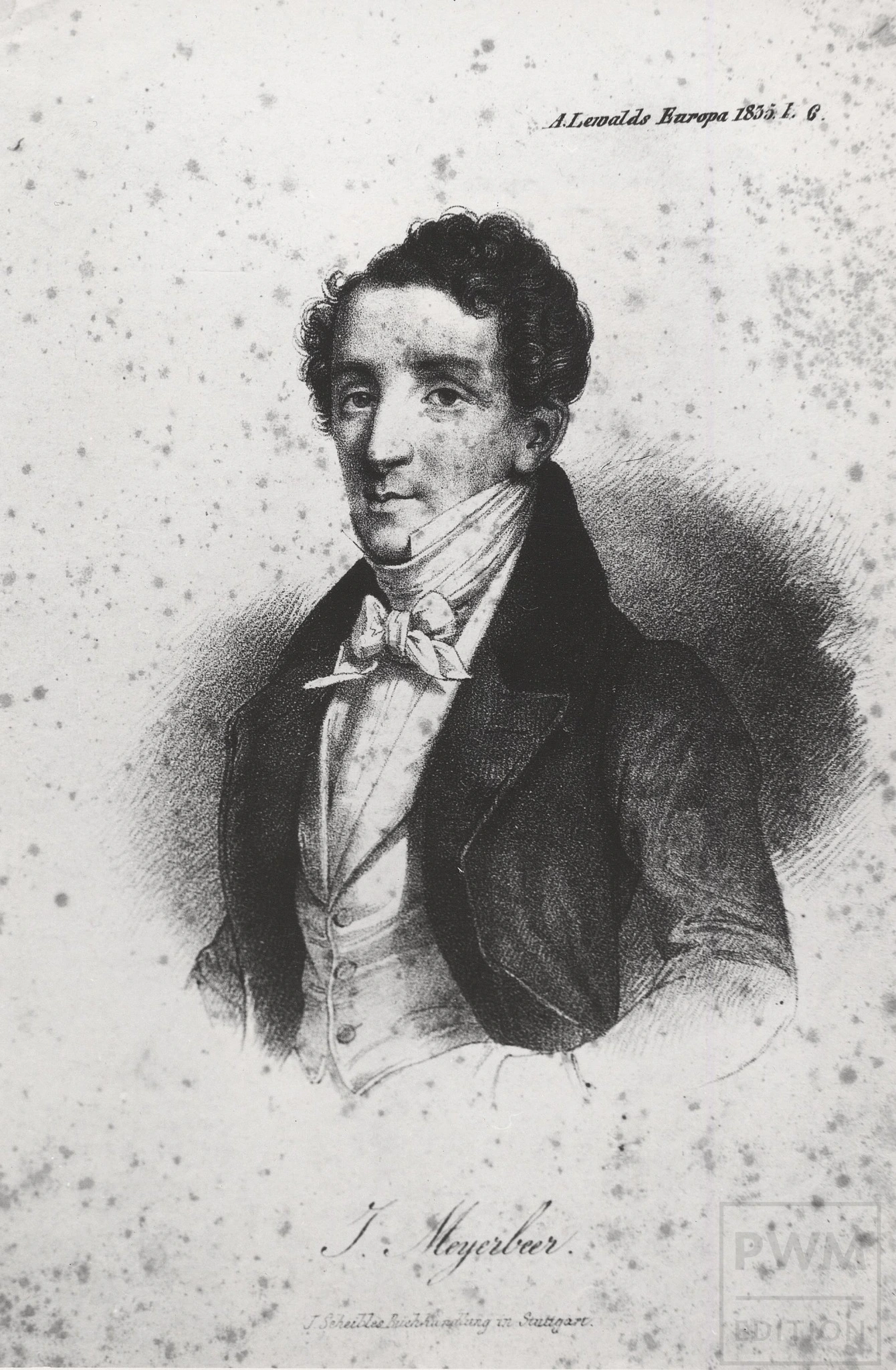
Meyerbeer Giacomo, born Jakob Liebmann Meyer Beer, *5 September 1791 Tasdorf (near Berlin), †2 May 1864 Paris, German composer. He came from a wealthy Jewish family and had been using the name Meyerbeer since 1810. His father, Jakob Hertz Beer, was an entrepreneur and head of the Berlin Jewish community, while his mother, Amalia, was the daughter of banker Liebmann Meyer Wulff. Her salon was frequented by A. Catalani, M. Clementi, F. Kalkbrenner, I. Moscheles, L. Spohr, C.M. von Weber, as well as A. von Humboldt and the future King Frederick William IV. Meyerbeer initially studied music with the court teacher F. Lauski; at the age of 11, he was already performing publicly as a pianist. Between 1805 and 1807, he studied composition with C.F. Zelter and then B.A. Weber; from 1810 to 1812, he studied counterpoint with G.J. Vogler in Darmstadt. He was a member of the Harmonischer Verein, founded there by C.M. von Weber, whose aim was to support its members, among other things by publishing reviews; at that time, he used the pseudonym “Julius Billig” or “Philodikaios.”
In 1810, Meyerbeer wrote the music for the ballet-pantomime Der Fischer und das Milchmädchen, and in 1811, the operas Der Admiral and Jephtas Gelübde. In 1813, thanks to the patronage of G.J. Vogler, he was appointed court composer to the Grand Duke of Hesse. The premieres of Meyerbeer’s first stage works (in Munich, Stuttgart, and Vienna) went unnoticed, but he enjoyed success as a pianist. In his recitals he performed, among other things, his own compositions, most of which survive only in manuscript and some of which have been lost. After a brief stay in Paris at the end of 1815, he left for London. In March 1816, he stayed in Italy – in Venice and Genoa, where he composed the monodrama Gli amori di Teolinda; in Rome, he attended a performance of Rossini’s Il barbiere di Siviglia, and in Naples and Palermo, he studied Sicilian folk music. His trip to Italy turned into a stay lasting several years, during which Meyerbeer established numerous artistic contacts and received commissions for further works. His operas, staged at the most important Italian theatres, enjoyed widespread acclaim. Il crociato in Egitto, the last of those composed in Italy, was staged again in July 1825 at the King’s Theatre in London, and two months later at the Théâtre Italien in Paris, directed by Rossini. this favourably received French debut marked the beginning of the composer’s long-standing collaboration with the Opéra de Paris and the librettist E. Scribe. Meanwhile, however, Meyerbeer’s work suffered a crisis lasting several years, caused by the death of his father and two sons.
The first work produced in collaboration with Scribe was Robert le Diable. The three-act version of the libretto, initially designed as an opéra comique with spoken dialogue, was reworked into a five-act grand opéra at Meyerbeer’s request. Its premiere (21 November 1831) was met with an enthusiastic response unprecedented in the history of the Opéra de Paris (review by F.-J. Fétis in “Revue musicale,” 1831, and also by Wagner in “Abendzeitung,” Dresden, 1841). Numerous paraphrases and variations on themes from Robert le Diable, by Chopin (Grand duo concertant in E major for piano and cello, Op. 16a), Liszt, Kalkbrenner, H. Herz, A. Adam, among others, testify to the popularity of this opera. Thanks to his success, Meyerbeer received honourable positions and titles: in 1832 he became a Knight of the Legion of Honour, in 1834 a member of the Institut de France, in 1832 he took up the position of court conductor in Prussia, and in 1833 he joined the senate of the Preussische Akademie der Künste.
After several unrealised or unfinished projects for new stage works, on 23 October 1832 Meyerbeer signed a contract with the director of the Paris Opéra, L. Véron, for Les Huguenots, another grand opera, initially entitled Léonore ou La Saint Barthélemy. Having failed to complete it by the agreed deadline, he was forced by Véron to pay a fine. The reason for the delay was probably a disagreement with Scribe, who refused to make any corrections to the libretto. Ultimately, the fourth act of the libretto was written by G. Rossi (translated into French by E. Deschamps), but just before the premiere, at the request of tenor A. Nourrit (the role of Raoul de Nangis), changes were made to the ending of this act – Meyerbeer then recomposed the famous love duet between Raoul and Valentine. After completing Les Huguenots, Véron returned the money he had paid to Meyerbeer, but was himself forced to resign. The premiere was another triumph for Meyerbeer, who had been considered one of Europe’s leading composers since the time of Robert le Diable.
The acquaintance with the 26-year-old Wagner, made in August 1839 during a cure in Boulogne-sur-Mer, who expected Meyerbeer’s patronage, ended in hostility between the two composers, as Meyerbeer’s letters of recommendation did not bring the expected results. In 1842, Meyerbeer became the general music director of Prussia, succeeding G. Spontini, thanks to which he managed to bring about the German premiere of Les Huguenots [Hugenotten] (Berlin, 20 May 1842), which had previously been banned by the censors. In recognition of his achievements, he was the first composer to be awarded the Order of Peace. For the opening of the opera house in Berlin, rebuilt after a fire (1844), he composed another monumental work, Ein Feldlager in Schlesien, referring to the reign of Frederick the Great, known for his love of playing the flute. Due to its nationalistic overtones, the opera did not gain international recognition, and, outside Berlin, it was only performed in 1847 in Vienna under the title Vielka, with the action moved to the Czech. In 1846, Meyerbeer resigned from his position as general music director but remained court composer until his death.
At that time, Meyerbeer began work on completing Le Prophète; staging this work had been hampered by disagreements with the director of the Opéra de Paris, L. Pillet; it was only after his dismissal and the takeover of the management by N. Roqueplan and E. Duponchel in 1847 that Meyerbeer was able to stage the opera. The premiere (16 April 1849) was once again a success, with enthusiastic reviews written by H. Berlioz and T. Gautier. Soon after, Le Prophète premiered in London and Berlin, and then in over 30 other European cities. In the early 1850s, Meyerbeer resumed work on the opera Ein Feldlager in Schlesien, in which he decided to change the plot while retaining the music he had already composed; the basis for this was the libretto of Scribe’s ballet La cantinière, which he reworked for opera purposes as L’étoile du Nord. This opera, as well as his next, Le pardon de Ploërmel, was staged with remarkable success at the Opéra-Comique. During the last years of his life, Meyerbeer worked on L’Africaine but did not live to see its premiere. He died after a short illness and was buried in the Jewish cemetery in Berlin. The funeral ceremony was attended by the royal family and numerous personalities from the world of culture. In 1865, the premiere of L’Africaine, with minor revisions by F.-J. Fétis, became an international event.
Of Meyerbeer’s 19 stage works, historical significance is attributed to four, namely Robert le Diable, Les Huguenots, Le Prophète and L’Africaine, described by the composer himself as grand opéra. Meyerbeer’s central position in the history of this type of opera is unquestionable, which is justified both by the reception of the composer’s works in the 19th century and by the critical assessment of the composer’s contribution to the history of opera as a genre. When he began working with the Opéra de Paris, Meyerbeer demonstrated a profound command of a range of operatic styles, from which he drew the elements most essential to his own practice – much as W.A. Mozart, his lifelong model, had done half a century earlier. However, the two composers differed in the scale of their talent – Mozart achieved a brilliant synthesis, while Meyerbeer proved to be merely a skilful eclectic.
Meyerbeer’s interest in vocal issues stems from Italian opera. He assigned priority to music rather than to the verbal text (which in practice meant placing high demands on librettist, E. Scribe), because he conceived dramaturgy of his works, their staging and the gradation of tension, through the prism of the singer and the particular qualities of the voice.. Sometimes, due to a lack of suitable performers, he abandoned ideas that had already been partially realised. Problems with casting the extremely difficult tenor lead role in Le Prophète prompted Meyerbeer to simplify it and instead highlight the mezzo-soprano role of Fidès, conceived for Pauline Viardot-Garcia. The composer made a significant contribution to discovering and promoting outstanding vocal talents. The solo parts in Meyerbeer’s operas pose enormous difficulties for performers, although there are few elaborate arias with intricate coloratura. Intended exclusively for the main characters (Isabella’s aria En vain j’espère from Act 2 of Robert le Diable, Queen Marguerite’s aria O beau pays de la Touraine from Act 2 of Les Huguenots, Fidès’ beggar aria in Act 4 of Le Prophète, and Sèlika’s aria in Act 2 of L’Africaine) are generally in two parts, cantabile and cabaletta, contrasting in tempo and character. The composer tried to link the arias, as well as other types of solo parts (ariosas, cavatinas, romances, ballads, prayers), musically with the whole scene through choral interludes between verses of the text or parts of the aria, as well as by “surrounding” them with recitative dialogues. Among the most musically valuable fragments in Meyerbeer’s operas are the duets, both those constructed according to traditional patterns (e.g. the duet between Marguerite and Raoul in Act 2 of Les Huguenots) and those composed in accordance with the dynamics of the characters’ feelings and changing decisions (the duet between Raoul and Valentine in Act 4 of the same opera, culminating in the famous cavatina).
In his choral writing Meyerbeer undoubtedly drew on Gluck’s experience. The instrumental and decorative treatment of large vocal ensembles gradually gave way to active choruses, subject to the laws of stage movement. Meyerbeer often divided them into groups representing opposing factions in the action; he associated the intensification of sound with the growing dynamics of emotions and reactions of the conflicting masses. This led to the creation, most often in the finales, of spectacular group scenes, supported by massive orchestration, which the composer himself described as “tableau” (e.g. the scene of the consecration of swords in Act 4 of Les Huguenots). Their grandeur (Meyerbeer also assigned a significant role to ballet in them) does not, however, compensate for their dramatic weaknesses, since Scribe’s librettos only gave the appearance of historical issues (religious struggle and conflict in Les Huguenots, the tragedy of John of Leiden, betrayed by the people, in Le Prophète, the conflict between the brave explorer Vasco da Gama and the hidebound courtiers in L’Africaine); in reality, it had no influence on the development of the drama, serving merely as a kind of narrative background. The driving force behind the action is always a love intrigue, calculated to suit the unsophisticated tastes of the Parisian audience, sometimes even contradicting historical facts (e.g. in Le Prophète). The romantic twists and turns are intertwined with historical themes (scenes of riots, wedding processions, coronations, etc.) in stunningly colourful scenery, which, as in the case of L’Africaine, does not shy away from sophisticated pseudo-exotic splendour. In line with audience expectations, Meyerbeer’s works abounded in theatrical effects, becoming a challenge for the stage directors of the Opéra de Paris, an opportunity to showcase extravagant costumes and use new technical inventions, such as a moving panorama or gas lighting (used for the first time in Robert le Diable).
Meyerbeer’s operas featured more psychologically complex characters, especially the male ones. Heroes such as Robert, Raul and Vasco da Gama were people with unstable personalities and unpredictable reactions, uncertain of the rightness of their decisions and not subject to unambiguous moral judgements, which was a novelty in the history of the genre.
Meyerbeer contributed significantly to the development of instrumentation, drawing on the achievements of his predecessors. The orchestral sonority in his operas is characterised by its massiveness and richness of expression and colour. He employed novel instrumental groupings and melody combinations, using them to characterize figures, settings, events, and atmospheres. In vocal passages, the large orchestra is greatly reduced. A singer is often accompanied by a solo instrument or a small ensemble with a distinctive sonority, which musically represents, symbolises or characterises a given character (e.g., a trio consisting of a flute, cello and harp represents the character of Marguerite in Les Huguenots) or the mood which evoked by that character (e.g. the melody entrusted to four timpani and the combination of piccolo and double basses in Robert le Diable repeatedly evokes and deepens the mood of demonism, grotesqueness and macabre associated with the character of Bertram). Throughout his work, Meyerbeer showed a predilection for the sound of lower string instruments – violas and cellos, combined with bassoons (Nelusco’s prayer in Act 3 of L’Africaine, Raoul’s romance accompanied by the viola d’amore, and the duet between Valentine and Marcel in Les Huguenots, Fidès’ beggar’s aria in Le Prophète). Another novelty was the use of the speaking tube by the choir in the demonic waltz in Robert le Diable and, occasionally, harp harmonics. Meyerbeer sometimes refrained from using the string section as the core of the orchestra, particularly in passages with a sacred character. Among the wind instruments he used in his works, notable are the English horn, bass clarinet (African horn), ophicleide, and – for the first time in the history of the orchestra – the recently invented saxophone and saxhorn. The composer made a real breakthrough by using brass instruments not only in triumphant tutti to increase the massiveness of the sound (e.g. the famous coronation march in Le Prophète), but also in pianissimo, achieving a muffled, quasi-organ sound (e.g. the march of the priests in L’Africaine). An integral part of Meyerbeer’s style is the so-called “couleur locale,” i.e. emphasising the specificity of the place of action, the era, the environments presented, etc. through musical means, most often through the use of unusual instruments, church songs, feast songs, soldier songs, Protestant chorales, as well as ritual dances and bacchanalia. Ballet scenes are also a regular feature, which the composer customarily included in the third or fourth act.
Among Meyerbeer’s other works, his songs are particularly notable, encompassing French salon pieces, sometimes tending towards miniature dramatic forms, German Lieder (including texts by Heine and Müller), and Italian canzonettas.
The significance of Meyerbeer’s creative output lies primarly in its influence on 19th-century opera composers, including Berlioz, Gounod, Massenet, Verdi, Saint-Saëns, and Wagner. On the one hand, they drew on Meyerbeer’s concepts (for example, Verdi’s Il trovatore in relation to Le Prophète, Wagner’s Rienzi), while on the other they reacted against the dominance of his music on European opera stages (e.g., Wagner’s music dramas, the so-called lyric opera in France). In the history of theatre, Meyerbeer’s opera productions represent an important stage in the development of stage art and technique (illusory scenography, elaborate costumes, unconventional choreography, new lighting techniques), preliminary and indispensable for the creation of Wagner’s Gesamtkunstwerk concept, and consequently also for the great theatre reform at the turn of the century.
While Meyerbeer’s position during his lifetime was dominant and unquestionable in the opera world, for many reasons his work was overshadowed in the first decades after his death and in the 20th century. This process was initiated by Richard Wagner’s anti-Jewish campaign (Das Judenthum in der Musik, Oper und Drama), which included scathing criticism of the achievements of the creator of Les Huguenots, taken up and developed by some apologists for the author of Der Ring des Nibelungen. However, the intensification of anti-Semitic sentiments in Europe in the first decades of the last century was decisive (in Nazi Germany, a ban on the performance of Meyerbeer’s works was introduced in 1933). The decline of grand opera was also caused by the high production costs involved in staging operas of this type, the huge casts and the vocal difficulties faced by the performers of the leading roles (e.g. the tenor part of Raoul). As a result, Meyerbeer’s works almost completely disappeared from the repertoire of opera theatres, including in France, which was their birthplace.
A renewed interest in Meyerbeer’s work has been marked by initiatives of German and English musicologists in the last three decades of the 20th century (H. Becker, R.I. Lettelier, S. Henze-Döhring et al.), aimed at publishing sources – comprising the composer’s diaries and correspondence, as well as his scores, taking into account the requirements of a critical edition. This gave impetus to new stage productions (including L’Africaine in 2004 in Strasbourg and in 2015 in Berlin, Robert le Diable in 2012 in London, Le Prophète in Münster in 2004, then in Toulouse and Essen in 2017, and finally Les Huguenots for the opening of the jubilee 350th season of the Opéra de Paris in 2018) and recordings (and not only the four most famous ones, such as the “grand” ones), as well as more insightful research and objective assessments.
Literature:
Correspondence, documents, memoirs:
Giacomo Meyerbeer. Briefwechsel und Tagebücher, vols. 1–3, pub. H. Becker, Berlin 1960, 1970, 1975, 4th edition publ. H. Becker and G. Becker, Wilhelmshaven 1983, reprint 2019; vol. 5 pub. S. Henze-Döhring, H. Möller, Berlin, New York 1999, vols. 6–7. ed. S. Henze-Döhring, Berlin, Munich, Boston 2004, reprint 2020, vol. 8 pub. S. Henze-Döhring, Berlin 2012; H. Becker Giacomo Meyerbeer in Selbstzeugnissen und Bilddokumenten, Reinbek near Hamburg 1980; Giacomo Meyerbeer. Ein Leben in Briefen, publ. H. Becker and G. Becker, «Taschenbücher zur Musikwissenschaft» LXXXV, Wilhelmshaven 1983, English edition Portland 1989; “Robert le diable,” catalogue of the exhibition at the Opéra de Paris (20 August–20 September 1985), Paris 1985; R. Zimmermann Giacomo Meyerbeer. Eine Biographie nach Dokumenten, Berlin 1991, 2nd edition 1994, reprint 2014; The Diaries of Giacomo Meyerbeer, vols. 1–4, editing and translation R. I. Letellier, Madison (New Jersey) 1999–2004;
Biographies and monographs:
E. de Mirecourt Meyerbeer, Paris 1854; A. de La Salle Meyerbeer. Sa vie et Catalogue de ses oeuvres, Paris 1864; A. Pougin Meyerbeer. Notes biographiques, Paris 1864; H. Blaze de Bury Meyerbeer et son temps, Paris 1865; H. Mendel Giacomo Meyerbeer, sein Leben und seine Werke, 1869, reprint New York 2011; J.F. Schucht Meyerbeers Leben und Bildungsgang, seine Stellung als Operncomponist im Vergleich zu den Tondichtern der Neuzeit, Leipzig 1869; J. Bennet Giacomo Meyerbeer, London, New York 1880; A. Kohut Meyerbeer, Leipzig 1890; J. Weber Meyerbeer, Paris 1898, reprint 2019; H. de Curzon Meyerbeer, Paris 1910; H. Eymieu L’oeuvre de Meyerbeer, Paris 1910; L.A. Dauriac Meyerbeer, Paris 1913; A. Hervey Meyerbeer, London 1913; reprint 2018; J. Kapp Giacomo Meyerbeer, Berlin 1920, 8th edition, 1932; H. Becker Der Fall Heine-Meyerbeer. Neue Dokumente revidieren ein Geschichturteil, Berlin 1958; reprint 2018; B. Wessling Meyerbeer. Wagners Beute – Heines Geisel, Düsseldorf 1984; S. Segalini Meyerbeer, diable ou prophète, Paris 1985; S. Henze-Döhring, S. Döhring Giacomo Meyerbeer. Der Meister der Grand Opera. Eine Biographie, Munich 2014; V. Anger Giacomo Meyerbeer, Paris 2017; J.-Ph. Thiellay Meyerbeer, Arles 2018; D. Faiman Giacomo Meyerbeer. The Deliberately Forgotten Composer, Jerusalem 2020; E. Thornton Giacomo Meyerbeer and His Family. Between Two Worlds, Elstree (Hertfordshire) 2021; R. Monacco, Meyerbeer. La vita, le opere, Turin 2022.
Critical and analytical works:
L. Hirschberg Meyerbeers religiöse Tonwerke, “Die Musik” XIII, 1914; G.R. Kruse Meyerbeers Jugendopern, “Zeitschrift für Musikwissenschaft” I, 1918/19; A.E. Brent Smith Tragedy of Meyerbeer, “Music and Letters” VI, 1925; E. Istel, Th. Baker Meyerbeer’s Way to Mastership: Employment of the Modern Leading-Motive before Wagner’s Birth, ,”The Musical Quarterlyˮ XII/1 (1926); G. Servières Les transformations et tribulations de “L’Africaine”, “Rivista Musicale Italiana” XXXIV, 1927; H. Abert Giacomo Meyerbeer, in: Gesammelte Schriften und Vorträge, ed. F. Blume, Halle 1929; E. Istel Act IV of “Les Huguenots”, “The Musical Quarterly” XXII, 1936; W. L. Crosten French Grand Opera: An Art and a Business, New York 1948; H. Becker Meyerbeers Ergänzungsarbeit an Webers nachgelassener Oper “Die drei Pintos”, “Die Musikforschung” VII, 1954; H. Becker Meyerbeers in seinen Beziehungen zu L. Spohr, “Die Musikforschung” X, 1957; H. Kirchmeyer Psychologie des Meyerbeer-Erfolges, “Neue Zeitschrift für Musik” CXXV, 1964; H. Becker Die historische Bedeutung der Grand Opéra, in: Beiträge zur Geschichte der Musikanschauung im 19. Jahrhundert, ed. W. Salmen, Regensburg 1965; H. Frederichs Das Rezitativ in den “Hugenotten” Giacomo Meyerbeers, in: Beiträge zur Geschichte der Oper, ed. H. Becker, «Studien zur Musikgeschichte des 19. Jahrhunderts» XV, Regensburg 1969; H. Becker Giacomo Meyerbeers Mitarbeit an den Libretti seiner Opern, in the conference book, Bonn 1970; C. Frese Dramaturgie der grossen Opern Giacomo Meyerbeers, Berlin 1970; J.L. Thomson Giacomo Meyerbeer. The Jew and His Relationship with Richard Wagner, “Musica judaica” I, 1975/76; H. Becker Die “couleur locale” als Stilkategorie der Oper, in: Die “couleur locale” in der Oper des 19. Jahrhunderts, ed. H. Becker, «Studien zur Musikgeschichte des 19. Jahrhunderts» XLII, Regensburg 1976; H. Becker Meyerbeer und seine Vaterstadt Berlin, in: Musikgeschichte Berlins im frühen 19. Jahrhundert, ed. C. Dahlhaus, Regensburg 1977; P. Besnier Berlioz et Meyerbeer, “Revue de Musicologieˮ LXIII (1977), no. 1–2; K. Pendle Eugène Scribe und French Opera of the Nineteenth Century, “Studies on Musicology” VI, Ann Arbor 1979; C. Join-Dieterle “Robert le diable.” Le premier opéra romantique, “Romantisme” 28/29, 1980; J. Budden Verdi and Meyerbeer in Relation to “Les Vêpres siciliennes”, «Studi verdiani» I, 1982; S. Döhring Die Autographen der vier Hauptopern Meyerbeers; ein erster Quellenbericht, “Archiv für Musikwissenschaftˮ XXXIX, 1982; H. Becker Zwischen Oper und Drama. Zu Meyerbeers Konzeption der dramatischen Szene and S. Döhring Meyerbeers Konzeption der historischen Oper und Wagners Musikdrama, in: Wagnerliteratur und Wagnerforschung, book of materials from the Wagner symposium, Munich 1983; S. Münch Co to jest „grand opéra”?, “Pamiętnik Teatralny” 1983 no. 2; H. Becker Meyerbeers Wiener Reisetagebuch 1813 and C. Dahlhaus Wagner, Meyerbeer und der Fortschritt. Zur Opernästhetik des Vormärz, in commemorative book of R. Elvers, Tutzing 1985; N. Miller Grosse Oper als Historiengemälde. Überlegungen zur Zusammenarbeit von Eugène Scribe und Giacomo Meyerbeer, in: Oper und Opertexte, Heidelberg 1985; H. Becker Eine “Undine” Oper Meyerbeers für Paris, w commemorative book of M. Ruhnke, Neuhausen 1986; A. Gerhard Die französische “Grand Opéra” in der Forschung seit 1945, “Acta Musicologica” LIX, 1987; M. Walter “Hugenottenˮ Studien, Frankfurt am Main 1987; A. Everett “Bewitched in a Magic Garden.” Meyerbeer in Italy, in: “Journal of the Donizetti Society” VI, 1988; H. Weinland Wagner und Meyerbeer, «Musik-Konzepte» LIX, eds. H.-K. Metzger and R. Riehn, Munich 1988; M.-H. Coudrov-Saghai La critique parisienne des “grands opéras” de Meyerbeer: Robert le Diable-Les Huguenots-Le Prophète-L’Africaine, ‹‹Studien zur französischen Oper des 19. Jahrhunderts = Etudes sur l’opéra français du XIXème siècle›› vol. 2, Saarbrücken 1988; J. Fulcher The Nation’s Image: French Grand Opera as Politics and Politicized Art, Cambridge 1987, reprint 2002, French version entitled Le Grand Opéra en France: un art politique, 1820–1870, Paris 1988; S. Huebner Italianate Duets in Meyerbeer’s Grand Operas, “Journal for Musicological Research” VIII, 1989; S. Döhring Grand Opéra als historisches Drama und als private Tragödie. Meyerbeers “Le Prophète” und Verdis “Don Carlos,” in the congress book of the International Musicological Society, Turin 1990; A. Gerhard Meyerbeer und das “juste milieu”, in: Die Verstädterung der Oper, Stuttgart 1992; M. Wittmann Meyerbeer und Mercadante? Rezeption of Meyerbeer in Italy, “Cambridge Opera Journal” V, 1993; M. Everist Giacomo Meyerbeer, the Théâtre Royal de l’Odéon, and Music Drama in Restoration Paris, in: ‹‹19th Century Music››, XIX/2 (1993), pp.124–148; M. Everist The Name of Rose. Meyerbeer’s opéra comique “Robert le diable,” “Revue de Musicologieˮ LXXX/2, 1994; S. Döhring Paradoxie der Gefühle. Das Grand Duo aus Meyerbeers “Les Huguenots,” “Schweizerisches Jahrbuch für Musikwissenschaft” XV, 1995; Giacomo Meyerbeer – Musik als Welterfahrung: Heinz Beckerzum 70. Geburtstag, eds. S. Döhring and J. Schläder, Munich 1995; Meyerbeer Studien 1 (Beiträge zu Theater, Musik und Gesellschaft im 19. Jhdt. sowie die Editionsrichtlinien für die bei Ricordi erscheinende Meyerbeer-Werkausgabe), Berlin 1997, French version entitled Meyerbeer-studien 1, livre sur le musique;Meyerbeer und der Tanz, “Meyerbeer Studien 2”, materials from the 1995 conference in Thurnau, ed. G. Oberzaucher-Schüller, H. Möller, Munich, Padeborn 1998; G. Oberzaucher-Schüller, M. Linhardt, T. Steiert Meyerbeer – Wagner: eine Bewegnung, Vienna, Cologne, Weimar 1998; J. H. Baron A Golden Age for Jewish Musicians in Paris: 1820–1865, “Musica judaica” XIV, 1999; R. I. Letellier Meyerbeer Studies. A Series of Lectures, Essays, and Articles on the Life and Work of Giacomo Meyerbeer, Lanham (Maryland) 1995, Vancouver 2005; Meyerbeer und das europäische Musiktheater, eds. S. Döhring, A. Jacobshagen, Lilienthal 1998; M. Wittmann Meyerbeer und Mercadante? Überlegungen zur italienischen Meyerbeer-Rezeption, in: Meyerbeer und das europäische Musiktheater, eds. S. Döhring, A. Jacobshagen, Laaber 1998, pp. 352–385; Meyerbeers Bühne im Gefüge der Künste, “Meyerbeer Studien 4”, eds. S. Dahms, M. Jahrmärker, G. Oberzaucher-Schüller, Feldkirchen near Munich, Padeborn 2002; The Cambridge Companion to Grand Opera, ed. D. Charlton, Cambridge 2003; The Complete Libretti of Giacomo Meyerbeer, in the Original and in Translation on five Volumes, ed. R. Arsenty, Newcastle upon Tyne 2004; Die Ballettpantomimen von Eugène Scribe.Texte, Skizzen und Entwürfe, “Meyerbeer Studien 3”, ed. M. Jahrmärker, Berlin 2005; R. I. Letellier Meyerbeer studies: a series of lectures, essays, and articles on the life and work of Giacomo Meyerbeer, Madison (New York) 2005; R.I. Letellier The operas of Giacomo Meyerbeer, Madison (New Jersey) 2006; Giacomo Meyerbeer. The Non-Operatic Texts, eds. R. I. Letellier, R. Arsenty, Newcastle 2007; R. I. Letellier Giacomo Meyerbeer. A reader, Newcastle 2007; M. C. Pellegrini, R. I. Letellier Giacomo Meyerbeer: a guide de research, Newcastle 2007; Giacomo Meyerbeer ‘Le Prophète’: Edition, Konzeption, Rezeption, materials from the 2007 international congress in Essen, eds. M. Brzoska, A. Jacob, N. K. Strohman, Olms, Hildesheim, Zurich, New York 2009; R. I. Letellier An Introduction to the Dramatic Works of Giacomo Meyerbeer: Operas, Ballets, Cantatas, Plays, Milton Park (Oxfordshire) 2009; C. Cruz Meyerbeer’s Music of the Future, “The Opera Quarterlyˮ XXV, no. 3–4, 2009; J. Jackson Giacomo Meyerbeer: reputation without cause?: a composer and his critics, Newcastle upon Tyne 2011; J. F. Schucht Meyerbeer’s Leben und Bildungsgang, seine Stellung als Operncomponist im Vergleich zu den Tondichtern der Neuzeit, New York 2012; R. Arsenty Giacomo Meyerbeer: a discography of vintage recordings 1889–1955, Newcastle upon Tyne 2013; Europa war sein Bayreuth, materials from the symposium on Meyerbeer’s life and work in 2014 at the Berlin Opera, ed. J. Königsdorf, C.A. Roesler, Berlin 2015; C. Bahr Grand Opéra an deutschen Hoftheatern (1830–1848): Studien zu Akteuren, Praktiken und Aufführungsgestalten, Würzburg 2016; R. I. Letellier Meyerbeers ‘Le Prophète, Newcastle upon Tyne 2018; M. Everist Giacomo Meyerbeer and Music Drama in the Nineteenth-Century Paris, Oxford 2018; R. I. Letellier Giacomo Meyerbeer: A Critical Life and Iconography, Newcastle upon Tyne 2021.
Compositions
Stage:
operas:
Der Admiral oder Der verlorene Prozess, 1811
Jephtas Gelübde, 3 acts, libretto A. Schreiber, based on a biblical theme, premiere Munich, 23 December 1812
Alimelek lub Wirth und Gast oder Aus Scherz Ernst, musical comedy, 2 acts, revised version entitled Die beyden Kalifen, 1814, libretto J.G. Wohlbrück, premiere Stuttgart, 6 January 1813
Das Brandenburger Tor, singspiel, 1 acts, 1814, libretto J. E. Veith, premiere Berlin, 7 August 1814
Robert und Elise, 1 acts, 1816
Romilda e Costanza, opera semiseria, 2 acts, libretto G. Rossi, premiere Padua, 19 July 1817
Semiramide riconosciuta, opera seria, 2 acts, libretto G. Rossi after P. Metastasio, premiere Turin, 3 February 1819
Emma di Resburgo (initially entitled Emma di Leicester, German version entitled Emma von Leicester oder Die Stimme des Gewissens), opera seria, 2 acts, libretto G. Rossi, premiere Venice, 26 June 1819
Margherita d’Anjou, opera semiseria, 2 acts, libretto F. Romani after R. Pixérécourt, premiere Milan, 14 November 1820
L’esule di Granata, opera seria, 2 acts, libretto F. Romani, premiere, Milan, 12 March 1821
Il crociato in Egitto, opera seria, 2 acts, libretto G. Rossi, premiere, Venice, 7 March 1824
Robert le diable, grand opéra, 5 acts, libretto E. Scribe, C. Delavigne, premiere Paris, 21 November 1831, Polish premiere Warsaw, 16 December 1837
Les Huguenots, grand opéra, 5 acts, libretto E. Scribe, E. Deschamps, G. Rossi, premiere Paris, 29 February 1836, Polish premiere Warsaw, 11 July 1858
Ein Feldlager in Schlesien, singspiel, 3 acts, libretto E. Scribe, L. Rellstab, C. Birch-Pfeiffer, premiere Berlin, 7 December 1844
Le prophète, grand opéra, 5 acts, libretto E. Scribe, premiere Paris, 16 April 1849, Polish premiere Warsaw, 11 April 1867
L’étoile du Nord (music based on opera Ein Feldlanger in Schlesien), opéra comique, 3 acts, libretto E. Scribe, partly based on his own libretto for ballet La cantinière, premiere Paris,16 February 1854
Le pardon de Ploërmel (later also entitled Dinorah oder die Walfahrt nach Ploërmel and Le chercheur du trésor), opéra comique, 3 acts, libretto J. Barbier, M. Carré, after Carré’s Les chercheurs de trésor, premiere Paris, 4 April 1859
L’Africaine (before the premiere, the opera was titled Vasco da Gama; final version [music and libretto] revised and prepared for staging by F.-J. Fétis), 1837–64, grand opéra, 5 acts, libretto E. Scribe, some fragments C. Birch-Pfeiffer, premiere Paris, 28 April 1865, Polish premiere Warsaw, 20 December 1870
unfinished operas:
Le bachelier de Salamanque, 1815 (?)
L’Almanzore, libretto G. Rossi, 1821
Ines de Castro, libretto S. Cammarano, 1824
Malek Adel, libretto G. Rossi, 1824
La nymphe de Danube, libretto T. Sauvage, 1826
Le portefaix, libretto E. Scribe, 1831
Cinq-Mars, libretto J.H. Vernoy de Saint-Georges and F.A.E. de Planard after A. de Vigny, 1837
Noëma ou Le repentir (L’ange au exil), libretto E. Scribe and J.H. Vernoy de Saint-Georges, date in the contract 15 January 1846
Judith, libretto E. Scribe, 1854
***
Der Fischer und das Milchmädchen oder Viel Lärm um einen Kuss (Le passage de la rivière ou La femme jalouse, Le pêcheur et la laitière), divertissement, 1 act, libretto E. Lauchery, staged in Berlin, 26 March 1810
Gli amori di Teolinda (Theolindens Liebschaften), monodrama for soprano, clarinet and orchestra, libretto G. Rossi, staged in Genua 1816
music for theatre plays:
E. Raupach Das Hoffest von Ferrara, after T. Tassa, staged in Berlin, 28 February 1843 (mask theatre)
M. Beer Struensee, staged in Berlin, 19 September 1846
Aylic-Langlé (M.A. Langlois) Murillo ou La corde du pendu, staged in Paris, 18 October 1853 (Ballad)
H. Blaze de Bury La jeunesse de Goethe (L’étudiant de Strasbourg), 1860–62, not formally staged, lost
Vocal-instrumental:
secular occasions:
Zur Feier des 15ten Juni 1810 for solo voices and piano, with J. Gänsbacher, for G.J. Vogler’s birthday
Bayerischer Schützenmarsch, cantata for 4 solo voices, male choir and wind ensemble, text by Louis I, Duke of Bavaria, 1829
anthem for the unveiling of the Gutenberg monument in Mainz, for 2 tenors, 2 basses, male choir and piano ad libitum, text by C. Rosenberg, 1834
Freundschaft for male choir, at the opening of the festival of friends Singakademie in Berlin, 1842
Dem Meister deutschen Lieds ein Lied for male choir, for reception of L. Spohr in Berlin, 1845
Le voyageur au tombeau de Beethoven for solo bass and female a cappella choir, text by M. Bourges, 1845
Festhymne for solo voices and piano ad libitum, for the 25th wedding anniversary of the Prussian royal couple, text by C.G.T. Winkler, 1848
Ode an (Christian) Rauch for solo voices, mixed choir and orchestra, text by A. Kopisch, piano reduction ed. Berlin 1851, with text by L. Rellstab titled Opferhymne an den Zeus, Berlin 1854
Maria und ihr Genius, cantata for soprano, tenor, mixed choir and piano, for Prince Carl’s 25th wedding anniversary, text by Goldtammer, 1852
Brautgeleite aus der Heimat (Adieux aux jeunes mariés), serenade for double mixed choir a cappella, on the occasion of Princess Louise’s wedding, 1856
Choeur des sybarites, 1857
Nice à Stéphanie for soprano, three-part chorus and piano, for the birthday of the Grand Duchess of Baden, 1857
Festgesang zur Feier des 100 jährigen Geburtsfestes von F. Schiller for soprano, alto, tenor, bass, mixed chorus and orchestra, text by L. Pfau, 1859
anthem for solo voices and piano ad libitum, for coronation of Wilhelm I, 1861
several songs for male choir
sacred:
Gott und die Natur, oratorium, text by A. Schreiber, performed in Berlin, 8 May 1811
Geistliche Gesänge, 7 pieces for soprano, alto, tenor and bass, text by F. Klopstock, ca. 1811
An Gott, anthem for soprano, alto, tenor and bass, text by F.W. Gubitz, 1814
Hallelujah for 4 male voices, choir ad libitum and organ, text by E. Kley, before 1815
8 religious choral songs
approx. 120 songs, including:
6 élégies et romances, Leipzig 1839
12 mélodies, Paris 1839 or 1840
40 mélodies, Paris 1849
6 canzonettes italiennes, text by P. Metastasio, 1810
Ballade de la reine Marguerite de Valois, text by Marguerite de Valois, 1829, in: Hommage aux dames, Paris 1829
De ma première amie (Hör ich das Liedchen klingen), text by H. Heine, Paris 1837
Guide au bord ta nacelle (Komm du schönes Fischermädchen), text by H. Heine, Paris 1837
Die Rose, die Lilie, die Taube (C’est elle), text by H. Heine and Die Rosenblätter, text by W. Müller, in: Album für Pianoforte und Gesang für Jahr 1839, Leipzig 1838
Suleika, text by J.W. Goethe, 1838, Paris 1839
Der Garten des Herzens, text by W. Müller, Paris 1839
Se per tutte ordisce amore, canzonetta, text by P. Metastasio, 1855, Florence 1866
La lavandière, ballad, text by M. Carré, in: Messager des dames et des demoiselles from 15 October 1855
Instrumental:
orchestral:
Symphony in E-flat major, 1811
Concerto for piano, 1811
Concerto for piano, violin and orchestra, 1812
4 dances for military orchestra [4 Fackeltänze], for Prussian royal weddings: 1. B-flat major 1844, 2. E-flat major 1850, 3. C minor 1856, 4. C minor 1858
march [Festmarsch] for centenary of F. Schiller’s birth, 1859
march for 2 orchestras [Krönungsmarsch], for coronation of Wilhelm I, 1861
march-style overture [Fest-Ouvertüre im Marschstyl] for the opening of the London World Exhibition, 1862
early works, variations for piano and orchestra, sonata, fugues, dances, variations for solo piano
Editions:
facsimile scores of 7 operas by Meyerbeer, published by C. Rosen and P. Goselt, «Early Romantic Opera» XVIII-XXIV, New York 1978–83.
Critical edition of operas produced by Ricordi’s Berlin branch:
Semiramide, score, critical commentary and piano reduction, eds. M. Beghelli, S. Piana
Margherita D’Anjou, score, critical commentary and piano reduction, eds. P.A. Rossini, P. Kaiser
Robert le diable, score, critical commentary and piano reduction, eds. W. Kühnhold, P. Kaiser, 2011
Le Prophète, score, critical commentary and piano reduction, ed. M. Brzoska, 2013
Vasco da Gama (L’Africaine), score, critical commentary and piano reduction, ed. J. Selk, 2018
Les Huguenots, score, critical commentary and piano reduction, ed. O. Jacob, 2022