
[Johann Sebastian Bach grający przed królem Prus Fryderykiem Wielkim]

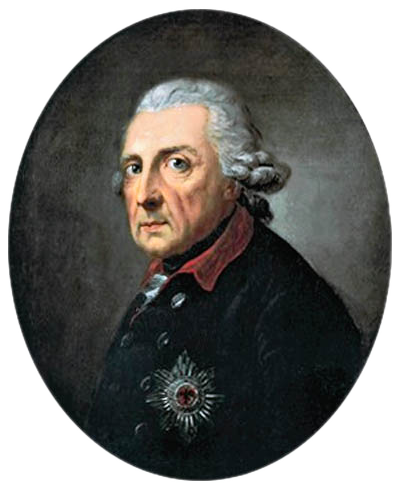
Frederick the Great of the Hohenzollern dynasty, *24 January 1712 Berlin, †17 August 1786 Sanssouci near Potsdam, King of Prussia from 1740, patron of the arts, flutist, composer, and librettist. He studied the flute under J.J. Quantz, whose works, alongside his own, he performed most frequently. In 1732, he founded a small court orchestra in Rupin, which was moved to Rheinberg in 1736. Its members included the brothers J.G. and C.H. Graun, F. Benda, J.E. Agricola; C.Ph.E. Bach served as harpsichordist from 1740 to 1767. During his stay in Potsdam in 1747, J.S. Bach composed Das musikalische Opfer on a theme provided by Frederick II, dedicating the work to him. In 1742, the king opened an opera house in Berlin, whose repertoire consisted of Italian-style operas personally selected by him, mostly by C.H. Graun and J.A. Hasse. Frederick II’s compositional output is eclectic; the authenticity of only some of the works attributed to him has been confirmed. He also wrote librettos for operas in French, which were translated into Italian by the court poet G. Tagliazucchi; Frederick the Great was also a co-author of several opera librettos, as well as the inspiration behind many creative ideas.
Symphony in G major
3 marches for military orchestra
4 concertos for flute and string orchestra
121 sonatas for flute and cembalo
Solfeggien for flute (with J.J. Quantz) 4 iss.
3 secular cantatas (lost)
overture to Il re pastore opera, co-composed by C.H. Graun, J.J. Quantz and C. Nichelmann
several arias to operas by C.H. Graun, J.A. Hasse, J.J. Quantz
Librettos:
to operas by C.H. Graun: Silla (1753), Montezuma (1755), I fratelli nemici (1756), Merope (1756)
Editions:
Musikalische Werke, ed. P. Spitta, 4 vols., 1889; a range of later selections ed.: G. Lenzewski, G. Müller, E. Schwarz-Reiflingen et al.