
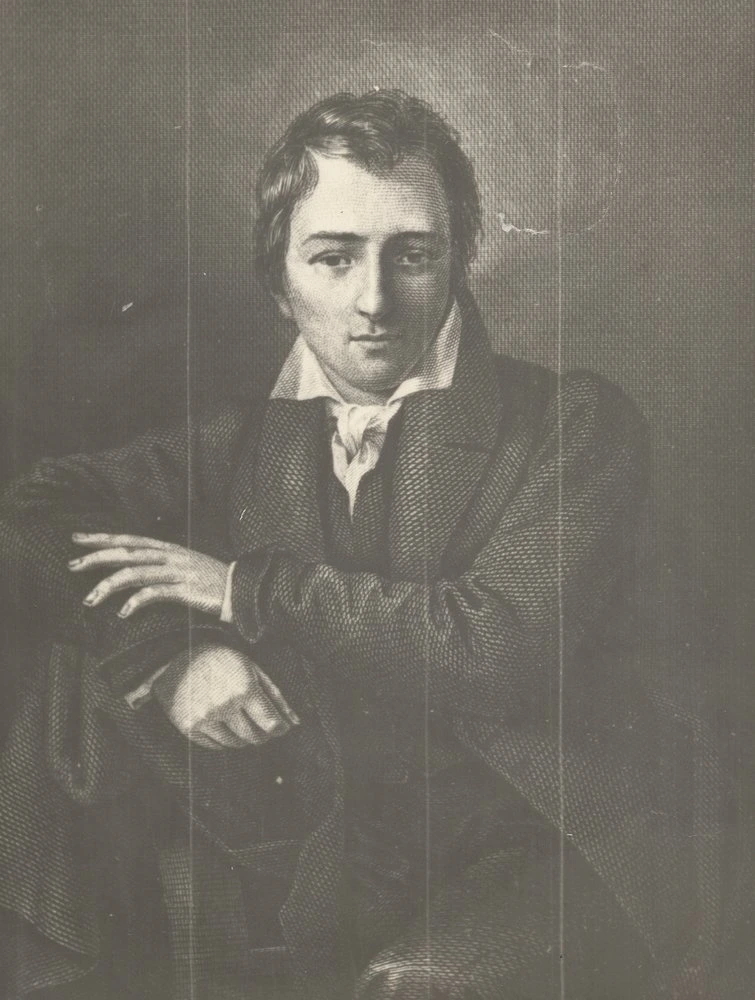
[Heinrich Heine.]

Heine Heinrich, Harry, *13 December 1797 Düsseldorf, †17 February 1856 Paris, German poet, novelist, journalist and art critic; deeply involved in the musical life of his time.
Life. Musical connections
His early youth was marked by unsuccessful attempts to carry on the family’s merchant traditions (apprenticeships in Frankfurt am Main and Hamburg), unrequited love; inside him, “flared up (…) flames of those two passions (…): the love of fair women and the love of the French Revolution” (Geständnisse; English translation in: Hainrich Heine’s Memoirs vol. 1), and a fascination with German folk song; he grouped his early, highly romantic poems (1817–21) – fantasies (Traumbilder), songs, romances and sonnets – under the collective title Junge Leiden. He spent his student years (1819–25) in Bonn, Göttingen and Berlin, and these were at the same time and above all years of poetic explosion; two collections of love poems were written: Lyrisches Intermezzo, 1822–23, and Heimkehr, 1823–24, which would form the core of the soon-to-be-famous Book of Songs (Buch der Lieder, 1827; 13 editions during the poet’s lifetime), the richest source of German song texts of the 19th century. The first to turn to them were his composer friends: in Hamburg, A. Methfessel (the im Volkston songs of 1823, regarded by the poet as the ideal musical setting for his poems), and in Berlin, J. Klein (the prototype for Kreisler in E.T.A. Hoffmann’s short story; his songs have been lost). Hoffmann’s ideas had a certain influence on Heine’s aesthetic outlook, as evidenced in his early music reviews, devoted, among others, to Weber’s The Marksman (Der Freischütz) and Spontini’s Olimpie (Briefe aus Berlin 1822). The artistic circle in which the poet’s personality was directly shaped at that time was Rahel Varnhagen’s Berlin salon. Heine listened to university lectures (including those by Hegel) with a “critical ear”, but as pointed out, “it is not favourable conditions that stimulate his creativity, but by what stands against him” (translation of R. Stiller’s interpretative formulation) [all translations of quotations are provided by the translator of this entry from the source languages, unless otherwise indicated]. In 1825, he finally completed his studies in Göttingen (with a doctorate in law) and changed his religion (from Judaism to Protestantism). Years of intense travel followed: he visited various parts of Germany, England and Italy. In Frankfurt (1827) he became friends with F. Hiller; in Genoa (1828) he encountered Rossini’s music, which remained close to his heart for the rest of his life (Reise von München nach Genua); in Hamburg (1830) he experienced a revelation whilst listening to Paganini. He contained his impressions of past and present travels in the four volumes of Reisebilder (1826–31); among them are Harzreise, inspired by the atmosphere of folk songs, and Das Buch “Le Grand”, a nostalgic, musical and symbolic recollection of a Napoleonic drummer (its counterpart would be Mickiewicz’s Yankiel’s Concerto (Koncert Jankiela)). Encouraged by A. Methfessel, in 1833 he wrote a collection (44) of particularly simple (yet somewhat perfunctory) texts intended for music: Neuer Frühling (according to Mendelssohn, “only some of them appear to have artistic vitality”).
The year 1831 marked the beginning of a new era in Heine’s life and work: he settled permanently in Paris, as an exile by choice and necessity (from 1835 he was banned in Germany). The 1830s were marked by exceptional dynamism, versatility and seriousness of purpose, but above all in the field of prose. “But I must observe that my poetical,” as Heine wrote in 1837, “and my political, theological, and philosophical writings are sprung from the same thought” [English translation in: Hainrich Heine’s Memoirs vol. 1]; he believed that “truth is reluctant to appear in poetic garb”. He was “completely immersed in liberal ideas and politics” (Mendelssohn, 1832). Musical themes recurred in his texts of every kind: in Zur Geschichte der Religion und Philosophie in Deutschland (1835) he wrote enthusiastically about the Protestant chorale, he called Ein feste Burg the “Marseillaise of the Reformation”, and in Die romantische Schule (1833–36) he wrote about German folk songs and the collection Des Knaben Wunderhorn. In the subsequent volumes of Der Salon he published short stories and poems; some of these would inspire composers (Aus den Memoiren des Herren Schnabelewopski, Elementargeister, Tannhäuser), whilst others documented significant encounters with musicians and music (Rossini, Bellini, Paganini in Florentine Nights (Florentinische Nächte)). Well established in Parisian artistic circles, he associated with or was friends not only with H. Balzac, A. Musset, A. Lamartine, V. Hugo, Th. Gautier, A. de Vigny, A. Dumas (senior) and G. Sand, but also with F. Kalkbrenner, F. Hiller, S. Thalberg, F. Liszt, F. Chopin, H. Berlioz, R. Wagner, G. Rossini, V. Bellini, G. Donizetti, G. Meyerbeer, P. Viardot and many others; a regular at the theatre and art galleries, but above all at the opera (Italian) and concerts – he wrote series of bold critical reports (including 10 letters Über die französische Bühne for the “Allgemeine Theaterrevue”). Particular renown was gained by the euphoric reviews of Meyerbeer’s world premieres (Robert le Diable (1832), Les Huguenots (1836)) and the critical assessment of Liszt’s concert (1837; which provoked a response from the pianist). The 1840s brought a continuation of his previous creative activities, yet at the same time new forms of them; political texts were written (for Karl Marx’s Vorwärts) or strongly politicised works: the poems Zeitgedichte (1844) and two great allegorical and digressive poems: Deutschland, ein Wintermärchen (1844) and Atta Troll, ein Sommernachtstraum (1846). In the reviews he wrote (anonymously) for the Augsburg “Allgemeine Zeitung”, the poet’s focus shifted even further towards the world of music (articles on the cancan, sacred music, and Liszt fever). The review announcing the arrival of G. Verdi (February 1847) was his last; the poet suffered a stroke and from 1848 was confined to his bed (he called it a “mattress-grave” (“Matratzengruft”)), surviving only thanks to the devotion of his wife (C.E. Mirat, known as Mathilde). There was a return to poetic genres, but these were transformed by a tone of pessimism and biting irony. Two volumes date from this period: Romanzero (1852) – considered by some to be the poet’s most outstanding collection of all, comprising Histories, Lamentations and Hebrew Melodies – and Gedichte 1853 und 1854, a lyrical account of dying and an examination of conscience. In the collection entitled Lutetia. Berichte über Politik, Kunst und Volksleben (1854), Heine included his previously published critical texts (from 1840–44), expanding them and adding radicalising commentary, and at times also censoring them. His judgements on Meyerbeer, as well as on Mendelssohn and Liszt, were subject to a negative revision. This did not apply to Chopin: the impact of his music proved enduring; as Liszt attests: “at (…) a word, a tone, Chopin and Heine understood each other” (Chopin, 1852, English translation in: Life of Chopin, 1863).
Heine’s poetic oeuvre, which Th. Adorno described as the greatest contribution to German culture between Goethe and Nietzsche, remains to this day the subject of debate on both artistic and ideological grounds; its various phases (1819–30, 1831–47, 1848–56), genres (Lied, romance, fantasy, ballad, “story”, poem) and individual works are frequently regarded as more significant than others. For example, the value of the Book of Songs, generally regarded as a “poetic bible” and the “household book of the German intelligentsia and bourgeoisie” of the second half of the 19th century, was called into question at the dawn of the 20th century; according to L. Marcuse, “Heine and Nietzsche were unfortunate: their most popular works were their weakest ones”; according to K. Kraus, “lyric poetry reduced Heine to a product, to a consumer good – for the public”. Collections from his later years, hitherto unnoticed or rather overlooked due to their overly blatant transgression of erotic, religious and political taboos, began to receive higher acclaim. The poet’s oeuvre, which for a wide audience is almost the embodiment of Romanticism, is classified by literary historians as belonging to a movement (Junges Deutschland) opposed to Romantic idealism. Heine himself, whose controversial nature also stems from internal contradictions, described himself (in Geständnisse (1854), English taranslation in: The Prose Writings of Heinrich Heine, 1887) as (the last) Romantic (“and that in a higher degree than I myself realised”) and, at the same time, as (the first) representative of the new wave of “exterminatory campaigns against Romanticism” (ibid.). Heine also revealed (in Geständnisse) the external sources of his art; he saw them in Goethe’s song lyrics (with their pantheistic undertones) and in the aphoristic nature of the poems in West–Eastern Divan, in the balladic and pastoral style of L. Uhland, in the versification secrets of A. Schlegel, in the choral intonations of Luther, in the “the pure sound and the true simplicity for which I was for ever striving” [English translation of H. Heine’s letter to W. Müller in: Hainrich Heine’s Memoirs vol. 1] of W. Müller, and above all in the German folk song, discovered through Des Knaben Wunderhorn and from personal experience, and experienced as “the beating heart of the German people” (Buch der Lieder); Heine heard in it “all its sad gaiety, all its foolish reason (…), German anger drums, German mockery fifes, German love kisses” (Geständnisse, English translation in: The Works of Heinrich Heine vol. 6); commenting it with words: “What naïveté in the truth! What honesty there is in that untruth!!” (ibid.). The material of his own sensations and experiences became an unceasing inner source (“From the great pain of my spirit / Come the little songs I am singing” (Buch der Lieder, English translation in Heine’s Book of Songs, 1864)), subjected to a distancing objectification.
The central theme that recurs in countless variations in Heine’s work is unhappy love – indeed, the impossibility of love, which in the modern world degenerates into “loneliness as a couple” (J. Zinke). In Adorno’s interpretation, “Heine’s stereotypical theme, unrequited love, is an image for homelessness” (Die Wunde Heine, English translation in: Notes to Literature), and the aim of his poetry is to overcome this sense of alienation (Heine was to confess towards the end of his life that he felt a threefold alienation: as a German amongst the French, a Jew amongst Christians, and a sick man amongst the healthy). In a broader sense, Heine’s theme—consistently, from Junge Leiden and Lyrisches Intermezzo through to Romanzero and the Gedichte 1853 und 1854 – is the human condition, its empirical and existential determinants, social realities and moral dimension.
A unique combination of characteristics forms the specific poetics of Heine. His poetic expression, always close to spoken language, is characterised by a rich repertoire of intonations (most often occurring in combination); it is dominated by “tones”: the sentimental (mood-setting, contrasted with factuality, but also with lofty sentimentality), the pathos-laden (imbued with personal suffering or Weltschmerz, contrasted with a lack of sensitivity), the cynical (derisive, unmasking, contrasted with false solemnity), and the ironic (sceptical, detached, contrasted with naivety). The vital dynamism of Heine’s poetry stems from its specific structure: the poet employs mainly: condensation of content (miniaturisation), the juxtaposition of elements (heterogeneity), the variation of the initial model (variation) and a surprising conclusion (poignancy). He almost always (82%) uses a four-line stanza (“Heinestrophe”), the origins of which can be traced back to folk and medieval melic versification (the vagabond verse, Hildebrandston, Nibelungenzeile). The stanza is usually built on tonic verse, with four or, three stresses (less commonly
accentual-syllabic verse, e.g. trochee); it is characterised (cf. L. Kolago), the variable number of syllables, by exceptional accentual mobility (freigefüllter Viertakter), the divergence between word stress and verse stress, the avoidance of caesuras, the (moderate) use of enjambment, sudden rhythmic shifts (rhythmische Brechung), and changing tempo – all of these serving as means of heightened expression. The extraordinary variety of Heine’s quatrain (over 30 variations) stems from the use of contrasting cadences (masculine and feminine, voiced and unvoiced) and the application of all possible rhyme schemes; alternate rhyme schemes occur most frequently (ab’ab’: Still ist die Nacht; a’ba’b: Leise zieht durch mein Gemüt; xa’ya’: Du bist wie eine Blume; xaya: Sie liebten sich beide, etc.), while couplet rhymes (a’a’b’b’: Ich grolle nicht) or enclosed rhymes (abba: Aus meinem grossen Schmerzen; a’x’y’a’: Der Tod, das ist die kühle Nacht), and unique patterns appear occasionally (e.g. x’aaa: Im wunderschönen Monat Mai; a’xyz’: Ich unglückse’ger Atlas). Heine’s verse is generally regarded as “musical”: it is described as fluid, flowing, melodious and lyrical. According to K. Kraus, “this poetry is melody, so much so that it is necessary to set it to music” (Heine und die Folgen).
The musical resonance of Heine’s work was immense, though highly uneven: only certain types of text aroused composers’ interest, and only certain genres of music proved to be a suitable medium for them. Inspired by Heine’s themes and texts (see selection of works), a dozen or so stage works (operas and ballets) and concert works (cantatas, choral ballads, symphonic poems) were composed; none of them, however, made a significant mark on the history of music, apart from very distant and fragmentary inspirations (Wagner’s Der fliegende Holländer and Tannhäuser, and A. Adam’s Giselle). His following works proved to be the most influential: the early drama William Ratcliff (7 operas, including works by C. Cui and P. Mascagni), the famous ballad Loreley (including 2 symphonic poems), the moving romance The Pilgrimage to Kewlar [Die Wallfahrt nach Kevlaar] (3 small cantatas) and the dance poem Doctor Faustus (including W. Egk’s ballet).
Heine’s poetry had a significant influence on the history of music, particularly in the field of art song, an influence perhaps comparable only to that of Goethe’s works. Over 3,000 songs have been set to Heine’s texts (according to Segher’s Musiklexikon; A. Eckhoff’s catalogue lists around 600); among the composers (around 150) are almost all the major figures of the 19th century. There are four distinct phases of attention to Heine’s texts: the 1820s and 1830s: the Schubert phase (6 Heine-Lieder from Schwanengesang, 1828); songs by composers known and appreciated by the poet also emerged during this period: F. Hiller (12, Op. 16), K. Loewe (6, Op. 9), G. Meyerbeer, A. Methfessel and J. Klein, as well as the most popular of the songs to Heine’s words – F. Silcher’s Loreley (1837); the 1840s and 1850s: the Schumann phase (Heine-Liederkreis, Dichterliebe 1840 and songs from Opp. 25, 33, 45, 49, 53, 57, 64, 127 and 142), as well as those by Mendelssohn (6 from Opp. 19, 34, 47 and 86, and choral works) and Liszt (7); a prolific output by German composers, including R. Franz (around 60), Th. Kirchner (10), F. Lachner (8) and J. Vesque von Püttlingen (approx. 90); the 1860s and 1870s: the Brahms phase (6 from his late opuses: 71, 85, 96) and Wolf (22 early works, including the Heine-Liederstrauss, 1878); individual songs by many lesser-known German composers (P. Cornelius, A. Ritter, A. Jensen, and others) and a significant number of Russian (C. Cui, A. Borodin, M. Mussorgsky, N. Rimsky-Korsakov, A. Rubinstein, P. Tchaikovsky), Polish (A. Zarzycki, W. Żeleński, Z. Noskowski, J. Gall) and Nordic (N. Gade, E. Grieg, Ch. Sinding) composers; the turn of the century: the phase of R. Strauss (7 of his late opuses: 51, 56, 69) and H. Pfitzner (6 of his earlier works: 4, 6); in addition, songs by M. Reger, A. Berg, J. Marx, Ch. Ives (Ich grolle nicht, 1899), as well as M. Karłowicz (Śpi w blaskach nocy), L. Różycki and A. Szeluta were composed during this period.
As the echoes of Romanticism faded, Heine’s texts disappeared; their subsequent, sporadic appearances relate either to the composers’ early works or to texts overlooked in the 19th century (H. Eisler’s Zeitgedichte, G. Bialas’s Romanzero). In songs set to Heine’s words (see selection of works), love poetry predominates, drawn almost exclusively from four collections: Lieder, Neuer Frühling, but above all Lyrisches Intermezzo and Heimkehr; the dominant genre is the Lied, the lyric song in all its forms, ranging from the song im Volkston (Silcher) to the concert song (Wolf, Strauss). The influence of Heine’s texts on the structure of the songs becomes noticeable; it shows marked condensation (cf. the miniaturized character of Schumann’s Die Rose, die Lilie), avoids repetition of words (cf. Schubert’s Still ist die Nacht), and becomes a fusion of heterogeneous elements (e.g. Schumann’s Die alten, bösen Lieder), involving variation of the melorhythmic pattern (e.g. the variations in Ich will meine Seele tauchen); in terms of form, it is varied (the frequency of the AA’ scheme, e.g. Du bist wie eine Blume), yet it is predominantly throgh-composed, sometimes allowing for a musical interpretation of the poetic conclusion (e.g. Liszt’s Vergiftet sind meine Lieder). The types of intonations characteristic of Heine’s poetry were generally adopted in the songs, though not always with complete literalness. The sentimental tone pervades in the Romantic songs set to his text to a significant extent, reflecting the poet’s words; it is sometimes rendered faithfully (Mendelssohn’s Auf Hügeln des Gesanges), or trivialised (Mendelssohn’s Leise zieht durch mein Gemüt), though not infrequently also – deepened (Schubert’s Ihr Bild), e.g. transposed from the sensual to the emotional sphere (Schumann’s Die Lotosblume); similarly, the pathos-laden tone – rendered literally (Ich hab im Traum geweinet) or verging on exaggeration (Schubert’s Atlas). Texts in a cynical tone were undertaken sporadically; the closest to buffo in Heine’s style seem to be certain songs by Wolf (Es blasen die blauen Husaren) and Püttlinger, maintained in an almost couplet-like style (Sie saßen am Teetisch). The ironic tone, difficult to realise musically, was the least frequently employed in song (cf. Schumann’s Ein Jüngling liebt ein Mädchen and Strauss’s Schlechtes Wetter).
The numerous forms of epic and dramatic-lyrical poetry (primarily romances) found in Heine’s oeuvre have had little impact on song; among the notable examples are works by Schumann, some balladic (Belsazar, Die Grenadiere, Der arme Peter) or scherzo-like (Abends am Strand), as well as those by Liszt (the dramatised Loreley), Wagner (also Die Grenadiere) and Strauss (Frühlingsfeier). Composers completely ignored overtly erotic or political texts and poems in which resentments came to the fore too intensely. One encounters clearly exaggerated claims that, in general, composers were most inclined to turn to the least original works, those most easily susceptible to being shifted into sentimental mawkishness (R. Stiller), and that they “transformed the irony and mockery”, found in the selected poems, “into pathos and emphasis, softening or losing what was dissonant” (J. Zinke [indirect translation from Polish]). According to C. Debussy, Schumann failed to recognise Heine’s irony in Dichterliebe; according to J.M. Stein, Schubert did not always manage to interpret the meaning of a poem correctly. Indeed, the songs from Schwanengesang and Dichterliebe represent the pinnacle of music set to the poet’s texts; according to Z. Mycielski “it is quite simply impossible to imagine Heine’s poems without Schumann’s music once one has heard it” [source not specified]. It turns out that the laws of music in the song remain independent; in the most outstanding works of this genre, some of Heine’s texts have been not so much “distorted” as elevated by omitting or pushing into the background that which is adventitious to the idiom of the lyric song, that which is too entangled in context or situation.
In his search for a full equivalent of the content conveyed by Heine’s work, Adorno looked beyond his Lieder: “Heine’s essence is fully revealed not in the music composed to his poems but only in the songs of Gustav Mahler, written forty years after his death, songs in which the brittleness of the banal and the derivative is used to express what is most real, in the form of a wild, unleashed lament” (Die Wunde Heine, English translation in: Notes to Literature). Music criticism was Heine’s occupation and passion sporadically from 1822 (Briefe aus Berlin) to 1854 (Lutetia), and systematically between 1840 and 1844 (“Allgemeine Zeitung”). Since, as regards the musical substance itself, Heine was – as he himself admits – “too of a dilettante to express his own judgements” (1836 [indirect translation from Polish]), he became primarily a literary chronicler of expert opinions and a reporter on the phenomena of musical life, not shying away, moreover, from anecdotes and colourful accounts of external events. At the same time, however, as H. Berlioz and F. Hiller attest, he had an exceptional sensitivity to music, which is why his own opinions and characterizations often hit the mark. He thus practised music criticism from a general aesthetic perspective; as his outlook on the world shifted (“at first ideas warmed me but did not enlighten me; now they enlighten me but do not warm me”, [indirect translation from Polish] 1854), this perspective underwent a significant evolution, enriched by sociological, axiological and ethical dimensions. Heine was regarded as a continuator of E.T.A. Hoffmann’s tradition of music writing and as a successor to F. Rochlitz and L. Rellstab. He read R. Schumann’s reviews in the “Neue Zeitschrift für Musik” (just as Schumann read his); he developed his own distinctive style of writing about music as a phenomenon deeply rooted in the context of history, society and culture.
Heine’s essays and columns had a significant influence on public opinion of the time; they mentioned the names of over a hundred musicians: composers (G. Rossini, V. Bellini, G. Donizetti, D. Auber, F. Halévy, H. Berlioz, F. Chopin, F. Hiller, F. Mendelssohn, R. Wagner, G. Verdi), singers (G. Grisi, M. Malibran, G. Pasta, L. Lablache, G. Mario, G.B. Rubini, P. Viardot, J. Lind), pianists (F. Kalkbrenner, S. Thalberg, H. Herz, S. Heller, F. Liszt, I. Moscheles, Th. Döhler, A. Dreyschock, E. Wolf, A. Kątski), violinists (N. Paganini, Ch.A. Bériot, E.C. Sivori, H.W. Ernst, A.J. Artôt, H. Vieuxtemps, O. Bull) and conductors, opera directors, publishers and dancers (F. Elssler, C. Grisi, M. Taglioni). These concise, sometimes merciless characterisations, often expressed in metaphorical language, became both a testament to and a tool of a particular aesthetic; for example, Heine believed that: F. Hiller was “a musician who thinks rather than feels” (Lutetia, English translation in: Heinrich Heine’s Musical Feuilletons), Mendelssohn demonstrated “impassioned indifference” (ibid.), Berlioz was “a colossal nightingale” (ibid.), Donizetti’s “talent is great, his prolificacy, however, is greater” (ibid.), J. Lind was “singing maidenhood” (ibid.), the playing of Th. Döhler was “elegant impotence”, S. Thalberg “gentleman of music” (ibid.), Liszt “storming the heavens” [indirect translation from Polish], “the great agitator (…), the wandering knight” (ibid.), “the mad (…) and at the same time very childlike child” (ibid.), Chopin – “far more the composer than the virtuoso” (ibid.), “the gracious tone-poet” (ibid.), to whom “Poland gave him her spirit of chivalry and her historic sorrow, France her facile charm, and Germany romantic depth” (Über die Französische Bühne, English translation in: Heinrich Heine’s Musical Feuilletons). From an aesthetic perspective: Heine favoured simplicity, naturalness, even primitiveness – as opposed to excessive virtuosity, artificiality and convention – and directness of expression – as opposed to “affectation, grimaces and forced genius”. He believed that what stems from calculation is less valuable than what is spiritual. He valued beautiful music more than “interesting” music (on the music of Berlioz and Liszt: “I say most remarkable, not most beautiful and pleasurable” (Über die Französische Bühne, English translation in: Heinrich Heine’s Musical Feuilletons); he praised imagination, yet sought artistic order, clarity, logic and coherence. He held in particular esteem that which was melodic (he called Italian opera a musical oasis), singable, song-like. The beauty of Heine’s art lies above all in the truth of expression; it is destroyed by an excess of pure technicality, the play of effects, “eccentric distortion”, but also by the “hypocrisy of flattering melodies” and the submissiveness of “smooth harmonies”; he described both as pretence, falseness, the lie of art. It was a contradictory aesthetic, a romantically tinged realism with Enlightenment and Classical roots, critical of Romantic excesses, yet at the same time anticipating certain aspects of positivist and symbolic aesthetics; Heine, for example, drew attention to the way music is conditioned by nature and history and – by virtue of his particular talent – to the phenomenon of synaesthesia (“music is visible to my inner eye”, 1837; it constitutes “tönende Bilderschrift”, 1836). He frequently drew comparative references to other, “sister arts” (poetry, painting), standing at the threshold of the concept of the correspondence of the arts. He detested theorising and a priori judgements (a negative judgement of F.J. Fétis); he wrote: “the soul of music is revelation [Offenbarung]; there can be no accurate account thereof” (Über die Französische Bühne, English translation in: Heinrich Heine’s Musical Feuilletons), hence “musical criticism is a science of experience” (1838; ibid.). It was this experience alone that raised the issues; Heine considered, for example, the criteria for evaluating truly sacred music (the vitality of inner truth in Rossini’s Stabat Mater and the lifelessness of Mendelssohn’s calculated Paulus) or, for instance, the difference between the dominance of melody (Rossini) and harmony (Meyerbeer), coming to the conclusion that the former is linked to the expression of individual feelings, the latter to collective ones. He reflected on the unique role of music in his time, which might one day be called (following past periods in which architecture, sculpture and painting successively prevailed) the Age of Music (Zeitalter der Musik); at the same time, he viewed certain trends in the “music of the future” with concern (beginning with the “late” Beethoven as interpreted by Liszt: a musical record of the “agony of all which is perceptible” (Lutetia in: Französische Zustände, English translation in: French Affairs vol. 2), owing to its growing detachment from sound and the increasing abstraction of musical thought. This led him to the catastrophic conclusion that “music may be the last word in art, as death is the last word in life” (Lutetia 1841, English translation in: Heinrich Heine’s Musical Feuilletons).
His pessimism and sense of impending doom intensified in the final years of the poet’s life, when his focus shifted from works and individuals to the phenomena of musical perception and reception – Heine distinguished between individual, subjective impressions and general judgements – and his criteria for evaluation shifted from aesthetic to ethical. He saw the progressive commercialisation of music and its transformation into a commodity, the loss of poetic truth and the identification of art with falsehood; he corrected his greatest mistake: his once high regard for Meyerbeer’s work, and observed with distaste Liszt’s mechanism of dazzling the audience: “What is the reason of this phenomenon? The solution of this question belongs to the domain of pathology rather than that of aesthetics” (1841; Lutetia, English translation in: Heinrich Heine’s Musical Feuilletons). He sounded the alarm about a “the great turning-evil” [in German “die große Drehkrankheit”] – referring to the polka madness: “The physicians, especially those specializing in insanity, will soon have a great deal to do. (…) In this multi-colored delirium, this rage for enjoyment, this singing, bounding whirlpool, death and madness lurk”, (Lutetia, 1844, English translation in: Heinrich Heine’s Musical Feuilletons) and because of the spreading mania for Klavierspielerei (“in every house, in every society, day and night” (ibid.)) – according to Heine, this overuse of the piano dulls the senses, numbs the mind, “kills all thought and feeling”, and “the triumphal progresses of the artists are characteristic of our time, and really denote the triumph of machinery over mind” (1843, ibid.). Heine defended music as he defined it in 1838: “But what is music? (…) I must say it is a marvel. It has a place between a thought and what is seen; it is a dim mediator between spirit and matter, allied to and differing from both; it is spirit wanting the measure of time and matter, which can dispense with space” (Lutetia, English translation in: Heinrich Heine’s Musical Feuilletons).
Editions:
Heinrich Heine. Sämtliche Werke, ed. A. Strodtmann, 20 vols., Hamburg 1861–63; Sämtliche Werke, ed. E. Elster, 7 vols., Leipzig 1887–90; Briefe, ed. F. Hirth, 6 vols., Mainz 1948–51; Werke und Briefe, ed. H. Kaufmann, 10 vols., Berlin 1961–64; Sämtliche Schriften, ed. K. Briegleb, 12 vols., Munich 1976; Poezje wybrane, translated by S. Łempicki, Wrocław 1951; Dzieła wybrane, ed. A. Sowiński, introduction R. Karst, 2 vols., Warsaw 1956; Poezje wybrane, translated by R. Stiller, Warsaw 1978; Księga pieśni, translated by A. Mieleszko-Maliszkiewicz, Warsaw 1880; Księga pieśni, translated by. R. Stiller, Warsaw 1980.
Literature:
Bibliographies:
G. Wilhelm, E. Galley Heine-Bibliographie, part 1 essential literature 1817–1953, part 2 supplementary reading 1822–1953, Weimar 1960; S. Seifert Heine-Bibliographie 1954–64, Berlin 1968; “Heine-Jahrbuch”, ed. E. Galley, Hamburg from 1961; A. Eckhoff Dichterliebe. Heinrich Heine im Lied. Ein Verzeichnis der Vertonungen von Gedichten Heinrich Heines, introduction L. Lesle, Hamburg 1972.
Sources and summaries:
F. Lewald Erinnerungen an Heinrich Heine, in: Erinnerungen, Brunswick 1850; M. Heine Erinnerungen an Heinrich Heine und seine Familie, Berlin 1868; A. Strodtmann Immortellen Heinrich Heines, Berlin 1871; G. Karpeles Heinrich Heine und seine Zeitgenossen, Berlin 1888; Gespräche mit Heine, ed. H. Houben, Frankfurt am Main 1926; F. Hirth Heinrich Heine und seine französische Freunde, Mainz 1949; E.J. Krzywon Heinrich Heine und Polen, Cologne 1972; Heinrich Heine und die Zeitgenossen, collective work, Berlin 1979; A. Strodtmann Heinrich Heine Leben und Werke, 2 vols., Berlin 1867–69; F. Mende Heinrich Heine Chronik seines Lebens und Werkes, Berlin 1970; E. Galley Heinrich Heine, Stuttgart, 3rd ed. 1971; L. Kopelew Ein Dichter kam vom Rhein. Heinrich Heine Leben und Leiden, Munich 1980; M. Brod Heinrich Heine, Amsterdam 1934; Th.W. Adorno Die Wunde Heine 1956, in: Noten zur Literatur I, Berlin 1958, also in: Gesammelte Schriften, vol. 11, Frankfurt am Main 2nd ed. 1984 and in: Notes to Literature, translated by S. Weber Nicholsen, ed. R. Tiedemann, New York 1991/2019; K. Kraus Heine und die Folgen, in: Untergang der Welt durch Schwarze Magie, Munich 1960; H. Kaufmann Heinrich Heine Geistige Entwicklung und künstlerisches Werk, Berlin 1967; W. Maier Leben, Tat und Reflexion. Untersuchungen zu Heinrich Heines Ästhetik, in: Literatur und Wirklichkeit V, Bonn 1969; J. Zinke, afterword in: Heinrich Heine Buch der Lieder, Munich 1979, in: Heine’s Book of Songs, English translation by Ch. G. Leland, ed. F. W. Christern, pub. F. Leypoldt, New York 1864; H. Heine Der Salon 4 vols., ed. Hamburg, Hoffmann und Campe 1834–40; H. Heine Geständnisse, pub. Artemis & Winkler Verlag 1854/1969, Hamburg, in: The prose writings of Heinrich Heine, ed. Ernest Rhys, introduction by Havelock Ellis, pub. Walter Scott London 1887, in: The Works of Heinrich Heine vol. 6, 12 vols., translated by Ch. G. Leland, ed. William Heinemann, London 1891–1905, and in: Hainrich Heine’s Memoirs vol. 1, translated by Gilbert Cannan, ed. Gustav Karpeles, London 1910.
Musical connections:
Heinrich Heine i kompozytorowie, “Wędrowiec” 1898 No. 14; F. Robert Heine et ses musiciens, “Europa” 1956 no. 125/126; F. Hiller Aus dem Tonleben unserer Zeit, Leipzig 1868–71; P. Dietzsch Heinrich Heine und Chopin, “Neue Musikzeitung” 1918 nos. 3 and 4; F. Schnapp Heinrich Heine und R. Schumann, Hamburg 1924; F. Hirth Wagner, Meyerbeer und Heine, “Das goldene Tor” V, 1950 nr 10; W. Vontin La recherche de la paternité. Heinrich Heine, Richard Wagner und der “Fliegende Holländer”, in: Bayreuther Festspiele – Programmheft 1956; H. Becker Der Fall Heine – Meyerbeer. Neue Dokumente…, Berlin 1958; A. Milska Heine o Chopinie i muzyce, “Wiedza i Życie” VIII, 1958 no. 12; L. Guichard Berlioz et Heine, “Revue de Littérature comparée” XLI, 1967; R. Sietz H. Heine als Kritiker E. Hillers, «Mitteilungen der Arbeitsgemeinschaft für rheinische Musikgeschichte» IV, 1967; A. Schneider R. Schumann und Heinrich Heine Eine historisch-ästhetische Untersuchung, dissertation Humboldt University of Berlin, 1970; K. Musioł Heine o Chopinie, in: Empiria w badaniach muzyki, «Zeszyty Naukowe Akademii Muzycznej» no. 14, Warsaw 1986; R.H. Greinz Heinrich Heine und das deutsche Volkslied, Leipzig 1894; L. Franz F. Chopin, Leipzig/Brussels 1852, in: Life of Chopin, translated by M. Walker Cook, 2nd revised ed., ed. F. Leypoldt, New York 1863.
Interpretations of the creative work:
E. Elster Das Vorbild des freien Rhythmus Heinrich Heines, “Euphorion” vol. 25, 1924; W. Berendsohn Heines “Buch der Lieder”. Struktur und Stilkunde, “Heine-Jahrbuch” 1962; S. Teichgräber Bild und Komposition in Heinrich Heines “Buch der Lieder”, Munich 1964; L.M. Hammerich Trochäen bei Heinrich Heine, in the commemorative book of P. Böckmann, Hamburg 1964; B. Fairley Heinrich Heine Eine Interpretation, Stuttgart 1965; A. Schweickert Heinrich Heines Einflüsse auf die deutsche Lyrik 1830-1900, «Abhandlungen zur Kunst-, Musik- und Literaturwissenschaft» LVII, Bonn 1969; G. Storz Heinrich Heines Lyrische Dichtung, Stuttgart 1971; L. Kolago Untersuchungen zur Verskunst Heinrich Heines, Warsaw 1982; O. Walzel Heines Tanzpoem “Der Dr. Faustus”, Weimar 1917, reprint Hildesheim 1962; J. Mittenzwei Musikalische Inspiration in Heines Erzählung “Florentinische Nächte”, in: Das Musikalische in der Literatur, Halle (Saale) 1962; J. Garewicz Dwa koncerty. Ze studiów porównawczych nad Mickiewiczem i Heinem, “Ruch Muzyczny” 1984 no. 13.
Musical resonance:
J. Chochłow Pieśni Schuberta na tieksty Gejne, in: Woprosy muzykoznanija, eds. J. Kiełdysz and A. Ogolewiec, vol. 3, Moskwa 1960; W. Kubacki Heine i Polska, in: Poezja i proza, Krakow 1966 (includes a bibliography of Polish songs set to Heine’s texts); J.M. Stein Schubert’s Heine Songs, “Journal of Aesthetics and Art Criticism” XXIV, 1966; F.D. Stovall Schubert’s Heine Songs. A Critical and Analytical Study, dissertation University of Texas, Austin, 1967; M. Natanson-Duncker Schubert et Heine Le Schwanengesang, in: Motifs et figures, Paris 1974; H. Goldschmidt Welches war die ursprüngliche Reihenfolge in Schuberts Heine-Liedern?, “Deutsches Jahrbuch der Musikwissenschaft” XVII 1972; G. Gruber Romantische Ironie in den Heine-Liedern, in: Schubert-Kongressbuch, Vienna 1978; R.E. Hallmark The Genesis of Schumann’s “Dichterliebe”. A Source Study, Essex 1980; M. Tomaszewski R. Schumann: Dichterliebe (H), in: Muzyka i liryka, 1, «Zeszyty Naukowe Akademii Muzycznej», Krakow 1989; M. Tomaszewski Heinrich Heine i jego muzyczny rezonans, in: Muzyka i liryka, 4, «Zeszyty Naukowe Akademii Muzycznej», Krakow, in print; M. Niehaus Himmel, Hölle und Trikot. Heinrich Heine und das Ballett, Munich 1959.
Music criticism:
O. Sonneck Heinrich Heine’s Musical Feuilletons, “The Musical Quarterly” VIII, 1922; E. Fueter Heinrich Heine als Musikkritiker, “Schweizerische Musikzeitung und Sängerblatt” LXV, 1925; H. Kühner Zu Heinrich Heines musikkritischer Tätigkeit in Paris, in: Amerbach almanach, Basel 1949/50; G. Werker Heinrich Heine als schriver over muziek, “Mens en melodie” XI, 1956; M. Mann Heinrich Heine als Musikkritiker, “Schweizerische Musikzeitung und Sängerblatt” XCIX, 1959; M. Mann Französische Quellen über Heinrich Heines Bericht über “Die musikalische Saison”, “Germanisch-Romanische Monatsschrift” XII, 1962; Zeitungsberichte über Musik und Malerei, ed. M. Mann, Frankfurt am Main 1964; M. Mann Heinrich Heines Musikkritiken, «Heine-Studien» I, Hamburg 1971; J. Rudolph Bemerkungen zum Thema Heinrich Heine und die Musik, in: commemorative book of E.H. Meyer, Leipzig 1973; G. Müller Heinrich Heine und die Musik. Publizistische Arbeiten und poetische Reflexionen, Leipzig 1987; H. Heine Musikalische Saison von 1841, 1843, 1844 in: Werke und Briefe in zehn Bänden, vol. 6, Berlin and Weimar, 2nd ed. 1972 and in: Die parlamentarische Periode des Bürgerkönigtums, Aufbau-Verlag, 1974, English translation of Musical Season of 1841, 1843, 1844 in: O. G. Sonneck Heinrich Heine’s Musical Feuilletons, “The Musical Quarterly” VIII, translated by F. H. Martens, 1922; H. Heine Über die Französische Bühne in: „Heinrich Heine’s gesammelte Werke”, pub. G. Grote, Berlin, 1893 and in: Heinrich Heine’s Musical Feuilletons, “The Musical Quarterly” VIII, translated by F. H. Martens, 1922; H. Heine Französische Zustände pub. Hoffmann & Campe, 1988, English translation in: French Affairs. Letters from Paris 2 vols., translated by Ch. G. Leland, W. Heinemann, London, 1893
Abbreviations:
LK – Liederkreis; M – Myrthen; D – Dichterliebe, R. Schumann’s; Schw – Schwanengesang F. Schubert’s; LS – Liederstrauss, and H. Wolf’s cycles; I. Z Buch der Lieder (ed. 1827)
A. From the collection Junge Leiden (1817–21)
Traumbilder
Mir träumte einst von wildem Liebesglühn: R. Franz, J. Püttlingen, N. Rimski-Korsakow et al.
Lieder
Morgen steh ich auf und frage: R. Schumann (LK 1), R. Franz, F. Liszt
Es treibt mich hin: R. Schumann (LK 2), R. Franz
Ich wandelte unter den Bäumen: R. Schumann (LK 3)
Lieb Liebchen, leg’s Händchen: R. Schumann (LK 4), F. Lachner, R. Franz et al.
Schöne Wiege meiner Leiden; Warte, warte, Wilder Schiffsmann; Berg’ und Burgen schaun herunter: R. Schumann (LK 5-7)
Anfangs wollt ich fast verzagen: R. Schumann (LK 8), F. Liszt
Mit Rosen, Zypressen: R. Schumann (LK 9)
Romanzen
Zwei Brüder: R. Schumann
Der arme Peter: R. Schumann (parts 1–3), L. Różycki (part 2)
Die Grenadiere: R. Schumann, R. Wagner
Die Botschaft: N. Rimski-Korsakow et al.
Belsazar: R. Schumann, A. Ritter et al.
Der wunde Ritter: Ph. Jarnach
Wasserfahrt: F. Mendelssohn, R. Franz, F. Kücken, H. Pfitzner
Sonette
Im Hirn spuckt mir ein Märchen: J. Gall
B. From the collection Lyrisches Intermezzo (1822–23)
Im wunderschönen Monat Mai: R. Schumann (D 1), R. Franz, E. Nevin, B. Bartok et al.
Aus meinen Tränen spriessen: R. Schumann (D 2), M. Musorgski, A. Borodin, N. Rimski-Korsakow, A. Szeluto
Die Rose, die Lilie: R. Schumann (D 3), R. Franz, G. Meyerbeer, J. Karłowicz
Wenn ich in deine Augen seh: R. Schumann (D 4), R. Franz, F. Lachner, H. Wolf, N. Rimski-Korsakow et al.
Dein Angesicht, so lieb und schön: R. Schumann, A. Szeluto et al.
Lehn deine Wang: R. Schumann, A. Jensen, N. Rimski-Korsakow, E. Nevin, A. Szeluto et al.
Ich will meine Seele tauchen: R. Schumann (D 5), R. Franz, F. Lachner et al.
Auf Flügeln des Gesanges: F. Mendelssohn, W. Berger
Die Lotosblume: R. Schumann (M 7), C. Loewe, R. Franz, F. Lachner, W. Kienzl, A. Rubinstein et al.
Im Rhein im schönen Strome: R. Schumann (D 6), R. Franz et al.
Ich grolle nicht: R. Schumann (D 7), Ch. Ives
Ja, du bist elend: R. Franz et al.
Das ist ein Flöten und Geigen: R. Schumann (D 9)
Und wüssten`s die Biurnen: F. Mendelssohn, R. Schumann (D 8), A. Zarzycki et al.
Warum sind denn die Rosen so blass: P. Cornelius, P. Czajkowski, A. Bungert, O. Schoeck, E.H. Meyer et al.
Ein Fichtenbaum steht einsam: F F. Liszt, R. Franz, Th. Kirchner, H. v. Bülow, E. Grieg, J. Püttlinger, N. Rimski-Korsakow, J. Marx, A. Szeluto et al.
Aus meinen grossen Schmerzen: R. Franz, H. Wolf (LS 4)
Ein Jüngling liebt ein Mädchen: R. Schumann (D 11), F. Lachner, J. Püttlingen
Hör ich das Liedchen klingen: R. Schumann (D 10), G. Meyerbeer, R. Franz, E. Grieg
Mir träumte von einem Königskind: F. Lachner, R. Volkmann, H. Wolf (LS 5) et al.
Mein Liebchen, wir sassen beisammen: R. Franz, J. Brahms, H. Wolf (LS 6), W. Żeleński et al.
Aus alten Märchen winkt es: R. Schumann (D 15) et al.
Am leuchtenden Sommermorgen: R. Schumann (D 12), R. Franz et al.
Es leuchtet meine Liebe: R. Schumann
Es liegt der heisse Sommer: K. Szeluto
Wenn Zwei voneinander scheiden: R. Franz, C. Reinecke et al.
Sie sassen und tranken: J. Püttlingen, M. Castel-nuovo-Tedesco
Vergiftet sind meine Lieder: F. Liszt, A. Borodin
Mein Wagen rollet langsam: R. Schumann, Ryszard Strauss
Ich hab im Traum geweinet: R. Schumann (D 13), C. Loewe, R. Franz, J. Joachim, E. Kania, Z. Noskowski et al.
Allnächtlich im Traume: R. Schumann (D 14), F. Mendelssohn, R. Franz, A. Zarzycki et al.
Das ist ein Brausen und Heulen: R. Franz, H. Wolf (LS 3)
Der Herbstwind rüttelt die Bäume: F. Mendelssohn et al.
Es fällt ein Stern herunter: R. Franz, C. Cui, H. Pfitzner, W. Markiewiczówna
Die Mitternacht war kalt: A. Szeluto
Wo ich bin, mich rings umdunkelt: H. Wolf, R. Strauss, A. Szeluto
Die alten, bösen Lieder: R. Schumann (D 16)
C. From the collection Die Heimkehr (1823–24)
Ich weiss nicht, was soll es bedeuten (Loreley): F. Silcher, F. Liszt, W. Troszel et al.
Mein Herz ist traurig: J. Püttlingen
Die Nacht ist feucht: J. Püttlingen
Wir sassen am Fischerhause: R. Schumann, J. Püttlingen
Du schönes Fischermädchen: F. Schubert (Schw 10), C. Loewe, G. Meyerbeer, S. Moniuszko, A. Borodin, A. Zarzycki et al.
Der Mond ist aufgegangen: Püttlingen, L. v. Bayern
Das Meer erglänzte weit hinaus: F. Schubert (Schw 12)
Am fernen Horizonte: F. Schubert (Schw 11), F. Mendelssohn, R. Franz
Still ist die Nacht (Doppelgänger) : F. Schubert (Schw 13), J. Püttlingen
Die Jungfrau schläft: J. Püttlingen, G. Alwin
Ich stand in dunkeln Träume: F. Schubert (Schw 9), C. Schumann, W. Kienzl, H. Wolf (LS 2), W. Berger, E. Grieg et al.
Ich unglücksel’ger Atlas: F. Schubert (Schw 8)
Die Jahre kommen und gehen: J. Püttlingen
Was will die einsame Träne: R. Schumann (M 21), P. Cornelius, R. Franz et al.
Das ist ein schlechtes Wetter: Ryszard Strauss et al.
Deine weissen Lilienfinger: R. Franz, J. Püttlingen et al.
Sie liebten sich beide: C. Loewe, C. Schumann, O. Klemperer et al.
Die heiligen Drei Könige: J. Püttlingen, Ryszard Strauss
Im Traum sah ich die Geliebte: C. Loewe
Den König Wiswamitra: J. Püttlingen
Herz, mein Herz: C. Loewe et al.
Du bist wie eine Blume: R. Schumann (M 24), F. Liszt, F. Kücken, A. Rubinstein, H. Wolf, W. Burmester, E. Nevin, E. Pankiewicz, A. Szeluto, M. Sołtys, J. Maklakiewicz et al.
Wenn ich auf dem Lager liege: F. Mendelssohn, R. Franz et al.
Mädchen mit dem roten Mündchen: R. Franz, W. Berger, H. Wolf, J. Gall, S. Niewiadomski
Zu fragmentarisch ist Welt: J. Püttlingen
Sie haben heut Abend Gesellschaft: H. Wolf (LS 1)
Ich wollt, meine Schmerzen ergössen sich: F. Mendelssohn, M. Musorgski, P. Czajkowski et al.
Mir träumt, ich bin der liebe Gott: J. Püttlingen
Es blasen die blauen Husaren: W. Kienzl, H. Wolf (LS 7)
Auf den Wällen Salamankas; Neben mir wohnt Don Henriquez: J. Püttlingen
Über die Berge steigt schon die Sonne: F. Mendelssohn, E. Pankiewicz
Dämmernd liegt der Sommerabend: J. Brahms, O. Schoeck, M. Castelnuovo-Tedesco
Nacht liegt auf den fremden Wegen: J. Brahms et al.
Der Tod, das ist die kühle Nacht: J. Brahms, P. Cornelius, M. Reger, A. Szeluto et al.
Aus der Harzreise
Schwarze Röcke, seidne Strümpfe: H. Tiessen
Die Ilse: F. Lachner
Die Nordsee
Erklärung: A. Ritter
Nachts in der Kajüte: R. Franz (1-6), Th. Kirchner (1), M. Reger (3)
II. From Neue Gedichte (ed. 1844)
A. From the collection Neuer Frühling (1830)
Unterm weissen Baume sitzend: R. Franz, Th. Kirchner
In dem Walde spriesst: F. Hiller, Th. Kirchner, A. Rubinstein
Die schönen Augen der Frühlingsnacht’: R. Franz, Th. Kirchner, P. Czajkowski
Ich lieh eine Blume: F. Hiller, R. Franz, Th. Kirchner, A. Knab
Gekommen ist der Maie: R. Franz, F. Hiller, J. Wertheim, O. Schoeck
Leise zieht durch mein Gemüt: F. Mendelssohn, C. Loewe, R. Franz, Th. Kirchner, A. Rubinstein, A. Bruckner, N. Gade, E. Grieg, H. Jelinek et al.
Der Schmetterling ist in die Rose verliebt: R. Franz
Es drängt die Not: F. Hiller
Die blauen Frühlingsaugen: R. Franz, Th. Kirchner, A. Rubinstein et al.
Die schlanke Wasserlilie: C. Loewe, F. Hiller, R. Franz
Was treibt sich umher: F. Hiller
Mit deinen blauen Augen: R. Strauss et al.
Wie des Mondes Abbild zittert: R. Franz, H. Wolf
Sag mir, wer einst die Uhren erfand: R. Franz
Wie die Nelken dufiig atmen: F. Hiller, S. Lapunow
Küsse, die man stiehlt im Dunkeln: E. Pankiewicz
Es war ein alter König: F. Hiller, J. Püttlingen, H. Wolf, E. Grieg et al.
In meiner Erinnerung erblühen: F. Hiller
Durch den Wald im Mondenscheine: F. Hiller, R. Franz
Sterne mit den goldnen Füsschen: F. Hiller, R. Franz, H. Wolf et al.
Ernst ist der Frühling: H. Wolf, A. Berg
Schon wieder bin ich fortgerissen: F. Hiller
Verdross ’nen Sinn im kalten Herzen: A. Grieczaninow
Spätherbstnebel, kalte Träume: H. Wolf, A. Berg
B. Verschiedene (1833)
Seraphine
Wandl` ich in dem Wald des Abends: R. Franz et al.
Mit schwarzen Segeln: R. Franz, H. Wolf, M. Karłowicz (lost)
Im Mondesglanze ruht das Meer: M. Karłowicz
Es ziehen die brausenden Wellen: R. Franz
Es ragt ins Meer der Runenstein: R. Franz, E. Grieg
Das Meer erstrahlt: R. Franz et al.
Angelique
Ich halte ihr die Augen zu: K. Schwaen et al.
Kathrina
Ein schöner Stern geht auf: R. Franz, Th. Kirchner et al.
Ein jeder hat zu diesem Feste: R. Franz
In der Fremde
Es treibt dich fort: R. Franz
Tragödie
Entflieh mit mir: F. Mendelssohn, R. Schumann, A. Rubinstein
Es fiel ein Reif in der Frühlingsnacht: F. Mendelssohn, R. Schumann, A. Knab et al.
Auf ihrem Grab, da steht eine Linde: F. Mendelssohn, R. Schumann
C. From the collection Romanzen (1840)
Ein Weib: Ch. Sinding, K. Schwaen
Frühlingsfeier: R. Franz, R. Strauss
Childe Harold: R. Franz et al.
Die Nixen: J. Püttlingen
Frühling: R. Franz, J. Brahms
Unterwelt V: R. Franz, H. Eisler
D. From the collection Zeitgedichte (1844)
Heinrich: Th. Kirchner
Die Tendenz: H. Eisler
III. From Romanzero (1848–51)
Historie
Azra: A. Rubinstein.
Heine’s texts, themes and ideas in his operas, ballets, cantatas and orchestral works:
Belsazar (1822), romanza – W. Walton Belshazzar’s Fest, cantata for baritone, choir and orchestra, 1931
William Ratcliff (1823), tragedy – C. Cui, grand romantic opera, 1869; P. Mascagni, opera, 1895; X. Leroux, opera, 1906; C. Dopper, opera, 1912; V. Andreae, opera, 1914; B. Wefelmeyer, opera, 1976; J.P. Ostendorf, chamber opera, 1987
Loreley (1826), ballad – M. Bruch, grand romantic opera, 1863; F. Klose, symphonic poem, 1884; L.S. Giarda, symphonic poem
Die Wallfahrt nach Kevlaar [The Pilgrimage to Kewlar] (1826), romanza – A. Södermann, choral ballad; E. Humperdinck, choral ballad, 1878; F. Klose, choral cantata, 1911
Aus den Memoiren des Herrn Schnabelewopski (1834), story – R. Wagner Der fliegende Holländer, romantic opera (thematic concept), 1843
Elementargeister (1835), story – A. Adam
Giselle ou Les Willis, ballet based on a libretto by Th. Gautier and others (thematic inspiration), 1841
Tannhäuser (1836), romanza – R. Wagner, romantic opera (one of the sources of inspiration), 1845
Florentinische Nächte (1836), novella – Ż. Hirschler, opera, ca. 1930
Ritter Olaf (1840), romanza – L. Lambert Sire Olaf, dramatic legend, 1887
Atta Troll. Ein Sommernachtstraum (1842), poem – R. Chevreuille, chamber opera, ca. 1935
Doctor Faust (1846), dance poem – P. Taglioni (choreography), Satanella, ballet, 1854; W. Egk Abraxas