
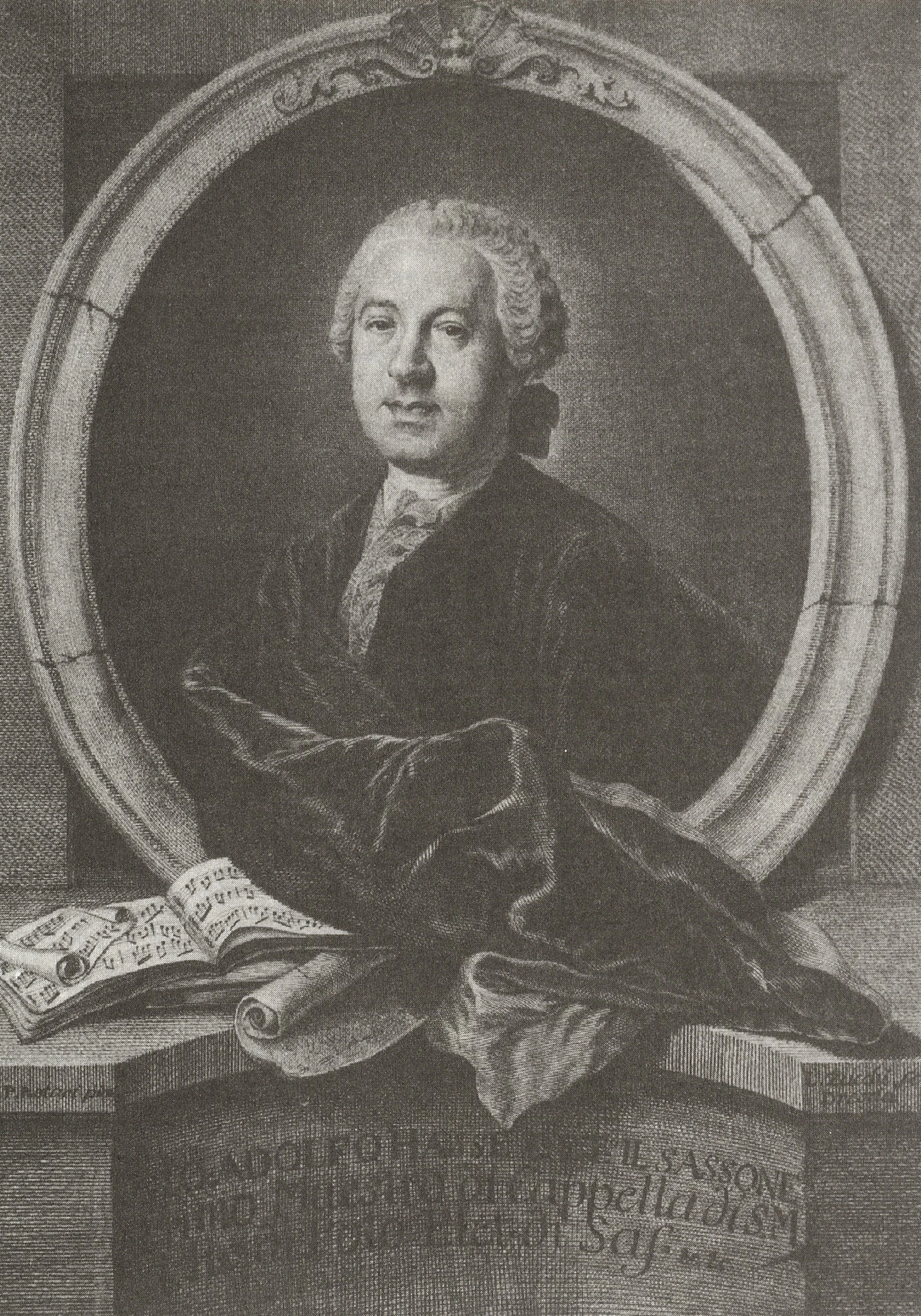
Hasse, Faustina

Hasse Johann Adolf, *baptised 25 March 1699 Bergedorf (near Hamburg), †16 December 1783 Venice, German composer, conductor, singer (tenor). He came from a family of musicians active from the beginning of the seventeenth century in Lübeck. His grandfather Friedrich, father Peter, and older brother Johann Peter were successive organists in Bergedorf. As a boy, Hasse was a member of the local church choir. From 1714 to 1717, he studied in Hamburg, where he became a singer in an opera company in 1718; it was probably there that he became more familiar with the works of R. Keiser. From 1719 to 1721, Hasse worked as a singer at the princely court in Brunswick. It was probably during this time that he was appointed maestro di cappella to the Duke of Brunswick, as this title appears next to his name in printed opera librettos until 1728. He sang in German and Italian operas by G.K. Schürmann, F.B. Conti and A. Caldara, and also performed the title role in his first dramma per musica, Antioco, to a libretto by A. Zeno and P. Pariati (carnival 1721). J. Mattheson spoke highly of his voice and acting talent. In 1721, following the example of other German composers of the time, Hasse travelled to Italy to study the secrets of opera. He stayed initially in Trieste, where he presented his first intermezzo, La contadina (1721), and where he was first given the nickname “il Sassone” (the Saxon), and also in Venice, Bologna, Florence and Rome. He was in Naples between 1722 and 1927 (28?) where he studied with A. Scarlatti (counterpoint) and probably with N. Porpora; it was also there that he converted from Protestantism to Catholicism. J.J. Quantz recounted his meeting with Hasse in Naples (1725). According to the flutist, the success of Hasse’s serenata Antonio e Cleopatra, performed by Farinelli and Vittoria Tesi in 1725 at the palace of C. Carmignani, contributed to the composer’s long-term collaboration with the Teatro S. Bartolomeo, the leading opera house in Naples at the time. His stay in Naples also resulted in acquaintances with the aforementioned singers, as well as with soprano M.A. Benti-Bulgarelli and poet P. Metastasio, who made his debut in 1723–1724 as an opera librettist. Between 1726 and 1730, seven drammi per musica (Il Sesostrate, L’Astarto, Gerone tiranno di Siracusa, Attalo, re di Bitinia, L’Ulderica, Il Tigrane, Ezio) and at least eight intermezzos by Hasse were staged there with great success; these works brought the composer fame not only in Italy, but also in many other European countries. In 1729, the Neapolitan Teatro Nuovo staged Hasse’s only commedia per musica (opera buffa), La sorella amante. Cardinal Althann, exercising authority in Naples on behalf of the emperor, granted the composer the title of fifth maestro di cappella of the Neapolitan court (this title appears in printed librettos up to 1733, although from as early as 1730 Hasse was already entitled to the designation of Royal-Electoral Kapellmeister at the court in Dresden). The Neapolitan period was concluded with two more serenatas, La Semele (1726) and Enea in Caonia (1727). Hasse’s presence in Venice is confirmed during the carnival of 1730, when the Teatro S. Giovanni Grisostomo staged his opera Artaserse with Nicolò Grimaldi, known as Nicolini, Francesca Cuzzoni and Farinelli. Legend has it that two arias from this opera, Per questo dolce amplesso and Pallido il sole (texts by G. Boldini), were later adopted into Farinelli’s permanent repertoire and performed each evening for the Spanish king Philip V. This opera was then used in London (1734) to stage the famous pasticcio, in which Farinelli made his first appearance before an English audience as part of the Opera of the Nobility, which competed with G.F. Handel’s opera and was directed by another outstanding castrato, Senesino, and N. Porpora. In the first half of 1730, Hasse was appointed Kapellmeister of the Königliche Capelle und Cammer-Musique (in Italian librettos as maestro di cappella del re di Polonia) at the Dresden court of the Polish king and Elector of Saxony, Augustus II the Strong (Frederick Augustus I). However, the composer remained in Venice, where he married the outstanding singer Faustina Bordoni on 24 June 1730. At the beginning of 1731, he probably arrived in Vienna with his wife; his oratorio Daniello was performed in the imperial chapel on 15 February 1731. The couple arrived in Dresden on 6 July 1731. Although Hasse held the position of court Kapellmeister for 32 years, he did not give up his close contacts with Italian theatres; he usually used the court’s absence from Saxony to travel to Italy. His first stay in Dresden lasted only three months. However, the Hasses enjoyed success with the premiere of Cleofide (libretto based on Metastasio’s Alessandro nell’India, premiered on 13 September 1731) – the composer’s first opera written for Dresden. It was perhaps at this time that Hasse met J.S. Bach, who gave a concert at the Sophienkirche there on 14 September 1731. From C.Ph.E. Bach’s account, we know that the two composers knew each other well, and the royal court’s visits to the annual fair in Leipzig may have provided an opportunity for direct contact.
On 8 October 1731 Hasse left for Italy; between December 1731 and May 1733, five of his operas premiered: Catone in Utica (Turin), Cajo Fabricio (Rome), Demetrio, Euristeo (Venice), Issipile (Naples) and Siroe (Bologna), featuring an outstanding cast, including Farinelli, Cafarelli and V. Tesi. Hasse took part in rehearsals and often played the harpsichord during performances. Due to the mourning period declared after the death of Augustus II (who died on 1 February 1733), Hasse was able to extend his stay abroad until 1734; during this time, he wrote a number of religious works for the Ospedale degli Incurabili in Venice. Before returning to the court in Dresden, he stayed in Vienna, where he taught music to Empress Maria Theresa. He arrived in Dresden on 3 February 1734. This time, Hasse’s stay in Saxony lasted nine months; during this period, he composed, among others, the oratorio Il cantico de’tre fanciulli, the serenata Sei tu, Lidippe, ò il sole, the prologue Senz’attender che di maggio and probably several church works. At the beginning of November 1734, when Augustus III went to Poland, the composer hurried to Italy and remained there until the end of 1736. He stayed mainly in Venice, collaborating again with the Ospedale degli Incurabili. In September 1735, he conducted the premiere of his Tito Vespasiano in Pesaro, and in early 1736, he staged a new version of Cleofide, titled Alessandro nell’Indie, in Venice. From February 1737 to September 1738, Hasse graced the court in Dresden with new operas (Senocrita, Atalanta, Asteria, Irene, Alfonso) based on texts by the court poet S.B. Pallavicini. The king’s next visit to Poland gave Hasse the opportunity to visit Venice and stage his opera Viriate there during the 1739 carnival. At the beginning of 1740, the composer returned to Dresden, where he worked until 1746, with a break from January 1744 to autumn 1745, which he probably spent in Venice and Naples. The permanent presence of the court in Saxony – the king stayed in Warsaw only from September to November 1740 – resulted in increased compositional activity on the part of Hasse, who prepared revised versions of several earlier operas and also wrote a number of new works: four drammi per musica (Numa Pompilio, Lucio Papirio, Didone abbandonata, Antigono), two intermezzi (Pimpinella e Marcantonio, Rimario e Grilantea) as well as one festa teatrale (Asilio d’amore). In Antigono Hasse used an original libretto by P. Metastasio for the first time, having previously only used his texts in adaptations by other authors. This marked the beginning of a long friendship between the two artists. The Prussian King Frederick II, who was in Dresden in January 1742 and saw the opera Lucio Papirio on stage, became an admirer of Hasse’s talent. During Frederick II’s return visit to Dresden in December 1745, Hasse, at the king’s request, conducted two of his own works: Arminio (at the court theatre) and a Te Deum (at the Kreuzkirche). In February 1746, on his way to Italy, Hasse stopped at the court of the Bavarian Elector Maximilian in Munich, where he gave concerts together with the Elector and his sister, Maria Antonia Walpurgis. After spending several months in Venice, he returned to Dresden on 7 January 1747 to take part in the celebrations. After spending several months in Venice, on 7 January 1747 he returned to Dresden to take part in the celebrations marking the wedding of Princess Maria Josepha of Saxony to Louis, Dauphin of France. Hasse’s compositional contribution was limited to the arrangement of a new version of Semiramide riconosciuta. In June 1747, the weddings of two other children of Augustus III took place in Dresden – Maria Anna to Maximilian, Elector of Bavaria, and Frederick Christian, heir to the Saxon throne, to Maria Antonia Walpurgis. Hasse prepared the premiere of La spartana generosa for this double wedding. From June 1748 to January 1749, the court of Augustus III resided in Poland, where the king took with him some musicians, singers, and dancers from the Dresden ensemble. The precise whereabouts of Hasse during this period remain unknown; it is presumed that he spent this period in Venice (where revised versions of his Demofoonte and Leucippo were staged in the first half of 1747). His presence in Warsaw in 1748 also merits consideration, since in a conversation with Charles Burney (1772) the composer stated that he frequently accompanied Augustus III on his journeys to Poland and composed several works in Warsaw. This information has only been partially confirmed by documents. Research into Hasse’s connections with Poland conducted by A. Żórawska-Witkowska confirms only one stay by Hasse in Warsaw – from autumn 1762 to April 1763 – although there may in fact have been as many as five in total. Hasse’s surname appeared on the list of artists who returned with the king to Dresden on 2 April 1763. The Warsaw premiere of his Il re pastore (7 October 1762) took place in the composer’s presence. It was also here that he wrote the second version of his Il Siroe (he wrote the first in Bologna in 1733), which was finally completed and performed in Dresden in 1763.
Hasse’s works were well known to regulars at the Warsaw theatre, where several of his operas were staged: 1754 – L’eroe cinese, 1759 – La Nitteti and Demofoonte, 1760 – Artaserse and Semiramide riconosciuta, 1761 – L’Olimpiade, L’Arminio and La Zenobia, 1762 – Il Ciro riconosciuto, Il trionfo di Clelia, Il rè pastore; opera performances were usually accompanied by the publication of the libretto. Hasse’s oratorios were also performed in Warsaw: in 1748 and 1764 – I pellegrini al sepolcro di Nostro Signore, in 1755 – Il cantico de’tre fanciulli, as well as serenatas – Il sogno di Scipione (1758) and L’Endimione, which he composed for the local audience. During his visits to Poland, Hasse encountered local music. In a conversation with Burney, he described it as “truly national, often very tender and delicate”. He also admitted that one of his most original and best-received compositions was an aria in the Polish style (perhaps aria nel gusto polacco from Act II of Zenobia).
In the summer of 1749, Hasse was in Dresden and then in Hubertusburg – the nearby court residence – where the premiere of Il natal di Giove took place. The composer’s year-long stay in Saxony was additionally marked by the carnival premiere in 1750 of the opera Attilio Regolo. On 7 January of that year, in recognition of his achievements and talent, Hasse was appointed Oberkapellmeister of the royal-electoral orchestra. This promotion was linked to the appointment in April 1748 of N. Porpora, who was awarded the title of Kapellmeister. In 1750, he composed another very successful oratorio, La conversione di Sant’Agostino, to a libretto by M.A. Walpurgis, and in the summer of that year, at the request of Augustus III, Hasse travelled to Paris, where he sang in a duet with his wife Faustina at the court of the Dauphin. He also composed six harpsichord sonatas (dedicated to Maria Josepha) and the only cantata in his oeuvre, based on the French text Long tems par une rigueur feinte. After returning from Paris, in January 1751, another version of Leucippo was staged in Dresden, and the premiere of Ciro riconosciuto was held. Around 1752, Hasse’s wife Faustina had a dispute with another outstanding singer, Porpora’s pupil Regina Mingotti, who was to be employed at court as a prima donna. The composer was involved in the dispute between the two ladies. As a result, Mingotti was not hired. After the performance of the opera Solimano (February 1753), marked by extraordinary staging (including 18 live horses and 4 camels brought onto the stage), Hasse stayed at the court of Frederick II in Potsdam in March. The years 1753–56 were the heyday of the Dresden theatre and orchestra, directed by Hasse. In 1753, the composer had a team of 76 people at his disposal: 5 composers (alongside Hasse: G.A. Ristori, J.M. Breunich, T. Butz and N. Porpora), 20 singers (including Faustina Hasse, A.M. Monticelli, P. Amorevoli), 44 instrumentalists (led by J.G. Pisendel), a poet (G.A. Migliavacca) and 6 technical support staff. The Dresden orchestra of the time was considered by J.J. Rousseau to be the best (best organised) orchestra in Europe. The new version of Ezio, performed in 1755, outshone even Soliman in terms of the splendour of its staging and the number of extras. However, L’Olimpiade, staged in 1756, turned out to be Hasse’s last opera composed for Dresden. On 29 August, Prussian troops entered the electorate and occupied the capital without a fight. The outbreak of the Seven Years’ War put an end to the cultural splendour of the court and the political and economic prosperity of Saxony. These events prevented Hasse from achieving his ambitious and unprecedented publishing project for the 18th century, namely the publication of his complete works by Breitkopf in Leipzig, for which the composer had received a special privilege from the king in 1756. A significant part of the autographs prepared for printing were burned on 19 June 1760 during the entry of Frederick II’s army into the city. After the outbreak of war, August III left for Warsaw in September 1756 with part of his court and orchestra. Hasse remained in Dresden until the end of 1756, giving daily concerts from 14 November to 20 December for Frederick II, a long-time admirer of the composer’s talent. At the beginning of 1757, Hasse left for Italy; he worked in Venice until the autumn of 1758, then went to Naples. As a result, the premiere of the azione teatrale Il sogno di Scipione in Warsaw on 7 October 1758 had to take place without Hasse’s personal supervision. In Naples, he staged new versions of his operas Demofoonte, La clemenza di Tito and Artaserse, and also prepared the premiere of Achille in Sciro. In the autumn of 1760, he travelled to Vienna, where his festa teatrale Alcide al bivio graced the wedding celebrations of Joseph II. It is possible that he was in Warsaw in the autumn of 1761 (although there is no evidence of this), as the birthday of Augustus III (7 October) was celebrated with the Polish premiere of the opera Zenobia; the composer may have arrived in Poland as early as the summer of that year and remained there until February 1762 to personally direct performances of his other works at the court theatre and the Theatine theatre.
Shortly after arriving in Dresden, which had been ravaged by war, August III died (5 October 1763). The new elector, Frederick Christian, was forced to significantly reduce the size of the Dresden orchestra for economic reasons. He also dismissed, among others, the distinguished Oberkapellmeister. Hasse, however, retained his title and also received a two-year salary. He took part in the funeral ceremonies for Augustus III and Frederick Christian, who died suddenly on 17 December 1763.
Hasse finally left Dresden on 20 February 1764. He settled with his wife in Vienna, where he wrote religious works and compositions commissioned by the imperial court. The festa teatrale Egeria was composed for the coronation of Joseph II (1764), and the dramma per musica Romolo ed Ersilia for the wedding celebrations of Archduke Leopold (1765). In September 1767, he wrote Partenope for the engagement of Archduchess Maria Josepha to Ferdinand IV, King of the Two Sicilies. Hasse’s last opera was the dramma per musica Il Ruggiero, written at the request of Maria Theresa for the wedding of Archduke Ferdinand and Maria Beatrice d’Este (the composer personally supervised its staging in Milan in 1771). However, W.A. Mozart’s serenata Ascanio in Alba, commissioned for the same occasion, was more highly rated by the audience. Finally, in 1764, Hasse prepared a revised version of L’Olimpiade for performance in Turin, and in November 1771 he visited Venice, where he moved permanently in early 1773 and spent the last 10 years of his life. He visited Vienna only once more, briefly, in November 1773. In his later years, he reworked earlier pieces and composed new works for the Ospedale degli Incurabili in Venice and the court of Maria Antonia Walpurgis in Dresden. He was also involved in teaching and maintained close contacts with B. Galuppi, J.G. Vogler and J.G. Naumann. In 1782, during Pope Pius VI’s visit to the Basilica dei Santi Giovanni e Paolo, Hasse’s Te Deum in G major (probably composed in 1776) was performed, conducted by B. Galuppi. Hasse’s last composition was the Mass in G minor, written in 1783. Faustina died in 1781, and two years later, after a period of suffering from arthritis, Hasse, the most famous composer of his time, passed away in obscurity. He was buried in the church of San Marcuola, where a tombstone funded by F.S. Kandler, Hasse’s first biographer, was erected at the beginning of the 19th century.
Of Faustina and Hasse’s three children, two daughters inherited their musical talent – Cristina and Maria Gioseffa. According to Burney, one of them had a powerful operatic contralto voice, while the other had a lyrical soprano voice. There is no information about Hasse’s son, Francesco Maria.
Hasse’s compositional legacy, bequeathed to his daughter Maria Gioseffa in his will and then transferred to the Milan Conservatory in the summer of 1817, remained forgotten for almost 150 years. It was not until 1965 that S. Hansell identified the scores of 27 operas, 7 oratorios and several dozen sacred works as Hasse’s autographs. Many copies of his works (some with the composer’s own corrections and additions) are kept at the Sächsische Landesbibliothek in Dresden. In addition, numerous copies of his works can be found in libraries throughout Europe. This attests to the wide reach of Hasse’s musical influence, although only a small number of his works were published in print. During the composer’s lifetime, fragments of his stage works (operas, pasticcios) were published as separate prints in London, and arias and duets from operas and other vocal-instrumental works appeared in anthologies (London, Paris, Leipzig).
Hasse was a composer recognised in the era of Handel and Bach as the most outstanding artist, sought after by the most illustrious courts; after his death, he was forgotten as quickly as his fame had arisen. In his time, he was undoubtedly the most frequently performed opera composer. Hasse’s works appeared in the repertoires of numerous Italian and German theatres and were staged in Lisbon, Madrid, Versailles, Paris, Brussels, Amsterdam, Copenhagen, London, Berlin, Vienna, Warsaw, Saint Petersburg and Moscow. In London, G.F. Handel became an influential promoter of Hasse’s music, using his arias in his pasticcios (Handel’s seven pasticcios from 1730–34 contain as many as 49 arias by Hasse from 15 different operas). The success of Hasse’s music in London is also evidenced by numerous editions of The Favourite Songs… from operas staged there and editions of his instrumental music. In Berlin, Hasse’s drammi per musica were, alongside the works of C.H. Graun, almost the exclusive repertoire of Frederick II’s court opera for 40 years. Hasse was also the favourite composer of Maria Theresa and the Viennese court, for whom he wrote pieces performed by members of the imperial family, among others. After the composer left Naples, Princess Maria Amalia of Saxony, married to Charles Bourbon, King of the Two Sicilies, became the patroness of his art. Her sister Maria Josepha, wife of the Dauphin of France, assembled a collection of Hasse’s operas at her court in Paris (manuscript in the Bibliothèque Nationale in Paris). In the spring of 1739, the Spanish court unsuccessfully sought to recruit Hasse. The composer was highly esteemed not only by royals; the most flattering assessments of his achievements appear in the writings and statements of contemporary artists and scholars such as L. and W. A. Mozart, J.J. Rousseau, Ch.F.D. Schubart, Ch. Burney, J.A. Hiller, and E.L. Gerber. These figures proclaimed that Hasse could be regarded as the most outstanding of all opera composers (Burney), the greatest German composer and one of the foremost in Italy (Beloselski). Contemporaries admired Hasse’s taste, elegance, charm, precision, simplicity, clarity, restraint in expressing emotions, genius in selecting beautiful and tender melodies, ability to touch hearts and accurately convey the content of the text, masterful command of bel canto technique, maintaining the right balance between the literary and musical layers of the work while taking into account the primary role of the virtuoso singer. It was emphasised with appreciation that the composer’s main concern was the human voice, and his striving to highlight it to the maximum was considered an undeniable asset. It was written that Hasse was the most natural, elegant and intelligent composer (Burney), and that his music was captivating, harmonious and natural, appealing to the ears as well as the soul and the heart (Beloselski). The composer himself is said to have expressed his artistic credo in advice given to J. G. Vogler, stating that music should be understandable and simple, yet at the same time elevated.
Hasse thus earned his reputation through his skilful adherence to the aesthetic canons and principles prevailing at the time. He became the ideal exponent of the taste of his age, an age of classicism represented in the poetry of Metastasio, musical pre-classicism, and the waning phase of aristocratic court culture. Hasse’s popularity peaked between 1730 and 1760, while the changes that took place in the 1770s (the decline of court culture and the transfer of patronage to the bourgeoisie, new romantic trends in literature, the rise of the classical style in music, the triumph of opera buffa and the decline of the traditional Neapolitan dramma per musica, and the opera reform of C.W. Gluck) meant that the works of a composer so strongly associated with the spirit of a bygone era lost their appeal and began to fall out of circulation. In the first half of the 1780s, Hasse’s operas were performed almost exclusively at the court of Frederick II. The composer was fully aware of the changes taking place around him (he lived in Vienna, the centre of the musical avant-garde at the time) and in a letter written in 1769, he wrote that his theatre career had lasted too long and that he wished to devote the last years of his life to chamber and sacred music. He achieved this goal (with the exception of Ruggiero II), but nevertheless experienced the bitterness of oblivion. Even then, however, there were a few enthusiasts of his talent. In Leipzig, the composer’s fame was zealously upheld by J.A. Hiller, who published his works, wrote about him in his theoretical works and in the magazine Wöchentliche Nachrichten. In Dresden, J.G. Naumann, Hasse’s successor as court kapellmeister, established a tradition of performing Hass’s sacred works on certain religious holidays, a tradition that continued into the 20th century: the Mass in D minor and Te Deum (from 1751) and one of the Regina coeli. In 1820, the first biography of Hasse, written by F.S. Kandler, was published in Venice. A renewal of interest in the composer and his work did not begin until the early 20th century. Despite several attempts to revive his operas (Alcide al bivio, staged in Dresden in 1883, Attilio Regolo, staged in Rome in 1891 and Göttingen in 1971, L’Olimpiade, staged in Göttingen in 1971, Piramo e Tisbe, staged in Cologne in 1939, Don Tabarano e Scintilla, staged in Warsaw in 1980, La serva scaltra, staged in Leipzig in 1982/83), they never returned to the stage, and the composer’s name means little to music lovers today.
Hasse was a representative of the Neapolitan school, and the style of his operas is sometimes referred to as Neapolitan, neoclassical, gallant or pre-classical. Hasse’s perfect mastery of the Italian musical idiom earned him the nickname “caro Sassone”, and even “divino Sassone”, in Italy.
Both in the minds of contemporary audiences and from a historical perspective, Hasse was primarily an opera composer, a master of dramma per musica. It has often been written that his opera seria (drammi per musica), composed over a period of half a century (from Antioco in 1721 to Il Ruggiero in 1771), did not evolve, rigidly adhering to the format established by A. Scarlatti. However, Hasse’s work shows some development and changes within the convention. The works composed in the first half of the 1720s (Antioco, Antonio e Cleopatra) belong to an earlier operatic model, featuring a French-style overture (an allegro in fugal form), a rich orchestral accompaniment, at times contrapuntal treatment of the vocal lines, and a very extensively developed middle section in the da capo aria. In the second half of the 1720s, a tendency towards gradual simplification of harmony and orchestral accompaniment began to emerge. In his early-1730s works, the composer unmistakably tailored his melodic invention to the virtuoso requirements of the singers, enriching the arias with numerous intricate coloraturas. It was then that Hasse developed the structure of his dramma per musica, which he adhered to – with minor deviations – until his last work. It is a type of three-act solo opera seria, preceded by a three-part Italian sinfonia (overture) with a fast-slow-fast structure. The work consists of a series of recitatives and arias, occasional ensembles (none of Hasse’s operas feature more than one duet, and trios and quartets appear in only five of his numerous works) and a final chorus. The composer sometimes also introduces choruses within the work in crowd scenes (in 22 operas), but rarely includes more than two choruses in an opera (only in five cases). Short instrumental sections – marches or sinfonias – are designed to fill in prolonged stage action. Operas intended for court celebrations also contain, after the final chorus, so-called licenze, a kind of occasional panegyric set to music in the form of a recitative and aria or chorus.
Secco recitatives predominate among the recitatives, quickly advancing the action. Hasse deliberately used accompanied recitatives sparingly, employing them in moments of particular dramatic and emotional tension. In scenes of an elevated character, the melodic line of these recitatives approaches that of an arioso. Arias and ensembles express the characters’ emotions or offer moral reflection, and they generally follow a five-part da capo structure (AA¹BAA¹). From the late 1950s, the composer also used a shortened form of the da capo aria (AA¹BA¹), but did not introduce it into a work more than three times. Section A is usually extensively developed and richly ornamented with coloratura, while the shorter section B is sometimes set in a different key (e.g., the parallel key) and features contrasting metre and tempo. Instrumental ritornellos appear at the beginning and end of the aria, as well as between its individual parts. The final choruses, which convey the moral or ideological message of the work, are written in a syllabic-chordal texture to ensure maximum clarity of the text. In the conventional operatic overtures, with themes based on repeated notes and harmonies in a slowed rhythm, certain innovations occasionally appear in the slow sections (for example, in the overture to Leucippo, a brief 11-bar connecting passage) or in the final sections (as in the third section of the overture to Asteria, where a minuet with two episodes shaped like a rondo is introduced, considered a precursor to later rondo finales).
Hasse’s final opera, Il Ruggiero, deliberately adheres to a well-known convention, but the formulaic patterns of his earlier works have been largely overcome here. Of the 17 arias, 11 are in the abbreviated da capo form, while one (Ottone’s aria from Act III – Di pietà, d’aita indegno) has an ABA1 structure. Of the 30 recitatives, almost half (12) were accompanied by an orchestra (strings and basso continuo). This work is distinguished by its maturity and the power of its musical drama, its inventiveness, and even the refinement of its melodic invention, as well as the meticulous treatment of the recitatives. At times, a motivic connection links the recitative with the succeeding aria, and in some cases the recitative flows directly into the aria, (without the instrumental ritornello that opens the aria), creating a kind of musical scene. However, Il Ruggiero did not find favour with the Milanese audience due to, as the composer himself wrote in one of his letters, an excess of recitatives and a lack of theatrical effects. The beauty and value of Hasse’s music was appreciated by the young W.A. Mozart, who was his rival at the time.
Until 1743, Hasse used only adaptations by other authors in all his operas based on Metastasio’s texts. The composer used Metastasio’s original libretto for the first time in Antigono. From then on, Hasse became Metastasio’s favourite composer, who often entrusted him with his librettos for musical adaptation and repeatedly expressed his admiration for the musician’s talent in public. The drammi per musica based on Metastasio’s texts draw their themes from ancient history. The exception is Il Ruggiero, which uses the plot of a medieval chivalric poem. The action of the operas usually revolves around 5-6 solo characters: a ruler, a primary and secondary pair of lovers, and their confidants (confidenti). The action plays out in the spiritual and moral sphere and is a struggle of the main character, torn between his sense of duty and the dictates of his heart. The complicated fates of the characters usually find an unexpected but happy resolution (the so-called lieto fine). Metastasio’s strict adherence to structural rules, along with the entire conventionality, formalism, and schematism of his libretti met Hasse’s perfect understanding. Interestingly, Metastasio’s last libretto (Il Ruggiero) was also Hasse’s last opera. The combination of the talents of two outstanding individuals, the most famous librettist and the most renowned composer of the time, created the ideal of the opera seria of the period and left its mark on an entire era in the history of opera.
In addition to his drammi per musica, which are the most significant works in Hasse’s oeuvre, the composer’s theatrical output also includes other genres: festa teatrale, serenata and intermezzo. Feste teatrali, whose protagonists are gods and allegorical figures, have a 1- or 2-act structure and, unlike opera seria, contain numerous choruses (sometimes with solo passages) and accompanied recitatives. Contrapuntal devices are often used in the choruses. The festa teatrale Alcide al bivio (1760) stands out for its unconventionality; here, the composer introduces as many as three choruses and one quartet, with two arias featuring internal recitatives separating the main parts, and some recitatives containing more extensively developed instrumental parts. Hasse’s two-act serenatas usually have pastoral themes and are characterised by numerous accompanied recitatives; the serenata Piramo e Tisbe bears traces of Gluck’s reformist achievements (e.g. Hasse’s favourite da capo form appears only once here). The three-act comic intermezzos date from the composer’s earlier period (the last of them being Rimario e Grilantea from 1741). In addition to secco recitatives, each act has one aria for each of the two characters (initially antagonists, but united in marriage in the finale) and one duet. Hasse’s intermezzos were among the most popular works of their kind at the time.
The orchestra in Hasse’s operas always plays a secondary role to the vocal parts. Its task is to discreetly support the soloists and paint a delicate backdrop for their performances. The core of the ensemble consists of a string section and instruments playing basso continuo (a set used in all accompanied recitatives). In arias, ensembles, choruses and instrumental sections, two or three flutes, oboes, horns, bassoons and, less frequently, trumpets (in marches) are generally added in various combinations. At times the wind instruments are employed in a concertante role, but they never come to the fore at the expense of the singer.
Throughout his life, Hasse carried out various revisions and more or less extensive reworkings of his compositions. In fact, each new staging brought changes, dictated not only by the desire to improve the work, but also by the specific requirements of singers and impresarios. In accordance with the custom of the time, Hasse sometimes used arias by other composers in his operas, but more often his own works were used, with fragments of his compositions being included in pasticcios. In the 1750s and 1760s, Hasse repeatedly returned to Metastasio’s libretti, which he had already adapted, this time meticulously remaining faithful to the originals and setting them to new music. By 1761, Hasse had set all of the poet’s opera libretti written before Antigono to music, with the exception of Temistocle.
Hasse’s 11 oratorios (written between 1730 and 1750) differ only slightly in terms of musical language from his drammi per musica. They feature a greater number of choruses and accompanied recitatives, and the composer makes more frequent use of polyphonic techniques. The arias – usually shorter than in operas – are in da capo form. The middle sections of almost all the arias from La conversione di Sant’Agostino use thematic material from the main section. This work is notable for its vivid musical characterisation of the characters and its one-movement overture – rarely used by Hasse – which leads directly into the vocal scene.
The sacred works written for Dresden are marked by their simple and clear texture, clear voice leading, slow harmonic rhythm, and a tendency to use triad sequences in the melody. Researchers attribute this to the specific acoustics of the court chapel and church, which were unfavourable for rich polyphonic textures. In the sacred works of his late period, written for Vienna and Venice, the orchestral parts are richer and more elaborate, and some parts of the masses were arranged in the form of fugues. Hasse’s late sacred compositions testify that his great compositional talent remained undiminished until the end of his life. The dates of composition of Hasse’s numerous cantatas are rarely recorded, but it is believed that works for voice and basso continuo predominate in the years 1720–30, while compositions with orchestral accompaniment belong to a later period. The most interesting cantatas were written in the 1760s and 1770s to texts by Metastasio. A significant part of the flute works (concertos, trios, sonatas) were written either inspired by or commissioned by Frederick II. These compositions have a three-part cyclical structure (fast-slow-fast) and display the typical characteristics of the galant style. The music for keyboard instruments does not stand out in terms of quality from other works of this kind from that period, but it must have been popular, as evidenced by the numerous surviving copies.
Hasse, like many other composers of the 18th century, was an extremely prolific artist, ready to satisfy every wish of his patrons, who were eager for novelty. Such enormous output was possible thanks to the use of conventional, stereotypical musical language. The composer himself – in conversations with Burney in 1772 (published in The Present State of Music in Germany…) – admitted disarmingly that he would be unable to recognise all of his works, yes the noble beauty of his music fully justifies R. Rolland’s judgement that Hasse’s oblivion is one of the greatest injustices in history.
Literature: R. Eitner Johann Adolf Hasses Werke auf der königlichen Bibliothek zu Berlin, “Monatshefte für Musikgeschichte” XI, 1879; C. Mennicke Hasse und die Brüder Graun als Symphoniker nebst Biographien und thematischen Katalogen, Leipzig 1906, reprint Hildesheim Wiesbaden 1977; W. Müller Johann Adolf Hasse als Kirchenkomponist (…) mit thematischen Katalog, «Publikationen der Internationalen Musikgesellschaft, Beihefte» II, Leipzig 1910; S.H. Hansell Works for Solo Voice of Johann Adolf Hasse, «Detroit Studies in Music Bibliography» XII, Detroit 1968 (catalogue). J.A. Scheibe Critischer Musikus, Leipzig 2nd edition 1745, reprint 1970; J.J. Quantz Lebenslauf von ihm selbst entworfen, in: F. W. Marpurg Historische-kritische Beyträge zur Aufnahme der Musik, vol. 1, Berlin 1754, reprint 1970; Ch. Burney The Present State of Music in France and Italy, London 1771, 2nd edition 1773 The Present State of Music in Germany, The Netherlands and United Provinces, London 1773, 2nd edition 1775, both volumes in: Dr. Burney’s Musical Tours, ed. P. Scholes, London 1959; J.A. Hiller Anweisung zum musikalisch-richtigen Gesange, Leipzig 1774, expanded 2nd edition 1798; J.F. Reichardt Briefe eines aufmerksamen Reisenden, vol. 2, Leipzig 1776; A.M. Beloselski-Belozerski De la musique en Italie… The Hague 1778, reprint 1969; J.A. Hiller Lebensbeschreibungen berühmter Musikgelehrten und Tonkünstler, Leipzig 1784; J.A. Hiller Über Alt und Neu in der Musik, Leipzig 1787; J.A. Hasse and J.A. Hiller Beyträge zur wahren Kirchenmusik, Leipzig 2nd edition 1791; F.S. Kandier Cenni storico-critici intorno alla vita ed alle opere del cel[ebre] compositore di musica Giovanni Adolf Hasse detto il Sassone, Venice 1820; A. Stierlin Johann Adolf und Faustina Hasse, Zurich 1852; P. Scudo Hasse et la Faustina, in: Critique et littérature musicales, Paris 1854; M. Fürstenau Zur Geschichte der Musik und des Theaters am Hofe zu Dresden, 2 vols., Dresden 1861-62, reprint Hildesheim-Leipzig 1971; E. Hasse Nachrichten über die Familie Hasse, Leipzig 1878; A. Urbani de Gheltof La“nuova Sirena” e il “caro Sassone”, Venice 1890; B. Zeller Das recitativo accompagnato in den Opern Johann Adolf Hasses, thesis at the university of Halle 1911; Ł. Kamieński Die Oratorien von Johann Adolf Hasse Leipzig 1912; O.G.T. Sonneck Die drei Fassungen des Hasse “Artaserse”, “Sammelbände der Internationalen Musikgesellschaft” XIV, 1912/13; R. Gerber Der Operntypus Johann Adolf Hasses und seine textlichen Grundlagen, «Berliner Beiträge zur Musikwissenschaft» 11, 1925; R. Engländer Dresdner Musikleben und dresdner Instrumentalpflege in der Zeit zwischen Hasse und Weber, “Zeitschrift für Musikwissenschaft” XIV, 1931–32; J. Prosnak Kultura muzyczna Warszawy XVIII wieku, Krakow 1955; H. Engel Hasses “Ruggiero” und Mozarts Festspiel “Ascanio”, “Mozart-Jahrbuch” 1960/61; S.H. Hansell The Solo Cantatas, Motets and Antiphons of Johann Adolf Hasse, thesis at the University of Illinois, 1966; A. Della Corte Cori monodici di dieci musicisti per le “Tragedie Cristiane”…, “Rivista Italiana di Musicologia” I, 1966; H. Feicht Królewsko-polska i kurfirstowsko-saska kapela muzyczna w Dreźnie, in: Sarmatia artistica, commemorative book for W. Tomkiewicz, Warsaw 1968; S.H. Hansell Sacred Music at the “Incurabili” in Venice at the Time of Johann Adolf Hasse, “Journal of the American Musicological Society” XXIII, 1970; E. Dégrada Aspetti gluckiani dell’ultimo Hasse, «Chigiana» 1972–73, also in: Il palazzo icantato. Studi sulla tradizione del melodramma dal Barocco al Romantismo, Tiesolo 1979; P. Drummond The Concertos of Johann Adolf Hasse, “Proceedings of the Royal Musical Association” XCIX, 1972–73; K.-H. Viertel Neue Dokumente zu Leben und Werk Johann Adolf Hasses, “Analecta Musicologica” XI, 1973; K.-H. Viertel Podstawa źródłowa i budowa dramaturgiczna librett operowych “Cleofide” Hassego i “Poro” Haendla, “Muzyka”, Warsaw 1973 no. 3; A. Chodkowski Repertuar muzyczny teatru saskiego w Warszawie, in: Opera w dawnej Polsce na dworze Władysława IV i królów saskich, ed. J. Lewański, Wrocław 1973; H.Ch. Wolff Giovanni Adolf Hasse e l’opera veneziana, Venice 1973; F.L. Millner Hasse and London’s Opera of the Nobility, “The Music Review” XXV, 1974; R. Strohm Hasse, Scarlatti, Rolli, “Analecta Musicologica” XV, 1975; R. Strohm Italienische Opernarien des frühen Settecento (1720–1730), 2 parts, “Analecta Musicologica” XVI, 1976; J.L. Schwartz Opening Themes in Opera Ouvertures of Johann Adolf Hasse, in: A Musical Offering, commemorative book M. Bernsteina, New York 1977; D. Heartz Hasse, Galuppi and Metastasio and H. Ch. Wolff Johann Adolf Hasse und Venedig, in: Venezia e il melodramma nal Settecento, Florence 1978; R. Monelle Recitative and Dramaturgy in the Dramma per Musica, “Music and Letters” LIX, 1978; R. Strohm Die italienische Oper im 18. Jahrhundert, Wilhelmshaven 1979; F.L. Millner The Operas of Johann Adolf Hasse, Ann Arbor 1979 (contains a full list of pasticcios); H. Lühning “Titus” Vertonungen im 18. Jahrhundert and F. Lippmann Motivische Arbeit bei Hasse, “Analecta Musicologica” XXI–XXII, 1983–1984; A. Chodkowski Johann Adolf Hasse und Polen, in: Dresdner Operntraditionen, part 1: Die Dresdner Oper von H. Shütz bis J.A. Hasse, «Schriftenreihe der Hochschule für Musik Dresden» IX (special issue), Dresden 1985; M. Hopper An Historical Analysis and Performance Edition of the Miserere in D Minor by Johann Adolf Hasse, thesis at the University of Iowa, 1985; Colloquium “Johann Adolf Hasse und die Musik seiner Zeit” (Siena 1983), “Analecta Musicologica” XXV, 1987 (contains various articles); Johann Adolf Hasse und Polen. Materialen der Konferenz, Warszawa, 10–12 Dezember 1993, ed. I. Poniatowska, A. Żórawska-Witkowska, Warszawa 1995; Johann Adolf Hasse in sejner Epoche und Gegenwart. Studien zur Stil-und Quellenproblematik, ed. Sz. Paczkowski, A. Żórawska-Witkowska, Warsaw 2002; R. Mellace Johann Adolph Hasse, Palermo 2004; R. Mellace L’autunno del Metastasio: gli ultimi drammi per musica di Johann Adolf Hasse, Firenze 2007; A. Żórawska-Witkowska Muzyka na polskim dworze Augusta III. cz. 1, Lublin 2012; R. Mellace German composers and “Italian” music: “Cajo Fabricio” between Rome, Dresden and London, “Handel Jahrbuch” LVIII, 2012; Johann Adolf Hasse. Tradition, Rezeption, Gegenwart, ed. W. Hochstein, «Hasse-Studien» 3, Stuttgart 2013 (contains various articles); R. Locke Alexander der Grosse und der indische Raja Puru: Exotik in einem Libretto Metastasios und in darauf basierenden Opern von Hasse und von Händel, in: Fremde Helden auf europäischen Bühnen 1600–1900, ed. A. Aurnhammer, B. Korte, Würzburg 2016; Johann Adolf Hasses Musiktheater: Orte und Praxen der Auffürung, ed. W. Hochstein, S. Woyke, «Hasse-Studien» 4, Stuttgart 2022 (contains various articles).
Compositions
Instrumental:
64 flute concertos
2 concertos for two flutes
violin concerto
oboe concerto
3 harpsichord concertos
3 quartets for various ensembles (Quartet in G major identical to one of the flute concertos)
38 trios for 2 flutes and b.c.
18 sonatas for flute and b.c.
8 sonatas for violin and b.c.
27 harpsichord sonatas
minuets, polonaises, preludes, toccatas and other pieces for harpsichord, lute and other instruments
Different publishers assigned their own numbering to Hasse’s instrumental works, most of which were published in London by J. Walsh: Six sonatas or trios…, Op. 1 for 2 flutes or violin and b.c., 1739, 2nd edition 1750; Solos…, Op. 2 for flute or violin and b.c., 1740; Twelve concertos…, Op. 3 for flute, 2 violins, viola and b.c., 1741, 2nd edition 1749; Six concertos…, Op. 4 (opera sinfonias) for orchestra, 1741, 2nd edition 1745, 3rd edition 1749; Six concertos…, from Op. 3 and Op. 4 for harpsichord or organ, ca. 1743; Six Solos…, Op. 5 for flute or violin and b.c., 1744; Six concertos in six parts…, Op. 6 for flute, 2 violins, tenor and b.c., 1745; Sonate per cembalo, Op. 7, no date; Twelve duets or canzonets…, for 2 flutes or voices, 6 vols., 1748–59.
Stage:
Antioco, dramma per musica, in 3 acts, libretto by B. Feind after A. Zeno and P. Pariati, world premiere Brunswick 11 August 1721
Antonio e Cleopatra, serenata, in 2 acts, libretto by F. Ricchiardi, world premiere Palazza Carmignano (near Naples) September 1721
Il Sesostrate, dramma per musica, in 3 acts, libretto by A. Carasale after A. Zeno and P. Pariati, world premiere Naples 13 May 1726
Miride e Damari, intermezzo, in 2 acts, world premiere Naples 13 May 1726
Semele, ossia La richiesta fatale, serenata, in 2 acts, libretto by F. Ricchiardi, world premiere Naples autumn 1726
L’Astarto, dramma per musica, in 3 acts, libretto by A. Zeno and P. Pariati, world premiere Naples December 1726
Larinda e Vanesio, also titled L’artigiano gentiluomo, intermezzo, in 3 acts, libretto by A. Salvi and A. Carasale after Molière, world premiere Naples December 1726
Enea in Caonia, serenata, in 2 acts, libretto by L.M. Stampiglia, world premiere Naples 1727
Gerone tiranno di Siracusa, dramma per musica, in 3 acts, libretto after A. Aurele, world premiere Naples 19 November 1727
Grilletta e Porsugnacco, also titled Monsieur de Porsugnacco, intermezzo, in 3 acts, libretto after Molière, world premiere Naples 19 November 1727
Attalo, rè di Bitinia, dramma per musica, in 3 acts, libretto after F. Silvani, world premiere Naples May 1728
Carlotta e Pantaleone, also titled La finta tedesca, intermezzo in 3 acts, world premiere Naples May 1728
Scintilla e Don Tabarano, also titled La contadina or Don Tabarano e Scintilla, intermezzo in 3 acts, libretto by B. Saddumene, world premiere Naples autumn 172, Polish premiere Warsaw 1980 Warsaw Chamber Opera
L’Ulderica, dramma per musica, in 3 acts, world premiere Naples 29 January 1729
Merlina e Galoppo, also titled La fantesca or Il capitano Galoppo, intermezzo, in 3 acts, libretto by B. Saddumene, world premiere Naples 29 January 1729
La sorella amante, also titled Lavinia, commedia per musica, in 2 acts (?), libretto by B. Saddumene, world premiere Naples spring 1729
Tigrane, dramma per musica, in 3 acts, libretto by F. Silvani, world premiere Naples 4 November 1729
Dorilla e Balanzone, also titled La serva scaltra or La moglie a forza, intermezzo, in 3 acts, world premiere Naples 4 November 1729
Artaserse, dramma per musica, in 3 acts, libretto by D. Lalli after P. Metastasia, world premiere Venice February 1730, other versions Dresden 9 September 1740, 1760, 2nd version libretto by P. Metastasio world premiere Naples 20 January 1760, Polish premiere Warsaw 3 August 1760
Dalisa, dramma per musica, in 3 acts, libretto by D. Lalli after N. Minato, world premiere Venice May 1730
Arminio, dramma per musica, in 3 acts, libretto by A. Salvi, world premiere Milan 28 August 1730, 2nd version, autograph title Egeste e Tusnelda, libretto by G. C. Pasquini, world premiere Dresden 7 October 1745, another version Dresden 8 January 1753, Polish premiere Warsaw 3 August 1761
Ezio, dramma per musica, in 3 acts, libretto after P. Metastasia, world premiere Naples autumn 1730, 2nd version libretto by P. Metastasio, world premiere Dresden 20 January 1755
Lucilla e Pandolfo, also titled Il tutore, intermezzo, in one act, world premiere Naples autumn 1730
Cleofide, also titled Alessandro nell’Indie, dramma per musica, in 3 acts, libretto by M.A. Boccardi after P. Metastasio, world premiere Dresden 13 September 1731, other versions from 1736, 1738 and 1743
Catone in Utica, dramma per musica, in 3 acts, libretto after P. Metastasio, world premiere Turin 26 December 1731
Cajo Fabricio, dramma per musica, in 3 acts, libretto after A. Zeno, world premiere Rome 12 January 1732, another version Dresden 8 July 1734
Demetrio, also titled Cleonice, dramma per musica, in 3 acts, libretto after P. Metastasio, world premiere Venice carnival 1732, other versions Venice carnival 1737, Dresden 8 February 1740, Venice carnival 1747
Euristeo, dramma per musica, in 3 acts, libretto by D. Lalli after A. Zeno, world premiere May 1732, score in the Paris Conservatory Library, signed: Warsaw 1733
Issipile, dramma per musica, in 3 acts, libretto after P. Metastasio, world premiere Naples 1 October 1732
Arrighetta e Cespuglio, also titled La donna accorta, intermezzo, in 2 acts, world premiere Naples ca. 1733; Messina carnival 1733
Siroe, rè di Persia, also titled L’innocenza difesa (?), dramma per musica, in 3 acts, libretto after P. Metastasio (?), world premiere Bologna 2 May 1733, autograph score from the Milan Conservatory Library, signed: Warsaw 1762
Sei tu, Lidippe, ò il sole, serenata, in one act, world premiere Dresden 4 August 1734
Senz’attender che di maggio, prologue (?), in one act, world premiere Dresden 1734
Tito Vespasiano, also titled La clemenza di Tito, dramma per musica, in 3 acts, libretto after P. Metastasio, world premiere Pesaro 24 September 1735, another version Dresden 17 January 1738, 2nd version libretto by P. Metastasio, world premiere Naples 20 January 1759
Senocrita, dramma per musica, in 5 acts, libretto by S.B. Pallavicino, world premiere Dresden 27 February 1737
Atalanta, dramma per musica, in 3 acts, libretto by S.B. Pallavicino, world premiere Dresden 26 July 1737
Asteria, favola pastorale, in 3 acts, libretto by S.B. Pallavicino, world premiere Dresden 3 August 1737
Irene, dramma per musica, in 3 acts, libretto by S.B. Pallavicino, world premiere Dresden 8 February 1738
Alfonso, dramma per musica, in 3 acts, libretto by S.B. Pallavicino, world premiere Dresden 11 May 1738
Viriate, dramma per musica, in 3 acts, libretto by D. Lalli after P. Metastasia, world premiere Vanice carnival 1739
Numa Pompilio, dramma per musica, in 3 acts, libretto by S.B. Pallavicino, world premiere Hubertusburg 7 October 1741
Pimpinella e Marcantonio, intermezzo, in one act, world premiere Hubertusburg 7 October 1741
Rimario e Grilantea, intermezzo, world premiere Hubertusburg 3 November 1741
Lucio Papirio, dramma per musica, in 3 acts, libretto by A. Zeno, world premiere Dresden 18 January 1742
Didone abbandonata, dramma per musica, in 3 acts, libretto by P. Metastasio and F. Algarotti, world premiere Hubertusburg 7 October 1742
Antigono, dramma per musica, in 3 acts, libretto by P. Metastasio, world premiere Hubertusburg 7 October 1743
Asilio d’amore, festa teatrale, in one act, libretto by P. Metastasio, world premiere Dresden, Hubertusburg or Naples autumn 1743
Ipermestra, dramma per musica, in 3 acts, libretto by P. Metastasio, world premiere Vienna 8 or 17 January 1744, another version Hubertusburg 7 October 1751
Semiramide riconosciuta, dramma per musica, in 3 acts, libretto by P. Metastasio, world premiere Naples 4 November 1744 or /?/ Venice 26 December 1744, another version Dresden 17 January 1747, Polish premiere Warsaw 7 October 1760
La spartana generosa, ovvero Archidiamia, dramma per musica, in 3 acts, libretto by G.C. Pasquini, world premiere Dresden 14 June 1747
Leucippo, favola pastorale, in 3 acts, libretto by G.C. Pasquini, world premiere Hubertusburg 7 October 1747, another version Venice May 1749, Dresden 7 January 1751
Demofoonte, dramma per musica, in 3 acts, libretto by P. Metastasio, world premiere Dresden 9 February 1748, another version Venice carnival 1749, Polish premiere Warsaw 1748 (?), 2nd version world premiere Naples 4 November 1758, Polish premiere 7 October 1759
Il natal di Giove, serenata, in one act, libretto by P. Metastasio, world premiere Hubertusburg 3 August or 7 October 1749
Attilio Regolo, dramma per musica, in 3 acts, libretto by P. Metastasio, world premiere Dresden 12 January 1750, a copy of the score can be found, among others, in the Library of the Warsaw Music Society, ref. no. 9/op.
Ciro riconosciuto, dramma per musica, in 3 acts, libretto by P. Metastasio, world premiere Dresden 20 January 1751, Polish premiere Warsaw 17 January 1762
Adriano in Siria, dramma per musica, in 3 acts, libretto by P. Metastasio, world premiere Dresden 17 January 1752
Solimano, dramma per musica, in 3 acts, libretto by G.A. Migliavacca, world premiere Dresden 5 February 1753
L’eroe cinese, dramma per musica, in 3 acts, libretto by P. Metastasio, world premiere Hubertusburg 7 October 1753, Polish premiere Warsaw 7 October 1754
Artemisia, dramma per musica, in 3 acts, libretto by G.A. Migliavacca, world premiere Dresden 6 February 1754
Il rè pastare, dramma per musica, in 3 acts, libretto by P. Metastasio, world premiere Hubertusburg 7 October 1755, another version Warsaw 7 October 1762, copy of the score from the Sächsische Landesbibliothek in Dresden, signed: Warsaw, 7 October 1762
L’Olimpiade, dramma per musica, in 3 acts, libretto by P. Metastasio, world premiere Dresden 16 February 1756, another version Turin 26 December 1764, Polish premiere Warsaw 17 January 1761, a copy of the score from the Sächsische Landesbibliothek in Dresden intended for the court theatre in Warsaw
Nitteti, dramma per musica, in 3 acts, libretto by P. Metastasio, world premiere Venice January 1758, another version Vienna 1762, Polish premiere Warsaw 3 August 1759
Il sogno di Scipione, azione teatrale, in one act, libretto by P. Metastasio, world premiere Warsaw 7 October 1758
Achille in Sciro, dramma per musica, in 3 acts, libretto by P. Metastasio, world premiere Naples 4 November 1759
Alcide al bivio, festa teatrale, in one act, libretto by P. Metastasio, world premiere Vienna 8 October 1760
Zenobia, dramma per musica, in 3 acts, libretto by P. Metastasio, world premiere Vienna carnival 1761, Polish premiere Warsaw 7 October 1761, autograph score from the Milan Conservatory Library signed: Warsaw
Il trionfo di Clelia, dramma per musica, in 3 acts, libretto by P. Metastasio, world premiere Vienna 27 April 1762, Polish premiere Warsaw 3 August 1762
Egeria, festa teatrale, in one act, libretto by P. Metastasio, world premiere Vienna 24 April 1764
Romolo ed Ersilia, dramma per musica, in 3 acts, libretto by P. Metastasio, world premiere Innsbruck 6 August 1765
Partenope, festa teatrale, in 2 acts, libretto by P. Metastasio, world premiere Vienna 9 September 1767
Piramo e Tisbe, intermezzo tragico, in 2 acts, M. Coltellini, world premiere Vienna November 1768, another version Vienna September 1770
Il Ruggiero, ovvero L’eroica gratitudine, dramma per musica, in 3 acts, libretto by P. Metastasio, world premiere Milan 16 October 1771
pasticcios, over 70, including:
(a complete list is provided by F.L. Millner, see literature)
Lo specchio della vertià, staged in Vienna 1733
Tar conte, principe de Volsci, staged in Vienna 1734
Orfeo, staged in London 1735
Die Farbe macht die Königin oraz Die Hochzeit der Statira, staged in Hamburg 1737
Sabrina, staged in London 1737
Rosmira, staged in Ljubljana 1740
Alessandro in Persia, staged in London 1741
Gianguir, staged in London
Annibale in Capua, staged in London 1746
Lo Starnuto d’Ercole oraz Eurymedonte e Timocleone, staged in Venice 1746
Antonino Commodo, staged in Brunswick 1747
Il baron Cespuglio, staged in Madrid 1747
Pharamundus, staged in Wolfenbüttel 1748
L’ingratitudine punita, staged in London 1748
Ercole al Termodonte and Tomiri, staged in Brunswick 1749
Andromeda, Euridice and Armida Placata, staged in Vienna 1750
Nerone, staged in London 1753
Penelope, staged in London 1754
Il Calandrano, staged in Frankfurt am Main 1755
Berenice, staged in London 1756
La petite maison, staged in Paris 1757
The Stratagem, staged in London 1761
Eumene, staged in London 1765
The Maid of the Mill, staged in London 1765
vocal-instrumental:
oratorios:
Daniello, libretto by A. Zeno, staged in Vienna 15 February 1731
Serpentes ignei in deserto, also titled Christus Dominus in serpente and Popolo ebreo nel deserto, libretto by B. Bonomo, staged in Venice ca. 1730–33
Sanctus Petrus et Sancta Maria Magdalena, staged in Venice end of 1730 (?)
Il cantico de’tre fanciulli, libretto by S.B. Pallavicino, staged in Dresden 23 April 1734, other versions Dresden 1743 or 1763 and Vienna 1774, Warszawa 28 and 29 March 1755
Le virtù appié della croce, libretto by S.B. Pallavicino, staged in Dresden 19 April 1737
Giuseppe riconosciuto, libretto by P. Metastasio, staged in Dresden 31 March 1741
I pellegrini al sepolcro di Nostro Signore, libretto by S.B. Pallavicino, staged in Dresden 23 March 1742, piano reduction by J.A. Hiller, published as Die Pilgrimme auf Golgotha, German text by J.J. Eschenburg, Leipzig 1784, Warsaw, 12 April 1748, libretto Warsaw 1748
La caduta di Gerico, libretto by G.C. Pasquini, staged in Dresden 12 April 1743
La deposizione dalla croce di Gesù Cristo, libretto by G.C. Pasquini, staged in Dresden 4 April 1744, Polish text by J.A. Załuski in: Zebranie rytmów, vol. 2, Warsaw 1754
Sant’Elena al calvario, libretto P. Metastasio, staged in Dresden 10 April 1746, another version Vienna 1772, Polish text J.A. Załuski in: Zebranie rytmów, vol. 2, Warsaw 1754, probably Warsaw Holy Week 1790
La conversione di Sant’Agostino, libretto by M.A. Walpurgis, staged in Dresden 28 March 1750, Polish text J.A. Załuski in: Zebranie rytmów, vol. 2, Warsaw 1754
cantatas:
37 cantatas for voice (soprano or alto) and b.c., including:
Povero giglio, oh Dio, 1729
Orgoglioso fiumicello, also titled L’inciampo, text by P. Metastasio, 1732
Long tems par une rigueur feinte, staged in Paris 1750
Dalle tenebre orrende, also titled Orfeo ed Euridice, for 2 sopranos and b.c.
16 cantatas for voice (sopran or alto), 1 or 2 instruments (flute or violin) and b.c., including:
Solitudini campestre and Vaga madre di cari diletti, also titled Adone, text by P.A. Rolli
27 cantatas for voice (soprano or alto, one for bass) and orchestra, including.:
Senz’attender che di maggio, 1734
Che ti dirò Regina? and Grande Augusto, ricevi frà tanti ardenti voti, text by M.A. Walpurgis, 1747
No, perdonami, o Clori, also titled La Scusa, text by P. Metastasio, 1760
Scrivo in te l’amato nome, also titled Il Nome, text by P. Metastasio, 1761
Che vuoi, mio cor?, also titled Amor timido, text by P. Metastasio, 1762
Perdono, amata Nice, bella Nice, also titled La Gelosia, text by P. Metastasio, 1762
Ah perché col canto mio, also titled L’Armonica, text by P. Metastasio, 1769
Ah troppo è ver! Quell’amoroso ardore, also titled Il primo amore, text by P. Metastasio, 1729
7 cantatas for soprano, alto and orchestra, including those set to texts by P. Metastasia:
Apprenuesti, o germana, also titled Complimento per due serenissime arciduchesse d’Austria, 1760
In van ti scuoti, Amor, also titled Amor prigioniero, 1761
Ah Nice, ah già rosseggia, also titled La Danza, 1755
Deh, tacete una volta, also titled Il Ciclope, 1776
41 motets for voice (soprano or alto, 2 – for bass) and orchestra
13 antiphons for voice (soprano or alto) and orchestra and 4 antiphons for choir and orchestra
Salve Regina for soprano, alto and orchestra
Lamentatio Jeremae Prophète for soprano, alto and b.c.
16 masses for solo voice, choir and orchestra
numerous individual mass parts: Kyrie, Gloria, Credo, Sanctus, Agnus Dei
21 psalms for solo voices, choir and orchestra or for choir and orchestra
12 hymns for solo voice and orchestra or for solo voice, choir and orchestra
10 offertories for choir and orchestra
In addition, around 30 other sacred works for solo voice, choir and orchestra or for choir and orchestra and around 50 arias for voice and a chamber instrumental orchestra or for voice and orchestra, probably from operas or larger sacred works
works in:
Venetian ballads compos’d by Sigr Hasse and all the celebrated Italian masters, for voice and b.c., 3 vols., London 1742–48
67 solfeggi for voice and b.c., arias and songs sometimes originating from larger works, preserved in manuscripts or in collective prints
Editions
Arminio, ed. R. Gerber, “Das Erbe Deutscher Musik” XXVII, XXVIII, Mainz 1957, 1966
Il Ruggiero, ovvero L’eroica gratitudine, ed. K. Hortschansky, «Concentus Musicus» I, Cologne 1973
Larinda e Vanesio, ed. L. Bettarini, Milan 1973, also ed. G. Lazarevitch, «Recent Researches in the Music of the Classical Era» IX, Madison 1979
Siroe, rè di Persia (version from 1733), Il trionfo di Clelia oraz Alcide al bivio, facsimile edition, «Italian Opera 1640–1770» XXXIII, LXXXIII, LXXXI, New York 1977, 1981, 1983
Don Tabarrano (version from 1737), facsimile edition O. Landmann, Leipzig 1982
La serva scaltra, «Collezione Settecentesca Bettarini» XVI, Milan 1985
La conversione di Sant’Agostino, ed. A. Schering, “Denkmäler Deutscher Tonkunst” XX, Leipzig 1905, 2nd edition 1958
Cantates pour une voix de femme et orchestre (4 cantatas), ed. S.H. Hansell, «Le pupitre» XI, 1968
Che ti dirò Regina?, ed. R. Eitner in: Kantaten des 17. und 18. Jahrhunderts, vol. 3, Leipzig 1886
Miserere in C minor for two sopranos, two altos and piano, ed. L. Hellwig, Berlin 1834, also ed. A. Schering, Leipzig 1922
Der 113. Psalm for bass, choir and orchestra, Bonn 1835
Te Deum laudamus for SATB and orchestra, German text by G.W. Fink, Leipzig 1840
Flute concerto in B minor, ed. A. Schering, “Das Erbe Deutscher Musik” XXIX/XXX, 1906, 2nd edition 1958
Flute concerto in D major, ed. K. Walther, Leipzig 1934 (arrangement for flute and b.c.), 1953 (arrangement for flute and orchestra) also ed. R. Engländer, London 1953
Flute concerto in G major, ed. R. Engländer, “Nagels Musik-Archiv” CXCIV, Hanover 1934
Flute concerto in A major, ed. W. Mohr, Heidelberg 1964
Mandolin concerto in G major, ed. H. Neemann, Berlin 1938
Oboe concerto in F major, ed. H. Töttcher and K. Spannagel, Hamburg 1966.
Trio sonata in D major for 2 flutes and b.c., ed. R. Engländer, Wolfenbüttel 1945, also „Nagels Musik-Archiv” CLIX, Kassel 1957
Trio Sonata in D major for 2 flutes and b.c., ed. E. Schenk, «Diletto Musicale» CDXXXV, Vienna 1954
Trio Sonata in F major for oboe, violin and b.c., ed. H. Winschermann, «Ludus Instrumentalis» VII, Hamburg 1962
Trio Sonata in C major for flute, violin and b.c. (guitar), ed. K. Scheit and W Kammerling, «Gitarre – Kammermusik» LXXVII, Vienna 1969
Sonata in D major for flute and b.c., ed. K. Walther, “Nagels Musik-Archiv” XCIX, Hanover 1933
Sonata in G major for flute and b.c., ed. R. Engländer, Leipzig 1934, 2nd edition 1953
Sonata in E minor for violin and b.c., ed. R. Engländer, Leipzig 1933, 2nd edition 1953
Harpsichord Sonata in F major, ed. R. Engländer, Leipzig 1930
Harpsichord Sonata in E-flat major, wyd. R. Steglich, Wolfenbüttel 1936
L’artigiano gentiluomo or Larinda e Vanesio, ed. G. Lazarevich, 1979
Domine ad adjuvandum me in C major, Dixit Dominus in C major, Confitebor tibi in F major, Beatus vir in A minor, Laudate pueri in A major, ed. W. Hochstein, Carlus-Verlag, 1999
Kirchenmusik (Litanie), W. Hochstein, Carlus-Verlag 2004
Marc’Antonio e Cleopatra, ed. R. Wiesend, Carlus-Verlag 2002
Cleofide, ed. Z. Mojzysz, Carlus-Verlag 2008
Demetrio, ed. R. Strohm, F. Manchelli-Buttini, facsimile edition Venice 2014
Requiem in B and Requiem in C, ed. W. Hochstein, Carlus-Verlag 2021