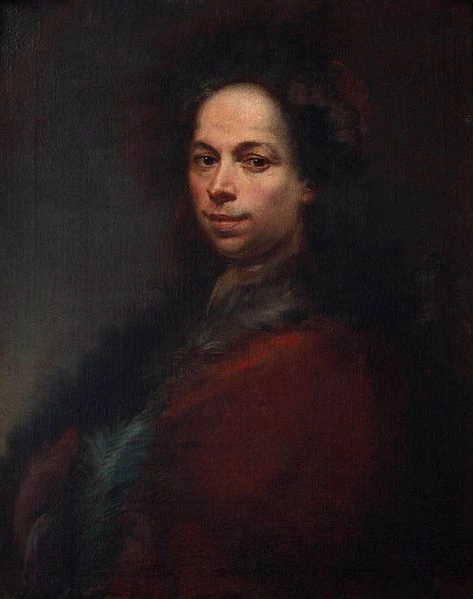
Conti Francesco Bartolomeo, *20 January 1681 or 1682 Florence, †20 July 1732 Vienna, Italian composer, theorbist and mandolinist. Between 1701 and 1726 (with a brief interruption at the turn of 1706 and 1707), he was a theorbist at the imperial court in Vienna, and from 1713 he also held the title of court composer, making him one of the highest-paid musicians in the imperial capital. Around 1729, he moved from Vienna to Italy, probably to Florence, where he had his own house; he returned to Vienna around 1732, shortly before his death. He was married three times.
Conti, together with A. Caldara, was one of the most outstanding Italian composers working at the Viennese court in the first half of the 18th century, whose work established the great importance of this centre in the musical life of Europe at that time.
He collaborated with outstanding librettists: S. Stampiglia, A. Zeno and P. Metastasio, and especially P. Pariati (who provided him with the most librettos), as well as set designers: Ferdinand, Giuseppe and Antonio Galli-Bibiena. Nearly 30 of Conti’s stage works (including operas, serenades and intermezzos) were staged in Vienna between 1706 and 1732. His operas are in the style of Italian lyric opera, with an emphasis on the skilful use of comic effects. The most successful was the opera Don Chisciotte in Sierra Morena, staged in 1719 in Vienna and later also in Hamburg in a partial translation into German. The opera Clotilda, staged in Vienna in 1706, also enjoyed some popularity, with excerpts published several times in London. Many of his contemporaries praised Conti’s skill as a theorbo player.
Literature: C. and E. Fruchtman Instrumental Scoring in the Chamber Cantatas of Conti in: Studies in Musicology, commemorative book for G. Haydon, Chapel Hill 1969; H. Williams Francesco Bartolomeo Conti, His Life and Music, Aldershot 1999.
Compositions:
Stage:
Clotilde, staged in Vienna 1706, lost, only fragments survive.; selected arias published multiple times in London
Il trionfo dell’amicizia e dell’amore, staged in Vienna 1711, manuscript preserved
Circe fatta saggia, staged in Vienna 1713, manuscript preserved
Alba Cornelia, staged in Vienna 1714, manuscript preserved
I Sattiri in Arcadia, staged in Vienna 1714, manuscript preserved
intermezza i licenza do Atenaidy (autorstwa A. Caldary et al.), staged in Vienna 1714, manuscript preserved
Ciro, staged in Vienna 1715, manuscript preserved
Teseo in Creta, staged in Vienna 1715, manuscript preserved
Il finto Policare, staged in Vienna 1716, manuscript preserved
Sesostri, Rè di Egitto, staged in Vienna 1717, manuscript preserved
Amore in Tessaglia, staged in Vienna 1718, manuscript preserved
Astarto, staged in Vienna 1718, manuscript preserved
Don Chisciotte in Sierra Morena, staged in Vienna 1719, manuscript preserved
Galatea vendicata, staged in Vienna 1719, manuscript preserved
Cloris und Thirsis, staged in Hamburg 1719, manuscript preserved
Alessandro in Sidone, staged in Vienna 1721, manuscript preserved
La via del saggio, staged in Vienna 1721, manuscript preserved
Pallade trionfante, staged in Vienna 1722, manuscript preserved
Archelao, Rè di Cappadocia, staged in Vienna 1722, manuscript preserved
Il trionfo della fama, staged in Prague 1723, manuscript preserved
Creso, staged in Vienna 1723, manuscript preserved
Penelope, staged in Vienna 1724, manuscript preserved
Meleagro, staged in Vienna 1724, manuscript preserved
Griselda, staged in Vienna 1725, manuscript preserved
Il contrasto della bellezza e del tempo, staged in Vienna 1725, manuscript preserved
Issicratea, staged in Vienna 1726, manuscript preserved
L’Issipile, staged in Vienna 1732, manuscript preserved
oratorios:
(mostly performed for the first time in Vienna and preserved there in manuscripts)
Il Gioseffo 1706
Il martirio di san Lorenzo 1710
La colpa originale 1718
Dio sul Sinai 1719
Mosè preservato 1720
Naaman 1721
Il David perseguitato da Saul 1723
David 1724
L’osservanza della divina legge nel martirio de’Maccabei 1732
Gioseffo che interpreta i sogni 1736
S. Elena al Calvario, performed in 1736 Brno
***
solo (secular) cantatas accompanied by b.c. or instrument and b.c
5 masses for 4 voices with instrumental accompaniment
Te Deum for 10 voices with instrumental ensemble
10 Hymni sacri per tutto l’anno for 4 voices with organ accompaniment
2 Alma redemptoris for voices with instrumental accompaniment
motets, offertorios
Instrumental:
Allegro
Ouverture
Sonata al mandolino solo
fugues
symphonies
Editions (selected):
Don Chisciotte in Sierra Morena, facsimile edition H.M. Brown, «Italian Opera 1640–1770» LXIX, New York 1982
9 Symphonies (including the overtures to Don Chisciotte…, Alessandro in Sidone, Pallade trionfante, Il trionfo della fama oraz L’Issipile), ed. H. Williams, in: Italians in Vienna, «The Symphony 1720–1840» series B, vol. 2, New York 1983 (contains a thematic catalogue)
Cantate con instromenti, facsimile edition S. Mengozzi, Florence 1990–1991, «Archivum musicum. La cantata barocca» vols. 28, 29