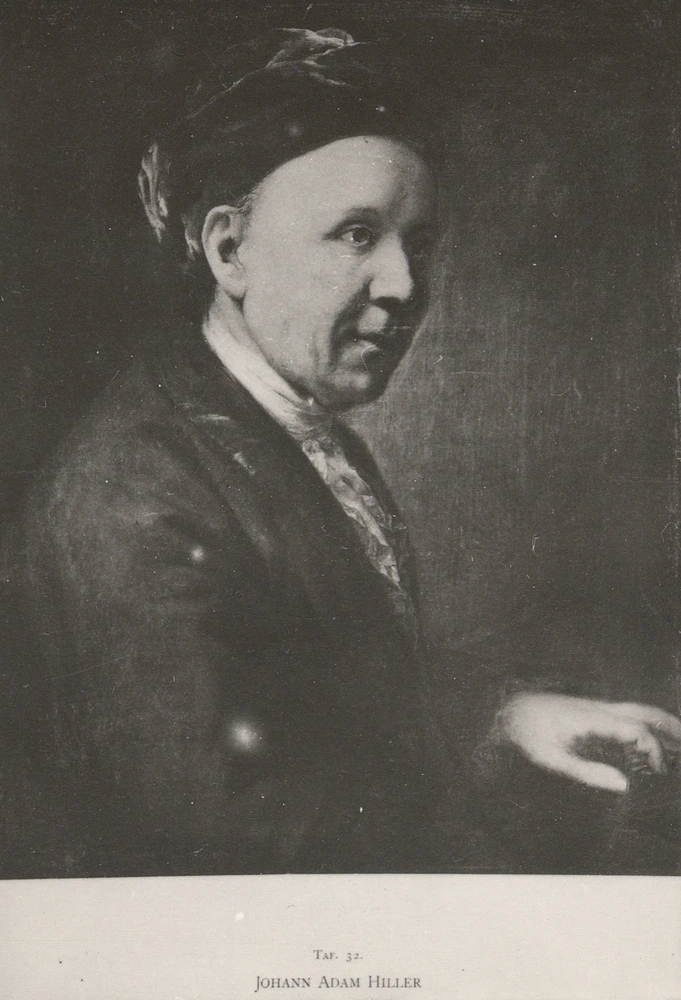
Hiller, Hüller, Johann Adam, *25 December 1728 Wendisch-Ossig (near Görlitz), †16 June 1804 Leipzig, German composer, music writer and organiser of musical life. He received his early education, including lessons in violin and harpsichord, from A. Berndt, a teacher from his home village. Between 1740 and 1745, Hiller attended secondary school in Görlitz, where he learnt to play the harpsichord, violin, flute, oboe and trumpet from his classmates, and played the double bass (Bassgeige) at the school’s Collegium musicum. From 1745 to 1746 he worked as a clerk in Spreewald. In 1746 he received a scholarship which enabled him to study at the Kreutzschule in Dresden. There he studied harpsichord and the principles of thoroughbass with G.A. Homilius, and the flute with J.A. Schmidt; he acquired his knowledge of composition by analysing the scores of J.A. Hasse’s operas, which were staged at the court theatre under the composer’s direction. It was during this time that Hiller composed his first works: songs, arias, occasional cantatas and instrumental music. In 1751 he moved to Leipzig, where he studied law at the university until 1754; he also performed professionally as a singer (bass) and as a flautist in public concerts at Das Grosse Konzert, gave harpsichord lessons, composed musical and poetic works, and wrote Abhandlung über die Nachahmung der Natur in der Musik. In the spring of 1754, he returned to Dresden as tutor to Count H.A. Brühl von Martinskirch. In 1758, he travelled with him to Leipzig, but in early 1760 he resigned from his post due to worsening symptoms of depression. Once his illness had passed, Hiller embarked on an exceptionally active and wide-ranging career. In the summer of 1762, he organised a series of public subscription concerts in Leipzig, and between 1763 and 1771 he directed the Das Grosse Konzert series, which had been revived following the Seven Years’ War. He founded a three-year singing school for girls and boys, and wrote textbooks and pedagogical works. Between 1766 and 1771, he published the music journal “Wöchentliche Nachrichten”, whilst also authoring or translating most of the texts contained therein. In 1775, he organised the Musikübende Gesellschaft, comprising pupils from his school, professionals and amateurs, which gave 30 concerts a year. In 1778 he became music director at the Paulinerkirche, and in 1783 also at the Neukirche. During Lent he organised concerts spirituels, and in 1781 he initiated a series of concerts at the Gewandhaus, which he directed until 1785. All his stage works were composed between 1766 and 1779. Although he was the most prominent figure in Leipzig’s musical circles, in 1785 he unexpectedly left the city and took up a modest post as Kapellmeister at the provincial court of the Duke of Courland in Mitau. In 1786, Hiller returned to Leipzig, but found all his former posts taken; he therefore left for Berlin, where in 1786 he conducted Handel’s Messiah in his own arrangement. Between 1787 and 1788, he worked in Wrocław as the city’s music director and also conducted a series of concerts spirituels. Following an unsuccessful attempt to take up the post of music director in Hamburg (following the death of C.P.E. Bach), in 1789 the Leipzig city council offered him the position of music director at the Thomaskirche and cantor at the Thomasschule. At that time, Hiller focused his compositional work on sacred music, whilst at the school he implemented a series of progressive reforms. In 1792, he prepared a performance of W.A. Mozart’s Requiem with his pupils. In 1800, due to poor health, Hiller resigned from both posts. He died four years later and was buried in St John’s Cemetery. His son Friedrich Adam (*1767 Leipzig, †23 November 1812 Königsberg) was a composer and singer. In 1784 he became director of the musical society in Schwerin, and in 1796 of the theatre orchestra in Altona; from 1799 until his death, he served as musical director of the theatre in Königsberg. He composed theatre music, songs and instrumental works. Together with the poet C.F. Weiss, Hiller is the founder of the German national form of comic opera. His singspiels — today regarded as “trivial” (C. Dahlhaus) – became a model for other composers of the time, such as J. André, J.A. Benda and C.G. Neefe. His first works – Die verwandelten Weiber and Der lustige Schuster – are adaptations of texts from English ballad operas, and the music consists of solo pieces of a very simple form, with folk-like melodies and extremely modest instrumentation. It was precisely these features that contributed to the works’ enormous success with a wide audience. Hiller’s subsequent singspiels are modelled, in their literary content, on French comedies, whilst the music is a conglomeration of formal and stylistic devices drawn from Italian opera buffa and seria, French opéra-comique and German Lied. Hiller’s finest singspiels were considered to be Lottchen am Hofe, Die Liebe auf dem Lande and Die Jagd. They were a staple of the repertoire in German theatres of the time, and the songs and arias from these works became widely known. Hiller’s singspiels were also performed at the public theatre in Warsaw (Die Muse 1775, Die Jagd 1781) and at the Sułkowski family’s court theatre in Rydzyna (Lottchen am Hofe, n.d.). Hiller composed songs – both secular and sacred – for educational purposes (to improve the skills of professional singers and to popularise singing among amateurs), as well as with the intention of creating a national repertoire. His Allgemeines Choral-Melodienbuch was still in use in Saxony as late as the 20th century. However, the formulaic nature of the form (usually a verse structure) and the lack of melodic inventiveness mean that these works are overshadowed by songs from singspiels. Today, Hiller’s compositional output is of purely historical interest, whereas his significance as one of the era’s principal chroniclers and ‘reporters’ has grown immensely. “Wöchentliche Nachrichten” was the first modern music magazine. Aimed not only at professionals but also at amateurs, it had a significant influence on the development of the tastes of the German middle classes. The primary task of the magazine was to record current events and opinions, for the benefit not only of contemporary readers but also of future generations. The publications were divided into three sections: documentary (reports on performances, concerts, orchestral line-ups, and the repertoire of various centres), critical (reviews of published and performed works), and theoretical (theoretical and aesthetic works, including translations of J.J. Rousseau, J. Le Rond d’Alembert and J.F. Marmontel). In his aesthetic views, Hiller was not original. Abhandlung über die Nachahmung is based on the ideas of C. Batteaux; later, Hiller came under the influence of the aesthetics of “sentimental style” (Empfindsamkeit). His entire career is characterised by Enlightenment didacticism and rationalism, evident both in his strictly pedagogical work (practical and theoretical – numerous textbooks), as well as in his organisational activities (ensembles established for the benefit of the general public and directed by him, with the Gewandhaus Orchestra at the forefront), publishing (promoting piano reductions, popularising the works of other composers), compositional (works for children and amateurs) and journalistic activities.
Literature: C. Naumann Johann Adam Hiller. Eine bescheidene Würdigung seiner Verdienste als Mensch, Künstler und Schulmann, Leipzig 1804; K. Peiser Johann Adam Hiller, Leipzig 1894; M. Friedlaender Das deutsche Lied im 18. Jahrhundert, 2 vols., Stuttgart 1902, reprint 1970; G. Calmus Die ersten deutschen Singspiele von Standfuss und Hiller, Leipzig 1908; H. von Hase Johann Adam Hiller und Breitkopfs’, “Zeitschrift für Musikwissenschaft” II, 1919/20; A. Schering Musikgeschichte Leipzigs, vol. 3, Leipzig 1941; G. Sander Das Deutschtum im Singspiel Johann Adam Hillers, Würzburg 1943; W. Serauky Johann Adam Hiller als Erwecker der Händel-Tradition im 18. Jahrhundert, in a commemorative publication marking the 175th anniversary of the Gewandhauskonzerte, Leipzig 1965; K. Kawada Studien zu den Singspielen von Johann Adam Hiller (1728–1804), Marburg 1969; V. Duckies Johann Adam Hiller’s “Critical Prospectus for a Music Library”, in: Studies in Eighteenth Century Music, Festschrift for K. Geiringer, ed. C.R. Landon, R.E. Chapman, New York 1970.
Compositions
Instrumental:
Loisir musical, contenant deux sonates… for harpsichord, 1762
50 Fugetten for organ, 1791
Tre Quartetti for string instruments, published in Brunswick 1796
in addition, works included in numerous anthologies and preserved in manuscripts
the arrangement and publication of works by other composers, including: G.B. Pergolesi, G.A. Homilius, J.A. Benda, F.G. Handel, J.A. Hasse, A.M.E. Gretry, C.H. Graun and W.A. Mozart.
Vocal and vocal-instrumental:
Songs and secular cantatas, including:
15 Lieder mit Melodien, 1759, 2nd ed. Leipzig 1760
Wöchentlichen musikalischen Zeitvertrieb for 1–5 voices and basso continuo, 1759–60 (in weekly issues)
71 Lieder für Kinder, 1769, 2nd edition 1775, 3rd edition Leipzig 1784
Der Greis, Mann und Jüngling, cantata, 1778
Cantaten und Arien verschiedener Dichter for voice and keyboard instrument, 1781
Sammlung der Lieder aus dem Kinderfreunde, 1782
Sacred songs, including:
22 Choralmelodien for voice and basso continuo, 1761, new version for 4 voices and basso continuo
50 geistliche Lieder für Kinder for voice and keyboard instrument, 1774, with added violin part, 1775
Allgemeines Choral-Melodienbuch für Kirchen und Schulen, auch zum Privatgebrauch for 4 voices and basso continuo, 1793, Leipzig 2nd edition 1793 (expanded to include 24 additional pieces), 3rd edition 1794 titled Nachtrag (…) zur Beförderung des Choralsstudiums (expanded to include 11 additional pieces)
Stage:
singspiels:
Die verwandelten Weiber oder Der Teufel ist los, Part 1, libretto by C.F. Weisse after The Devil to Pay by C. Coffey, performed in Leipzig 28 May 1766, piano score published in Leipzig 1770 (contains 12 pieces with music by J.C. Standfoss)
Der lustige Schuster oder Der Teufel ist los, Part 2, libretto by C.F. Weisse after The Merry Cobler by C. Coffey, performed in Leipzig summer 1766, piano score published in Leipzig 1771 (most pieces with music by J.C. Standfoss)
Lisuart und Dariolette oder Die Frage und die Antwort, libretto by D. Schiebeier after La fée Urgèle by C. S. Favart, performed in Leipzig 25 November 1766, piano score published in Leipzig 1768, 3-act version performed in Leipzig 7 January 1767, piano score published in Leipzig 1770
Lottchen am Hofe, libretto by C.F. Weisse after Ninette à la cour by C. S. Favart, performed in Leipzig 24 April 1767, piano score published in Leipzig 1769
Die Muse, libretto by D. Schiebeler, performed in Leipzig 3 October 1767, piano score published in Leipzig 1771
Die Liebe auf dem Lande, libretto by C.F. Weisse after Annette et Lubin by J. B. and C. S. Favart and La clochette by L. Anseaume, performed in Leipzig 18 May 1768, piano score published in Leipzig 1769, 2nd ed. 1770
Die Jagd, libretto by C.F. Weisse after La partie de chasse de Henri IV by C. Collé, performed in Weimar 29 January 1770, piano score published in Leipzig 1770, 3rd edition 1776
Der Dorfbarbier, libretto by C.F. Weisse after Blaise le savetier by J.M. Sédaine, performed in Leipzig 1771, piano score published in Leipzig 1771 (contains 10 pieces with music by C. G. Neefe)
Der Aerndtekranz, libretto by C.F. Weisse, performed in Leipzig spring 1771, piano score published in Leipzig 1772
Der Krieg, libretto by C. Goldoni La guerra in German translation with annotations by C.F. Weisse, performed in Leipzig 1772, piano score published in Leipzig 1773
Die Jubelhochzeit, libretto by C.F. Weisse, performed in Leipzig 5 April 1773, piano score published in Leipzig 1773
Die kleine Aehrenleserin, libretto by C.F. Weisse, piano score published in Leipzig 1778
Das Grab des Mufli oder Die beiden Geitzigen, libretto by A.G. Meissner after Les deux avares by F. de Falbaire, performed in Leipzig 17 January 1779, piano score published in Leipzig 1779, Wrocław 2nd edition 1781
Polits oder Das gerettete Troja, libretto by G.S. Brunner, performed in Leipzig 1777 (?), piano score published in Leipzig 1782
Editions:
140 Choralmelodien nach Hiller, ed. H.B. Schulze, Zwickau 1838
Hillers Choral-Melodienbuch in ganz ursprünglicher Form, Ordnung und Harmonie, ed. J.H.L. Müller, Meissen 1844
44 Kinder- und Volkslieder (von 1769), ed. R. Schaab, Leipzig 1865
Writings (published in Leipzig, unless stated otherwise)
Abhandlung über die Nachahmung der Natur in der Musik, in: F.S. Marpurg Historisch-kritische Beiträge, vol. 1, published in Berlin 1754, reprinted in 1970
articles and translations in “Wöchentliche Nachrichten” 1766–70, reprinted in 1970, suppl. “Musikalische Nachrichten und Anmerkungen” 1770
Anweisung zur Singekunst in der deutschen und italienischen Sprache, zum Gebrauch der Schulen, published in Frankfurt 1773
Musikalisches Handbuch für Liebhaber des Gesanges und Claviers, published in Leipzig 1773
Anweisung zum musikalisch-richtigen Gesänge, published in Leipzig 1774, 2nd revised edition 1798
Anweisung zum musikalisch-zierlich en Gesänge, published in Leipzig 1780
Lebensbeschreibungen berühmter Musikgelehrten und Tonkünstler neuerer Zeit, vol. 1, Leipzig 1784 (includes Hiller’s autobiography)
Über Metastasio und seine Werke, nebst einigen Übersetzungen, Leipzig 1786
Über Alt und Neu in der Musik, Leipzig 1787
Was ist wahre Kirchenmusik?, Leipzig 1789
Bey träge zu wahrer Kirchenmusik von J.A. Hasse und J.A. Hiller, Leipzig 2nd ed. 1791
Kurze und erleichterte Anweisung zum Singen, Jur Schulen in Städten und Dörfern, Leipzig 1792
Anweisung zum Violinspielen für Schulen und zum Selbstunterrichte, Leipzig 1792
in addition, translations into German from English, French, Italian and Latin