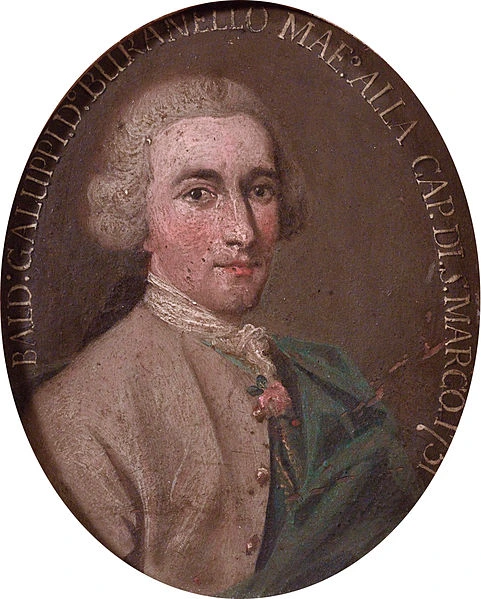
Galuppi Baldassare, known as Il Buranello, *18 October 1706 Burano (near Venice), †3 January 1785 Venice, Italian composer. He initially studied music with his father, a barber by profession, but occasionally playing the violin in theater orchestras. He made his debut as a composer in 1722 with the opera La fede nell’incostanza ossia Gli amici rivali, but it was not a success. At the urging of B. Marcello, he began studying composition and harpsichord with A. Lotti. In 1726, he became harpsichordist at the Teatro della Pergola in Florence. He began his actual opera career at the turn of 1728 and 1729, writing, in collaboration with another pupil of Lotti, G.B. Pescetti, the opera Gl’odi delusi dal sangue, staged at the Teatro di S. Angelo in Venice, and in 1729 the opera Dorinda, presented at the Teatro di S. Samuele, which brought him fame. In the 1730s, he mostly adapted works by other composers to the tastes of Venetian audiences, adding his own arias to the pasticcios presented there. Gradually, his own arias began to attract more and more attention from listeners. In 1740, he became maestro di musica at the Ospedale dei Mendicanti in Venice and held this position until 1751. In the 1740s, he composed mainly opere serie. Among the more interesting dramatic works from this period are: Argenide (1733), L’ambizione depressa (1733), Tamiri (1734), and Elisa regina di Tiro (1736). In 1738, the composer received a commission to compose an opera for the royal theater in Turin. In 1740, the composer’s first work written in collaboration with the playwright C. Goldoni was created. It was the opera seria Gustavo Primo Re di Svezia, followed a year later by Oronte re de’Sciti, which was a significant success. Between 1741 and 1743, Galuppi stayed in London; his first two opere serie staged at the King’s Theatre did not achieve the expected success, but the third, Enrico, in which Ch. Burney discovered many “pleasant and elegant moments,” won over the London audience for a long time and had a significant impact on English music of that period. In 1743, Galuppi returned to Venice, where he wrote several operas to librettos by Metastasio, including Olimpiade, Semiramide riconosciuta, Artaserse, L’eroe cinese, Siroe, Ezio, and Il re pastore. In a letter to Farinelli, however, the poet himself spoke unfavorably of Galuppi’s music, accusing him of not caring about the proper arrangement of the words. In 1748, he became deputy bandmaster, and in 1762, the bandmaster at the church of S. Marco. At the end of the 1740s, he resumed his interrupted collaboration with Goldoni. It was precisely the opere buffe written to his texts, especially L’Arcadia in Brenta, Arcifanfano re dei matti (1749), Il mondo della luna (1750), Il mondo alla roversa (1750), and Il filosofo di campagna (1754), brought him European fame. In 1765–68, at the invitation of Catherine II, he worked at the court in St. Petersburg, where D. Bortnianski was his student at the time. In St. Petersburg, Galuppi wrote two occasional cantatas, La virtù liberata (1765) and La pace fra la Virtù e la Bellezza (1766), the opera seria Ifigenia in Tauride (1768), as well as a cycle of 15 compositions for the Russian Orthodox Church. In 1768, he returned to Venice, took up the position of bandmaster at St. Mark’s Basilica, and also became maestro di coro at the Ospedale degli Incurabili. After 1773, he composed mainly sacred music (a total of about 200 compositions): arrangements of psalms, antiphons, a new version of the oratorio Jahel from 1747, masses and mass parts, motets, and oratorios. His dramatic work culminated in the sacred cantata Il ritorno di Tobia (Venice, 1782). Throughout his life, he also wrote harpsichord sonatas (over 120 in total, most of them unpublished) and concertos for this instrument. Galuppi’s last composition was a Christmas Mass (1784), which he was unable to conduct due to illness. According to Ch. Burney, Galuppi was an open man with a great sense of humor, with whom conversation was a great pleasure. According to witnesses, his funeral took the form of a “grand spectacle.” The composer’s son Antonio wrote opera librettos.
Galuppi was an extremely popular composer of opere serie and opere buffe in the mid-18th century. During this period, the number of his opere serie exceeded the number of comic operas, but in retrospect, the most important place is occupied by opere buffe written to texts by C. Goldoni. According to the composer, good music consisted of “charm, expressiveness, and good modulation.” Galuppi’s style is therefore characterized by charming melodies, symmetrical, built of short 2- or 4-measure phrases, characterized by diatonic harmony and lively rhythm. In addition to the buffa parts in Galuppi’s operas, there are also serie and semiserie parts, which contribute to greater diversity not only in the dramatic action, but also in the vocal style. In his early opere buffe, Galuppi employed only the then widely prevalent da capo aria form (ABA) or the expanded da capo aria (AABAA, ABCAB). After 1755, the grand aria da capo completely disappeared from his operas, replaced by a simple two-part aria, often with changes in tempo and meter (AA, ABA1B1, ABCB1). In Il filosofo di campagna, we find chain finale for the first time, which would become an important element of the genre. In Galuppi’s works, they consist of five or six separate parts with contrasting keys, tempos, and meters. Galuppi’s opere serie are mostly solo operas. The exception is Ifigenia in Tauride, composed in St. Petersburg, which, under the influence of French opera, features independent instrumental and dance parts, as well as choral parts.
In his choral concerts, composed for the Orthodox Church to Russian texts, Galuppi combined elements of Russian music with Italian counterpoint, creating a new style that was imitated in similar works by his successors at the tsar’s court, T. Traetta and G. Sarti. Galuppi was one of the most important precursors of the classical sonata. His harpsichord sonatas, dominated by 2- and 3-part works, have, on the one hand, expressive and quite varied themes, and on the other, still contain elements of the sonata da chiesa (the use of polyphonic means, beginning the work with a slow movement, 2-part form with repetitions). His sacred works, which have been the least studied, are characterized, depending on the occasion of their creation and place of performance, by the use of stile antico (mainly for S. Marco) or theatrical style (for girls’ ospedali ensembles).
The 20th century saw a gradual renaissance of Galuppi’s music. A number of his operas were performed and many instrumental works were published. In Poland, Galuppi’s operas were performed only during the Stanisław period (the reign of Stanisław August Poniatowski). In 1766, the Italian opera company in Warsaw had La calamità de’cuori, Il filosofo di campagna, Il marchese villano, and Le nozze di Dorina in its repertoire, and in 1774 L’amante di tutte. In 1783, Polish actors staged Bałamuta kobiet (trans. of L’amante di tutte) in Warsaw.
Literature: A. Wotquenne Baldassare Galuppi. Étude bibliographique sur ses oeuvres dramatiques, “Rivista Musicale Italiana” VI, 1899, also Brussels 1902; F. Piovano Baldassare Galuppi. Note bio-bibliografiche, “Rivista Musicale Italiana” XIII, XIV, XV, 1906, 1907, 1908; F. Torrefranca Per un catalogo tematico delle sonate per cembalo di Baldassare Galuppi, “Rivista Musicale Italiana” XVI, 1909; F. Torrefranca Le sonate per cembalo del Buranello, “Rivista Musicale Italiana” XVIII, XIX, 1911, 1912; Ch. van den Borren Contribution au catalogue thématique des sonates de Galuppi, “Rivista Musicale Italiana” XXX, 1923; F. Raabe Galuppi als Instrumentalkomponist, Munich 1929 (thesis, contains a list of Galuppi’s sonatas); G. Bernardi Il mondo alla roversa, dramma bernesco di Baldassare Galuppi, “Musica d’oggi” VI, 1934; W. Bollert Tre opere di Galuppi, Haydn e Paisiello sul Mondo della luna di Goldoni, “Musica d’oggi” IX, 1939; A. Della Corte Baldassare Galuppi. Profilo critico, “Quaderni dell’Accademia Chigiana” XVIII, Siena 1948; Baldassare Galuppi detto „Il Buranello” (1706–1785). Note e documenti raccolti in occasione della settimana celebrativa, Siena 1948; A.L. Chiuminatto The Liturgical Works of Baldassare Galuppi, Northwestern 1959 (thesis); D.E. Pullmann A Catalogue of the Keyboard Sonatas of Baldassare Galuppi (1706–1785), Washington 1972 (thesis); F. Piva Contributi alla conoscenza della figura e dell’opera di Baldassare Galuppi detto „Il Buranello”, «Rassegna di studi musicali» I, 1974; D. Heartz Hasse, Galuppi and Metastasio, in: Venezia e il melodramma nel Settecento, Venice 1975; D. Heartz Hasse, Galuppi and Metastasio, in: Venezia e il melodramma nel Settecento, I, Venice 1978; D. Heartz Vis comica: Goldoni, Galuppi and „L’Arcadia in Brenta”, M.F. Robinson Three versions of Goldoni’s „Il filosofo di campagna”, in: Venezia e il melodramma nel Settecento, II, Venice 1981; M.F. Robinson Three versions of Goldoni’s „Il filosofo di campagna”, ibid.; D. Heartz, The creation of the buffo finale in Italian opera, “Proceedings of the Royal Musical Association”, CIV, 1977–78; R. Wiesend, Il giovane Galuppi e l’opera: materiali per gli anni 1722–1741, “Nuova Riv. musicale italiana”, XVII, 1983; R. Wiesend Studien zur opera seria von Baldassare Galuppi, Tutzing 1984; Galuppiana 1985. Studi e ricerche. Atti del convegno internazionale (Venezia, 28–30 ottobre 1985), eds. M. T. Murano, R. Rossi, Firenze 1986; G. di Mauro A stylistic analysis of selected keyboard sonatas by Baldassare Galuppi (1706–1785), unpublished doctoral dissertation, University of Miami, 1989; P. Cahalan The Magnificats of Baldassare Galuppi, „The Choral Journal”, 33, 1992; D. Molino Sei sonate inedite di Baldassare Galuppi, “Studi musicali”, 2, 1994; D. Heartz Music in European Capitals. The Galant Style 1720-1780, New York 2003.
Compositions
Instrumental:
symphonies and overtures, including:
Sinfonia no. 3 for 2 horns, 2 violins, viola and basso, Leipzig 1758
Sinfonia no. 4 for 2 horns, 2 violins, viola and basso, Leipzig 1758
Simphonie périodique a più stromenti, no. 47, Paris n.d.
Simphonie périodique a più stromenti, no. 51, Paris n.d.
***
concertos, trios
more than 120 sonatas for harpsichord, including:
6 Sonate per cembalo, Op. 1, London, n.d.
6 Sonate per cembalo, Op. 2, London n.d.
toccate, divertimenti
3 lessons
2 overtures, London, n.d.
Vocal and vocal-instrumental:
La virtù liberata, cantata, text by L. Lazzaroni, 1765, performed in Saint Petersburg
La pace fra la Virtù e la Bellezza, componimento drammatico, text by P. Metastasio, 1766
masses and mass movements with instruments and a cappella
Requiem
3 magnificats
3 Te Deum
Beatus vir
Confitebor
Confitebor tibi Domine
Domine ad adiuvandum
Laudate pueri Dominum
Miserere
numerous motets (ca. 35), psalms, litanies, hymns
over a dozen choral concertos for the Orthodox Church
Stage:
Gl’odi delusi del sanque, with G. B. Pescetti, libretto Lucchini, staged in Venice 1728
Elisa regina di Tiro, libretto A. Zeno, P. Pariati, staged in Venice 1736
Issipile, libretto P. Metastasio, staged in Turin 1737
Alessandro nell’ Indie, libretto P. Metastasio, staged in Mantua 1738
Adriano in Siria, libretto P. Metastasio, staged in Turin 1740
Gustavo primo re di Svezia, libretto C. Goldoni, staged in Venice 1740
Oronte re de’ Sciti, libretto C. Goldoni, staged in Venice 1740
Didone abbandonata, libretto P. Metastasio, staged in Modena 1741
Penelope, libretto P. A. Rolli, staged in London 1741, with an excerpt published there
Scipione in Cartagine, libretto F. Vanneschi, staged in London 1742, with an excerpt published there
Enrico, libretto F. Vanneschi, staged in London 1743, with an excerpt published there
Sirbace, libretto C.N. Stampa, staged in London 1743, with an excerpt published there
Ricimero, libretto F. Silvani, staged in Milan 1744, with an excerpt published in London
Antigono, libretto P. Metastasio, staged in London 1746, with an excerpt published there
L’Olimpiade, libretto P. Metastasio, staged in Milan 1747, with an excerpt published in London
Demetrio, libretto P. Metastasio, staged in Vienna 1748
Vologeso, libretto A. Zeno, staged in Rome 1748
Semiramide riconosciuta, libretto P. Metastasio, staged in Milan 1749
Artaserse, libretto P. Metastasio, staged in Vienna 1749
Demofoonte, libretto P. Metastasio, staged in Madrid 1749
Lucio Papirio, libretto A. Zeno, staged in Reggio Emilia 1751
L’eroe cinese, libretto P. Metastasio, staged in Naples 1753
Sesostri, libretto A. Zeno, P. Pariati, staged in Venice 1757
Adriano in Siria, libretto P. Metastasio, staged in Livorno 1758
Sofonisba, libretto M. Verazi, staged in Turin 1764
Cajo Mario, libretto G. Roccaforte, staged in Venice 1764
Ifigenia in Tauride, libretto M. Coltellini, staged in Saint Petersburg 1768
Montezuma, libretto V. A. Cigna-Santi, staged in Venice 1772, with an excerpt published there 1772
over 30 opere buffe (including 20 settings of librettos by C. Goldoni):
La forza d’amore, libretto P. Panicelli, staged in Venice 1745
L’Arcadia in Brenta, libretto C. Goldoni, staged in Venice 1749
Il conte Caramella, libretto C. Goldoni, staged in Verona (?) 1749
Arcifanfano re dei matti, libretto C. Goldoni, staged in Venice 1749
Il mondo della luna, libretto C. Goldoni, staged in Venice 1750, with an excerpt published in London
Il mondo alla roversa ossia Le donne che comandano, libretto C. Goldoni, staged in Venice 1750, published in a harpsichord transcription, together with two symphonies in orchestral version, Leipzig 1758
La calamità de’cuori, libretto C. Goldoni, staged in Venice 1752
Il filosofo di campagna, libretto C. Goldoni, staged in Venice 1754, with an excerpt published in London
Le nozze, libretto C. Goldoni, staged in Bologna 1755
La diavolessa, libretto C. Goldoni, staged in Venice 1755, sinfonia published in Leipzig 1757
L’amante di tutte, libretto A. Galuppi, staged in Venice 1761
Li tre amante ridicoli, libretto A. Galuppi, staged in Venice 1761
Il marchese villano, libretto P. Chiari, staged in Venice 1762
Il re alla caccia, libretto C. Goldoni, staged in Venice 1763
La cameriera spiritosa, libretto C. Goldoni, staged in Milan 1766
Il villano geloso, libretto G. Bertati, staged in Venice 1769
Amor lunatico, libretto P. Chiari, staged in Venice 1770
L’inimico delle donne, libretto G. Bertati, staged in Venice 1771
La serva per amore, libretto F. Livigni, staged in Venice 1773
***
Dorinda, libretto B. Pasqualigo (?) or B. Marcello (?), pastorale in musica, staged in Venice 1729
Editions:
Il filosofo di campagna, piano reduction ed. V. Mortari, Milan 1938; 18 musical numbers from this opera in: I classici della musica italiana, vol. 13, as well as in «Raccolta nazionale delle musiche italiane» iss. 54–58, ed. G. F. Malipiero, Milan 1918–20
L’inimico delle donne, ed. Helen Geyer-Kiefl, Venice 1986
Artaserse, ed. F. Menchelli-Buttini, Venice 2010
Overture to L’eroe cinese, «Collezione musicale italiana. Antica musica strumentale», no number, ed. H. Annovazzi, Milan 1964
4-voice mass in: Sammlung ausgezeichneter Compositionen für die Kirche, vol. 1, ed. S. Lück, Trier 1859, and in «Altklassische Messen», iss. 7, ed. H. Bäuerle, Leipzig 1927
Missa in C major, ed. H. Bäuerle, Leipzig 1957
Rapida cerva, fugue for soprano, string instruments, and basso continuo, «Die Kantate», vol. 12, ed. R. Ewerhart, Cologne n.d.
3 harpsichord sonatas in: Antologia di musica antica e moderna per il pianoforte, vol. 12, ed. G. Tagliapietra, Milan 1931–32
Sonate in D major pour le piano, «Le pianiste célèbre (…) par W. Oberfeit» no. 3, Warsaw 1896 K. Trepte, part IV of sonata Giga, «Choix des compositions classiques et modernes pour piano revues (…) par R. Strobl» IV/220, Warsaw 1904 Gebethner and Wolff
12 harpsichord sonatas, ed. G. Benvenuti, Bologna 1920
6 harpsichord sonatas, ed. G. Piccioli, Milan 1951
6 harpsichord sonatas ed. E. Woodcock, London 1963
6 harpsichord sonatas Passatempo al cembalo, 1781, «Collana di musiche veneziane inedite o rare» VI, ed. F. Piva, Venice 1964
6 harpsichord sonatas, ed. I. Caruana, Padua 1969
Sonate per cembalo, «Musiche vocali e stromentali sacre e profane dei secoli XVII–XIX» no number, ed. H. Illy, Rome 1969 (contains a thematic catalogue of Galuppi’s sonatas and concertos)
Trio sonata in G major for flute, oboe and basso continuo, «Flötenmusik» no number, ed. H. Ruf, Kassel 1960
6 Trio sonatas (ca. 1750), vol. 1 and vol. 2, eds. F. Ammetto, A. de Piero, 2021
Concerto in C minor for string orchestra, ed. V. Mortari, Milan 1959
Concerto a 4 no. 1 in G minor and no. 2 in G major, «Diletto musicale» nos. 94, 95, ed. H. Heussner, Vienna 1962
Concerto in E minor for 2 flutes and harpsichord, ed. F. Schroeder, Wilhelmshaven 1963
Concerto in D major for flute, string instruments and harpsichord, ed. F. Schroeder, Wiesbaden 1965
Concerto in F major for harpsichord and string instruments, «Antica musica strumentale italiana» no number, ed. E. Giordani Sartori, Milan 1968
Concerto in D minor for 2 flutes and string instruments, ed. N. Jenkins, New York 1970
Concerto no. 3 for harpsichord and string instruments, «Musiche vocali e strumentali sacre e profane dei secoli XVII–XIX» no number, ed. H. Illy, Rome 1972
Sinfonia in D major and Sinfonia della „Serenata” for 2 horns and strings, ed. E. Bonelli, Padua 1956
3 symphonies in D major, «Collezione di musiche sinfoniche italiane dei secoli XVIII e XIX» no number, ed. G. Piccioli, Milan 1961