
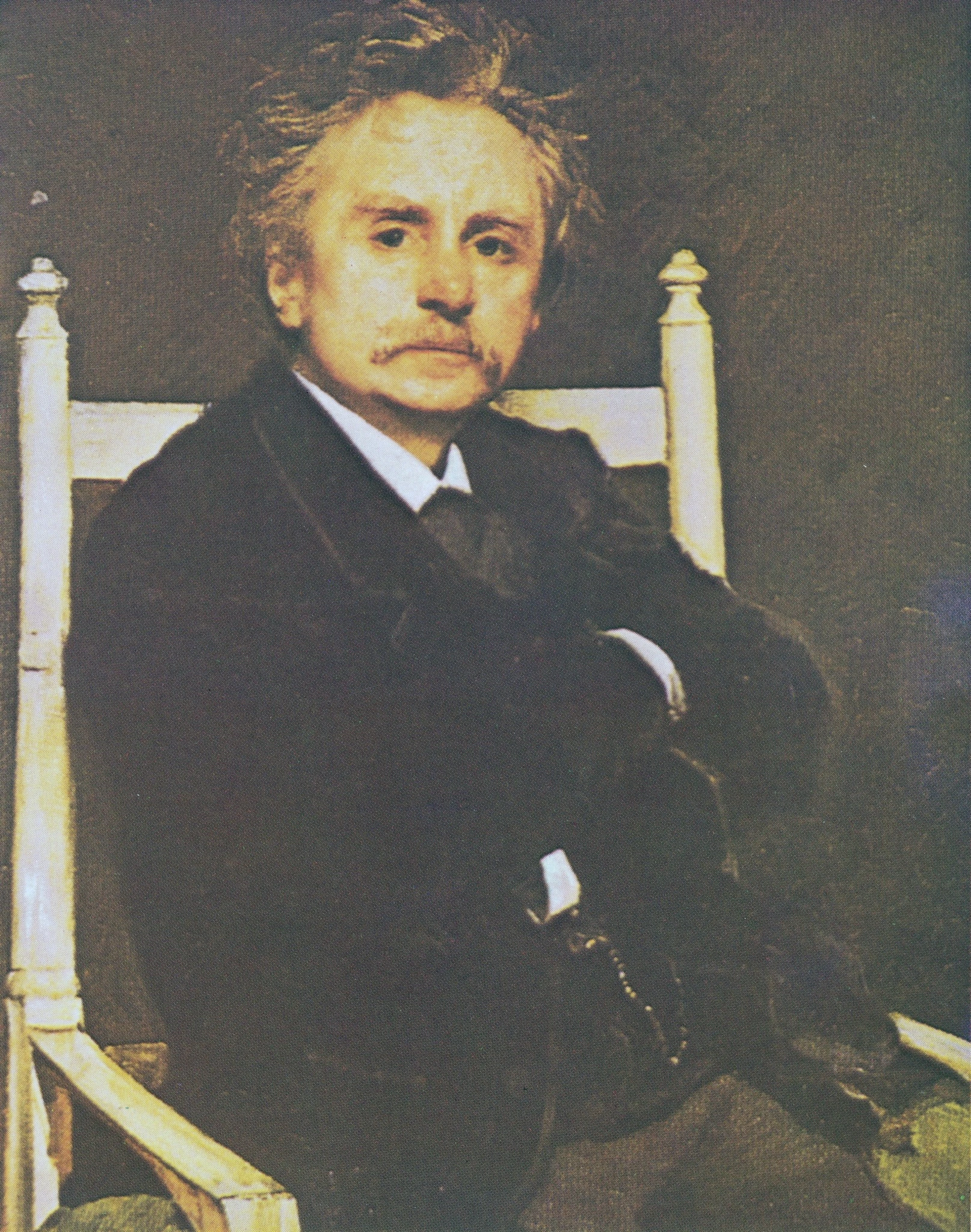
[Edvard Grieg]

Grieg Edvard Hagerup, *15 June 1843 Bergen, †4 September 1907 Bergen, Norwegian composer, conductor, and pianist. Edvard Grieg’s great-grandfather, a Scot, settled in Norway in the second half of the 18th century. His grandfather and father served successively as British consul in Bergen. His mother, Gesine Judith Hagerup, was a well-known pianist in Bergen and an author of poems and plays; his father also played the piano as an amateur. At musical evenings in Grieg’s family home, works by Wolfgang Amadeus Mozart, Ludwig van Beethoven, Carl Maria von Weber, and Frédéric Chopin were performed. At the age of six, Grieg began piano lessons with his mother, and around 1857, he composed his first unpublished piano pieces. In October 1858, at the urging of Ole Bull, he began his musical studies at the Leipzig Conservatory, where he studied piano with Louis Plaidy, Ernst Ferdinand Wenzel, and Ignaz Moscheles, and harmony and counterpoint with Robert Papperitz, Moritz Hauptmann, and Ernst Friedrich Richter, and composition with Carl Reinecke. In 1860, he interrupted his studies due to illness and returned to Norway. On 19 August 1861, on his way back to Leipzig, in Karlshamn (southern Sweden), he gave his first public concert, performing works by Felix Mendelssohn, Ignaz Moscheles, and Robert Schumann, as well as three of his own piano miniatures. In April 1862, he graduated from the conservatory; at a public graduate concert, he played his Vier Klavierstücke Op. 1, and accompanied songs Op. 2, which were published in Leipzig the following year. These were Grieg’s first published works, though not the only ones composed during his studies. After returning to Bergen, Grieg gave his first concert in Norway in May 1862, the programme of which, in addition to his own works (Op. 1, 2, and the Quartet in D minor), also included works by Moscheles, Beethoven, and Schumann. In April 1863, Rückblick was performed in Bergen – Grieg’s first piece for a larger ensemble.
In the spring of 1863, Edvard Grieg moved to Copenhagen, then the cultural centre of Denmark and Norway. He spent two and a half years there; it was one of the most creative periods of his life. In Copenhagen, he encountered Niels Wilhelm Gade and Johan Peter Emilius Hartmann, the most prominent representatives of Danish Romanticism. At Gade’s urging, Grieg began work on his first and only symphony, three movements of which were performed in Copenhagen in 1864. During this time, he met Hans Christian Andersen and composed several songs to his texts (e.g. Op. 5). In November 1864, together with Rikard Nordraak, C.F.E. Horneman, C. Hornbeck, and Gottfred Matthison-Hansen, he organised the “Euterpe” society, whose mission was to promote and perform contemporary Scandinavian music. The first concerts of this society (beginning in 1865) were devoted to the works of Nordraak and Grieg, who, however, withdrew from “Euterpe” in 1867. His friendship with Nordraak was pivotal for Grieg’s subsequent work and activity. Although Grieg had already encountered Norwegian folk music, mainly through Ole Bull, it was only under Nordraak’s influence that he decided to devote himself to creating Norwegian national art. He spent the winter of 1865/66 in Italy, where he met Henrik Ibsen. During this time, he composed the overture I høst in a version for two pianos, which won first prize in a composition competition organised by the Kungliga Musikaliska Akademien in Stockholm. On his way back from Italy, Grieg stopped for several months in Copenhagen; with his friend Matthison-Hansen, Grieg took organ lessons, which he mastered to a level that allowed him to perform occasionally in concert. In 1865 in Copenhagen he met his cousin, Nina Hagerup (*24 November 1845, Bergen, †9 December 1935, Copenhagen), a Norwegian singer, whom he married on 11 June 1867. From then on, most of Grieg’s songs were written with his wife in mind, who performed them with him in joint concerts.
In the autumn of 1866, Edvard Grieg settled in Christiania (now Oslo). Here he met Bjørnstjerne Bjørnson, the eminent Norwegian playwright, with whom he collaborated for many years; he also maintained friendly relations with Norwegian composers Halfdan Kjerulf and Johan Svendsen. Grieg’s first concert as a composer in Christiania took place on 15 October 1866; after this concert, Grieg was hired as conductor of Det Philharmoniske Selskab, a society supporting an amateur symphony orchestra. Christiania was not a culturally active centre at the time. In 1867, seeking to attract regular listeners, Grieg introduced subscription concerts, which, alongside works by Scandinavian composers, featured performances of the most outstanding works of European music (e.g. Wolfgang Amadeus Mozart’s symphonies and Requiem, Ludwig van Beethoven’s Piano Concerto in E-flat major, Felix Mendelssohn’s oratorio Elijah, and excerpts from Richard Wagner’s Lohengrin). In 1871, thanks to Grieg’s efforts, the Musikforeningen was founded in Christiania, a society that had a professional orchestra. Its first concert took place on 2 December 1871, under Grieg’s direction; Grieg remained its conductor, alongside Svendsen, until 1880. At the same time, he continued his concert career as a pianist, performing in Christiania, Copenhagen, and various Swedish cities (1876–77), as well as several times in Leipzig (1878–79). He also taught for several years at the Musikakademie in Christiania, which opened on 14 January 1867, at the initiative of Grieg himself and Otto Winter-Hjelm.
Edvard Grieg’s numerous obligations during the autumn and winter seasons meant that he devoted himself almost exclusively to composing during the several-month summer break in the countryside. This was also when he deepened his knowledge of Norwegian folk music. In the summer of 1868, he wrote the Piano Concerto in A minor, one of his most frequently performed works. During his stays in the Hardanger countryside (from mid-1877 to autumn 1878, and during the summers of the following years), he studied the style and playing of folk fiddlers. In the early 1870s, Grieg and Bjørnstjerne Bjørnson decided to write a national opera based on Old Norwegian legends (Olav Trygvason). In 1873, Bjørnson prepared the text of the first three scenes, for which Grieg immediately wrote the music; despite numerous requests, however, he received no further text, and the project was never realised. In January 1874, Henrik Ibsen asked Grieg to write stage music for his drama Peer Gynt, which he intended to perform in Christiania. He also instructed the composer precisely which scenes should be set to music. In 1875, Grieg completed Peer Gynt. The work was a resounding success, receiving 36 performances within a few months; the stage music later became two orchestral suites, among the composer’s most frequently performed works.
Edvard Grieg travelled abroad twice (1869–70 and 1874) for several months, receiving a stipend from the Norwegian authorities. During his first trip, he visited Franz Liszt in Rome at his invitation. Furthermore, in August 1876, he travelled to Bayreuth to see Der Ring des Nibelungen. He wrote reports of the performances for Bergensposten, the local newspaper in Bergen. In 1883, he travelled to Bayreuth again, this time to see Parsifal. Grieg’s attitude towards Richard Wagner was exceptionally objective and unusual for his era; he was neither an opponent of Wagner nor was he under his spell.
In 1880, Edvard Grieg moved to Bergen, where he served as conductor of the Bergen Harmoniske Selskab musical society for two years. Finally, in 1881, he reached an agreement with C.F. Peters, granting it exclusive rights to publish his works in exchange for a substantial sum of money paid in advance. This allowed the composer to free himself from his regular obligations and devote himself entirely to his creative work. In 1884, he composed two commemorative works (a cantata and a suite) for the festivities in Bergen in December of that year, commemorating the 200th anniversary of the birth of Ludvig Holberg. This resulted in one of Grieg’s most popular works, the Holberg Suite. In the spring of 1885, Grieg moved to his home in Troldhaugen near Bergen, which became his permanent residence from then on. In 1886, he befriended the writer Holger Drachmann. This friendship became the impetus for a return to vocal composition; in the same year, Grieg composed the song cycle Rejseminder Op. 44, with texts by Drachmann. In 1898, Grieg was one of the main organisers of the Norwegian music festival in Bergen. The performances of the Royal Concertgebouw Orchestra, which he had invited, became the impetus for the creation of Norway’s first major symphony orchestra in Christiania the following year, subsidised by the city authorities.
In the 1880s, Edvard Grieg began extensive concert tours, primarily performing his own works, appearing as a pianist, conductor, and accompanist. In addition to regular concerts in Scandinavian countries, he gave concerts in various cities in Germany and the Netherlands for several months in 1883 and 1887; in England in 1887, 1888, and 1889; and in Brussels and Paris in 1889. His international fame reached its peak during this time. Invitations to concerts flooded in from around the world, of which Grieg accepted only a few. After several years of diminished concert activity, he performed in Vienna in 1896 and 1897, and in 1897, he again embarked on a several-month concert tour of England and the Netherlands. Due to the Dreyfus affair, he cancelled his Paris concerts in protest, publishing an open letter justifying this move in the Leipzig press. This letter, reprinted by most European newspapers, caused a considerable sensation and hostility towards Grieg in France. Consequently, his next concerts in that country did not take place until 1903, but even then they were met, alongside enthusiasm from some audiences, with clearly manifested hostility. Grieg maintained a vibrant concert career until the end of his life. Among other events, on 22 April 1902 and 14 and 15 April 1903, concerts of his compositions were held in Warsaw, at which Grieg appeared as both conductor and accompanist. These included performances (in 1902): March from the stage music Op. 22, to Sigurd Jorsalfar, Two Elegiac Melodies Op. 34, Piano Concerto in A minor (T. Carreño), and several songs and minor piano pieces; in 1903: Overture I høst, Op. 11, the Piano Concerto in A minor (R. Pugno), the cantatas Landkjenning and Foran sydens kloster, several songs, and small chamber works. These concerts were very well received by critics and enjoyed great success with audiences. Grieg also performed in Riga (1902), Prague (1903), and other cities. In 1906, he toured the Netherlands, where, among other pieces, he performed his Cello Sonata with P. Casals, and at the turn of 1906/07, he toured England.
Edvard Grieg maintained contacts with many prominent composers of the time, especially J. Brahms, P. Ilyich Tchaikovsky, and M. Reger. Highly regarded as a composer and pianist, he received various honours and recognition. As early as 1872, he was elected a member of the Royal Swedish Academy of Music; in 1873, Oscar II awarded him the title of Knight of St Olav; in 1883, he was elected a corresponding member of the Academy of Music in Leiden; in 1889, he became a member of the Institut de France; in 1893, he received an honorary doctorate from the University of Cambridge (along with C. Saint-Saëns, Tchaikovsky, and A. Boito); in 1896, he was awarded the Legion of Honour; in 1897, he was elected a full member of the Berliner Akademie; and on 22 January 1907, he received an honorary doctorate from the University of Oxford.
Edvard Grieg made his last public appearance on 27 April 1907, conducting a concert in Cologne. Active until the last moment, he died in Bergen, en route to another concert tour in England. He was buried in a rock grotto above the fjord, near his home in Troldhaugen. In 1925, the house was converted into a museum dedicated to Grieg.
Edvard Grieg is the most outstanding Norwegian composer of the 19th century. His work coincides with a period of particularly intense nationalist tendencies in Norwegian literature and art, significantly greater than in other Western European countries. This is linked to the historical situation. In 1814, Norway freed itself from Danish rule, regained a degree of independence, and began to build an independent state and develop its own institutions, seeking to break free from Danish cultural hegemony. Hence, a demand for a distinct national art arose among Norwegian artists. These tendencies were clearly manifested in painting and literature, reaching their peak in the works of B.M. Bjørnson and H. Ibsen, with whom Grieg collaborated. In music, they appeared in the works of H. Kjerulf and R. Nordraak, finding their highest artistic expression in Grieg. Nordraak’s enthusiasm for Norwegian nature, tradition, poetry, and music sparked Grieg’s keen interest in national culture and his conscious pursuit of creating music with a national character. Grieg’s work owes its distinctive character to its connection with national literature, including folk literature (sagas, legends, folk poetry), its references to the work of Norwegian composers, particularly Kjerulf and Nordraak, and, above all, its extensive use of Norwegian musical folklore, which permeates his entire oeuvre.
In his vocal-instrumental works, Grieg drew on Old Norse sagas. The composer drew directly on texts from folk poetry (Den bergtekne Op. 32), folk poetry adapted by Norwegian poets (e.g. Haugtussa Op. 67, Tolv sange Op. 33), or original works by Norwegian poets whose themes were drawn from Norse sagas and legends (e.g. Bergliot Op. 42). This, in turn, influenced the choice of forms – for example, Grieg revived an Old Norse ballad performed by a solo singer and choir (e.g. Den store hvide flok Op. 30 No. 10) – as well as the selection of musical devices that emphasised the national character of the texts. Several stages can be distinguished in Grieg’s exploration of Norwegian folklore and his use of it. Grieg’s early works (Poetiske tonebilleder Op. 3) already incorporate elements of Norwegian folk-dance rhythms (halling, springdans, gangar). The composer drew inspiration from indirect sources, not yet having direct contact with folk music. However, in the Fantasy I høst Op. 11, and the Piano Concerto in A minor, folk dance rhythms are supplemented by a quotation from a folk melody (I høst), and Grieg’s original melody features characteristics borrowed from Norwegian folk melodies: augmented fourths, the so-called “Grieg leitmotif” (falling minor second and major third), and a type of figuration characteristic of the hardingfele, a folk string instrument.
In the late 1860s, Edvard Grieg encountered L. M. Lindeman’s collection of Norwegian folk songs and dances (Ældre og nyere Norske Fjeldmelodier), which played an important role in his work. Almost until the end of his life, Grieg drew melodies from this collection, arranging them for various performing forces (e.g. 25 norske folkeviser og danser Op. 17 for piano, Album for mandssang Op. 30 for male choir and solo voices), or basing his own compositions on these themes (e.g. Ballade in G minor Op. 24, Improvisata Op. 29, Altnorwegische Romanze Op. 51). Grieg used folk material in various ways. In many works, especially his early ones, he essentially limited himself to harmonising the melody, which differed little from Lindeman’s version (e.g. 25 norske folkeviser og danser). Works adapted from folk melodies are somewhat more elaborate than the originals, primarily through the inclusion of a short introduction and coda, yet they generally do not exceed a dozen or so bars. Sometimes the melody undergoes certain modifications, while retaining the rhythm and basic intervallic sequences (e.g. Solveig’s Song from the stage music for the drama Peer Gynt Op. 23 No. 18, is such a modification of melody No. 300 from Lindeman’s collection). Sometimes, Grieg combined several melodies in a single piece or even within a single movement (e.g. in the 4th dance from Symphonic Dances Op. 64).
Edvard Grieg from 1877 began studying the performance techniques of folk singers and instrumentalists playing the hardingfele, and after 1890, together with F. Beyer, J. Röntgen, and J. Halvorsen, he collected and arranged previously unpublished folk melodies. During this period, Grieg utilised not only the melodic and rhythmic patterns of folk songs in his compositions but also their other musical properties. He treated material borrowed from folklore much more freely (e.g. Norske folkeviser Op. 66, Slåtter Op. 72). Sometimes the composer introduced only fragments of folk melodies (Op. 66 No. 1), contrasted a folk melody with an intensely chromatic melody of his own (Op. 66 No. 2), or combined motifs from several melodies, thereby achieving melodic, rhythmic, and agogic variations within a work. Sometimes he expanded a section of a piece by transforming selected motifs or phrases from the original, or added a middle section developed through the transformation of a folk melodic motif (Slåtter Op. 72, Nos. 4, 7). Grieg also imitated the playing styles characteristic of the hardingfele (trills, tremolos, ostinatos of open fifths, sharp unresolved dissonances), thus enriching the sound with a distinctive colour and new harmonic effects. This is particularly characteristic of the Slåtter collection, which contains pieces that freely transfer peasant dances performed on the hardingfele to the piano. Characteristic features of Norwegian folk music were transformed by the composer into his own individual style (chromaticism, free treatment of dissonances, modal instability, pedal notes, ostinatos, sequential writing, phrase repetition, structural symmetry, sharp dotted rhythms, combinations of time signatures, melodic saturation with augmented fourths, and the so-called “Grieg leitmotif”). Norwegian folk music also inspired Grieg’s harmonic explorations, as evidenced by the fact that his folk arrangements are among his most harmonically advanced works. The national character of Grieg’s work was one of the main factors determining the worldwide popularity of his music.
Edvard Grieg was, above all, a lyrical poet. He had a special ability to create and modify moods. Lyrical compositions – solo songs and piano miniatures – constitute a very important area of his work, cultivated throughout his life, and the typical principles of shaping them also appear in other works. During Grieg’s lifetime, 148 of his solo songs were published, including 82 songs set to Norwegian texts, 48 to Danish texts, and only 18 to German texts. This is one of the reasons why, despite their artistic merit, Grieg’s songs are relatively little known and rarely performed outside Scandinavia. Grieg placed great importance on the text; according to the composer’s own words, his primary goal in songs was to convey the poet’s intentions. Grieg’s songs are characterised by a perfect harmony of structure, intonation, rhythm, and verbal and musical accents, which is difficult to maintain in translation; this applies especially to songs with texts in the regional dialect of Landsmål (Tolv sange Op. 33; Haugtussa Op. 67).
Edvard Grieg’s songs are characterised by a balance between vocal line and accompaniment, sometimes with a slight predominance of the vocal part. Sometimes the accompaniment merely doubles the melodic line and provides its harmonic foundation, but more often it emphasises the song’s mood primarily through rich harmony, appropriate use of registers, forms of movement, and the use of tremolos, arpeggios, and so on. In his later songs, especially those set to texts by Benzon, (Op. 69, 70), the accompaniment is more elaborate, and its texture approaches orchestral writing. Grieg’s songs can be divided into three groups in terms of structure: strophic, strophic with variation technique, and recomposed. The first two groups clearly predominate. Strophic forms are characteristic primarily of songs set to texts by Arne Garborg and Aasmund Olavsson Vinje (Op. 33 and 67), which originate from folk poetry. Here, the strophic form becomes one of the stylistic elements. The song structure is dominated by symmetry in four-bar sections and is characterised by the repetition of phrases, often in variation form, and the sequential development of phrases and motifs, leading to a motivic uniformity that also occurs in recomposed songs despite contrasts in tempo and expression (e.g. Efteraarsstormen Op. 18 No. 4). Motivic affinities can also be observed between songs within certain cycles (Haugtussa). Grieg’s songs are characterised by a wide range of expression, from deep and serious (Den saerde, Langs ei å Op. 33) to dazzling liveliness and humour (Og jeg vil ha mig en hjertenskjaer Op. 60). Among the later songs, some exhibit impressionistic qualities. These are manifested in the recitative treatment of the voice with a dominant sonorous accompaniment (Lys nat Op. 70). The songs set to Norwegian texts are characterised by a high concentration of expression and an economy of means, unlike the songs set to Danish texts. In the latter, especially in some songs from Op. 70, there are also concert-hall characteristics and operatic elements (Digtervise Op. 70). Grieg set six of his most popular songs to orchestral accompaniment.
Edvard Grieg’s piano works, constituting the composer’s most personal expression, occupy a central place in his oeuvre. Miniatures predominate, the most popular of which are the Lyrische Stücke (Lyric Pieces), published in ten volumes. They are written in variously modified ABA or ABABA forms and are characterised by periodic structure, symmetry, simple piano texture, melodiousness, and considerable melodic inventiveness. In addition to these, Grieg composed a number of other cycles of piano miniatures, all characterised by similar structures. Among the miniatures, Slåtter stands out for its innovative harmonies, highly transparent, linear texture, and occasionally percussive treatment of the piano, and Stimmungen for its depth and variety of moods.
In addition to miniatures, Edvard Grieg composed several larger piano pieces, which treat the instrument in a more virtuosic manner. Variation forms dominate these. The most important of these is the Ballade in G minor, composed of 14 variations, distinctly different in their piano textures, drawing on Chopin’s Ballade in G minor (variation 5 – Piu lento) and Schumann’s Andante and Variations in B flat major (variation 9 – Un poco andante). The treatment of dynamics in this piece (the use of all possible piano shades, the inverse proportions of sound volume and intensity) brings Grieg closer to the Impressionists. Grieg’s only piano sonata (in E minor), written in his youth, displays connections with works by Danish composers (the first theme, developed canonically, is similar to the first theme of Gade’s Sonata in E minor, which also employs canonic technique, and the third movement bears a striking resemblance to J.P.E. Hartmann’s piano piece Vikingefruens Drøm, published a year before Grieg composed his sonata). Grieg explored sonata form primarily in chamber music. In the 1860s and 1870s, the composer worked intensively on mastering this form, but his sonatas lacked developmental strength, as the lyrical, often short and closed themes did not provide suitable material for thematic development. Grieg transformed themes, primarily modifying their sound and rhythm. He also introduced new themes, which is why his early sonata works are close to the fantasy type. Grieg’s most important chamber piece, the Quartet in G minor, is an attempt to break with the classical quartet style. It is based on the song Spillemaend (Op. 25 No. 1), whose motivic material forms the basis of the themes for all movements. This contributes to the work’s substantial unity. The piece is static in nature, and the fundamental shaping lies in the different timbral contrasts between the instruments. This treatment of form, along with the developed harmony and weakened functional gravitation between chords, anticipated Claude Debussy’s Quartet in G minor by 15 years. Grieg’s Quartet in G minor is one of the most outstanding Norwegian chamber works.
Edvard Grieg’s orchestral works are of much lesser importance. Within this group, only the youthful Concerto in A minor and Symphony in C minor are original works. In its melodic, rhythmic, and sonorous style, the Concerto approaches a virtuoso fantasy. The symphony, written at Gade’s urging, was marked “never to be performed” by the composer himself after its performance in Bergen, and was also never published; Grieg arranged two of its movements for piano four hands (Op. 14). The remaining orchestral works are adaptations of other Grieg works (often miniatures), made in connection with his conducting career. This type of composition includes the popular Holberg Suite, a stylisation of 18th-century dances. Adapting his own works for various performance mediums was a characteristic feature of Grieg’s creative process. Most of his works exist in versions for different ensembles, and these versions are often completely identical melodically, rhythmically, and harmonically. This indicates that, unlike most Romantic composers, Grieg’s performance practice was secondary to his compositional process. Reworkings of his own works often bore different titles and opus numbers.
Edvard Grieg’s choral works are also linked to his conducting career; some are occasional pieces. Many are ballads. Grieg’s stage work was connected to the theatrical situation in Christiania at the time; Norwegian theatre – a relatively young institution at the time – only performed plays with musical accompaniment to attract a still unsophisticated audience. At the request of B. Bjørnson and H. Ibsen, stage music was composed for the dramas Sigurd Jorsalfar and Peer Gynt, which covers only selected scenes, effectively constituting a collection of short pieces. Of the music for Peer Gynt, which has been repeatedly reworked and supplemented, the most popular is Orchestral Suite No. 1.
From the perspective of European music, Edvard Grieg’s achievements in harmony are most important. The composer was particularly sensitive to timbral qualities, his harmony evolving from a functional, highly chromatic approach toward a sonority typical of the Impressionists. Even his early works are characterised by tonal ambiguity, frequent ninth and seventh chords, pedal notes, clusters of dissonant sounds in the low register (Humoresker Op. 6), and modal elements (Sørgemarsj over Rikard Nordraak). In the late 1870s, Impressionist traits in Grieg’s harmony intensified. The functional relationships between chords became increasingly loose (G minor Quartet), freely treated dissonances were exposed (Slåtter Op. 72 No. 11), leading tones appeared rarely, dominant relationships were replaced by parallel movements (Slåtter Nos. 4 and 7), modal turns, chord progressions (Symphonische Tänze), and even series of functionally unrelated chords shifted along the scale (Bergliot) occur, much like later at the beginning of Claude Debussy’s Danseuses de Delphes. Seventh and ninth chords are expanded to eleventh chords and thirteenth chords (Tolv sange Op. 33; Valse mélancolique Op. 68 No. 6). Long, receding sonorities appear, weakening the functional effect (G minor Quartet), as do static structures built from superimposed fifths (An den Frühling Op. 43 No. 6). Impressionistic traits are most fully revealed in Grieg’s harmonies in Norske folkeviser and in Haugtussa songs, but Grieg’s harmony never became fully Impressionistic. Grieg’s final works (Slåtter, Fire salmer Op. 74) marked a shift towards linearity.
Edvard Grieg played a major role in the development of Norwegian musical culture as an organiser, conductor, teacher, and, above all, composer. During his regular work as a conductor in Christiania and Bergen, he introduced many outstanding works of European music to Norwegian concert halls. He contributed to the establishment of Norway’s first music academy and the first professional symphony orchestra, and supported the development of Norwegian music by organising festivals dedicated to it. His work influenced not only the next generation of Norwegian composers but also all of Scandinavian music (J. Sibelius, C. Nielsen, J.G.E. Sjögren, O.W. Peterson-Berger), providing a starting point and impetus for composers whose subsequent development took a different direction.
Literature: Ø. Gaukstad Edvard Grieg. 1843–1943: en bibliografi, “Norsk Musikkgranskning” 1942; Edvard Grieg, Bergen 1962 (catalogue of an exhibition containing letters and other documents); D. Fog En fortegnelse over Edvard Griegs trykte kompositioner, Copenhagen 1980; Breve fra Grieg. Et udvalg, ed. G. Hauch, Copenhagen 1922; Breve fra Edvard Grieg til Frants Beyer 1872–1907, ed. M. Beyer, Christiania 1923; Edvard Grieg. Briefe an die Verleger der Edition Peters 1866–1907, ed. E. von Zschinsky-Troxler, Leipzig 1932; Ø. Anker Grieg-brev i Universitetsbiblioteket Oslo, “Norsk Musikkgranskning” 1937 (contains an incomplete list of Grieg’s articles in daily Norwegian press); Ø. Anker Knut Dale – Edvard Grieg – Johan Halvorsen. En brevveksling, “Norsk Musikkgranskning” 1947; J. Foerster Edvard Hagerup Grieg, Prague 1890; E. Closson E. Grieg et la musique scandinave, Paris 1892; L. Monastier-Schroeder Edvard Grieg, Lausanne 1897; P.A. van Westrhene Edvard Grieg, Haarlem 1897; G. Schjelderup Edvard Grieg og hans vaerker, Copenhagen 1903; H.T. Finck Edvard Grieg, New York 1905, 2nd extended ed. Grieg and his Music, New York 1909, reprint 1929; E.M. Lee Edvard Grieg, London 1908; G. Schjelderup, W. Niemann Edvard Grieg. Biographie und Würdigung seiner Werke, Leipzig 1908; E. Haraszti Das Nationalelement in Griegs Musik, Budapest 1911; R.H. Stein Grieg. Eine Biographie, Berlin 1921; P. de Stoecklin Grieg, Paris 1926; J. Röntgen Grieg, Hague 1930; G. Schjelderup Edvard Grieg und sein Einfluss auf die Entwicklung der Musik, “Die Musik” 1931–32 no. 24; J. Freiheiter O harmonice Edvarda Griega, “Kwartalnik Muzyczny” 1932, book 16; Y. Rokseth Grieg, Paris 1933; D. Monrad-Johansen Edvard Grieg, Oslo 1934, 3rd ed. 1956, English transl. 1938, reprint 1948; W. Muzalewski Edvard Grieg, Leningrad 1935; K. von Fischer Griegs Harmonik und die nordländische Folklore, Berno 1938; K.G. Fellerer Edvard Grieg, Potsdam 1942; A. Bakke Edvard Grieg, Berno 1943; Edvard Grieg 1843–15 juni 1943. Til hundre-årsdagen for hans fødsel, collective work, Bergen 1943; F.H. Törnblom Grieg, Stockholm 1943; H.J. Ustvedt Edvard Grieg. Tonedikteren, nordmanen, demokraten, Stockholm 1943; K. Dale Edvard Grieg’s Pianoforte Music, “Music and Letters” XXIV, 1943; L.A. Day Grieg, New York 1945; A.E. Cherbuliez Edvard Grieg. Leben und Werk, Zurich 1947; G. Grieg Cederblad Sangen om Norge. Edvard Grieg og hans samtid, Oslo 1948; Grieg, A Symposium, ed. G. Abraham, London 1948; D. Schjelderup-Ebbe A Study of Grieg’s Harmony. With Special Reference to his Contributions to Musical Impressionism, Oslo 1953; S. Jordan Edvard Grieg. En oversikt over hans liv og verker, Bergen 1954, suppl. 1959; O. E. Lewaszowa Edvard Grieg, Moscow 1957; J.A. Kremlev Edvard Grieg. Ocherk zhizni i tvorchestva, Moscow 1958; H.J. Hurum I Edvard Griegs verden, Oslo 1959; O.E. Levashova Edvard Grieg. Ocherk zhizni i tvorchestva, Moscow 1962; E. Muradova Romansy i pesni Edvarda Griega, Baku 1962; E. Dolinescu Edvard Grieg, Bucharest 1964; D. Schjelderup-Ebbe Edvard Grieg, 1858–1867. With Special Reference to the Evolution of his Harmonic Style, Oslo 1964; B. Kortsen Grieg’s String Quartet and R. Heckmann, “Music and Letters” XLIX, 1968; B. Kortsen Four Unknown Cantatas by Grieg, Bergen 1972; J. Horton Grieg, London 1974; F. Benestad, D. Schjelderup-Ebbe Edvard Grieg. Mennesket og Kunstneren, Oslo 1980.
Compositions:
Podstawę do sporządzenia wykazu twórczości Griega stanowił opracowany przez D. Foga katalog tematyczny dzieł Griega oraz wydanie E. Griega Samlede Verker, w którym zastosowano uwspółcześnioną wersję zapisu tytułów kompozycji.
Instrumental:
for piano:
Lavvigspolka for piano, 1858?, autograph in Offentlige Bibliotek, Bergen
23 småstykker for piano, 1858–59, autograph in Offentlige Bibliotek, Bergen
Tre klaverstykker for piano, 1860, autograph in Offentlige Bibliotek, Bergen
Vier Klavierstücke op. 1 for piano, 1861, published in Leipzig 1863 Peters, autograph in Offentlige Bibliotek, Bergen
Poetiske tonebilleder (‘Poetic Tone-Pictures’) op. 3 for piano, 1863, published in Copenhagen 1864
Horneman, autograph in Offentlige Bibliotek, Bergen
Deux pièces symphoniques op. 14 for piano for 4 hands, 1864, published in Copenhagen 1869 Horneman & Erslev, Adagio and Scherzo from Symphony in C minor, autograph in Offentlige Bibliotek, Bergen
[4] Humoresker op. 6 for piano, 1865, published in Copenhagen 1865 Horneman & Erslev, Leipzig 1866 Peters, autograph in Offentlige Bibliotek, Bergen: 1. Tempo di valse, 2. Tempo di minuetto ed energico, 3. Allegretto con grazia, 4. Allegro alla burla
Sonata in E minor op. 7 for piano, 1865, published in Leipzig 1866 B&H, revised ed. Leipzig 1887 Peters, autograph in Offentlige Bibliotek, Bergen
Agitato for piano, 1865, autograph in Offentlige Bibliotek, Bergen
I höst (In Autumn) op. 11, fantasia for piano for 4 hands, 1866, published in Stockholm 1867 A. Hirsch, based on Efteraarsstormen op. 18 no. 4, later revised for orchestra (with German title), autograph in Offentlige Bibliotek, Bergen
Sørgemarsj over Rikard Nordraak in A minor (Funeral March in Memory of Rikard Nordraak) for piano, 1866, published in Copenhagen 1866 Horneman, revised for orchestra, autograph in Offentlige Bibliotek, Bergen
Lyriske småstykker (Lyric Pieces) op. 12 for piano, published in Copenhagen 1867 Horneman, autograph in Offentlige Bibliotek, Bergen: 1. Arietta, 2. Vals, 3. Vaegtersang (Watchman’s Song), 4. Elverdans (Fairy Dance), 5. Folkevise, 6. Norsk, 7. Stambogsblad, 1864?, also as Albumblad in “Musikalsk museum” XX, 1865 book 2 (Copenhagen), 8. Faedrelandssang, 1867
25 norske folkeviser og dandse (‘25 Norwegian Folk Melodies and Dances’) op. 17 for piano, 1869, published in Bergen 1870 C. Rabe, W. Harloff, no. 22 and 18 arranged for string orchestra as op. 63, no. 23 and 24 used in Symphonische Tänze op. 64 no. 4, autograph in Offentlige Bibliotek, Bergen: 1. Springdans, 2. Ungersvennen, 3. Springdans, 4. Nils Tallefjorden, 5. Jølstring, 6. Brurelåt, 7. Halling, 8. Grisen, 9. Når mitt øje, 10. Friervise, 11. Kjempevise, 12. Solfager og ormekongen, 13. Reiselåt, 14. Jeg sjunger med sorrigfullt hjerte, 15. Den sidste lørdagskvelden, 16. Eg veit ei lita jente, 17. Kleggen og fluga, 18. Stabbelåten, 19. Hølje Dale, 20. Halling, 21. Saebygga, 22. Kulokk, 23. Såg du nokke kjeringa mi, 24. Brurelåt, 25. Rabnabryllup I Kraakalund
Folkelivsbilleder op. 19 for piano, 1871, published in Copenhagen 1872 Horneman & Erslev, no. 2 published also for 4 hands in Leipzig 1893 Peters, Copenhagen 1893 W. Hansen, no. 2 orchestrated by J. Halvorsen used in Peer Gynt op. 23 no. 2, autograph in Offentlige Bibliotek, Bergen: 1. Fjeldslåt, 2. Brudefølget drager forbi, 3. Fra karnevalet
Norges melodier for piano, 1875, piece revised, 1886, published in the collection Norges melodier, Copenhagen 1875 E. Wagner (42 melodies arranged by various authors), published independently Sex norske fjeldmelodier, Copenhagen 1886 W. Hansen, autograph in Offentlige Bibliotek, Bergen: 1. Springdans fra Nummedal, 2. Baadnlaat, 3. Springdans fra Vinje, 4. Sjugurd og trollbrura, 5. Halling fra Østerdalen, 6. Guten og gjenta paa Fjøshjellen
Ballad in G minor op. 24 for piano, 1876, published in Leipzig 1876 Peters, autograph in Offentlige Bibliotek, Bergen
Fire albumblade op. 28 for piano, ed. Christiania 1878 C. Warmuth, autograph in Offentlige Bibliotek, Bergen: 1. Allegro con moto, 1864, 2. Allegretto espressivo, 1874, 3. Vivace, 1876, 4. Andantino serioso, 1878
Improvisata over 2 norske folkeviser op. 29 for piano, 1878, ed. Christiania 1878 C. Warmuth, Leipzig 1879 Peters, autograph in Offentlige Bibliotek, Bergen: 1. Andante, 2. Allegretto con moto
[4] Norwegische Tänze op. 35 for piano for 4 hands, 1880, published in Leipzig 1881 Peters, autograph in Offentlige Bibliotek, Bergen: 1. Allegro marcato, 2. Allegretto tranquillo, 3. Allegro moderato alla marcia, 4. Allegro molto-presto con brio; also for piano for 2 hands, published in Leipzig 1887 Peters, autograph in Offentlige Bibliotek, Bergen
[2] Walzer-Capricen op. 37 for piano for 4 hands, 1883, published in Leipzig 1883 Peters, autograph in Offentlige Bibliotek, Bergen; also for piano for 2 hands, published in Leipzig 1887 Peters, autograph in Offentlige Bibliotek, Bergen
Neue lyrische Stücke op. 38 for piano, published in Leipzig 1883 Peters, autograph in Offentlige Bibliotek, Bergen: 1. Berceuse, 1883, 2. Volksweise, 1883?, 3. Melodie, 4. Halling, 1883, 5. Springtanz, 1883?, 6. Elegie, 1883, 7. Walzer, 1866, adaptation, 1883, 8. Canon, 1883
Fra Holbergs tid op. 40, suite for piano, 1884, published in Leipzig 1885 Peters, Copenhagen 1885 W. Hansen, adaptation for string orchestra, autograph in Offentlige Bibliotek, Bergen: 1. Praeludium, 2. Sarabande, 3. Gavotte, 4. Air, 5. Rigaudon
Klavierstücke nach eigenen Liedern op. 41 for piano, 1884, published in Leipzig 1885 Peters, Copenhagen 1885 W. Hansen, arrangement of following songs for voice solo and piano: op. 9 no. 2, op. 15 no. 1, op. 5 no. 3, op. 18 no. 2, songs with no op. from 1871, op. 21 no. 3, autograph in Offentlige Bibliotek, Bergen: 1. Wiegenlied, 2. Klein Haakon, 3. Ich liebe dich, 4. Sie ist so weiss, 5. Prinsessen, 6. An den Lenz
Lyrische Stücke op. 43 for piano, 1886, published in Leipzig 1886 Peters, autograph in Offentlige Bibliotek, Bergen: 1. Schmetterling, 2. Einsamer Wanderer, 3. In der Heimat, 4. Vöglein, 5. Erotik, 6. An den Frühling
Lyrische Stücke op. 47 for piano, 1886–88, published in Leipzig 1888 Peters, Springdans in “Nordisk Musik Tidende” VI, 1885 no. 1, (Christiania), autograph in Offentlige Bibliotek, Bergen: 1. Valse-Impromptu, 2. Albumblatt, 3. Melodie, 4. Halling, 5. Melancholie, 6. Springdans, 7. Elegie
Altnorwegische Romanze mit Variationen op. 51 for 2 pianos, 1890, published in Leipzig 1890 Peters, orchestrated in 1900, autograph in Offentlige Bibliotek, Bergen
Klavierstücke nach eigenen Liedern op. 52 for piano, 1890, published in Leipzig 1890 Peters, arrangement of the following songs for voice solo and piano: op. 15 no. 4, op. 21 no. 1, op. 5 no. 2, op. 23 no. 18, op. 15 no. 2, op. 33 no. 7, autograph in Offentlige Bibliotek, Bergen: 1. Mutterschmerz, 2. Erstes Begegnen, 3. Das Dichters Herz, 4. Solvejgs Lied, 5. Liebe, 6. Die alte Mutter
Lyrische Stücke op. 54 for piano, 1891, published in Leipzig 1891 Peters, no. 1–4 in version for orchestra (1904) titled Lyrische Suite, Leipzig 1905 Peters, autograph in Offentlige Bibliotek, Bergen: 1. Gjaertergut, 2. Gangar, 3. Troldtog, 4. Notturno, 5. Scherzo, 6. Klokkeklang
Lyrische Stücke op. 57 for piano, 1893, published in Leipzig 1893 Peters, autograph in Offentlige Bibliotek, Bergen: 1. Svunne dager (Entschwundene), 2. Gade, 3. Illusjon, 4. Hemmelighet (Geheimnis), 5. Hun danser (Sie tanzt), 6. Hjemve (Heimweh)
Lyrische Stücke op. 62 for piano, 1895, published in Leipzig 1895 Peters, autograph in Offentlige Bibliotek, Bergen: 1. Sylfide, 2. Tak, 3. Fransk serenade, 4. Baekken, 5. Drömmesyn, 6. Hjemad
Lyrische Stücke op. 65 for piano, 1896, published in Leipzig 1897 Peters, autograph in Offentlige Bibliotek, Bergen: 1. Fra ungdomsdagene (Aus jungen Tagen), 2. Bondens sang (Lied des Bauers), 3. Tungsinn (Schwermuth), 4. Salong (Salon), 5. I balladetone (Im Balladenton), 6. Bryllupsdag på Troldhaugen (Hochzeitstag auf Troldhaugen), also for 4 hands, published in Leipzig 1897 Peters
Norske folkeviser op. 66 for piano, 1896, published in Leipzig 1897 Peters, autograph in Offentlige Bibliotek, Bergen: 1. I Kulok, 2. Del er den störste dårlighet, 3. En konge hersket i Østerland, 4. Siri Dale-visen, 5. Det var i min ungdom, 6. Lokk og bådnlåt, 7. Bådnlåt, 8. Lokk, 9. Liten va guten, 10. Morgo ska du få gifte deg, 11. Der Stander to piger, 12. Ranveig, 13. En liten grå mann, 14. I Ole-dalom, i Ola-kjönn, 15. Bådnlåt, 16. Ho vesle Kari var, 17. Bådnlåt, 18. Jeg gaar i tusen tanker, 19. Gjendines bådnlåt
[4] Symphonische Tänze for piano for 4 hands, 1897, published in Leipzig 1897 Peters, piano works op. 17 no. 23 and 24 were used in the 4th dance, autograph in Offentlige Bibliotek, Bergen
Drei Klavierstücke for piano, published in Leipzig 1908 Peters, autograph in Offentlige Bibliotek, Bergen: 1. Hvide skyer, 1891, 2. Tusselslåt, 1898, 3. Dansen går, 1898
Lyrische Stücke op. 68 for piano, 1898–99, published in Leipzig 1899 Peters, no. 4 and 5 in a version for orchestra as Zwei Lyrische Stücke, published in Leipzig 1900 Peters, autograph in Offentlige Bibliotek, Bergen: 1. Matrosenes oppsang, 2. Bestemors menuett, 3. For dine fötter, 4. Aften på höyfjellet, 5. Bådnlåt, 6. Valse mélancolique
Lyrische Stücke op. 71 for piano, 1901, published in Leipzig 1901 Peters, autograph in Offentlige Bibliotek, Bergen: 1. Det var engang, 2. Sommeraften, 3. Småtroll, 4. Skogstillhet, 5. Halling, 6. Forbi, 7. Efterklang
Slåtter op. 72 for piano, 1902–03, published in Leipzig 1903 Peters, autograph in Offentlige Bibliotek, Bergen: 1. Gibøens bruremarsj (Gibøens Brautmarsch), 2. Jon Vaestafes springdans, 3. Bruremarsj fra Telemark (Brautmarsch aus Telemark), 4. Haugelåt. Halling (Halling aus dem Hügel), 5. Prillaren fra Os prestegjeld. Springdans (Der Prillar aus dem Kirchenspiel Os. Springdans), 6. Gangar etter Myllarguten (Myllargutens Gangar), 7. Røtnams-Knut-Halling, 8. Bruremarsj (Brautmarsch), 9. Niels Rekves halling, 10. Knut Luråsens halling I, 11. Knut Luråsens halling II, 12. Springdans, 13. Håvard Gibøens draum ved Oterholtsbrua. Springdans (Havard Gibøens Traum an der Oterholtsbrücke. Springdans), 14. Tussebrurefaerda på Vossevangen. Gangar (Die Brautfahrt der Unterirdischen auf Vossewangen. Gangar), 15. Skuldalsbrura. Gangar (Die Skuldalsbraut. Gangar), 16. Kivlemöyerne. Springdans (Die Mädchen aus dem Kivledal. Springdans), 17. Kivlemöyerne. Gangar (Die Mädchen aus dem Kivledal. Gangar)
Stimmungen op. 73 for piano, 1901–05, published in Leipzig 1905 Peters, autograph in Offentlige Bibliotek, Bergen: 1. Resignation, 2. Scherzo-Impromptu, 3. Natligt ridt, 4. Folketone, 5. Studie (Hommage à Chopin), 6. Studenternes serenade, 7. Lualåt
chamber:
String Quartet in D minor, 1861, premiere Bergen 21 May 1862, lost
Fugue in F minor for string quartet, 1861, published in «Edvard Grieg. Samlede Verker» IX, Frankfurt am Main 1978 Peters, autograph in Offentlige Bibliotek, Bergen
Sonata in F major for violin and piano no. 1 op. 8, 1865, premiere Leipzig November 1865, published in Leipzig 1865 Peters, autograph in Offentlige Bibliotek, Bergen
Sonata in G major for violin and piano no. 2 op. 13, 1867, premiere Christiania 16 November 1867, published in Leipzig 1871 B&H, autograph in Offentlige Bibliotek, Bergen
Intermezzo in A minor for cello and piano, 1866?, published in «Edvard Grieg. Samlede Verker» VIII, Frankfurt am Menem 1979 Peters, autograph in Offentlige Bibliotek, Bergen
String Quartet in G minor op. 27, 1878, premiere Cologne 29 October 1878, published in Leipzig 1879 Fritzsch, autograph in Offentlige Bibliotek, Bergen
Andante con moto in C minor for violin, cello and piano, 1878, premiere Copenhagen 22 January 1908, published in «Edvard Grieg. Samlede Verker» VIII, Frankfurt am Menem 1979 Peters, autograph in Offentlige Bibliotek, Bergen
Sonata in A minor for cello and piano op. 36, 1883, premiere Dresden 22 October 1883, published in Leipzig 1883 Peters, autograph in Offentlige Bibliotek, Bergen
Sonata in C minor for violin and piano, no. 3 op. 45, 1886–87?, premiere Leipzig 10 December 1887, published in Leipzig 1887 Peters, autograph in Offentlige Bibliotek, Bergen
String Quartet in F major, part 1 and 2 as well as fragments of part 3 and 4, 1891, premiere Copenhagen 22 January 1908, published in Leipzig 1908 Peters, autograph in Offentlige Bibliotek, Bergen
for orchestra:
Symphony in C minor, 1864, premiere Copenhagen 4 June 1864 (3 parts), Bergen 1 January 1867 (all), autograph in Offentlige Bibliotek, Bergen, Adagio and Scherzo arranged for piano for 4 hands as op. 14, autograph in Offentlige Bibliotek, Bergen
Piano Concerto in A minor op. 16, 1868, premiere Copenhagen 3 April 1869, published in Leipzig 1872 Fritzsch, autograph in Offentlige Bibliotek, Bergen
Sørgemarsj over Rikard Nordraak for orchestra, 1867, arrangement of a piano piece with the same title; 2nd version, 1878, published in Leipzig 1899 Peters, autograph in Offentlige Bibliotek, Bergen
Zwei elegische Melodien for string orchestra op. 34, 1880, premiere Bergen 3 October 1880, published in Leipzig 1881 Peters, for piano and for piano for 4 hands, Leipzig 1887 Peters, arrangement of songs op. 33 no. 3 and no. 2, autograph in Offentlige Bibliotek, Bergen
Fra Holbergs tid, suite for orchestra, op. [40], 1885, premiere Bergen 13 March 1885, published in Leipzig 1885 Peters, orchestra version of a piano work op. 40, autograph in Offentlige Bibliotek, Bergen
Im Herbst op. 11, concert overture, 1887, premiere Birmingham 29 August 1888, published in Leipzig 1888 Peters, orchestra version of a piano fantasia I höst op. 11, autograph in Offentlige Bibliotek, Bergen
Peer Gynt op. 46, suite no. 1 for orchestra, 1888, published in Leipzig 1888 Peters, for piano, 1888, for piano for 4 hands, Leipzig 1888 Peters, Copenhagen 1892 W. Hansen, no. 13, 12, 16, 7 from scenic music for drama Peer Gynt op. 23, autograph in Offentlige Bibliotek, Bergen
Zwei Melodien for string orchestra op. 53, 1890, premiere Christiania 18 October 1890, published in Leipzig 1891 Peters, for piano, Leipzig 1891 Peters, arrangement of songs from op. 33 no. 12 and op. 21 no. 1, autograph in Offentlige Bibliotek, Bergen
Peer Gynt op. 55, suite no. 2 for orchestra, 1892, published in Leipzig 1893 Peters, for piano and for piano for 4 hands, Copenhagen 1893 W. Hansen, Leipzig 1893 Peters, no. 4, 15, 19, 18 from scenic music for drama Peer Gynt op. 23, autograph in Offentlige Bibliotek, Bergen
Drei Orchesterstücke aus Sigurd Jorsalfar op. 56, 1892, premiere Christiania 5 November 1892, published in Leipzig 1893 Peters, for piano and for piano for 4 hands, Leipzig 1893 Peters, no. 1 for violin and piano, Leipzig 1898 Peters, arrangement no. 1, 2, 4 from scenic music for drama Sigurd Jorsalfar op. 22, autograph in Offentlige Bibliotek, Bergen
Zwei nordische Weisen for string orchestra op. 63, 1895, premiere Christiania 12 October 1895 (only no. 1), published in Leipzig 1896 Peters, for piano and for piano for 4 hands, Leipzig 1896 Peters, no. 1 based on a melody composed by F. Due, no. 2 arrangement of a piano work op. 17 no. 22 and no. 18, autograph in Offentlige Bibliotek, Bergen
4 Symphonische Tänze op. 64, 1896–98, premiere Bergen 1898, published in Leipzig 1898 Peters, orchestra version of a piano work with the same title, autograph in Offentlige Bibliotek, Bergen
vocal:
for unaccompanied male choir:
Fire sange for mandsstemmer, words by H. Wergeland, C. Richardt, A. Munch, 1863, autograph in Offentlige Bibliotek, Bergen
Aftenstemning na chór męski, words by J. Moe, 1867, in: Samling af flerstemmige mandskorsange, ed. J.D. Behrens, vol. 5 no. 454, Christiania 1868, autograph in Offentlige Bibliotek, Bergen
Sjømandssang for male choir, words by B.M. Bjørnson, 1870, in: Samling af flerstemmige mandskorsange, ed. J.D. Behrens, vol. 6 no. 15, Christiania 1870, autograph in Offentlige Bibliotek, Bergen
Landkjenning op. 31, cantata for baritone and male choir, words by B.M. Bjørnson, 1872, in: Sangbok for mandssangforeninger, ed. J.D. Behrens, vol. 6 no. 55, Christiania 1872, autograph in Offentlige Bibliotek, Bergen; 2nd version for baritone and male choir with orchestra and organ ad libitum, 1881, published in Leipzig 1881 Peters, autograph in Offentlige Bibliotek, Bergen
Ved Weldhavens baare for male choir, words by J. Moe, 1873, in: Samling af flerstemmige mandskorsange, ed. J.D. Behrens, vol. 7 no. 8, Christiania 1876, autograph in Offentlige Bibliotek, Bergen
Opsang til frihedsfolket i Norden, words by B.M. Bjørnson, 1874, in: “Danske Folketidende” 1874 no. 30 (Copenhagen), autograph in Offentlige Bibliotek, Bergen
Ved Halfdan Kjerulfsmindestøtte, cantata for tenor and male voices, words by A. Munch, 1874, in: Sangbok for mandssangforeninger, ed. J.D. Behrens, vol. 6 no. 73–74, Christiania 1874, autograph in Offentlige Bibliotek, Bergen
Album for mandssang op. 30 for male choir and solo voices, words of no. 8 and 9 by H.D. Brorson, 1877–78, ed. Christiania 1878 Warmuth, arrangement of Norwegian folk songs from the collection Aeldre og nyere Norsk fjeldmelodier by L.M. Lindeman, autograph in Offentlige Bibliotek, Bergen: 1. Jeg lagde mig så sildig, 2. Bådnlåt, 3. Torö liti, 4. Kvålins hailing, 5. Dae ae den störste dårlighet, 6. Springdans, 7. Han Ole, 8. Halling, 9. Dejligste blandt kvinder, 10. Den store, hvide fiok, 11. Fanteguten, 12. Rötnams knut
Min dejligste tanke for unaccompanied male choir, words by O. Lofthus, 1881, in: Kor- og kvartet sangbok, ed. J.D. Behrens, vol. 8 no. 4, Christiania 1882, autograph in Offentlige Bibliotek, Bergen
Vort Løsen for unaccompanied male choir, words by O. Lofthus, 1881, in: Kor- og kvartet sangbok, ed. J.D. Behrens, vol. 8 no. 19, autograph in Offentlige Bibliotek, Bergen
Sangerhilsen for unaccompanied male choir, words by S. Skavlan, 1883, in: Firstemmig mands-sangbok, ed. J.D. Behrens, vol. 7 no. 97, Christiania 1883, autograph in Offentlige Bibliotek, Bergen
Kantate ved Halbergmonumentets afsløring for baritone and male voices, words by N. Rolfsen, 1884, ed. Christiania 1884, autograph in Offentlige Bibliotek, Bergen
Valgsang for unaccompanied male choir, words by B.M. Bjørnson, 1893, Christiania 1894 Brøderne Hals, autograph in Offentlige Bibliotek, Bergen
Kristianiensernes sangerhilsen for baritone and 4-voice male choir, words by J. Lie, 1896, Christiania 1896 Brøderne Hals, autograph in Offentlige Bibliotek, Bergen
Fire salmer op. 74 for baritone and mixed voices, 1906, published in Leipzig 1907 Peters: 1. Hvad est du dog skjøn, words by H.A. Brorson, 2. Guds Søn har gjort mig fri, words by H.A. Brorson, 3. Jesus Kristus er opfaren, words by H. Tomissøn, 4. I himmelen, i himmelen, words by L. Laurenti, autograph in Offentlige Bibliotek, Bergen
Vocal-instrumental:
for voice solo and piano:
Den syngende menighet for voice solo and piano, words by N.F.S. Grundtrig, 1860, copy in the Grieg Museum in Troldhaugen, autograph in Offentlige Bibliotek, Bergen
Vier Lieder op. 2 for alto and piano, 1861, published in Leipzig 1863 Peters, autograph in Offentlige Bibliotek, Bergen: 1. Die Müllerin, words by A. Chamisso, 2. Eingehüllt in graue Volken, words by H. Heine, 3. Ich stand in dunkeln Träumen, words by H. Heine, 4. Was soll ich sagen, words by A. Chamisso
Ich denke dein for voice solo and piano, words by J.W. Goethe, 1862?, lost
Sex digte op. 4 for alto and piano, 1863–64, published in Copenhagen 1864 Horneman & Erslev, autograph in Offentlige Bibliotek, Bergen: 1. Den Foraeldreløse (Die Waise), words by A. Chamisso, 2. Morgendugg (Morgentau), words by A. Chamisso, 3. Afsked (Abschied), words by H. Heine, 4. Jagersang (Jägerlied), words by L. Uhland, 5. Den gamle vise (Das alte Lied), words by H. Heine, 6. Hvor er de nu? (Wie sind sie hin?), words by H. Heine
Til kirken hun vandrede for voice solo and piano, words by C. Groth, transl. B. Feddersen, 1864, autograph in Offentlige Bibliotek, Bergen
Fire romancer op. 10 for voice solo and piano, words by C. Winther, 1864, published in Copenhagen 1866 Horneman & Erslev, autograph in Offentlige Bibliotek, Bergen: 1. Taksigelse, 2. Skovsang, 3. Blomsterne tale, 4. Sang paa fjelder
Claras sang af „Frieret paa Helgoland” for voice solo and piano, words by B. Feddersen, 1864, autograph in w Uniwersitetsbiblioteket, Oslo
Min lille fugl for voice solo and piano, words by H.Ch. Andersen, 1865, published in Copenhagen 1895 W. Hansen, autograph in Offentlige Bibliotek, Bergen
Hjertets melodier op. 5 for voice solo and piano, words by H.Ch. Andersen, 1864–65, published in Copenhagen 1865 Horneman & Erslev, no. 2 arrangement for piano as op. 52 no. 3, no. 3 for piano as op. 41 no. 3, autograph in Offentlige Bibliotek, Bergen: 1. To brune øjne, 2. Du fatter ej bølgernes evige gang, 3. Jeg elsker dig, 4. Min tanke er et maegtigt fjeld
Dig elsker jeg for voice solo and piano, words by Caralis, 1865, in: Efterladte sange I, Copenhagen 1908 W. Hansen, Peters 1908 Leipzig, autograph in Offentlige Bibliotek, Bergen
Taaren for voice solo and piano, words by H.Ch. Andersen, 1865, in: Efterladte sange I, Copenhagen 1908 W. Hansen, Peters 1908 Leipzig, autograph in Offentlige Bibliotek, Bergen
Soldaten for voice solo and piano, words by H.Ch. Andersen, 1865, in: Efterladte sange I, Copenhagen 1908 W. Hansen, Peters 1908 Leipzig, autograph in Offentlige Bibliotek, Bergen
Romancer og ballader op. 9 for voice solo and piano, words by A. Munch, published in Copenhagen 1866 Horneman & Erslev, no. 2 arrangement for piano as op. 41 no. 1, autograph in Offentlige Bibliotek, Bergen: 1. Harpen, 1866, 2. Vuggesang, 1866, 3. Soldnedgang, 1863, 4. Udfarten, 1866
Vesle gut for voice solo and piano, words by K. Janson, 1866, autograph in Offentlige Bibliotek, Bergen
Den blonde pige for voice solo and piano, words by B.M. Bjørnson, 1867, in: Efterladte sange I, Copenhagen 1908 W. Hansen, autograph in Offentlige Bibliotek, Bergen
Romancer op. 15 for voice solo and piano, published in Copenhagen 1868 Horneman & Erslev, no. 1 in: Album for sang II, 1868 book 2, no. 2 in: Musikalsk museum XXI, 1867 book 6, no. 3 in: Album for sang I, 1867 book 5, no. 1 arrangement for piano as op. 41 no. 2, no. 2 and 4 for piano as op. 52 no. 5 and no. 1, autograph in Offentlige Bibliotek, Bergen: 1. Margaretes vuggesang, words after H. Ibsena, 1868, 2. Kjaerlighed, words by H.Ch. Andersen, 1864, 3. Langelandsk folkemelodi, words by H.Ch. Andersen, 1864, 4. Modersorg, words by C. Richardt, 1868
Romancer og sange op. 18 for voice solo and piano, published in Copenhagen 1869 Horneman & Erslev, no. 9 in: Samling af forstemmige mandssange, ed. J.D. Behrens, vol. 5 no. 474, Christiania 1869, no. 2 arrangement for piano as op. 41 no. 4, no. 4 used in a piano fantasia I höst, autograph in Offentlige Bibliotek, Bergen: 1. Vandring i skoven, words by H.Ch. Andersen, 1869, 2. Hun er saa hvid, words by H.Ch. Andersen, 1869, 3. En digters sidste sang, words by H.Ch. Andersen, 1869, 4. Efteraarsstormen, words by C. Richardt, 1865, 5. Poesien, words by H.Ch. Andersen, 1869, 6. Ungbirken, words by J. Moe, 1869, 7. Hytten, words by H.Ch. Andersen, 1869, 8. Rosenknoppen, words by H.Ch. Andersen, 1869, 9. Serenade til Welhaven for baritone and male choir, words by B.M. Bjørnson, 1869
Odalisken synger for voice solo and piano, words by C. Bruun, 1870, published in Copenhagen 1872 Horneman & Erslev, autograph in Offentlige Bibliotek, Bergen
Prinsessen for voice solo and piano, words by B.M. Bjørnson, 1871, in: Fra nordiske komponister, Copenhagen 1871 Immanuel Rées Forlag, also for piano as op. 41 no. 5, autograph in Offentlige Bibliotek, Bergen
Fire digte op. 21 for voice solo and piano, words by B.M. Bjørnson with Fiskergjenten, published in Copenhagen 1873 Horneman, no. 1 arrangement for piano as op. 52 no. 2 and for orchestra as op. 53 no. 2, no. 3 arrangement for piano as op. 41 no. 6, autograph in Offentlige Bibliotek, Bergen: 1. Det første møde, 1870, 2. God morgen, 1870, 3. Jeg giver mit digt til våren, 1872, 4. Tak for dit råd, 1872
Til Generalkonsul Tønsberg for solo voice and piano, words by J. Bøgh, 1873, Christiania 1873, autograph in Offentlige Bibliotek, Bergen
Suk for voice solo and piano, words by B.M. Bjørnson, 1873, in: Efterladte sange II, Copenhagen 1908 W. Hansen, Leipzig 1908 Peters, autograph in Offentlige Bibliotek, Bergen
Sex digte op. 25 for voice solo and piano, words by H. Ibsen, 1876, published in Copenhagen 1876 C.C. Lose, no. 2 also in: 6 Lieder mit Orchester, Leipzig 1896 Peters, autograph in Offentlige Bibliotek, Bergen: 1. Spillemaend, 2. En svane, 3. Stambogsrim, 4. Med en vandlilje, 5. Borte!, 6. En fuglevise
Fem digte op. 26 for voice solo and piano, words by J. Paulsen, 1876, published in Copenhagen 1876 C.C. Lose, autograph in Offentlige Bibliotek, Bergen: 1. Et håb, 2. Jeg reiste en deilig sommerkvaeld, 3. Den aergjerrige, 4. Med en primulaveris, 5. På skogstien
Attegløjma for voice solo and piano, words by A.O. Vinje, 1880, autograph in Offentlige Bibliotek, Bergen
Gjenta for voice solo and piano, words by A.O. Vinje, 1880, autograph in Offentlige Bibliotek, Bergen
Tolv sange op. 33 for voice solo and piano, words by A.O. Vinje, published in Copenhagen 1881 W. Hansen, no. 2 also in: 6 Lieder mit Orchester, Leipzig 1896 Peters, no. 2 and 3 arranged for string orchestra as Zwei elegische Melodien op. 34, no. 7 arrangement for piano as op. 52 no. 6, no. 12 arrangement for orchestra as op. 53 no. 1, autograph in Offentlige Bibliotek, Bergen: 1. Guten, 1880, 2. Våren, 1880, 3. Den saerde, 1880, 4. Tyteberet, 1880, 5. Langs ei å, 1877, 6. Eit syn, 1880, 7. Gamle mor, 1873, 8. Det første, 1880, 9. Ved Rundarne, 1880, 10. Et vennestykke, 1880, 11. Trudom, 1880, 12. Fyremål, 1880
Paa Hamars ruiner for voice solo and piano, words by A.O. Vinje, 1880, in: Efterladte sange II, Copenhagen 1908 W. Hansen, Leipzig 1908 Peters, autograph in Offentlige Bibliotek, Bergen
Romancer (aeldre og nyere) for voice solo and piano, published in Copenhagen 1884 W. Hansen, no. 1 also in: 6 Lieder mit Orchester, Leipzig 1896 Peters, autograph in Offentlige Bibliotek, Bergen: 1. Fra Monte Pincio, words by B.M. Bjørnson, 1870, 2. Dulgt kjaerlighed, words by B.M. Bjørnson, 1873, 3. I liden højt deroppe, words by J. Lie, 1884, 4. Millom roser, K. Janson, 1869, 5. Ved en ung hustrus bare, words by O.P. Monrad, 1873, 6. Hører jeg sangen klinge, words by N. Rolfsen after H. Heine, 1884, autograph in Offentlige Bibliotek, Bergen
Under juletraet for voice solo and piano, words by N. Roysen, 1885?, in: “Illustreret tidende for børn”, vol. 1, 1885–86, suppl., autograph in Offentlige Bibliotek, Bergen
Rejseminder. Fra fjeld og fjord op. 44 for voice solo and piano, words by H. Drachmann, 1886, published in Copenhagen 1886 W. Hansen, autograph in Offentlige Bibliotek, Bergen: 1. Prologue, 2. Johanne, 3. Ragnhild, 4. Ingebjørg, 5. Ragna, 6. Epilogue
Sechs Lieder op. 48 for voice solo and piano, 1889, published in Leipzig 1889 Peters, autograph in Offentlige Bibliotek, Bergen: 1. Gruss, words by H. Heine, 2. Dereinst, Gedanke mein, words by E. Geibel, 3. Lauf der Welt, words by L. Uhland, 4. Die verschwiegene Nachtigall, words by W. von der Vogelweide, 5. Zur Rosenzeit, words by J.W. Goethe, 6. Ein Traum, words by F.M. von Bodenstedt
Sechs Gedichte op. 49 for voice solo and piano, words by H. Drachmann, 1889, published in Leipzig 1889 Peters, autograph in Offentlige Bibliotek, Bergen: 1. Så du knøsen, som strøg forbi, 2. Vug o vove, 3. Vaer hilset i damer, 4. Nu er aftnen lys og lang, 5. Jule-sne, 6. Forårsregn
Osterlied for voice solo and piano, words by A. Böttger, 1889, published in Leipzig 1904 Peters, autograph in Offentlige Bibliotek, Bergen
Simpel sang for voice solo and piano, words by H. Drachmann, 1889, in: Efterladte sange II, published in Copenhagen 1908 W. Hansen, Leipzig 1908 Peters, autograph in Offentlige Bibliotek, Bergen
Norge op. 58 for voice solo and piano, words by J. Paulsen, 1894, published in Copenhagen 1894 W. Hansen, no. 3 also in: 6 Lieder mit Orchester, Leipzig 1896 Peters, autograph in Offentlige Bibliotek, Bergen: 1. Hjemkomst, 2. Til Norge, 3. Henrik Wergeland, 4. Turisten, 5. Udvandreren
Elegiske digte op. 59 for voice solo and piano, words by J. Paulsen, no. 2 after H. Heine, 1894, published in Copenhagen 1894 W. Hansen, autograph in Offentlige Bibliotek, Bergen: 1. Når jeg vil dø, 2. På Norges nøgne fjelde, 3. Til en I, 4. Til en II, 5. Farvel, 6. Nu hviler du
Digte op. 60 for voice solo and piano, words by V. Krag, 1894, published in Leipzig 1894 Peters, Copenhagen 1894 W. Hansen, autograph in Offentlige Bibliotek, Bergen: 1. Liden Kirsten, 2. Moderen synger, 3. Mens jeg venter, 4. Der skreg en fugl, 5. Ogjeg vil ha mig en hjertenskjaer
Sange op. 61 for voice solo and piano, 1895, Christiania 1895 Brøderne Hals, Leipzig 1895 R. Forberg, all subsequent editions titled Barnlige sange, autograph in Offentlige Bibliotek, Bergen: 1. Havet, words by N. Rolfsen, 2. Sang til Juletraet, words by J. Krohn, 3. Lok, words by B.M. Bjørnson, 4. Fiskervise, words by P. Dass, 5. Kveld-sang for blakken, words by N. Rolfsen, 6. De norske fjelde, words by N. Rolfsen, 7. Faedrelands-salme, words by N. Rolfsen after J.L. Runeberg
Jeg elsket for voice solo and piano, words by B.M. Bjørnson 1896, published in: Efterladte sange II, Copenhagen 1908 W. Hansen, Leipzig 1908 Peters, autograph in Offentlige Bibliotek, Bergen
Haugtussa op. 67 for voice solo and piano, words by A. Garborg 1895–98, published in Leipzig 1898 Peters, Copenhagen 1898 W. Hansen, autograph in Offentlige Bibliotek, Bergen: 1. Del syng, 2. Veslemöy, 3. Blåbaerli, 4. Møte, 5. Elsk, 6. Killingdans, 7. Vond dag, 8. Ved gjaetle-bekken
Ave Maris Stella for voice solo and piano, words by T. Lange after a Latin text, 1898, published in Copenhagen 1899 C.J. Kihl Langkjaer, for a double unaccompanied choir, Copenhagen 1899 W. Hansen, autograph in Offentlige Bibliotek, Bergen
Fem digte op. 69 for voice solo and piano, words by O. Benzon, 1900, published in Copenhagen 1900 W. Hansen, Leipzig 1900 Peters, autograph in Offentlige Bibliotek, Bergen: 1. Der gynger en båd på bølge, 2. Til min dreng, 3. Ved moders grav, 4. Snegl, snegl!, 5. Drømme
Fem digte op. 70 for voice solo and piano, words by O. Benzon, 1900, published in Leipzig 1900 Peters, Copenhagen 1900 W. Hansen, autograph in Offentlige Bibliotek, Bergen: 1. Eros, 2. Jeg lever et liv i laengsel, 3. Lys nat, 4. Se dig for, 5. Digtervise
Julens vuggesang for voice solo and piano, words by A. Langsted, 1900, in: Efterladte sange II, Copenhagen 1908 W. Hansen, Leipzig 1908 Peters, autograph in Offentlige Bibliotek, Bergen
Jaegeren for voice solo and piano, words by W. Schultz, 1905, in: Efterladte sange II, Copenhagen 1908 W. Hansen, Leipzig 1908 Peters, autograph in Offentlige Bibliotek, Bergen
for voices or choir and piano:
Rückblick for mixed voices and piano, 1863, lost
Danmark for mixed voices and piano, words by H.Ch. Andersen, 1864, autograph in Offentlige Bibliotek, Bergen
Bjørneskytten for male choir and piano, words by J. Moe, 1867, in: Samling af flerstemmige mandskorsange, ed. J.D. Behrens, vol. 5 no. 455, Christiania 1868, autograph in Offentlige Bibliotek, Bergen
Cantata for the 25th anniversary of the Halsa piano company for tenor, mixed voices, and piano, words by B.M. Bjørnson 1874, autograph in Offentlige Bibliotek, Bergen
for voices, choir and orchestra:
Cantata for the unveiling of the Christie monument in Bergen for male voices and military orchestra, words by A. Munch, 1868, premiere Bergen 17 May 1868, autograph in Offentlige Bibliotek, Bergen
Foran sydens kloster op. 20 for soprano, alto, female choir and orchestra, words after Arnljot Gelline B.M. Bjørnsona, 1871, premiere Christiania 30 October 1872, vocal parts and piano reduction, Copenhagen 1871 Horneman & Erslev, score, Leipzig 1876 Fritzsch, autograph in Offentlige Bibliotek, Bergen
Den bergtekne op. 32 for baritone, string orchestra and 2 horns, folk words from B. Landstad’s collection Norske folkeviser, 1878, published in Copenhagen 1882 W. Hansen, autograph in Offentlige Bibliotek, Bergen
Bergliot op. 42, melodrama with orchestra, words by B.M. Bjørnson 1871; 2nd version, 1885, premiere 1885, published in Leipzig 1887 Peters, autograph in Offentlige Bibliotek, Bergen
scenic:
Sigurd Jorsalfar op. 22, scenic music, words by B.M. Bjørnson, 1872, premiere Christiania 10 May 1872, piano reduction with vocal part published in Copenhagen 1874 C.C. Lose, no. 3 and 5 score, Leipzig 1893 Peters, no. 1, 2, 4 for piano for 4 hands, Copenhagen 1874 C.C. Lose, no. 2 for violin and piano, Copenhagen 1874 C.C. Lose, no. 1, 2, 4 arranged for orchestra as op. 56, autograph in Offentlige Bibliotek, Bergen: 1. Borghilds drøm for orchestra, 2. Ved mandjaevningen na orkiestrę, 3. Kvad. Norrønafolket det vil fare for tenor, male choir and orchestra, 4. Hyldnings marsch for orchestra, 5. Konge kvadet. Den som har drømt udfaert og dåd for tenor, male choir and orchestra
Peer Gynt op. 23, scenic music for voices solo, choir and orchestra, words by H. Ibsen, 1874–75 (1885, 1892), premiere Christiania 24 February 1876, piano reduction with vocal parts published in Copenhagen 1876 C.C. Lose, no. 1, 4, 7, 8, 12, 13, 15, 16, 19 for piano for 4 hands, Copenhagen 1876 C.C. Lose, no. 18, 23 for voice and orchestra, Leipzig 1896 Peters, score, Leipzig 1908 Peters, no. 2 from op. 19 no. 2, no. 13, 12, 16, 7 make orchestra suite op. 46, no. 4, 15, 19, 18 make orchestra suite op. 55, no. 18 used in Klavierstücke op. 52 nr 4, autograph in Offentlige Bibliotek, Bergen: act 1, 1. Forspil. I bryllupsgaarden, 2. Brudefølget drager forbi, 3. Halling og springdans, act 2, 4. Forspil. Bruderovet, Ingrids klage, 5. Peer Gynt og saetergjenterne, 6. Slutningen af scenen med den grønklaedte, 7. I dovregubbens hal, 8. Dans af dovregubbens datter, 9a. Peer Gynt jages af Trolde, 9b. Scene med bøigen, act 3, 10. Forspil. Dybt inde i barskogen, 11. Solvejgs sang, 12. Ases død, act 4, 13. Inledning. Morgenstemning, 14. Tyven og haeleren, 15. Arabisk dans, 16. Anitras dans, 17. Peer Gynts serenade, 18. Solvejgs sang, act 5, 19. Forspil. Peer Gynt hjemfart, 20. Solvejgs sang i hytten, 21. Natscene, 22. Kirkefolk synger paa skogstien, 23. Solvejgs vuggesang
Szenen aus Olaf Trygvason op. 50 for solo voices, choir and orchestra, words by B.M. Bjørnson 1873, arranged and instrumentalised 1888, premiere Christiania 1889, piano reduction and vocal parts published in Leipzig 1888 Peters, score, Leipzig 1890 Peters, autograph in Offentlige Bibliotek, Bergen
Editions:
Edvard Grieg. Samlede Verker, Frankfurt am Main 1977
Grieg, the Writer. Essays and Articles, ed. B. Korsten, Bergen 1972
Edvard Grieg. Izbrannyye stat’i i pis’ma, ed. O. E. Levashova, Moscow 1966
Writings:
Wagnerforestillingerne i Bayreuth, “Bergenposten” 20 August–3 September 1876
Robert Schumann, “The Century Illustrated Monthly Magazine”, January 1894
Mozart, “The Century Illustrated Monthly Magazine”, November 1897
Verdi, “The Nineteenth Century”, March 1901
My First Success, “Contemporary Review” 1905