
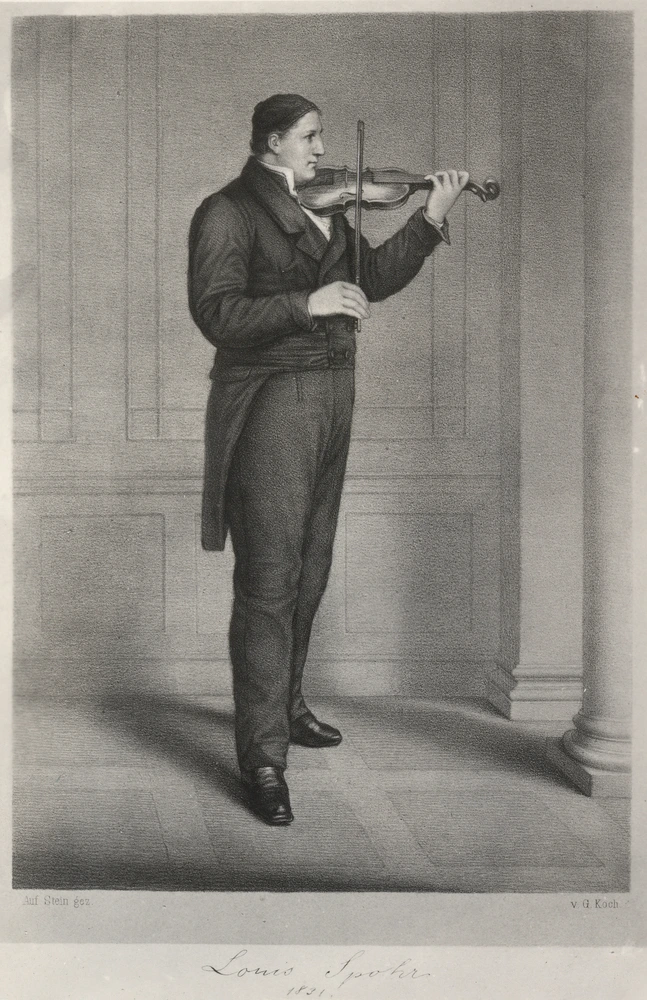
Louis Spohr 1831

Spohr Louis, Ludewig, Ludwig, *5 April 1784 Braunschweig, †22 October 1859 Kassel, composer, violinist, conductor, and teacher. Spohr’s father, a doctor and translator, played the flute as an amateur, while his mother was a pianist and singer. At the age of five, Spohr began learning to play the violin. In 1796, he joined the Collegium Carolinum in Braunschweig, where he learned to play the harp and perfected his violin skills under the tutelage of G. Kunisch, a musician in the ducal orchestra, and then for a year under the concertmaster of that ensemble, C.L. Maucourt. He was taught harmony by the local organist K.A. Hartung, but Spohr learned many aspects of music theory on his own by studying scores and textbooks. In 1799, he gained the patronage of Duke Karl Wilhelm Ferdinand of Braunschweig. Over the next three years, he participated as a court musician in performances of the latest, mostly French operas, including those by L. Cherubini, whom he held in the highest esteem at the time, and string quartets by Haydn, Mozart, and Beethoven (Op. 18). From April 1802 to the summer of 1803, Spohr accompanied the violinist F. Eck on a concert tour to Sankt Petersburg. During this time, he wrote, among other works, his Violin Concerto No. 1 and Duos for 2 violins, Op. 3. After returning to Braunschweig, he listened to the playing of P. Rode, who influenced the style of his Violin Concerto No. 2 and No. 3. From 1805 to 1812, he was concertmaster and conductor in Gotha. In 1806, he married harpist Dorothea Scheidler, with whom he had three daughters. Between 1806 and 1813, he and his wife made regular concert tours, for which he composed a number of works for violin and harp. During this time, he also wrote many virtuoso pieces for violin, numerous chamber works, a songbook, 3 operas, Symphony No. 1, and the oratorio Das Jüngste Gericht, intended for the festival in Frankenhausen, where he performed as a conductor. In 1812–13, he was concertmaster of the Theater an der Wien orchestra. At that time, he established a friendly relationship with Beethoven, under whose influence he composed numerous chamber works (string quartets and quintets, Octet, Nonet). In 1813, he also completed the Faust opera, which he was unable to stage in Vienna. In February 1815, he embarked on a two-year concert tour of Switzerland, Italy, and Germany. During this time, he composed two song cycles (Op. 37 and 41), another collection of violin duets, and his Violin Concerto No. 8. From 1817 to 1819, Spohr served as director of the opera in Frankfurt am Main, while working on a new version of Faust and another opera titled Zemire und Azor. He also performed as the first violinist in a string quartet at chamber concerts, enriching the program with a new collection of quartets, Op. 45.
In February 1820, thanks to the support of F. Ries, Spohr signed a five-month contract with the London Philharmonic Society He led the orchestra as concertmaster and was the first conductor in England to use a baton during rehearsals; during concerts, he used a bow to conduct. Spohr’s performances, both as a virtuoso violinist and as a conductor, received enthusiastic acclaim from English critics. He also enjoyed success with the premieres of his Symphony No. 2 and Violin Concerto No. 9 (at the Quedlinburg Festival). In London, Spohr also began work on his Quintet in C major, Op. 52, for piano and wind instruments, written for his wife, who, for health reasons, was gradually giving up playing the harp and had begun performing as a pianist. On December 7, 1820, Spohr arrived in Paris with her. His only performance, during which he presented his Violin Concerto No. 9, was received with enthusiasm by the public, but coolly by Parisian critics, who held French violinists’ (P.M.F. Baillot, C.P. Laronta, R. Kreutzer, F.A. Habeneck, and others) playing up as a standard of artistic taste in contrast to his; L. Cherubini expressed his approval of Spohr’s works, especially his String Quartets, Op. 45, and Quintet, Op. 52.
In October 1821, Spohr arrived in Dresden, where he began work on the opera Jessonda and another series of string quartets (Op. 58). With the help of C.M. von Weber, he was appointed conductor of the opera in Kassel in 1821, a position he held until the end of his professional career. Spohr’s organizational talent and authority enabled the ensemble he led quickly reached a high level of performance. In the first decade of his work, he added around 40 new works to the repertoire, including Weber’s Der Freischütz (1822, just one year after its premiere) and Rossini’s Wilhelm Tell (1831). In addition to opera performances, Spohr also conducted subscription symphony concerts and founded a Cecilian association to cultivate choral music. At the same time, he limited his foreign tours as a virtuoso violinist, as he enjoyed increasing recognition as a composer of operas (with Jessonda bringing him success), oratorios, and chamber music. The events of the 1830 revolution led to the closure of the opera in Kassel in 1832; at that time, Spohr devoted himself to teaching (throughout his career, he educated about 200 students, including H. Ries and F. David), and he also wrote the later popular textbook Violin-Schule. He also became active in social initiatives, establishing a fund for widows and orphans, as well as a pension fund aimed at supporting the families of musicians involved in the opera.
In 1832, he composed his Symphony No. 4, “Die Weihe der Töne.” The death of his wife in 1834 caused a year-long interruption in his work on the oratorio Des Heilands letzte Stunden for a year. In 1836, the composer married Marianna Pfeiffer, a talented pianist, for whom he wrote several chamber works featuring the piano: five trios, three duos concertantes, a Piano Quintet in D major and a Septet in A minor. In 1837, he composed his Symphony No. 5 and another collection of songs. In collaboration with the organisers of the festival in Norwich, he conducted performances of his oratorios Des Heilands letzte Stunde (1839) and Der Fall Babylons (1842) there. This brought him great recognition and popularity in England at the very time when, in Kassel, he was experiencing political repression as a supporter of the liberalization of social life. Despite reduced subsidies, however, he nevertheless managed to stage there, in 1843, the young Wagner’s opera Der fliegende Holländer and his own, last opera, Die Kreuzfahrer. In 1845, he appeared as a conductor at the Beethoven Festival in Bonn. In the following years, he repeatedly expressed his aversion to the policies of the Elector of Kassel. Bitterly disappointed by the failure of the Revolutions of 1848, and in protest against further restrictions, he boycotted proposals for public performances in Kassel from 1848 onward. In 1852 and 1853, he achieved considerable success in England, where two of his operas were staged at the Royal Italian Opera: a new versions of Faust and Jessonda. During the last years of his life, he composed little but remained full of vitality and energy to the very end. Spohr was one of the most influential composers of the early Romantic period. He began his career as a virtuoso violinist; his playing was characterised by solid technical mastery and a noble tone, while he shunned flashy displays and Paganini-style leggiero playing. Spohr’s compositional output began with works for the violin, among which 18 concertos (including three unnumbered ones) stand out. Unlike his violin duets, which were composed for advanced amateurs, Spohr wrote his concertos with his own public performances in mind. He initially adopted his virtuoso style from Mozart, as well as from G.B. Viotti and R. Kreutzer (especially in Concerto No. 1), and P. Rode (Concerto No. 2). He refined the French type of concerto – brilliant, full of verve, yet sentimental and pompous in expression – with classical perfection of form. Following Viotti’s example, he preceded his first concertos with slow introductions, while often giving the finales the rhythm and character of a polonaise, as Rode did. Without abandoning the latest achievements in violin technique and classical form, Spohr expressed the emotional turmoil and melancholy typical of early Romanticism in his later works, such as Concerto No. 7. He drew new inspiration from Italian bel canto opera singing. The Violin Concerto No. 8 “in modo di scena cantante” is structured in the manner of a vocal scene, consisting of a recitative, an arioso, and an aria. Spohr abandoned spectacular cadenzas in his concertos (with the exception of Concerto No. 5 and Concerto No. 8, which feature short virtuoso solos). Spohr’s four clarinet concertos, alongside those by Mozart and Weber, are the most important works in this genre. Composed for S. Hermstedt, they became the impetus for modifying the construction of the clarinet (adding seven additional keys) in order to expand its technical possibilities. Of particular interest from the perspective of performance techniques and sound concept are the 2 Concertantes for violin, harp, and orchestra, as well as the Concerto in A minor for string quartet and orchestra.
Spohr left behind nine symphonies (he withdrew Symphony No. 10 from circulation as unsuccessful). The first two meet the criteria of the classical style, while the next ones feature newer, post-Beethovenian and Romantic traits. In these compositions, the composer embraced the concept of the program symphony; only the Nos. 3 and 8 belong to the realm of absolute music. Symphony No. 5, Spohr’s crowning achievement in this genre, was inspired by E. Raupach’s tragedy Die Tochter der Luft (after Calderón de la Barca). In this composition, Spohr employed characteristically Romantic, lyrical themes with wide, arching melodic lines, and enriched the orchestral texture – and consequently its tone colour – by introducing a second pair of horns and using trombones in the upper register in the slow, lyrical section. The thematic connection between the outer movements is an expression of the desire for unity and balance in the cycle. The structures of Spohr’s Symphonies Nos. 4, 6, 7, 9 are reflective and philosophical, and sometimes have epic character. Some modify the basic assumptions of the symphony and the traditional structure of its cycle, e.g., in Symphony No. 7, “Irdisches und Göttliches im Menschenleben,” two orchestras take part: a chamber orchestra – consisting of 11 instruments in a single ensemble, representing human spirituality, and a large orchestra – contrasting it with human carnality. The three parts of this symphony correspond to the three stages of human life: childhood – the age of innocence, youth as a period of heightened emotions, and maturity, in which the divine element prevails.
Spohr’s chamber music oeuvre comprises over 100 works for a wide variety of instruments, ranging from duos for two violins to octets and nonets for strings and wind instruments, as well as works featuring the harp or piano. The majority of these works are for string instruments only, primarily the 36 quartets that Spohr composed throughout his life. Following Rode’s example, the three-part Quatuors brillants are the chamber music equivalent of a violin concerto. However, Spohr more often leaned towards the concept of the Viennese classics, especially Mozart. He tried to balance the parts of the individual instruments, only occasionally omitting the concertante element in the first violin part, most often in connecting passages. The quartets from Opp. 29 and 45, which are the most valuable in terms of melodic and harmonic inventiveness and the organization of thematic material, were perhaps influenced by Beethoven’s chamber works and by Spohr’s personal acquaintance with the composer. The four double quartets, in which Spohr initially combined the double choir principle, adopted from A.J. Romberg, with the concertante technique, achieving the best results in Double Quartet No. 3, are considered to be of exceptional value, confirmed by their permanence in the chamber repertoire. In the last, Double Quartet No. 4, he conducted a dialogue between completely equal quartets with greater consistency than before, while reducing the virtuoso factor in favour of romantic expression, achieved through increased chromaticism and refined rhythmics. His late chamber works include the piano trios, masterful within their genre, and the Septet in A minor for flute, clarinet, horn, bassoon, violin, cello, and piano stand out for their romantic melancholy and constant changes in tone colour and texture.
Spohr composed songs throughout most of his life, which are now considered to be important in the history of German musical Romanticism. The works he composed before 1815 (including some of the earliest arrangements of Goethe’s Gretchen am Spinnrade and Mignon) can be compared to Schubert’s vocal lyrics in terms of the wide range of emotions and moods they express. The later works, despite a certain mannerism in their melodic and harmonic means, deserve attention because of Spohr’s experiments with accompaniment (four-hand piano, piano and clarinet, piano and violin). The texture of the songs from Op. 103, for soprano, clarinet, and piano, is similar to that of a chamber trio.
He provided important guidance to F. Halévy, G. Meyerbeer, and R. Wagner – his successors in the field of opera. Faust (1813) rivals E.T.A. Hoffmann’s Undine for the title of the first German Romantic opera. Jessonda, in which Spohr achieved a balance between musical and dramatic qualities, remained in the repertoire for a particularly long time, until the Nazi era. From the beginning, he experimented with characterization and operatic dramaturgy. In Faust, the first opera that brought him widespread recognition, he consistently used the technique of leitmotifs; the three main motifs of the opera (hell, love, and Faust’s inner conflict) recur in the orchestral part at key moments of the action. In his subsequent operas, the number of leitmotifs varied, e.g., in Jessonda, it was limited to the motif of Tristan’s oath. Spohr sought to deepen the expression of his characters’ feelings through the intensive use of chromaticism. In the internal structure of the work, he gradually moved away from the principle of number opera in favour of a division into more elaborate scenes, linked to the development of the dramatic action. The spoken dialogues, still present in the first version of Faust, were replaced in later operas by recitatives, which often took the form of melodious declamation. In his use of choirs and ballet, Spohr went beyond the practice he knew from the German-language opera repertoire and drew inspiration from Parisian grand opéra; in Jessonda, for example, he made use of the da lontano choir and contrasted two choirs as representatives of hostile armies (Hindu and Portuguese). He also appreciated the value of tone colour and orchestration in the dramaturgy of opera; he used unusual combinations of instruments, e.g., divisi violas in the absence of violins, and emphasized the tone colour of low registers, e.g., in the choir of flutes, clarinets, and horns. Spohr’s oratorios have many features in common with operas, in which the composer sought internal integration through thematic reminiscences, and he also gave the orchestra a greater role than before as a means of expression. For many years, his oratorios were held in as high regard as Mendelssohn’s.
Spohr’s exceptionally versatile activity as a virtuoso violinist, chamber musician, conductor, organizer of musical life, teacher, brought him widespread recognition during his lifetime, and he was regarded on a par with J.S. Bach, Handel, Gluck, the Viennese classics, and L. Cherubini. Supporters of early Romantic tendencies in music quickly recognized in his works an extraordinary emotionality and ability to influence listeners, who appreciated the somewhat exalted, sentimental tone, the cantilena melodies, and the brilliance of virtuosity, while respecting the classical rules of composition and technical reliability. Chopin, Mendelssohn, Schumann, Brahms, and Wagner spoke enthusiastically about his music. However, Spohr’s later works were criticized for their mannerism, stagnation, and indifference to newer trends in composition. Subsequent generations of German Romantics, especially Wagner, overshadowed Spohr’s achievements. With a few exceptions, his works disappeared from the repertoire or, at best, enriched pedagogical literature. Renewed interest in Spohr’s music, sparked by the publication of a thematic catalogue of his works, began in the 1980s. Since then, most of his works, including stage works, have been published and recorded many times; a significant number of them have also returned to the concert repertoire, especially chamber music.
Literature: F. Göthel Thematisch-bibliographisches Verzeichnis der Werke von Louis Spohr, Tutzing 1981;
Briefe von Moritz Hauptmann an Louis Spohr und andere, ed. F. Hiller, Leipzig 1876, English translation by A.D. Coleridge, London 1892; Louis Spohr. Briefwechsel mit seiner Frau Dorette, ed. F. Göthel, Kassel 1957; “With True Esteem and Friendship”: The Correspondence of Felix Mendelssohn Bartholdy and Louis Spohr, eds. J. M. Cooper, R. Larry Todd, “Journal of Musicological Research” XXIX/2–3, 2010, p. 171
Louis Spohr. Selbstbiographie, vol. 2, Kassel 1860-61,2nd issue, ed. E. Schmitz, Kassel-Basel 1954–55, reprint New York 2012, Berlin 2015; English edition London 1865, 2nd issue 1878, reprint London 2010, e-book Norderstedt 2016, publ. of excerpt titled The Musical Journeys of Louis Spohr, translation by H. Pleasants, Oklahoma 1961; H. Giehne Zur Erinnerung an Louis Spohr, Karlsruhe 1860; Louis Spohr. Spohrsches Familienbuch, Karlsruhe 1918; Louis Spohr. Lebenserinnerungen, ed. F. Göthel, Tutzing 1968; H. Homburg Louis Spohr. Bilder und Dokumente seiner Zeit, Kassel 1968. W. Neumann Louis Spohr, Kassel 1854; H.M. Schletterer Louis Spohr, Leipzig 1881 (contains a list of compositions); H. Glenewinkel Spohrs Kammermusik für Streichinstrumente, Munich 1912; F. Göthel Bildnisse Ludwig und Dorette Spohrs, “Zeitschrift für Musik” CI, 1934; B. F. Swalin The Violin Concertos of Louis Spohr, “Bulletin of the American Musicological Society,” No. 2, 1937; H.J. Becker Meyerbeers in seinen Beziehungen zu Ludwig Spohr, “Die Musikforschung” X, 1957; D.M. Mayer The Forgotten Master. The Life and Times of Louis Spohr, London 1959, reprint New York 1981; H. Homburg Louis Spohr und die Bach-Renaissance, “Bach-Jahrbuch” 1960; C. Tuthill Burnet The Concertos for Clarinet, “Journal of Research in Music Education” X/1, 1962; A.A. Abert Webers “Euryanthe” und Spohrs “Jessonda” als grosse Opern, in the commemorative book of W. Wióra, eds. L. Finscher and C.-H. Mahling, Kassel 1967; J. Berret Characteristic Conventions of Style in Selected Instrumental Works of Louis Spohr, doctoral dissertation at the University of Michigan 1974, www.scribd.com; H. Becker Louis Spohr. Leben und Wirken, in: Louis Spohr. Avantgardist des Musiklebens seiner Zeit, ed. W. Marschner, Kassel 1979; C. Brown Spohr’s ‘Jessonda’, “The Musical Times” CXXI/1644, 1980; P. Katow Louis Spohr. Persönlichkeit und Werk, Luxembourg 1983; C. Brown Louis Spohr. A Critical Biography, Cambridge 1984, reprint 2008; H. Peters Der Komponist, Geiger, Dirigent und Pädagoge Louis Spohr (1784–1859), Braunschweig 1987; C. Brown Weber und Spohr, in: The Nineteenth-Century Symphony, ed. D.K. Holoman, New York 1997; D. F. Baldwin Louis Spohr and Program Music. A Study of his Fourth, Sixth, Seventh and Ninth Symphonies, Austin 1989; C. Brown The Chamber Music of Spohr and Weber, w: Nineteenth-Century Chamber Music, ed. S. Heffling, New York 1998; S. Kogler “Die Geige spricht”: Zur Aktualität des Komponisten Louis Spohr, “International Review of the Aesthetics and Sociology of Music” XXXII/2, 2001; W. Boder Die Kasseler Opern Louis Spohrs. Musikdramaturgie im sozialen Kontext, Kassel 2006; W.-M. Chen, An Analysis of Sonata Form in Clarinet Concertos by Wolfgang Amadeus Mozart, Louis Spohr, and Carl Maria von Weber, doctoral dissertation at the University of Cincinnati 2012; W. Boder Louis Spohr und die Musikpädagogik, English translation titled Louis Spohr as a Teacher, Kassel 2012
Louis Spohr. Festschrift, eds. G. Kraft, P. Michel and H.R. Jung, Weimar 1959; Louis Spohr. Festschrift und Ausstellungs-Katalog zum 200. Geburtstag, eds. H. Becker and R. Krempien, Kassel 1984, includes, among others: F. Göthel Der Romantiker Louis Spohr, H. Becker Einflüsse musikalischer Traditionen in Louis Spohrs Braunschweiger Jugendjahren, M.F. Powell Louis Spohr und die Harfe, D. Greiner Die Rolle des Rezitativs in den Opern Spohrs, R. Krempien Louis Spohrs pädagogisches Wirken, C. Brown Spohrs Popularität in England; “Musik und Politik”: Louis Spohr Symposium Braunschweig 2014; politische Einflüsse auf Musikerbiografien und kompositorisches Schaffen von 1784 bis heut, conference materials, Berlin 2015, includes, among others: H.-W. Heister Mozart, Spohr, Musik-Fest. Zur politischen Dimension der Musik, K. T. Goldbach Die Rezeption von Spohrs Jessonda im Nationalsozialismus.
Compositions
Instrumental:
orchestral:
Concerto in G major for violin and orchestra, ca. 1799
Concerto No. 1 in A major, Op. 1, for violin and orchestra, 1803
Concertante in C major for violin, cello and orchestra, 1803
Concerto in E minor for violin and orchestra, 1804
Concerto in A major for violin and orchestra, 1804
Concerto No. 2 in D minor, Op. 2, for violin and orchestra, 1804
Concerto No. 3 in C major, Op. 7, for violin and orchestra, 1806
Concerto No. 4 in B minor, Op. 10, for violin and orchestra, 1805
Concertante in G major for violin, harp and orchestra, 1806
Overture in C minor, Op. 12, 1806
Concertante in E minor for violin, harp and orchestra, 1807
Concerto No. 5 in E-flat major, Op. 17, for violin and orchestra, 1807
Symphony No. 1 in E-flat major, Op. 20, 1811
Potpourri in G major, Op. 23, for violin and orchestra, on themes by Mozart, 1808
Concerto No. 1 in C minor, Op. 26, for clarinet and orchestra, 1808
Concerto No. 6 in G minor, Op. 28, for violin and orchestra, 1809
Variations in B-flat major on a theme from the opera Alruna for clarinet and orchestra, 1809
Notturno in C major, Op. 34, for wind instruments and percussion, 1815, Leipzig 1816
Concerto No. 7 in E minor, Op. 38, for violin and orchestra, 1814
Concerto No. 8 „in modo di scena cantante” in A minor, Op. 47, for violin and orchestra, 1816, Leipzig 1894
Concertante in A major, Op. 48, for 2 violins and orchestra, 1808
Symphony No. 2 in D minor, Op. 49, 1820
Concerto No. 9 in D minor, Op. 55, for violin and orchestra, 1820, New York n.d.
Concerto No. 2 in E-flat major, Op. 57, for clarinet and orchestra, 1810
Potpourri sur des thèmes irlandais in A major, Op. 59, for violin and orchestra, 1820
Concerto No. 10 in A major, Op. 62, for violin and orchestra, 1810
Grand Concert Ouverture in F major, 1819
Concerto No. 3 in F minor for clarinet and orchestra, 1821
Potpourri in A-flat major, Op. 64, for violin, cello, and orchestra, on themes from Jessonda, 1823
Potpourri in A minor, Op. 66, for violin and orchestra, on themes from Jessonda, 1823
Concerto No. 11 in G major, Op. 70, for violin and orchestra, 1825
Symphony No. 3 in C minor, Op. 78, 1828, Berlin 1870
Concerto No. 12 (Concertino No.1) in A major, Op. 79 for violin and orchestra, 1828
Potpourri in F major, Op. 80, for clarinet and orchestra, accompanied by orchestra or piano, based on themes from P. von Winter, 1811
Concerto No. 4 in E minor for clarinet and orchestra, 1828
Symphony No. 4 in F major “Die Weihe der Töne,” Op. 86, 1832, Vienna 1834
Concertante in B minor, Op. 88, for 2 violins and orchestra, 1833
Concerto No. 13 (Concertino No. 2) in E major, Op. 92, for violin and orchestra, 1835
Concerto No. 14 (Concertino No. 3) “Sonst und jetzt” in A minor, Op. 110, for violin and orchestra, 1839
Symphony No. 5 in C minor, Op. 102, 1837, Vienna 1840
Symphony No. 6 in G major “Historische Symphonie im Styl und Geschmack vier verschiedener Zeitabschnitte,” Op. 116, 1839, Vienna 1842
Symphony No. 7 in C major “Irdisches und Göttliches im Menschenleben,,” Op. 121, for 2 orchestras, 1841, Hamburg 1842
Concert Ouverture “im ernsten Stil” in D major, Op. 126, 1842, Leipzig 1846
Concerto No. 15 in E minor, Op. 128, for violin and orchestra, 1844
Concerto in A minor, Op. 131, for string quartet and orchestra, 1845
Symphony No. 18 in G major, Op. 137, 1847, Leipzig 1854
Symphony No. 9 in B-flat minor “Die Jahreszeiten,” Op. 143, 1850, Hamburg 1853
Symphony No. 10 in E major, Op. 156, 1857
chamber:
Duo in E-flat major for 2 violins, ca. 1797
Duo in E-flat major for 2 violins, ca. 1797
Duets in F major and G major, Op. 3, for 2 violins, 1802–03, Leipzig 1805
String Quartets in C major and G minor, Op. 4, 1804–05
Potpourri in G major, Op. 5, for violin accompanied by violin, viola, and cello, on a theme from Le petit matelot by P. Gaveaux, 1804
Introduction in G major for harp/piano and violin, 1805
Sonata in C minor for harp and violin, 1805
Sonata in E (F) minor for Violin and Harp, ca. 1806
Variations in D minor, Op. 6, for violin accompanied by violin, viola, and cello, 1806
Variations in A major, Op. 8, for violin accompanied by violin, viola, and cello, 1805
Duos in C major and in A major, Op. 9, for 2 violins, 1806–07, Leipzig 1807
String Quartet in D minor, Op. 11, (Quatuor brillant), 1806
Trio in E (F) minor for violin, cello and harp, 1806
Waltzer in C minor for piano, ca. 1808, Leipzig 1891
Duet in E minor, Op. 13, for violin and viola, 1807, Leipzig 1808
String Quartets in E-flat major and D major, Op. 15, 1806–08
Sonata in B-flat major, Op. 16, for harp and violin, 1806, Bonn 1809
Potpourri in B-flat major, Op. 22, for violin accompanied by two violins, viola, cello, and double bass, based on themes from Mozart’s works, 1807
Duo in C major for 2 violins, ca. 1808
Potpourri in B major, Op. 24 for violin with violin, viola, and cello accompaniment, based on themes from Mozart, 1808
String Quartet in G minor, Op. 27, 1812
String Quartets in E-flat major, C major and F minor, Op. 29, 1813–15
String Quartet in A major, Op. 30, 1814
Nonet in F major, Op. 31, for flute, oboe, clarinet, horn, bassoon, violin, viola, cello, and double bass, 1813, Berlin 1878
Octet in E major, Op. 32, for clarinet, 2 horns, violin, 2 violas, cello, and double bass, 1814, Berlin ca. 1878
String Quintets in E-flat major and G major, Op. 33, 1813–14
Fantasia in C minor, Op. 35 for harp, 1807, Bonn 1816
Variations on “Je suis encore dans mon printemps” (E.N. Méhul), Op. 36, for harp, 1807, Bonn 1816
Duos in D minor, E-flat major and E major, Op. 39 for 2 violins, 1816, Leipzig 1816
String Quartet in E major, Op. 43 (Quatuor brillant), 1817
String Quartets in C major, E minor and F minor, Op. 45, 1818
Introduction and Rondo in E major, Op. 46 for violin and piano, 1816, Vienna 1820
Quintet in C major, Op. 52, for flute, clarinet, horn, bassoon and piano, 1820, Leipzig 1821, version for string quartet and piano, Op. 53, 1820, Leipzig 1821
String Quartets in E-flat major, A minor and G major, Op. 58, 1821–22
String Quartet in B-flat minor, Op. 61 (Quatuor brillant), 1819
Double String Quartet in D minor, Op. 65, 1823, Florence ca. 1880
Duos in A minor, D major and G minor, Op. 67 for 2 violins, 1824, Leipzig 1825
String Quartet in A major, Op. 68 (Quatuor brillant), 1823
String Quintet in B minor, Op. 69, 1826
String Quartets in A minor, B-flat major and D minor, Op. 74, 1826
Double String Quartet in E-flat major, Op. 77, 1827, Leipzig 1888
Fantasy and Variations, in B-flat major, Op. 81, for clarinet and string quartet or piano, on a theme of F. Danzi, 1814
String Quartets in E major, G major and A minor, Op. 82, 1828–29
String Quartet in E-flat major, Op. 83 (Quatuor brillant), 1829
String Quartets in D minor, A-flat major and B minor, Op. 84, 1831–32
Double String Quartet in E minor, Op. 87, 1833, Leipzig 1888
String Quintet in A minor, Op. 91
String Quartet in A major, Op. 93 (Quatuor brillant), 1835
Duo concertante in G minor, Op. 95, for violin and piano, 1836, Leipzig 1837
Duo concertante in F major “Nachklänge einer Reise nach Dresden und in die sächsische Schweitz,” Op. 96, for violin and piano, 1836, Bonn 1837
String Quintet in G minor, Op. 106, 1838
Rondo “alla spagnuola” in C major, Op. 111, for violin and piano, 1839, Vienna 1839
Duo concertante in E major, Op. 112, for violin and piano, 1837, Drezno 1840
Sonata in D (E-flat) major, Op. 113, for harp/piano and violin, 1806, Hamburg 1840
Sonata in D (E-flat) major, Op. 114, for harp/piano and violin, 1811, Hamburg 1841
Sonata in G (A-flat) major, Op. 115, for harp/piano and violin, 1809, Hamburg 1841
Fantasia in B (C) minor/A (B-flat) major, Op. 118, for harp/piano and violin, on themes by G.F. Händel and G.J. Vogler, 1814, Hamburg 18450
Piano Trio in E minor, Op. 119, 1841, Hamburg 1842
Piano Trio in F major, Op. 123, 1842, Hamburg 1843
Piano Trio in A minor, Op. 124, 1842, Hamburg 1843
Sonata in A-flat major, Op. 125 for piano, 1843, Vienna 1843
6 Duettinen, Op. 127, for violin and piano, 1843, Hamburg 1844
String Quintet in E minor, Op. 129, 1845
Piano Quintet in D major, Op. 130, 1845, Hamburg 1846
String Quartet in A major, Op. 132, 1846
Piano Trio in B-flat major, Op. 133, 1846, Hamburg 1847
Double String Quartet in G minor, Op. 136, 1847, Leipzig 1888
Sextet in C major, Op. 140, for 2 violins, 2 violas, and 2 cellos, 1848
String Quartet in C major, Op. 141, 1849
Piano Trio in G minor, Op. 142, 1849, Hamburg 1852
String Quintet in G minor, Op. 144, 1850
String Quartet in G major, Op. 146, 1851
Septet in A minor, Op. 147, for flute, clarinet, horn, bassoon, violin, cello, and piano, 1853, Leipzig 1855
Duo in F major, Op. 148, for 2 violins, 1854, Leipzig 1856
Rondoletto in G major, Op. 149, for piano,1848, Leipzig 1855
cadences for Beethoven’s Violin Concerto in D major for violin, ca. 1850, London 1896
Duo in D major, Op. 150, for 2 violins, 1854, Leipzig 1856
String Quartet in E-flat major, Op. 152, 1855
Duo in C major, Op. 153, for 2 violins, 1855, Leipzig 1856
[Scherzino] in D major for violin and piano, ca. 1856, Berlin 1896
String Quartet in E-flat major [Op. 155], 1856
String Quartet in G minor [Op. 157], 1857
Duo in F major for 2 violins
Duo in C major for 2 violins
Duo in E-flat major for 2 violins
compositions for violin and piano (potpourris, Grand Rondo in G major, Fantasia in D major, Adagio in F major) based on earlier works by Spohr
vocal:
Der Kompass for 4 male voices a cappella, ca. 1807, Meissen 1826
Freude, Jubel for 3 female voices a cappella, ca. 1808
Lebe wohl, du Vater Brocken for 4 male voices a cappella, 1808
6 Gesänge, Op. 44, for 4 male voices a cappella, words by K. Grumbach, J.W Goethe, F. Brun, T. Körner and an anonymous author, 1817, Leipzig 1818
Willst du immer weiter schweifen for 4 male voices a cappella, words by J.W. Goethe, 1817, Leipzig 1818
2 Gesänge for 4 male voices a cappella, words by J.W.L. Gleim and an anonymous author, 1820, Leipzig 1821
6 Gesänge, Op. 90, for 4 male voices a cappella, words by C. Pfeiffer and an anonymous author, 1833, Hamburg 1838
Wer das schneiden hat erfunden for 2 mixed voices a cappella, before 1835
6 Lieder, Op. 120, for 4 mixed voices a cappella, words by K.F. Dräxel-Manfred et al., 1841–42, Kassel 1842 and [Op. 151], words by F.K. Müller von der Werra et al., 1855, Hamburg 1873
Kurz ist der Schmerz for 3 female voices a cappella, words by F. Schiller, 1848
Vocal-instrumental:
songs:
6 deutsche Lieder, Op. 25, Op. 37, Op. 41, Op. 72, Op. 94, Op. 101, for voice with piano accompaniment for 2 or 4 hands, Op. 103, with piano accompaniment and clarinet, Op. 105, Op. 154, accompanied by violin and piano, to words by J.W. Goethe, J.G. Salis, F. Kind, 1809–56
Lied des verlassenen Mädchens for voice with piano accompaniment, words by J.L.F. Deinhardstein, 1815, Vienna 1815
Nachgefühl for voice with piano accompaniment, words by J.W. Goethe, 1819, Meissen 1824
Was treibt den Weidmann in den Wald, for voice accompanied by harp or piano and horn, words by W. Vogel, 1825, Vienna 1826
Das Wirtshaus zu… for voice with piano accompaniment, words by A. von Marées, 1836, Mainz 1836
3 Duette, Op. 107, for two voices with piano accompaniment, words by H. Schulz et al., and Op. 108, words by F. Rochlitz et al., 1838, Bonn 1839
5 deutsche Lieder, Op. 139, for voice with piano accompaniment, words by K. Simrock, M. Bekmann, A.H. Hoffmann von Fallersleben and an anonymous author, 1836–48, Kassel 1848
Jenseints for 2 voices with piano accompaniment, words by F. Bobrich, 1838, Leipzig 1838
Mitternacht, for voice with piano accompaniment for 4 hands, words by F. Dingelstedt, 1838, Dresden 1840
Verlust for voice with piano accompaniment, words by B.F.W. Zimmermann, 1839, Vienna 1839
An die Geliebte for voice with piano accompaniment, words by V. Hugo, 1839, Hamburg 1850
Unterwegs for voice with piano accompaniment, words by F. Dingelstedt, 1839, Braunschweig 1842
Die sieben Schwestern, for voice with piano accompaniment for 4 hands, words by L. Wihl, 1839, Bonn 1840
Schill for 4 voices with piano accompaniment for 4 hands, 1840, Leipzig 1842
Rätselhaft, for voice with piano accompaniment for 4 hands, words by an anonymous author, 1841, Braunschweig 1841
Abendlied for voice with piano accompaniment, words by J. Becker, 1841, Kassel 1841
Singet die Nachtigall im Dunkeln Wald for voice with piano accompaniment, words by J.C. von Zedlitz, 1841, Leipzig 1841
Wolle keiner mich fragen for voice with piano accompaniment, words by E. Geibel, 1842, Stuttgart 1842
Thränen for voice with piano accompaniment, words by A. von Chamisso, 1842, Leipzig 1842
Liebt er mich for voice with piano accompaniment, words by an anonymous author, 1843, Stuttgart 1843
Gruss for voice with piano accompaniment, words by K.J. Braun von Braunthal, 1843, Vienna 1844
Mein Vaterland for voice with piano accompaniment, words by A.H. Hoffmann von Fallersleben, 1844, Mannheim 1845
Ermutigung for voice with piano accompaniment, words by C. von Schweizer, 1845, Kassel 1845
Immerdar Liebe for voice with piano accompaniment, words by K.E.K. Göchhausen, 1845, Rudolstadt 1845
Every Where Far and Near (Sehnsucht) for voice with piano accompaniment, words by Meier, 1846, London 1848
Herbst for voice with piano accompaniment, words by A.L. Lua, 1847, Berlin 1848
Mein Heimatland for 2 voices with piano accompaniment, words by Mecklenburg, 1847, Berlin 1849
An Sie am Clavier, Op. 138, sonatina for piano and one voice, words by K.J. Braun von Braunthal, 1848, Kassel 1848
3 Lieder for 2 voices with piano accompaniment, words by K.E. Ebert, A. Lange, G. Scheurlin, 1849, Leipzig-London 1854
Glockenklänge for voice with piano accompaniment, words by an anonymous author, 1850, Braunschweig 1852
3 Lieder for voice with piano accompaniment, words by F. von Bodenstedt after the tale “The Thousand and One Nights,” 1850, Leipzig 1855
Erwartung for voice with piano accompaniment, words by K. Bassewitz, 1853, Göttingen 1854
Mein Verlangen for voice with piano accompaniment, words by F.K. Müller von der Werra, 1854, Sankt Gallen 1855
Grüsse for voice with piano accompaniment, words by A. Linden, 1855, Leipzig 1862
Immer dasselbe for voice with piano accompaniment, words by A. Linden, 1856, Leipzig 1858
Wohin for voice with piano accompaniment, words by J. Sturm, 1856
Die verschwiegene Nachtigall for voice with piano accompaniment, words by Walther von der Vogelweide, 1857, Würzburg 1858
Neue Liebe, neues Leben for voice with piano accompaniment, words by J.W. Goethe, 1858, Würzburg 1859
***
Das befreite Deutschland, cantata, words by K. Pichler, 1814
Hessens Feiergesang for choir in unison and wind orchestra, words by K. Wolf, 1830, Kassel 1830
Hymne an die heilige Cäcilie, Op. 97, for soprano, choir and piano, words by P. von Calenberg, 1823, Kassel 1859
religious:
Das Jüngste Gericht, oratorio for solo voices, choir and orchestra, words by A. Arnold, 1812
Jubilate Deo, offertory for soprano, choir, solo violin and orchestra, 1815
Mass C minor, Op. 54, for 5 solo voices and double choir, 1821, Leipzig 1822
Vater unser for 4 solo voices, choir and orchestra, words by A. Mahlmann, 1829, Berlin 1831
3 Psalms (8, 23, 130), Op. 85, for solo voices and double choir, 1832, Bonn 1833
Des Heilands letzte Stunden, oratorio for solo voices, choir and orchestra, words by F. Rochlitz, 1835, London 1884
Gott, du bist gross, Op. 98, hymn for 4 solo voices, choir and orchestra, words by J.F. Rohdmann, 1836, Bonn 1838
Psalm 24, Op. 97a, for 4 solo voices, choir and piano, 1836
Friede den Entschlafenen for 2 solo voices, words by J. Neus, 1837, Mainz 1838
Lasst uns Dankgesang erheben for 4 voices, 1838, Berlin 1839
Vater unser for double male choir and wind ensemble, words by F.G. Klopstock, 1838, version with symphony orchestra, Op. 104, 1845
Der Fall Babylons, oratorio for solo voices, choir and orchestra, words by E. Taylor, German translation by F. Oetker, 1840, Leipzig 1843
Psalm 128, Op. 122, for 4 solo voices, choir and piano or organ, 1841, version with orchestral accompaniment, 1842
Psalm 84 for 4 solo voices, choir and orchestra, 1847, Hamburg 1873
Selig alle, die im Herrn entschliefen for 4 male voices, 1844
Die letzten Dinge, oratorio for solo voices, choir and orchestra, words by F. Rochlitz, London 1881
stage:
Die Prüfung, operetta, in one act, libretto by E. Henke, concert performance Gotha 1806
operas:
Alruna, die Eulenkönigin, in three acts, 1808
Der Zweikampf mit der Geliebten, in three acts, libretto by J.E Schink, 1811, staged in Hamburg 1811
Faust, in two acts, libretto by J.K. Bernard, 1813, staged in Prague 1816, revised version., in three acts, staged in London 1852
Zemire und Azor, in two acts, libretto by J. J. Ihlee after J.F. Marmontel, 1819, staged in Frankfurt am Menem 1819
Jessonda, in three acts, libretto by E. Gehe after La veuve de Malabar by A.-M. Lemierre, 1822, staged in Kassel 1823
Der Berggeist, in three acts, libretto by G. Döring, 1824, staged in Kassel 1825
Pietro von Abano, in two acts, libretto by C. Pfeiffer after L. Tieck, 1827, staged in Kassel 1827
Der Alchymist, in three acts, libretto by F.G. Schmidt (C. Pfeiffer) after The Student of Salamanca by W. Irving, 1830, staged in Kassel 1830
Die Kreuzfahrer, in three acts, libretto by L. and M. Spohr after A. von Kotzebue, 1844, staged in Kassel 1845
music for theatre plays, including:
Macbeth, words by S.H. Spiker after Shakespeare, 1825
Der Matrose, with M. Hauptmann et al., words by K. Birnbaum, 1838, staged in Kassel 1839
Works:
Violin-Schule, Vienna 1833, reprint Munich 2000, English translation titled Louis Spohrs celebrated Violin School, translated by E. Taylor, London no year of publication, 2nd issue. 1860, French translation titled Méthode de violon, translated by F. Roussel, Pantin 2017
Editions:
Louis Spohr. Neue Auswahl der Werke, ed. F. Göthel and H. Homburg, Kassel-Tutzing 1963
Selected Works of Louis Spohr, ed. C. Brown, vol. 10, New York 1987–90, vol. 1: Faust, 1990, vol. 2: Jessonda, 1988, vol. 3: Pietro von Abano, 1988, vol. 4: Die letzten Dinge, 1987, vol. 5: Des Heilands letzte Stunde, 1987, vol. 6: Symphonies No. 1, 2, 5, 1987, vol. 7: Violin Concertos No. 10, Op. 62, No. 12, Op. 79, Concertante in C major for Violin and Violoncello, 1987, vol. 8: The Complete Lieder, 1988, vol. 9: Chamber Music for Strings, 1987, vol. 10: Trios Concertants, Piano Quintet, Op. 130, 1987
Louis Spohr Lied Edition, eds. S. Owen-Leinert, M. Leinert, vol. 12, Kassel, Braunschweig, Düsseldorf 2011 (first complete edition of 111 songs by Spohr for 1 or 2 voices with piano accompaniment)
Das Gesamtwerk für Harfe, (WoO 23, Op. 16, 36, 113, 114, 115, 118), ed. H. Storck, published by Verlag Dohr Köln
Spohrschriften, textbooks 1–20, eds. W. Boder, Louis-Spohr-Stiftung Kassel 2012–2022