
VARIATIONS brillantes Pour Le Pianoforte sur le Rondeau favori: „Je vends des Scapulaires” de Ludovic de HEROLD et HALEVY dédiées à Mademoiselle Emma Horsford par Fréd. Chopin.

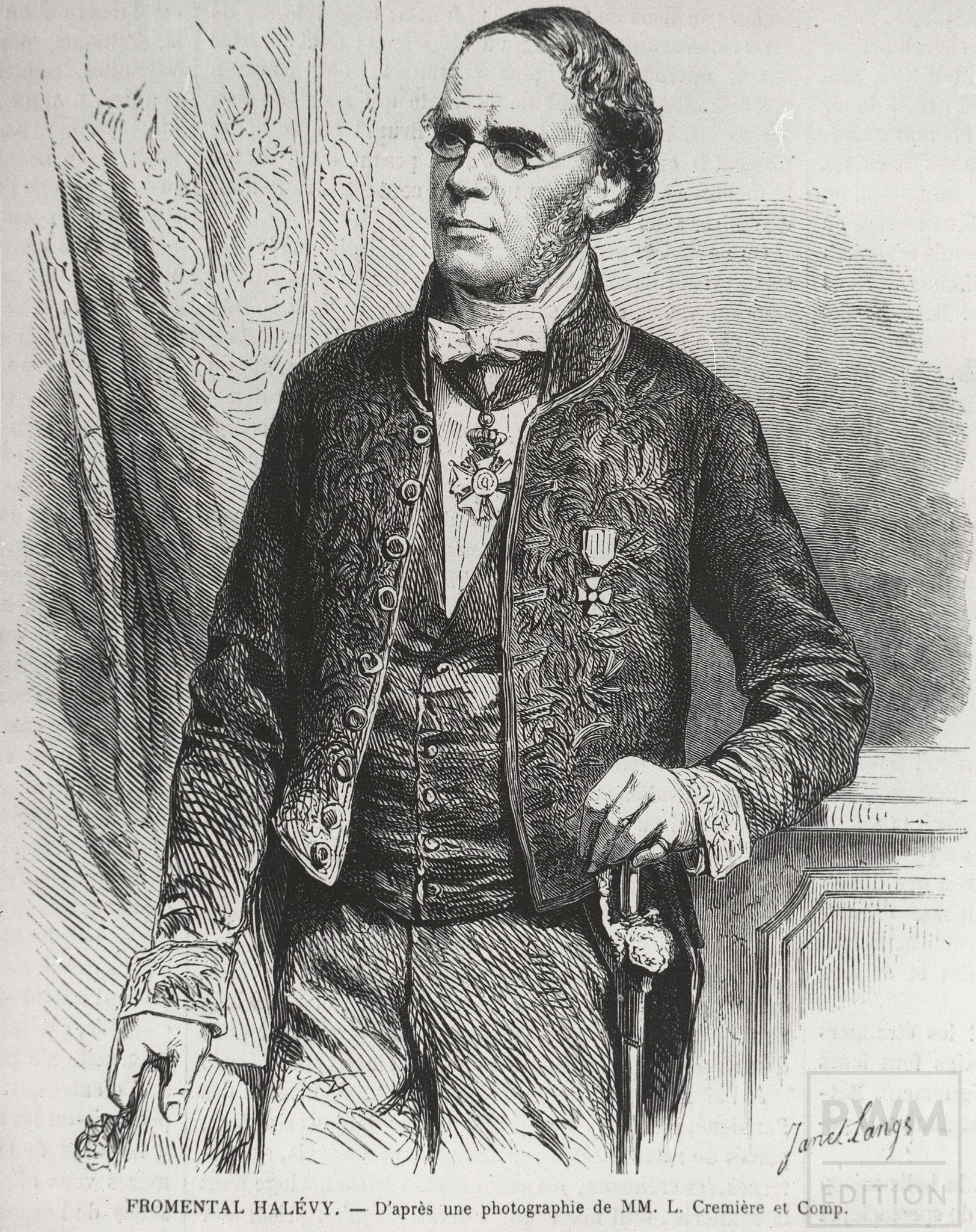
Halévy Jacques François Fromental, Fromentin, Elie, born Elias Lévy, *27 May 1799 Paris, † 7 March 1862 Nice, French composer, teacher, and music writer.
His parents, Elias Levy from Fürth, a poet and scholar, and Julie Meyer from Nancy, were Jewish. In 1807, they changed their surname to Halévy. Halévy began studying music at an early age and, at the age of nine, was already a student at the Paris Conservatoire. In 1816, he completed his studies in composition in the class of L. Cherubini, with whom he maintained a friendly relationship. He was also a student of H.M. Berton (harmony) and E. Méhul. In 1816 and 1817, he won second prize for his cantatas Les derniers moments du Tasse and La mort d’Adonis in the Grand Prix de Rome competition, and in 1819 he won first prize for his cantata Herminie. Before departing for Rome, he composed, on commission from the Jewish congregation, the funeral cantata De profundis, performed on 24 March 1820 at the service following the assassination of the Duke of Berry. His stay in Rome resulted in several small vocal-instrumental works and fragments of an opera in the Italian style. After several months in Vienna (1822–23), Halévy returned to Paris. Halévy’s career as a teacher began in 1827, when he was appointed professor of harmony and accompaniment at the Conservatoire. From 1830, he taught counterpoint and fugue, and from 1840, composition; his students included Ch. Gounod, E. Deldevez, G. Bizet, Ch. Lecocq and C. Saint-Saëns, as well as the Polish composer F. Jaroński. Concurrently, he held the position of chef du chant at the Théâtre Italien until 1826, and at the Paris Opera from 1829 to 1845. In 1835, he was made a Knight of the Legion of Honour; in 1836, he was elected a member of the Académie des Beaux Arts to replace the late A. Reicha. In 1854, he took up the position of secretary of this institution. From 1840 he was also conductor at the court of Louis Philippe I. Two years before his death, he moved to Nice.
Halévy devoted almost his entire creative life to composing operas. After initial failures (Les bohémiennes, Les deux pavillons, Erostrate, Pygmalion – never staged), the composer managed to stage the opéra comique L’artisan. This marked the beginning of a long and fruitful collaboration with the then highly regarded librettist J.H. Vernoy de Saint-Georges. For King Charles X’s birthday, Halévy composed – together with L.V.E. Rifaut – the opera Le roi et le batelier, staged in 1827 at the Opéra Comique. In 1828, with M. Malibran in mind, who was then performing at the Théâtre Italien, he composed the opera semiseria Clari, set to an Italian libretto. The following year, he enjoyed considerable success with the opéra comique Le dilettante d’Avignon, with a libretto by, among others, his brother, Léon Halévy, which was a satire on Italian opera. The bankruptcy declared by the Opéra Comique in 1832 prevented the staging of Halévy’s next opera, Yella. However, the suspension did not last long, as the following year saw the staging of the opera Ludovic, a work by F. Herold, completed by Halévy. That same year, Chopin wrote Variations brillantes, Op. 12, based on a theme from this opera (the aria Je vends des scapulaires). Halévy’s greatest and most immediate success was his first grand opera, La Juive (The Jewess) from 1835, the composer’s only work that became a permanent part of the opera repertoire and thus secured the composer a place among the authorities of French music in the second half of the 19th century. This work (apart from the ballet Manon Lescaut) marked the beginning of Halévy’s collaboration with E. Scribe and L. Véron, director of the Opera. Halévy also enjoyed great success that same year at the Opéra Comique with the opera L’éclair. Among Halévy’s other great operas, those that stand out are La reine de Chypre (1841), for which R. Wagner prepared a piano score for M. Schlesinger’s publishing house, and Charles VI (1843), with its patriotic accents (the chorus Guerre aux tyrans and the ensemble Vive le roi! Vive la France), stand out. In the late 1840s, Halévy wrote several more opéras comiques, of which Les mousquetaires de la reine (1846) and Le val d’Andorre (1848) were successful. For the opening of the Opéra National at the Théâtre Lyrique (1847), Halévy wrote the prologue Les premiers pas along with other composers. In 1850, he created an opera for London’s Queen Theatre, with a libretto by Scribe based on Shakespeare’s The Tempest. The Paris premiere of this work (1851) was not a success; Halévy’s last completed opera, La magicienne (1850), also enjoyed only fleeting success. His work on Noé ou Le Déluge, left unfinished at his death, was completed by G. Bizet, Halévy’s son-in-law. Halévy’s literary work comprises two volumes of sketches on music history, the second published posthumously, including essays on Froberger, the origins of French opera, and Mozart.
Halévy’s compositional legacy is almost entirely dominated by his operatic works, which developed within two genres popular in France in the first half of the 19th century: grand opéra (grand heroic opera) and opéra comique. In both genres Halévy drew on established traditions (those of Méhul, Boieldieu, Cherubini, Spontini, and Rossini). In his serious operas, he drew on historical, fantastical and biblical themes. These works display characteristics typical of the grand opéra style: a five-act structure, monumental choruses generally in simple homophonic arrangements, ritual scenes with impressive musical accompaniment, ballet scenes, marches accompanying processions and parades, extensively developed ensemble parts, passages featuring organs, solo parts of various character (prayer, serenade, romance, banquet song, ballad). Halévy’s only masterpiece, La Juive, achieved its high artistic value thanks to attempts to overcome operatic clichés by deepening the psychological portrayal of the characters. With a wealth and variety of musical nuances, Halévy aptly emphasised the instability and inner struggle of the main characters: Rachel (romance from Act II, duet between Rachel and Eudora from Act IV) and her father (scene with Cardinal Brogni and Eleazar’s famous aria from Act IV). More than other contemporary French composers, Halévy avoided dramatically unjustified vocal display, and in La Juive local colour, which the title and the central conflict of the drama might suggest, only appears to a small extent (the prayer and the Passover supper in Act II). Halévy handled the orchestra with great skill and ease, especially the wind section (chromatic passages in the brass and a prominent expressive role for the woodwinds), often anticipating orchestral ideas later found in Berlioz’s music. However, La Juive is inferior to Meyerbeer’s works in terms of emotional power and dynamism. The composer’s lack of critical attitude in his choice of librettos meant that none of his other great operas stood the test of time. Halévy’s later works, in particular, discourage listeners with the artificiality of their plots, a lack of plausibility in the unfolding action, cheap sentimentality, and contrived pathos (criticism that were already felt in the 19th century). Among his opéras comiques, L’éclair enjoyed considerable popularity for quite some time. This small work, written for four voices (two sopranos and two tenors) without a choir, is full of grace and amusing stage situations (influenced by Mozart), but does not match the vitality of Rossini’s or Auber’s operas. In Le val d’Andorre and Le guitarrero, the emphasis on local colour (Basque and Spanish) is noteworthy – a technique aimed at creating an attractive sound atmosphere. It is more of an idea of the music of a given nation than a specific reference to it.
Wagner, who spoke so disparagingly of Meyerbeer’s operas and of French music in general, held Halévy’s works in high esteem: “I have never heard dramatic music which has transported me so completely to a particular historic epoch”, and he even called La Juive a “trace of the spirit of Beethoven”. Berlioz, for his part, described Halévy’s most outstanding work as “this miserable La Juive […] everything I would have to say about it is so awful that I could be accused of jealousy”, yet he praised Le val d’Andorre for its interesting instrumentation and the excellently constructed Act II finale. Berlioz also originated the opinion, often repeated later, that Halévy’s talent was better suited to lighter operas. As a professor at the Conservatoire, Halévy was very popular with his students, although in the opinion of some (e.g. C. Saint-Saëns) he was not demanding enough and lacked teaching skills.
Literature: H. Berlioz Les musiciens et la musique, introduction by A. Hallays, Paris 1903, reprint 2011, 2021; R. Wagner Bericht über eine neue Pariser Oper “La reine de Chypre” von Halévy., in: Gesammelte Schriften und Dichtungen, vol. 1, Leipzig 1897, e-book 2016, new edition titled Dichtungen und Schriften, vol. 5, ed. D. Borchmeyer, Frankfurt am Main 1983; R. Wagner Halévy et “La reine de Chypre”, in: R. Wagner Mein Leben, Leipzig 1911, new edition ed. M. Gregor-Dellin Munich 1963, 2nd edition 1976; Fromental Halévy : Lettres. Pour le bicentenaire de la naissance de Fromental Halévy 1799–1999, ed. M. Galland, series «La musique en France au XIXe siècle» vol. 2, Heilbronn 1999, Weinsberg 2005;
C. de Lorbac Fromental Halévy. Sa vie, ses oeuvres, Paris 1862; L. Halévy Fromental Halévy. Sa vie et ses oeuvres, Paris 1862; A. Castelin Fromenal Halévy. Notice biographique, Paris 1863; E. Monnais Fromental Halévy. Souvenirs d’un ami, Paris 1863; Ch.A. Sainte-Beuve Nouveaux lundis, Paris 1864; A. Pougin Fromental Halévy, écrivain, Paris 1865; E. Hanslick Jasques Fromental Halévy, in: Die moderne Oper, vol. 9, Berlin 1900; C. Saint-Saëns Ecole buissonnière. Notes et souvenirs, Paris 1913; W.L. Crosten French Grand Opéra. An Art and a Business, New York 1948; M. Curtiss Fromental Halévy, “The Musical Quarterly” XXXIX, 1953; J.W. Klein Jasques Fromental Halévy(1799–1862), “The Music Review” XXIII, 1962; H. Becker Die historische Bedeutung der Grand Opéra, in: Beiträge zur Geschichte der Musikanschauung im 19. Jahrhundert, ed. W. Salmen, “Beiträge zur Musikgeschichte des XIX Jahrhunderts”vol. 1, Regensburg 1965; K. Leich Lokalkolorit in Fromental Halévy’s “Guitarrero” (1841), in: Die Couleur locale in der Oper des 19. Jahrhunderts, ed. H. Becker, “Beiträge zur Musikgeschichte des XIX Jahrhunderts” vol. 42, Regensburg 1967; K. Pendle E. Scribe and French Opera of the 19th Century, “The Musical Quarterly” LVII, 1971 No. 4; H.C. Wolff Halévy als Kunst- und Musikschriftsteller, in: Musicae scientiae collectanea, commemorative book for K.G. Fellerer, ed. H. Häschen, Cologne 1973; L’Avant-scène opera, No. 100 (1987) dedicated to La juive; K. Leich-Galland Fromental Halévy, ‘La juive’ : dossier spécial. Chanteurs français aujourd’hui, Paris 1987; K. Leich-Galland ‘La Magicienne’ (1858). Dernier Grand Opéra de Fromental Halévy, livret de Jules de Saint-Georges, «Revista de Musicología» XVI No. 6 (1993); R. Jordan Fromental Halévy – His Life and Music, 1799–1862, Londyn 1994, New York 1996, reprint London 2006; Th. G. Kaufman Jacques Fromental Halévy: More than a one-opera composer, “The Opera Quarterly” XV (1999), pp. 660–676; D.R. Hallman Opera, Liberalism, and Antisemitism in Nineteenth-Century France. The Politics of Halévy’s ‘La Juive’, Cambridge 2002; Actes du colloque Fromental Halévy, ed. F. Claudon, G. de Van, K. Leich-Galland, materials from the symposium in Paris in 2000, Weinsberg 2003; A.-S. Métérie Fromental Halevy, ‘La reine de Chypre’ dossier de presse parisienne (1841), «Critiques de l’opéra français du XIXème siècle» vol. 16, Weinsberg 2005; M. Jahn Jacques Fromental Halévy – La Juive, libretto and reviews from 1836-1933, Vienna 2009; The Cambridge companion to grand opera, ed. D. Charlton, Cambridge 2011; C. Risi Fromental Halévy: zwischen Pessach und Te Deum. Report from the symposium held on 8 February 2016 in Nuremberg, Nuremberg 2016 Jewishness, Jewish identity and music culture in 19th-century Europe, ed. L. Sala, Bologna 2020; C. Leich-Galland Fromental Halévy 1799–1862. Sa vie, sa musique. vol. 1 A la recherche “des pures beautés de l’art, vol. 2 Extraits d’opéras composes par lui, French and German editions, Weinsberg 2020; R. I. Letellier, N. L. Fuller Fromental Halévy and his operas, 2 vols., Newcastle upon Tyne vol. 1 2021, vol. 2 2023, e-book 2021; B. Petersen Halévy, fugue d’école und basse donnée, “Zeitschrift der Gesellschaft für Musiktheorie” XVIII, No. 1 (2021); La juive di Jacques Fromental Halévy : diritto, religione e diversità, ed. I. Ferrero, P. Giani, M. Riberi, Turin 2023.
Compositions
Stage:
operas:
Les bohémiennes, 1819–20, lost
Marco Curzio, 1822 (only the finale)
Les deux pavillons ou Le jaloux et le méfiant, opéra comique, 1824, libretto by J.B.C. Vial
Pygmalion, in one act, ca. 1824, libretto by A. Arnoult, Patin
Erostrate, in 3 acts, ca. 1825, unfinished, libretto by A. Arnoult, L. Halévy
L’artisan, opéra comique in one act, libretto by J.H. Vernoy de Saint-Georges, world premiere Paris 30 January 1827
Le roi et le batelier, with L.V.E. Rifaut, opéra comique in one act, libretto by J.H. Vernoy de Saint-Georges, world premiere Paris 8 November 1827
Clari, 3-act opera semi-seria, libretto by P. Giannone, world premiere Paris 9 December 1828
Le dilettante d’Avignon, opéra comique in one act, libretto by F.B. Hoffman, L. Halévy, world premiere Paris 7 November 1829
Attendre et courir, with H. de Ruolz, opéra comique in one act, libretto by Fulgence, Henri, world premiere Paris 28 May 1830
La langue musicale, opéra comique in one act, libretto by Saint-Yves, world premiere Paris 11 December 1830
La tentation opéra-ballet in 5 acts, with C. Gide, libretto by E. Cavé, J. Coralli, world premiere Paris 20 June 1832
Yella, opéra comique in 2 acts, ca. 1832, libretto by H. Moreau, P. Dupont
Les souvenirs de Lafleur, opéra comique in one act, libretto by P.F.A. Carmouche, de Courcy, world premiere Paris 4 March 1833
Ludovic, opéra comique in 2 acts, completion of an opera by F. Hérold, libretto by J.H. Vernoy de Saint-Georges, world premiere Paris 16 May 1833
La Juive, in 5 acts, libretto by E. Scribe, world premiere Paris 23 February 1835, Warsaw 18 February 1857 (titled Żydówka)
L’éclair, opéra comique in 3 acts, libretto by J.H. Vernoy de Saint-Georges, F.A.E. de Planard, world premiere Paris 16 December 1835, Warsaw 24 September 1835 (titled Błyskawica)
Guido et Ginevra ou La peste de Florence, in 5 acts, libretto by E. Scribe, world premiere Paris 5 March 1838, revised version in 4 acts 23 October 1840
Les treize, opéra comique in 3 acts, libretto by P. Duport, E. Scribe, world premiere Paris 15 April 1839
Le shérif, opéra comique in 3 acts, libretto by E. Scribe after Balzac, world premiere Paris 2 September 1839
Le drapier, in 3 acts, libretto by E. Scribe, world premiere Paris 6 January 1840
Le guitarrero, opéra comique in 3 acts, libretto by E. Scribe, world premiere Paris 21 January 1841
La reine de Chypre, in 5 acts, libretto by J.H. Vernoy de Saint-Georges, world premiere Paris 22 December 1841
Charles VI, in 5 acts, libretto by C. and G. Delavigne, world premiere Paris 15 March 1843
Le lazzarone ou Le bien vient en dormant, in 2 acts, libretto by J.H. Vernoy de Saint-Georges, world premiere Paris 23 March 1844
Les mousquetaires de la reine, opéra comique in 3 acts, libretto by J.H. Vernoy de Saint-Georges, world premiere Paris 3 February 1846
Le val d’Andorre, opéra comique in 3 acts, libretto by J.H. Vernoy de Saint-Georges, world premiere Paris 11 November 1848, Warsaw 9 October 1852 (titled Dolina Andory)
La fée aux roses, opéra comique in 3 acts, libretto by E. Scribe, J.H. Vernoy de Saint-Georges, world premiere Paris 1 October 1849, Warsaw 15 February 1855 (titled Wieszczka róż)
La tempestà, in 3 acts, libretto by P. Giannone, E. Scribe after Shakespeare, world premiere London 8 June 1850
La dame de pique, opéra comique in 3 acts, libretto by E. Scribe, world premiere Paris 28 December 1850
Le juif errant, in 5 acts, libretto by E. Scribe, J.H. Vernoy de Saint-Georges after E. Sue, world premiere Paris 23 April 1852
Le nabab, opéra comique in 3 acts, libretto by E. Scribe, J.H. Vernoy de Saint-Georges, world premiere Paris 11 October 1853
Jaguarita l’Indienne, opéra comique in 3 acts, libretto by J.H. Vernoy de Saint-Georges, A. de Leuven, world premiere Paris 14 May 1855
L’inconsolable, opéra comique in one act, world premiere Paris 13 June 1855, performed under the pseudonym “Alberti”
Valentine d’Aubigny, opéra comique in 3 acts, libretto by J. Barbier, M. Carré, world premiere Paris 26 April 1856
La magicienne, in 5 acts, libretto by J.H. Vernoy de Saint-Georges, world premiere Paris 17 March 1858
Noé ou Le déluge, in 3 acts, completed by G. Bizet under the title Le déluge, libretto by J.H. Vernoy de Saint-Georges, world premiere Karlsruhe 5 April 1885, Warsaw 2 February 1887
Vanina d’Ornano, in 3 acts, unfinished, libretto by L. Halévy
***
additionally, Manon Lescaut, ballet in 3 acts, libretto by E. Scribe after A.F. Prévost, world premiere Paris 3 May 1830 and the prologue to Les premiers pas, with L. Adam, F. Auber and M. Carafa de Colobrano, libretto by A. Royer, G. Vaëz, world premiere Paris 15 November 1847.
Instrumental:
orchestral:
Ouverture for orchestra, 1822
Les cendres de Napoléon for brass band, 1840
piano:
dramatic scherzo La tombola 1859,
Rondeau ou caprice
Sonata for piano 4 hands
Vocal-instumental:
cantatas:
Les derniers moments du Tasse, text by V.-J. É de Jouy 1816
La mort d’Adonis, text by J.A. Vinaty 1817
Herminie, text by J.A. Vinaty 1819
Marche funèbre et De profanáis 1820
Les plages du Nil 1846 for solo voice and piano, text by L. Halèvy
Prométhée enchaîne, text by L. Halèvy after Aeschylus, 1849
Ave verum for solo voice, choir and orchestra 1850
Italie 1859
La nouvelle alliance, text by J.-F. Vaudin, 1860
France et Italie, text by P.-E.-A. baron du Casse 1860
***
songs for voice with piano accompaniment
Works:
Leçons de lecture musicale […] pour les écoles de la ville de Paris, Paris 1857
Souvenirs et Portraits, Paris 1861, reprint London 2018, reprint Weinsberg 2019
Derniers souvenirs et portraits (collected writings), Paris 1863, reprint New York 2010