
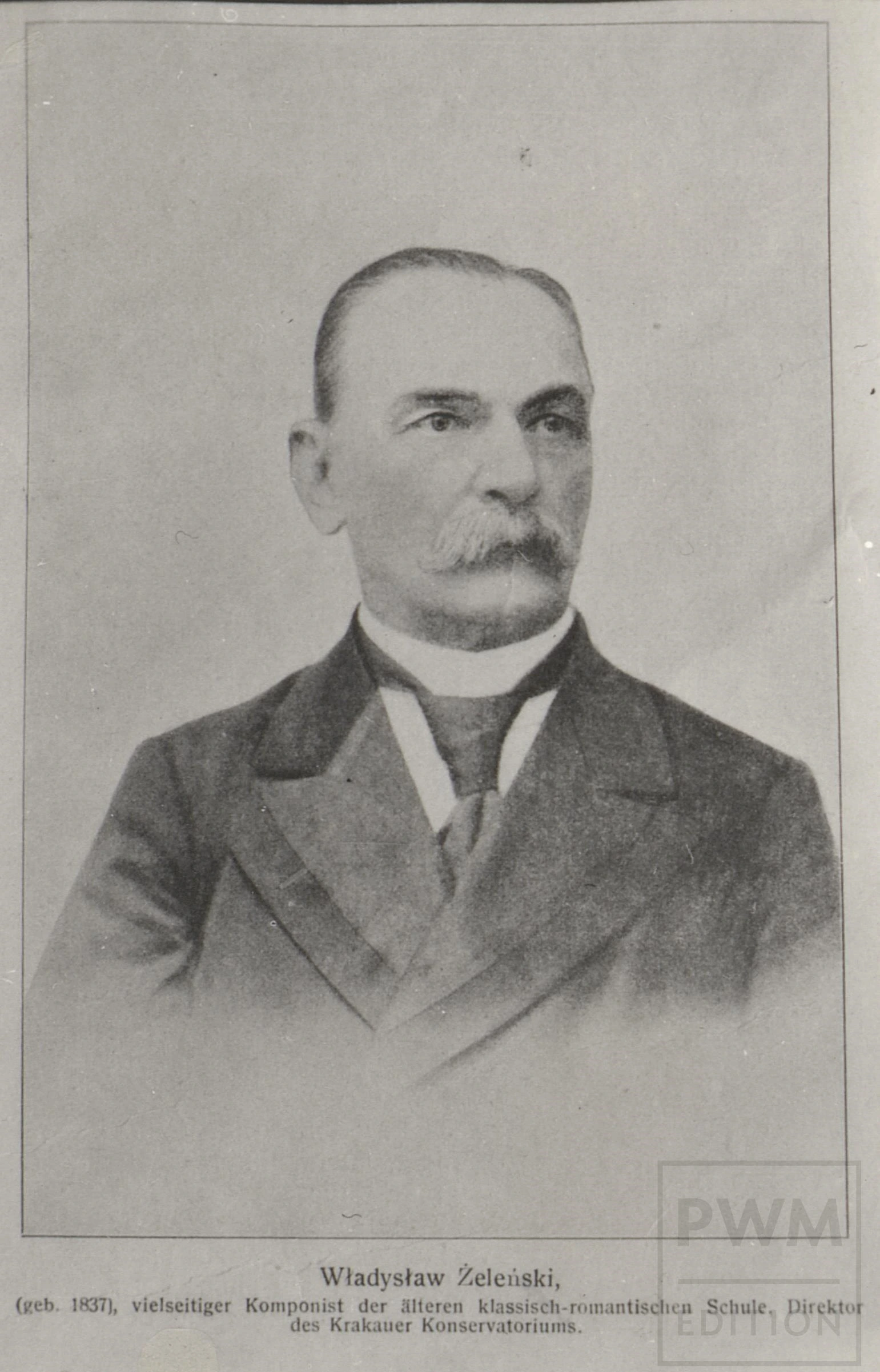
Żeleński Boy, Tadeusz

Żeleński Władysław, *6 July 1837 Grodkowice (near Kraków, currently Wieliczka district), †23 January 1921 Kraków, Polish composer and teacher. The branch of the Żeleński family of the Ciołek coat of arms, from which he descended, settled at the end of the 16th century near Kraków, initially in Łucjanowice (now Łuczanowice), then in Grodkowice and Brzezie; its members were Calvinists and held numerous offices. The composer’s father, Marcjan Żeleński (1804–1846), was an exceptionally talented amateur pianist who tried his hand at composition. In 1828, he converted to Catholicism, participated in the November Uprising, and in 1833 married Kamila Russocka; Władysław was the second of their five children. His older brother, Stanisław (1835–1909), a lawyer and heir to Grodkowice, studied piano with A. Dreyschock in Prague and also played the cello. On 23 February 1846, during the so-called rabacja, the Galicja peasants’ uprising, the manor house in Grodkowice was attacked by armed peasants; Marcjan Żeleński was killed, and his wife and children soon afterwards moved to Kraków, where in 1850–57, Żeleński attended St. Anne’s Gymnasium (Collegium Novodvorscianum), and also learned to play the piano with K. Wojciechowski, and from 1854 with J. Germasz. In 1853 and 1856, he visited Vienna twice, where he heard, among others, Requiem (conducted by F. Liszt), Symphony in G minor, The Marriage of Figaro and Don Giovanni by Mozart, as well as Robert le diable by G. Meyerbeer. Ambitious compositional attempts come from this time (two string quartets, piano trio) undertaken under the direction of F. Mirecki; on 29 July 1857, at the performance of the School and Dormitory of Music in Kraków (founded by Mirecki), Żeleński made his debut as a composer and conductor, leading the first performance of his Overture for orchestra (lost, wrongly described as a “symphony” by a German-language reviewer of the “Krakauer Zeitung”). It was probably also thanks to Mirecki that his Piano Sonata op. 5, was published by Ricordi in Milan in the first half of 1859 at the latest.
In 1857, at the request of his mother, Żeleński began studying philosophy at the Jagiellonian University, which he completed in 1862 with a doctorate from Charles University in Prague, where he went in 1859 to deepen his musical skills. There, he began piano lessons with A. Dreyschock, but soon abandoned the idea of a pianistic career, focusing on studying counterpoint and organ with J. Krejči; it is not certain whether he was formally a student of the so-called Prague Organ School (Ústav pro církevní hudbu), of which Krejči was the director, or rather became his private pupil. In Prague, he composed, among other works, Five Songs from a Royal Court Manuscript, String Sextet op. 9 and several fragments of music for Konrad Wallenrod; he also established publishing contacts and established himself as a composer (his Hymn orłów was performed there as late as 1873). He spent the summer of 1860 in the Tatras, and also travelled to Leipzig and Dresden, where he met K. Lipiński and became acquainted with the operas of Ch.W. Gluck, which made a great impression on him. In 1865, he went to Vienna, where he attended performances of Tannhäuser and Lohengrin by R. Wagner, and there he became friends with A. Grottger. The two met later in Paris, where Żeleński began studying composition with N.H. Reber at the conservatory at the end of 1866 and worked on the never-completed opera Dziwożona; Grottger created a well-known portrait of Żeleński at that time, one of his last works. After a few months, Żeleński gave up studying with Reber and in 1868–70, privately completed his composition studies with B. Damcke; the characteristic symphonic painting W Tatrach comes from this period.
Żeleński came back to Krakow in 1870 and gave a concert there on 30 January 1871 (W Tatrach, piano and choral pieces and songs) with the participation of, among others, K. Hofman and a singer M. Mecenseffi, allocating the proceeds to the renovation of the Cloth Hall. He also presented his works in Warsaw, where he moved at the end of 1871, probably at Moniuszko’s suggestion. In 1872, he married literally-talented Wanda Grabowska (1841–1904), a close friend of N. Żmichowska; they had three sons: Stanisław Gabriel (1873–1914), architect, founder of a famous stained-glass workshop in Krakow, Tadeusz Kamil (pseudonym Boy, 1874–1941), writer and social activist, and Edward Narcyz (1877–1910), lawyer and journalist. On 19 April 1872, Żeleński conducted the premiere of his Symphony No. 1 in Warsaw. In the autumn, he took over the position of professor of counterpoint and harmony at the Warsaw Institute of Music after S. Moniuszko; in 1875–76, he published music reviews in the weekly “Kłosy” and also developed with G. Roguski the textbook Nauka harmonii oraz pierwszych zasad kompozycji. In 1875, he received a prize for the String Quartet in F major at a competition announced by the WTM. In 1878, he became the artistic director of the WTM, however, in the face of the failure of attempts to base Warsaw concert life on permanently operating choral and orchestral ensembles, he resigned in the autumn of 1880, recommending Z. Noskowski in his place.
While in Warsaw, Żeleński maintained lively contacts with Kraków, where on 19 January 1877, he gave a composition concert (Symphony No. 1, songs); in March and April, he took part in the “historical concerts” of the Music Society, and in December 1879, he gave two more composition concerts. At the beginning of 1880, he travelled to Dresden and Prague, where he found the impulse to resume work on the opera Konrad Wallenrod. Finally, on 6 July 1881, he settled in Kraków permanently, taking up the duties of professor of harmony and counterpoint at the music school of the Music Society from 1 September; on 23 December, he published an article in “Czas” (no. 293) containing an analysis of musical relations in Kraków and an outline of a plan to create a music school, orchestra and opera in Kraków. Together with the president of the Music Society in Kraków, S. Niedzielski, and the editor of “Czas,” art historian S. Tomkowicz, and with the support of Princess Marcelina Czartoryska, he began long-term efforts to establish a music school. At the same time, he participated as a pianist in concerts for social purposes (including on 24 April 1882 for the monument of A. Mickiewicz, on 22 March 1886 for the hospital of St. Ludwik), and wrote music reviews in “Czas” The event of those years was the premiere of the opera Konrad Wallenrod on 26 February 1885 in Lviv, which, despite the modest possibilities of the ensemble of the Skarbkowski Theatre, was received with great enthusiasm; after five performances, the ensemble repeated it in Kraków twelve times in the summer, which consolidated Żeleński’s authority as the most outstanding figure of Kraków’s musical life.
On 1 February 1888, on the day the Conservatory of the Music Society in Kraków began its activity, Żeleński took over the position of director of the academy and held this position for 33 years until the end of his life, at the same time lecturing in theoretical subjects. From 1891, he also taught a higher course in organ playing, and periodically also a higher course in piano playing, and also gave private lessons. He led an extremely regulated lifestyle, emphasising his duties at the conservatory, sometimes appearing as an accompanist; around 1909, he performed the piano part in Trio op. 22 at his concert in Kiev and accompanied S. Korwin-Szymanowska; apart from that, he rarely left Kraków. The rhythm of his activity was determined by creative work; until 1914, he composed continuously, and presented his works at his concerts in 1890, 1894, 1900–03, 1906, 1912 and 1914. From 1886, he worked on a new opera based on J. Słowacki’s Balladyna, the libretto of which he commissioned to be developed by L. German. At the end of 1891, the Warsaw Opera announced its readiness to stage it; at the request of the local censorship, Żeleński made minor changes and gave the work the title Goplana, but it was not produced at that time. The premiere of Goplana was given in Kraków by the new ensemble of the Lviv Opera, conducted by H. Jarecki, only on 23 July 1896; by the end of the season, there had been six performances to packed audiences. In the same year, Żeleński went to Prague, where together with K. Čech and Z. Fibich, he discussed the project of the local premiere of Goplana, which however did not come to fruition despite the purchase of musical materials by the Prague Opera and the printing of the libretto in Czech. The successes of Goplana in Lviv (1897) and Warsaw (1898) brought Żeleński fame and the title of Moniuszko’s successor. During the celebrations of the 40th anniversary of Żeleński’s debut as a composer, celebrated on 6 December 1897 in the Sokół Hall in Kraków, the artistic and intellectual circles of Kraków, Lviv and Warsaw paid tribute to him, and Z. Noskowski publicly called him his master. Żeleński’s appreciation was expressed by the selection of his next opera – Janek – for the opening ceremony of the new Municipal Theatre in Lviv on 4 October 1900; this work was also well received. On 4 December 1903, the first performance of the Piano Concerto in E flat major took place in Kraków, and Żeleński entrusted it to his pupil Janina Ładówna. In March 1904, Żeleński’s wife died; in the same year, together with the singer A. Bandrowski, Żeleński began to devise the concept of a new opera – Stara baśń based on J.I. Kraszewski. The work, completed at the beginning of 1906, was performed in Lviv on 14 March 1907 with A. Bandrowski in the role of Doman, and was a great success; its performances in Kraków were part of the celebrations of the composer’s 70th birthday; in the same year, Żeleński married Tekla Symonowicz (1838–1935). One of Żeleński’s most outstanding works comes from these years – Piano Quartet in C minor. On 15 July 1910, on the occasion of the unveiling of the Grunwald Monument in Kraków, his opera Konrad Wallenrod was ceremoniously revived.
The deaths of his sons – Edward (1910) and Stanisław (1914), old age and the difficult war years did not stop Żeleński’s activity. In 1912, he received the 2nd prize in a competition announced by the Warsaw Philharmonic for Symphony No. 2, and on the 75th anniversary of his birth – the title of honorary citizen of the city of Kraków. He managed to maintain the activity of the Conservatory during the war, despite a fourfold decrease in the number of students and teaching staff, and the necessity to move the institution to temporary premises. In 1917, at the jubilee concert on the 80th anniversary of his birth, Żeleński presented Sonata No. 2 for violin and piano. As one of the few artists of his generation, he lived to see the rebirth of Poland, composing and teaching until the last moments of his life.
Żeleński was one of the most outstanding Polish composers of the late 19th century, but his work has been largely forgotten. Most editions of his works are hard to come by today, modern reissues are rare, many pieces have been lost and never systematically searched for. The fate of most of his autographs is also unknown; some of them are kept in the Jagiellonian Library. In the Polish concert repertoire for almost 80 years, Żeleński’s music has been represented only by the overture W Tatrach, a dozen or so songs and the Piano Quartet op. 61, as well as arias from the operas Goplana and Janek. However, even during Żeleński’s lifetime, his compositions, although they enjoyed great recognition and were successful, never extended beyond the borders of Poland, and after 1900 – like Noskowski’s works – they were overshadowed by the achievements of composers from the Young Poland movement. Musicologists associated with this group – Z. Jachimecki and J.W. Reiss – consolidated the image of Żeleński as a conservative, drawing on the musical tradition of F. Mendelssohn and R. Schumann. However, they emphasised the reliability of Żeleński’s compositional skills and his responsible approach to the artist’s tasks. They considered his operas (especially Goplana) and songs to be the most valuable of his achievements, describing him as Moniuszko’s successor; Jachimecki also initiated research on Żeleński’s work, the fruit of which in the years 1934–48 was a number of master’s theses, and in 1952, he published a short monograph on the composer, in which he referred to the findings contained in them, already then indicating the difficulties in reaching the sources. W. Poźniak included a concise description of Żeleński’s operas, songs and chamber works in the collective work Z dziejów polskiej kultury muzycznej (1966). In the last twenty years of the 20th century, there was a marked interest in Żeleński’s vocal lyrics (recordings by J. Kowalski, J. Rappé, articles by A. Nowak and Z. Chechlińska); M. Tomaszewski highly praised it in his radio series Godzina pieśni polskiej. Source research undertaken recently by G. Zieziula has allowed us to establish some details of the composer’s biography and operatic output.
Żeleński was a versatile artist, reaching out to almost all genres and forms of music known in the second half of the 19th century. He belonged to the generation of J. Brahms, C. Saint-Saëns and M. Bruch, for whom attachment to tradition and the craft of composition was an important value. He studied with conservative but experienced teachers. He owed his knowledge of the principles of composition and singing technique to F. Mirecki; J. Krejčí instilled in him a love of counterpoint and interested him in the genre of song, while B. Damcke enabled him to become more familiar with the works of Gluck, whom Żeleński valued the most among composers of dramatic music. His creative aesthetics were influenced by the music of Mendelssohn and Schumann, and later also by Moniuszko and Smetana. On the other hand, there are few connections between Żeleński’s music and the otherwise close to him work of Chopin, which resulted from the fear of being too influenced by it. From the 1880s, Brahms’s music became his ideal, he admired the works of A. Dvořák and P. Tchaikovsky, praised Wagner’s musical drama for the close fusion of music with text, but he was not influenced by his musical language, although according to W. Poźniak, traces of the influence of the harmony of Tristan and Isolde can be seen already in the orchestral introduction to Konrad Wallenrod (ca. 1861). At the age of 65, he confessed in an interview for EMTA: “I am not a modernist. In the face of all these secessionist oddities, I seem terribly backward to myself.” The way he treated folk music as a source of artistic inspiration also speaks volumes about his aesthetic attitude. Żeleński reached for it mainly out of a sense of patriotic duty and could not resist the need – as he himself emphasised – to “idealise” it, that is, to reconcile it with the conventions of the common musical language. These efforts were summed up by Z. Noskowski, who wrote about the opera Janek in a letter to L. German dated 19 October 1900: “Żeleński has never been and cannot be a national artist, because he was not born one.” Żeleński’s reserve towards folk music may have been the result of his childhood experiences and the influence of Mirecki, who described it as a “horizontal source,” but he treated his mission of “elevating native art” with the same seriousness as Noskowski.
Żeleński’s most outstanding artistic achievements include operas. Each of them carries a patriotic message: Konrad Wallenrod and Goplana – by reaching for masterpieces of native literature and taking up the national themes contained therein; the opera Janek – by attempting to reach the truth about the life and customs of Polish highlanders. The message of Stara baśń directs the listener’s attention to the mythical beginnings of the House of Piast. Żeleński never used librettos in circulation, but commissioned their writing after making a previously considered choice of topic. This is how his first opera came into being – Konrad Wallenrod, planned from his early youth, several numbers of which he wrote in Prague, around 1861/62, directly to fragments of Mickiewicz’s poem; he began work on the libretto by Z. Sarnecki and W. Noskowski only around 1876. The musical concept of the work intersects numerous tendencies, subordinated to the assumptions of grand opéra, realised in a four-act opera with a ballet in Act 3. The static nature of the extended, often imitative choral parts is balanced by factors supporting the course of the action, such as the use of leading motifs or smooth transitions between scenes. A specific bond is also the type of melody and sound, characterised by severity, corresponding to the character of the stage environment, dominated by male characters. This feature of the libretto, criticised, although dictated by fidelity to the original, did not prevent Żeleński from creating such contrasting images as the gloomy scene of the court in the underground (Act 4) and the feast scene (Act 3), in which the colourful series of ballads and songs externally resembles the scene of the singing tournament in Wagner’s Tannhäuser. The limitation of female roles to one part of Aldona makes the opera extremely difficult from a dramaturgical point of view. In the whole – apart from Konrad’s song about Alpuhar – there are no popular arias, but there are scenes of great expression and beauty of sound, such as the duet of Konrad and Aldona (Ciebież to widzę) from Act 2.
Goplana is in many ways the opposite of the previous opera. The departures from the original are more profound here due to the emphasis on Goplana’s role, the action is multi-threaded, and the stage environment is highly diverse, which is associated with a large number of solo parts, this time female voices (four sopranos, two mezzo-sopranos); the main motif of the drama – Balladyna’s crime – competes with others, and the opera lacks a clear protagonist. The work’s framework is the contrast between the real and the fantastic world, which paved the way for Żeleński’s masterful characterisation of environments and individual characters. The real world is embedded in the conventional conventions of “knightly” or “hunting” music (some choirs), the traditions of romantic opera (Kirkor’s popular arioso Za jaskółeczką ciągną me oczy from Act 1 and Kostryn’s aria Jam pokochał cię jak szalony from Act 3), and above all in the folk environment, characterised by the use of stylisation. The composer approached this problem very seriously, consulting with O. Kolberg, and achieved convincing effects in the group scenes (the wedding choir from Act 2) and in the part of Grabiec, effectively juxtaposed with the unreal part of Goplana, maintained in a high tessitura and operating with a melody full of artificiality. Being aware that the intended shift of emphasis towards fantasy was unconvincingly realised in the libretto, Żeleński took care to present the world of elves and spirits using very subtle means of orchestral colour. He also removed several dances of folk provenance in the final editing (published separately as the Suite of Polish Dances op. 47). The aptness of the characterisation is revealed, among other things, in in dramatic dialogues (e.g. Balladyna with Alina in the murder scene in Act 2, or Balladyna with the Widow in Act 3), in which the individual parts are distinguished in terms of melody, harmony, and the colour and texture of the orchestral accompaniment. The weight of the action also rests on the dialogues, which develop smoothly due to the blurring of the boundaries between scenes and the discreet use of leitmotifs.
The next opera, Janek, presents a different approach. It is Żeleński’s only stage work based – at least in the author’s opinion – on a true event, and the only one preceded by an extensive overture. The action, enclosed in two acts, takes place exclusively in the environment of the Podhale highlanders, the plots are barely sketched, and the subject matter is contained in the conflict of feelings of love and jealousy leading to the crime. The vocal cast is also sparse (five soloists). Żeleński deepened these features of realistic opera by using several authentic highland melodies (including Chałubiński’s March, W murowanej piwnicy) and giving the famous Sabałowa nuta (Śpiewam ja se, śpiewam) the role of the leitmotif of the whole. He approached these melodies with great reverence, preserving their scale properties and rhythm; he also successfully – and in accordance with Kolberg’s earlier advice not to quote but to “tune in” to the folk tone – created many fragments based on the authentic model. This material imposed certain limitations on the means of expression developed by Żeleński so far, which resulted in a less expressive characterisation of the characters, and it also remained in contradiction with the conventional language of the libretto – the greatest success was achieved by Janek’s lyrical arioso from Act 1 (Gdy ślub weźmiesz z swoim Stachem).
Żeleński’s last opera – Stara baśń based on the novel by J.I. Kraszewski – which the composer had already been thinking about in 1903, was written to a libretto by the famous tenor A. Bandrowski, who placed great emphasis on the continuity of the course, almost completely eliminating the division into numbers, and wrote the whole thing in prose. According to Jachimecki, this caused serious difficulties for Żeleński, who was accustomed to poetic periods; however, it is known that the composer was very fond of the libretto and completed the four-act work within a year – hence the accusation that Stara baśń was underdeveloped. However, this is contradicted by the very careful instrumentation of the work; it is in a sense a consequence of the construction of the libretto, which demanded a symphonic approach following the model of Wagner’s dramas. This is expressed in extensive symphonic fragments, such as the so-called forest symphony in Act 2, the almost impressionistic introduction to Act 4 and the scene of Piast’s appointment to the throne, presented in the form of a “living tableau” and constituting the final apotheosis. This scene, combined with the opera’s theme, indicates a strong kinship between Stara baśń and Smetana’s Libusza. The main means of developing the action is dialogue, hence the importance of the character’s characterisation, which is complemented by songs, which belong to the few closed fragments; of these, Dziwa’s song from Act 2 is an arrangement of Jaruha’s Song, composed to Kraszewski’s lyrics 30 years earlier, while the character of Jaruha herself is outlined in the opera, among others, by the new song Stało się, co stać się miało. Stara baśń is evidence of the continuous development of the musical language in the late phase of Żeleński’s work, especially in the field of harmony (free modulation, whole-tone structures) and sound colouring, but currently it is one of the completely forgotten works.
Żeleński’s songs are still considered one of the representative areas of his work. 90 of them have survived, 60 of which are included in collections of various sizes. All of them, except for Five Songs from a Royal Court Manuscript, Marzenia dziewczyny to an anonymous Czech text, and the song Nocna jazda, based on a parody of a poem by H. Heine, were written to Polish texts. Initially, Żeleński reached for Romantic poetry (A. Mickiewicz, B. Zaleski), later mainly for poems by contemporary authors; over the course of half a century, he was inspired by the work of several generations of Polish poets, from Z. Krasiński, through T. Lenartowicz, A. Asnyk, K. Tetmajer to M. Wolska. Only a small part of Żeleński’s output consists of simple songs to trivial lyrics (e.g. Do Polek to words by F. Żygliński), and only a few songs are intended for singing at home; among them, Czarna sukienka to words by K. Gaszyński, written during the January Uprising, became a symbol of universal mourning after the national tragedy. Żeleński selected texts that found a special resonance in his musical imagination, tuned mainly to lyrical categories of elegiacity, longing, resignation, but sometimes also vitality and wit (O Jaśku spod Sącza, Czy aniołek, czy diabełek). The mood and tone of the text were more important to the composer than its structure, which is why Żeleński’s songs are, against the background of contemporary tendencies, a rather isolated example of the dominance of the musical layer over the verbal layer. Sometimes, as in the collection of nine songs to words by K. Przerwa-Tetmajer (after 1891), the stanzaic structure of the poem is completely ignored, and the poetic statement is forced into the framework of a musical form of the ABA type or its variants. Despite this, this collection is one of the most perfect in Żeleński’s output, similarly to the earlier collection of five songs with lyrics by Z. Krasiński (ca. 1881). Among the individual songs, the most famous is Piesń Jaruhy with lyrics by J.I. Kraszewski, with its archaising melody.
The loss of both of Żeleński’s symphonies meant that his only representative symphonic work is the “characteristic painting” W Tatrach, which dates back to his Parisian studies and is known as an overture. Conceived in sonata form with an introduction and a dynamically developing fugue in the development, it is distinguished by the great plasticity of its themes, the first of which reveals a previously unexplained kinship with the theme of the finale of Dvořák’s Cello Concerto (1895). The only preserved fragment of Symphony No. 1 – its slow movement, published as a separate piece entitled Trauerklänge – is distinguished by a similar expressiveness of themes and compactness of form. It allows us to hypothetically place Symphony No. 1 among the Polish symphonies containing an elegy by I.F. Dobrzyński, Z. Noskowski and I.J. Paderewski. Piano Concerto in E flat major, once performed with great success by I. Friedman, but now completely forgotten, comes from the last period of his work. It is characterised by a monumental approach, a dense piano texture and a melody full of archaising intonations reminiscent of modalities.
The opinion of the great value of Żeleński’s chamber compositions can currently only be confirmed by a few of his works. Written in Paris, Variations on an Original Theme for string quartet and Piano Trio are distinguished by excellent mastery of compositional skills and freshness of ideas. One of Żeleński’s greatest achievements is Piano Quartet in C minor op. 61, fully representing the composer’s mature style. In its sound climate, it comes close to Brahms’s chamber works, but both the formal discipline, the dark sound, the balance of instrumental parts and the dense texture are a consequence of Żeleński’s creative path to date. The quartet is characterised by a very high level of thematic invention. In part 3 – Intermezzo. Allegretto – modulation processes and harmony, sometimes reaching the limits of the functional system, are abstracted from the scale properties of Polish folk music, analogously to the work of L. Janáček, with which, however, Żeleński’s work shows no connection.
In Żeleński’s modest piano output (18 opuses), two early sonatas stand out, as well as the late Variations in B minor op. 62. Sonata op. 5, the only surviving composition from the time of his studies with Mirecki, refers to Beethoven’s patterns. Sonata op. 20 was written during his Paris studies; with its compactness, logical construction, texture permeated with counterpoint and motor movement, almost toccata-like in part 1, it corresponds with the post-Romantic tendencies in the music of the second half of the 19th century. Variations in B minor (theme and 10 variations) prove that the generalised features of Polish folk music became an organic element of Żeleński’s musical thinking over the years. A separate group consists of a dozen or so salon miniatures and stylised dances (mazurkas, krakowiaks, polonaises), as well as several concert pieces, including the Grand scherzo de concert op. 35 and Moments d’un carnaval. Valse brillante op. 52.
To this day, Żeleński’s preludes, included in the collection of 25 Organ Preludes op. 38, have remained in the repertoire of Polish organists. Based on themes from Polish church songs, they combine simplicity with a whole range of stylistic and textural devices. Much more advanced devices, including colouristic ones, are revealed by Prélude pastoral op. 68, written on commission from J. Joubert, completely unknown in Poland.
Żeleński made great contributions to Polish musical culture as an organiser and teacher, thanks to which his name still functions in the public consciousness; in his activities, one can see a convergence with the positivist idea of grassroots work. He saw the foundation for the development of musical culture in education, teaching highly professional forces capable of creating further musical institutions, such as permanent orchestras, choral groups, and ultimately also opera groups. The dispute over the quality of education and the level of music performed was the reason for Żeleński’s departure from the Warsaw Institute of Music. His efforts to establish a conservatory in Kraków were carried out against the intentions of the Austrian authorities, who consciously sought to marginalise the role of the former capital of Poland. Żeleński’s idea was to provide musical education for young people, who had begun to come to Kraków again since the reform of the Jagiellonian University carried out by J. Dietl. Żeleński ensured the development of the school, basing its functioning on piano classes, which enjoyed particular social interest, for which he acquired outstanding teachers, including J. Drozdowski, B. Domaniewski, J. Lalewicz and S. Eisenberger. During his 33 years as director, he also ensured the continuity of teaching in the violin, cello, organ and solo singing classes, as well as the principles of music and harmony. Thanks to his energy and conciliatory skills, he suppressed conflicts that emerged between the conservatory and the not always competent boards of the Music Society. The model of functioning of the school that he developed proved effective even after his death; the conservatory operated until the outbreak of World War II, for a total of 51 years, which was unique in a city where many cultural institutions went bankrupt due to lack of funds and conflicts within the community. As a teacher, Żeleński was considered a strict conservative; he did not teach composition, but only its basics, which in practice translated into extended study of harmony. His students included I.J. Paderewski (in Warsaw), H. Opieński, R. Statkowski, Z. Stojowski and F. Szopski.
It is currently impossible to make a synthetic approach to Żeleński’s work and a full assessment of his activity. Traditionally, it is placed next to Noskowski’s work, between Moniuszko’s works and the achievements of the composers of Young Poland. However, it can also be seen as a manifestation of European academism, a trend whose significance in art has only recently been appreciated, and which in the history of Polish music had no equally outstanding representative apart from Żeleński.
Literature: F. Szopski Władysław Żeleński, «Biblioteka Muzyczna» III, ed. M. Gliński, Warsaw 1928; J.W. Reiss Almanach muzyczny Krakowa 1780– 1914, vol. 1, Kraków 1939; J.W. Reiss Najpiękniejsza ze wszystkich jest muzyka polska, Kraków 1946, 31984; Z. Jachimecki Władysław Żeleński. Życie i twórczość (1837–1921), “Rocznik Krakowski” XXXII, 1952, reprint «Biblioteka Słuchacza Koncertowego» V, Kraków 1959, 2 1987; W. Poźniak Opera po Moniuszce, Pieśń solowa po Moniuszce, Muzyka kameralna i skrzypcowa, in: Z dziejów polskiej kultury muzycznej, vol. 2, Kraków 1966; J. Gołos Polskie organy i muzyka organowa, Warsaw 1972; A. Nowak Pieśni Władysława Żeleńskiego, in: Krakowska Szkoła Kompozytorska 1888–1988, ed. T. Malecka, Kraków 1992; A. Nowak Liryki Tetmajera w pieśni postromantycznej i młodopolskiej, in: Poeci i ich muzyczny rezonans. Od Petrarki do Tetmajera, «Muzyka i Liryka», ed. M. Tomaszewski, book 4, Kraków 1994; Z. Chechlińska Pieśni solowe Władysława Żeleńskiego do tekstów A. Mickiewicza, in: Mickiewicz i muzyka. Słowa – dźwięki – konteksty, ed. T. Brodniewicz, M. Jabłoński and J. Stęszewski, Poznań 2000; Z. Chechlińska Pieśni Żeleńskiego do słów Tetmajera, in: Pieśń polska. Rekonesans, «Muzyka i Liryka», red. M. Tomaszewski, book 10, Kraków 2002; G. Zieziula Życie i twórczość Władysława Żeleńskiego w świetle źródeł epistolarnych, “Muzyka” 2008 no. 4; G. Zieziula Wokół opery „Goplana” Władysława Żeleńskiego. Pytania o genezę i styl, in: O Słowackim – „umysły ludzi różne”, ed. U. Makowska, Warsaw 2009.
Compositions
Instrumental:
for orchestra:
Symphony No. 1, only Andante sostenuto part preserved, lost, published as Trauerklänge. Elegisches Andante op. 36, 1871, performed in Warsaw 19 April 1872, performed in Leipzig ca. 1884 Kistner
Symphony No. 2, ca. 1910–12, performed in Warsaw after 1912, lost
Overture for orchestra, 1857, performed in Kraków 29 July 1857, lost
W Tatrach for orchestra, characteristic picture (overture) op. 27, 1870, performed in Kraków 30 January 1871, no year, Kistner
Two Polish Dances for orchestra op. 37, ca. 1880, including Mazur, published in Kraków PWM
Echa leśne, concert overture for orchestra op. 41, ca. 1880 (?), lost (?)
Suite of Polish Dances for orchestra op. 47, ca. 1890, published in Londyn no year, Lucas, Weber, Pitt & Hatzfeld
Oda do młodości for orchestra, solemn march (to bring back Mickiewicz’s body) op. 51, 1890, Kraków no year Krzyżanowski (piano reduction)
Polonaise in D minor for orchestra (in memory of J. Matejko, version for piano for 4 hands), published in Prague 1894 Urbánek
Roma for orchestra, paraphrase on two themes from Chopin op. 65, ca. 1910
Marsz dla szwoleżerów polskich for orchestra, 1919
for instrument solo and orchestra:
Romans op. 40, for cello and orchestra, ca. 1880 (?), published in Leipzig, no year, Kistner
Piano Concerto in E-flat major op. 60, 1903, performed in Kraków 4 December 1903 (piano J. Ładówna), published in Braunschweig no year Litolff
chamber:
String Sextet op. 9, ca. 1861, lost
String Quartet in E minor op. [1], before 1859, lost
String Quartet op. [2], before 1859, lost
Variations op. 21, for string quartet, before 1870, published in Leipzig 1880–85 Kistner
String Quartet in F major op. 28, ca. 1875, published in Leipzig ca. 1883 Kistner
String Quartet in A major op. 42, after 1880 (?), published in Wrocław ca. 1890 Hainauer
Piano Quartet in C minor op. 61, 1904 or 1909, published in Braunschweig 1910 Litolff
Piano Trio op. [3], before 1859, lost
Piano Trio in E major op. 22, before 1870, published in Leipzig, no year, Kahnt
Deus morceaux de salon op. 16, for violin and piano: 1. Romance, 2. Chant élégiaque, published in Prague 1860 Wetzlar
Romans op. 29, for violin and piano, after 1870, published in Warsaw, no year, F. Hoesick
Taniec fantastyczny op. 29, for violin and piano, after 1870, published in Warsaw, no year, F. Hoesick
Sonata No. 1 in F major op. 30, for violin and piano, after 1870, published in Warsaw, no year, F. Hoesick
Sonata No. 2 for violin and piano, ca. 1917, published in Kraków 1917 (parts 2 and 3), lost
Lyrischer Walzer op. 15, for cello and piano, published in Vienna 1871 Gotthard
Berceuse in F major op. 32, for cello and piano, before 1880, published in Berlin, no year, Ries & Erler; version for violin (viola) and piano, before 1880, published in Kraków 2021 PWM
solo:
Valse caprice in D-flat major op. 9, for piano, 1858, published in Leipzig, no year, Kahnt
Sonata in G minor op. 5 for piano, before 1859, published in Kraków 2020 PWM
Sonata op. 5, for piano, ca. 1859, published in Milan 1859 Ricordi
Sonata [No. 2] op. 20, for piano, before 1870, published in Leipzig, no year, Kahnt
Sechs charakterstücke op. 17, for piano, book 2, published in Vienna ca. 1871 Gotthard
Humoreske und Gavotte op. 18, for piano, published in Vienna ca. 1871 Gotthard
Deux mazourkas op. 31, for piano, ca. 1875–80, published in Berlin, no year, Ries & Erler
Two Polish Dances (version for piano for 4 hands), published in Prague, no year, Urbánek
Grand scherzo de concert op. 35, for piano, published in Leipzig ca. 1882 (?) Kistner
Prélude-Caprice op. 43, for piano, 1888–93, published in Vienna, no year, Doblinger
Moments d’un carnaval. Valse brillante op. 52, for piano, ca. 1890, published in Kraków, no year, Krzyżanowski
Suite of Polish Dances (version for piano), published in Moscow, no year, Jurgenson
Thème varié in B minor op. 62, for piano, 1909, published in Warsaw, no year, Gebethner & Wolff
Roma, paraphrase on two themes from Chopin (version for piano), published in Kraków, no year, Krzyżanowski
Two Polish Dances op. 3, for piano, published in Prague, no year, Urbánek
Deux morceaux de salon op. 11, for piano, published in Leipzig, no year, Kahnt
Marsz uroczysty [Solemn March] (in honour of the immortal bard A. Mickiewicz) op. 44, for piano, published in Kraków, no year, Krzyżanowski
Gavotte op. 45, for piano, published in Warsaw, no year, Gebethner & Wolff; arrangement for orchestra 1912, published in Kraków 2019 PWM
Wielki polonez op. 46, for piano, published in Lviv, no year, Jakubowski
Rêverie op. 48, for piano, published in Warsaw, no year, Gebethner & Wolff
Deux morceaux op. 63, for piano, published in Kiev, no year, Idzikowski
25 Preludes op. 38, for organ, 1881, published in Warsaw 2 1913 Gebethner & Wolff (the collection also includes 7 pieces by other composers: A. Freyer, S. Moniuszko, A. Rzepka and S. Solecki)
Prélude pastoral op. 68, for organ, in: J. Joubert Les maîtres contemporains de l’orgue, vol. 8, published in Paris 1914
Vocal:
Two Male Choirs op. 34, published in Leipzig ca. 1880 Leuckart: no. 1: Chór żeglarzy, words by E. Wasilewski, 1861; no. 2: Pieśń do Wilii, words by A. Mickiewicz, 1861
Pieśń myśliwska op. 33, for male choir and 4 horns ad libitum, words by S. Garczyński, published in Leipzig ca. 1880 Leuckart
Morze for male quartet, published in Lviv 1898
Nasza Hanka for male choir, published in Prague, no year, Urbánek
Vocal-instrumental:
songs:
Śpiew op. l (opus number re-assigned by the composer), for voice and piano, words by S. Garczyński, 1857–60, 1st ed. 1860–67
Moja pieszczotka op. 2 (opus number re-assigned by the composer), for voice and piano, words by A. Mickiewicz, 1857–60
Śpiewak w obcej stronie op. 3 (opus number re-assigned by the composer), for voice and piano, words by B. Zaleski, 1857–60, 1st ed. 1860–67
Pajęczyna op. 6, for voice and piano, words by W. Syrokomla, 1857–60
2 Songs op. 7, for voice and piano, words by B. Zaleski, 1857–60, 1st ed. Kraków 1860–67 Grzybowski: 1. Czarnobrywka (in the original version – purchased and destroyed by Żeleński – as Spotkanie się nasze gdzieś daleko), 2. Zakochana
3 Songs op. 8, for voice and piano, ca. 1859–60, 1st ed. Warsaw 1861 Dzwonkowski: 1. Triolety, words by B. Zaleski; 2. W imionniku S.B., words by A. Mickiewicz; 3. Wspomnienie, words by B. Zaleski, ca. 1859–60
Pięć śpiewów z królodworskiego rękopisu (should be królowodworskiego. This edition is currently unavailable, it is not known whether the cycle was written to the original Czech words or to the Polish translation, hence the origin of the error in the title, known only from indirect sources, is unknown) op. 10, for voice and piano, words by V. Hanka, 1861–62, 1st ed. 1862: 1. Zazulka, 2. Róża, 3. Opuszczona, 4. Skowronek, 5. Wianek
2 Songs op. 12, for voice and piano, 1st ed. Kraków. no year, Krzyżanowski: 1. Czarna sukienka, words by K. Gaszyński, 1863; 2. Do Polek, words by F. Żygliński, 1864
Rojenia wiośniane op. 13, for voice and piano, words by B. Zaleski, ca. 1864
2 Songs op. 14, for voice and piano, words by M. Bołoz Antoniewicz, ca. 1864: 1. Mój kwiatek, 2. Posyłka, ed. Dix mélodies
3 Songs op. 19, for voice and piano, ca. 1864, 1st ed. 1867 (?), Warsaw 1898 Gebethner & Wolff: 1. Młodo zeswatana, words by B. Zaleski; 2. Jaskółka, words by T. Lenartowicz; 3. Łzy, words by T. Lenartowicz
Sen for voice and piano, words by A. Mickiewicz, 1865
2 Songs op. 23, for voice and piano, words by Miron (A. Michaux), 1st ed. ca. 1872, Warsaw 2 1895 Gebethner & Wolff, ed. Pieśni wybrane, book 1: 1. Sen nocy letniej, 2. Pod okienkiem
Dzikie sny op. 24, for voice and piano, words by M. Romanowski, ca. 1870, 1st ed. 1873
Pieśni Gabryelli op. 25, for voice and piano, words by N. Żmichowska, 1st ed. Warsaw 1897 F. Hoesick: 1. Z księgi pamiątek, 1871–73, ed. Dix mélodies; 2. Podarunek, 1871–73, ed. Pieśni wybrane, book 1; 3. Tęsknota, 1871–73; 4. Niepodobieństwo, 1871–73; 5. Łaskawa dziewczyna, 1871–73, ed. Dix mélodies; 6. Co bym ci chciała dać, 1871–73, ed. Pieśni wybrane, book 1; 7. Dziwne dziewczę, 1876–77
Czy aniołek, czy diabełek for voice and piano, words by A.E. Odyniec, 1877, ed. Pieśni wybrane, book 1
Oczywistość op. 25 (the song may have been originally intended for the collection Pieśni Gabryelli), for voice and piano, words by N. Żmichowska
Z teki Józefa Kozielskiego op. 26, for voice and piano, words by J. Kościelski, 1877–78, ed. Dix mélodies: 1. Tęsknota za zimą, 2. Dzieje serca, 3. Wieje wietrzyk po polu, ed. Pieśni wybrane, book 1; 4. Pytania
Pieśń Jaruhy (in literature often mentioned in the spelling “Jaruchy”; included in the opera Stara baśń as Pieśń Dziwy with words by A. Bandrowski, published in Kraków ca. 1907 Krzyżanowski) for voice and piano, words by J.I. Kraszewski, 1877–79, 1st ed. Album jubileuszowy ku czci Kraszewskiego, Kraków 1879, ed. Dix mélodies, Pieśni wybrane, book 1
Marzenia dziewczyny for voice and piano, words from a transl. of an unknown Czech text, 1st ed. Kraków (?) 1879, Pieśni wybrane, book 1
Niepewność for voice and piano, words by A. Mickiewicz, 1st ed. Kraków 1880 (?), ed. Dix mélodies
Zaczarowana królewna for voice and piano, words by A. Asnyk, 1880, ed. Dix mélodies, Pieśni wybrane, book 1
Gdy ostatnia róża zwiędła for voice and piano, words by A. Asnyk, 1880 (?), 1st ed. Lviv, no year, Jakubowski, ed. Pieśni wybrane, book 1
Róża dzika for voice and piano, words by K. Kucz, 1st ed. Kraków 1880 (?), ed. Pieśni wybrane, book 1
Szło dziecię z fujarką for voice and piano, words by M. Kwilecka, 1881, 1st ed. Kraków 1891, ed. Pieśni wybrane, book 1
5 Songs for voice and piano, words by Z. Krasiński, ca. 1881: 1. Ja błąkam się wszędzie (mentioned also with a title Z Nieboskiej komedii), 1st ed. Kraków 1881, ed. Pieśni wybrane, book 1; 2. Zawsze i wszędzie, 1st ed. Kraków 1881, ed. Pieśni wybrane, book 1; 3. Przy rozstaniu, ed. Pieśni wybrane, book 2; 4. Elegia, 1st ed. Kraków after 1891, ed. Pieśni wybrane, book 2; 5. Czy pamiętasz, 1st ed. Kraków after 1891, ed. Pieśni wybrane, book 2
4 Songs for voice and piano, words by M. Konopnicka, 1881–83, 1st ed. Kraków 1890–91: 1. Z nocy letnich; 2. Na fujarce, ed. Pieśni wybrane, book 1; 3. Poleciały pieśni moje, ed. Dix mélodies, Pieśni wybrane, book 1; 4. Z łąk i pól, ed. Dix mélodies
Na śnieżnym krzaku choiny for voice and piano, words by T. Wodzicka, 1st ed. Kraków 1883, ed. Pieśni wybrane, book 1
Robaczek kochał się w róży for voice and piano, words by T. Wodzicka, 1st ed. Kraków 1883, ed. Dix mélodies
Życzenie for voice and piano, words by F. Żygliński, 1st ed. 1886, ed. Pieśni wybrane, book 1
Słowiczku mój for voice and piano, words by A. Mickiewicz, 1st ed. Kraków 1888–90, ed. Pieśni wybrane, book 1
Te rozkwitłe ciche drzewa for voice and piano, words by A. Mickiewicz, 1886, 1st ed. 1890–91, ed. Pieśni wybrane, book 2
Polały się łzy for voice and piano, words by A. Mickiewicz, 1st ed. 1891
3 Songs for voice and piano, words by A. Asnyk, po 1888, 1st ed. Kraków 1902 Krzyżanowski: 1. Powrót piosenki, ed. Pieśni wybrane, book 2; 2. Pan Jezus chodzi po świecie; 3. Siedzi ptaszek na drzewie, ed. Pieśni wybrane, book 2
9 Songs for voice and piano, words by K. Przerwa-Tetmajer, po 1891: 1. Zawód, ed. Pieśni wybrane, book 2; 2. A kiedy będziesz moją żoną, ed. Pieśni wybrane, book 2; 3. Na Anioł Pański, ed. Pieśni wybrane, book 2; 4. Blada róża, ed. Pieśni wybrane, book 2; 5. Brzozy, ed. Pieśni wybrane, book 2; 6. Wierzba, ed. Pieśni wybrane, book 2; 7. Preludium. Widzę ją, 1st ed. Kraków 1903, ed. Pieśni wybrane, book 2; 8. Skonaj, ty serce, 1st ed. Kraków 1903, ed. Pieśni wybrane, book 2; 9. Cień Chopina
Co mi tam for voice and piano, words by T. Wodzicka, 1894, 1st ed. Kraków 1894
Nie wróci for voice and piano, words by T. Wodzicka, 1894, 1st ed. Kraków 1894, ed. Pieśni wybrane, book 2
Pieśni Dudarza for voice and piano, words by A. Mickiewicz, 1st ed. Kraków before 1900 Krzyżanowski, ed. Pieśni wybrane, book 2: 1. Idę ja Niemnem, 2. Komu ślubny splatasz wieniec
3 Songs for voice and piano, words by M. Gawalewicz, 1st ed. Kraków 1900: 1. Smutno, 2. Serenada, 3. Babie lato
Ja Tobie serce ślę for voice and piano, words by J. Malczewski, 1st ed. Kraków 1904, ed. Pieśni wybrane, book 2
Leci piosenka for voice and piano, words by L. Rydel, 1st ed. Kraków 1904–08
Ja dzisiaj wieczorem for voice and piano, words by L. Rydel, 1st ed. Kraków 1904–08
O Jaśku spod Sącza for voice and piano, words by M. Wolska, 1st ed. Kraków ca. 1908, ed. Pieśni wybrane, book 2
Dola moja for voice and piano, words by M. Wolska, ca. 1908 (?)
Rapsod for voice and piano, words by J. Relidzyński, 1st ed. Kraków 1909
O pieśni moje for voice and piano, words by J. Relidzyński, 1st ed. Kraków 1909
3 Songs, for voice and piano, words by Z. Ułaszynówna, 1st ed. Kraków 1911: 1. W białym sadzie; 2. Preludium. Drzemie blask miesiąca, ed. Pieśni wybrane, book 2; 3. Płyną wonie
Nocna jazda for voice and piano, words after H. Heine, ed. Pieśni wybrane, book 1
Złota rybka for voice and piano, words by J. Zacharyasiewicz, 1st ed. Lviv, no year, Jakubowski
Barkarola for 2 voices and piano, words by A. Asnyk, 1st ed. Kraków, no year, Krzyżanowski
other:
Poranek cantata for soprano and flute, words by J.K. Turski, performed in Kraków 1859
Kantata na cześć J.I. Kraszewskiego [Cantata in honour of J.I. Kraszewski] for male choir and orchestra, words by A. Asnyk,
1879
Kantata na pamiątkę dwóchsetnej rocznicy zwycięstwa króla Jana III pod Wiedniem [Cantata to commemorate the two hundredth anniversary of King John III’s victory at Vienna] for male choir and orchestra, words by W.L. Anczyc, 1883, published in Kraków ca. 1884
Kantata na odsłonięcie pomnika J. Szujskiego w Tarnowie [Cantata for the unveiling of the J. Szujski monument in Tarnów], 1886
Kantata akademicka na pamiątkę trzechsetletniej rocznicy założenia Gimnazjum św. Anny [Academic cantata to commemorate the three hundredth anniversary of the foundation of St. Anne’s Secondary School], words by L. German, 1888
Gloria Tibi Alma Mater, cantata to commemorate the 500th anniversary of the Jagiellonian University, for male choir and orchestra, 1900
Do pieśni, cantata for the opening of the Warsaw Philharmonic, 1901
Kantata na odsłonięcie pomnika T. Kościuszki w Waszyngtonie [Cantata for the unveiling of the Kościuszko monument in Washington], 1910
Hymn orłów for male choir and orchestra, words by E. Wasilewski, ca. 1862, performed in Prague 1873
Hymn do pracy, for the opening ceremony of the National Exhibition in Lviv, 1894
Latin Mass for male choir and organ
Mass for female choir
Mass for mixed choir
Psalm 46. In exitu Israel for mixed choir, words by J. Kochanowski
Veni creator for mixed choir
Salve Regina
Te Deum
Bogarodzica
Scenic:
operas:
Konrad Wallenrod, in 4 acts, libr. Z. Sarnecki and W. Noskowski after A. Mickiewicz’s poem, ca. 1861–62 and 1876–84, premiere Lviv 26 February 1885, published in Kraków 1886 (piano reduction)
Goplana, in 3 acts, libr. L. German after J. Słowacki’s Balladyna, ca. 1890–95, premiere Kraków 23 July 1896, published in Leipzig 1897 Hofmeister (piano reduction), Kraków–Vienna 1897 Eberle (3 volumes, author’s expense)
Janek, in 2 acts, libr. L. German, ca. 1891–98, premiere Lviv 4 October 1900, published in Kraków 1900 Krzyżanowski
Stara baśń, in 4 acts, libr. A. Bandrowski after J.I. Kraszewski’s novel, ca. 1904–06, premiere Lviv 14 March 1907, published in Kraków 1910 Piwarski
theatre music:
Wit Stwosz, text by W. Rapacki, 1857
Lilla Weneda, text by J. Słowacki, 1904.
Mindowe, text by J. Słowacki, 1904
Editions:
Pieśni wybrane, book 2, ed. W. Poźniak, Kraków 1958
Dix mélodies, Paris-Berlin, no year, Ries & Erler
Wariacje na temat własny op. 21, Kraków 1948
Barkarola, Kraków 1953
Romans op. 16, «Miniatury Skrzypcowe» book 116, Kraków 1956, 32003
25 Preludes op. 38, ed. J. Kucharski, Kraków 1960, M. Merunowicz, Kraków 31973, 92010
W Tatrach op. 27, ed. W. Poźniak, «Biblioteka Małych Partytur» no. 38, Kraków 1963, «Musica Viva», Kraków 21987
Kantata na cześć 200-letniej rocznicy zwycięstwa króla Jana III pod Wiedniem, ed. Sz. Kawalla, Bydgoszcz 1986
Sonata in F major op. 30, ed. K. Danczowska and J. Zathey, Kraków 1988
Piano Quartet in C minor op. 61, Kraków 2000
Solemn March op. 44, Warsaw 2004
Rêverie op. 48, Warsaw 2004
2 Mazurkas op. 31, Warsaw 2004
Valse-Caprice op. 9, Warsaw 2004
Walc liryczny op. 15, Gdynia 2009
Works:
Nauka harmonii oraz pierwszych zasad kompozycji, with G. Roguski, Warsaw 1877, 21899
Nauka pierwszych zasad muzyki, Warsaw 1898
reviews and press articles, including F. Chopin w 50. rocznicę zgonu, EMTA 1899 no. 41