
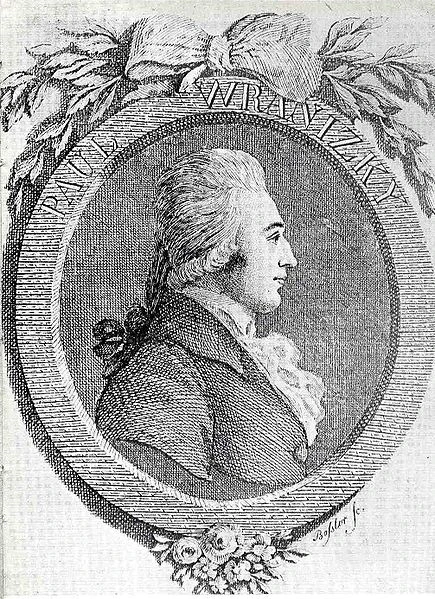
Vranický, Antonín

Vranický, Wranitzky, Wraniczky, Wranizky, Pavel, *30 December 1756 Neureisch (now Nová Říše, Moravia), †26 September 1808 Vienna, Czech composer, violinist and conductor active in Vienna. Initially, he studied at the school at the Premonstratensian monastery in Nové Říše, and in 1770–71 at the Jesuit grammar school in Iglau (now Jihlava), including singing, organ and violin. From 1771, he studied theology in Olomouc; he left for Vienna in 1776, where he continued his studies at the theological seminary and music (he soon became an excellent violinist), including composition. In the early 1780s, he abandoned his theological studies, choosing a musical career. In 1783, he studied with J.M. Kraus – vice-kapellemaster of the Swedish King Gustav III, who was then residing in Vienna. In the spring of 1784, he became music director at the court of Count Johann Nepomuk Esterházy in Galanta; he met J. Haydn (Kapellmeister at the court of Prince Miklós József Esterházy) at that time. From October 1785, he directed the orchestra of the Kärntnertortheater, and from 1787, also the orchestra of the Burgtheater in Vienna. From 1792 or 1793 until the end of his life, he was the director of the orchestras of both theatres. In 1793, he was elected secretary of the Tonkünstler-Sozietät.
Vranicki’s compositions were known throughout Europe, published and reprinted many times in Offenbach, Amsterdam, Vienna, Paris, Speyer, Leipzig, Augsburg, Braunschweig, and Berlin. Most of the manuscripts are located in the Lobkowitz archive (formerly in Roudnice nad Labem, currently in the Národní Muzeum in Prague). They gained great popularity at the court, in aristocratic circles, and among Viennese music lovers. During the coronation ceremonies of Emperor Leopold II in Frankfurt am Main, the composer performed his singspiel Oberon on 15 October 1790, and in 1792, for the coronation of Emperor Francis II, he wrote the Symphony in C major Op. 19. He also composed works for the private use of Maria Theresa Bourbon, the second wife of Francis II, as well as symphonies and stage works for court ceremonies. He was valued as a conductor, among others, by J. Haydn and Beethoven; in 1799 and 1800, he conducted Haydn’s Creation at the Tonkünstler-Sozietät concerts in Vienna, in 1800, he conducted the first performance of Beethoven’s Symphony No. 1. He was friends with W.A. Mozart, from 1784 he belonged to the same Masonic lodge; he also wrote songs for it.
Vranický’s music represents the trend of mature classicism and is close in character to the works of Haydn and Mozart. Being an excellent conductor, the composer knew the possibilities of the instrumental ensemble very well, and his works are distinguished by their colourful orchestration and exposing the possibilities of individual instruments. He had a melodic talent, so the melodiousness of the slow movements is noteworthy; he also used elements of Czech folk music. Instrumental music, especially symphonic and chamber one, plays a leading role in his work. He was one of the most important creators of symphonies in Vienna in the 1780s and 1790s. He composed them from the mid-1780s, and over 20 have been published in print. Symphonies usually have a four-movement form, sometimes with a slow introduction (e.g. the majestic introduction in dotted rhythms in the Grande sinfonie in C major Op. 17), and the influence of Beethoven was evident in the later ones (Op. 50–52; Vranický was already familiar with his Symphonies No. 1 and No. 2). In Op. 52, the slow movement has a “Beethovenian” character, and the Allegretto has the scherzo form introduced to the symphony by Beethoven. The composer’s penchant for illustrativeness is evident in the programme pieces (e.g. the trumpet fanfares in the symphony La chasse). The 4-movement Grande sinfonie caractéristique pour la paix avec la République Françoise Op. 31 is worth attention, as Vranický referred to the events of the French Revolution in each movement; the slow movement is a funeral march after the death of Louis XVI (the diminished seventh chord used in this context sounds particularly moving).
An important place in Vranický’s legacy is also occupied by chamber works featuring the violin, primarily string quartets (over 50 published during the composer’s lifetime). Vranický wrote mostly 3-part quartets in the then popular concert style (according to the generally accepted convention, each instrument had its own showpiece, leading parts), sometimes also virtuoso quartets, in which he treated the violin as the concert instrument, and the other instruments provided the accompaniment. In the quartets Op. 23, dedicated to the King of Prussia Frederick William II (a good cellist), the virtuoso cello part plays a significant role.
Associated with the Vienna Hofoper, Vranický was successful as the author of singspiel, music for plays, ballets, and ballet interludes for operas. Ballets, especially Das Waldmädchen, were very popular. The “grosse kommissche Feen–Oper” Oberon, König der Elfen deserves special attention. This is one of the first (and the first significant) fantasy operas, popular in Vienna at the end of the 18th and beginning of the 19th century, representing the type of Viennese singspiel, with a clear influence of local farce. K.L. Giesecke made significant changes to F.S. Seyler’s original libretto, including shortening the work from 5 to 3 acts and emphasising the comic plot. Oberon’s coloratura arias (his part is entrusted to a soprano) are next to Hüon’s bass buffo arias. Oberon begins with a three-part Neapolitan overture, the subsequent numbers are connected by spoken dialogues, and Acts 2 and 3 are crowned by elaborate finales. The world premiere of Oberon in Vienna was a great success, as was the performance on the occasion of Leopold II’s coronation. The piece was later presented in theatres in Germany and other countries, and inspired E. Schikaneder to write the libretto for The Magic Flute; Mozart’s work shares many musical and textual features with Oberon. The fame of Vranický’s singspiel reached J.W. Goethe, who in 1796 proposed that the composer write music for the second part of The Magic Flute (on which he was working at the time), but Vranický did not undertake the task. The fame of his work was only eclipsed by C.M. von Weber’s Oberon.
Literature: M. Poštolka Thematisches Verzeichnis der Sinfonien P. Vranickýs, “Miscellanea Musicologica” XX, 1967; V. Blažek Bohemica v lobkovském zámeckém archivu v Roudnici n. L., Prague 1936; R. Mužíková Složeni lobkovické kapely v roce 1811, “Miscellanea Musicologica” XII, 1960; A. Weinmann Verzeichnis der Musikalien aus dem k.k. Hoftheater–Musik–Verlag, Vienna 1961; C. Schoenbaum Die böhmischen Musiker in der Musikgeschichte Wiens, “Studien zur Musikwissenschaft” XXV, 1962; P. Heerenová Zpěvohra Oberon P. Vranického a její libreto, “Opus Musicum” IV, 1972; J. Trojanová Pavel a Antonín Vraničtí. Personální bibliografie, Brno 1975; Ch.-H. Mahling Original und Parodie. Zu G. Bendas “Medea und Jason” und P. Wranitzkys “Medea” in: Untersuchungen zu Musikbeziehungen zwischen Mannheim, Böhmen und Mähren im späten 18. und frühen 19. Jahrhundert, materials from a colloquium in Mannheim 1987, ed. Ch. Heyter-Rauland and Ch.-H. Mahling, «Beiträge zur Mittelrheinischen Musikgeschichte» XXXI, Mainz 1994; R. Hickman The Flowering of the Viennese String Quartet in the Late Eighteenth Century, “The Music Review” L, 1989; A.A. Abert “Oberon” in Nord und Süd, in: Beiträge zur Musikgeschichte Nordeuropas, commemorative book of K. Gudewill, ed. U. Haensel, Wolfenbüttel 1997; J. Veit Wranitzky contra Weber. Zu den Auseinandersetzungen um die Berliner Erstaufführung von C.M. von Webers, commemorative book of Ch.-H. Mahling, ed. A. Beer et al., Tutzing 1997; N. Al-Taee Fidelity, Violence, and Fanaticism. Orientalism in Wranitzky’s “Oberon, König der Elfen”, “The Opera Quarterly” XVII/1, 2001; S. Tesař Olomoucká léta P. Vranického, in: Kritické edice hudebních památek VI, Ołomuniec 2003; F. Krummacher Paul Wranitzky bei der Arbeit. Zum Autograph der Streichquartette op. 10, commemorative book of O. Biba, ed. I. Fuchs, Tutzing 2006; R. Steblin Paul Wranitzky (1756–1808), in: “Mozart Studien” XXI, 2012.
Compositions
Instrumental:
for orchestra:
over 50 symphonies, including:
Grande Simphonie “A Magyar Nemzet Öröme” in C major Op. 2, Offenbach 1790
Symphony in D major Op. 5, Paris, no year
3 symphonies Op. 11, Offenbach 1791
3 symphonies Op. 16, Offenbach ca. 1792
Grande Simphonie in C major Op. 17, Spira 1791
Grande Simphonie in B-flat major Op. 18, Spira 1792
Grosse Sinfonie C-dur Op. 19, Offenbach 1792
Symphony in D major “La chasse” Op. 25, 1793, arrangement for piano, 2 flutes, 2 oboes, 2 clarinets, 2 bassoons, 2 horns and timpani Op. 44, Offenbach ca. 1807
Grande sinfonie caractéristique pour la paix avec la République Françoise in C minor Op. 31, Augsburg 1797
3 symphonies Op. 33, Offenbach ca. 1798–99
3 symphonies Op. 35, Offenbach ca. 1800
Symphony in D major Op. 36, Offenbach ca. 1799
Symphony in D major Op. 37, Offenbach ca. 1799
Symphony in G major Op. 50, Offenbach 1804
Symphony in A major Op. 51, Offenbach 1804
Symphony in D major Op. 52, Offenbach ca. 1805
Symphony Concertante in G major for piano and orchestra, preserved in a manuscript
Symphony Concertante in A major for harpsichord, violin and orchestra, preserved in a manuscript
divertimentos, dances and other
concertos, including:
Violin Concerto in F major, preserved in a manuscript
Violin Concerto in D major, preserved in a manuscript
Violin Concerto in G major, preserved in a manuscript
Flute Concerto in D major Op. 24, Offenbach 1793
Cello Concerto in C major Op. 27, Offenbach 1794
Concertante in C major Op. 39, for flute, oboe and orchestra, Offenbach ca. 1800
chamber:
6 divertimenti for 2 violins/oboe and violin, 2 violas, 2 horns ad libitum and a bass instrument, preserved in a manuscript
Parthia in F major for 2 oboes, 2 clarinets, 2 bassoons and 2 horns, preserved in a manuscript
6 sestetti for flute, oboe, violin, 2 violas and cello, Vienna 1788 (in a manuscript as 6 symphonies)
quintets:
3 string quintets Op. 11, Paris 1791
3 quintetti concertants Op. 14, for string instruments, Paris ca. 1792–93
6 string quintets Op. 18, 2 books, Offenbach ca. 1792–93 (3 quintets from book 1 the same as Op. 11)
3 string quintets Op. 29, Offenbach 1794
3 string quintets Op. 38, Offenbach ca. 1800
Grand quintetto Op. 45, for string instruments, Offenbach ca. 1803
6 quintets Op. 1, for oboe, violin, 2 violas and cello, Offenbach 1789
4 quintets Op. 3, for flute, oboe, 2 violins and cello, Berlin ca. 1798
string quartets:
3 string quartets Op. 1, Vienna 1788
3 string quartets Op. 2, Vienna 1788
6 string quartets Op. 10 (in an autograph from 1787 as Op. 4), Offenbach 1790
6 string quartets Op. 9, Spira 1791 (?)
6 string quartets Op. 15, Offenbach 1791
6 string quartets Op. 16, Paris 1793, as Op. 26, Offenbach 1793
6 string quartets Op. 23, Offenbach 1793
6 string quartets Op. 30, Offenbach 1794
6 string quartets Op. 32, Augsburg ca. 1798
3 string quartets Op. 40, Vienna ca. 1803
String Quartet Op. 41, Offenbach ca. 1804
String Quartet Op. 45, Offenbach ca. 1804
String Quartet Op. 49, Offenbach ca. 1804
6 quartets with no opus number for flute, violin, viola and cello, Vienna 1786–87
3 quartets Op. 17, for flute, violin, viola and cello, Vienna 1796
3 quartets Op. 28, for flute, violin, viola and cello, Offenbach 1794
3 divertimentos Op. 34, for piano, violin, viola and cello, Offenbach 1798 (?)
string trios, including:
6 string trios, with no opus number, Vienna 1788
3 trios concertans Op. 2, Paris ca. 1795
3 string trios Op. 3, Paris ca. 1796 (?)
6 string trios Op. 13, preserved in a manuscript from 1781
6 Trios concertans Op. 17, Offenbach 1792–93
3 string trios Op. 20, Offenbach 1793
***
3 sonatas Op. 21, for harpsichord/piano, violin and cello, 1792, as Op. 1, Vienna 1793
Sonata in D major Op. 2, for harpsichord/piano, violin and cello, Vienna 1793
3 Divertissements en trio Op. 32, for harpsichord/piano, violin and cello, Offenbach 1799
3 trios Op. 53, for 2 flutes and cello, Offenbach 1806–07
3 sonatas for violin and viola, preserved in a manuscript from 1789
Grande sonate Op. 31, for harpsichord/piano and flute, Offenbach 1794
duos:
6 flute duos Op. 2, Berlin 1798
6 flute duos Op. 33, Augsburg ca. 1798
3 flute duos Op. 42, Offenbach 1804
solo:
3 sonatas Op. 22, for harpsichord/piano, Offenbach 1793
Feldmarsch des russischen Generals Benningsen, for harpsichord/piano, Altona no year, for piano for 4 hands, including: Polonaise in F major, preserved in a manuscript
***
arrangements of string quartets of J Haydn (Hob. III/69–74) as divertimentos for 2 violins, 2 violas, cello, flute, oboe, 2 horns and a bass instrument, Offenbach ca. 1800
Scenic (staged in Vienna, if not given otherwise):
ca. 7 singspiels, including:
Oberon, König der Elfen, libretto K.L. Giesecke after the libretto Hüon und Amande by F.S. Seyler, based on Oberon by Ch.M. Wieland, staged in Vienna 1789, piano reduction, Berlin (?) 1791
Der Schreiner, libretto A. von Kotzebue, staged in Vienna 1799, preserved in a manuscript
Walmir und Gertraud oder Man kann es ja probieren, operetta, libretto J.B. Michaelis, staged in Vienna (?) 1791, manuscript
Das Fest der Lazaronen, operetta, libretto J. Perinet, staged in Vienna 1794, piano reduction, Offenbach 1795
Das Maroccanische Reich, opera, staged in Vienna (?) ca. 1794–95, fragments published in Offenbach 1797
Die gute Mutter, opera, libretto J.B. von Alxinger, staged in Vienna 1795, preserved in a manuscript
Das Mitgefühl, Liederspiel, libretto G.F. Treitschke, staged in Vienna 1804, preserved in a manuscript
Das Picknick der Götter, divertissement, staged in Vienna 1804, preserved in a manuscript
music for theatre plays, including Rollas Tod by A. von Kotzebue, staged in Vienna 1795, overture preserved
several ballets, including:
Die Weinese (La vendemmia, Les vendanges), libretto A. Muzzarelli, staged in Vienna 1794, piano reduction preserved
Zephir und Flora, staged in Vienna 1795, piano reduction of a few fragments, Vienna 1796
Das Waldmadchen (La selvaggia), with J. Kinsky, librretto G. Traffieri, staged in Vienna 1796, piano reduction
Die Waise der Berghöhle oder Der Zauber der beiden Bildnisse, with J. Weigl the Younger, libretto F. Clerico, staged in Vienna 1800, piano reduction, Vienna 1800
Das Urteil des Paris, libretto G. Gioja, staged in Vienna 1801, piano reduction preserved
Zufriedenheit mehr als Reichtum oder Der Tyroler Jahrmarkt, with J. Weigl the Younger and M. Umlauf, libretto S. Gallet, staged in 1805, piano reduction, Vienna 1805
Vocal and vocal-instrumental:
mass for 4 voices and 2 orchestras, preserved in a manuscript
Die Fürstenfeier, cantata for 4 voices, choir and orchestra, performed in Buda 1797, preserved in a manuscript
a few Masonic songs, composed ca. 1785, lost
numerous canons for 2–4 voices
solo songs
works for choir and for 1–4 voices a cappella or with an instrumental accompaniment, preserved in manuscripts
Editions:
Symphony in D major Op. 52, ed. E. Hradecký, Prague 1957, ed. also B. Hagels, Berlin 2003
Symphony in C minor, ed. E. Hradecký, Prague 1958; Symphony in C major “A Magyar Nemzet Öröme” Op. 2, ed. F. Bónis, Budapest 1978
Grande sinfonie caractéristique Op. 31, ed. J. Wagner, Vienna 1997, ed. also B. Hagels, Berlin 2003; Symphony in E-flat major, ed. J. Wagner, Vienna 1999
Symphony in D major Op. 37, Symphony in G major Op. 50 and Symphony in A major Op. 51, ed. B. Hagels, Berlin 2014; Symphony in D major Op. 16, ed. B. Hagels, Berlin 2015
Concertante in C major Op. 39 for flute, oboe and orchestra, ed. E. Hradecký, Prague 1957;
Cello Concerto in C major Op. 27, ed. E. Hradecký, Prague 1958, ed. also B. Hagels, Berlin 2015
6 sextets for flute, oboe, violin, 2 violas and cello, ed. N. November, Middleton (Wisconsin) 2012
string quartets: Op. 10 no. 6, Op. 23 no. 4 and no. 5, ed. S. Ondrâček, MAB LXXXII, 1986
3 string quartets Op. 16, ed. S. Ondrâček, MAB LXXXIV, Prague 2003
3 quartets Op. 28, ed. J. Schmidt, Warngau 2003; 6 string quartets Op. 10, ed. N. November, Ann Arbor 2014
3 trios for flute/oboe, viola and cello, ed. M. Jappe, Winterthur 2007
String Trio in F major Op. 3 no. 1, String Trio in E-flat major Op. 17 no. 2 and String Trio in G major Op. 3/2, ed. S. Veggetti, Vienna 2013, 2015, 2018
3 flute duos Op. 33, ed. W. Suppan, Wolfenbüttel 1983
6 flute duos, ed. G. Braun, Vienna 1984
3 duos (sonatas) for violin and viola, ed. B. Päuler, Winterthur 1996, ed. also V. Godár and P. Zajíček, Bratislava 2000
3 flute duos Op. 42, ed. J. Pinnock, Dietikon 2011
Oberon, König der Elfen, 2 volumes, ed. Ch.-H. Mahling and J. Veit, «Die Oper» IV, Munich 1993