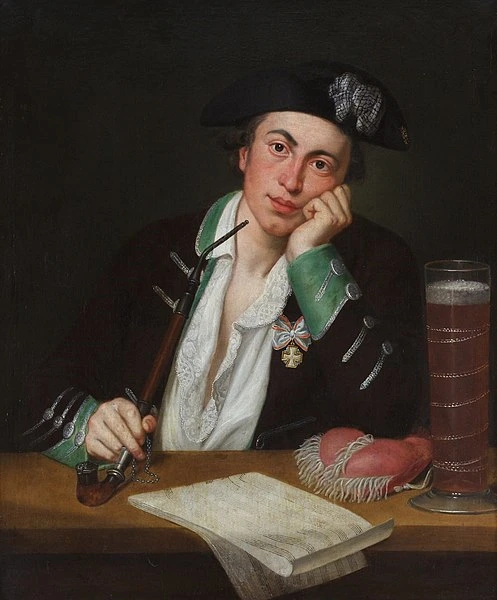
Kraus Joseph Martin, *20 June 1756 Miltenberg, †15 December 1792 Stockholm, German composer working in Sweden. He initially studied in Buchen im Odenwald, then from around 1768 he stayed in Mannheim, where he was a student of G.J. Vogler. In 1773–78, he studied philosophy and law in Mainz, Erfurt and Göttingen. In 1778, he settled in Stockholm. In 1781, after three years of trying to obtain a position, he became a member of the local Academy of Music, and then deputy kapellmeister at the court of Gustav III. Between 1782 and 1786, thanks to a royal scholarship, he travelled around Europe to further his musical knowledge. In 1783, he stayed in Vienna, where he became acquainted with J. Haydn, Ch.W. Gluck and J.G. Albrechtsberger. In 1784, he stayed in Paris, in 1785 in London, and also spent a lot of time in Rome, Naples, Florence and probably Bologna, as he personally met Padre Martini, for whose collection a portrait of Kraus was painted in 1783. At the end of 1786, he returned to Sweden. In 1787, he was appointed chief administrator of the Royal Academy of Music, and in 1788 he became the royal kapellmeister. He maintained close contacts with Stockholm’s circle of artists and intellectuals.
Despite his relatively modest output as a composer, Kraus ranks among the important artists of his era. His works were readily published by contemporary publishers, and numerous 20th-century editions and recordings revived his fame and brought his music into the modern performance repertoire. Alongside the Italian F.A.B. Uttini and the Germans J.G. Naumann and G.J. Vogler, Kraus was one of the creators of the first Swedish operas. His stage works show the influence of Gluck (a close relationship between music and text, expressive recitative, frequent use of the chorus), while in his instrumental music the influences of the Mannheim school, the aesthetics of Sturm und Drang, and the style of early Classicism are interwoven (skilful use of orchestral effects, rich harmony, a romantic mood, and developed transformation technique). Kraus’s oeuvre includes symphonies and other orchestral works, a violin concerto, sacred music based on chant, music for keyboard instruments influenced by C.Ph.E. Bach, as well as chamber works, including sonatas for violin and piano, piano trios, string quartets, and a flute quintet.
Literature: K.F. Schreiber Verzeichnis der musikalischen Werke von J. Kraus, “Archiv für Musikwissenschaft” VII, 1925; R. Engländer J.M. Kraus und die gustavianische Oper, Uppsala 1943 and Die gustavianische Oper, “Archiv für Musikwissenschaft” XVI, 1959; H.C.R. Landon J.M. Kraus, “The Musical Times” CIII, 1972; V. Bungardt J.M. Kraus. (…) ein Meister des klassischen Klavierliedes, Regensburg 1973; I. Leux-Henschen J.M. Kraus in seinen Briefen, Stockholm 1978; Internationale Kraus-Symposion. J.M. Kraus in seiner Zeit, Buchen 1980, ed. F.W Riedel, Salzburg 1982; B. van Boer The Travel Diary of Joseph Martin Kraus: translation and commentary, “The Journal of Musicology” 1990 no. 2; B. van Boer Joseph Martin Kraus (1756–1792): a Systematic-Thematic Catalogue of his Musical Works and Source Study, New York 1998; The musical life of Joseph Martin Kraus: letters of an eighteenth-century Swedish, ed. B. van Boer, Bloomington 2014.
Compositions
Instrumental:
symphonic:
Sinfonia buffa in F major, 1769–1772
7 symphonies in: F major, A major, C major, C-sharp minor, E-flat major, C minor, D major, 1775–1789
Sinfonia per la chiesa in D major, 1789
Symphonie funèbre in C minor, 1792, Stockholm 1792
Sinfonia con violino obligato in C major
Violin concerto in C major, 1777, revised 1783
2 polonaises for orchestra
3 orchestra overtures
chamber:
Quintet for flute and strings, 1783, Paris ca. 1799
9 string quartets
Piano trio, 1788
5 sonatas for violin and piano
duo for violin and bc.
duo for flute and viola
2 piano sonatas E flat major, E major, 1788
6 organ preludes
Wokalno-instrumentalne:
6 secular cantatas, including Begravningskantata för Gustavus III, performed and published in Stockholm 1792
5 church cantatas
Miserere in C minor, 1774
Requiem in D minor, 1775
Te Deum, 1776
Te Deum (surviving fragment), 1786–1788
Der Tod Jesu, oratorio, 1776
mass
motets, including Stella coeli (1783)
arias and songs
Stage works:
Azire, opera seria, libretto by C. Stridsberg, 1778 (unfinished)
Proserpina, opera seria, libretto by J.H. Kellgren, staged in Ulriksdal 1781
Aeneas i Carthago eller Dido och Aeneas (“Aeneas in Carthage”), opera seria, libretto by J.H. Kellgren, staged in Stockholm 1799, overture in an arrangement for 2 harpsichords, Stockholm, n.d.
Soliman II, eller De tre sultaninnoma, (“Soliman II, or The Three Sultanas”), comic opera, libretto by J.G. Oxenstjerna after C.S. Favarta, staged in Stockholm 1789, fragment published in “Musikaliskt tidsfördrif” 1792
intermèdes and ballet for Molière’s Amphitryon, staged in Stockholm 1784
Fiskarena (“The Fishermen”), ballet-pantomime, choreography by A. Bournonville, staged in Stockholm 1789
ballet for Gluck’s opera Armide, staged in Stockholm 1787
arias, ensembles, choruses, and musical inserts for other theatrical works
Writings:
Tolon. Ein Trauerspiel in drei Aufzügen, Frankfurt am Main 1776
Etwas von und über Musik fürs Jahr 1777, Frankfurt am Main 1778
articles in “Stockholms Posten”, 1778–80, poetry, drama and others
Editions:
Overture to the opera Proserpina, piano reduction, “Musikaliskt allehanda”, 22 January 1824
Sonata (duo) a flauto traverso e viola, ed. J.S. Winter, «Nagels Musik-Archiv» LXXVI, 1931
2 overtures to the opera Aeneas i Carthago, W. Lebermann Wiesbaden 1956
Symphonie funèbre, W. Lebermann Wiesbaden 1957
3 overtures, W. Lebermann Wiesbaden 1957
Violin concerto in C major, with U. Haverkamptem, W. Lebermann Wiesbaden 1957
Sinfonía con fugato per la chiesa, W. Lebermann Wiesbaden 1958
Quintet for flute and strings, W. Lebermann Wiesbaden 1959
Trio D-dur für Klavier, Violine und Violoncello, W. Lebermann Wiesbaden 1959
Sinfonie c-moll, ed. R. Engländer, «Monumenta Musicae Svecicae» II, 1960
7 string quartets, ed. A. Hoffmann, Wolfenbüttel 1961
Begravningskantata för Gustavus III, «Monumenta Musicae Svecicae» IX, 1979
Der Tod Jesu, ed. B. van Boer, jr., «Recent Researches in the Music of the Classical Era» XXVII, Madison 1987