
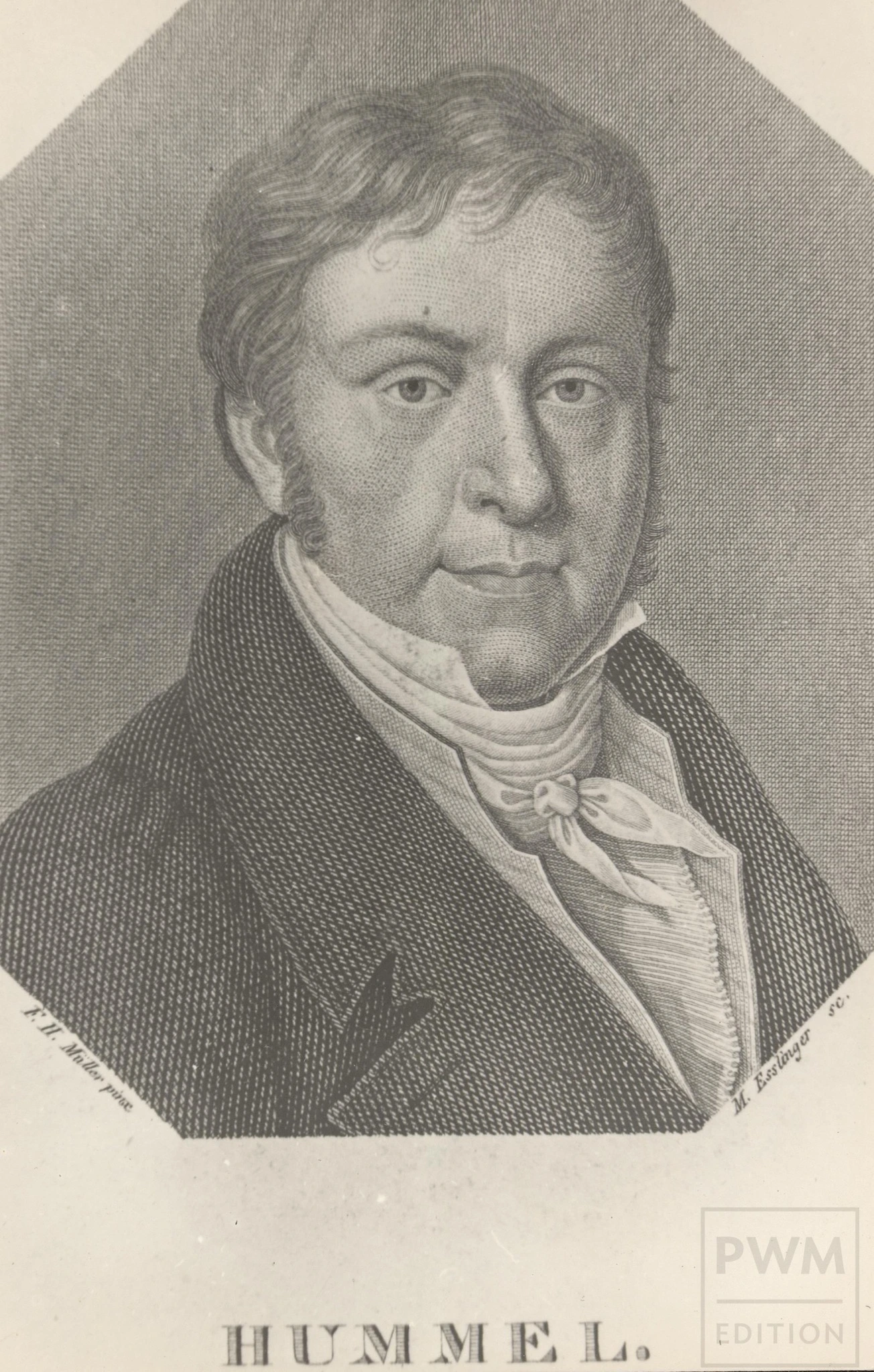
Szkoła na fortepian [partytura]

Hummel Johann Nepomuk, *14 November 1778 Bratislava, †17 October 1837 Weimar, Austrian pianist, composer, teacher, and conductor of Slovak origin. The son of Johann Hummel, a violinist and conductor, he played the violin at age of five and the piano at age of six. In 1786, he moved with his family to Vienna, where his father became music director of the Theatre auf der Wien. For two years, Hummel was a student of Mozart and lived in his home; under Mozart’s direction, he gave his first public concert in Dresden in 1787.
In 1788, he went on a concert tour with his father that lasted over four years. He performed in Prague (where he met J.L. Dusík), Dresden, and visited Berlin, Magdeburg, Göttingen, Braunschweig, Kassel, Hanover, Hamburg, Cologne, Lübeck, and other German cities, as well as Copenhagen. In the spring of 1790, the two musicians arrived in Edinburgh and also gave concerts in Durham and Cambridge. In the autumn of that year, they moved to London. Hummel gave his first major concert on 5 May 1792 at the Hanover Square Rooms, arousing enthusiasm (he played a Mozart concerto and his own sonata). In London, he met J. Haydn. After a two-year stay in England, in the autumn of 1792 Hummel and his father left for the Netherlands. Hummel played every Sunday at the royal court in the Hague; the Napoleonic campaign accelerated the Hummels’ return via Amsterdam and Germany to Vienna, where they arrived at the beginning of 1793. This marked the beginning of a 10-year period of study for Hummel: with J.G. Albrechtsberger (counterpoint), A. Salieri (vocal composition, philosophy and aesthetics of music), and from 1795 with Haydn (organ). He also gave many lessons every day and composed. He quickly gained a reputation as one of the best Viennese pianists. On 1 April 1804, he took the position of concertmaster with Prince M. Esterházy in Eisenstadt, essentially serving as bandmaster of a band of about 100 musicians and as a teacher of the boys’ choir (he taught violin, piano, and cello). There, he composed religious compositions (five masses) and stage compositions (three operas), and he maintained contacts with Vienna, where he gave concerts and published his works. Hummel’s relations with the prince, however, were not harmonious. At the end of 1808, the composer was dismissed, but, likely after Haydn’s intervention, he continued to perform his duties until May 1811.
After returning to Vienna, Hummel devoted himself to composition and teaching. In 1813, he married the renowned singer Elisabeth Röckel, with whom he had two sons: Eduard, a pianist, and Karl, a painter. Hummel was friends – despite some disagreements – with Beethoven and in 1814 performed the percussion part in his Wellingtons Sieg. During the Congress of Vienna, Hummel’s concerts became a sensation. A concert tour of Germany in the spring of 1816 solidified his fame.
From 1816 to 1818, Hummel served as Kapellmeister at the Stuttgart Opera, and on 5 January 1819, he signed a contract as Kapellmeister in Weimar, with annual leave for concert tours in the spring. The composer met Goethe and other Weimar personalities. With the court theatre orchestra, he performed works by Gluck, Salieri, Cherubini, Meyerbeer, Halévy, Bellini, and Rossini, establishing a tradition of performing Mozart’s operas; in 1821, he also staged his opera Mathilde von Guise. A production of Weber’s Der Freischütz was a huge success. Hummel brought in distinguished artists, including C. Wieck, H. Sontag, W. Schröder-Devrient, A. Milde-Hauptmann, M. Szymanowska, N. Paganini, A. Henselt, and I. Moscheles. After K. Weber, Hummel was a candidate for the position of director of the German Opera in Dresden. He went on tours almost annually, including: in 1820 to Prague, Vienna, and Munich; in 1821 to Berlin and Dessau; in 1822 to Riga, St. Petersburg (where he met J. Field) and Moscow; in 1823 to Amsterdam, the Hague, Rotterdam, and Utrecht; in 1825 to Paris, where he achieved the heights of success; in 1826 to the Netherlands and Belgium; in 1828 to Warsaw (a concert attended by 700 listeners, according to a report in “Kurier Warszawski” 1828, no. 106); in 1830 to Paris and London, where he returned in 1831 and 1833, conducting performances of the German opera from Dresden. In 1834, he gave concerts in Vienna and Bratislava. During the Weimar period, Hummel composed particularly intensively, creating cantatas, transcriptions of orchestral music, piano and chamber works, and arrangements of Scottish songs. He also wrote Ausführlich theoretisch-practische Anweisung zum Piano-Forte Spiel, published by Haslinger in 1828 and dedicated to Tsar Nicholas I. In 1827, Hummel traveled with Hiller to Vienna to visit Beethoven on his deathbed. At a concert after Beethoven’s death, in accordance with Beethoven’s wishes, he improvised, among other things, on themes from Fidelio. He also maintained contact with Schubert, who dedicated his last three sonatas to him (published posthumously with a changed dedication). He also maintained a friendly relationship with Chopin, who had already played Hummel’s works in his youth and appreciated them. For the last three years of his life, Hummel was ill; Mozart’s Requiem was performed during the funeral. Hummel was a member of, among others, the Institut de France, the Société des Enfants d’Apollon, the Société de Musique in Geneva, the Gesellschaft der Musikfreunde in Vienna, and the Philharmonic Society in London
Hummel was a kind, jovial, and hard-working man, who also knew how to look after his publishing interests. Initially, he published some of his works himself (op. 2a, 5, 6, also 49–68). From 1801/02, Hummel began a 20-year collaboration with the Artaria publishing house. The publishing house Kunst und Industrie Kontor also played a significant role in promoting his works; he also published in Leipzig and collaborated with publishers in Paris, England, the Netherlands, and Russia. He fought to protect the composer’s copyright and to prevent illegal printing. An interesting contribution to Hummel’s biography are the dedications of his works to musicians (op. 7 to G. Albrechtsberger, op. 13 – J. Haydn, op. 83 – J.B. Cramer, op. 112 – H. Sontag, op. 118 – M. Malibran-Garcia), to people from the aristocratic circles of Vienna, Weimar and St. Petersburg; he dedicated several works to people of Polish origin (op. 11 to Countess Józefa Rzyszewska, op. 18 to Karolina Chodkiewicz, op. 113 to General Albrecht née Lang from Warsaw, op. 117 to Dorota Wertheim from Warsaw).
Hummel was a leading representative of the brillant style, which manifested itself in compositional technique and performance style, which was associated with a specific type of piano. While English pianos attracted the attention of Clementi, Cramer, J.L. Dusik and especially Beethoven, Haydn, Mozart, and composers of the brillant style found the sound of Viennese instruments appealing. In his Anweisung, Hummel praised their “round, flute-like tone, which cuts through the orchestral accompaniment, especially in a large hall, without hindering fluency,” because “the strength of the sound should be achieved by the elasticity of the fingers.” The carrying capacity and fullness of the sound of English instruments, however, required a stronger and deeper attack, which, in Hummel’s opinion, prevented fast, fluent playing.
Hummel – the last great representative of the Viennese School – in the transition period between Classicism and Romanticism, revitalised the art of piano with a precise, virtuoso technique based on fingerplay; his improvisational skills were highly valued. Hummel emphasised that “the pianist’s mechanism for fantasising must be so developed that what the spirit creates can be executed immediately and without difficulty” (Anweisung). “La Revue Musicale” (vol. XIII, no. 31) wrote: “One must improvise like Hummel, or not attempt to improvise at all, because it is a skill that cannot be imitated.” The composer himself confessed that he preferred improvisation to slavish submission to a musical text (“Le Pianiste” 1833, no. 2). He fantasised on themes from popular operas, most often combining free and contrapuntal variations, culminating in a bravura finale. In concert, he performed essentially only his own compositions, which he also relied on in his teaching. The confidence, clarity, and simplicity of his playing, the evenness and delicacy of his touch, and the impression of very fast playing, despite avoiding excessively fast tempos, were emphasised. On the other hand, Hiller criticised Hummel’s playing for a lack of warmth and passion. As a conductor, Hummel was also highly praised for the precision of the orchestra’s sound, but a certain coldness was perceived in his performances. In his teaching, Hummel placed the greatest importance on mastering technique and fingering, the execution of ornaments, and the cantilena. He did not consider the problems of sound attack and articulation in any detail, and even took a negative stance on the use of the pedals. He permitted the right pedal at slow tempos and only with slow harmonic changes, which was recommended in all contemporary playing schools, although he believed that good effects could be achieved by combining both pedals. In the Anweisung, however, he arbitrarily stated that neither Mozart nor Clementi needed the forte pedal to achieve fame as the most expressive and great pianists, and that one could therefore reach the heights of the art of reproduction without employing “this worthless device.” His remarks regarding “proper and beautiful performance” are rather superficial. In his playing, Hummel adhered strictly to a set tempo (according to an 1816 report by V.J. Tomášek of Prague). The table of metronome markings included in the Anweisung, however, indicates that Hummel treated the same tempo with considerable tolerance, depending on the nature of the composition. Although his sound aesthetic was deeply rooted in Classicism, the virtuosic techniques he employed were forward-looking in the coming era. Hummel’s students included F. Hiller, F. Mendelssohn (briefly), A. Henselt, and S. Thalberg.
Hummel was a rather versatile composer; he wrote operas, singspiels, masses and other religious forms, chamber works, piano works, concertos, and songs. However, some of his work was inspired by market demand (including dances for carnival balls in Vienna and arrangements of Scottish songs for the G. Thomson publishing house); many of Hummel’s piano works are occasional in nature. The vividness of the periodic structure, supported by a melodious, ornamented melody, a relatively slow harmonic rhythm, and figurations representing various modifications of Alberti’s bass, indicates a connection between Hummel’s music and mature Classicism. The composer generally used keys up to three key signatures (only in the Preludes did he utilise all keys in the succession of fifths) and preferred major keys (especially in chamber music). In developments, he more often employed parallel relationships and the minor mode rather than higher dominant references. In his most creative phase of composition (from c. 1811), Hummel abandoned symmetrical phrase patterns in favour of irregular, ornamentally rich melodies, a novelty in instrumental texture at the time. He expanded functional references and saturated the progression with transitional notes (including chromatic ones). Although the structure of Hummel’s piano and chamber music is primarily based on the upper voice and accompaniment, he occasionally employed counterpoint; he employed fugatos (in some developments, e.g., in the finale of the Sonata in F sharp minor Op. 81, and in the reprise of the first movement of the Quintet in E flat minor Op. 87 – instead of the second theme), or split the melodic line into two levels, suggesting a polyphonic texture. He displayed no flair for large-scale form, although his sonata cycles retain a four- or three-movement structure (solo sonatas and sonatas for two instruments, and piano trios). In the sonata allegro, Hummel employed a rather mosaic-like juxtaposition of melodies and textures. Thematic work appears rarely, for example, in the finales of the Quartets Op. 30, Nos. 1 and 2. Even in the Sonata in F-sharp minor, considered his most mature work, the principle of sequencing figurative and cantilena sections prevails. Hummel’s themes, though they demonstrate the composer’s considerable melodic inventiveness, lack any developmental force. The development in the first movement of the Septet in D minor is a kind of fantasy based on modulations (E-flat-D-flat-a-d), similarly, the development in the Military Septet exhibits an improvisational character. In the concertos, too, which retain a classical structure (double exposition of orchestra and solo instrument), the thematic dualism is weakened, as both themes alternate between ornamental-cantilena and showy-figurative elements. Only their number differs: in Theme I, 3–5 sections (Concerto in A minor, Op. 85, and A flat major, Op. 113), and in Theme II, 2 sections. This type of concerto brillant, imbued with virtuosity (although without the soloist’s improvisational cadenza), with a predominance of the solo instrument over the supporting orchestra (although Hummel sometimes sought to exploit the orchestra’s sonic effects), strongly influenced Chopin. The use of larghetto and romanza in the concertos of both composers is also similar. Hummel, however, did not reach the heights of lyricism reached by the Romantics. The middle movements of Hummel’s cycle are primarily in ABA song form, occasionally with variations, while the finales maintain the rondo pattern, most often sonata-like, sometimes with characteristic elements, for example, à la burlesque (String Trio in E-flat major S30/W3) and à la russe (Piano Trio Op. 96). The four-movement cycle was supplemented with minuets in the Ländler style or scherzo. Hummel wrote rondos brillant and various dances, among which the polonaise La bella capricciosa was popular. The piano clearly dominates Hummel’s chamber music, as evidenced by, among other things, the bravura solo cadenzas in the first movement of the Trio in E-flat major Op. 93 and the Septet in D minor.
Hummel’s virtuosic texture came to fullest expression in variation forms and fantasias, among which the Fantasina, Op. 124, is particularly noteworthy. Despite a certain schematic architectural style (a potpourri-like pattern in Fantasia Op. 18, among others) and the sometimes-banal variation themes, Hummel skillfully utilises variation technique, employing a variety of instrumental figures. Hummel also employed variation form in other genres, for example in the Nocturne, Op. 99, for four hands. The composer borrowed his figurative resources primarily from Mozart, and partially from Clementi, such as arpeggios and broken chords, scale progressions, double thirds and sixths (the first movement of the Concerto in A minor and the Sonata F-sharp minor), but he expanded the figurative models to tenths and duodecimals (the development of the first movement of the Concerto in B minor), and even to greater ambitus, thanks to octave “reflections” in the bass. Virtuoso technique also includes broken octaves (the first movement of the Concerto in B minor), leaps (Etude Op. 125 No. 10), and hand-flipping and crossing (Etude Op. 125 No. 14). Chords are most often used in arpeggios, which later became a typical performance technique for the brillant style. Hummel’s ornamentation is associated with the development of melodic figuration, interweaving passages with chromaticism and ornamentation, especially in the slow movements. Ornamental, improvisational figurations and irregular groups of up to 50 notes in a single measure (the third movement of the Sonata in D major, Op. 106) violate the classical principles of closed period structure and constitute a bridge between the ornamentation of Mozart and Chopin. In Anweisung, in which Hummel systematically reviewed ornamental devices, he introduced, among other things, the trill from the main note, as opposed to the traditional trill from the top note. The revival of the Classical style with pioneering elements of Romantic virtuosity and ornamentation establishes Hummel’s position in the history of instrumental music. His religious, stage, and vocal works are of incomparably lesser importance, although the masses for choir and orchestra, Op. 77 and Op. 111a, also worth noting, are the Mass in E-flat major, Op. 80, which also exhibits a tendency toward a homogeneous, massive sound, forte dynamics, and the predominance of choirs over solo and ensemble fragments. Although Hummel was an extremely popular, even overrated, composer and teacher during his lifetime, his work and contributions were quickly forgotten. Hummel’s finest and most enduring works are considered to be the piano concertos in A minor and B minor, as well as the Septet in D minor, which blended concert and chamber music styles. Recent years have seen a certain revival of Hummel’s work, as evidenced by the increasing number of recordings, performances, and sessions devoted to the composer’s life and work (Bratislava 1972, 1987, Weimar 1978, Eisenstadt 1987).
Literature: D. Zimmerschied Thematisches Verzeichnis der Werke von Johann Nepomuk Hummel, Hofheim 1971 (revised by J. Sachs, “The Musical Times” CXIV, 1973); J. Sachs A Checklist of the Works of Johann Nepomuk Hummel, “Notes” XXX, 1973/74, A. Kahlert Zur Erinnerung an Johann Nepomuk Hummel, “Deutsche Musik-Zeitung” I, 1860; C. Richter Hummels Clavierconcerte und ihre Bedeutung Jur die jetzige Zeit, “Neue Zaitschrift für Musik” 1883 no. 41 and 42; J. Batka, E. Wodianer Johann Nepomuk Hummel. Biographische Skizze, Bratislava 1887; A. Bartels Chronik des Weimarischen Hoftheaters 1817–1907, Weimar 1908; W. Meyer Johann Nepomuk Hummel als Klavierkomponist, 1922 (dissertation, University of Kiel); G. Sporck L’interprétation des sonates de Johann Nepomuk Hummel, Paris 1933; K. Benyovszky Johann Nepomuk Hummel. Der Mensch und Künstler, Bratislava 1934 (contains 106 letters and documents from Hummel’s correspondance); K. Benyovszky Hummel und seine Vaterstadt, Bratislava 1937; W. Schmieder Hummel. Dokumente eines alten Musikverlagsarchiv, “Allgemeine Musikzeitung” LXIV, 1937; Korespondencja Fryderyka Chopina, 2 volumes, ed. B. Sydow, Warsaw 1955; K. Benyovszky Johann Nepomuk Hummel der Nachfolger Haydns, in: Joseph Haydn und seine Zeit, «Burgenländische Heimatblätter» XXI, 2nd ed. 1959; J. Hárich Esterházy – Musikgeschichte im Spiegel der zeitgenössischen Textbücher, Eisenstadt 1959; A. Klodner Hummel a Chopin, “Slovenska Hudba” 1960 no. 9, also in “Chopiniana Bohémica” I, 1963; D. Zimmerschied Mozartiana aus dem Nachlass von Johann Nepomuk Hummel, Mozart Jahrbuch XV, 1964; Z. Hrabussay Odraz tvorby Johann Nepomuk Hummel v diele F. Chopina, “Chopiniana Bohémica et Slovenica” II, 1964; R. Münster Mozarts Persönlichkeit und Schaffensweise in der Sicht seines Schülers Johann Nepomuk Hummel, “Acta Mozartiana” XI, 1964; R. Davis The Music of Johann Nepomuk Hummel. Its Derivation and Development, “The Music Review” XXVI, 1965; D. Zimmerschied Die Kammermusik Johann Nepomuk Hummels, 1966 (dissertation, University of Mainz; contains also 144 unpublished Hummel’s letters); D.G. Brock The Church Music of Hummel, “The Music Review” XXXI, 1970; J. Sachs Hummel and G. Thomson of Edinburgh, “The Musical Quarterly” LVI, 1970; J. Sachs Authentic English and French Editions of Johann Nepomuk Hummel, “Journal of the American Musicological Society” XXV, 1972; J. Sachs Hummel and the Pirates. The Struggle for Musical Copyright, “The Musical Quarterly” LIX, 1973; I. Poniatowska Johann Nepomuk Hummel. Kompozytor muzyki fortepianowej i jego „Szkoła gry na fortepianie”, in: VI Ogólnopolska Konferencja Muzykologiczna, Gdańsk 1972 – materials, Gdańsk 1973, extended ed. titled Problemy klavírnej sadzby w klavírnych dielach J.N. Hummela a v jeho „Klavírnej škole”, «Hudobné tradície Bratislavy a ich tvorcovia» I, ed. Z. Novácek, Bratislava 1974 (contains also: L. Mokry Ku genéze Hummelovej klavírnej školy, J. Albrecht Instrumentálna sadzba v Hummelových skladbách); J. Sachs Kapellmeister Hummel in England and France, Detroit 1977; B. Jeszka-Blechert Związki faktury fortepianowej Hummla i Chopina, in: Chopin a muzyka europejska, «Prace Biblioteki Głównej PWSM w Katowicach» X, Katowice 1977; Aus Anlass des 200. Geburtstages Johann Nepomuk Hummels 18 XI 1978 Weimar, «Schriftenreihe der Hochschule für Musik F. Liszt Weimar» I (contains, among others: K. Bula Über Bedeutung Johann Nepomuk Hummels kompositorisch technischer Errungenschaften Jur die Gestaltung des Klavierstils von F. Chopin); I. Poniatowska Il metodo per pianoforte di Johann Nepomuk Hummel. Commente storico, commemorative book of G. Vecchi, ed. I. Cavallini, Modena 1989.
Writing:
Ausjuhrlich theoretisch-practische Anweisung zum Piano-Forte Spiel vom ersten Elementar. Unterrichte an bis zur vollkommensten Ausbildung, 3 parts, S157, Vienna 1828, published at the same time in Paris, London, Milan; Russian ed. St Petersburg 1829, revised ed. Vienna 1838
Compositions:
Numbers without letters indicate the opus numbering given by Hummel; S indicates the numbering introduced by J. Sachs in A Checklist of the Works of Johann Nepomuk Hummel (see literature); W = Werke ohne Opuszahl (works without opus number) according to the thematic catalogue of Hummel’s works prepared by D. Zimmerschied (see literature).
Vocal-instrumental:
Le portrait d’amour op. 48, couplets accompanied by piano ed. Vienna 1810 L. Maisch
La sentinelle op. 71, for voice accompanied by violin, guitar, cello ad libitum or piano, violin, cello, double bass ad libitum, ed. Vienna 1815 Steiner
5 Lieder op. 84: An die Entfernte, Berlin 1816, others Berlin after 1820: Air à la tirolienne avec variations op. 118, for voice and orchestra, ca. 1829, ed. Vienna 1830 Haslinger, published at the same time in London and Paris
20 Scottish Songs S169, 178, 197, ed. for voice accompanied by piano, flute or violin, cello, 1825–32, published in collections of Scottish songs, Edinburgh 1826–31, G. Thomson and London 1831 T. Preston, a few not published
multiple songs in manuscripts
multiple choral works, including Patriotischer Chor und Canon op. 62, for choir and orchestra, 1814, reduction for voice and piano Vienna 1814 self-published; Polymelos russischer national Lieder op. 82 for 4 solo voices, mixed choir and orchestra, 1818, ed. Leipzig 1819–20 Peters
several not published cantatas, including Cantate pour le Mariage de l’Empereur Napoleon avec Marie Louise d’Autriche S87, 1810
Mass in B-flat major op. 77 for choir and orchestra, ca. 1804–10, ed. Vienna ca. 1818 Steiner
Mass in E-flat major op. 80 for 4 solo voices, choir and orchestra, 1804, ed. Vienna 1819–20 Steiner
Quod, quod in orbe op. 88, gradual for choir and orchestra, 1808–14, ed. Vienna ca. 1827 Haslinger
Alma Virgo op. 89a, offertory for soprano, choir and orchestra, 1805, ed. Vienna ca. 1827 Haslinger
Mass in D major op. 111a, for choir and orchestra, 1808, ed. Vienna ca. 1830 Haslinger
religious works, preserved in manuscripts, mainly in the British Museum in London, including: Mass in D minor S67/W13, 1805, Missa solemnis in C major S74/W12, 1806; 5 offertories – in E major S52/W22 and in G major S54, 1804–10, in A major S68/W19, before 1806, in B-flat major S79/W18, 1809, in F major S96/W20, 1813; oratorio Der Durchzug durchs Rote Meer S33/W11, 1800–10(?)
Scenic:
comic operas preserved in manuscripts in the British Museum in London: Mathilde von Guise, heroic-comic opera, libretto after L.E.F.C. Mercier-Dupaty, staged in Vienna 1810, piano reduction as op. 100 Leipzig ca. 1826 Peters
singspiels, including Die Rückfahrt des Kaisers, libretto E. Veith, staged in Vienna 1814, piano reduction as op. 69 Vienna ca. 1814 Artaria, and Die gute Nachricht S103, libretto G.F. Treitschke, with W.A. Mozart, V. Jírovec, J. Weigle, F. Kann and L. v. Beethoven, by Hummel: overture, quartet, duet, trio, staged in Vienna 1814, overture published as op. 61, piano reduction Vienna ca. 1815 Artaria
theatre music
ballets:
Helene und Paris op. 26, before 1807, piano reduction Vienna 1808 Kul
Das belebte Gemählde op. 33, 1809, piano ed. Vienna ca. 1810 Artaria
Sappho von Mitilene op. 68, libretto G. Vigano, staged in Vienna 1812, piano ed. in Répertoire… II, books 10–12, Vienna ca. 1814
Quintuor des nègres op. 41, ballet-pantomime scene, ca. 1809, piano ed. Vienna ca. 1810 Kul
pantomimes:
Der Zauberring oder Harlekin als Spinne op. 46, libretto P.N. Angiolini, staged in Vienna 1811, piano ed. Vienna ca. 1811 T. Weigl
Der Zauberkampf Harlekin in seiner Heimat S92/W34, libretto F. Kees, staged in Vienna 1812, piano reduction in Potpourri für das Pianoforte, book 20 Vienna K. k. Hoftheater Musik-Verlag
Instrumental:
march for orchestra dedicated to the citizens’ artillery corps in Vienna, S26, 1798, ed. Vienna (?) no year
8 Variations and a Coda in C major on the theme of O du lieber Augustin for orchestra, S47/W2, ca. 1803, ed. F. Stein Kassel 1959 Alkor
6 German Dances op. 16, for orchestra, 1804, piano ed. Vienna ca. 1805 Traeg
7 Hungarian Dances op. 23 for orchestra, piano ed. Vienna ca. 1806 Kul
12 Minuets op. 24 for orchestra, 1806, piano ed. Vienna ca. 1807 Kul
12 German Dances with a Coda La battaglia op. 25, before 1807, piano ed. Vienna ca. 1807 Kul
Apollo-Saal Tänze I, 12 minuets and trios op. 27 for orchestra, 1808, piano ed., also for 2 violins, basso and viola ad libitum, published in Vienna 1808 Kul
Apollo-Saal Tänze II, 12 dances op. 28 for orchestra, 1808, piano ed. Vienna ca. 1808 Kul
Redout-Deutsche, 12 dances with a coda op. 29 for orchestra, 1808, arrangement for piano, also for 2 violins and basso, published in Vienna ca. 1808 Artaria
Apollo-Saal Tänze III, 6 minuets and 6 German dances op. 31 for orchestra, 1809, arrangement for piano, also for 2 violins, viola ad libitum and cello, published in Vienna ca. 1810 Kul
Contradance in B-flat major for orchestra, S80, ca. 1810 (?)
5 écossaises for orchestra, S81, ca. 1810 (?)
7 ländlers for orchestra, S82, ca. 1810 (?)
3 military marches (no. 1 = op. 45 no. 1) for orchestra, S83, ca. 1810 (?)
Apollo-Saal Tänze IV, 6 dances and 4 German dances op. 39 for orchestra, 1811, arrangement for piano published in Vienna ca. 1811 Kul
12 German dances with a coda “vom Römischen Kaiser” op. 40 for orchestra, 1811, arrangement for piano, also for 3 violins and basso published in Vienna ca. 1811 Artaria
12 German dances with a coda “zur St. Catherinen Redoute” op. 44 for orchestra, 1811, arrangement for piano published in Vienna ca. 1812 Kul
Apollo-Saal Tänze V, 6 dances and 6 German dances op. 45 for orchestra, 1811, arrangement for piano published in Vienna ca. 1812 Kul
Polonoises favorites, 6 polonaises op. 70 for orchestra, arrangement for piano published in Vienna ca. 1815 Artaria
12 waltzes with a coda for orchestra, S104, 1817, 4 waltzes arranged for piano included in op. 112 – see works for piano
6 Neue Walzer mit Trios… fur den Apollo Saal op. 91, 1820, also for piano, for piano for 4 hands, for violin and double bass, for 2 violins, for flute, for flute or violin and guitar, for 2 csakans, arranged for piano et al. in Vienna ca. 1821 Steiner
Overture no. 1 in B-flat major op. 101, published in Leipzig ca. 1826 Peters, also arranged for piano
for solo instrument and orchestra:
Piano Concerto in A major, S4/W24, po 1790
Piano Concerto in A major, S5/W24a, po 1790(?)
Variations on Theme from ‘Castor and Pollux’ by Vogler arranged for piano and orchestra, published in Vienna ca. 1798 self-published
Mandoline Concerto in G major, S28, 1799, ed. V. Hladký Vienna ca. 1960; Concertino op. 73, transcription for piano and orchestra, published in Vienna ca. 1816 Steiner
Concerto in E-flat major for trumpet (‘E major’ in manuscript), S49/W1, 1803, piano reduction ed. F. Stein Leipzig 1957 Hofmeister; score ed. N. Richardson London 1969
Concerto in F major for bassoon, S63/W23, in «Musica Rara» ed. R.W. Tyree London 1971
Concerto in G major op. 17 for piano and violin with orchestra, published in Vienna ca. 1805 Traeg
Piano Concerto in C major op. 34a, also as op. 36, published in Vienna ca. 1810 Kul
Rondo brillant in A major op. 56 for piano and orchestra, in Répertoire de musique pour les dames I, books 8–9, Vienna 1810–14 self-published
Piano Concerto in A minor op. 85, ca. 1816, published in Vienna ca. 1821 Steiner
Piano Concerto in B minor op. 89, 1819, published in Leipzig ca. 1820 Peters
Potpourri in G minor op. 94 for viola and orchestra, 1820, published in Leipzig ca. 1820 Peters; transcription for cello and orchestra op. 95, published in Leipzig
Variations in F major op. 97 for piano and orchestra, ca. 1820, published in Leipzig ca. 1821 Peters
Rondo brillante in B-flat major op. 98, for piano and orchestra, 1823, published in Leipzig ca. 1824 Peters
Adagio and Variations in F major op. 102 for oboe and orchestra, published in Leipzig ca. 1824 Peters (transcription of Nocturn for piano for 4 hands op. 99)
Piano Concerto in E major (“Les adieux”) op. 110, 1814, published in Leipzig 1826 Peters, London 1826 Welsh & Hawes, Paris 1826 Farrenc
Piano Quartet in A-flat major op. 113, 1827, published in Vienna 1830 Haslinger, London 1830 Cramer, Addison & Beale, Paris 1830 Farrenc
Variations in B-flat major on the singspiel Das Fest der Handwerker op. 115 for piano and orchestra, 1830, published in Vienna 1830 Haslinger, London 1830 Cramer, Addison & Beale, Paris 1830 Farrenc, Prague 1830 M. Berta
Oberons Zauberhorn op. 116, large fantasia for piano and orchestra, 1829, published in Vienna 1830 Haslinger, London 1830 Cramer, Addison & Beale, Paris 1830 Farrenc
Gesellschafts Rondo in D major op. 117 for piano and orchestra, 1829, published in Vienna 1830 Haslinger, London 1830 Cramer, Addison & Beale, Paris 1830 Farrenc
“Le retour de Londres” in F major op. 127, rondo brillante for piano and orchestra, 1830, published in Vienna (?) 1831 Haslinger, London (?), 1831 Wessel, Paris (?) 1831 Farrenc, Moscow (?) 1831 C.J. Lehnhold
Piano Concerto in F major op. posth. 1, 1833, published in Leipzig 1839 B & H, London 1839 Olivier, Paris 1839 Schonenberger
chamber:
Parthia in E-flat major for 2 clarinets, 2 oboes, 2 horns, 2 bassoons, S48, 1803 mm published in «Musica Rara» London 1970
Septet in D minor op. 74 for piano, flute, oboe, horn, viola, cello and double bass, arranged also for piano quintet, published in Vienna ca. 1816 Artaria
Septet “militaire” in C major op. 114 for piano, flute, violin, clarinet, cello, trumpet, double bass, arranged also for piano quintet, 1829, published in Vienna 1830 Haslinger, Paris 1830 Farrenc, London 1830 Cramer, Addison & Beale
Sérénade en potpourri in G major op. 63 for piano, violin, guitar, clarinet or flute, bassoon or cello; or for piano, flute, cello; or for piano, violin, clarinet, double bass, ca. 1814, published in Répertoire… II, book 1, Vienna ca. 1814–15 self-published
Serenade no. 2 in C major op. 66 for piano, violin, guitar, clarinet or flute, bassoon or cello, published in Répertoire… II, book 7 and 8, published in Vienna ca. 1814–15, self-published
Piano Quintet in E-flat major/E-flat minor op. 87, 1802, published in Vienna ca. 1822 Steiner
3 string quartets op. 30: in E-flat major, in G major, in E-flat major, before 1804, published in Vienna ca. 1808 Artaria (Kul)
Piano Quartet in G major, W6, published in (?) Leipzig B&H probably after 1900
Piano Quartet in G major (2 parts) op. posth. 4th ed. Leipzig 1839 B&H, London 1839 Olivier
Quartet in E-flat major for clarinet, violin, viola and cello, S78/W5, 1808, published in «Musica Rara» London 1958
Trio in E-flat major for 2 violas (or violin and viola) and cello, S30/W3, 1799, published by F. Stein in Frankfurt am Main 1958 Peters
Trio in G major for 2 violas (or violin and viola) and cello, S46/W4, 1801, published by F. Stein in Frankfurt am Main 1958 Peters
Trio in B-flat major op. 2a no. 1 for piano or harpsichord, flute or violin and cello, published in Vienna 1792 self-published, London 1792 Preson & Son
Piano Trio in E-flat major op. 12, published in Vienna ca. 1803 Kul
Piano Trio in F major op. 22, 1799, published in Vienna 1807 Kul
Piano Trio in G major op. 35, published in Vienna ca. 1811 Kul
Piano Trio in G major op. 65, published in Répertoire… II, book 5 and 6, Vienna ca. 1814–15 self-published
Adagio, Variations and Rondo in A major on “Die schöne Minka” op. 78 for piano, flute and cello, published in Vienna ca. 1818 Steiner
Piano Trio in E major op. 83, published in Leipzig 1819–20 Peters, London 1819–20 Boosey & Co, Petersburg 1819–20 M. Bernard
Piano Trio in E-flat major op. 93, 1821, published in Berlin ca. 1822 E.H.G. Christiani
Piano Trio in E-flat major op. 96, published in Leipzig ca. 1822 Peters
Sonata in G major op. 2a/2 for piano or harpsichord, flute or violin, published in Vienna 1792 self-published, London 1792 Preston & Son
3 sonatas op. 5: in B-flat major and in F-major for piano and violin, in E-flat major for piano and viola, published in Vienna ca. 1798 self-published
Variations in G major op. 14 on E. N. Méhul’s Romance, published in Vienna ca. 1803 Artaria
Sonata in C minor op. 37a for harpsichord or piano and mandolin or violin, published in Vienna ca. 1810 L. Maisch
Sonata in D major op. 50 for piano and violin or flute, published in Répertoire… I, book 2, Vienna 1810–14 self-published
Potpourri in G minor op. 53 for piano and guitar, published in Répertoire… I, book 5, Vienna 1810–14 self-published
Variations in D minor op. 54 for piano and cello, published in Répertoire… I, book 6, Vienna 1810–14 self-published
Sonata in A major op. 64 for piano or violin and flute, published in Répertoire… II, book 4, Vienna ca. 1814–15 self-published
Grand potpourri national op. 74 for piano and guitar, with M. Giuliani, published in Vienna ca. 1818 T. Mollo
Rondoletto in E-flat major for harp and piano, S146, published in Paris (?) after 1820 Pacini
Cello Sonata in A major op. 104, 1824, published in London 1826 Boosey
Amusement in F major op. 108 for piano and violin, 1825, published in Leipzig 1826 Peters, Paris 1826 Hanry, London 1826 Welsh & Hawes
Rondo brillante in G major op. 126 for violin and piano, 1834, published in Vienna ca. 1835 Haslinger, Paris 1835 Farrenc, London 1835 Cramer, Addison & Beale, Moscow 1835 C.J. Lehnhold
Variations in F major op. posth. 2 for violin and piano, published in Leipzig ca. 1839 B & H
for solo instrument:
3 airs variés op. 1 for piano: 1. The Plough Boy in C major, 2. Blühe liebes Veilchen in G major, 3. La belle Cathérine in C major, published in London 1791 self-published
variations for piano: 1. The Lass of Richmond Hill in G major, 2. Jem of Aberdeen in G major, published in London ca. 1791 Preston & Son
Sonata in C major op. 2a no. 3 for piano, published in Amsterdam 1792 J. Schmitt
variations for piano: 1. Air éccosais in G major (= op. 2 no. 2), 2. Air anglais in G major (= op. 2 no. 1), 3. Air allemand in G major, published in Vienna ca. 1794 self-published
3 Fugues op. 7: in D minor, in E-flat major, in F-sharp minor, after 1793, published in Vienna 1799 self-published
13 Variations in G major on a folk melody op. 8 for piano, published in Vienna ca. 1801 Artaria
Variations in E major on a March from L. Cherubini’s Opera “Les deux journées” (Woziwoda) op. 9 for piano, published in Vienna ca. 1802 Artaria
Variations in D major on “God save the King” op. 10 for piano, published in Vienna ca. 1804 Kul
Rondo in E-flat major op. 11 for piano, published in Vienna ca. 1804 Kul
Sonata in E-flat major op. 13 for piano, published in Vienna ca. 1805 Kul
Variations in A minor on the March from N. Dalayrac’s opera “Les deux petits Savoyards” op. 15 for piano, published in Vienna ca. 1804 Artaria
Fantasia in E-flat major (4 parts) op. 18 piano piano, published in Vienna ca. 1805 Kul
Rondo quasi una fantasia in E major op. 19 for piano, published in Vienna ca. 1806 Kul
Sonata in F minor op. 20 for piano, published in Vienna ca. 1807 Kul
Variations in B-flat major on a Dutch Song op. 21 for piano, published in Vienna ca. 1806 Kul
Variations op. 34 for piano: 1. La sentinelle in C major, 2. Partant pour la Syrie in D major, 3. Vivat Bacchus in C major, published in Vienna ca. 1812 Artaria
Choix des plus beaux morceaux de musique, 8 pieces op. 37 for piano, published in Vienna ca. 1812 Artaria
Sonata in C major op. for piano, published in Vienna ca. 1812 Artaria
Variations in C major on the March from N. Isouard’s opera “Cendrillon” op. 40a, published in Vienna ca. 1812 Artaria
Potpourri in C major on C.M. Weber’s opera Der Freischütz op. 47 for piano, from 1820s, first known ed. Paris ca. 1825 Schlesinger
Capriccio in F major op. 49 for piano, published in Répertoire… I, book 1, Vienna ca. 1811–14 self-published
Sonata in E-flat major op. 51 for piano for 4 hands, published in Répertoire…I, book 3, Vienna ca. 1811–15 self-published
6 piéces très faciles op. 52 for piano, 1811, published in Répertoire…I, book 4, Vienna ca. 1811–14 self-published; no. 2 as op. 42 Warsaw 1900 Hoesick
La bella capricciosa, una polacca in B-flat major op. 55 for piano, published in Répertoire…I, book 7, Vienna ca. 1811–14 self-published
Variations in F major on C.W. Gluck’s Armida op. 57 for piano, published in Répertoire…I, book 10, Vienna ca. 1811–14 self-published
Potpourri in C minor from J.N. Hummel’s Die Eselshaut op. 58 for piano, published in Répertoire…I, book 11, Vienna ca. 1814–15 self-published
Potpourri no. 2 in C major from J.N. Hummel’s Die Eselshaut op. 59 for piano, published in Répertoire…I, book 12, Vienna ca. 1814–15 self-published
24 Preludes op. 67 for piano, published in Répertoire…II, book, 9, Vienna ca. 1814–15 self-published
6 polonoises favorites op. 70 for piano, published in Vienna ca. 185 Artaria (see works for orchestra)
Adagio, Variations and Rondo on “The Pretty Polly” op. 75 for piano, published in Vienna ca. 1817 Steiner
Variations in A major on its own Themes op. 76 for piano, Vienna ca. 1817 Artaria
Sonata in F-sharp minor op. 81 for piano, Vienna 1819 Steiner
Sonata in A-flat major op. 92 for piano for 4 hands, 1820, Vienna ca. 1820 Cappi & Diabelli
Nocturne in F major op. 99 for piano for 4 hands and 2 horns ad libitum, 1822, published in Leipzig ca. 1824 Peters
3 grandes valses en forme de rondeaux op. 103 for piano: in C major, in A major, in B-flat major, 1823, Vienna ca. 1824 Steiner
3 amusements en forme de caprices op. 105 for piano: in E major, in A-flat major, in D major, 1823, Leipzig 1824 Peters
Variation on Diabelli’s Waltz for piano, S161, Vienna 1824 Diabelli
Marche à la romaine in E-flat major for piano, S162, published in “The Harmonicon” III (1825)
Sonata in D major op. 106 for piano, 1824, Vienna ca. 1825 Diabelli
Variations in E major for piano, S164, published in “The Harmonicon” III (1825)
6 bagatelles op. 107 for piano, Leipzig ca. 1825 Peters
Rondoletto in C major for piano, S165, published in “The Harmonicon” IV (1826)
Rondo brillant in B minor op. 109 for piano, 1825, Vienna 1826 Steiner, London 1826 Welsh & Hawes, Paris 1826 Erard
2 rondolettos en valse in F major op. 109a for piano, Vienna ca. 1824–26 Sauer & Leidesdorf
3 pièces faciles in E-flat major, in E major, in C major op. 111 for piano, Leipzig ca. 1828 Peters
Zwölf neue favorit Ländler [Walzer à la Sonntag] op. 112 for piano, Leipzig 1828 Peters, London 1828 Chappell, Paris 1828 Richault
Variations on “God save the King” for piano (variation 4. from op. 10) with L. v. Beethoven and F. Kalkbrenner, S145, 1820–30 (?), published in “Wiener musikalisches Pfennig-Magazin” 1835
Variations on “Rule Britannia” for piano, with J. B. Cramer, F. Kalkbrenner and I. Moscheles, S187/W10, ca. 1830 in “Apollo’s Gift for 1831”, London 1830
Klavierstück in A-flat major, S188, 1830, published in “Apollo’s Gift for 1831”, London 1830
Fantasia in C major “Recollections of Paganini” for piano, S190/W8, 1831 (?), Vienna 1831 Haslinger, London 1831 Cramer, Addison & Beale, Paris 1831 Farrenc
Les charmes de Londres, 3 cycles of variations op. 119 (also 120) for piano, varied themes as in op. 1, published in Leipzig ca. 1831 Peters, London ca. 1831 Cramer, Addison & Beale, Paris ca. 1831 Farrenc
La galante, rondo in E-flat major op. 120 (also 121) for piano, Leipzig ca. 1831 Probst & Kistner, London ca. 1831 Cramer, Addison & Beale, Paris ca. 1831 Farrenc
Rondeau villageois in C major op. 122 for piano, Halle 1832 H. Helmuth, Prague 1832 M. Berra, London 1832 Paine & Hopkins, Paris 1832 Farrenc
Fantasia in G minor for themes from S. Neukomm op. 123 for piano, published in Vienna 1833 Haslinger, London 1833 Cramer, Addison & Beale, Paris 1833 Farrenc
Etude in B-flat major for piano, S191, 1831 (?), published in: I. Moscheies, F. Fetis Méthode des méthodes, Paris 1840 Schlesinger
Fantasina in C major on W.A. Mozart’s “Marriage of Figaro” op. 124 for piano, published in Vienna 1833 Haslinger, London 1833 Cramer, Addison & Beale, Paris 1833 Farrenc
24 Etudes op. 125 for piano, 1833, Vienna 1833 Haslinger, London 1833 Cramer, Addison & Beale, Paris 1833 Farrenc
Impromptu in C major for 2 pianos, S205, 1836, not published, manuscript in Düsseldorf Muzeum Goethego
Introduction and Rondo in E-flat major op. posth. 5 for 2 pianos, Leipzig ca. 1839 B & H
Scotch – Country Dance – Rondo op. posth. 3 for piano, Leipzig 1839 B & H
Capriccio in E-flat minor op. posth. 6 for piano, 1839, Leipzig 1839 B & H, London 1839 Olivier
2 Preludes and 2 Fugues op. posth. 7 for organ, Leipzig ca. 1839 B & H, London ca. 1839 Olivier
Ricercare in G major op. posth. 8 for organ, arranged for piano, Leipzig 1839 B & H, London 1839 Olivier
2 rondinos, 2 caprices, 2 impromptus op. posth. 9 for piano, 1839, Leipzig 1839 B & H, London 1839 Olivier
Klavierstück in D-flat major, S181/W9, after 1830 (?), published in Vienna 1850–60 (?) C.A. Spina, Paris 1855 J. & Rle
Editions:
Antologia di musica antica e moderna per il pianoforte, vol. 14, ed. G. Tagliapietra, Milan 1931–32
Rondo op. 11 for piano, numerous editions, among others in Utwory romantyczne book 3, ed. S. Szpinalski, Warsaw 1948 and Kraków 1953
10 Variationen über ein Thema aus Glucks “Armida” op. 57 for piano, “Organum” V, no. 8, ed. H. Albrecht, Lippstadt 1951
Sonata in C minor op. 37a for mandoline and piano, ed. V. Hladký, Vienna 1954
Concerto in G major S28 for mandoline and orchestra, ed. V. Hladky, Vienna 1960 (?)
Sonata in E-flat major op. 5 no. 3 for viola and piano, «Diletto musicale» 65, ed. P. Doktor, Vienna 1960, also ed. W. Lebermann, Mainz 1969
Le tresor des pianistes, vol. 22, ed. A. Farrenc, Paris 1862–71
Sonata in B-flat major op. 5 no. 1 for violin and piano, «Diletto musicale» 100, ed. F. Samohyl, Vienna 1963
Sonata in D major op. 50 for flute and piano, «Diletto musicale» 148, ed. H. Riessberger, Vienna 1964, also ed. D. Sonntag, Wilhelmshaven 1965
Präludium, Zwischenspiel und 2 Fugen op. posth. 7 for organ and Ricercare op. posth. 8, for piano, ed. H. Poos, Berlin 1966
Sonata in G major op. 2a no. 2 for flute and piano, «Diletto musicale» 181, ed. H. Riessberger, Vienna 1967
Sonata in A major op. 64 for flute and piano, «Diletto musicale» 473, ed. H. Riessberger, Vienna 1973
Complete Piano Sonatas, 2 volumes, London 1975
Piano Concert in A minor op. 85 and in B minor op. 89, ed. R. Wittmann, Leipzig 1975(?)
Piano Concert in A-flat major op. 113, score and facsimile by J. Sachs, Madison (Wisconsin) 1980
Adagio und Variationen op. 102 for oboe and orchestra, ed. H. Steinbeck, Zurich 1970
Septet “militaire” op. 114, ed. R. Hellyer, London 1970
Etudes op. 125 for piano, Bratislava 1972
Piano Quartet op. posth. 4, «Diletto musicale» 538, ed. K. Stierhof, Vienna 1976
Sonata in A major op. 104 for cello and piano, «Diletto musicale» 518, ed. H. Kann, Vienna 1977
selected works for piano in 7 volumes by F. Becker, Leipzig, no year; in 2 volumes by C. Reinecke, Leipzig ca. 1880; in 3 volumes by W. Speidel, Stuttgart no year
Collection complète des oeuvres pour le pianoforte, 21 volumes, ed. J.P. Pixis, Paris no year
see also first editions after 1945: S28/73, S30/W3, S46/W4, S47/W2, S48, S49/W1, S63/W23, S78/W5, see also op. 113