
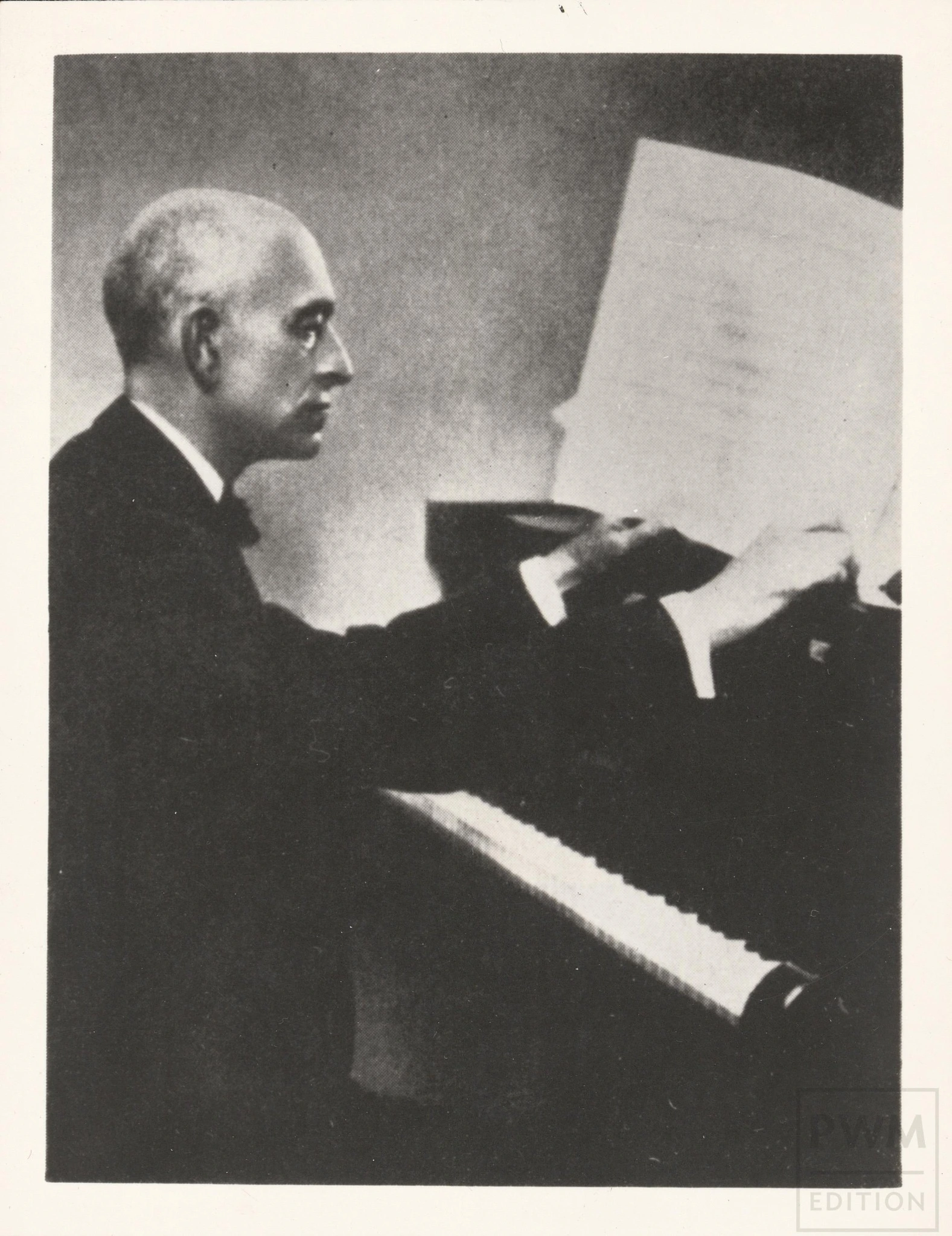
[Manuel de Falla]

Falla Manuel Maria de, full name de Falla y Matheu, *23 November 1876, Cádiz; †14 November 1946, Alta Gracia near Córdoba (Argentina), Spanish composer, pianist and conductor.
His mother was his first piano teacher; around 1885, she helped him transcribe Joseph Haydn’s oratorio The Seven Last Words of Christ on the Cross for piano duet. He also showed creative talent at an early age, composing several short chamber pieces between 1888 and 1889. After studying in his hometown of Cádiz with A. Oderó and E. Broka (harmony and counterpoint) and with E. Galluzzo (solfège and piano), he studied piano in Madrid from 1890 with J. Tragó, initially on an occasional basis, and from 1896 – following the Falla family’s move to the capital – regularly with the same teacher in the piano class at the Madrid Conservatoire.
He graduated in 1899 with the highest honours, though he had already discovered his calling as a composer earlier, a realisation brought about by his encounter with F. Pedrell, a leading composer of the Spanish national school. Five zarzuelas date from this period (the last, Los amores de la Inés, was performed in Madrid in 1902) as well as a number of piano pieces, of which the Allegro de concierto won a prize in a competition organised in 1902 by the Madrid Conservatoire.
In 1905 – in addition to winning yet another prize for his performance at a piano competition – Falla triumphed in a competition for a national opera organised by the Academia de Bellas Artes, presenting his two-act opera La vida breve (The Brief Life). However, this opera was never staged, and Falla, seeing no opportunity to further develop his talent in his homeland, settled in Paris in 1907, where he befriended C. Debussy, M. Ravel, F. Schmitt, and particularly P. Dukas, as well as Spanish artists living in Paris: I. Albéniz, J. Turina and R. Viñes. Thanks to recommendations from Ravel and Dukas, some of Falla’s works were published by Parisian publishers, and in 1913, La vida breve premiered in Nice, going on to enjoy success in Paris the following year.
In 1914, Falla turned down an offer of French citizenship and returned to Madrid, where – nine years after the results of the competition were announced – La vida breve received an enthusiastic reception. Encouraged by his successes and growing fame, Falla stepped up his creative output; by 1920, most of his most popular works had been composed: El amor brujo (Love, the Sorcerer) *, the symphonic impressions Nights in the Gardens of Spain for piano and orchestra, which he had begun as early as 1909, and above all the ballet The Three-Cornered Hat, whose 1919 London production by Diaghilev’s Ballets Russes, choreographed by L. Miasin, with sets by P. Picasso and conducted by E. Ansermet, was arguably Falla’s greatest success. The composer’s limitless devotion to the cause of Spanish national music found its expression in his organisation, together with his friend F. García-Lorca, of the Cante Jondo (“deep song”) festival in Granada in 1922, dedicated to this typically Andalusian style of performance.
Another major success for Falla was the staging in 1923 – first as a concert version in Seville, and subsequently as a stage production in Paris – of the puppet opera Master Peter’s Puppet Show, written to his own libretto. The work soon enjoyed extraordinary success in the Western Hemisphere as well; it was staged, amongst other places, in New York in 1925. Despite his numerous successes and accolades, Falla suffered a severe nervous breakdown, which significantly hampered his creative output; between 1923 and 1926, he composed the Concerto for harpsichord and five instruments.
In 1928, he began work on the monumental stage oratorio Atlántida (Atlantis); however, the gradual deepening of the crisis, compounded by his self-imposed isolation, prevented the composer from completing the work. It was not until after Falla’s death that one of his pupils, E. Halffter, finally finished it. Falla spent the years of the Civil War travelling to Paris and London, and attempted to settle permanently in Mallorca, where in 1933–34 he composed Balada de Mallorca (an arrangement of Chopin’s Ballade in F minor for a cappella choir). Falla’s last completed composition, Homenajes for orchestra, also dates from this period. In 1937, Falla was appointed president of the Instituto de España in Madrid, but as early as 1939, together with his unmarried sister, who had been looking after him since 1919, he left for Argentina, where he spent the last years of his life, having withdrawn completely from musical activity; he only took part as conductor in the premiere of Homenajes in Buenos Aires. He died of a heart attack a few days before the celebrations for his 70th birthday, which were being prepared in Buenos Aires.
Although Falla’s output was modest in volume, it occupies a highly prominent place in 20th-century music. To a certain extent, it represents a continuation of the ideas of the Spanish national school, as previously or contemporaneously manifested in the works of F. Pedrell, E. Granados, I. Albéniz and J. Turina. This continuation concerns the use of a common source, namely the regionally diverse Spanish folk music. However, in his approach to folklore, Falla joined the circle of “20th-century folklorists” such as Bartók, Janáček, Enescu and Szymanowski, as well as, to some extent, Stravinsky in the early period of his career. At the root of this approach—which involved integrating the fundamental characteristics of folk music into the framework of compositional techniques, rather than merely superficially quoting or stylising elements of folklore—lay a fascination with the work of Chopin, whom Falla revered throughout his life.
The influence of Andalusian folk music, the cante jondo, with all its uniqueness and distinctiveness, shaped the fundamental characteristics of Falla’s music. These include functional tonality, the modal character of the melodies, the structural value of the diatonic scale contrasted with the ornamental treatment of chromaticism, the colourful instrumentation, and the raw, primal emotionalism of folk music. Falla supplemented this musical language with elements of contemporary French music, much of which featured in his piano repertoire. This fusion of elements of French Impressionism and a distinctive use of Spanish folk music created the specific sound of Falla’s music, which is considerably more authentic and less stylised than, for example, the music of Ravel.
The national character of Falla’s work is also reflected in his choice of themes for his stage works. The plot of the libretto for the ballet El amor brujo is drawn from a Gypsy legend, while the action of the ballet The Three-Cornered Hat is based on an Andalusian folk tale; the setting for the opera Una vida breve is Granada, and the libretto for the opera Master Peter’s Puppet Show is based on a passage from Cervantes’ Don Quixote.
Falla also carved out a unique place for himself among the composers of the Spanish national school through his distinctive approach to the genres he explored. In his stage works, he focused heavily on the orchestral part, often chamber-like in character, introducing, for example, in the opera Una vida breve unusual effects such as the use of the guitar or the percussive sounds of hammers striking anvils, as well as imitating the sounds of the guitar and castanets in his ballets. Both the ballets and operas, as well as the symphonic impressions Nights in the Gardens of Spain, possess that atmosphere of primal, folk emotionalism which, among other factors, determined the affinity of the opera La vida breve with the conventions of verismo. Apart from such obvious features as the omission of the overture or the merging of the first and second acts with a choral-orchestral intermezzo, it is precisely this austerity and conciseness of the action, rooted in a focus on the most basic reactions and violent passions of ordinary people, that links Falla’s opera to such a classic work of verismo as Mascagni’s Cavalleria Rusticana. These features account for the great popularity of La vida breve, as evidenced by its numerous transcriptions (also by Falla); among them, the best known is F. Kreisler’s violin transcription of the Spanish Dance from Act 2. Falla’s ballets enjoy similar popularity. In El amor brujo, in addition to the extensive use of folk music elements, the use of a solo alto voice is noteworthy; this work was written for the outstanding Gypsy singer and dancer Pastora Imperio. In contrast, in the ballet The Three-Cornered Hat, Falla introduced a wide range of national dances: bolero, fandango, sevillana, farruca, and jota.
The year 1920 is often considered a turning point in Falla’s career. Indeed, as his compositional technique matured, Falla’s musical language underwent a certain sublimation: in his later works (Master Peter’s Puppet Show, Harpsichord Concerto) elements of folklore underwent significant refinement, while the modal character of the melody and harmony became established; this, combined with a polyphonic approach to musical thinking—distinct from his earlier style—cleansed the composer’s style of the remnants of the functional system, thereby imbuing it with a stronger stamp of individuality and, at the same time, bringing it closer to certain manifestations of the neoclassical style. Hence, Falla’s oeuvre is often divided into an Impressionist period (up to ca. 1920) and a Neoclassical period (later years), a division that, however, did not fully correspond to reality, as Falla avoided classical forms and genres, and in his most “Neoclassical” works (Harpsichord Concerto) are dominated by a reflection on the beauty of sound—an element essentially foreign to the neoclassical approach, stemming perhaps also from Falla’s working style: slow, meticulous, and driven by a quest for balance in the finest details of the composition. At the same time, the works of this period clearly lose their national character.
Today, Falla’s figure and his work are today placed among those artists who, drawing on folk material or merely taking inspiration from folklore, overcame the legacy of 19th-century Romantic ideology, and at the same time the remnants of the functional system through their choice of musical language. Carving out a path among numerous stylistic directions, Falla achieved not only the position of the most outstanding Spanish composer and one of the classics of 20th-century music, but also a harmony between appeal and high artistic value that is rarely found in modern music. His music continues to be performed on concert stages around the world.
Literature: J.B. Trend Manuel de Falla and the Spanish Music, New York 1929, 2nd edition 1935, London 1935; Roland-Manuel Manuel de Falla, Paris 1930; A. Sagardía Manuel de Falla, Madrid 1946; J. Pahissa Vida y obra de Manuel de Falla, Buenos Aires 1947, English translation London 1954, Italian translation Milan 1961; J.M. Thomas Manuel de Falla en la Isla, Palma de Mallorca 1947; J. Jaenisch Manuel de Falla und die spanische Musik, Zurich 1952 (contains a list of works and discography); K. Pahlen Manuel de Falla und die Musik in Spanien, Olten 1953 (contains a list of works), French translation Paris 1957, Spanish translation Madrid 1960, Dutch translation Haarlem 1961; L. Campodonico Falla, Paris 1959; R. Arizaga Manuel de Falla, Buenos Aires 1961; Catálogo de la Exposición Manuel de Falla, Grenada 1962; Manuel de Falla, collection of articles edited by M. Mila, Milan 1962; S. Demarquez Manuel de Falla, Paris 1963, English translation Philadelphia 1968; Catálogo de la Exposición Manuel de Falla, Madrid 1964; A. Sagardía Vida y obra de Manuel de Falla, Madrid 1967; B. Schaeffer Muzyka XX wieku, twórcy i problemy, Krakow 1975
Instrumental:
orchestral:
Nights in the Gardens of Spain (Noches en los jardines de España), symphonic impressions for piano and orchestra, 1909–15, performed in Madrid, 9 April 1916, piano: J. Cubiles, conductor: E. F. Arbós, published Paris 1923, Eschig: 1. En el Generalife, 2. Danza lejana, 3. En los jardines de la sierra de Córdoba
El amor brujo (Love, the sorcerer) suite from the ballet for orchestra with or without voice, 1915, performed in Madrid, 28 March 1916, conductor: B. Pérez-Casas, published London 1921, Chester
The Three-Cornered Hat (El sombrero de tres picos), suite from the ballet for orchestra, 1918–19, performed in London, 22 July 1919, conductor: E. Ansermet, published London 1921, Chester
Fanfare for wind instruments and percussion (= part 1 of Homenajes), 1933–34, performed in Madrid, 28 March 1934, conductor: E. F. Arbós
Homenajes, suite in 4 movements for orchestra, 1920–38, first performed Buenos Aires, 18 November 1939, conductor: M. de Falla, published Milan 1938, Ricordi: 1. Fanfare sobre el nombre de E. F. Arbós, 2. À C. Debussy (= arrangement of Hommage pour le tombeau de C. Debussy for guitar), 3. À P. Dukas (= arrangement of Hommage pour le tombeau de P. Dukas for piano), 4. Pedrelliana
chamber:
Melodia for cello and piano, ca. 1888–89
Andante and scherzo for piano quintet, ca. 1888–89
Fantasía for flute, violin, viola, cello and piano, ca. 1888–89
Hommage pour le tombeau de Claude Debussy for guitar, 1920, performed in Paris 24 January 1921, harp M.-L. Casadesus, 2 December 1922, guitar E. Pujol, published in Paris “La Revue Musicale” 1920 December, London 1920 Chester, piano version, 1921 Chester
Concerto for harpsichord or piano, flute, oboe, clarinet, violin and cello, 1923–26, performed in Barcelona 5 November 1926, Asociación de Música de Cámara, harpsichord W. Landowska, conductor M. de Falla, published in Paris 1928 Eschig
for piano:
Serenata andaluza for piano, ca. 1896–98, published in Madrid 1940 F. Fuentes
Vals capricho for piano, ca. 1896–98, published in Madrid 1940 F. Fuentes
Nocturno for piano, ca. 1896–98, published in Madrid 1940 F. Fuentes
Canción for piano, ca. 1896–98
Allegro de concierto for piano, 1902, performed in Madrid 4 May 1905, M. de Falla
Cuatro piezas españolas (dedicated to I. Albéniz) for piano, 1906, performed in Paris 27 March 1909, R. Viñes, performed in Paris 1909 Durand: 1. Andaluza, 2. Cubaña, 3. Aragoñesa, 4. Montañesa
Fantasía bética (dedicated to A. Rubinstein) for piano, 1919, performed in New York 1920, A. Rubinstein, published in London 1922 Chester
Hommage pour le tombeau de Paul Dukas for piano, 1935, published in Paris, “La Revue Musicale” 1936 May/June
Vocal:
Balada de Mallorca for mixed a cappella choir, text by J. Verdaguer, 1933, performed in Mallorca 21 May 1933 (Chopin Festival)
Vocal-instrumental:
Tus ojillos negros for voice and piano, text by C. de Castro, 1900–02, performed in Madrid 1940 F. Fuentes
Trois mélodies for voice and piano, text by Th. Gautier, 1909, performed in Paris 1910, A. Adiny-Milliet, M. de Falla, published in Paris 1910 Rouart-Lerolle: 1. Les colombes, 2. Chinoiserie, 3. Seguidilla
Siete canciones populares españolas for voice and piano, popular text, adapted by P. Milliet, 1914–15, performed in Madrid 14 January 1915, L. Vela, M. de Falla, published in Paris 1922 Eschig (also published in a version for violin or cello and piano): 1. Seguidilla murciana, 2. El paño moruno, 3. Asturias, 4. Jota, 5. Nana, 6. Canción, 7. Polo
Oración de las madres que tienen a sus hijos en brazos na głos i fortepian, text by G. Martínez Sierra, 1914, performed in Madrid 8 February 1915, J. Revillo, M. de Falla
Psyché for mezzosoprano, flute, harp, violin, viola and cello, text by G. Jean-Aubry, 1924, performed in Barcelona December 1924, mezzosoprano C. Badia, published in London 1927 Chester
Soneto a Córdoba for voice and harp or piano, text by L. de Gongora, 1927, performed in Paris 14 May 1927, singer M. Greslé, published in Paris 1932 Eschig
Stage:
La limosna de amor, zarzuela in one act, libretto by J. Veyan, 1900–02
La casa de Tócame Roque, zarzuela in one act, libretto by da Ramón de la Cruz, 1900–02
El corneta de órdenes (with A. Viñes, zarzuela in three acts, 1900–02
La cruz de Malta (with A. Viñes), zarzuela in one act, 1900–02
Los amores de la Inés, zarzuela in one act, libretto by E. Dugi, 1902, performed in Madrid 12 April 1902
La vida breve (A brief life), two-act lyric drama (revised 1913), libretto by C. Fernandez Shaw, 1904–05, performed in Nice 1 April 1913, conductor Falconnet, published in Paris 1913 Eschig
El amor brujo (Love, the Sorcerer), one-act ballet (gitanería), libretto by G. Martínez Sierra, 1914–15, performed in Madrid 15 April 1915, conductor M. Ballesteros, score and piano reduction published, London 1921 Chester
El corregidor y la molinera (The magistrate and the miller’s wife), pantomime in two parts with mezzosoprano solo, libretto by G. Martínez Sierra after the novel by P. Alarcone, 1916–17, performed in Madrid 7 April 1917, conductor J. Turina
El sombrero de tres picos (The Three-Cornered Hat), the composer partly reused music from La casa de Tócame Roque and entirely from El corregidor y la molinera; comic one-act ballet, libretto by G. Martínez Sierra, 1918–19, performed in London, 22 July 1919, conductor: E. Ansermet, published in London 1921, Chester
El fuego fatuo, comic opera in three acts, libretto G. Martínez Sierra, 1918–19
El retablo de maese Pedro (Master Peter’s Puppet Show), one-act puppet opera, libretto by M. de Falla after M. Cervantes’ Don Quixote, 1919–22, performed in Seville 23 March 1923, conductor M. de Falla (concert performance), Paris 25 June 1923, conductor W. Golschmann (staged performance), score and piano reduction published, London 1924 Chester
La Atlántida (Atlantis), staged oratorio for soloists, choir, and orchestra (completed by E. Halffter), libretto by J. Verdaguer, 1926–47, performed in Barcelona, 24 November 1961, conductor: E. Toldrá (concert performance), Milan, 18 June 1962, conductor: Th. Schippers (staged performance), published in Milan 1962, Ricordi