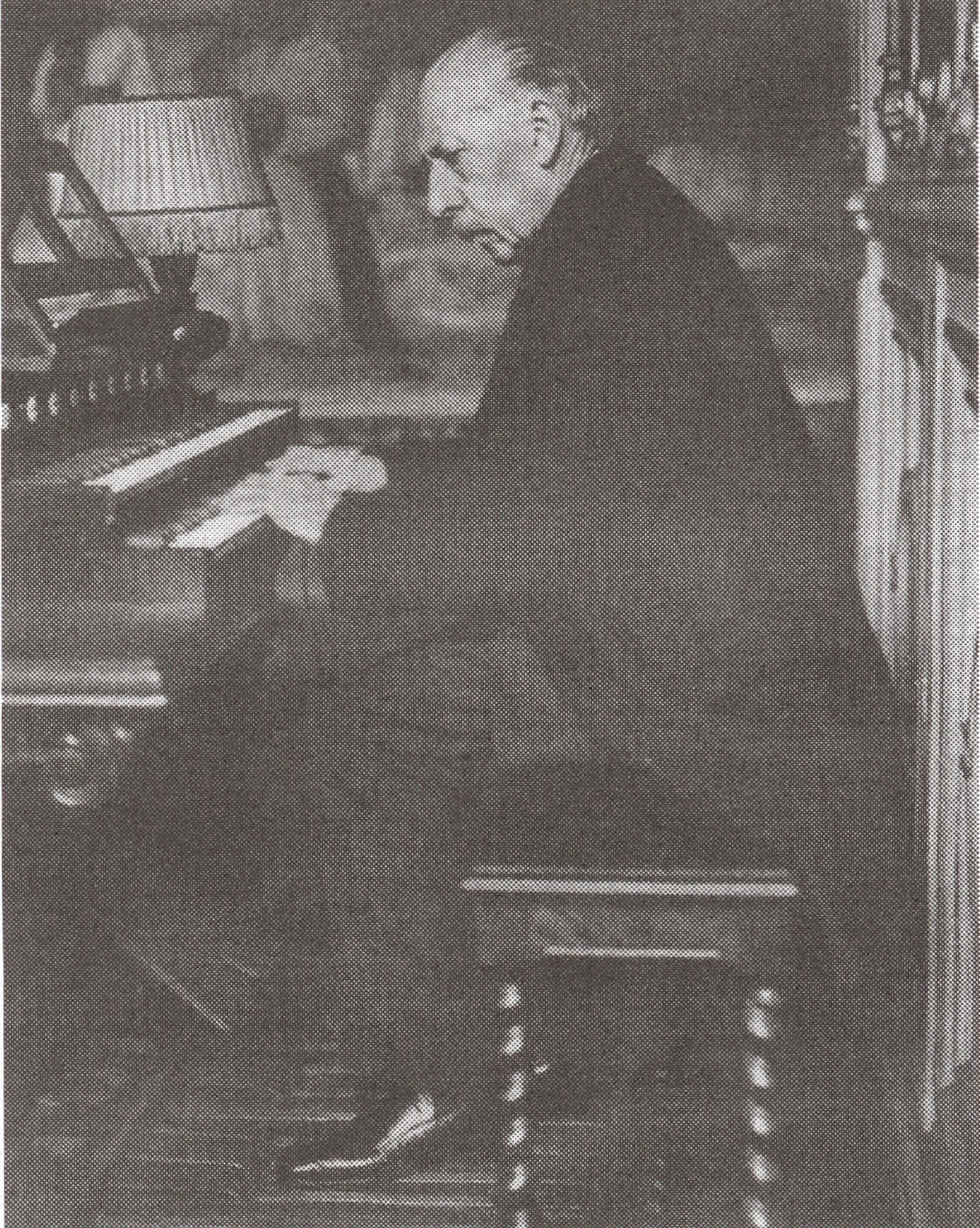
Widor Charles-Marie, *21 February 1844 Lyon, †12 March 1937 Paris, French organist, composer, and teacher. His grandfather, Jean Widor (1775–1854), was an organ builder for the Callinet company in Rouffach; his father, François-Charles (1811–1899), and brother, Paul (1847–1930), were organists at the Church of St-François de Sales in Lyon. Widor received his initial musical education from his father; at the age of 11, he became organist at the College des Jésuites de la Trinité in Lyon, from which he graduated in 1862 with a classical degree. In 1863, he studied organ privately in Brussels for about seven months with J.N. Lemmens and counterpoint, fugue, and composition with F.-J. Fétis, and on 28 July of that year, he gave his first concert at the Church of St-Sulpice in Paris. Recommended by A. Cavaillé-Coll, C. Saint-Saëns, and Ch. Gounod, he became interim organist of this church in 1870, succeeding L.J.A. Lefébure-Wély; he never gained the title of titular organist, but held that position for 64 years, until 1933. At the Paris Conservatory, he taught organ (December 1870–96) and composition (October 1896–1927). His students included renowned organists, including H. Busser, A. Schweitzer, Ch. Tournemire, C. Quef, L. Vierne, and composers, including M. Dupré, A. Honegger, D. Milhaud, N. Boulanger, and E. Varèse. In the 1926/27 academic year, O. Messiaen was also a student in Widor’s composition class. Widor gave private organ lessons until 1933; his last students included H. Klotz and S. Jeans. Widor made dozens of concert trips abroad, including to Portugal (1865), England (1865, 1888, 1890), the Netherlands (1886), Switzerland (1894), Germany (1895, 1899, 1921), Russia (1896, 1901, 1903), Italy (1898), and in 1901 he played in Warsaw. Widor’s last public appearances as an organist took place in 1932 – on 10 June in Paris and in the autumn in Salzburg, and as a conductor – on 19 April 1934 in Paris. Together with F. Casadesus, he founded Le Conservatoire Américain in Fontainebleau in 1921 and served as its director from 1923 to 1934. Committed to supporting French composers, he initiated the establishment of the Casa de Velázquez in Madrid (1920–32) in 1916–18 and a similar centre, the E. Rothschild Foundation, in London (1921). From 29 October 1910, Widor was a member of the Academié des Beaux-Arts, and on 18 July 1914 became its secretary for life; he was appointed to similar societies in Berlin (1906), Brussels (1907), Stockholm (1909), Florence (1923), and Bologna (1924). He was awarded the Grand Gold Medal of the City of Paris (1930) and the Order of Officer of the Legion of Honour (1933). He died in his own home in Paris and was buried in the crypt of the Church of St-Sulpice.
After the deaths of C. Saint-Saëns and G. Fauré in the mid-1920s, Widor became the doyen of French music; alongside C. Franck, he was the father of the so-called French symphonic organ school, inspired by the sonic possibilities of A. Cavaillé-Coll’s organs, and the creator (1872) of the name for its specific genre – the organ symphony (its features were already present in the second piece from Franck’s cycle Six pièces pour grand orgue). His close relationship with A. Cavaillé-Coll was decisive not only for his studies with the Belgian organist and his position as organist at St-Sulpice, but also for Widor’s inauguration (with Franck, Saint-Saëns, Guilmant, Gigout, Dupré, and others) of many instruments by this outstanding designer in churches and halls of Paris, including the Notre-Dame (1867, reinaugurations 1894, 1932), Saint-Trinité (1869), Trocadéro (1878), St-François-Xavier (1879), St-Philippe-du-Roule (1903), Sacré-Coeur (1919) and other cities, for example in Rouen (St-Quain, 1890), as well as abroad, for example in London (Carmelite monastery in Kensington, 1865). In his private salon, Widor also had an A. Cavaillé-Coll organ from 1893, which he moved to the Musée de Caen in 1917, seat of the Académie des Beaux-Arts, where he organised organ and chamber concerts every first Saturday of the month. He also inaugurated the E.F. Walcker of Ludwigsburg organ at the Warsaw Philharmonic (1901). Widor greatly enjoyed conducting his own works, even though his skills in this field were not highly regarded. He achieved the highest acclaim as an organ virtuoso, distinguished, according to L. Vierne, by his extraordinary musicality and ability to play a wide phrase with perfect accentuation, impeccable legato, and precise staccato that did not shorten the duration of the note, his superb pedal technique, and his always independent, rapid registration changes. Especially in the Church of St-Sulpice, as I.J. Paderewski recalled, “at Widor’s famous morning concerts, one could meet the entire artistic and aristocratic world of Paris every Sunday. The church was always crowded with the most splendid and beautiful ladies of Parisian society. Sometimes even (…) foreigners frequenting the high society would come.” In addition to his own compositions, Widor’s repertoire included works by Bach, Handel, and Mendelssohn, among others. The 88-year-old Widor’s performance of his Toccata from Op. 42, No. 1, and the Andante sostenuto and Finale from Op. 70 on the organ in St-Sulpice was recorded in 1932 by La Voix de son Maître (DB 4856, 4864-65), and these recordings were reissued by EMI (C 153-16411/5) in 1981 on the album Orgues et organistes français en 1930. Widor, as Franck’s successor at the Paris Conservatoire, thoroughly reformed organ teaching; he emphasized, among other things, precision of playing technique and the important role of reason in interpretation. Maintaining the tradition of his teacher, J.N. Lemmens, Widor promoted Bach’s music in France, including through concerts of the Parisian oratorio society “La Concordia” (of which he was director and conductor from 1880). He also contributed to the writing of a monograph on Bach by A. Schweitzer and, with it, the publication of the German master’s organ works. Widor prepared a free transcription of six Bach works for organ, entitled Bach’s Memento, especially for the inauguration of the new organ (1925) at the Conservatoire Américain. Widor’s interest in the works of Liszt (whom Widor met personally in 1866, 1876, and 1878) and Wagner (including his 1876 trip to Bayreuth for the premiere of the tetralogy Der Ring des Nibelungen) influenced, among other things, on the homophonisation and symphonisation of the organ texture, the dramatisation of Widor’s musical narrative, the harmony (especially of his late chamber and orchestral works) and the introduction of numerous examples from Wagner’s operas in the treatise Technique de l’orchestre moderne.
The first 8 of Widor’s 10 organ symphonies (op. 13 and 42) have a 5-6-movement structure, with passages characteristic of a suite (e.g. Prélude, Marche, Minuet, Pastorale, Toccata). Analogous predilections are visible in his chamber music, for example in op. 34, 51, 58. In all the organ symphonies, the ABA form predominates, with the rondo (op. 42 No. 2, movement 5), the theme with variations (op. 42 No. 1, movement 1; op. 70 movement 4), while the sonata allegro appears sporadically. In op. 13 and 42, Widor’s perfect mastery of the art of counterpoint is already evident, but in op. 42 is dominated by the homophonic texture, the melodic factor, with the cantabile genre typical of Widor (op. 42 No. 1, movement 2 and No. 2, movement 3), and the virtuosic element (e.g. the famous final Toccata from op. 42 No. 1). A characteristic feature of the last organ symphonies, op. 70 Gothic and op. 73 Romanesque, which are a synthesis of Widor’s achievements in this genre and in terms of playing technique, is the unification of the cycle through the use of the Gregorian chant melody Puer natus est, which returns three times in movement 3 of op. 70, and in movement 4 is the theme for three variations, of which the 2nd and 3rd are canons. In turn, Haec dies appears in all movements of op. 73, and in the third movement, additionally, are used from the same Easter Mass: Ite missa est, Victimae paschali laudes, Agnus redemit oves, and Ressurexi. Chorale themes also appear in symphonies with concertante organ participation: Op. 81 (Te Deum, Lauda Sion) and Op. 83 (Nun komm der Heiden Heiland).
His career as a virtuoso organist and conductor, his teaching career and that of the Académie des Beaux-Arts, and his related journalistic work (under the pseudonym Tibićen or Aulétès in publications such as “Le Correspondant,” “Le Piano-Soleil,” and “L’Estafette”) did not limit Widor’s compositional activity, as he composed almost 100 opuses and published his first four organ symphonies op. 13 in 1872, just two years after taking up his position at St-Sulpice. However, he was working on the final versions of all the symphonies, op. 13 and op. 42, as evidenced by their subsequent editions, the last revised by the composer himself in 1928–29. Some religious works, such as the Messe op. 36, were written for the St-Sulpice church choir, while a composition with concertante piano – the Fantaisie op. 62 and Piano Concerto No. 2 op. 77, were inspired by Widor’s friend I. Philippe, a virtuoso pianist and their first performer. Among Widor’s stage works, the ballet La Corrigane (160 performances at the Paris Opéra between 1880 and 1962) and the opera Maître Ambros, a synthesis of Meyerbeer and Wagner’s stylistic elements, gained attention. His extensive chamber works, including the Serenade op. 10, Piano Quartet op. 66, and songs to poetry by V. Hugo, were often intended for performance in Parisian salons, but although published, they never entered the wider concert circuit. Organ symphonies, however, have taken a permanent place in the repertoire, and are still frequently performed by Polish organists. They have influenced contemporary French organ music, including the works of C. Tournemire (e.g. Triple choral op. 41, L’orgue mystique op. 55–57) and L. Vierne (e.g. symphonies for organ no. 4 op. 32, no. 6 op. 59).
Literature: (published in Paris if not stated otherwise) H. Imbert Portraits et études, 1894; H. Reynaud L’Oeuvre de Charles-Marie Widor, étude d’esthétique musicale, Lyon 1900; A. Boschot Notice sur la vie et les oeuvres de M. Charles-Marie Widor, 1937; H. Klotz Erinnerungen an Charles-Marie Widor, “Musik und Kirche” 1937; I.J. Paderewski Memoirs, written down by M. Lawton, London 1939, Polish ed., Kraków 1961; N. Dufourcq La musique d’orgue française de J. Titelouze à J. Alain, 1941, 2nd ed. 1949; I. Philipp Charles-Marie Widor. A Portrait, “The Musical Quarterly” XXX, 1944; L. Vierne Mes souvenirs, “L’Orgue. Cahiers et mémoires,” special issue (134 bis), 1970, German ed., Cologne 2004; M. Dupré M. Dupré raconte, 1972; G. Favre Silhouettes du Conservatoire. Charles-Marie Widor, A. Gédalge, M. d’Ollone, 1986; A. Thomson The Life and Times of Charles-Marie Widor. 1844–1937, Oxford 1987; A. Hobbs Charles-Marie Widor (1844–1937), “L’Orgue. Cahiers et mémoires” no. 40, 1988/2; E. Kooiman J. Lemmens, Charles-Marie Widor und die französische „Bach-Tradition”, “Ars organi” XXXVII, 1989/4 and XXXVIII, 1990/1; S. Hiemke Die Bach-Rezeption CharlesMarie Widors, Frankfurt am Main 1994; B. van Oosten Charles-Marie Widor. Vater der Orgelsymphonie, Paderborn 1997; M. Murray French Masters of the Organ. Saint-Saëns, Franck, Widor, Vierne, Dupré, Langlais, Messiaen, New Haven 1998; French Organ Music. From the Revolution to Franck and Widor, ed. L. Archbold, W.J. Peterson, Rochester 1999; W. Syre Individualismus der zyklischen Form. Einige Randbemerkungen zur Formentwicklung in Widors Orgelsinfonien Opus 13 und 42, parts 1 and 2, “Organ – Journal für die Orgel” 2005 no. 4 and 2006 no. 1; G. Clericetti Charles-Marie Widor. La Francia organistica tra Otto e Novecento, Varese 2010; J. R. Near Widor a Life beyond the Toccata, Rochester 2011; A.-I. de Parcevaux Charles-Marie Widor, 2015; M. R. Bundy Visions of Eternity. The Choral Works and Operas of Widor, Vierne and Tournemire, Leicester 2017; C. Miller Sinfonische Orgel nach 1870 zwischen Sakralität, Profanität und Nationalismus. Ein deutsch-französischer Vergleich, “Die Musikforschung” 70, 2017 no. 2; H. Fabrikant The Pianists Hardly Spoil Me with too Much Attention. A Study of the Forgotten Piano Works of Charles-Marie Widor, 1844–1937, introduction J. R. Near, Caulfield 2019; J. R. Near Widor on Organ Permormance Practice and Technique, Rochester 2019.
Compositions:
Published in Paris, unless otherwise stated, publishers: Maho, Hamelle, Schoen werk et Cie., A. Durand et fils, Plon, Heugel, Durand, Schott; the year of creation of the work is identical to the year of its publication, unless otherwise stated.
Instrumental:
Grande phantasia for organ and orchestra, 1865
Variations sur un thème originale op. 1 for piano, 1876, 2nd version as op. 29, published in 1887
Airs de ballet op. 4 for piano, 1868
Scherzo brillant op. 5 for piano, 1868
Deux suites italiennes op. 6 for piano, 1868
Piano Quintet in D minor op. 7, 1868
Caprice op. 9 for piano, 1868
La prière for piano, 1868
L’orientale. Scherzo for piano, 1868
Six duos for piano and harmonium, 1869, Mainz 1891
Sérénade op. 10 for piano, flute, violin, cello and harmonium, 1870 (also arranged for orchestra; piano, violin and cello, 1922; piano and harmonium; piano for 4 hands; organ)
Trois valses op. 11 for piano, 1871
Impromptu op. 12 for piano, 1871
Symphonies op. 13 for organ: no. 1 in C minor, no. 2 in D major, no. 3 in E minor, no. 4 in F minor, 1872
Six morceaux de salon op. 15 for piano, 1872
Symphony No. 1 in F major op. 16, 1873
Prélude, Andante et Finale op. 17 for piano, 1874
Piano Trio in B-flat major op. 19, 1874, published in 1875
Scènes de bal op. 20 for piano, 1874, published in 1875
Trois pièces op. 21 for cello and piano, 1875
Six valses caractéristiques op. 26 for piano, 1876
Douze feuillets d’album op. 31 for piano, 1876, published in 1877
Suite op. 34 for flute and piano, 1877
Concerto No. 1 op. 39 for piano and orchestra, 1876
Violin Concerto, 1877
La barque, fantaisie italienne for piano, 1877
Le corricolo, fantaisie italienne for piano, 1877
Concerto op. 41 for cello and orchestra, 1878, published in 1882
Symphonies op. for organ: no. 1 in F minor, no. 2 in G minor, no 3 in A minor, no. 4 in B minor, 1878–87
Dans le bois op. 44 for piano, 1880
Romance op. 46 for violin and piano, 1889 (?)
Pages intimes op. 48 for piano, [1876], published in 1879
Deux scènes mélodiques for piano, 1881
Sonate no. 1 in C minor op. 50 for violin and piano, 1881
Suite polonaise op. 51 for piano, 1881
Soirs d’Alsace op. 52 for violin, cello and piano, 1908
Symphony No. 2 in A major op. 54, 1882
Cavatine op. 57 for violin and piano, 1887
Suite op. 58 for piano, 1887
La nuit de Walpurgis op. 60, symphonic poem for orchestra and choir, 1880, published in 1888
Carnaval op. 61 for piano, 1889
Fantaisie op. 62 for piano and orchestra, 1889
Piano Quartet op. 66, 1891
Suite pittoresque (Ouverture espagnole), 1893
Piano Quintet op. 68, 1894
Symphony No. 3 in E minor op. 69 for organ and orchestra, published in Mainz 1895
Symphonie gotique in C minor op. 70 for organ, 1894, published in Mainz 1895
Kermesse carillonnante op. 71 for piano, 1894
Introduction et Rondo op. 72 for clarinet and piano, 1898
Symphonie romane in D major op. 73 for organ, 1899, published in 1900
Choral et Variations op. 74 for harp and orchestra, 1900
Suite op. 76 for violin and piano, 1903
Concerto No. 2 op. 77 for piano and orchestra, 1905
Suite écossaise op. 78 for piano, 1905 (?)
Sonate no. 2 in D minor op. 79 for violin and piano, 1907
Sonate in A major op. 80 for cello and piano, 1907
Sinfonia sacra in C minor op. 81 for organ and orchestra, Leipzig [1907]
Fugue sur nom de Haydn op. 82 for piano, 1910
Symphonie antique op. 83 for organ, orchestra and choir (in the finale), 1911
Salvum fac populum tuum op. 84 for organ, 3 trumpets, 3 trombones and cymbal, 1917
Suite florentine for violin/flute and piano, 1919
Suite latine op. 86 for organ, published in 1927
Trois pièces nouvelles op. 87 for organ, published in 1934
Vocal and vocal-instrumental:
O Salutaris op. 8 for voice, violin, cello and organ, 1868
Six mélodies op. 14 for voice and piano/organ, words by T. De Banville, E. Cabrol, L. Paté et al., 1872
Deux motets op. 18: 1. Tantum Ergo, 2. Regina Coeli for 2 choirs and 2 organs, 1874
Six mélodies op. 22 for voice and piano/organ, words by V. Hugo et al., 1875
Trois motets op. 23: 1. Psaume LXXXIII, 2. Tu es Petrus, 3. Sacerdos et pontifex for 4 mixed voices and 2 organs, 1876
Ave Maria op. 24 for mezzo-soprano, harp and organ, 1877
Trois choeurs op. 25: 1. Barcarolle, 2. Au matin, 3. Rèverie for 4 mixed voices, 1876
Trois mélodies op. 28 for baritone and piano/organ, words by V. Hugo (nos 1–2), A.M. Blancheotte, 1876
Deux duos op. 30 for 2 voices and piano: 1. J’étais seul près des flots, 2. Je ne croyais pas au bonheur, words by V. Hugo, 1876
Trois mélodies italiennes op. 32 for voice and piano/organ, 1876, published in 1877
Trois mélodies italiennes op. 35 for mezzo-soprano and piano/organ, 1878
Messe op. 36 for 2 choirs and 2 organs, 1878, also version for choir and organs
Six mélodies op. 37 for mezzo-soprano and piano/organ, words by V. Hugo, 1877
Deux duos op. 40 for 2 voices and piano: 1. Nocturne, 2. Qu’un sogne au ciel, 1876
Six mélodies op. 43 for voice and piano/organ, words by V. Hugo, R.-F. Sully-Prudhomme et al., 1878
Psaume CXII „Laudate Pueri” for double choir, 2 organs and orchestra, 1879
Six mélodies op. 47 for voice and piano/organ, words by V. Hugo, 1879
Chant séculaire op. 49 for soprano, choir(s) and orchestra, 1881
Duos op. 52 for 2 voices and piano: 1. L’hiver, 2. Guitare, 1881
Six mélodies op. 53 for voice and piano/organ, words by F. Coppée, V. Hugo, R.-F. Sully-Prudhomme et al., 1881
Veilles chansons et rondes pour les petits enfants for voice and piano/organ, 1883
Ave Maria op. 59 for voice, harp and organ, 1884
O Salutaris for voice, violin, cello and organ, 1889
Soirs d’été op. 63 for voice and piano/organ, words by P. Bourget, 1889
Non Credo for voice and organ, words by S. Bordèse, 1890 (?)
Chanson de mer. Serenade italienne for voice and piano/organ, words by P. Bourget, 1902
Scenic (staged in Paris if not stated otherwise):
Le capitaine Loys, comédie lyrique, in 5 acts, libretto E. Noel and L. d’Hève, 1878, staged in Lyon 1900, not published;
La Korrigane, ballet fantastique, in 2 acts, libretto F. Coppée and L. Mérante, published and staged in 1880
Maître Ambros op. 56, drame lyrique, in 4 acts, libretto F. Coppée and A. Dorchain, staged 1886, piano reduction 1886
Jeanne d’Arc, légende mimée (pantomime musicale), in 4 acts, libretto A. Dorchain, published and staged in 1890
Les pêcheurs de Saint-Jean, drame lyrique, in 4 acts, libretto H. Cain, 1895, staged 1905, piano reduction 1905
Nerto, drame lyrique, in 4 acts, libretto M. Léna after F. Mistral’s poem, 1919, published and staged in 1924
theatre music:
Les Jacobites, text F. Coppée, staged in January, published in 1885
Conte d’Avril op. 64, text A. Dorchain after Shakespeare, staged in 1885, published in 1891
***
Bach’s Memento, transcription of 6 words by J.S. Bach, 1925
Works (dates refer to the Paris edition unless otherwise stated):
La musique grecque et les chants de l’église latine, “Revue des deux monde” no. 131, 1895
Technique de l’orchestre moderne faisant suite au „Traité d’instrumentation et d’orchestration” d’H. Berlioz, 1904, extended 5th ed. 1925, new ed. 2022, German transl. no place 1903, English transl., London 1906, new ed., New York 2005, Spanish transl., no place 1913
Notice sur la vie et les oeuvres de M. Saint-Saëns, 1922
L’initiation musicale, 1923
Académie des Beaux-Arts. Fondations. Portraits de Massenet à Paladilhe, 1927
L’orgue moderne. La décadence dans la facture contemporaine, 1928
Introductions to, among others:
A. Pirro L’orgue de J.S. Bach, 1895
E. de Bricquevile Notes historiques et critiques sur l’orgue, 1899
A. Schweitzer J.S. Bach, German ed., Leipzig 1908, numerous reprints and transl., Polish ed., Kraków 1972, Warsaw 3rd ed. 2009
C. Bouvet Les Couperin, 1919
R. Brancour Histoire des instruments de musique, 1921
J. Huré L’esthétique de l’orgue, 1923
F. Raugel Les maîtres français de l’orgue aux XVLIe et XVIIIe siècles, [between 1931 and 1932]
F. Chopin. Exposition de tableaux, gravures, manuscrits, souvenirs, 1810–1849, organisée par la Bibliothèque polonaise… [Paris 22–30 juin 1932], introduction F. Pułaski, 1932
editions:
L’orgue moderne, Paris 1896–1932
J.S. Bach Complete Organ Works. A Critico-Practical Edition, with A. Schweitzer, volumes 1–5, New York 1912–14