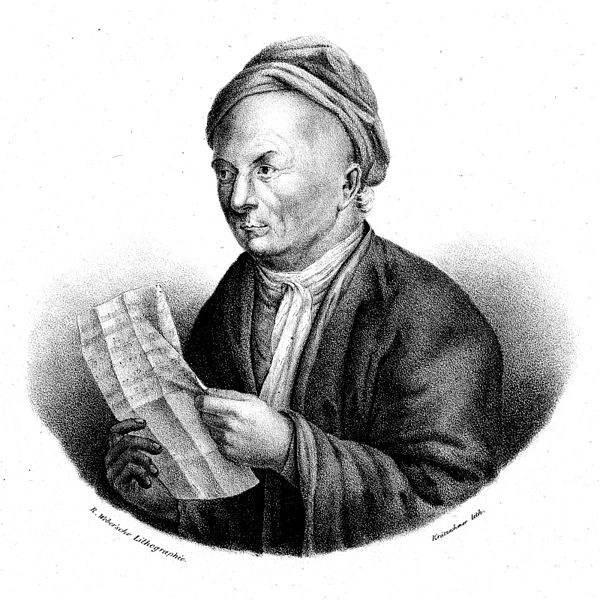
Homilius Gottfried August, *2 February 1714 Rosenthal (near Königstein, Saxony), †2 June 1785 Dresden, German composer, cantor and organist. Following the death of his father (a pastor) in 1722, he became a pupil at Annenschule in Dresden, where he was probably taught by J.G. Stübner (organist). In 1735, he began studying law at the University of Leipzig; there he also continued his musical studies with J.S. Bach (composition, harpsichord) and, probably, with the organist at the Nikolaikirche, Johann Schneider. From 1742, he served as organist at the Frauenkirche in Dresden, although his attempts to secure a similar position in Bautzen in 1741 and in Zittau in 1753 were unsuccessful. In 1755, Homilius became cantor of the Kreuzkirche and a teacher of music, Latin and Greek at the Kreuzschule, thereby becoming one of the leading figures in Dresden’s musical community, where he remained active until the end of his life. In 1755, he was appointed director of music at three local churches: the Frauenkirche, the Kreuzkirche and the Sophienkirche. He gained recognition as an outstanding organ virtuoso and improviser. Homilius’s pupils included J.A. Hiller, J.G. Naumann, J.F. Reichardt and D.G. Türk.
Homilius was a leading figure in German Protestant sacred music during the second half of the 18th century. His vast body of work, particularly in the field of vocal-instrumental music (cantatas, motets, Passions, oratorios), earned him the respect of his contemporaries (D.G. Türk, J.F. Reichardt, J.A. Hiller) and the recognition of today’s scholars (G. Feder and others). In his organ works, Homilius does not venture beyond the traditions of Pachelbel and J.S. Bach in terms of form and compositional technique, frequently employing the chorale cantus firmus and polyphonic techniques. His large-scale vocal-instrumental works employ a more modern musical language. Although they stem from the legacy of Handel and Bach, they display tendencies characteristic of Classicism: a simplification of form and harmony, symmetrical structure, and a lyrical style. Homilius is regarded, alongside J.F. Doles, as one of the leading figures of the Empfindsamer Stil in church music. However, the tendency to deepen musical expression and the attention to the clear conveyance of the verbal text (syllabic treatment, homophony, shaping of the sound material, musical imitation and the use of musical symbolism) are particularly evident in songs and arias accompanied by the piano. Homilius’s motet works are characterised by a wealth of melody and a clear declamatory style.
Literature: R. Steglich K.Ph.E. Bach und der Dresdner Kreuzkantor G.A. Homilius im Musikleben ihrer Zeit, “Bach-Jahrbuch” XII, 1915; R. Fricke G.A. Homilius, “Zeitschrift für Kirchenmusiker” XVII, 1935; H. Löffler Die Schüler J.S. Bach, “Bach-Jahrb” XL, 1953; G. Feder Verfall und Restauration in: F. Blume, L. Finscher, G. Feder, A. Adrio, W. Blankenburg Geschichte der evangelischen Kirchenmusik, Kassel 1965, English translation 1974; H. John G.A. Homilius und die evangelische Kirchenmusik Dresdensim 18. Jahrhundert, Halle 1973 (dissertation, which includes a catalogue of Homilius’s works and a bibliography).
Compositions:
numerous organ arrangements of chorales and preludes, manuscripts in Bautzen, Berlin, Leipzig, Dresden and Brussels
7 songs in Gesänge für Maurer, accompanied by piano, Dresden 1782
Sechs Arien im Auszuge für Clavier, für Freunde ernsthafter Gesänge for voice with piano accompaniment, Dresden 1786
in addition, songs in anthologies
Wir weinen dir und deiner, duet, in manuscript
Lass uns deine Stimme hören, duet, in manuscript (lost)
8 four- and eight-part Magnificats, manuscripts in Berlin, Dresden and Brussels
over 60 motets for 4 and 8 voices, manuscripts in Berlin and Brussels
Die Freude der Hirten, über die Geburt Jesu, an oratorio for solo voices, choir and orchestra, Frankfurt (Oder) 1777
excerpts from the Passion oratorio, manuscript in Berlin
over 200 cantatas, manuscripts in Berlin, Dresden, Frankfurt am Main, Gotha and Schwerin
5 Passions, manuscripts in Berlin and Schwerin
Ein Lämmlein geht, Passion for solo voices, choir and orchestra, Leipzig 1775
Der Messias, Passion, ca. 1776, libretto, Schwerin 1780
Writings:
General-Bass von Homilius, manuscript in Berlin
Ode, dem gesegneten Gedächtniss des weiland (…) Herrn J.J. Gottlob Am-Ende, Friedrichstadt 1777
Editions:
5 chorale arrangements and 6 chorale preludes, ed. G. Feder, «Die Orgel» I–II, series 2, Lippstadt 1957
3 preludes, ed. G.W. Körner, «Der Orgelfreund» XII/13, Erfurt n.d.
duet Lass uns deine Stimme hören, ed. R. Fricke, Hameln 1935
3 motets in «Die heilige Cäcilie» 11/20, Berlin 1918
one motet in each: “Singet dem Herrn” CXCVIII supplement, Elberfeld n.d., «Klassische Kirchenmusik» XXIV, n.d., 88 Motetten und geistliche Gesänge, Leipzig n.d., «Kirchliche Gesänge» V, Hanower n.d.
1 motet, ed O. Richter, Leipzig 1926
2 motets, ed. G. Feder, «Das Chorwerk» LXXXIX, 1963
1 motet, «Kantate-Chorblatt» XI, Dresden 1965
5 cantatas, ed. R. Fricke, «Meisterwerke alter Kirchenmusik aus Sachsen und Türingen» series 1, VII, 1931, VIII, X, XI, XIII, 1932