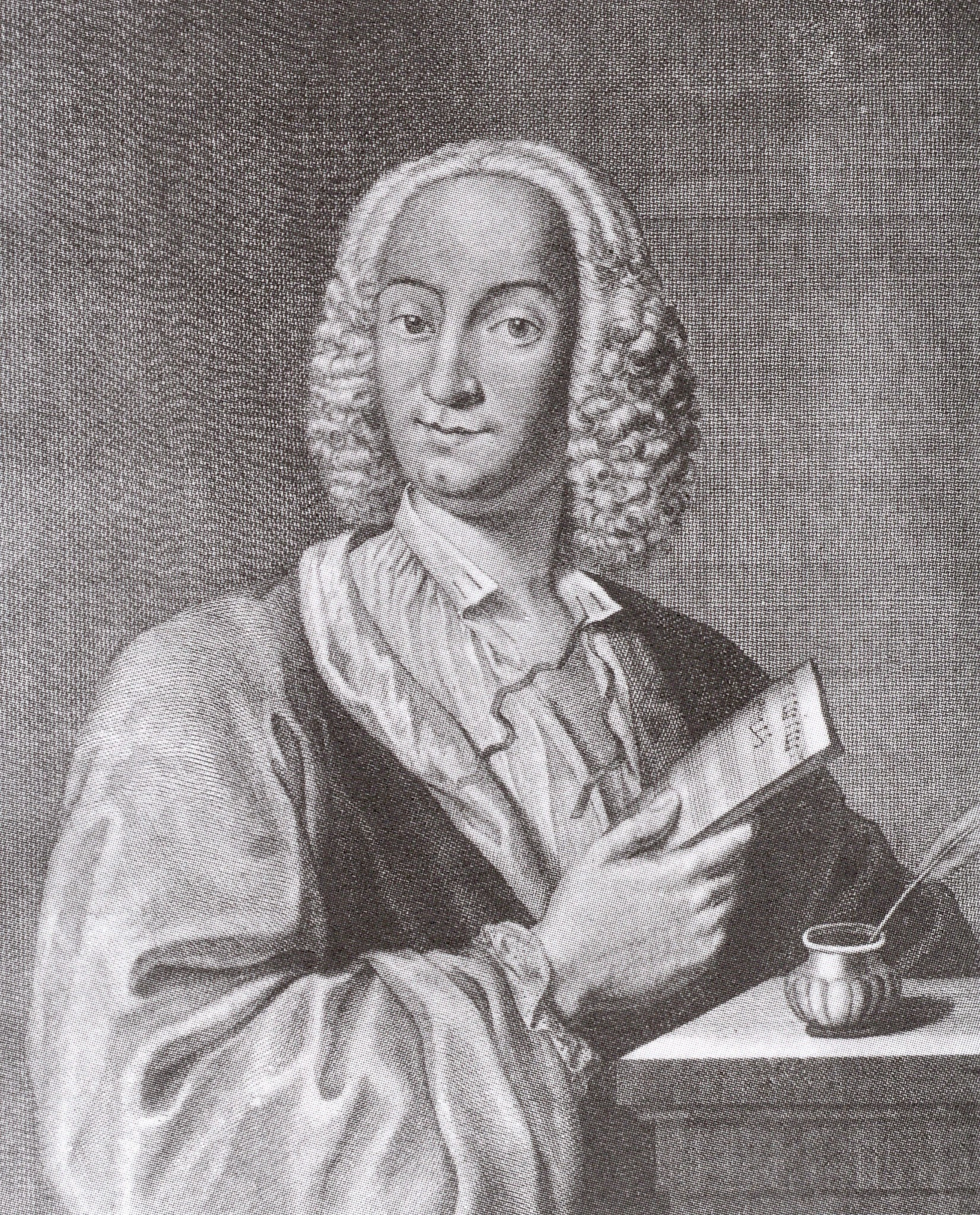
Vivaldi Antonio Lucio, *4 III 1678 Wenecja, †27 lub 28 VII 1741 Wiedeń, włoski kompozytor i skrzypek. Był najstarszym synem Giovanniego Battisty (Giambattisty) Vivaldiego (1655–1736), zwany Rossi lub Rosetto (od rudego koloru włosów), który w 1666 przybył do Wenecji z Brescii, a w latach 1685–1729 był skrzypkiem bazyliki S. Marco. Na temat studiów muzycznych Vivaldiego brak informacji, prawdopodobnie jego pierwszym nauczycielem był ojciec, być może w latach 1700–03 uczył się u L.F. Somisa w Turynie, a także u G. Torellego w Bolonii. Od lat młodzieńczych Antonio odbywał z ojcem podróże koncertowe, zastępował go w orkiestrze bazyliki (1696 i 1697), powierzał mu kopiowanie swoich utworów. W IX 1693 wstąpił do stanu duchownego, w III 1703 otrzymał święcenia kapłańskie; nazywano go „il prete rosso” (rudy ksiądz).
W IX 1703 Vivaldi otrzymał stanowisko maestro di violino i kapelana w Ospedale della Pietà w Wenecji (związany był z tą instytucją z przerwami przez ok. 40 lat, 1706–09 na prawach mansjonarza), w latach 1704–09 uczył tam gry na wiolach i odpowiadał za zakup instrumentów smyczkowych. W 1705 Vivaldi wydał w Wenecji swój pierwszy zbiór utworów – Suonate da camera a tre op. 1. W 1708 sprzedał hr. R.F.E. von Schönborn swoje koncerty i sonaty wiolonczelowe. Po zwolnieniu ze stanowiska w Ospedale della Pietà w 1709 udzielał lekcji gry na skrzypcach i kompozycji D.G. Treuowi. W II 1711 grał z ojcem w kościele Santa Maria della Pace w Brescii, tam rok później wykonano Stabat Mater RV 621. W IX 1711 wrócił do Ospedale jako nauczyciel gry na skrzypcach, a w latach 1713–16 pełnił także obowiązki maestro di coro; pisał wówczas m.in. msze, nieszpory, oratoria, motety. W 1711 wydano w Amsterdamie L’estro armonico op. 3, pierwszy i najbardziej popularny zbiór koncertów Vivaldiego (odtąd kompozytor publikował tylko poza granicami Włoch). 15 II 1712 Vivaldi wystąpił w bazylice San Antonio w Padwie, prezentując swój wirtuozowski koncert skrzypcowy Per la solennità della S. Lingua di S. Antonio di Padova RV 212 (jego ojciec grał w orkiestrze). W VI 1713 w kościele S. Corona w Vicenzy wykonano La vittoria navale – pierwsze oratorium Vivaldiego; podczas przerwy kompozytor zachwycił publiczność solowym recitalem skrzypcowym.
Prawdopodobnie Giambattista Vivaldi zaszczepił synowi zainteresowanie muzyką sceniczną. Można udokumentować ok. 60 premier oper Vivaldiego, w wystawianiu których był on osobiście zaangażowany w latach 1713–39. W V 1713 wystawiono w Teatro delle Garzerie w Vicenzy jego pierwszą operę – Ottone in villa. W 1714 Vivaldi po raz pierwszy podjął funkcję impresaria w Teatro Sant’Angelo w Wenecji, w XI wystawił tam Orlando finto pazzo. Premierą La costanza trionfante degl’amori w I 1716 rozpoczął współpracę z weneckim Teatro San Moisè. W III 1715 udzielał lekcji F. von Uffenbach, a w IV 1716 J.G. Pisendelowi, którym sprzedał swoje utwory. Od V 1716 pracował jako maestro de’ concerti w Ospedale della Pietà, tamże w XI wykonano jego oratorium Juditha triumphans. Prawdopodobnie między II 1716 a VII 1717 Vivaldi zetknął się z przebywającym wówczas w Wenecji Fryderykiem Augustem (późniejszym elektorem saskim i królem Polski), dla drezdeńskiej kapeli skopiowano wtedy ok. 40 jego sonat i koncertów. Od III 1718 do wiosny 1720 Vivaldi przebywał w Mantui, gdzie otrzymał stanowisko maestro di cappella da camera na dworze cesarskim gubernatora ks. Filipa von Hessen-Darmstadt; do jego obowiązków należało dostarczanie oper dla Teatro Arciducale oraz kantat i serenat dla dworskich akademii. W Mantui, a także we Florencji, Vicenzy i Rzymie Vivaldi wystawił w tych latach kilka oper. Kilkadziesiąt utworów sprzedał hrabiemu W. von Morzin z Pragi.
Wydana w XII 1720 satyra Il teatro alla moda B. Marcella, ośmieszająca impresariat i styl operowy Vivaldiego, zapewne przyczyniła się do tego, że Vivaldi wyjechał do Mediolanu. Tam w VIII 1721 w Teatro Ducale odbyła się prapremiera opery La Silvia, a w I 1722 w kościele San Felice wykonano oratorium L’adorazione delli tre re magi al bambino Gesù (obecnie zaginione). Prawdopodobnie w lecie 1722, z okazji koronacji Ludwika XV, Vivaldi odbył z muzykami weneckimi podróż do Francji. Początek 1723 roku spędził w Rzymie, pozostając pod opieką ks. Marii Livii Spinola Borghese i kardynała P. Ottoboniego, dla którego skomponował wiele koncertów oraz kilkanaście kompozycji wokalno-instrumentalnych. W I tegoż roku w Teatro Capranica wystawił Ercole sul Termodonte i dwukrotnie wystąpił przed papieżem Innocentym XIII. Po powrocie do Wenecji w VII 1723 wznowił współpracę z Ospedale della Pietà; nie przyjął żadnego stanowiska, lecz zobowiązał się dostarczać 2 koncerty miesięcznie i przeprowadzać kilka prób ich wykonań (do VIII 1729 zapłacono mu za ponad 140 koncertów). W karnawale 1724 wystawił jedną operę i pasticcio w Teatro Capranica w Rzymie. Jesienią 1724 jego Orlando furioso grano na otwarcie Sporcksches Theater hrabiego F.A. von Sporck w Pradze. 12 IX 1725 z okazji ślubu króla Ludwika XV z Marią Leszczyńską wykonano serenatę Vivaldiego Dall’eccelsa mia reggia (Gloria e Imeneo) we francuskiej ambasadzie w Wenecji. Jesienią 1725 Vivladi objął ponownie impresariat w Teatro Sant’Angelo i wystawiał tam swoje kolejne opery. W XII 1725 w Amsterdamie zostało wydanych jego 12 koncertów pt. Il cimento dell’armonia e dell’inventione op. 8, ze sławnymi już wtedy Le quattro stagioni.
W1726 odbyły się prapremiery 4 oper Vivaldiego w Wenecji i Pradze. Występ Anny Girò w Dorilla in Tempe w Teatro Sant’Angelo zapoczątkował wieloletnią współpracę i przyjaźń kompozytora z tą mezzosopranistką. 31 VII 1726 serenatę Vivladiego Questa Eurilla gentil (obecnie zaginiona) wystawiono w Mantui z okazji urodzin ks. Filipa von Hessen-Darmstadt; prawdopodobnie 25 VIII tego roku na okoliczność imienin Ludwika XV kompozytor poprowadził wystawienie serenaty La Senna festeggiante we francuskiej ambasadzie w Wenecji, zaś 19 IX 1727 urodziny królewskich bliźniaczek uczczono tam wystawieniem serenaty L’unione della Pace e di Marte oraz wykonaniem Te Deum RV 622 w kościele Madonna dell’Orto. W XI 1727 ukazał się w Amsterdamie zbiór 12 koncertów La cetra op. 9, dedykowany Karolowi VI Habsburgowi; w IX 1728 w Trieście Vivaldi wręczył cesarzowi rękopiśmienny zbiór, podobnie zatytułowany, lecz zawierający inne koncerty. Jesienią 1729 Vivaldi udał się wraz z ojcem w ok. dwuletnią podróż po Austrii, Czechach i Niemczech. W 1730 i 1731 wystawił 3 opery w Sporcksches Theater w Pradze, w tych latach skomponował koncerty lutniowe dla hrabiego J.J. von Wrtba, odwiedził też prawdopodobnie Drezno, gdzie jego uczeń i przyjaciel J.G. Pisendel został kapelmistrzem kapeli dworskiej, dla której potrzeb Vivaldi sprzedał kolejne utwory. Jesienią 1731 Vivaldi objął impresariat w Teatro Arciducale w Mantui i w XII wystawił tam operę Semiramide (obecnie zaginiona). W I 1732 La fida ninfa grano na otwarcie Teatro Filarmonico w Weronie; w karnawale 1735 Vivaldi został impresariem w tym teatrze i wystawił operę L’Adelaide (obecnie zaginiona) oraz pasticcio Il Tamerlano (Il Bajazet). W 1735 otrzymał tytuł honorowego kapelmistrza Franciszka III, ks. Lotaryngii; w tymże roku w Wenecji jego opery po raz pierwszy prezentowano na scenie prestiżowego Teatro San Samuele (Griselda i pasticcio Aristide).
W latach 1735–38 Vivialdi ponownie pełnił funkcję maestro de’ concerti w Ospedale della Pietà. W latach 1736–38 podejmował nieudane próby zaprezentowania kilku swoich oper w Ferrarze. Kolejne opery wystawiał w Wenecji i Weronie. 26 VIII 1739 prowadził od klawesynu orkiestrę akompaniującą Annie Girò u hiszpańskiego ambasadora w Wenecji na koncercie z okazji zaślubin infanta Filipa z księżniczką francuską Marią Luizą Elżbietą. Wzrastająca popularność opery neapolitańskiej i coraz mniejsze zainteresowanie muzyką Vivaldiego w Wenecji zmusiły kompozytora do poszukiwań innych źródeł dochodu. Wystawiona w XI 1739 Feraspe była ostatnią operą napisaną dla rodzinnego miasta. 21 III 1740 na prośbę przebywającego w Wenecji ks. Fryderyka Krystiana (syna Augusta III) wykonano podczas koncertu na jego cześć w Ospedale della Pietà koncerty RV 540, 552, 558 i sinfonię RV 149. Vivaldi nie pracował już wtedy dla tej instytucji, ale prawdopodobnie brał udział w owym wydarzeniu i wręczył księciu rękopis wykonanych utworów. W V 1740 Vivaldi sprzedał władzom Ospedale ponad 20 nowych koncertów i przypuszczalnie latem udał się do Wiednia w nadziei uzyskania stanowiska na dworze przychylnego mu Karola VI. Śmierć cesarza w X 1740 przekreśliła plany Vivaldiego; w II 1741 kompozytor bezskutecznie zabiegał u ks. Antona Ulricha von Sachsen-Meiningen o sfinansowanie wystawień jego oper w Kärntnertortheater. W VI 1741 sprzedał dużą część rękopisów hrabiemu A. Vinciguerra di Collalto. Vivaldi zmarł w nocy z 27 na 28 VII 1741 w domu hotelowym przy Kärntnertor; nazajutrz został pochowany bez ceremonii pogrzebowych na cmentarzu Spettaler Gottesacker w Wiedniu. Jego śmierci nie odnotowano w wiedeńskim środowisku muzycznym, dopiero 2 VIII 1741 informował o niej zdawkowo „Wiener Diarium”. Obecnie na miejscu pochówku kompozytora znajduje się budynek Technische Universität, na którym umieszczono tablicę pamiątkową.
Vivaldi był obok A. Corellego najbardziej cenionym instrumentalistą epoki baroku. Za życia cieszył się sławą niezrównanego skrzypka i najwybitniejszego twórcy koncertów, które przez kilkadziesiąt lat służyły za wzór kompozytorom całej Europy (m.in. J.S. Bachowi, J.J. Quantzowi, J.G. Pisendelowi, J.-M. Leclairowi st., G. Tartiniemu); jego twórczość kompozytorska i jej znacząca rola w kształtowaniu nowych nurtów stylistycznych została w pełni doceniona w XX wieku.
Vivaldi był pierwszym w historii muzyki kompozytorem, który pozostawił tak wiele utworów skrzypcowych i orkiestrowych, choć w jego twórczości reprezentowane są wszystkie najważniejsze gatunki muzyczne epoki. Miał niezwykłą łatwość komponowania. Często przerabiał własne utwory oraz posługiwał się zapożyczeniami z dzieł innych autorów (m.in. G.M. Ruggieriego, A. Lottiego). Na jego warsztat kompozytorski oddziałała silnie muzyka skrzypcowa i operowa; krzyżowanie ich cech stylistycznych było krytykowane m.in. przez B. Marcella, Quantza i Tartiniego. Formę i fakturę utworów Vivaldiego cechuje zwykle przejrzystość i prostota, a melodie tematów zwięzłość i wyrazistość. Kompozytor stronił od kunsztownych rozwiązań kontrapunktycznych; wprowadzał je na zasadzie zapożyczeń z dzieł innych twórców, homofonia continuo dawała mu więcej swobody w zakresie ekspresji i retoryki muzycznej. Często wykorzystywał grę unisono kilku głosów, synkopowaną rytmikę, barwę brzmienia różnicował za pomocą bogatych środków artykulacyjnych i instrumentacji, a pod względem stosowania odcieni dynamicznych wyprzedzał szkołę mannheimską. W zakresie techniki skrzypcowej i traktowania orkiestry osiągnięcia Vivaldiego stanowią zapowiedź poczynań klasyków wiedeńskich. Już jego pierwsze utwory świadczą o dojrzałości warsztatu kompozytorskiego. Po 1720 zaznacza się większe oddziaływanie stylu galant i szkoły neapolitańskiej. W tematach arii i koncertów widoczna jest większa skłonność do periodycznego kształtowania melodii, rytmika staje się bardziej skontrastowana, figuracje bardziej fantazyjne.
W spuściźnie kompozytorskiej Vivaldiego najliczniejszą i najważniejszą pozycję zajmują koncerty (ok. 550 utworów). Vivaldi doprowadził ten gatunek do szczytu popularności, szybko stając się najwybitniejszym twórcą koncertów. Na podstawie jego dzieł Quantz zredagował w Versuch einer Anweisung die Flöte traversiere zu spielen (1752) zalecenia dotyczące komponowania utworów tego gatunku. W twórczości Vivaldiego można wyróżnić 5 rodzajów koncertów: 1. solowe, 2. na wiele instrumentów solowych (con molti stromenti), 3. na instrumenty solowe i 2 orkiestry, 4. kameralne (da camera), 5. na orkiestrę smyczkową (ripieni). Nie pisał koncertów typu grosso; w zbliżonych do nich pod względem obsadowym koncertach dla wielu solistów (od 2 do 13) nie dochodzi do antyfonalnego przeciwstawiania grupy concertini i grosso według wzoru zaproponowanego przez A. Stradellę i A. Corellego. Utwory te są odmianą koncertu solowego (instrumenty obbligato traktowane solistycznie), wpływy Corellego ujawniają się jedynie w kilku wczesnych utworach z op. 3 (RV 578, 550, 567, 565) i op. 4 (RV 185, 249), w których Vivaldi zastosował formę 4- lub 5-częściową, a solistów traktował jak concertino.
Vivaldi przejął od G. Torellego i T. Albinoniego model formy 3-częściowej, który w dużej mierze za jego sprawą rozpowszechnił się. Wprowadził go już w najwcześniejszych utworach z 1708 (RV 402, 416, 420) i konsekwentnie stosował. We wszystkich typach koncertów w szybkich częściach skrajnych, a nierzadko również w środkowych, najczęściej posługiwał się formą ritornelową. Nieritornelowe finały są niekiedy fugą lub 2-3-członową formą taneczną. W zakresie aplikowania formy ritornelowej Vivaldi ujawnił dużą inwencję. Ilość ritorneli orkiestry waha się od 4 do 9; ich tematy obejmują kilka do kilkudziesięciu taktów (krótkie sprowadzają się do motta i formuły kadencyjnej), podobnie jak epizody solowe, które czasami nawiązują do materiału ritornela, zwykle jednak silnie z nim kontrastują. Epizody solowe zazwyczaj różnią się między sobą (na zasadzie kupletów formy rondowej). Ritornele złożone są przeważnie z 3 segmentów (niekiedy więcej). Zazwyczaj w toku utworu Vivaldi skracał ritornele orkiestry, wydłużając epizody solowe; gdy ostatni ritornel jest powtórzeniem pierwszego, wzorem arii wprowadzał oznaczenie „da capo”. Mimo iż w owym czasie obowiązywał standardowy plan tonalny części ritornelowych (następstwo stopni I–V–VI–I dla tonacji durowych oraz I–III–V–VI–I dla molowych), w koncertach Vivaldiego taki schematyzm nie występuje; przeważnie ritornele utrzymane są w tonacji głównej, a nowe tonacje pojawiają się w epizodach solowych. W przypadku zamknięcia ritornela nie na tonice plan tonalny całej części jest bogatszy i bardziej dynamiczny. Sporadycznie (zwłaszcza w koncertach orkiestrowych) Vivaldi stosował technikę fugowaną, w której rolę ritornela pełnią imitacyjne przeprowadzenia tematu, a rolę łączników zewnętrznych modulujące epizody solowe lub orkiestrowe. W częściach środkowych koncertów panuje większa swoboda formalna, występują różnego typu formy 2-częściowe, 3-częściowe (ABA lub ABA1), wariacyjne, przekomponowane, ostinatowe lub ritornelowe; utrzymane są zwykle w tonacji paralelnej, subdominanty lub medianty.
Wkładem Vivaldiego w historię koncertu jest wprowadzenie do niego elementów ilustracyjnych i programowych, sugerowanych tytułem, np. La tempesta di mare (‘burza na morzu’) RV 98, Il gardellino (‘szczygieł’) RV 90, La caccia (‘polowanie’) RV 362, lub dodatkowo didaskaliami umieszczonymi w partyturze, np. w Le quattro stagioni (‘cztery pory roku’) RV 269, 315, 293, 297 czy w La notte (‘noc’) RV 439. Większość tytułów wskazuje jedynie na charakter utworu, dotyczą one m.in. uczuć, np. L’inquietudine (‘niepokój’) RV 234, przeznaczenia utworu, np. Concerto funebre RV 579, Per il Santissimo Natale RV 270, adresata koncertu, np. Il Carbonelli RV 366 (dla skrzypka G.S. Carbonellego) lub szczegółów wykonania, np. L’ottavina RV 763 (partie solowe należy grać o oktawę wyżej w stosunku do zapisu).
Szczególne znaczenie w twórczości koncertowej Vivaldiego ma zbiór L’estro armonico (‘muzyczny kaprys’) op. 3 (1711), zawierający koncerty na 1, 2 i 4 skrzypiec z akompaniamentem orkiestry smyczkowej, w którym muzycy towarzyszącego zespołu smyczkowego wykonują sporadycznie również partie solowe (np. wiolonczeli lub II skrzypiec). Międzynarodowy sukces tego zbioru upowszechnił model koncertu Vivaldiego poza Włochami; 6 koncertów (RV 310, 522, 230, 580, 565, 265) opracował na instrumenty klawiszowe J.S. Bach (BWV 978, 593, 972, 1065, 596, 976). Drugim historycznie ważnym zbiorem jest Il cimento dell’armonia e dell’inventione (‘próba harmonii i inwencji’) op. 8 (1725), w którym znajdują się 4 programowe koncerty skrzypcowe pt. Le quattro stagioni. Posługując się środkami ilustracji muzycznej, zarezerwowanymi dotychczas dla dzieł operowych (tremola, figuracje ilustrujące burzę, ilustracja śpiewu ptaków, fanfar z polowania i in., kantylena solisty), nie rezygnując wszakże z przyjętych i konsekwentnie realizowanych założeń formalnych koncertu solowego, Vivaldi osiągnął siłę wyrazu, nadającą tym dziełom wartości ponadczasowe.
W twórczości Vivaldiego najliczniej reprezentowane są koncerty solowe (zachowanych ponad 370), większość (ponad 250) przeznaczona jest na skrzypce. 77 koncertów skrzypcowych zostało wydanych za życia Vivaldiego; poza 4 utworami w L’estro armonico 12 znalazło się w zbiorach La stravaganza, 6 w op. 6 i 10 w op. 7, 12 w Il cimento, 12 w La cetra, 5 w op. 11 i 5 w op. 12, 2 w Two celebrated concertos, 1 w L’élite des concerto italiens oraz w antologiach (8). Niewydane koncerty skrzypcowe Vivaldiego są, z wyjątkiem Le quattro stagioni, utworami bardziej wartościowymi od opublikowanych. Vivaldi już w 2. dekadzie XVIII w. wprowadził po raz pierwszy do koncertu skrzypcowego solową cadenzę, zwykle w ostatnim epizodzie przed końcowym ritornelem orkiestry. Cadenze, liczące do kilkudziesięciu taktów, znajdują się tylko w rękopisach (np. RV 212); ujawniają najbardziej wirtuozowskie aspekty techniki wiolinistycznej Vivaldiego (gra na strunie E do XIV pozycji, gra polifoniczna, skomplikowane arpeggia, bariolage, lotne staccata w szybkich figuracjach). W koncertach Vivaldi wykorzystywał specyficzne właściwości skrzypiec, zarówno pod względem doboru tonacji (często D-dur), jak i kształtowania melodii (puste struny, strój kwintowy). W La cetra op. 9, dedykowanym cesarzowi Karolowi VI, często stosował scordaturę (praktyka szczególnie popularna wśród austriackich skrzypków).
Koncerty na inne instrumenty solowe – wiolonczelę, violę d’amore, różne odmiany fletów (prosty, prosty sopranowy zwany flautino, traverso), obój, fagot, mandolinę i klawesyn pisane były przeważnie dla profesorów i uczennic Ospedale della Pietà. Wśród nich koncerty wiolonczelowe należą do najbardziej wirtuozowskich przykładów tego gatunku w owym czasie. Koncerty zachowane w Wiesentheid (np. RV 402, 416, 420, 405 i 407) powstały ok. 1708–14 dla grającego na wiolonczeli hr. R.F.E. von Schönborn; pozostałe, datowane na lata 20., przeznaczone były dla nauczycieli gry wiolonczelowej w Ospedale. Koncerty fagotowe tworzą drugą co do liczebności grupę koncertów solowych Vivaldiego. Koncerty na flet traverso, z których część ukazała się jako op. 10, to pierwsze w historii muzyki utwory tego typu, obojowe wpisują się w tradycję podobnych utworów weneckich, zainicjowaną przez B. Marcella i T. Albinoniego.
Koncerty na wiele instrumentów solowych (w tym podwójne) zbudowane są na podobnych zasadach jak solowe. Oprócz kilku wydanych w op. 3 (RV 549, 550, 565, 567, 578, 580) nie były publikowane za życia Vivaldiego. Powstawały głównie dla Ospedale oraz orkiestry elektorskiej w Dreźnie, zespołów znanych z dużych możliwości obsadowych. Spośród koncertów podwójnych w 28 partie solo realizuje 2 skrzypiec, w 10 dwa inne jednakowe instrumenty, a w pozostałych 2 różne instrumenty (skrzypce z organami, skrzypce z wiolonczelą, skrzypce z obojem, obój z fagotem, viola d’amore z lutnią). W koncertach na 3–13 instrumentów Vivaldi traktował formę ritornelową bardziej swobodnie niż w koncertach na 1 instrument, soliści współdziałają ze sobą lub z orkiestrą w urozmaicony sposób. Poza epizodami solowymi, krótkie partie solowe pojawiają się niekiedy w ritornelach. W tych koncertach Vivaldi z dużą inwencją zestawiał różne instrumenty smyczkowe (skrzypce, wiole, wiolonczele), dęte (flety, oboje, szałamaje, klarnety, fagoty, rogi), szarpane (mandoliny i teorby) i klawiszowe (organy, klawesyny). Na uwagę zasługuje użycie klarnetów (RV 559–560), wówczas stosowanych bardzo rzadko. Na tle włoskiej muzyki instrumentalnej utwory te, powstające już od 1716, są dziełami wyjątkowymi; stylistycznie należą do typu koncertu uprawianego przez kompozytorów niemieckich, np. J.S. Bacha (Koncerty brandenburskie).
Najmniej liczną grupę stanowią koncerty na instrumenty solowe i 2 orkiestry, które powstały najprawdopodobniej w latach 1717–25 dla kaplicy przy Ospedale (2 z nich: RV 581 i 582 przeznaczone są na święto Wniebowzięcia Najświętszej Marii Panny). Wpisują się one wprawdzie w wenecką tradycję utworów polichóralnych, ale sprawiają wrażenie dzieł pierwotnie przeznaczonych na jeden zespół. W tych utworach soliści traktowani są podobnie jak w koncertach solowych (RV 581–583) i con molti stromenti (RV 584–585, 793), tzn. partie solowe zarezerwowane są dla epizodów w formie ritornelowej lub niewielkie fragmenty solowe mogą występować w ramach ritornelu.
Koncerty kameralne (da camera) pochodzą z lat 1717–31; są to utwory przeznaczone dla solistów z towarzyszeniem basso continuo, adresowane do wytrawnych muzyków, nierzadko wirtuozów. Kilka z nich nosi tytuły programowe. Niekiedy są to wersje znanych koncertów solowych (np. La tempesta di mare RV 98 to wersja RV 433). Niektóre mają wymienną obsadę; partia basso continuo zwykle nie jest cyfrowana, co może sugerować ich wykonanie bez udziału instrumentu harmonicznego. Ujęte są w formę 3-częściową, z formami ritornelowymi w częściach skrajnych; partie ritornelowe wykonują wszyscy soliści, w epizodach występują oni pojedynczo, rzadziej parami. Koncerty kameralne, zwykle o mniejszych rozmiarach niż solowe, mają ograniczoną liczbę tematów. Koncerty te były we Włoszech zjawiskiem unikatowym, reprezentują typ kameralistyki kultywowany częściej przez muzyków niemieckich (G.Ph. Telemann, J.S. Bach), będący zapowiedzią klasycznych dzieł kameralnych.
Spośród 60 koncertów na orkiestrę smyczkową bez udziału solistów tylko jeden (RV 124) ukazał się drukiem jako op. 12 nr 3. Podobne utwory wydawali w pierwszych dekadach XVIII w. G. Torelli, T. Albinoni, G. Gentili, G. Taglietti. Z wyjątkiem 2-częściowego Concerto madrigalesco RV 129 mają budowę 3-częściową, znacznie rzadziej jednak niż w innych koncertach pojawiają się w nich formy ritornelowe. Vivaldi używał określeń concerto ripieno, concerto a quattro i sinfonia wymiennie, jednak pomiędzy utworami określanymi jako concerto lub sinfonia można zauważyć różnice stylistyczne. Sinfonie są utrzymane w prostym stylu homofonicznym, często skrzypce pierwsze i drugie grają unisono. Części pierwsze (allegra) mają formę da capo lub prostą ritornelową, kontrastujące tonalnie kantylenowe części środkowe są zwykle 1- lub 3-ustępowe, a taneczne finały mają budowę dwuczłonową z modulacją do dominanty i powrotem do toniki. Z uwagi na cechy stylistyczne niektóre sinfonie (np. RV 112, 122, 131, 135, 140, 146) mogły pełnić funkcję uwertur oper, lub wstępów do serenat. Utwory określone mianem concerto utrzymane są w stylu kontrapunktycznym i mają 4-głosową fakturę, co zdaje się wskazywać na ich kościelne przeznaczenie. Części skrajne przeważnie mają postać fugi lub są swobodnie szeregowane (3–5 odcinków). W przypadku form ritornelowych na plan pierwszy wysuwają się raczej epizody orkiestrowe, a ritornele mają postać skróconą i najczęściej modulują do dominanty lub toniki VI stopnia. W częściach środkowych częściej niż w sinfoniach stosowane są ostinatowe basy. Poprzez usunięcie z koncertów smyczkowych i sinfonii elementów wirtuozowskich i programowych oraz położenie większego nacisku na przejrzystość formy i faktury ta twórczość orkiestrowa Vivaldiego odegrała ważną rolę w kształtowaniu nowych nurtów stylistycznych (szkoła mannheimska, klasycy wiedeńscy).
Sonata zajmuje miejsce drugoplanowe w twórczości instrumentalnej Vivaldiego; kompozytor uprawiał ten gatunek głównie przed 1720, podążając za przykładem Corellego, Gentilego i Albinoniego. Większość sonat utrzymana jest w typowej dla późnego baroku 4-częściowej formie o naprzemiennym następstwie części adagio i allegro, mniej licznie reprezentowane są sonaty 3-częściowe (RV 70, 71, 72, 76, 78). We wszystkich typach sonat Vivaldi stosował formę hybrydyczną, w której krzyżują się elementy sonaty da chiesa i da camera, z przewagą tych ostatnich – po preludio następują części taneczne (allemande, courante, gigue, sarabanda, gawot) i nietaneczne, w tym – bardzo rzadko – fugowane.
Spośród ponad 90 zachowanych sonat 62 przeznaczone są na 1 instrument solowy z basso continuo (46 na skrzypce). W 12 sonatach wydanych jako op. 2 zwraca uwagę częste dialogowanie partii basso continuo ze skrzypcami. Faktura 4 sonat z op. 5 (RV 18, 30, 33, 35) oraz sonat drezdeńskich, dedykowanych Pisendelowi (RV 2, 6, 13, 25, 29), jest homofoniczna, a melodia kształtowana symetrycznie, z elementami wirtuozowskimi. W cyklu 12 sonat, znanych obecnie jako Sonaty manchesterskie (RV 3, 6, 12, 17a, 754-760), kształtowanie melodii i różnicowanie wyrazu wskazuje na wpływy opery. W sonatach na 2 instrumenty z basso continuo zaznacza się charakterystyczna dla Vivladiego skłonność do homofonizowania faktury (dominacja melodyczna pierwszych skrzypiec). Wyróżniają się 4 sonaty na 2 skrzypiec RV 68, 70, 71, 77, zarówno ze względu na homofoniczną fakturę, jak i możliwość pominięcia partii basso continuo; mają one 3-częściową formę i należą do pierwszych w historii przykładów duetu skrzypcowego. Sonaty na 3 i 4 instrumenty z basso continuo nawiązują w stylu do koncertów kameralnych (mają zbliżoną do koncertów formę, soliści wspólnie grają ritornele, w epizodach solowych dochodzi do głosu wirtuozeria). Sonata al Santo Sepolcro RV 130 jest 2-częściowym kwartetem smyczkowym z fugą w części drugiej. Podobnie jak Sinfonia RV 169 wykonywana była w kaplicy Ospedale della Pietà w Wielką Sobotę podczas paraliturgicznych nabożeństw przed grobem Pańskim, gdy zezwalano już na udział instrumentów.
W twórczości wokalno-instrumentalnej również występują przejawy nowatorstwa; Vivaldi należał do pierwszych kompozytorów, którzy uniezależnili partię orkiestry od głosów wokalnych (np. Credo RV 591), przyczyniając się do wykształcenia pod koniec XVIII w. dojrzałego stylu symfonicznego. W konstruowaniu melodii i doborze środków wyrazowych kierował się głównie przesłankami czysto muzycznymi, bardzo często czerpiąc pomysły z muzyki instrumentalnej.
Zachowało się ponad 60 dzieł religijnych Vivaldiego, skomponowanych na potrzeby Ospedale della Pietà, kościołów w Rzymie, Brescii, Vicenzy i Mediolanie oraz na użytek kapeli dworskiej w Dreźnie. Są to części mszalne (Kyrie, Gloria, Credo, wykonywane podczas missa lecta), muzyka do nieszporów (psalmy, hymny, antyfony, sekwencje, motety i introduzioni) i oratoriów, przeznaczone na: 1. głosy solowe i orkiestrę, 2. chór i orkiestrę, 3. głosy solowe, chór i orkiestrę, 4. głosy solowe, 2 chóry i orkiestrę. Niektóre mają kilka wersji, co było spowodowane potrzebą dostosowania istniejących dzieł do możliwości obsadowych innego zespołu. Vivaldi wykorzystywał zarówno teksty liturgiczne (z ordinarium missae i nieszporów), jak i nieliturgiczne łacińskie i włoskie (anonimowe w motetach i introduzioni, autorskie w oratoriach). Zasadniczy wpływ na dobór środków warsztatowych miały możliwości wykonawcze zespołów, dla których komponował. W utworach z głosami solowymi dominuje technika koncertująca, w kompozycjach chóralnych (bez solistów) zaznacza się większa skłonność do ujęć kontrapunktycznych; utwory na 2 chóry utrzymane są w technice polichóralnej i koncertującej. W utworach liturgicznych Vivaldi wprowadzał tzw. Kirchenarie (termin używany przez muzykologów niemieckich, m.in. W. Kolnedera), złożoną z 2 lub 3 odcinków solowych, przedzielonych 3 lub 4 ritornelami; arie do tekstów nieliturgicznych mają formę da capo lub przekomponowaną (RV 625, 633).
Części mszalne są opracowane wieloodcinkowo, z podziałem na arie, duety i chóry, w których Vivaldi stosował kontrapunkt w stile concertato oraz antico (np. fugi zapożyczone od G.M. Ruggieriego w Glorii RV 588, albo z własnego Concerto madrigalesco RV129 w Kyrie RV 587) oraz recytację chóru w falso bordone. W psalmach niemal każdy wers zgodnie z tradycją ujęty jest w osobną, kontrastującą z sąsiednimi część; Vivaldi wykorzystywał w nich wyróżnione wyżej typy obsady i techniki, wprowadzając nawet w kompozycjach polichóralnych części kontrapunktyczne i fugowane (m.in. RV 594, 595, 597). Wśród psalmów wyróżnia się Dixit Dominus RV 594, w którym 2 chóry prowadzone są w blokach akordowych lub kontrapunkcie imitacyjnym (np. 4-tematowe fugato na słowach „Tu es sacerdos”), albo dzielone na grupy głosowe, wprowadzające efekty echa. Beatus vir RV 598 jest przykładem wielkiej formy ritornelowej o bogatszym planie tonalnym niż w utworach instrumentalnych (B-dur, F-dur, B-dur, g-moll, d-moll, a-moll, C-dur, F-dur, g-moll, c-moll, g-moll, d-moll, F-dur, B-dur). Ritornele tutti wykonuje chór. Wpływy stylu operowego zaznaczają się w Laudate pueri RV 601; przykładów sugestywnego, teatralnego malarstwa dźwiękowego dostarcza Nisi Dominus RV 608. Podobnie został potraktowany tekst w najwcześniejszym dziele religijnym Vivaldiego – Stabat Mater RV 621 (1712). Jest to utwór w rzadkiej w owych czasach tonacji f-moll, podzielony na 9 skontrastowanych części; opracowanie muzyczne wersów 1–4 powtórzone w wersach 5–8 wywołuje wrażenie budowy stroficznej. W hymnach Vivaldi stosował formę zwrotkową, przedzielając strofy ritornelem orkiestry i pomijając zwykle zwrotki 2. i 4., które mogły być odmawiane cicho przez celebransa podczas wykonania ritornelu.
Motety są kompozycjami na głos solowy (sopran lub alt) z orkiestrą i stanowią odpowiednik włoskiej kantaty solowej. Składają się z typowego dla kantaty następstwa ARA (arie da capo, recytatyw secco) z koloraturowym finałem na słowie Alleluja. Różnią się od kantaty nie tylko łacińskim tekstem i liturgiczną funkcją, lecz również planem tonalnym, gdyż dodanie Alleluja pozwalało utrzymać drugą arię w tonacji innej niż główna, do której zwykle powracano w finale. Z uwagi na silne wpływy koncertu (forma ritornelowa) i kształtowanie melodii wokalnej na sposób instrumentalny (szczególnie w Alleluja) motety Vivaldiego (m.in. RV 626, 627, 630), podobnie jak jego kantaty, zyskały miano „wokalnych koncertów” (K. Heller Antonio Vivaldi, 1965). W pierwszej arii Longe mala, umbrae terrores RV 629 kompozytor przeciwstawił dwa skrajnie różne nastroje, co bywa traktowane jako zapowiedź dualizmu tematycznego sonaty klasycznej (M. Talbot The Sacred Vocal Musie of Antonio Vivaldi, 1995). Stylistycznie do motetów zbliżają się utwory określane przez Vivaldiego jako introduzioni; pełniły one funkcję muzycznego spoiwa, łączącego części mszy lub nieszporów. Od motetów różni je brak części Alleluja, obie arie utrzymane są w tej samej tonacji. Poza kantatowymi strukturami ARA kompozytor stosował również układy RAR (np. RV 638 i 641), a nawet RA (RV 640). Z uwagi na związki tonalno-tematyczne niektórych introdukcji z opracowanymi przez Vivaldiego psalmami lub częściami ordinarium missae, możliwe są obecnie do odtworzenia prawdopodobne pary utworów (np. RV 639 i 588).
Informacje o twórczości oratoryjnej Vivaldiego są znikome; znamy tytuły tylko 4 dzieł, z których zachowało się jedno – Juditha triumphans, będące doskonałym przykładem łacińskiego oratorium z 1. poł. XVIII w. Ta wczesna kompozycja Vivaldiego powstała w związku ze zwycięstwem Wenecji nad Turkami pod Petrovaradinem i Korfu (VIII 1716), określano ją mianem sacrum militare oratorium. Tytułową postać biblijnej Judyty wenecki librecista Giacomo Cassetti przedstawił jako alegorię Wenecji walczącej samotnie z Imperium Otomańskim. Pod względem stylistycznym dzieło to, zgodnie z ówczesną konwencją azione sacra, zbliżone jest do opery i serenaty; składa się z 2 części, obejmujących 28 numerów (nie zachowała się aria Ozjasza nr 25), w ramach których występują 4 chóry oraz 24 arie da capo, przedzielane recytatywami secco (tylko jeden accompagnato). Wykorzystane zostało bogate instrumentarium, jakim dysponowano w Ospedale della Pietà; jako instrumenty obbligato pojawiają się viole d’amore, szałamaja i skrzypce z tłumikiem, mandolina, obój, organy, 2 flety proste, 4 teorby oraz 5-głosowy zespół viol da gamba. Oratorium to jest jednym z pierwszych utworów w historii muzyki z użyciem klarnetu (chór żołnierzy Plena nectare non mero nr 19).
Zachowane kantaty i serenaty pochodzą głównie z mantuańskiego okresu działalności Vivaldiego (1718–20), niektóre powstały na użytek dworu w Dreźnie. Kantaty solowe przeznaczone są na głosy żeńskie, 31 ma towarzyszenie basso continuo, 3 instrumentów obbligato, 6 orkiestry smyczkowej. Pod względem formy dominują schematy ARA i RARA; obie arie, utrzymane w tej samej tonacji, różnią się metrum, tempem i charakterem. Przeważają arie da capo, zdarzają się również 2-częściowe arie taneczne. Wszystkie recytatywy należą do typu secco. Serenady (8, zachowane 3) Vivaldiego były niesłusznie określane mianem kantat, wykonywano je w kostiumach, z elementami gry scenicznej. Powstawały do alegorycznych tekstów, opiewających cnoty swych adresatów, zwykle członków rodzin panujących we Francji, Anglii, Niemczech, Norwegii. Vivaldi pisał je od najwcześniejszych lat (np. Le gare del dovere 1708), kulminacja tego typu twórczości przypada na lata 20. Spośród 3 zachowanych serenat na uwagę zasługuje największa i najbardziej zbliżona do opery La Senna festeggiante RV 693, dedykowana Ludwikowi XV. Obejmuje ona 35 numerów (arie, duety i tercety, recytatywy secco i accompagnato), ujętych w 2 części, poprzedzonych sinfonią, nawiązującą do stylu uwertury francuskiej.
Podobnie jak koncertom Vivaldi poświęcił operze wiele energii twórczej; czasem w jednym roku tworzył co najmniej 4 nowe opery i pasticcia (1720, 1726, 1727, 1735). Jego utwory sceniczne wystawiano w wielu miastach włoskich, także w Londynie, Wiedniu, Hamburgu, Monachium, Wrocławiu, Pradze i Brnie. Ok. 100 arii z oper Vivaldiego aranżowano jako solowe kantaty w różnych ośrodkach europejskich (np. w Dreźnie, Wiedniu, Londynie). Poza Włochami zaprezentowano ok. 30 dzieł scenicznych, często były wznawiane pod innymi tytułami. Pragnąc uzyskać większy finansowy profit, Vivaldi pełnił zwykle rolę impresaria teatrów, w których prezentował swe dzieła. Najdłużej związany był z Teatro Sant’Angelo, w którym wystawiono 18 jego oper. W ciągu 26 lat aktywności teatralnej (1713–39) Vivaldi zaangażował się w wystawienie ok. 60 premier swoich dzieł operowych. Z 37 oper, co do autorstwa których nie ma wątpliwości, zachowały się 23 (niektóre niekompletnie). Należą one do typu 3-aktowej dramma per musica. Komponując opery Vivaldi podążał utartą ścieżką konwencji; zaczął jako naśladowca F. Gaspariniego, potem uwzględnił przemiany szkoły neapolitańskiej. W czasach, gdy popularność zdobywała opera buffa, pisał opery seria, dystansował się też od reformy Metastasia (stworzył do jego librett zaledwie 3 opery, zachowane 2). Historyczna, baśniowa i egzotyczna tematyka odzwierciedlała gusty weneckiej publiczności.
Vivaldi pisał rozmaite typy arii (patetica, bravura, cantabile, parlante, di mezzo carattere, di paragone), utrzymane zarówno w formie da capo jak i przekomponowanej. Widoczne są w nich wpływy stylu galant (appoggiatury, metra 3/8 i 2/4, ósemkowa pulsacja, homofonia) oraz koncertów (np. colla parte smyczków z głosem solowym, formy ritornelowe). Recytatywy należą na ogół do typu secco. Vivaldi rzadko stosował partie zespołowe, najczęściej wprowadzał duety, zwykle o budowie stroficznej. Sporadycznie wprowadzał większe zespoły (trio w L’incoronazione di Dario, kwintet w La verità in cimento) i chóry, będące przeważnie chórami solistów (np. w Il Giustino). Wiązał niekiedy motywicznie sinfonie z pierwszym numerem wokalnym. Instrumentom powierzał funkcję nośnika tematów; jako obligatoryjne występują nawet tak rzadko stosowane instrumenty, jak psalterium (Il Giustino), viola da gamba (L’incoronazione di Dario), viola d’amore (Tito Manlio).
Dla rozwoju twórczości scenicznej Vivaldiego istotne znaczenie miał pobyt w latach 1723–24 w Rzymie, gdyż poznał wówczas opery N. Porpory, L. Vinciego, L. Lea i dokonał znaczących zmian stylistycznych: ograniczenia liczby arii na korzyść partii zespołowych, zwiększenia liczby recytatywów accompagnato, rezygnacji z przesadnego malarstwa dźwiękowego i udziału licznych instrumentów obbligato, powiększenia faktury orkiestrowej z realnego 2–3-głosu do 4-głosu, nasycenia partii orkiestrowej treścią wyrazową i jej ściślejszego powiązania melodycznego z partią solisty. Od końca lat 20. Vivaldi starał się budować większe sceny, wykorzystując zarówno arie, recytatywy jak i arioso (m.in. w Orlando finto pazzo i L’Atenaide), dążył do nadania ostatnim scenom aktu roli kulminacji wyrazowej poprzez zwiększenie liczby głosów i wprowadzanie rzadko używanych tonacji (Farnace, L’Olimpiade, Griselda). W ariach z późnych oper pogłębiony jest kontrast wyrazowy między częścią A i B, a najważniejszym postaciom przypisane są określone tonacje (Griselda, Arsilda, Farnace). W operach, podobnie jak w innych utworach, Vivaldi posługiwał się autozapożyczeniami (np. z koncertu na obój RV 450 w arii Scocca dardi z opery Griselda). W pasticciach postępował w trojaki sposób: wykorzystywał arie innych kompozytorów, uzupełniając je recytatywami własnego autorstwa (Tamerlano, Rosmira), komponował muzykę do wybranego aktu lub niektóre arie, dokonywał współautorsko gruntownej przeróbki opery swojej lub innego kompozytora (Orlando furioso).
Przez współczesnych Vivaldi był bardziej ceniony jako skrzypek niż kompozytor. Quantz (Versuch einer Anweisung die Flöte…) podziwiał wprawdzie jego koncerty, lecz krytykował częste wprowadzanie szablonowych rozwiązań i uleganie wpływom muzyki operowej. J. Mattheson (Der vollkommene Capellmeister, 1739) chwalił Vivaldiego za umiejętność odpowiedniego różnicowania idiomu instrumentalnego i wokalnego. Tartini (cytowany przez Ch. de Brossesa) podawał go za przykład kompozytora, który odnosił sukcesy na polu muzyki instrumentalnej i porażki w dziedzinie opery. Pod koniec XVIII w. był Vivaldi kompozytorem niemal całkowicie zapomnianym, w XIX w. nie znano już i nie grano jego utworów. Dopiero badania twórczości J.S. Bacha, zwłaszcza jego klawiszowych opracowań dzieł innych kompozytorów, zapoczątkowane w ostatniej ćwierci XIX w. przez Ph. Spittę, J.N. Forkela i P. von Waldersee, doprowadziły do odkrycia niektórych koncertów Vivaldiego. Na początku XX w. A. Schering (Geschichte des Instrumentalkonzerts, 1905) jako pierwszy wskazał na historyczne znaczenie koncertów, jednak inni badacze na ogół nie doceniali twórczości Vivaldiego (P. von Waldersee, J. von Wasielewski). Do lat 20. XX wieku znany był głównie jako autor Le quattro stagioni czy L’estro armonico. Do szerszego poznania jego muzyki nie przyczynił się pierwszy katalog tematyczny, wydany w 1913 przez A. Bachmanna.
Przełom w badaniach i odbiorze muzyki Vivaldiego spowodował A. Gentili, zakupując w 1927 dla Biblioteca Nazionale w Turynie ok. 450 kompozycji Vivaldiego, które odnalazł w zbiorach salezjańskiego kolegium San Carlo w Borgo San Martino (Piemont). Zbiór ten (dziś znany jako Fondo Foà i Fondo Giordano), zawierający w przeważającej mierze autografy Vivaldiego, sporządzone na przestrzeni kilkudziesięciu lat, ukazał wszystkie uprawiane przez niego gatunki muzyczne, w tym dotąd nieznane utwory wokalno-instrumentalne. Po raz pierwszy do programów koncertowych włączył muzykę Vivaldiego (m.in. Stabat Mater i L’Olimpiade) A. Casella wraz z Accademia Musicale Chigiana podczas Settimana Celebrativa di Antonio Vivaldi w Sienie 16–21 IX 1939. W 1943 i 1948 ukazały się pierwsze znaczące monografie poświęcone Vivaldiemu (M. Rinaldi, M. Pincherle), z katalogami tematycznymi, uwzględniającymi nowo odnalezione dzieła. W 1947 z inicjatywy A. Ephrikiana i A. Fanny założono w Treviso Istituto Italiano Antonio Vivaldi, który we współpracy z wydawnictwem Ricordiego w Mediolanie podjął m.in. pod redakcją G.F. Malipiera trud wydania wszystkich dzieł instrumentalnych Vivaldiego. Publikacje te nie spełniały wymogów wydań źródłowo-krytycznych, ale za sprawą wykorzystujących je do koncertów i nagrań płytowych licznych zespołów przyczyniły się do popularyzacji muzyki Vivaldiego. W 1978 z okazji 300. rocznicy urodzin kompozytora Istituto Italiano Antonio Vivaldi przeniesiono na wyspę San Giorgio Maggiore w Wenecji, gdzie dzięki Fondazione Cini pod przewodnictwem F. Fanny i rady naukowej, złożonej z najwybitniejszych znawców twórczości Vivaldiego, stymulowane są główne kierunki badań; instytut organizuje konferencje międzynarodowe, wydaje biuletyn („Informazioni e studi vivaldiani”, „Studi vivaldiani”) i nadzoruje źródłowo-krytyczną edycję zarówno dzieł wokalnych, jak i nowo odkrytych utworów instrumentalnych.
Obecnie znanych jest ponad 800 kompozycji Vivaldiego, przy czym za jego życia wydano ponad 130 utworów instrumentalnych, natomiast żadnej kompozycji wokalnej, ponadto kilkadziesiąt utworów posiada niepewną atrybucję (w katalogu Ryoma oznaczone sygnaturą „Anh.”). Utwory Vivaldiego rozproszone są w wielu archiwach, do najważniejszych należą zbiory w Biblioteca Nazionale Universitaria w Turynie (ponad połowa twórczości), Sächsische Landesbibliothek w Dreźnie, Henry Watson Music Library w Manchesterze, Conservatorio di Musica „Benedetto Marcello” w Wenecji oraz Musikbibliothek des Grafen von Schönborn w Wiesentheid. Wzrastające zainteresowanie muzyką Vivaldiego sprawiło, że zasób zachowanych utworów stale jest poszerzany, następuje rewaloryzacja jego twórczości wokalnej; współczesne badania zmierzają do ustalenia właściwego datowania i wydania dzieł wszystkich.
Literatura:
Dokumentacja – A. Fuchs Thematisches Verzeichniss über die Compositionen von Antonio Vivaldi, rkp. 1839, faks. wyd. P. Ryom w: „Vivaldi Informations” I, 1971–72; A. Bachmann Les grands violinistes du passé, Paryż 1913; M. Rinaldi Catalogo numerico tematico delle composizioni di Antonio Vivaldi, Rzym 1945, nowe wyd. 1954; A. Fanna Antonio Vivaldi (1678–1741). Catalogo numerico-tematico delle opere strumentali, Mediolan 1968, wyd. zrewid. pt. Opere strumentali di Antonio Vivaldi, 1986; P. Ryom Antonio Vivaldi. Table de concordances des œuvres, Kopenhaga 1973; P. Ryom Verzeichnis der Werke Antonio Vivaldis Kleine Ausgabe, Lipsk 1974, zrewid. 21979; O. Landmann Katalog der Dresdener Vivaldi-Handschriften und -Frühdrucke, w: Vivaldi-Studien (zob. publikacje specjalne); P. Ryom Répertoire des œuvres d’Antonio Vivaldi. Les compositions instrumentales, Kopenhaga 1986; I. Fragalà Data, A. Colturato Biblioteca Nazionale Universitaria di Torino, I: Raccolta Mauro Foà, raccolta Renzo Giordano, «Cataloghi di Fondi Musicali Italiani» VII, Rzym 1987; P. Ryom Antonio Vivaldi. Thematisch-systematisches Verzeichnis seiner Werke (RV), Wiesbaden 2007, zrewid. 22017; F.M. Sardelli Aggiornamenti del catalogo vivaldiano, “Studi Vivialdiani”, 2007–12, 2014–15; M. Talbot The Vivaldi Compendium, Woodbridge 2011.
R. Eller Über Charakter und Geschichte der Dresdner Vivaldi Manuskripte, w: Vivaldiana I (zob. publikacje specjalne); P. Ryom Les manuscrits de Vivaldi, Kopenhaga 1977; M. Talbot Vivaldi’s „Manchester Sonatas”, „Proceedings of the Royal Musical Association” CXIV, 1977–78; M. Fechner Neue Vivaldi-Funde in der Sächsischen Landesbibliothek Dresden, w: Vivaldi-Studien (zob. publikacje specjalne); M. Talbot Anna Maria’s Partbook, w: Musik an den venezianischen Ospedali / Konservatorien vom 17. bis zum frühen 19. Jahrhundert, red. H. Geyer i W. Osthoff, Rzym 2004; L. Kačic Vivaldiana in der Sammlung italienischer Konzerte der Piaristen in Podolínec, „Studi Vivaldiani“ VI, 2006; J. Stockigt, M. Talbot Two More New Vivaldi Finds in Dresden, „Eighteenth-Century Music“, III, 2006; C. Pancino Le musiche per le Putte della Pietà: riordino dei manoscritti musicali del “Fondo Correr” oraz H. Seifert Vivaldi in the “Este” Music Collection of the Österreichische Nationalbibliothek w: Antonio Vivaldi: Passato e futuro, red. F. Fanna, M. Talbot, Wenecja 2009; M. Talbot The Concerto Collection “Roger No.188”: its Origin, Nature and Content, “Studi Vivaldiani”, XII, 2012; P. Everett Vivaldi’s Bohemian Manuscripts, “Journal of the Society for Musicology in Ireland”, VIII, 2012–13;
W. Kolneder Antonio Vivaldi. Dokumente seines Lebens und Schaffens, Wilhelmshaven 1979; M. White Antonio Vivaldi: a Life in Documents w: Quaderni vivaldiani XVII (zob. publikacje specjalne)
R.-C. Travers Discographie Vivaldi, „Informazioni e studi vivaldiani” I–XXI, 1980–2000 oraz „Studi vivaldiani”, 2001–.
Biografie, przyczynki biograficzne – C. Goldoni Mémoires, t. 1, Paryż 1787; Ch. De Brosses Lettres historiques et critiques sur l’Italie, Paryż 1799; Sei lettere di Antonio Vivaldi, wyd. F. Stefani, Wenecja 1871; A. Salvatori Antonio Vivaldi (il prete rosso), „Rivista mensile della città di Venezia” VII, 1928; R. Galio Antonio Vivaldi, il prete rosso. La famiglia, la morte, „Ateneo Veneto” CXXIV, 1938; E. Preussner Die musikalische Reisen des Herrn von Uffenbach, Kassel 1949; T. Volek, M. Skalická Antonio Vivaldi a Čechy, „Hudební věda” II, 1965, wyd. niem. Vivaldis Beziehungen zu den böhmischen Ländern, „Acta Musicologica” XXXIX, 1967; A. Cavicchi Inediti nell’epistolario Vivaldi–Bentivoglio, „Nuova Rivista Musicale Italiana” I, 1967; H. Pabisch Neue Dokumente zu Vivaldis Sterbetag, „Österreichische Musikzeitschrift” XXVII, 1972; Th. Antonicek Vivaldi in Österreich, „Österreichische Musikzeitschrift” XXXIII, 1978; G. Corti Il Teatro La Pergola di Firenze e la stagione d’opera per il carnevale 1726–27. Lettere di Luca Casimiro degli Albizzi e Vivaldi, Porpora ed altri, „Rivista Italiana di Musicologia” XV, 1980; R.-C. Travers La maladie de Vivaldi, Poitiers 1982; M. Talbot Vivaldi and Rome. Observations and Hypotheses, „Journal of Royal Music Association” CXIII, 1988; G.A. Sechi Nuove scoperte dal carteggio tra Albizzi e Vivaldi (1735–1736), “Studi Vivaldiani”, XII, 2012; G. Grünsteude Vienna 5 maggio 1741: Ein unbekannter Brief Antonio Vivaldis an Graf Johann Friedrich zu Oettingen-Wallerstein, „Studi Vivaldiani“, XV, 2015; A. Ambrosiano I Vivaldi: Una famiglia di sonadori, barbieri e banditi oraz M. Gianola La più antica firma autografa di Vivaldi: L’adolescente Antonio e la sua famiglia attraverso la lettura della Commissaria Temporini, “Studi Vivaldiani”, XVI, 2016; R. Kintzel, Ch.E. Muntz Vivaldi, Gasparini, Mary Magdalene, and the women of the Pietà, “Women & music”, XX, 2016; M. Gianola Riflessioni attorno alla presunta casa natale di Antonio Vivaldi in Campo Grando alla Bragora e sull’attività di barbiere di Giovanni Battista, “Studi Vivaldiani”, XVIII, 2018.
Monografie – M. Rinaldi Antonio Vivaldi, Mediolan 1943; M. Pincherle Antonio Vivaldi et la musique instrumentale, 2 t. (t. 2: Inventaire thématique), Paryż 1948, przedr. Nowy Jork 1968, 31970; W. Kolneder Aufführungspraxis bei Vivaldi, Lipsk 1955, przedr. Adliswil 1973; M. Pincherle Vivaldi, Paryż 1955, wyd. w jęz. Ang. Vivaldi. Genius of the Baroque, Nowy Jork 1957; W. Kolneder Die Solokonzertform bei Vivaldi, Strasburg 1961; W. Kolneder Antonio Vivaldi. Leben und Werk, Wiesbaden 1965, wyd. ang. Londyn 1970; R. Giazotto Vivaldi, Mediolan 1965, wyd. poszerzone Turyn 1973; H.G. Klein Der Einfluss der Vivaldischen Konzertform im Instrumentalwerk J.S. Bachs, Baden-Baden 1970; W. Kolneder Melodietypen bei Vivaldi, Zurych 1973; E. Selfridge-Field Venetian Instrumental Music from Gabrieli to Vivaldi, Oksford 1975, 31994; M. Talbot Vivaldi, Londyn 1978, 21993, wyd. pol., tłum. H. Dunicz-Niwińska, Kraków 1988; M. Rinaldi Il teatro musicale di Antonio Vivaldi, Florencja 1979; E. Cross The Late Operas of Antonio Vivaldi, 1727–1738, Ann Arbor 1981; M. Stegemann Antono Vivaldi, Reinbek k. Hamburga 1985; K. Heller Antonio Vivaldi, Lipsk 1991, wyd. w jęz. Ang. Antonio Vivaldi. The Red Priest of Venice, Portland 1997; H.Ch.R. Landon Vivaldi. Voice of the Baroque, Londyn 1993; P. Everett Vivaldi „The Four Seasons” and other Concertos Op. 8, Cambridge 1996; Th. Antonicek, E. Hilscher Vivaldi, Graz 1997; M. Talbot The Chamber Cantatas of Antoni Vivaldi, Woodbridge 2006; S. Mamy Antonio Vivaldi, Paryż 2011; G. Giovani Vivaldi, Rzym 2020.
Studia analityczne – J. Rühlmann Antonio Vivaldi und sein Einfluss auf J.S. Bach, „Neue Zeitschrift für Musik” LXIII, 1867; J. von Wasielewski Die Violine und ihre Meister, Lipsk 1869; P. von Waldersee Antonio Vivaldis Violinconcerte unter besonderer Berücksichtigung der von J.S. Bach bearbeiteten, „Vierteljahrsschrift für Musikwissenschaft” I, 1885; S. Clercx A propos des sinfonies de Vivaldi, „La revue internationale de musique” I, 1938; W. Kolneder Vivaldi als Bearbeiter eigener Werke, „Acta Musicologica” XXIV, 1952; W.S. Newman The Sonatas of Albinoni and Vivaldi, „Journal of the American Musicological Society” V, 1952; R. Eller Zur Frage Bach–Vivaldi, w: Gesellschaft für Musikforschung, ks. Międzynarodowego kongresu w Hamburgu 1956, red. W. Gerstenberg, H. Husmann, H. Heckmann, Kassel 1957; R. Eller Vivaldi–Dresden–Bach, „Beiträge zur Musikwissenschaft” III, 1961; W. Kolneder Vivaldis Aria Concerto, „Deutsches Jahrbuch der Musikwissenschaft” IX, 1964; P. Ryom La comparaison entre les versions différentes d’un concerto d’Antonio Vivaldi transcrit par Johann Sebastian Bach, „Dansk aarbog for musikforskning” V, 1966/67; H.Ch. Wolff Vivaldi und der Stil der italienische Oper, „Acta Musicologica” XL, 1968; P. Damilano Antonio Vivaldi compose due vespri?, „Nuova Rivista Musicale Italiana” III, 1969; K. Heller Die Bedeutung J. G. Pisendels für die deutsche Vivaldi-Rezeption, w: Gesellschaft für Musikforschung, ks. Kongresu w Lipsku 1966, red. C. Dahlhaus i R. Kluge, Lipsk 1970; D. Arnold Vivaldi’s Church Music. An Introduction, „Early Music” I, 1973; E. Cross Vivaldi’s Operatic Borrowings, „Music and Letters” LIX, 1978; J.W. Hill Vivaldi’s „Griselda”, „Journal of the American Musicological Society” XXXI, 1978; M. Rinaldi Vita, morte e risurrezione di Antonio Vivaldi, „Studi musicali” VII, 1978; P. Ryom Antonio Vivaldi. Les relations entre les opéras et la musique instrumentale oraz R. Strohm Zu Vivaldis Opernschaffen, w : Venezia e il melodramma nel Settecento, red. M.T. Muraro, Florencja 1978 ; P. Ryom La situation actuelle de la musicologie vivaldienne, „Acta Musicologica” LIII, 1981 ; R. Strohm Bemerkungen zu Vivaldi und der Oper seiner Zeit, H.-J. Schulze Neue Ermittlungen zu J.S. Bachs Vivaldi-Bearbeitungen oraz P. Ahnsehl Bemerkungen zur Rezeption der Vivaldischen Konzertform durch die mittel- und norddeutschen Komponisten im Umkreis J.S. Bachs, w : Vivaldi-Studien (zob. publikacje specjalne) ; J.W. Hill Vivaldi’s „Ottone in villa” (Vicenza 1713), «Drammaturgia Musicale Veneta» XII, Mediolan 1983 ; E. Cross The Relationship between Text and Music in the Operas of Vivaldi oraz J.W. Hill Vivaldi’s „Orlando”. Sources and Contributing Factors, w: Opera and Vivaldi (zob. publikacje specjalne); P.G. Gillio Il mottetto per voce sola nella produzione di Antonio Vivaldi, „Rivista internazionale di musica sacra” VI, 1985; F. Tàmmaro „Il Farnace” di Vivaldi. Problemi di ricostruzione, „Studi musicali” XV, 1986; R. Strohm Vivaldi’s and Handel’s Settings of„ Giustino”, w: Music and Theatre, ks. pamiątkowa W. Deana, red. N. Fortune, Cambridge 1987; R. Stinson The „critischer musikus” as Keyboard Transcriber? Scheibe, Bach and Vivaldi, „The Journal of Musicological Research” IX, 1990; C. Fertonani Antonio Vivaldi. La simbologia musicale nei concerti a programma, Pordenone 1992; E. Cross Vivaldi and the Pasticcio. Text and Music in „Tamerlano”, w: „Con che soavità”. Studies in Italian Opera, Song and Dance 1580–1740, red. T. Carter i I. Fenlon, Oksford 1995; K. Hoffmann Zum Bearbeitungsverfahren in Bachs Weimarer Concerti nach Vivaldis „Estro armonico ”op. 3, w: Das Frühwerk J.S. Bach, red. K. Heller i H.-J. Schulze, Kolonia 1995; L. Pancino Le opere di Vivaldi nel raffronto fra libretti e partiture, cz. 1–5, „Informazioni e studi vivaldiani” XVI–XXI, 1995–2000, cz. 6–8, „Studi vivaldiani” I–III, 2001–03; M. Talbot Vivaldi’s Academic Cantatas for Mantua, w: 300 Let / Years Academia Philharmonicorum Labacensium 1701–2001, red. I. Klemenčič, Lubiana 2004; B. Brover-Lubovsky Tonal Space in the Music of Antonio Vivaldi, Bloomington (Indiana) 2008; R. Kintzel Completing the Tour: Vivaldi’s first Oratorio: “La vittoria navale”, rv782, “Studi Vivaldiani”, VIII, 2008; Vivaldi, ‘Motezuma’ and the Opera Seria: Essays on a Newly Discovered Work and its Background, red. M. Talbot, Turnhout, 2008; K. Heller Zur Sologestaltung in späten Violinkonzerten Vivaldis: Phrasenbildung, Motivarbeit, Stellung der Soloteile im Satzganzen, J. Cameron An Acknowledgement of Sacred Music Conventions: Vivaldi’s Et incarnatus and Crucifixus (RV 591), E. Corp La Senna festeggiante Reconsidered: Some Possible Implications of its Literary Text oraz S. Zips Die Ritornellform in den jeweils zweiten Sätzen der Cellosonaten rv40 und rv43 w: Antonio Vivaldi: Passato e futuro, red. F. Fanna, M. Talbot, Wenecja 2009; R. Kintzel Vivaldi’s Serenatas Revisited, I-III, “Studi Vivaldiani”, IX-XI, 2009-2011; M. Talbot Vivaldi and the Riddle of the Altered Basses, “Händel Jahrbuch”, 2012; B. Brover-Lubovsky Vivaldi, Tiepolo, Algarotti, and the Venetian bizzarie, “Ad Parnassum”, X, 2012; E. Careri ‘Se questa non piace non voglio più scriver di musica’: Arie sostitutive nei melodrammi di Vivaldi, RIM, LI, 2016; M. Ossi Musical Representation and Vivaldi’s Concerto “Il Proteo, ò Il mondo al rovverscio”, rv544/572, JAMS, LXIX, 2016; F.M. Sardelli Vivaldi prima di Vivaldi: La nuova sonata RV 820, F. Ammetto Dal manoscritto alla stampa: Aspetti del processo creativo nella sonata RV 35a/35 di Vivaldi, B. Brover-Lubovsky Concepts of modal dualism at the time of Vivaldi oraz C. Fertonani Ancora su Vivaldi e Bach: Una traccia della primavera nella cantata Wer Weiss, wie nahe mir mein Ende, BWV 27i, E. Careri Novità formali nelle sonate per violino Op.II di Vivaldi oraz K. Heller Zu der in Dresden überlieferten Fassung von Vivaldis Concerto rv564/564a: Informationen, Beobachtungen, Überlegungen w: Fulgeat sol frontis decorae, ks. pamiątkowa M. Talbota, red. A. Borin, J. Cameron, Wenecja 2016; N. Lockey Antonio Vivaldi and the Sublime Seasons: Sonority and Texture as Expressive Devices in Early Eighteenth-Century Italian Music, “Eighteenth-Century Music”, XIV, 2017; M. Talbot, K. Vlaardingerbroek, Vivaldi, bariolage, and a borrowing from Johann Paul von Westhoff, oraz F. Ammetto The (lost) violin concerto RV 316 by Vivaldi: Its reconstruction and dating, “Studi Vivaldiani”, XVIII, 2018; M. Talbot Vivaldi, Orlandini e un manoscritto conservato a Skara, “Studi Vivaldiani”, XIX, 2019; P.G. Gillio Su alcuni aspetti formali e costruttivi dei libretti vivaldiani w: Subsidia musicologica. II, red. C. Santarelli, Lucca 2019; G.M. Pysh A new Vivaldi discovery in Warsaw: Credo RV 592, “Choral Journal”, LXI, 2020; M. Talbot Vivaldi or not Vivaldi? The unreliable attribution of the sonata RV 34, “De Musica disserenda”, XVI, 2020; G. Sadler A cluster of allusions to Vivaldi’s Le quattro stagioni in Rameau’s Anacréon (1757) w: The operas of Rameau: Genesis, staging, reception, red. G. Sadler, S. Thompson, J. Williams, Abington 2022
Publikacje specjalne – „Informazioni e studi vivaldiani. Bollettino annuale dell’Istituto Italiano Antonio Vivaldi” I–XXI, Wenecja 1980–2000, kontynuacja pt. „Studi vivaldiani. Rivista annuale dell’Istituto Italiano Antonio Vivaldi”, 2001–;
w serii «Quaderni Vivaldiani», Florencja: I. Vivaldi veneziano europeo, ks. kongresu w Wenecji 1978, red. F. Degrada, 1980; II. Antonio Vivaldi. Teatro musicale, cultura e società, red. L. Bianconi i G. Morelli, 1982; III. A.L. Bellina, B. Brizi, M.G. Pensa I libretti vivaldiani. Recensione e collazione dei testimoni a stampa, 1982; IV. Nuovi studi vivaldiani. Edizione e cronologia critica delle opere, 2 z., ks. kongresu w Wenecji 1987, red. A. Fanna i G. Morelli, 1988; M. Talbot Vivaldi. Fonti e letteratura critica (pierwodruk Antonio Vivaldi. A Guide to Research, Nowy Jork 1988), 1991; VI. K. Heller Vivaldi. Cronologia della vita e dell’opera (pierwodruk Antonio Vivaldi. Kalendarium zur Lebens- und Werkgeschichte, Blankenburg 1987), 1991; VII. Vivaldi. Vero e falso. Problemi di attribuzione, ks. kongresu w Poitiers 1991, red. A. Fanna i M. Talbot, 1992; VIII. M. Talbot The Sacred Vocal Music of Antonio Vivaldi, 1995; IX. C. Fertonani La musica strumentale di Antonio Vivaldi, 1997; X. Cinquant’anni di produzioni e consumi della musica dell’età di Vivaldi 1947–1997, red. A. Fanna i M. Talbot, 1998; XI. F.M. Sardelli La musica per flauto di Antonio Vivaldi, 2001; XIII. R. Strohm The Operas of Antonio Vivaldi, 2008; XV. M. Talbot Vivaldi and fugue, 2009; XVI. F.M. Sardelli Catalogo delle concordanze musicali vivaldiane, 2012; XVII. M. White Antonio Vivaldi: a Life in Documents, 2013; XVIII. F. Ammetto I concerti per due violini di Vivaldi, 2013; XIX. B. Hoffmann I bassi d’arco di Antonio Vivaldi: Violoncello, contrabbasso e viola da gamba al suo tempo e nelle sue opere, 2020
Antonio Vivaldi. Note e documenti sulla vita e sulle opere, nr specjalny „Chigiana” I, 1939; Vivaldiana I, publikacja Centre International de Documentation Antonio Vivaldi, Bruksela 1969 (zawiera m.in.: P. Demoulin Chronologie des principaux événements qui ont marqué la résurrection d’Antonio Vivaldi au XXe siècle); Antonio Vivaldi da Venezia all’Europa, red. F. Degrada i M.T. Muraro, Mediolan 1978 (zawiera m.in.: E. Garbero Drammaturgia vivaldiana. Regesto e concordanze dei libretti); Antonio Vivaldi, nr specjalny „Nuova Rivista Musicale Italiana” XIII, 1979 (zawiera m.in.: N. Ohmura I concerti senza orchestra di Antonio Vivaldi); Vivaldi-Studien, materiały z kolokwium w Dreźnie 1978, red. W. Reich, Drezno 1981; Opera and Vivaldi, ks. kongresu w Dallas 1980, red. M. Collins i E.K. Kirk, Austin 1984; nr specjalny „Chigiana” XLI, n. seria XXI, 1989 (zawiera m.in.: P. Everett Vivaldi’s Paraphrased Oboe Concertos of the 1730s).
Kompozycje
Instrumentalne
koncerty:
na instrument solowy, ponad 370 utworów (zachowanych 360):
254 (zachowanych 242) na skrzypce z towarzyszeniem 2 skrzypiec, altówki i b.c.:
RV 170–173
RV 175–179
RV 180 (Il piacere)
RV 181–191
RV 192 (Sinfonia)
RV 192a
RV 194–198
RV 199 (Il sospetto)
RV 201–207
RV 208 (Il grosso Mogul)
RV 208a–211
RV 212 (Per la solennità della S. Lingua di S. Antonio in Padova)
RV 212a–220
RV 221 (Violino in tromba)
RV 222–233
RV 234 (L’inquietudine)
RV 235–242
RV 243 (Violino senza cantin)
RV 244–252
RV 253 (La tempesta di mare)
RV 254
RV 256 (Il ritiro)
RV 257–268
RV 269 (La primavera)
RV 270 (Il riposo. Concerto per il Santissimo Natale)
RV 270a
RV 271 (L’amoroso)
RV 273–276
RV 277 (Il favorito)
RV 278–285
RV 286 (Per la solennità di S. Lorenzo)
RV 287–289
RV 291–292
RV 293 (L’autunno)
RV 294 (Il ritiro)
RV 294a–296
RV 297 (L’inverno)
RV 298–303
RV 306–308
RV 310
RV 311 (Violino in tromba)
RV 312
RV 313 (Violino in tromba)
RV 314
RV 315 (L’estate)
RV 316a–334
RV 335 (The Cuckow)
RV 335a (Il rosignuolo)
RV 336
RV 339–350
RV 352–361
RV 362 (La caccia)
RV 363 (Il corneto da posta)
RV 364–391
RV 745
RV 761 (Annato bene)
RV 762
RV 763 (L’ottavina)
RV 768–773
RV 790
RV 792
RV 794
6 na violę d’amore z towarzyszeniem 2 skrzypiec, altówki i b.c., RV 392–397; RV 393 i 396 są wariantami RV 769, 770 i 768
29 na wiolonczelę z towarzyszeniem 2 skrzypiec, altówki i b.c.:
RV 398–424
RV 787
RV 788
18 na flet z towarzyszeniem 2 skrzypiec, altówki i b.c. (zachowanych 16):
RV 426–427
RV 428 (Il gardellino)
RV 429–432
RV 433 (La tempesta di mare); jest wariantem RV 98 oraz RV 570
RV 434–438; RV 438 jest wariantem RV 414
RV 439 (La notte)
RV 440
RV 783
5 na flet prosty z towarzyszeniem 2 skrzypiec, altówki i b.c., RV 441–445
21 na obój z towarzyszeniem 2 skrzypiec, altówki i b.c.:
RV 446–454
RV 455 (Sassonia)
RV 456–458
RV 460–465; RV 464 i 465 autorstwo Vivaldiego wątpliwe
39 na fagot z towarzyszeniem 2 skrzypiec, altówki i b.c.:
RV 466–500
RV 501 (La notte)
RV 502–504
1 na mandolinę z towarzyszeniem 2 skrzypiec, altówki i b.c., RV 425
1 na klawesyn z towarzyszeniem 2 skrzypiec, altówki i b.c., RV 780; jest to wariant RV 546
na 2 instrumenty solowe, 52 utwory:
28 na 2 skrzypiec z towarzyszeniem 2 skrzypiec, altówki i b.c.:
RV 505–517
RV 519–530; RV 528 jest wariantem RV 381
RV 552
RV 764
RV 765
6 na skrzypce i organy z towarzyszeniem 2 skrzypiec, altówki i b.c.:
RV 541
RV 542
RV 766; jest to wariant RV 510
RV 767; jest to wariant RV 765
RV 774
RV 775
4 na skrzypce i wiolonczelę z towarzyszeniem 2 skrzypiec, altówki i b.c.:
RV 544 (Il Proteo o sia Il mondo al rovescio)
RV Anh. 91
RV 546
RV 547
4 na 2 oboje z towarzyszeniem 2 skrzypiec, altówki i b.c.:
RV 534–536
RV 781
2 na skrzypce i obój z towarzyszeniem 2 skrzypiec, altówki i b.c.:
RV 543; jest to wariant RV 139
RV 548; jest to warrant RV 764
2 na 2 rogi z towarzyszeniem 2 skrzypiec, altówki i b.c.:
RV 538
RV 539
1 na 2 wiolonczele z towarzyszeniem 2 skrzypiec, altówki i b.c., RV 531
1 na 2 mandoliny z towarzyszeniem 2 skrzypiec, altówki i b.c., RV 532
1 na 2 flety z towarzyszeniem 2 skrzypiec, altówki i b.c, RV 533
1 na 2 trąbki z towarzyszeniem 2 skrzypiec, altówki i b.c., RV 537
1 na violę d’amore i lutnię z towarzyszeniem 2 skrzypiec, altówki i b.c., RV 540
1 na obój i fagot z towarzyszeniem 2 skrzypiec, altówki i b.c., RV 545
na 3–13 instrumentów solowych, 34 utwory:
1 na 3 skrzypiec z towarzyszeniem 2 skrzypiec, altówki i b.c., RV 551
1 na skrzypce, organy/skrzypce i obój z towarzyszeniem 2 skrzypiec, altówki i b.c., RV 554; wersja na skrzypce, organy/skrzypce i wiolonczelę z towarzyszeniem 2 skrzypiec, altówki i b.c., RV 554a
1 na skrzypce i 2 wiolonczele z towarzyszeniem 2 skrzypiec, altówki i b.c., RV 561
1 na skrzypce i 2 oboje z towarzyszeniem 2 skrzypiec, altówki i b.c., RV 563 (jest to wariant RV 781)
2 na 2 skrzypiec i wiolonczelę z towarzyszeniem 2 skrzypiec, altówki i b.c.:
RV 565
1 na flet, obój i fagot z towarzyszeniem 2 skrzypiec, altówki i b.c., RV 570 (Tempesta di mare)
3 na 4 skrzypiec z towarzyszeniem 2 skrzypiec, altówki i b.c.:
RV 549
RV 550
RV 553
2 na 2 skrzypiec i 2 wiolonczele z towarzyszeniem 2 skrzypiec, altówki i b.c.:
RV 564; wersja na skrzypce, 2 oboje i fagot z towarzyszeniem 2 skrzypiec, altówki i b.c., RV 564a
RV 575
2 na 2 oboje i 2 klarnety z towarzyszeniem 2 skrzypiec, altówki i b.c.:
RV 559
RV 560
2 na 4 skrzypiec i wiolonczelę z towarzyszeniem 2 skrzypiec, altówki i b.c.:
RV 567
RV 580
1 na 2 skrzypiec, 2 oboje/2 flety proste i fagot z towarzyszeniem 2 skrzypiec, altówki i b.c., RV 557
1 na skrzypce, 2 oboje i 2 rogi z towarzyszeniem 2 skrzypiec, altówki i b.c., RV 562 (Per la solennità di S. Lorenzo); wersja na skrzypce, 2 oboje, 2 rogi i kotły z towarzyszeniem 2 skrzypiec, altówki i b.c., RV 562a
1 na 2 obój, 2 rogi i 2 fagoty z towarzyszeniem 2 skrzypiec, altówki i b.c., RV 573
1 na skrzypce, 2 flety proste, 2 oboje i fagot z towarzyszeniem 2 skrzypiec, altówki i b.c., RV 577
1 na skrzypce, obój, szałamaję, 3 viole all’inglese z towarzyszeniem 2 skrzypiec, altówki i b.c., RV 579 (Concerto funebre)
4 na skrzypce, 2 oboje, 2 rogi i fagot z towarzyszeniem 2 skrzypiec, altówki i b.c.:
RV 568
RV 569
RV 571
RV 574
1 na 2 skrzypiec, 2 flety proste, 2 oboje i fagot z towarzyszeniem 2 skrzypiec, altówki i b.c., RV 566
1 na skrzypce, obój, 2 flety proste, 2 oboje i fagot z towarzyszeniem 2 skrzypiec, altówki i b.c., RV 576
1 na 2 flety, 2 oboje, skrzypce, wiolonczelę i klawesyn z towarzyszeniem 2 skrzypiec, altówki i b.c., RV 572 (Il Proteo o sia Il mondo al rovescio); jest to wariant RV 544
1 na 2 oboje, 2 klarnety, 2 flety proste, 2 skrzypiec i fagot/lutnię z towarzyszeniem 2 skrzypiec, altówki i b.c., RV 556 (Per la solennità di S. Lorenzo)
1 na 2 skrzypiec, 2 flety proste, 2 mandoliny, 2 szałamaje, 2 teorby i wiolonczelę z towarzyszeniem 2 skrzypiec, altówki i b.c., RV 558
1 na 3 skrzypiec, obój, 2 flety proste, 2 viole all’inglese, szałamaję, 2 wiolonczele i 2 klawesyny z towarzyszeniem 2 skrzypiec, altówki i b.c., RV 555
na instrumenty solowe z towarzyszeniem 2 zespołów smyczkowych, 6 utworów:
3 na skrzypce solo z towarzyszeniem 2 zespołów smyczkowych i b.c.:
RV 581(Per la SS.ma Assontione di Maria Vergine); jest to wariant RV 179
RV 582 (Per la SS.ma Assontione di Maria Vergine)
RV 583
1 na 2 skrzypiec i 2 organów z towarzyszeniem 2 zespołów smyczkowych i b.c., RV 584;
1 na 2 zespoły solowe (I: 2 skrzypiec, 2 flety proste i wioloncza, II: 2 skrzypiec, 2 flety proste, organy i wiolonczela) z towarzyszeniem 2 zespołów smyczkowych i b.c., RV 585
1 na 2 organów z towarzyszeniem 2 zespołów smyczkowych i b.c., RV 793
da camera, 22 utwory:
1 na flet prosty, obój, 2 skrzypiec i b.c., RV 87
4 na flet prosty, obój, skrzypce, fagot i b.c.:
RV 88
RV 94
RV 101 (jest to wariant RV 437)
RV 105
2 na flet, 2 skrzypiec i b.c.:
RV 89 (autorstwo Vivaldiego wątpliwe)
RV 102 (autorstwo Vivaldiego wątpliwe)
1 na flet/flet prosty/skrzypce, obój/skrzypce, skrzypce, fagot/wiolonczelę i b.c., RV 90 (Il gardellino); jest to wariant RV 428
1 na flet, skrzypce, fagot i b.c., RV 91
1 na flet prosty, skrzypce, fagot/wiolonczelę i b.c., RV 92
1 na lutnię, 2 skrzypiec i b.c., RV 93
1 na flet prosty/skrzypce, obój/skrzypce, skrzypce, fagot i b.c., RV 95 (La pastorella)
1 na flet, 2 skrzypiec, 2 fagoty i b.c., RV 96
1 na violę d’amore, 2 rogi, 2 oboje, fagot i b.c., RV 97
3 na flety, obój, skrzypce, fagot i b.c.:
RV 98 (La tempesta di mare)
RV 99
RV 107
1 na flet, skrzypce, fagot i b.c., RV 100
1 na flet prosty, obój, fagot i b.c., RV 103
1 na flet/skrzypce, 2 skrzypiec, fagot i b.c., RV 104 (La notte); jest to wariant RV 439
1 na flet/skrzypce, skrzypce, fagot/wiolonczelę i b.c., RV 106
1 na flet prosty, 2 skrzypiec i b.c., RV 108
na orkiestrę smyczkową (utwory te niekiedy zwane są w źródłach sinfoniami):
60 utworów na 2 skrzypiec, altówkę i b.c.:
RV 109–129 (Concerto madrigalesco)
RV 131–151 (Concerto alla rustica)
RV 152–163 (Conca)
RV 164–169 (Sinfonia al Santo Sepolcro)
RV 786
RV 802 (Improvisata)
sonaty:
na instrument solowy, 62 utwory (zachowanych 61):
(6 sonat na dudy, lirę korbową, flet, obój/skrzypce i b.c, RV 54–59, wyd. jako Il pastor fido op. 13 to pastisze N. Chédeville’a, wykorzystujące części koncertów Vivaldiego, G.M. Albertiego i J. Mecka)
46 na skrzypce i b.c.:
RV 1–12
RV 14–37
RV 754–760
RV 776
10 na wiolonczelę i b.c. (zachowanych 9), RV 39–47
4 na flet i b.c., RV 48–51
1 na flet prosty i b.c., RV 52
1 na obój i b.c., RV 53
na 2 instrumenty solowe, 28 utworów:
20 na 2 skrzypiec i b.c.:
RV 60–63 (Follia)
RV 64–68 (Anco senza basso)
RV 69
RV 70 (Anco senza basso)
RV 71 (Anco senza basso)
RV 72–77 (Anco senza basso)
RV 78
RV 79
2 na 2 flety i b.c.:
RV 80
RV 800 (Trio)
2 na skrzypce, lutnię i b.c.:
RV 82 (Trio)
RV 85 (Trio)
1 na 2 oboje i b.c., RV 81
1 na skrzypce, wiolonczelę i b.c., RV 83
1 na skrzypce, flet i b.c., RV 84
1 na flet prosty, fagot i b.c., RV 86
na 3-4 instrumenty solowe, 3 utwory:
1 na 2 skrzypiec, altówkę, wiolonczelę i b.c., RV 130 (Sonata a 4 al Santo Sepolcro)
1 na skrzypce, obój, organy, szałamaję ad libitum i b.c., RV 779
1 na skrzypce, obój, fagot i b.c., RV 801
Wokalno-instrumentalne
religijne
części mszalne:
Kyrie g-moll na 2 chóry z towarzyszeniem instrumentów smyczkowych i b.c., RV 587
3 Gloria (zachowane 2):
D-dur na 5 głosów, chór, obój, 2 skrzypiec, 2 altówki i 2 wiolonczele z towarzyszeniem instrumentów smyczkowych i b.c., RV 588
D-dur na 3 głosy, chór, skrzypce ad libitum, trąbkę i obój z towarzyszeniem instrumentów smyczkowych i b.c., RV 589
Credo e-moll na chór z towarzyszeniem instrumentów smyczkowych i b.c., RV 591
psalmy:
Domine ad adiuvandum me festina, G-dur na 2 chóry z towarzyszeniem instrumentów smyczkowych i b.c., RV 593
3 Dixit Dominus:
D-dur na 2 zespoły wokalno-instrumentalne (I: 4 głosy, chór, 2 oboje, 2 trąbki, instrumenty smyczkowe i b.c., II: sopran, chór, instrumenty smyczkowe i b.c.)
RV 594,
D-dur na 5 głosów, chór 5-głosowy, 2 oboje, trąbkę i 2 wiolonczele z towarzyszeniem instrumentów smyczkowych i b.c., RV 595
D-dur na 5 głosów, chór, 2 oboje i trąbkę z towarzyszeniem instrumentów smyczkowych i b.c., RV 807
2 Confitebor tibi, Domine:
C-dur na 3 głosy i 2 oboje z towarzyszeniem instrumentów smyczkowych i b.c., RV 596
B-dur RV 789, zachowane fragmenty
3 Beatus vir:
C-dur na 2 zespoły wokalno-instrumentalne (I: 4 głosy, chór, instrumenty smyczkowe i b.c., II: sopran, chór, instrumenty smyczkowe i b.c.) RV 597
C-dur na 4 głosy i chór z towarzyszeniem instrumentów smyczkowych i b.c., RV 795
B-dur na 3 głosy i chór z towarzyszeniem instrumentów smyczkowych i b.c., RV 598
4 Laudate pueri, Dominum:
c-moll na sopran z towarzyszeniem instrumentów smyczkowych i b.c., RV 600
G-dur na sopran i flet z towarzyszeniem instrumentów smyczkowych i b.c., RV 601
A-dur na 2 zespoły wokalno-instrumentalne (I: sopran, chór, obój/flet prosty, instrumenty smyczkowe i b.c., II: sopran, instrumenty smyczkowe i b.c.) RV 602 (2 wersje)
A-dur na 2 zespoły wokalno-instrumentalne (I: sopran, chór, flet prosty, instrumenty smyczkowe i b.c., II: chór, instrumenty smyczkowe i b.c.) RV 603
In exitu Israel, C-dur na chór z towarzyszeniem instrumentów smyczkowych i b.c., RV 604
Credidi propter quod locutus sum, C-dur na chór 5-głosowy z towarzyszeniem instrumentów smyczkowych i b.c., RV 605
Laudate Dominum, d-moll na chór z towarzyszeniem instrumentów smyczkowych i b.c., RV 606
Laetatus sum, F-dur na chór z towarzyszeniem instrumentów smyczkowych i b.c., RV 607
2 Nisi Dominus:
g-moll na alt i violę d’amore z towarzyszeniem instrumentów smyczkowych i b.c., RV 608
A-dur na 3 głosy, violę d’amore, szałamaję, skrzypce „in tromba marina” i organy z towarzyszeniem instrumentów smyczkowych i b.c., RV 803
2 Lauda Jerusalem:
e-moll na 2 zespoły wokalno-instrumentalne (I: sopran, chór, instrumenty smyczkowe i b.c., II: sopran, chór, instrumenty smyczkowe i b.c.) RV 609,
C-dur na 5 głosów z towarzyszeniem instrumentów smyczkowych i b.c., Anh. 35
hymny:
Deus tuorum militum, C-dur na 2 głosy i 2 oboje z towarzyszeniem instrumentów smyczkowych i b.c., RV 612
Gaude Mater Ecclesia, B-dur na sopran z towarzyszeniem instrumentów smyczkowych i b.c., RV613
Sanctorum meritis, C-dur na sopran z towarzyszeniem instrumentów smyczkowych i b.c., RV 620
antyfony:
Regina coeli, C-dur na tenor i 2 trąbki z towarzyszeniem instrumentów smyczkowych i b.c., RV 615
4 Salve Regina (zachowane 3):
c-moll na 2 zespoły wokalno-instrumetnalne (I: alt, 2 flety proste, instrumenty smyczkowe i b.c., II: instrumenty smyczkowe i b.c.) RV 616
F-dur na sopran i skrzypce z towarzyszeniem instrumentów smyczkowych i b.c., RV 617
g-moll na 2 zespoły wokalno-instrumentalne (I: alt, 2 oboje, instrumenty smyczkowe i b.c., II: instrumenty smyczkowe i b.c.) RV 618
sekwencja:
Stabat Mater, f-moll na alt z towarzyszeniem instrumentów smyczkowych i b.c., RV 621
magnifikaty:
g-moll na 4 głosy, chór i 2 oboje z towarzyszeniem instrumentów smyczkowych i b.c., RV 610; wersja na 2 zespoły wokalno-instrumentalne (I: 2 głosy, 2 oboje, instrumenty smyczkowe i b.c., II: 3 głosy, chór, instrumenty smyczkowe i b.c.) RV 610a; wersja na 4 głosy i chór z towarzyszeniem instrumentów smyczkowych i b.c., RV 610b
g-moll na 2 głosy i chór z towarzyszeniem instrumentów smyczkowych i b.c., RV 611
motety:
Canta in prato, ride in monte na sopran z towarzyszeniem instrumentów smyczkowych i b.c., RV 623
Carae rosae, respirate na sopran z towarzyszeniem instrumentów smyczkowych i b.c., RV 624
Clarae stellae, scintillate na alt z towarzyszeniem instrumentów smyczkowych i b.c., RV 625
In furore iustissimae irae na sopran z towarzyszeniem instrumentów smyczkowych i b.c., RV 626
In turbato mare irato na sopran z towarzyszeniem instrumentów smyczkowych i b.c., RV 627
Invicti, bellate na alt z towarzyszeniem instrumentów smyczkowych i b.c., RV 628
Longe mala umbrae terrores na sopran z towarzyszeniem instrumentów smyczkowych i b.c., RV 629
Nulla in mundo pax sincera na sopran z towarzyszeniem instrumentów smyczkowych i b.c., RV 630
O qui coeli terraeque serenitas na sopran z towarzyszeniem instrumentów smyczkowych i b.c., RV 631
Sum in medio tempestatum na sopran z towarzyszeniem instrumentów smyczkowych i b.c., RV 632
Vestro principi divino na alt z towarzyszeniem instrumentów smyczkowych i b.c., RV 633 (RV 646–648 to anonimowe aranżacje arii z oper Vivaldiego RV 700 i 728, dzieła wątpliwego autorstwa, dziś oznaczone Anh. 59.24–26.)
Vos aurae per montes na sopran z towarzyszeniem instrumentów smyczkowych i b.c., RV 634
introduzioni:
Ascende laeta, A-dur na sopran z towarzyszeniem instrumentów smyczkowych i b.c., RV 635, do Dixit RV 595
Canta in prato, ride in monte, G-dur na sopran i 2 oboje z towarzyszeniem instrumentów smyczkowych i b.c., RV 636, do Dixit RV 594
Cur sagittas, cur tela, B-dur na alt z towarzyszeniem instrumentów smyczkowych i b.c., RV 637, do Gloria RV 589
Filiae maestae Jerusalem, c-moll na alt z towarzyszeniem instrumentów smyczkowych i b.c., RV 638
Jubilate, o amoeni chori, D-dur na alt, 2 oboje, trąbkę i organy z towarzyszeniem instrumentów smyczkowych i b.c., RV 639, do Gloria RV 588; wersja na sopran, trąbkę, 2 oboje i organy z towarzyszeniem instrumentów smyczkowych i b.c., RV 639a
Longe mala umbrae terrores, g-moll na alt z towarzyszeniem instrumentów smyczkowych i b.c., RV 640 (oparty na motywach RV 629, tekst słowny ten sam), do Gloria RV 589
Non in pratis aut in hortis, F-dur na alt z towarzyszeniem instrumentów smyczkowych i b.c., RV 641
Ostro picta, armata spina, D-dur na sopran z towarzyszeniem instrumentów smyczkowych i b.c., RV 642, do Gloria RV 589
4 oratoria, w tym zachowane:
Juditha triumphans devicta Holofernes barbarie RV 644, tekst G. Cassetti, wyk. Wenecja
świeckie
41 kantat solowych:
All’ombra d’un bel faggio na sopran i b.c., RV 649
Allor che lo sguardo na sopran i b.c., RV 650
Amor, hai vinto na sopran i b.c., RV 651
Aure, voi più non siete na sopran i b.c., RV 652
Del suo natio rigore na sopran i b.c., RV 653
Elvira, anima mia na sopran i b.c., RV 654
Era la notte na sopran i b.c., RV 655
Fonti del pianto na sopran i b.c., RV 656
Geme l’onda che parte dal fonte na sopran i b.c., RV 657
Il povero mio cor na sopran i b.c., RV 658
Indarno cerca la tortorella na sopran i b.c., RV 659
La farfalletta s’aggira al lume na sopran i b.c., RV 660
Nel partir da te, mio caro na sopran i b.c., RV 661
Par che tardo oltre il costume na sopran i b.c., RV 662
Scherza di fronda in fronda na sopran i b.c., RV 663
Se ben vivono senz’alma na sopran i b.c., RV 664
Si levi dal pensier na sopran i b.c., RV 665
Sí, sí luci adorate na sopran i b.c., RV 666
Sorge vermiglia in ciel la bella Aurora na sopran i b.c., RV 667
T’intendo, sí mio cor na sopran i b.c., RV 668
Tra l’erbe i zeffiri na sopran i b.c., RV 669
Alla caccia dell’alme e de’cori na alt i b.c., RV 670
Care selve, amici prati na alt i b.c., RV 671
Filli di gioia na alt i b.c., RV 672
Ingrata, Lidia, hai vinto na alt i b.c., RV 673
Perfidissimo cor! Iniquo fato na alt i b.c., RV 674
Piango, gemo, sospiro na alt i b.c., RV 675
Pianti, sospiri e dimandar mercede na alt i b.c., RV 676
Qual per ignoto calle na alt i b.c., RV 677
All’ombra di sospetto na sopran, flet i b.c., RV 678
Che giova il sospirar, povero core na sopran, instrumenty smyczkowe i b.c., RV 679
Lungi dal vago volto na sopran, skrzypce i b.c., RV 680
Perché son molli na sopran, 2 skrzypiec i b.c., RV 681
Vengo a voi, luci adorate na sopran, instrumenty smyczkowe i b.c., RV 682
Amor, hai vinto na alt, instrumenty smyczkowe i b.c., RV 683
Cessate, omai cessate na alt, instrumenty smyczkowe i b.c., RV 684 (2 wersje)
O mie porpore più belle na alt, instrumenty smyczkowe i b.c., RV 685
Qual in pioggia dorate i dolci rai na alt, 2 rogi, instrumenty smyczkowe i b.c. RV 686
Tremori al braccio e lagrime sul ciglio na sopran i b.c., RV 798
Usignoletto bello na sopran i b.c., RV 796
Sceniczne
opery:
Creso tolto a le fiamme (zag.) RV Anh.138, libretto A. Aurelli, prapremiera Wenecja 5 XII 1705
Ottone in villa RV 729, libretto D. Lalli wg Messaliny F.M. Picciolego, prapremiera Vicenza 17 V 1713
Orlando finto pazzo RV 727, libretto G. Braccioli, prapremiera Wenecja ok. 10 XI 1714
Orlando furioso RV 819, libretto G. Braccioli, prapremiera Wenecja 1 XII 1714La costanza trionfante degl’amori e de gl’odi (zachowane fragmenty) RV 706, libretto A. Marchi, prapremiera Wenecja 18 I 1716
Arsilda, regina di Ponto RV 700, libretto D. Lalli, prapremiera Wenecja 27 lub 28 X 1716
L’incoronazione di Dario RV 719, libretto A. Morselli, prapremiera Wenecja 23 I 1717
Tieteberga RV 737, libretto A.M. Lucchini, prapremiera Wenecja 16 X 1717
Armida al. campo d’Egitto (zachowane fragmenty) RV 699, libretto G. Palazzi wg T. Tassa, prapremiera Wenecja 15 II 1718
Scanderbeg RV 7°2a, libretto A. Salvi, prapremiera Florencja 22 VI 1718
Teuzzone RV 736, libretto A. Zeno, prapremiera Mantua 26 XII 1718
Tito Manlio RV 738, libretto M. Noris, prapremiera Mantua karnawał 1719
La Candace, o siano Li veri amici (zachowane fragmenty) RV 704, libretto F. Silvani, D. Lalli wg Héracliusa P. Corneille’a, prapremiera Mantua karnawał 1720
La verità in cimento RV 739, libretto G. Palazzi, D. Lalli, prapremiera Wenecja 26 X (?) 1720
La Silvia (zachowane fragmenty) RV 734, libretto E. Bissari, prapremiera Mediolan 28 VIII 1721
Ercole sul Termodonte (zachowane fragmenty) RV 710, libretto A. Salvi, prapremiera Rzym 23 (?) I 1723
Il Giustino RV 717, libretto P. Pariati wg N. Beregana, prapremiera Rzym karnawał 1724
La fede tradita e vendicata (zachowane fragmenty) RV 712, libretto F. Silvani, prapremiera Wenecja 16 II 1726
Dorilla in Tempe RV 709, libretto A.M. Lucchini, prapremiera Wenecja 9 XI 1726
Ipermestra (zachowane fragmenty) RV 722, libertto A. Salvi, prapremiera Florencja 25 I 1727
Farnace RV 711, libretto A.M. Lucchini, prapremiera Wenecja 10 II 1727
Siroe, re di Persia (zag.) RV 735, libretto P. Metastasio, prapremiera Reggio nell’Emilia, 29 IV 1727
Orlando (Orlando furioso) RV 728, libretto G. Braccioli wg L. Ariosta, prapremiera Wenecja 5 XI 1727
Rosilena ed Oronta (zag.) RV 730, libretto G. Palazzi, prapremiera Wenecja 15 I 1728
L’Atenaide RV 702, libretto A. Zeno, prapremiera Florencja 29 XII 1728
Argippo (zachowane fragmenty) RV 697, libretto D. Lalli, prapremiera Praga jesień 1730
La fida ninfa RV 714, libretto S. Maffei, prapremiera Werona 6 I 1732
Semiramide (zachowane fragmenty) RV 733, libretto F. Silvani, prapremiera Mantua 26 XII 1731
Motezuma RV 723, libretto A. Giusti, prapremiera Wenecja 14 XI 1733
L’Olimpiade RV 725, libretto P. Metastasio, prapremiera Wenecja 17 II 1734
L’Adelaide (zag.) RV 695, libretto A. Salvi, prapremiera Werona karnawał 1735
Griselda RV 718, libretto A. Zeno i C. Goldoni wg Dekameronu G. Boccaccia, prapremiera Wenecja 18 V 1735
Ginevra, principessa di Scozia (zag.) RV 716, libretto A. Salvi, prapremiera Florencja 17 I 1736
Catone in Utica (I akt zaginiony) RV 705, libretto P. Metastasio, prapremiera Werona IV 1737
L’oracolo in Messenia RV 726, libretto A. Zeno, prapremiera Wenecja 30 XII 1737
Feraspe (zag.) RV 713, libretto F. Silvani, prapremiera Wenecja 7 XI 1739
serenaty:
Le gare del dovere (zag.) RV 688, prapremiera Rovigo VII 1708
Mio cor, povero cor RV 690, prapremiera 1719
Le gare di Giustizia e della Pace (zag.) RV 689, libretto G.B. Catena, prapremiera Wenecja 1720
Dall’eccelsa mia reggia (Gloria e Imeneo) RV 687, prapremiera Wenecja 12 IX 1725
La Senna festeggiante RV 693, libretto D. Lalli, prapremiera Wenecja 25 VIII (?) 1726
Queste, Eurilla gentil (zag.) RV 692, libretto V. Vettori, prapremiera Manuta 31 VIII 1726
L’unione della Pace e di Marte (zag.) RV 694, libretto A. Grossatesta, Wenecja 19 IX 1727
Il Mopso (zag.) RV 691, libretto G. Nonnanuci, prapremiera Wenecja 1737-8?
pasticcia:
Orlando furioso Anh. 84 (przeróbka opery G.A. Ristoriego z 1713), libretto G. Braccioli wg L. Ariosta, wyst. Wenecja 1713
Nerone fatto Cesare (zag.) RV 724 (muzyka G.A. Pertiego, F.A. Pistocchiego, A. Pollarola, G.M. Orlandiniego, A. Carlego, F. Gaspariniego), libretto M. Noris, wyst. Wenecja 1715
Die über Hass und Liebe siegende Beständigkeit oder Tigranes Anh. 57 (zawiera arie z zaginionej opery Artabano RV 701), wyst. Hamburg 1719
Filippo, re di Macedonia RV 715 (akt III, akt I i II G. Boniventiego), libretto D. Lalli, wyst. Wenecja 1720
Tito Manlio RV 778 (akt III, akt I G. Boniego, akt II G. Giorgiego), libretto M. Noris, Rzym 1720
La virtù trionfante dell’amore e dell’odio (akt II, akt I B. Michelego, akt III N. Romaldiego) RV 740, libretto F. Silvani, wyst. Rzym 1724
L’inganno trionfante in amore RV 721, libretto G.M. Ruggieri wg M. Norisa, wyst. Wenecja 1725
Cunegonda (zag.) RV 707, libretto A. Piovene, wyst. Wenecja 1726
La tirannia gastigata Anh. 55 (zawiera m.in. arie z La costanza trionfante RV 706), libretto F. Silvani, wyst. Praga 1726
L’odio vinto dalla costanza Anh. 51 (przeróbka La costanza trionfante RV 706), libretto B. Vitturi wg A. Marchiego, wyst. Wenecja karnawał 1731
Tamerlano (Bajazet) RV 703, libretto A. Piovene, wyst. Werona 1735 (zawiera arie G. Giacomellego, J.A. Hassego, N. Porpory, R. Broschiego)
Il giorno felice RV 777, arie Anh. 92, libretto S. Maffei, wyst. Wiedeń 1737
Rosmira (Rosmira fedele) RV 731, libretto S. Stampiglia, wyst. Wenecja (zawiera arie J.A. Hassego, G.F. Händla, A. Mazzoniego, G.A. Paganellego, A. Pampiniego, G.B. Pergolesiego, L. Vinciego)
Ernelinda Anh. 45, libretto F. Silvani, wyst. Wenecja 1750 (zawiera arie F. Gaspariniego i B. Galuppiego); przeróbka La fede tradita RV 712
Edycje:
Opere strumentali, wyd. G.F. Malipiero i in. (pod auspicjami Istituto Italiano Antonio Vivaldi), 529 z., Mediolan 1947–72
Nuova edizione critica delle opere di Antonio Vivaldi, wyd. P. Everett, M. Talbot, K. Heller, F. Degrada, R. Strohm, R. Ryom i in. (pod auspicjami Istituto Italiano Antonio Vivaldi), Mediolan 1982– (do 2023 ukazało się ponad 130 z.)
La fida ninfa, wyd. R. Monterosso, Cremona 1964
Juditha triumphans, wyd. A. Zedda, Mediolan 1971
Griselda, faks. wyd. H.M. Brown, «Italian Opera 1640–1770» XXV, Nowy Jork 1978, wyd. także R. Fasano, Palermo 1985
Ottone in villa, faks. wyd. J.W. Hill i M. Gemin, «Drammaturgia Musicale Veneta» XII, Mediolan 1983
Antonio Vivaldi. Due serenate (Dall’eccelsa mia reggia i La Senna festeggiante), faks. wyd. M. Talbot i P. Everett, «Drammaturgia Musicale Veneta» XV, Mediolan 1995
Pierwodruki:
Suonate da camera a tre, due violini, violone o cembalo op. 1, Wenecja 1705 G. Sala (RV 73, 67, 61, 66, 69, 62, 65, 64, 75, 78, 79, 63)
Sonate a violino, e basso per il cembalo op. 2, Wenecja 1709 A. Bertali (RV 27, 31, 14, 20, 36, 1, 8, 23, 16, 21, 9, 32)
L’estro armonico op. 3, koncerty na 1, 2, 4 skrzypiec i wiolonczelę, Amsterdam 1711 E. Roger (RV 549, 578, 310, 550, 519, 356, 567, 522, 230, 580, 565, 265)
La stravaganza op. 4, koncerty skrzypcowe, Amsterdam 1716 E. Roger (RV 383a, 279, 301, 357, 347, 316a, 185, 249, 284, 196, 204, 298)
VI sonate, quatro (sic!) a violino solo e basso & due a due violini & basso continuo op. 5, Amsterdam 1716 J. Roger (RV 18, 30, 33, 35, 76, 62)
VI concerti a cinque stromenti, tre violini, alto viola e basso continuo op. 6, Amsterdam 1719 J. Roger (RV 324, 256, 318, 216, 280, 239), zbiór nieautoryzowany
Concerti a cinque stromenti, tre violini, alto viola e basso continuo op. 7, Amsterdam 1720 J. Roger (RV 465, 188, 326, 354, 285a, 374, 464, 299, 373, 294a, 208a, 214), zbiór nieautoryzowany
Il cimento dell’armonia e dell’inventione. Concerti a 4 e 5… op. 8, Amsterdam 1725 M.-Ch. Le Cène (RV 269, 315, 293, 297, które tworzą cykl Le quattro stagioni oraz 253, 180, 242, 332, 236, 454, 362, 210, 178, 449)
La cetra op. 9, koncerty na 1–2 skrzypiec, Amsterdam 1727 M.-Ch. Le Cène (RV 181a, 345, 334, 263a, 358, 348, 359, 238, 530, 300, 198a, 391)
VI concerti a flauto traverso, violino primo e secondo, alto viola, organo e violoncello op. 10, Amsterdam 1729 M.-Ch. Le Cène (RV 433, 439, 428, 435, 434, 437)
Sei concerti a violino principale, violino primo e secondo, alto viola, organo e violoncello op. 11, Amsterdam 1729 M.-Ch. Le Cène (RV 207, 277, 336, 308, 202, 460), zbiór nieautoryzowany
Sei concerti a violino principale, violino primo e secondo, alto viola, organo e violoncello op. 12, Amsterdam 1729 M.-Ch. Le Cène (RV 317, 244, 124, 173, 379, 361), zbiór nieautoryzowany
Two celebrated concertos na skrzypce, Londyn 1720 J. Jones (RV 335, 347)
L’élite des concerto italiens a tre violini, alto viola, violoncello e organo, Paryż 1742–51 Madame Boivin, Le Clerc (RV 364a)
VI Sonates, violoncello solo col basso, Paryż 1740 Le Clerc le cadet, Le Clerc Mme Boivin (RV 47, 41, 43, 45, 40, 46)