
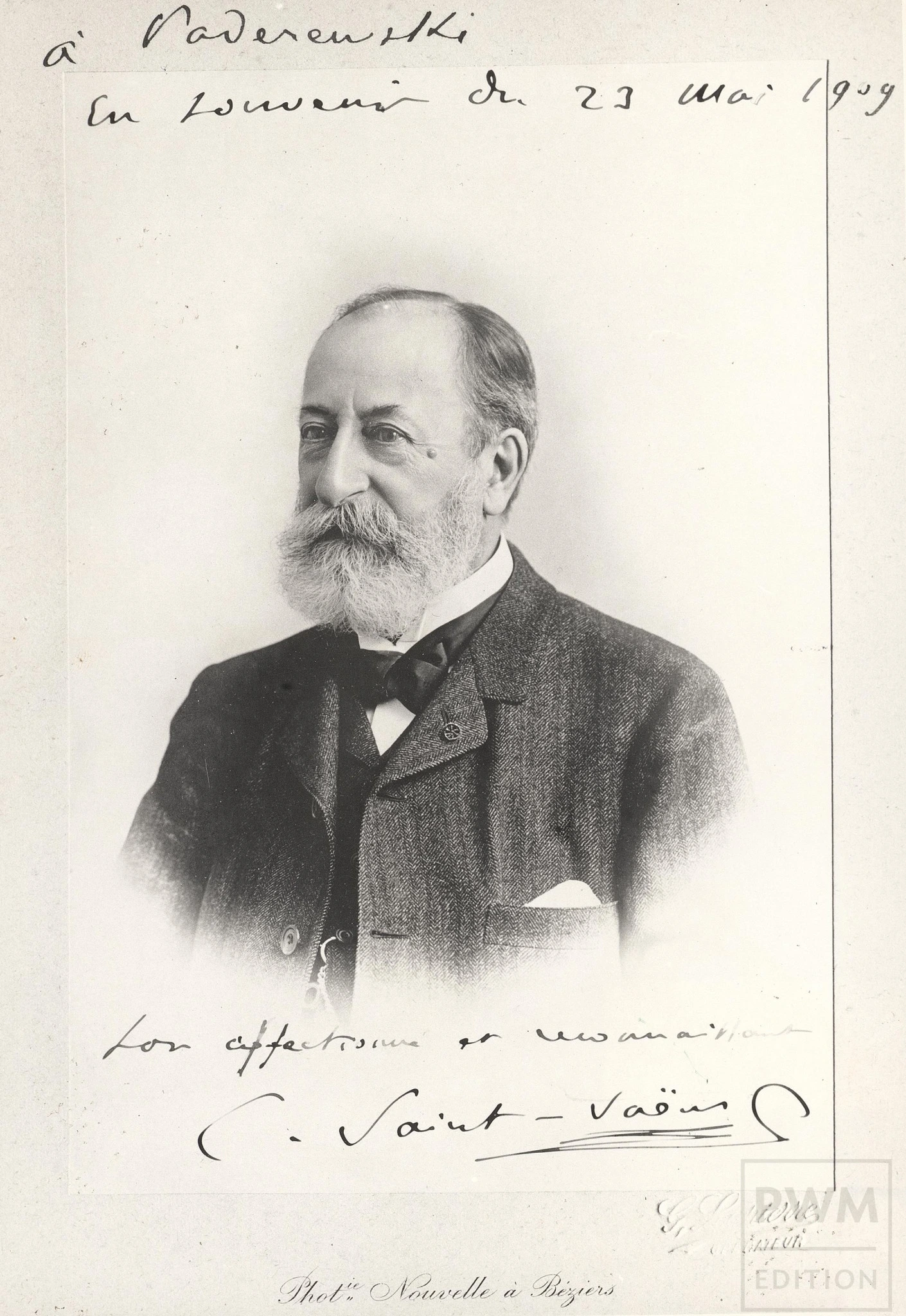
[Portret C. Saint-Saënsa z dedykacją dla Ignacego Jana Paderewskiego]

Saint-Saëns Charles Camille, *9 October 1835 Paris, †16 December 1921 Algiers, French composer, pianist, organist, and music writer. From 1838, he studied piano with his aunt, C. Masson. Saint-Saëns’s first attempts at composition, dating from 1841–42, took the form of salon piano pieces. He continued to develop his piano skills from 1843 under C. Stamaty (a pupil of F. Kalkbrenner); in 1846, he made his successful debut at the Salle Pleyel, performing Mozart’s Piano Concerto in B flat major (KV 450) and Beethoven’s Piano Concerto in C minor, Op. 37, as well as works by J.S. Bach, Händel, Hummel and Kalkbrenner with an orchestra conducted by T. Tilmant. From 1843, he studied harmony and counterpoint with P. Maleden, and from 1848, he studied organ playing with F. Benoist at the Paris Conservatoire (awards: 1849 and 1851) and composition with F. Halévy from 1851. At that time, he wrote, among others, his first symphonies: the unfinished B-flat major and D major, and the complete A major and E flat major, Op. 2, the performance of which on 18 December 1853 was Saint-Saëns’s public debut as a symphonist, favourably reviewed by Ch. Gounod. Saint-Saëns twice (in 1852 and 1864) unsuccessfully entered the Prix de Rome competition, but during this time he won first prizes in other composition competitions – the Société Sainte-Cécile in Bordeaux (in 1852, Ode à Sainte Cécile, and in 1857, Symphony “Urbs Roma”) and the Paris World Fair (1867, Les noces de Prométhée), whose jury included Auber, Berlioz, Gounod, Rossini and Verdi. Saint-Saëns began his career as an organist in 1853 with a short internship at the St-Severin church in Paris (where he occasionally replaced A. Périlhou between 1897 and 1914). In the same year, he was appointed titular organist at the church of St-Merry, and between 1857 and 1877 he was organist at the church of Ste-Madeleine. From 1853 to 1877, he wrote most of his religious works (including Messe Op. 4, Oratorio de Noël Op. 12, Coeli enarrant Op. 42, Le déluge Op. 45 and Requiem Op. 54). On 10 June 1857, he made his debut as a conductor (with the premiere of the Symphony “Urbs Roma” in Bordeaux). Between 1861 and 1865, he taught piano at the Ecole Niedermeyer; his students included G. Fauré and E. Gigout. He then gave occasional lessons (including composition) to A. Messager, L. Godowski, M. Sołtys and Z. Stojowski, among others. He had a particular influence on the development of Fauré’s career (introducing him to the salon of P. Viardot), whose family he was friends with. Saint-Saëns promoted the works of Schumann, Liszt, and Wagner at the traditionalist Ecole Niedermeyer. He was one of the first supporters of their art in France in the 1860s; he travelled to Munich and Bayreuth (1869, 1876, 1882) to attend musical drama exhibitions. He was friends with Liszt from 1852, and in 1878 he organised and conducted a monographic concert of his works in Paris. From the 1860s, Saint-Saëns made numerous concert tours (as a pianist, organist, and conductor) in France, as well as in Germany, England, Belgium, Austria, Switzerland, Sweden, Italy, Spain, Portugal, and Africa. He also performed in St Petersburg and Moscow (1875, 1887), Warsaw (1877, 1913), Prague (1882, 1886) and Łódź (1913). During the Franco-Prussian War in 1870, he was a soldier in the 4th Battalion of the National Guard of the Seine, gave concerts for the wounded, and wrote occasional pieces (including Marche héroïque, Op. 34). During the Paris Commune, he stayed in London (March–October 1871), where he gave concerts as an organist. After returning to Paris in November 1871, he founded the Société Nationale de Musique with R. Bussine (he was its vice-president until 1886), promoting French music, especially contemporary instrumental works. In the 1870s and 1880s, he composed his most important symphonic and chamber works: four symphonic poems, Symphony No. 3, concertos – for piano (No. 4), violin (No. 3) and cello (No. 1), Introduction et rondo capriccioso, Havanaise, Piano Quartet, Op. 41, Variations on a Theme of Beethoven, Op. 35; during this time, six of his thirteen operas were staged, including Samson et Dalila and Henry VIII. From April 1872, Saint-Saëns worked as a music critic for “La Renaissance littéraire et artistique” (under the pseudonym Phémius), “L’Estafette, La Voltaire,” “La Revue et gazette musicale,” “La nouvelle revue,” “Música,” “Le Ménestrel” and others. In 1875, he married Marie-Laure Truffot (1855–1950), but three years later, their two sons died, and in 1881, Saint-Saëns separated from his wife. After his mother’s death (18 December 1888), he fell into depression; on 31 December, he left Paris and stayed in Algeria from March 1889 to May 1890.
In July 1890, the Saint-Saëns Museum was established in Dieppe, collecting documents and memorabilia related to his life and work. From the end of 1890, Saint-Saëns travelled (including to Ceylon, Sicily, Saigon, a cruise on the Nile), gave many concerts (including in the Canary Islands, Egypt, Argentina, Brazil, and Uruguay) and was the first French composer to be invited on a tour of the United States (1906, 1915). In 1881, he became a member of the Académie des Beaux-Arts, in 1893 he received an honorary doctorate from the University of Cambridge, in 1907 from the University of Oxford, and in 1913 he was awarded the Grand Cross of the Legion of Honour. During the First World War, for ideological and political reasons, he criticised Wagner, especially his philosophical views, publishing a series of articles entitled Germanophilie in “L’Echo de Paris” (from September 1914); he himself wrote works with a patriotic tone. In March and April 1921, he performed outside France for the last time (in Algeria and Tunisia), bidding farewell to French audiences as a virtuoso pianist on 6 August in Dieppe and as a conductor on 21 August, when he conducted rehearsals for Antigone in Béziers. On 4 December 1921, he returned to Algiers, where he died on 16 December. The funeral ceremony took place on 19 December in the local cathedral. The composer’s body was transported to Paris, and on 24 December, official funeral ceremonies were held at the Church of Sainte-Madeleine; Saint-Saëns was buried in the family tomb at the Montparnasse Cemetery.
Saint-Saëns composed during a time of intense transformation in musical style and aesthetics, alongside such figures as Berlioz, Meyerbeer, Liszt, Wagner, Debussy, Stravinsky, Satie and members of Les Six. Although his symphonic works and Samson et Dalila secured his lasting place in music history, and he also gained fame among his contemporaries thanks to his chamber compositions, he wrote piano pieces, secular choral works and songs throughout his life. From the 1850s onwards, most of his works were premiered, sometimes performed directly from the manuscripts (including La jeunesse d’Hercule, completed on 6 January 1877 and performed in Paris on 28 January 1877 under the baton of E. Colonne). From 1875, the rights to print Saint-Saëns’s compositions were held exclusively by A. Durand, who published almost all of his works until 1922. When interpreting Saint-Saëns’s musical style and aesthetic attitude, it is essential to be familiar with his letters and texts, few of which concern his own works and life, but many of which concern other authors (Gluck, Haydn, Mozart), especially contemporary composers, including F. David, A. Holmes, Berlioz, Rossini, Liszt, Massenet, Meyerbeer, Offenbach and Fauré. Saint-Saëns wrote about issues important in 19th-century culture: art, religion and politics; programme music, absolute music and national music; opera and musical drama; Wagner’s art and philosophy. He also wrote about the performance of early music (Palestrina, Rameau, Mozart) and arranged it (Lully, Charpentier, Rameau).
Saint-Saëns’s extensive legacy (approx. 400 works) covers all musical genres of the 19th century and testifies to his mastery of the craft of composition, the perfection of which is already evident in his works from the 1860s and 1880s. The composer’s rich creative imagination was often stimulated by the music of the Viennese classics, the Romantics (Schumann, Mendelssohn, Berlioz, Liszt, Wagner) and the old masters (Gluck, Lully, Rameau, Bach, Händel). From the 1890s onwards, Saint-Saëns did not compose any outstanding works apart from his Violin Sonata No. 2, Piano Trio No. 2, Piano Concerto No. 5 and Fantaisie, Op. 101 for organ. However, he demonstrated his excellent knowledge of the specific characteristics of instrumental texture in works featuring wind instruments (sonatas: oboe, clarinet, bassoon, Odelette for flute and orchestra), strings (Op. 112, 143, 153, 160) and harp (Op. 95, 124, 154), whose sound he had used earlier (Symphony No. 1, Le rouet d’Omphale, Phaéton, La jeunesse d’Hercule, La princesse jaune). His travels and winter stays in warm countries (Algeria 15 times, the Canary Islands 6 seasons from 1889) did not limit Saint-Saëns’s creative activity (1863 Auvergne and the Pyrenees: Piano Trio No. 1; 1895/96 Egypt: Violin Sonata No. 2, Piano Concerto No. 5), and sometimes served as inspiration (1880 Spain, Portugal: Jota aragonese, Une nuit à Lisbonne). His success as an organist at the Albert Hall (October 1871) led to commissions for compositions, e.g. for the Birmingham Festival (La lyre et la harpe, 28 August 1879), addressed to the Frenchman for the first time. Continuing the French musical traditions of the revolutionary period and the work of Berlioz, Saint-Saëns wrote occasional pieces, often intended for outdoor performance (e.g. in the amphitheatre in Béziers on 28 and 29 August 1898 — Déjanire for two wind orchestras, 100 string instruments, 18 harps, 25 trumpets and a 200-strong choir conducted by Saint-Saëns, with an audience of around 10,000).
Saint-Saëns’s operas are stylistically diverse, divided into individual numbers that form larger musical units; in them, the composer combined elements of grand opéra and opéra lyrique with ballet scenes characteristic of the French tradition. A lack of dramatic development is compensated by a lyrical melodic style devoid of virtuoso display, well-crafted choral textures, and masterly though not innovative orchestration. The libretto’s themes include ancient stories (Phryné, Hélène, Déjanire) and heroic-historical stories (Etienne Marcel, Henri VIII, Ascanio), as well as comic (La princesse jaune, Le timbre d’argent) and exotic (La princesse jaune, Samson et Dalila) elements. Saint-Saëns’s operatic work did not gain recognition; even his best work, Samson et Dalila, which remains in the repertoire to this day, was first performed in German (translated by R. Pohl) in Weimar in 1877, and only in 1890 in France. Saint-Saëns drew on the biblical story of Samson, which had already been immortalised in dramatic works (Milton, Voltaire), operas (Rameau), and oratorios (Händel). Samson et Dalila is characterised by dramaturgically and musically diverse choruses (commentary, praise, thanksgiving), which dominate Act 1 and play an important role in Act 3, as well as convincingly constructed dialogue scenes (in Act 2); the arias of the title character stand out (not only in Saint-Saëns’s operatic oeuvre) for their dramatic and expressive power (grace and tenderness, Act 1, Scene 6; anxiety and hostility, Act 2, Scene 1; passion and sensuality, Act 2, Scene 3) and syllabically treated melodies; Saint-Saëns’s opera is also distinguished by a combination of a prayerful and contemplative tone with an expressive and sensual one, and universal symbolism with strongly individualised characters, derived from the tradition of 19th-century French sacred music.
In addition to his own works, Saint-Saëns’s piano repertoire included compositions by D. Scarlatti, Rameau, Clementi, Hummel, Chopin, Schumann, Liszt, and especially Bach, Mozart, and Beethoven. Saint-Saëns was valued for his flawless piano technique, colouristic nuances, almost symphonic sound, and excellent musical memory. His piano playing influenced his compositional work; he made full use of the possibilities of piano texture and, although he did not expand on Liszt’s technical achievements, he did create the first significant piano concertos in the history of 19th-century French music, which entered the global concert repertoire. He also wrote miniatures typical of the era, referring to the traditions of Mendelssohn and Schumann (Six bagatelles, Op. 3), salon pieces, dance compositions (Valse gaie, Op. 139, Polonaise, Op. 77), caprices, rhapsodies and pieces in the style of other composers (e.g. Haydn – Menuet et valse, Op. 56, Chopin – Mazurka, Op. 21). In these works, Saint-Saëns often used the variation technique with quasi-improvisational and virtuosic elements, based on his own themes (Caprice héroïque), foreign themes (Variations sur un thème de Beethoven – the theme of the Minuet from Beethoven’s Sonata No. 3, Op. 31,), or stylised themes (Caprice arabe, Souvenir d’Ismaïlia), or compositions on the borderline between transcription and variation (Caprice sur les airs de ballet d’Alceste de Gluck). Dance idiom, contrapuntal texture and use of strict polyphonic forms (e.g. in Scherzo, Op. 87) are also characteristic of the suite works (Album, Op. 72, Suite, Op. 90). In three sets of concerto etudes, alongside technical and rhythmic problems, there are dance-like and virtuosic elements (Op. 52 No. 6, Op. 135 Nos. 4 and 6) and illustrative elements (Op. 111 No. 4); there are studies of polyphonic texture (Op. 52 Nos. 3, 5, Op. 111 No. 3, Op. 135 Nos. 1, 2) and an etude (Op. 111 No. 6) preparing for the performance of the finale of Concerto No. 5. Impressive piano virtuosity is present not only in concertos (Allegro appassionato Op. 70, Africa), but also in chamber works (Septet, Piano Trio No. 2) and sometimes has a parodic tone (Le carnaval des animaux). Dance elements and rondo-variation-improvisation, passionate melodics, and an excellent sense of the technical and expressive possibilities of instruments also distinguish Saint-Saëns’s violin works (Introduction et rondo capriccioso, Havanaise, Caprice andalou, Concerto No. 3) and cello works (Suite Op. 16, Concerto No. 1, Allegro appassionato Op. 43). Piano transcriptions of his own works or those of other composers (over 50 pieces) occupied an important place in Saint-Saëns’s oeuvre. Sometimes the author’s version for two pianos, including the symphonic poem Le rouet d’Omphale, was performed (7 December 1871, Saint-Saëns and A. Castillon) and published (1872 G. Hartmann) as the first. Manuscripts of transcriptions of symphonies and operas by Haydn, Beethoven, F. David, G. Meyerbeer, Wagner, and others date from the 1840s and 1850s. Most of these arrangements of music by early and contemporary composers (H. Duparc, Gounod, Liszt, Massenet, E. Paladilhe) were published and played almost all over the world, e.g. transcriptions of parts of Bach’s cantatas and violin works (1861, 1872–73) and Beethoven’s string quartets (Op. 18 No. 6, Op. 59 Nos. 1 and 3; 1858, 1869).
Saint-Saëns’s musical imagination was influenced by his experience as an organist. He was renowned for his ingenious registration and skilful improvisation, which was admired by artists visiting Paris (Liszt, An. Rubinstein, J. Schulhoff, J. Hubay); he also made a name for himself in this respect in Warsaw (1877). “As one touches the organ,” wrote Saint-Saëns, “the imagination is awakened, and the unforeseen rises from the depths of the unconscious” (Ecole buissonnière). Virtuoso elements are particularly evident in Fantaisie, Opp. 101 and 157, Elévation, Sept improvisations, while the qualities of the organ’s colouring can be heard, for example, in Messe, Op. 4, Symphony No. 3. The mastery of polyphonic techniques evident in his organ and piano music – and, in the piano works, a marked preference for dance movements, suite structures, and variation technique – are traits characteristic of Saint-Saëns’s oeuvre as a whole. Canon occurs, among others, in the Prélude of the Suite, Op. 49, and the seventh variation in the Scherzo from the Cello Sonata No. 2; the fugue appears, for example, in the Prélude for string orchestra from Le déluge, the finale of the Piano Quintet, the first movement of the Symphony No.2, and the fourth movements of the Symphony No. 1 and No. 3. Fugato is often used, for example in the Requiem, Danse macabre, and mainly in the final movements of the Piano Trio No. 2, Suite Op. 16, and String Quartet No. 1. Saint-Saëns uses the stylisation of various dances, including the gavotte (Septet, Op. 65), sarabande (Suite, Op. 49), minuet (Finale from Album, Op. 72, Suite, Op. 90), tarantella (Scherzo from Op. 8), siciliana (Violin Concerto No. 3), waltz (fourth movement of Piano Trio No. 2, Danse macabre), habanera and Spanish rhythms (Havanaise, Introduction et rondo capriccioso, Caprice andalou). This reflects his search for original rhythmic invention and his preference for compound metres such as 6/8, 3/8, and 9/8, often contrasted with 4/4, 2/2, 2/4 (La jeunesse d’Hercule, Le rouet d’Omphale), sometimes in order to evoke an exotic colouring (Caprice arabe, Suite algérienne); Saint-Saëns also used complex metres: 5/4, 6/4, 7/4, 11/4 (Piano Trio No. 2, Symphony No. 2, Violin Concerto No. 1, Polonaise Op. 77, Trois morceaux Op. 1).
Four symphonic poems are of particular importance in his symphonic work, the first in France (1871) being Le rouet d’Omphalé. Saint-Saëns adapts the concepts of programme music developed by Berlioz (descriptive and dance elements, the important role of orchestral colour) and Liszt (the literary theme does not determine the musical structure, one-movement form but with distinct, strongly integrated phrases and transformations of themes) in his own unique way. The composer drew inspiration from mythological themes, except in Danse macabre, which was based on H. Cazalis’s poem Egalité, fraternité. The literary narrative is mirrored through analogies of motion – melodic and rhythmic motifs and the activities of spinning (Le rouet d’Omphale), horse riding (Phaéton), dancing (Danse macabre), or sound symbolism (violin, xylophone in Danse macabre). Saint-Saëns explained that in his symphonic poems he does not tell a story but only expresses “the terror and irony of death” (Danse macabre), “the struggle between heroism and debauchery” (La jeunesse d’Hercule), “pride” (Phaéton) and “seduction” (Le rouet d’Omphale). In chamber and symphonic music (apart from poems), he used classical-romantic, four-movement cyclical forms (exceptions: String Quartet No. 2 in 3 movements, Piano Trio No. 2 in 5 movements). The sonata allegro form appears not only in the first movement of symphonies (Urbs Roma, No. 1, No. 3), piano concertos (No. 2, No. 3, No. 5) and chamber works (Piano Trio No. 2), but also in other movements (Symphony in A major, Piano Concertos No. 2 and No. 5), in expanded or shortened form, combined with a fugue or rondo (Symphonies No. 3, No. 1, No. 2). Three-part structures are also used: ABC (fourth movement of Symphony No. 1, second movement of Piano Concerto No. 5), ABA’ (second movement of Symphony in A major, No. 3) and multi-part forms with rondo characteristics: AA’BA’ (Le rouet d’Omphale), ABA’B’ (Danse macabre), ABACA (Phaéton, La jeunesse d’Hercule). A characteristic feature of Saint-Saëns’s symphonies are slow introductions (it is it fast only in Symphony No. 2). For him, a characteristic tendency was the integration of the symphonic and chamber cycles; rhythmic ideas, motifs, or themes from the first or second movement often recur in the final movements (Suite Op. 16, Piano Quartet Op. 41, Cello Concerto No. 2). The introductory motif anticipates the first theme of the opening movement (Symphony in A major), references to it appear at various stages of the fourth movement (Symphony No. 1), it returns in first and fourth movement (“Urbs Roma”), or serves – as D.M. Fallón described it – a kind of idée fixe, related to Berlioz’s concept but purely instrumental in nature, present in the introduction and throughout all movements (e.g. Symphony No. 2, Piano Quintet, sonatas: Violin Sonata No. 1, Clarinet Sonata No. 1). Selected motifs from the introduction form particles (or prototypes) of themes in different movements of Symphony No. 3 and are subjected to transformation; variants of the first movement’s principal theme also occur in the finale and its coda. Saint-Saëns contributed significantly to the renewal of French symphonic music, which is why contemporary French audiences considered him a difficult composer, ‘an algebraist, a Wagnerian’ (G. Servières).
“Fundamentally, it is neither Bach, nor Beethoven, nor Wagner that I love, but Art. I am an eclectic” (Harmonie et mélodie). This statement by Saint-Saëns, and his use of various stylistic models, should not detract from the fact that he possessed a remarkable gift for synthesis. His compositions contain conscious references to the French musical tradition of the 17th and 18th centuries, which at the turn of the 19th and 20th centuries initiated a revival of French music and became characteristic of the innovative works of Debussy and Ravel; there are also visible analogies with the neoclassical style in 20th-century music. However, there is a clear difference between Saint-Saëns and his contemporary composers in terms of artistic attitude and place in music history: Saint-Saëns closes the classical-romantic era, Fauré and Debussy open the 20th century, and Satie is the precursor of many contemporary avant-garde trends. Saint-Saëns is a Parnassian musician (J.-M. Nectoux, D.M. Fallon), a proponent of the slogan “art for art’s sake,” music being “the most mysterious of the fine arts,” but one that “has its own laws, its grammar, its syntax — things for which people today have little concern, living as they do in a world where one seeks only to arouse impressions, to create moods and atmospheres” (Ecole buissonnière).
The reception of Saint-Saëns’s music during his lifetime was intense, especially in France, Germany, England, Russia and Poland; his works remained in the repertoire of outstanding pianists (R. Pugno, A. Cortot, I.J. Paderewski), violinists (P. Sarasate, E. Ysaÿe, J. Thibaud), cellists (A. Tolbecque, J. Gérardy, P. Casals) and conductors (J.E. Pasdeloup, E. Colonne, Ch. Lamoureux). The contemporary interpretation of Saint-Saëns’s works can be heard in his own recordings from 13 December 1905 (Rhapsodie d’Auvergne), which were restored at the end of the 20th century. In recognition of his achievements, anniversaries of his first concerts were celebrated in Paris (1896), Béziers (1906) and London (1913), as well as the Saint-Saëns music festivals held in Mulhouse, Paris, Cuba, Algiers, Cesena, Vichy, Ghent, and Las Palmas between 1882 and 1935. A sculpture of the composer by L.H. Marqueste was erected during his lifetime in the theatre in Dieppe (1907). Many composers (especially in the 1870s–1890s) transcribed his works (including Liszt, Faure, Bizet, Ravel, Debussy, and Dukas).
Concert programmes continue to feature Introduction et rondo capriccioso, Havanaise, Piano Concertos Nos. 2, 4 and 5, Violin Concerto No. 3, the ‘Organ’ Symphony, Danse macabre and Le Carnaval des animaux. Since the 1980s there has been a growing interest in Saint-Saëns; works that had previously been recorded only occasionally are now more regularly performed (Africa, Album Op. 72, La muse et le poète) and recorded. A melodic gift, evocative rhythms, colourful orchestration, extended harmony, and complex modulation processes, but rarely blurring functional relationships, together with impressive but not exaggerated instrumental virtuosity subordinated to melody, and clear yet restrained expressiveness, are the characteristics of Saint-Saëns’s music that earned him a wide audience.
In 1924, the Société des amis de Saint-Saëns was founded in Paris, operating until 1974. In 2017, a new Société Camille Saint-Saëns was established, which has been publishing “Cahiers Saint-Saëns” since 2020.
Literature:
Documentation — Catalogue général et thématique des oeuvres de Camille Saint-Saëns, Paris 1897, revised, Paris 1908; S. Teller Ratner A Thematic Catalogue of the Complete Works of Camille Saint-Saëns, vol. 1: The Instrumental Works, Oxford 2000, vol. 2: The Dramatic Works, Oxford 2012; A Cache of Saint-Saëns Autographs. Saint-Saëns et la France [complete documentation of Saint-Saëns’s works since 1863, continuously updated], eds. J. Élart, Dezède [online] dezede.org/dossiers/id/436/
Saint-Saëns par lui même, d’après les lettres reçues et commentées, ed. P. Aguétant, Paris 1938; Une discussion Saint-Saëns et d’Indy, ed. L. Vallas oraz Correspondance inédite entre Camille Saint-Saëns et Maurice Emmanuel à propos de Debussy, “La Revue Musicale” 1947 Nos. 205–207; Saint-Saëns et R. Rolland. Lettres inédites, ed. J. Bonnerot, “Revue de Musicologie” XXXIX–XL, 1957; Correspondance Saint-Saëns, Fauré, ed. J.-M. Nectoux, “Revue de Musicologie” LVIII–LIX, 1972–73, titled Camille Saint-Saëns et Gabriel Fauré. Correspondance (1862–1920), Paris 1973, 3rd edition revised and extended version, Paris 1994, Japanese translation S. Otani, T. Hiyoshi, M. Shimatani, Tokio 1993, English translation J. Barrie Jones, Richmond 2005; The Correspondence of Camille Saint-Saëns and Paul Taffanel, 1880–1906, editing and translation E. Blakeman, “Music and Letters” LXIII, 1982; Correspondance inédite [1898–1916], ed. E. Bondeville, “La Revue Musicale” 1983 Nos. 358–60; Lettres de compositeurs à Camille Saint-Saëns, eds. E. Jousse, Y. Gérard, Lyon 2009; Musique, foi et raison. Correspondance inédite Gabiel Renoud – Camille Saint-Saëns, 1914–1921, ed. P. Guillo, Paris 2014; Camille Saint-Saëns – Jacques Rouché, Correspondance (1913-1921), ed. M.-G. Soret, Arles 2016.
Ch. Gounod Mémoires d’un artiste, Paris 1896, reprint Paris 1992; G. Servières La musique française moderne, Paris 1897; G. Robert La musique à Paris 1895–1896, Paris 1896; R. Rolland Musiciens d’aujourd’hui, Paris 1908, 19th ed. Paris 1949; E. Reyer Quarante ans de musique, Paris 1909, 2nd ed. Paris 1910; O. Séré Musiciens français d’aujourd’hui, Paris 1911, 9th ed. 1921; C. Debussy Monsieur Croche Antidilettante, Paris 1921, Polish translation A. Porębowiczowa, Krakow 1961; Ch.-M. Widor Notice sur la vie et les oeuvres de M. Saint-Saëns, Paris 1922; G. Fauré Camille Saint-Saëns and Souvenirs, “La Revue Musicale” 1922 No. 4 and 11; G. Fauré Opinions musicales, ed. P.-B. Gheusi, Paris 1930; P. Dukas Les écrits sur la musique, compiled by G. Samazeuilh, Paris 1948; M. Nussy Saint-Saëns Saint-Saëns selon mes souvenirs, Bordeaux 1971; A. Milet Catalogue du Musée de Dieppe, Dieppe 1904; T.S. Flynn Camille Saint-Saëns, a Guide to Research, New York-London 2003 (includes discography).
Monographs of life and work — O. Neitzel Camille Saint-Saëns, Berlin 1899; L. Augé de Lassus Saint-Saëns, Paris 1914, reprint Sainte-Maxime 1978; J. Bonnerot Camille Saint-Saëns, sa vie et son oeuvre, Paris 1914, revised and extended version Paris 1923; A. Hervey Saint-Saëns, New York 1922, reprint Westport 1970; W. Lyle Camille Saint-Saëns. His Life and Art, London-New York 1923, reprint Westport 1971; G. Servières Saint-Saëns, Paris 1923; A. Dandelot La vie et l’oeuvre de Saint-Saëns, Paris 1930; J. Handschin Camille Saint-Saëns, Zurych 1930; E. Vuillermoz Saint-Saëns, Paris 1935; M. Nussy Saint-Saëns Camille Saint-Saëns et la musique française contemporaine, Paris 1936; J. Chantavoine Camille Saint-Saëns, Paris 1947; J. Harding Saint-Saëns and his Circle, London 1965; J. Kriemlow K. Saint-Saëns, Moskwa 1970; M. Stegemann Kriemlow Kamille Saint-Saëns, mit Selbstzeugnissen und Bilddokumenten, Reinbek 1988; B. Rees Camille Saint-Saëns. A Life, London 1999; S. Studd Saint-Saëns. A Critical Biography, London 1999; J. Gallois Charles-Camille Saint-Saëns, Sprimont 2004; Ph. Majorelle Saint-Saëns, le Beethoven français, Paris 2009; J. Bonnaure Saint-Saëns, Arles 2010; J.-L. Caron, G. Denizeau Camille Saint-Saëns, Paris 2014; G. Clericetti Camille Saint-Saëns Il re degli spiriti musicali, Varese 2016; The Many Faces of Camille Saint-Saëns, ed. M. Stegemann, Turnhout 2018; G. Clericetti Camille Saint-Saëns. Visionario, artigiano, sperimentatore, Varese 2020.
Studies, articles, dissertations — F. Morel Camille Saint-Saëns als Organist, “Musik und Gottesdienst” XXVI, 1972, French translation M.-O. Servajean, “Orgue” 1975 No. 160, 1976 No. 161; S. Teller Ratner Richard Wagner and Camille Saint-Saëns, “Opera Quarterly” I, 1983; S. Fruehwald Saint-Saëns’s Views on Music and Musicians, “International Review of the Aesthetics and Sociology of Music” XV, 1984; M. Faure Musique et société du Second Empire aux années vingt. Autour de Saint-Saëns, Fauré, Debussy et Ravel, 1985; R.M. Stevenson Saint-Saëns’s Views on the Performance of Early Music, “Performance Practice Review” 1989 No. 2; S. Teller Ratner Saint-Saëns’s Self-Borrowings, M. Stegemann Camille Saint-Saëns, “Germanophilie.” Hintergründe einer musikpolitischen Affäre, in: Echos de France et d’Italie, commemorative book of Y. Gérard, ed. M.-C. Mussat, J. Mongrédien, J.-M. Nectoux, Paris 1997; A. Legrand Le sentiment filial chez Camille Saint-Saëns, “Musica et Memoria” XIX, 1998; S. Teller Ratner Camille Saint-Saëns, Fauré’s Mentor, in: Regarding Fauré, ed. T. Gordon, Amsterdam 1999; K. Ring Psychological Perspective on Camille Saint-Saëns, New York 2002
E. Baumann Les grandes formes de la musique. L’oeuvre de Camille Saint-Saëns, Paris 1905, revised 2nd ed. Paris 1923; J. Chantavoine L’oeuvre dramatique de Camille Saint-Saëns, Paris 1921; A. Cortot La musique française de piano, vol. 2, Paris 1932, 3rd ed. Paris 1948, przedr. Paris 1981; L. Aguettant La musique de piano, des origines à Ravel, Sainte-Maxime 1954, reprint. Paris 1981; F. Noske La mélodie française de Berlioz à Duparc, Amsterdam 1954, English translation R. Benton, New York 1970; D.M. Fallon The Symphonies and Symphonie Poems of Camille Saint-Saëns, dissertation Yale University, 1973; P.C. Pollei Lisztian Piano Virtuoso Style in the Piano Concerti of Camille Saint-Saëns, “American Liszt Society Journal” VII, 1980; M. Stegemann Camille Saint-Saëns und das französische Solokonzert von 1850 bis 1920, Mainz 1984, English translation A.C. Sherwin, Portland 1991; S. Teller Ratner La genèse et la fortune de “Samson et Dalila,” “Cahiers I. Tourguéniev, P. Viardot, M. Malibran” IX, 1985; M. Stegemann Der Mord als schöne Kunst betrachtet. Camille Saint-Saëns und die Anfänge der Filmmusik, “Neue Zeitschrift für Musik” CXLVI, 1985; M. Stegemann Attizismus und Modernität, Camille Saint-Saëns und die Wiederbelebung der alten Musik, in: Alte Musik als ästhetische Gegenwart, eds. D. Berke, D. Hanemann, vol. 2, Kassel 1987; S. Teller Ratner “Henry VIII” de Camille Saint-Saëns, Compiègne 1991; S. Teller Ratner Saint-Saëns’s Last “Concerto,” “Notes” XLVIII, 1991; R. Smith Saint-Saëns and the Organ, Stuyvesant (New York) 1992; A. Edler Saint-Saëns’s Sinfonik als “haute composition,” in: Deutsche Musik im Wegekreuz zwischen Polen und Frankreich, eds. Ch.-H. Mahling, Ch. Pfarr, Tutzing 1996; R.P. Locke Constructing the Oriental “Other.” Saint-Saëns’s “Samson et Dalila,” in: The Work of Opera. Genre, Nationhood, and Sexual Difference, eds. R. Dellamora, D.T Fischlin, New York 1997; A.B. Ho Saint-Saëns’s Two-Piano Arrangements of Liszt’s Sonata. A Final Tribute, in: Liszt and his World, ed. M. Saffle, Stuyvesant (New York) 1998; S. Huebner French Opera at the “Fin de Siècle,” Wagnerism, Nationalism, and Style, Oxford 1999; M. Faure, V. Vivès Histoire et poétique de la mélodie française, Paris 2000; K. Ring Psychological Perspective on Camille Saint-Saëns, Lewiston 2002;
L. Hurpeau Correspondance Jaël-S.-S. Une Alsacienne et un maître à penser de la musique française, in: M. Jaël. Un cerveau de philosophe et des doigts d’artiste, ed. L. Hurpeau, Lyon 2004; M.-G. Soret “Samson et Dalila” ou comment ébranler les colonnes dutemple, in: Opéra et religion sous la IIIe République, eds. J.-Chr. Branger, A. Ramaut, Saint-Étienne 2006; Y. Gérard Saint-Saëns et la littérature. Les goûts littéraires du compositeur, in: La musique et les arts au temps de Winnaretta Singer, princesse de Polignac, ed. B. Duteurtre, Paris 2007; E. Brooks Une culture classique supérieure. Saint-Saëns et l’esthétique antique, in: Figures de l’Antiquité dans l’opéra français. Des “Troyens” de Berlioz à “Œdipe” d’Enesco, ed. V. Giroud, J.-Chr. Branger, J.-L. Pichon, Saint-Étienne 2008; Ph. Gonin Aux sources de la musique de film. Le film d’art, “L’assassinat du duc de Guise” et Camille Saint-Saëns, Lyon 2008; R. Smith Saint-Saëns and the organ, Stuyvesant 2010; Camille Saint-Saëns and His World, ed. J. Pasler, Princeton 2012; M.-G. Soret Camille Saint-Saens et sa “collection,” in: Collectionner la musique. Au ceour de l’interprétation, eds. D. Herlin, C. Massip, J. Duron, Turnhout 2012; S. Leteuré Camille Saint-Saëns et le politique de 1870 à 1921. Le drapeau et la lyre, Paris 2014; I. Zechner Christoph Wilibald Gluck in der Klaviermusik des 19. Jahrhunderts. Hans von Bülows “Tanzweisen aus Opern von Ritter von Gluck” und Camille Saint-Saëns „Caprice sur les airs de Ballet d’Alcesta,” “Die Musikforschung” 69, 2016, No. 4; S. Leteuré Camille Saint-Saëns, le compositeur globe-trotter, 1857–1921, Arles 2017; B. Rogers Between Berlioz & Fauré. Camille Saint-Saëns’sa “Messe de Requiem” Op. 54, “The Choral Journal” 58, 2018 No. 10; S. Leteuré Croquer Saint-Saëns. Une histoire de la représentation du musicien par la caricature, Arles 2021; Saint-Saëns, un esprit libre, ed. M.-G. Soret, Paris 2021; F. Guilloux Les esquisses et brouillons de Camille Saint-Saëns. L’oeuvre instrumental, in: Esquisses musicales. Enjeux et approches du XXe au XXe siècle, ed. F. Delécluse, [online] 2023 https://www.brepols.net/products/IS-9782503601144-1; “Cahiers Saint-Saëns” 1, 2020, 2, 2021 (Saint-Saëns and piano), 3, 2022 (organ music and motets by C. Franck and Saint-Saëns).
Reception — S. Ledbetter Two Seductresses, Saint-Saëns’s Delilah, and Chadwick’s Judith, in: A Celebration of American Music, commemorative book of H.W. Hitchcock, eds. R.A. Crawford, R.A. Lott, C.J. Oja, Ann Arbor 1990; M. Woźna-Stankiewicz Muzyka francuska w Polsce w II połowie XIX wieku. Analiza dokumentów jako podstawa źródłowa do badań nad recepcją oraz Recepcja muzyki francuskiej w Polsce w II połowie XIX wieku w kontekście idei estetycznych epoki, Krakow 1999, 2003; Camille Saint-Saëns “Les Barbares.” Dossier de presse parisienne (1901), ed. S. Douche, Weinsberg 2005; T. G. Biraud, La contribution de l’oeuvre de Camille Saint-Saëns dans la formation des interprètes violoniste. Essai, Paris 2009; H. MacDonald Saint-Saëns and the Stage. Operas, Plays, Pageants, a Ballet and a Film, Cambridge 2019.
Compositions
Published in Paris, unless otherwise stated; publishers: Choudens, Flaxland, Hamelle, Hartmann, Lecocq, Richault, from 1875 Durand; the year of composition is identical to the year of publication, unless otherwise stated.
OIC – Œuvres instrumentales complètes, editor-in-chief M. Stegeman (324 compositions from 1839–1921, 4 series: I Oeuvres symphoniques, 13 vols., II Oeuvres concertantes, 8 vols., III Musique de chambre, 9 vols., IV Oeuvres pour piano, orque & harmonium, 9 vols.), Kassel: Bärenreiter 2016–
Instrumental:
orchestral:
Symphony in A major, ca. 1850, published in 1974
Symphony No. 1 in E-flat major Op. 2, 1853, published in 1855
Ouverture d’un opéra comique inachevé for orchestra, ca. 1854, published in 1913
Symphony in F major “Urbs Roma”, 1856, published in 1974
Symphony No. 2 in A minor Op. 55, 1859, published in 1878
Suite, Op. 49 for orchestra, 1863, published in 1877
Spartacus ouverture for orchestra, 1863, Rome 1984
Pamponette for orchestra, 1864, published without date
Marche héroïque Op. 34 for orchestra, 1870, published in 1871
Le rouet d’Omphale, symphonic poem Op. 31, 1871, published in 1872, 2019, OIC I, 4
Phaéton, symphonic poem, Op. 39, 1873, published in 1875, 2019, OIC I, 4
Danse macabre, symphonic poem, Op. 40, 1874, published in 1875, 2019, OIC I, 4
La jeunesse d’Hercule, symphonic poem, Op. 50, 1877, published in 2019, OIC I, 4
Suite algérienne Op. 60 for orchestra, 1880, published in 1881
Une nuit à Lisbonne Op. 63 for orchestra, 1880, published in 1881
Jota aragonese Op. 64 for orchestra, 1880, published in 1881
Hymne à Victor Hugo for orchestra Op. 69, 1881, published in 1884 (with choir ad libitum)
“Organ” Symphony No. 3 in C minor Op. 78, 1886, published in 2016, OIC I, 3
Rapsodie bretonne Op. 7 bis for orchestra, 1891
Sarabande et rigaudon Op. 93 for orchestra, 1892
Paso-doble for orchestra, 1894, published without date
Marche du couronnement Op. 117 for orchestra, 1902
Ouverture de fête Op. 133 for orchestra, 1910
Hail! California for orchestra, 1915
for piano and orchestra:
Concerto No. 1 in D major Op. 17 for piano and orchestra, 1858, published in 1868
Concerto No. 2 in G minor Op. 22 for piano and orchestra, 1868
Concerto No. 3 in E-flat major Op. 29 for piano and orchestra, 1869, published in 1875, 2022, OIC II, 2
Concerto No. 4 in C minor Op. 44 for piano and orchestra, 1875, published in 1877, 2022, OIC II, 2
Allegro appassionato Op. 70 for piano and orchestra, 1884
Rhapsodie d’Auvergne Op. 73 for piano and orchestra, 1884
Africa Op. 89 for piano and orchestra, 1891
Concerto No. 5 in F major Op. 103 for piano and orchestra, 1896
for violin and orchestra:
Concerto No. 1 in A major Op. 20 for violin and orchestra, 1859, published in 1868
Introduction et rondo capriccioso Op. 28 for violin and orchestra, 1863, published in 1870
Romance Op. 48 for violin and orchestra, 1874, published in 1877
Concerto No. 2 in C major Op. 58 for violin and orchestra, 1858, published in 1879
Concerto No. 3 in B minor Op. 61 for violin and orchestra, 1880
Morceau de concert Op. 62 for violin and orchestra, 1880
Havanaise Op. 83 for violin and orchestra, 1887, published in 1888
Caprice andalou Op. 122 for violin and orchestra, 1904
for cello and orchestra:
Suite bis Op. 16 for cello and orchestra, 1919, published in 1920
Concerto No. 1 in A minor Op. 33 for cello and orchestra, 1872, published in 1873
Allegro appassionato Op. 43 for cello and orchestra, 1873, published in 1875
Concerto No. 2 in D minor Op. 119 for cello and orchestra, 1902
for other instruments and orchestra:
Tarantelle Op. 6 for flute, clarinet and orchestra, 1857
Romance Op. 67 for horn/cello and orchestra, 1866, published in 1885
Romance Op. 37 for flute/violin and orchestra, 1871, published in 1874
Romance Op. 36 for horn/cello and orchestra, 1874
Morceau de concert Op. 94 for horn and orchestra, 1887, published in 1893
La muse et le poète Op. 132 for violin, cello and orchestra, 1910
Morceau de concert Op. 154 for harp and orchestra, 1918, published in 1919
Cyprès et lauriers Op. 156 for organ and orchestra, 1919
Odelette Op. 162 for flute and orchestra, 1920
for military orchestra:
Orient et occident Op. 25, 1869, published in 1870
Pas redouble Op. 86 1887, published in 1890
Sur les bords du Nil Op. 125, 1908
Vers la victoire Op. 152, 1917, published in 1918
Marche interalliée Op. 155, 1918, published in 1919
Chamber:
Piano Quartet in E major, 1853, published in 1992
Adagio for horn and organ, ca. 1854, published in 1987
Piano Quintet in A minor Op. 14, 1855 (?), published in 1865
Six duos Op. 8 for harmonium and piano, 1858
Piano Trio No. 1 in F major Op. 18, 1864, published in 1867
Sérénade Op. 15 for piano, organ, violin, and viola/cello, 1865
Suite Op. 16 for cello and piano, 1862 (?), published in 1866
Romance Op. 27 for piano, organ, and violin, 1866, published in 1868
Berceuse Op. 38 for violin and piano, 1871, published in 1874
Sonata in C minor Op. 32 for cello and piano, 1872, published in 1873
Piano Quartet in B-flat major Op. 41, 1875
Romance Op. 51, for cello and piano, 1877
Septet in E-flat major Op. 65 for piano, trumpet, 2 violins, viola, cello, and double bass, 1880, published in 1881, 2023, OIC III, 8
Romance Op. 67 for horn and piano, 1885
Sonata No. 1 in D minor Op. 75 for violin and piano, 1885, published in 2022, OIC IV, 1
Wedding Cake Op. 76 for piano and string quartet, 1885, published in 1886
Le carnaval des animaux for 11 instruments, 1886, published in 1922, 2023, OIC III, 8
Caprice sur des airs danois et russes Op. 79 for piano, flute, oboe, and clarinet, 1887
Chant saphique Op. 91, for cello and piano, 1892
Piano Trio No. 2 in E minor Op. 92, 1892
Méditation for violin and piano, 1892
Sonata No. 2 in E-flat major Op. 102 for violin and piano, 1896
Barcarolle in F major Op. 108 for violin, cello, organs, and piano, 1898
String Quartet in E minor Op. 112 1899, published in 2018, OIC III, 1
Sonata No. 2 in F major Op. 123 for cello and piano, 1905
Fantaisie Op. 124 for violin and harp, 1907
Triptyque Op. 136 for violin and piano, 1912
Elégie in D major Op. 143 for violin and piano, 1915
Cavatine Op. 144 for trombone and piano, 1915
String Quartet in G major Op. 153, 1918, published in 1919, 2018, OIC III, 1
Prière Op. 158 for organ and cello, 1919
Prière Op. 158 bis for organ and violin, 1919, published in 1920
Elégie in F major Op. 160 for violin and piano, 1920
Sonata in D major Op. 166 for oboe and piano, 1921
Sonata in E-flat major Op. 167 for clarinet and piano, 1921
Sonata in G major, Op. 168, for bassoon and piano, 1921
piano:
[Morceau en ut majeur] for piano, 1839, first edition OIC I, 5
Six bagatelles Op. 3 for piano, 1855, published in 1856
Mazurka No. 1 in G minor Op. 21 for piano 1862, published in 1868
Gavotte Op. 23 for piano, 1871, published in 1872, also in the version for orchestra
Mazurka No. 2 in G minor Op. 24 for piano, 1871, published in 1872
Romance sans paroles for piano, 1871, published in 1872
Menuet et valse Op. 56 for piano 1872, published in 1878
Six études Op. 52 for piano, 1877, published in. 2020, OIC IV, 3
Mazurka No. 3 in B-flat minor Op. 66 for piano, 1882, published in 1883
Allegro appassionato Op. 70 for piano, 1884 (with orchestra ad libitum)
Album Op. 72 for piano, 1884
Improvisation for piano, 1885
Souvenir d’Italie Op. 80 for piano, 1887
Bourrée for piano, ca. 1888, published in 1888
Les cloches du soir Op. 85 for piano, 1889
Valse canariote Op. 88 for piano, 1890
Suite Op. 90 for piano, 1891, published in 1892
Six études Op. 111 for piano, 1899, published in 2020, OIC IV, 3
Thème varié Op. 97 for piano, 1894
Souvenir d’Ismaïlia Op. 100 for piano, 1895
Valse mignonne Op. 104 for piano, 1896
Berceuse Op. 105 for piano, 1896
Valse nonchalante Op. 110 for piano, 1898, exists also in version for orchestra, 13 December 1921
Le Ruisseau for piano, 1900
Valse langoureuse Op. 120 for piano, 1903
Morceaux de concours No. 2 for piano, 1904, published in 1905
Feuillet d’album in B-flat major for piano, 1909
Six études pour la main gauche seule Op. 135 for piano, 1912, published in 2020, OIC IV, 3
Valse gaie Op. 139 for piano, 1912, published in 1913
Allegro for piano, after Piano Concerto No. 3, 1913
Six fugues Op. 161 for piano, 1920, published in 2020, OIC IV, 3
Feuillet d’album Op. 169 for piano, 1921, published in 1922
for piano for 4 hands:
Duettino Op. 11 for piano for 4 hands, 1858 (?), published in 1861
König Harald Harfagar Op. 59 for piano for 4 hands, 1880, published in Berlin 1880
Feuillet d’album Op. 81 for piano for 4 hands, 1887
Pas redoublié Op. 86 for piano for 4 hands, 1887, published in 1890
Marche dédiée aux étudiants d’Alger Op. 163, 1921, published in 1922
for 2 pianos:
Variations sur un thème de Beethoven Op. 35 for 2 pianos, 1874
Polonaise Op. 77 for 2 pianos, 1885, published in 1886
Scherzo Op. 87 for 2 pianos, 1889, published in 1890
Caprice arabe Op. 96 for 2 pianos, 1894
Duos Op. 8 bis for 2 pianos, 1897, published in 1898 (after Six duos Op. 8, for harmonium and piano)
Caprice héroïque Op. 106 for 2 pianos, 1898.
organ:
Prélude for organ, ca. 1855, published in 1991
Fantaisie in E-flat major for organ, 1857
Bénédiction nuptiale Op. 9 for organ, 1859, published in 1868
Pièces for organ, 1859 (?), published in 1991
Trois rapsodies sur des cantiques bretons Op. 7 for organ, 1866
Trois préludes et fugues Op. 99 for organ, 1894
Fantaisie Op. 101 for organ, 1895
Marche religieuse Op. 107 for organ, 1897, published in 1898
Trois préludes et fugues Op. 109 for organ, 1898
Sept improvisations Op. 150 for organ, 1917
Fantaisie No. 3 Op. 157 for organ, 1919, published in 1919 (?)
for organ or harmonium:
Interlude fugué 1856 for organ or harmonium, published in 1936
Procession for organ or harmonium, 1858, published in 1901
Offertoire D major and Communion for organ or harmonium, 1859, published in 1901
Elévation, ou Communion Op. 13 for organ or harmonium, 1859, published in 1865
Praeludium et fuga for organ or harmonium, before 1870, published in 1991, unfinished
Deux pièces brèves for organ or harmonium, after 1870, published in 1991
***
Trois morceaux Op. 1, for harmonium, 1852, published in 1858
Fantaisie, for aeolian org, 1906, Bonn 1988
Fantaisie Op. 95, for harp, 1893.
Vocal a cappella pieces:
for solo voices:
Sérénade d’hiver for solo voices a cappella, text by H. Cazalis, 1867, published in 1868
Les soldats de Gédéon Op. 46 for solo voices a cappella, text by L. Gallet, 1876
Saltarelle Op. 74 for solo voices a cappella, text by E. Deschamps, 1885
Les guerriers Op. 84 for solo voices a cappella, text by G. Audigier, 1888
Chants d’automne Op. 113 for solo voices a cappella, text by S. Sicard, 1899
Romance du soir Op. 118 for solo voices a cappella, text by J.L. Croze, 1902
A la France Op. 121 for solo voices a cappella, text by J. Combarieu, 1903, published in 1904
Le matin Op. 129 for solo voices a cappella, text by A. Lamartine, 1909
Aux aviateurs Op. 134 for solo voices a cappella, text by J. Bonnerot, 1911, published in 1912 (?)
Aux mineurs Op. 137 for solo voices a cappella, 1912, n.d.
Hymne au travail Op. 142 for solo voices a cappella, 1914, n.d.
Trois choeurs Op. 151 for solo voices a cappella, text by J. Bonnerot, P. Fournier, J. Mirval, 1917
Aux conquérants de l’air Op. 164 for solo voices a cappella, text by the composer, 1921
Le printemps Op. 165 for solo voices a cappella, text by J. de la Fontaine, 1921, published in 1922
for choir:
Veni Creator for a cappella choir (with organ ad libitum), 1858, published in 1866
Laudate Dominum Op. 149 for a cappella choir, 1915, published in 1916
Deux choeurs Op. 71 for a cappella choir, text by T. Saint-Félix, 1884
La gloire de Corneille Op. 126 for a cappella choir, text by L. Augé de Lassus, 1906, published in 1908
Hymne au printemps Op. 138 for a cappella choir, text by J. Bonnerot, 1912, n.d.
Deux choeurs Op. 141 for a cappella choir, text by M. Boukay, P.-J. Béranger, 1913.
Vocal-instrumental:
for voice and piano (approx. 100 songs):
collections:
Mélodies persanes Op. 26 for voice and piano, text by A. Renaud, 1870, published in 1872
La cendre rouge Op. 146 for voice and piano, text by G. Docquois, 1914, published in 1915
Cinq poèmes de Ronsard for voice and piano, 1921
Vieilles chansons for voice and piano, text by C. d’Orléans, R. Belleau, V. de la Fresnaye, 1921
songs, including:
to words by V. Hugo:
Guitare for voice and piano, 1851, published in 1870
Soirée en mer for voice and piano, 1862, published in 1864
Le matin for voice and piano, ca. 1864, published in 1866
Le chant de ceux qui s’en vont sur la mer i A quoi bon entendre for voice and piano, 1868
La coccinelle for voice and piano, 1868, published in 1896
Si vous n’avez rien à me dire for voice and piano, 1870, published in 1896
Suzette et Suzon for voice and piano, 1888, published in 1889
S’il est un charmant gazon for voice and piano, 1915
to text by the composer:
Désir de l’orient for voice and piano, 1871, published in 1895
Guitares et mandolines for voice and piano, 1890
Sonnet for voice and piano, 1898
Thème varié for voice and piano, 1900
to the words of other authors:
Clair de lune for voice and piano, text by C. Mendès, ca. 1865, published in 1866
A Voice by the Cedar Tree for voice and piano, text by A. Tennyson, 1871, London 1871
Chanson triste. Dans ton coeur for voice and piano, text by H. Cazalis, 1872, published in 1884
Le vent dans la plaine for voice and piano, text by P. Verlaine, 1912, published in 1913
La cigale et la fourmi for voice and piano, text by J. de Lafontaine, Cologne 1958
for 2 voices and piano:
Viens for 2 voices and piano, text by V. Hugo, ca. 1855, published in 1856
Vénus for 2 voices and piano, text by the composer, 1896
for voice and organ:
Quam dilecta Op. 148 for voice and organ, 1915, published in 1917
Litanies à la Sainte Vierge for voice and organ, 1917
Tu es Petrus Op. 147, for 4 male voices and organ, 1914, published in 1916
for choir and organ:
Tantum ergo Op. 5 for choir and organ, 1856, published in 1868
Ave Maria Op. 145 for choir and organ, 1914
for solo voices, choir and piano:
Pour vous bénir, Seigneur for solo voices, for choir and piano, text by A. Cuinet, ca. 1860, published in 1866
La gloire Op. 131 for solo voices, choir, and piano, 1911, published in 1912 (?)
Panis angelicus for tenor/soprano and string quintet/organ, 1898
for voice and orchestra:
songs, including:
to text by V. Hugo:
Rêverie for voice and orchestra, 1851, published in 1852
La cloche and L’attente for voice and orchestra, ca. 1855, published in 1856
Extase for voice and orchestra, ca. 1860, published in 1864
L’enlèvement for voice and orchestra, 1865, published in 1866
La fiancée du timbalier Op. 82 for voice and orchestra, 1887, published in 1888
to text by the composer:
La libellule for voice and orchestra, 1893, published in 1894
Lever de soleil sur le Nil for voice and orchestra, 1898
Les cloches de la mer for voice and orchestra, 1900
to the words of other authors:
Danse macabre for voice and orchestra, text by H. Cazalis, 1872, published in 1873
Pallas Athénée Op. 98 for voice and orchestra, text by J.L. Croze, 1894
Scène d’Horace Op. 10, for 2 voices and orchestra, text by P. Corneille, 1860, published in 1861
Oratorio de Noël Op. 12, for solo voices, choir, string quartet, harp, and organ, 1858, published in 1863
Le feu céleste Op. 115, for soprano, orchestra, and organ, with narrator, text by A. Silvestre, 1900
Praiseye the Lord Op. 127, for double choir, orchestra, and organ, words of Psalm 150, 1908, New York 1908
for solo voices, choir, and orchestra:
Coeli enarrant Op. 42 for solo voices, choir, and orchestra, words of Psalm 18, 1865, published in 1875
Les noces de Prométhée Op. 19 for solo voices, choir, and orchestra, text by R. Cornut, 1867
Le déluge Op. 45 for solo voices, choir, and orchestra, text by L. Gallet, 1875, published in 1876
Requiem Op. 54 for solo voices, choir, and orchestra, 1878
Deux choeurs Op. 53 for solo voices, choir, and orchestra, text by V. Hugo, 1878
La lyre et la harpe Op. 57 for solo voices, choir, and orchestra, text by V. Hugo, 1879
Super fiumina Babylonis for solo voices, choir, and orchestra, words of Psalm 136, 1879
Nuit persane Op. 26 bis for solo voices, choir, and orchestra, text by A. Renaud, 1891, published in 1892
La nuit Op. 114 for solo voices, choir, and orchestra, text by G. Audigier, 1900
The Promised Land for solo voices, choir, and orchestra, text by H. Klein, 1913, published in 1913 (?)
Messe Op. 4, for solo voices, choir, orchestra, and organ, 1856, published in 1857.
Stage (performed in Paris, unless otherwise stated):
La princesse jaune, opéra comique, 1 act, libretto L. Gallet, staged in 1872
Samson et Dalila, 3 acts, libretto F. Lemaire, staged in Weimar 1877, Polish premiere in Warsaw 1903
Le timbre d’argent, drame lyrique, 4 acts, libretto J. Barbier, M. Carré, staged in 1877
Etienne Marcel, opera in 4 acts, libretto L. Gallet, staged in Lyon 1879
Henri VIII, opera in 4 acts, libretto L. Détroyat and A. Silvestre, staged in 1883
Proserpine, drame lyrique, in 4 acts, libretto L. Gallet after A. Vacqueurie, staged in 1887
Ascanio, opera in 5 acts, libretto L. Gallet after Benvenuta Celliniego by P. Meurice, staged in 1890
Phryné, opéra comique, 2 acts, libretto L. Augé de Lassus, staged in 1893
Frédégonde, drame lyrique, an opera Brunhilda by E. Guiraud, completed by Saint-Saëns, 5 acts, libretto L. Gallet,
staged in 1895
Les barbares, tragédie lyrique, 3 acts with a prologue, libretto V. Sardou and P.B. Gheusi, staged in 1901
Hélène, poème lyrique, 1 act, libretto by the composer, staged in Monte Carlo 1904
L’ancêtre, drame lyrique, 3 acts, libretto Augé de Lassus, staged in Monte Carlo 1906
Déjanire, tragédie lyrique based on music for theatre, staged in 1898, 4 acts, libretto L. Gallet and composed after Trachiniae by Sophocles, staged in Monte Carlo 1911
ballets:
Le malade imaginaire, comédie-ballet, music by M.-A. Charpentier reconstructed by Saint-Saënsa, 3 acts, libretto Molière, staged in 1892
Javotte, ballet in 1 act, libretto J.L. Croze, staged in Lyon 1896
music for theatre plays:
Nina Zombi, with, among others, Ch.-A. de Bériot, E. Guiraud, V. de Joncières, text by P. Tillier, staged in 1878, Le Sicilien, music by J.-B. Lully reconstructed by Saint-Saëns, text by Molière, staged in 1892
Antigone, text by P. Meurice and A. Vacqueurie after Sofoles, staged in 1894
Déjanire, text by L. Gallet, staged in Béziers 1898
Les burgraves, text by V. Hugo, staged in 1902
Parysatis, text by J. Dieulafoy, staged in Béziers 1902
Andromaque, text by J. Racine, staged in 1903
La foi Op. 130, text by E. Brieux, staged in Monte Carlo 1909
On ne badine pas avec l’amour, text by A. de Musset, staged in 1917
Gabriella di Vergy, dramma lirico, text by the composer, staged in 1884
Lola, scène dramatique Op. 116, 1 act, text by S. Bordèse, staged in 1901
music for silent film:
L’assassinat du duc de Guise Op. 128, script by H. Lavedan, directed by A. Calmettes, premiered in Paris 1908
Cadences:
to Beethoven and Mozart piano concertos and Beethoven’s Violin Concerto
Transcriptions and arrangements (for piano, violin, and piano):
works by J.S. Bach, Beethoven, Berlioz, Bizet, Chopin, F. David, Duparc, J. Durand, Gluck, Gounod, J. Haydn, Liszt, Lully, Massenet, Mendelssohn, Meyerbeer, L. don Milan, Mozart, E. Paladilhe, N.H. Reber, Schumann, Wagner, Weber
Issues:
selected operas by Ch.W. Gluck, with F. Pelletan, J. Tiersot et al. published between 1873–1902
Jean-Philippe Rameau. Oeuvres complètes, with Ch. Malherbe et al., 16 vols., published between 1895–1924
Works:
Harmonie et mélodie, Paris 1885, 9 eds. Paris 1923, facsimile ed. Paris 2008, German translation W. Kleefeld, Berlin 2 eds. 1905 (collection of articles)
Notes sur les décors de théâtre dans l’antiquité romaine, Paris 1886
Programme analytique de la 3me symphonie en ut mineur, Paris 1886
Rimes familières, Paris 1890, 2 eds. Paris 1902 (poems), new edition Clichy-la-Garenne 2010
Charles Gounod et le Don Juan de Mozart, Paris 1894, Italian translation and editing by E. Zanetti, Cagliari 1991
Problèmes et mystères, Paris 1894, extended edition titled Divagations sérieuses, Paris 1922 (philosophical essays)
Portraits et souvenirs, Paris 1899, 3 eds. Paris 1909, new edition Paris 2021, Spanish edition Barcelona 1924 (collection of articles)
Essai sur les lyres et les cithares antiques, Paris 1902
Quelques mots sur “Proserpine,” Alexandria 1902
La parenté des plantes et des animaux, Paris 1906
Ecole buissonnière. Notes et souvenirs, Paris 1913 (collection of articles)
Lyres et cithares, w: Encyclopédie de la musique et dictionnaire du Conservatoire, eds. A. Lavignac, L. de La Laurencie, vol. 1, part 1, Paris 1913
Au courant de la vie, Paris 1914
Un mot sur “Le timbre d’argent,” Paris 1914
On the Execution of Music and Principally of Ancient Music, English translation H.P. Bowie, San Francisco 1915
Germanophilie, Paris 1916 (collection of articles)
Les idées de M. Vincent d’Indy, Paris 1919
numerous selections of works and translations into English, Russian, and German (published since 1919), including:
Regards sur mes contemporains, ed. Y. Gérard, Arles 1990
On Music and Musiciens, editing and translation. R. Nichols, New York 2008
Écrits sur la musique et les musiciens (1870-1921), ed. M.-G. Soret, introduction Y. Gérard, Paris 2012 (435 texts arranged chronologically)