
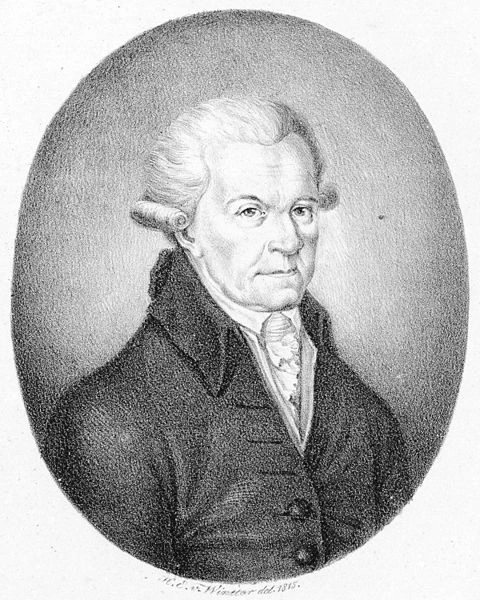
[Grobowiec Michaela Haydna]

Haydn Johann Michael, baptised 14 September 1737 Rohrau, †10 August 1806 Salzburg, Austrian composer and brother of Joseph Haydn. Around 1745, he went to Vienna, where he became a chorister and, thanks to his beautiful soprano voice, a soloist at St Stephen’s Cathedral; there he learnt to play the violin, piano and organ, as well as the principles of music (he studied, among other works, J.J. Fux’s “Gradus ad Parnassum”), and also served as assistant cathedral organist. From 1757 he was conductor of the bishop’s chapel in Nagyvárad (Grosswardein, now Oradea, Romania); during this time, he composed several symphonies, masses and a Te Deum. In 1762 he went to Salzburg, where he remained until the end of his life. In 1763 he was appointed concertmaster of the local orchestra and court composer to Archbishop S. Schrattenbach. On 17 August 1768, Haydn married the well-known singer Maria Magdalena Lipp (1745–1827), daughter of the archbishop’s court organist, F. J. Lipp. Many of Haydn’s symphonies and divertimenti date from the 1760s, and the death of his generous patron prompted him to compose one of his most famous works, the Requiem in C minor. Schrattenbach’s successor, Archbishop H. Colloredo, a supporter of Enlightenment reforms within the Catholic Church, introduced numerous restrictions on liturgy and church music; at his behest, Haydn composed liturgical works. At the end of 1777, Haydn took up the post of organist at the Dreifaltigkeitskirche following the death of his friend A.C. Adlgasser, and in 1781 he succeeded W.A. Mozart as court and cathedral organist, a position he held for over 25 years. In 1786, he composed the Missa hispanica on commission from the Spanish royal court, a work which brought Haydn European fame. From 1787, he taught the chapel choristers to play the piano as the successor to L. Mozart, and probably already before that, the violin and composition; Haydn’s pupils included C.M. Weber, S. Neukomm, J. Wölfl, I. Assmayer and A. Diabelli. In 1798 he travelled to Vienna, where he met Joseph Haydn and had the opportunity to meet many composers, including J. von Eybler and F. X. Süssmayr. He visited Vienna for a second time in the autumn of 1801 to present his Missa sotto il titulo di S. Teresia and Te Deum to Empress Maria Theresa. He also made a name for himself as an excellent organist and improviser. In Eisenstadt (1801 or 1802), during his final meeting with his brothers, he was offered the post of deputy vice-Kapellmeister to Prince Nikolaus II Esterházy’s orchestra (which he declined). In 1804, he became a member of the Royal Swedish Academy of Music [Kungliga Musikaliska Akademien]. Haydn’s final work was a Requiem commissioned by the Empress, which he did not, however, complete. Most of Haydn’s compositions have been preserved at the Benedictine Abbey of St Peter’s in Salzburg, with which he had close ties and where he lived, whilst his works for male voices are held at the Benedictine monastery in Michaelbauern, near Salzburg. He was buried in St Peter’s Cemetery [Petersfriedhof] in Salzburg.
The best-known part of Haydn’s compositional legacy is his sacred music, particularly his masses, in which, following the instructions of Archbishop H. Colloredo, he took care to ensure the liturgical character of the compositions. This applies, amongst other things, to the length of these works – they usually last no longer than 45 minutes. Haydn’s masses can be divided into two main groups: those in the Palestrina style, following the rules of counterpoint by J.J. Fux, and those in a newer style. The former, mainly Advent and Lent masses, were written using the nota contra notam technique for a four-part chorus accompanied by organ. A chorale melody often serves here as the cantus firmus. Masses in the newer style, featuring a more or less extensive orchestra (depending on the importance of the feast day), include coloratura in the solo vocal parts. There is also no shortage of extensively developed contrapuntal parts, particularly in the conclusions of the Gloria and Credo. Other religious works are predominantly composed using the nota contra notam technique.
Haydn’s achievements in the field of sacred music have unjustly overshadowed the significance of his instrumental music. His symphonies, concertos, serenades and divertimentos are characterised by originality and played an important role in shaping the fundamental forms and stylistic features of Classical music. Haydn’s early symphonies (up to around 1770) are written in four movements, with a minuet as either the second or third movement. In his later symphonies, however, he did not include a minuet. After 1780, the exposition’s two-theme structure was fully developed, while the development section remained relatively brief. The first movement usually begins with a slow introduction. The composer displays great inventiveness in the slow movements. The finales usually take the form of a rondo, sometimes ending with a fugato. In the orchestra, the first violins play the leading role, but the composer also entrusts virtuoso parts to the wind instruments. His serenades, cassations and divertimentos are characterised by a highly original treatment of the instruments; for example, the serenades from the late 1760s contain movements entitled “Concertino” for trumpet, flute, bassoon and other instruments, serving as showpiece passages for these instruments. Haydn also wrote German drinking songs for four male voices, which, like his songs for solo voice and piano, gained considerable popularity. He also composed oratorios to German texts and incidental music. Haydn’s stature as a composer is evidenced by the fact that scholars have occasionally attributed his works to Joseph Haydn, as well as to Mozart (for example, the Quintet in C was published as Joseph Haydn’s Op. 88, and the Symphony in G major from 1783 was previously identified as Mozart’s KV 444).
Literature: Biographische Skizze von J. M. Haydn, ed. J. S. Schinn, F.J. Otter, Salzburg 1808; C. von Wurzbach Joseph Haydn und sein Bruder Michael, Vienna 1861; O. Schmid J.M. Haydn (…) sein Leben und Wirken, Langensalza 1906; J. E. Engl Zum Gedenken J.M. Haydn, Salzburg 1906; A.M. Klafsky M. Haydn als Kirchenkomponist, “Studien zur Musikwissenschaft” III, 1915; B.A. Wallner M. Haydn zu seinem 200. Geburtstage, “Deutsche Musikkultur” II, 1937/38; H. Jančik M. Haydn. Ein vergessener Meister, Vienna 1952; R. G. Pauly The Motets of M. Haydn and Mozart, “Journal of the American Musicological Society” IX, 1956; R. G. Pauly Some Recently Discovered M. Haydn Manuscripts, “Journal of the American Musicological Society” X, 1957; R. Hess Serenade, Cassation, Notturno und Divertimento bei M. Haydn, Moguncja 1963; R. Münster Ein eigenhändiges Gradualverzeichnis von M. Haydn, “Österreichische Musikzeitschrift” XXVI, 1971; “Österreichische Musikzeitschrift” XXVII, 1972 – a special issue dedicated to Haydn; C.H. Sherman, T. D. Thomas The Collected Works of J. M. Haydn. A Thematic Catalog of Sources, pub. Pendragon Press, Stuyvesant, New York, 1993.
Compositions
Instrumental:
43 symphonies, 1759–89
concertos (1759–78): 2 for flute, 1 for trumpet, 2 for horn, 1 for 2 horns, 1 for harpsichord, 1 for organ or harpsichord and viola, 3 for violin, 1 for cello
over 1,600 minuets
10 marches
4 cassations
2 partitas
2 serenades
nocturn (excerpt)
approx. 30 divertimenti for various instrumental ensembles, 1760–95
2 nocturnes for 2 violins, 2 violas, and double bass, 1773
String Quintet in F major, 1784
Quartet in D major for flute and string instruments, 1776
Quartet in F major for flute and string instruments, 1776
12 string quartets, 1776–1802
4 sonatas for violin and viola, 1783
Antiphonarium for organ, 1792
Vocal-instrumental:
sacred:
approx. 38 Latin masses and 8 German masses, mainly for solo voices, choir, and orchestra or choir and organ, including:
Pro defuncto Archiepiscopo Sigismundo (Requiem in C minor), 1771
Hieronymi, 1777
Ruperti, 1782
A due cori (Missa hispanica), 1786
Pro Quadragesima, 1794
Pro tempore quadragesimae, 1794
Sotto il titulo di S. Teresia, 1801
Subtitulo S. Francisci, 1803
Leopoldi, 1805
Pro defunctis (Requiem B-flat major), unfinished
13 cantatas for solo voices, choir, and orchestra, 1760–1803
7 oratories, 1767–82
over 300 different sacred pieces, mainly for solo voices, chorus, and orchestra, including:
6 Te Deum
12 litanies
2 Completoria
130 graduals
65 offertories
13 Salve Regina
9 sequences
20 Tantum ergo
7 Regina coeli
6 responsories for choir and organ
Stage:
Andromeda e Perseo, opera 1787
7 Singspiels, 1766–88
music for dramatic works
Writings:
Partiturfundament, ed. P.M. Bischofreiter, Salzburg 1833
Editions:
instrumental works, ed. L. Perger, «Denkmäler der Tonkunst in Österreich» XXIX, Vienna 1907 (includes a thematic catalog of Haydn’s instrumental compositions)
Symphony in D major and Symphony in C major, ed. H.Ch.R. Landon, in «Diletto musicale» XX and CXLIII, 1962, 1968
Symphony in G major and Symphony in A major, ed. Ch.H. Sherman, in «Diletto musicale» CLXXXIII and CLXXXIV, 1968
Symphony in C major (from 1773) and Symphony in D major (from 1788), ed. L. Kalmár, in «Diletto musicale» CCCXIV and CCCXXII, 1969
Symphony in D major (from 1774), ed. P. Gombás, w «Diletto musicale» CCCXVII, 1969
Symphony in G major (from 1788), wyd. G. Kovács, w «Diletto musicale» CCCXX, 1969
Symphony in C major and Symphony in E flat major, ed. Ch.H. Sherman, Vienna 1977
Sinfonia D major, ed. L. Somfai
Serenata (from 1785), ed. G. Darvas, «Musica rinata» IV, XI, Budapeszt 1964, 1969
Flute Concerto (from 1766), ed. J. Vécsey, Budapeszt 1957, 3rd ed. 1976
Concerto in D major for flute, ed. H.Ch.R. Landon, Salzburg 1959
Concerto in B-flat major and Concerto in A major for violin, ed. P. Angerer and Ch.H. Sherman, «Diletto musicale» III, CXCIV, 1960, 1968
Concerto in D major for trumpet (piano reduction), ed. W. Heseke, Hamburg 1965
Concertino for horn and orchestra, 2 vols. (piano reduction and score), ed. Ch.H. Sherman, «Accademia musicale» IX, Vienna 1970
Concertino in C major for clarinet and orchestra, and Larghetto in F major for trombone and orchestra, ed. Ch.H. Sherman, Vienna 1974
3 string quartets, ed. H. Albrecht, «Organum» XXXVIII, XL, XLII, Lippstadt 1950
Quartet in D major, ed. H.-D. Sonntag, Berlin 1959
Divertimento à 5 in G major, ed. W. Höckner, H. Młynarczyk, Hamburg 1960
Divertimento in B-flat major and Divertimento in G major, ed. A. Stassl, «Diletto musicale» XXIV, XXV, 1962
Divertimento in D major, ed. L. Kalmar, «Musica rinata» VII, Budapest 1965
5 divertimenti and Quartet in C major for English horn, viola and violin, ed. W. Rainer, «Diletto musicale» XXXIX, CCLXXIII–CCLXXV, CCCXII, CCCLXXI, 1969, 1970
String quartet in A major, ed. F. Beyer, Zurich 1971
Divertimento in F miorl, ed. I. White and R. Statford, London 1971
6 string quartets, ed. H. Zehetmair, «Diletto musicale» CCCXXXI–CCCXXXIII, CCCXXXV, CCCXXXVI, 1974
Quartet in F major, ed. W. Rainer, Vienna 1974
2 violin duets, ed. G. Szeredi-Saupe, Frankfurt am Main 1976
Notturno in F major for 2 horns, 2 violins, a viola and a cello, ed. A. Stassl, Vienna 1977
4 Lieder, ed. O. Schmid, Leipzig 1897
Haydn-Album for voice and piano or harmonium, ed. O. Schmid, Leipzig 1896
3 Masses, ed. A.M. Klafsky, «Denkmäler der Tonkunst in Österreich» XLV, 1915
Kirchenwerke, ed. A.M. Klafsky, «Denkmäler der Tonkunst in Österreich» LXII, 1925 (includes a thematic catalogue of Haydn’s sacred compositions)
Missa S. Crucis, ed. E. Tittel, Vienna 1949
Missa sub titulo S. Leopoldi, ed. W. Reinhart, Zurich 1952
Missa dolorum Beatae Mariae Virginis, ed. E. Tittel, Vienna 1962
Missa hispanica (piano reduction), ed. Ch.H. Sherman, Salzburg 1966
Missa S. Hieronymi and Missa pro defunctis, 2 vol. (piano reduction and score), ed. Ch.H. Sherman, «Accademia musicale» VII, VIII, 1968, 1969