
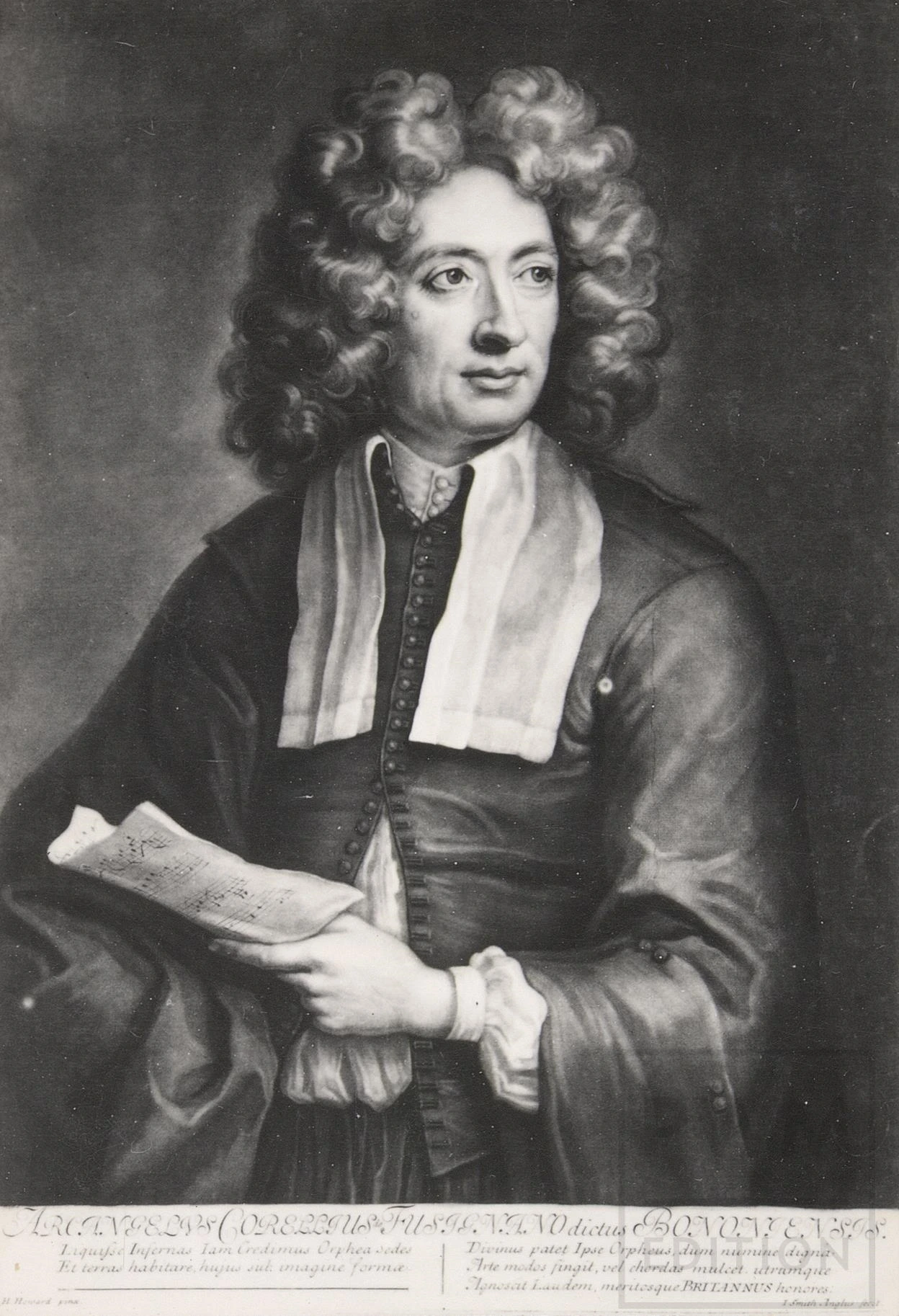
[Arcangelo Corelli]

Corelli Arcangelo, *17 February 1653 Fusignano (Province of Ravenna), †8 January 1713 Rome, Italian composer and violinist. He came from a well-known and affluent family. He received his early education in nearby Faenza and Lugo. The information that Corelli’s teacher was G.B. Bassani seems to be incorrect, as Bassani was younger than Corelli. In 1670, Corelli was admitted to the Accademia Filarmonica in Bologna, and his first works bear the nickname “il Bolognese”. In 1671, he left Bologna. There is no information available about the period between 1671 and 1675, and the frequently mentioned reference to his stay in France is not confirmed by archival materials. It is known that it was at this time that Corelli settled permanently in Rome. According to existing records, between 1675 and 1678 Corelli was a violinist at the churches of S. Giovanni dei Fiorentini and S. Luigi dei Francesi. In 1679, B. Pasquini’s opera Dove è amorè e pieta was performed at the Teatro Capranica; Corelli performed as first violinist and conductor; from February 1676 to 1680, he took part in performances at the Oratorio S. Crocifisso at the church of S. Marcello. During his early years in Rome, Corelli studied the principles of Palestrina’s counterpoint under M. Simonelli, known as the Palestrina of the 17th century; these studies had a significant influence on his work. In 1679, he sent his first composition, a sonata for violin and lute, to the Duke of Faenza, F. Ladarchi. There is no information about Corelli’s frequently mentioned trips to Germany, allegedly undertaken at that time. It is possible that researchers (A. Einstein) confused Corelli’s name with Torelli’s.
In 1681, his Trio Sonate da chiesa, Op. 1, dedicated to Christina, Queen of Sweden, who had settled in Rome at that time, were published. Corelli took part in concerts organised at her residence, the Palazzo Riario. In August 1682, he played again at the church of S. Luigi dei Francesi, conducting an ensemble of ten violinists; he remained active at this church until 1708. At his side sat Matteo Fornari, Corelli’s faithful pupil and later his successor, as second violinist. From 1684, Corelli served as violinist at the court of Cardinal B. Pamphili, to whom he dedicated his Trio Sonate da camera Op. 2, published in 1685. The Allemanda from Sonata No. 3 in this collection sparked a controversy with G.P. Colonna, who questioned Corelli’s use of fifth intervals. It seems that from that time Corelli’s relations with the musical world of Bologna began to grew cold. In January 1687, during celebrations organised by Queen Christina to mark the arrival in Rome of the Duke de Castlemain, envoy of James II Stuart, Corelli conducted a 150-piece string orchestra. In July of that year, Cardinal Pamphili appointed Corelli as his teacher; from then until 1690, Corelli lived with M. Fornari in the cardinal’s palace, where G.L. Lulli’s oratorio Santa Beatrice d’Este was performed in 1689, for which Corelli composed the introduction and sinfonia. In the same year, the Trio Sonate da chiesa, Op. 3, dedicated to Francesco II di Modena, were published almost simultaneously by various publishers (Rome, Bologna, Modena).
In 1689, Cardinal P. Ottoboni appointed Corelli as first violinist in an instrumental ensemble that played at concerts in the Palazzo della Cancelleria during various celebrations and at Monday evening concerts. Cardinal Ottoboni held Corelli’s artistry in high regard and treated him as a friend, also taking care of the composer’s family. In 1690, Corelli moved into Ottoboni’s palace along with M. Fornari, remaining there almost until the end of his life. The palace was also home to the painter Treviso, author of one of the composer’s portraits, and the sculptor Rossi, author of Corelli’s bust. During Cardinal Ottoboni’s patronage, the composer gained increasing fame. At that time, he devoted himself entirely to music and was also an avid collector of paintings. Students came from all over Europe to admire his playing and take lessons from him. Corelli perfected his compositions, refining them at length before deciding to publish them. Few composers were fortunate enough to experience such peaceful and glorious years as (according to historians) did Corelli during this period of his life. In 1694, Corelli published his Trio Sonate da camera, Op. 4, dedicated to P. Ottoboni. In 1700, he held the position of guardiano dei musici di Roma sotto invocazione di S. Cecilia. That same year, his Solo Sonate, Op. 5, dedicated to Sophie Charlotte of Brandenburg, were published and quickly became widely popular.
Corelli’s contemporaries emphasised his perfection in violin playing and his strict demands on the ensemble he conducted and, on his listeners, from whom he demanded absolute concentration. They portrayed the composer as a man of great nobility, spirituality and modesty. On 26 April 1706, Corelli, together with B. Pasquini and A. Scarlatti, was admitted to the Roman Accademia dell’Arcadia, where he was given the name Arcomelo Erimanteo. In 1702, Corelli took part in the performance of an opera (probably Tiberio, imperator d’Oriente) by A. Scarlatti in Naples; it was then that he is said to have realised that he had been surpassed by the violinist P. Marchitelli, known as Petrillo. A. Scarlatti valued Corelli as a violinist, but did not appreciate his work as a composer. From around 1706, Corelli played in public less and less frequently. In 1709, he fell into a state of melancholy and gave up public performances altogether. At the end of 1712, he moved to the Ermini Palace in Piazza Barberini, where his brother Giacinto resided. On 5 January 1713, he wrote his will, bequeathing his instruments to Fornari and his paintings to Ottoboni, among others. He passed away on the night of 8–9 January. In accordance with Ottoboni’s wishes, Corelli’s body was embalmed and laid to rest in the church of S. Maria della Rotonda (the Pantheon) and later a tombstone was carved and a bust made, which was moved to the Capitol in 1820. Corelli did not live to see the publication of his Concerti grossi Op. 6, which he had been refining for a long time and which had probably been performed in Rome for many years; he entrusted the publication of these works to Fornari. Corelli’s Concerti grossi were performed every year in Rome at concerts commemorating the anniversary of the composer’s death. Corelli lived on for a long time in the playing and works of his pupils: F. Geminiani in England, G. Muffat in Austria, and P. Locatelli in the Netherlands.
Corelli’s work falls within the late Baroque period in music. His surviving compositions are exclusively for instrumental ensembles. This clear limitation to instrumental music, with a particular fondness for string ensembles, especially violins, distinguishes Corelli from other Baroque composers; his virtuoso playing and, above all, his compositions laid the foundations for the further development of violin playing. Corelli occupies a special place in the history of violin playing. On the one hand, he put an end to the bold experiments of composers such as C. Farina and M. Ucellini, simplifying and smoothing out violin playing; on the other hand, he initiated a cantilena trend in violin playing, based on the traditions of vocal counterpoint. Corelli rarely went beyond the third position and only occasionally required the fifth; in other words, he wrote in a way that made the instrument sound its best. Many of his trio sonatas can be performed almost entirely without going beyond the first position. Corelli very rarely used the G string (e.g., the Adagio from the Concerto Grosso No. 8), as well as double stops and triple stops (in the first six solo sonatas and the Follia concluding Op. 5); he primarily required legato, sciolto playing, and only rarely staccato, and then in the form of martellato. Contemporaries admired the magnificent cantilena in Corelli’s own playing; reportedly, the composer used an elongated bow with a special screw to adjust the hair tension. As a violinist-conductor, he demanded great discipline from the ensemble he led, always requiring precise bowing in a single direction.
Corelli’s work is a synthesis of the vocal counterpoint tradition of Palestrina and the Italian violin school, stylistically linked to the achievements of Bolognese composers such as M. Cazzati, G.B. Bassani, B. Laurenti, P. degli Antonii, G.B. Vitali and G. Torelli. This synthesis is expressed in the full use of the technical and expressive possibilities of the violin and in the perfect balance between polyphony and homophony. Corelli’s work is developmental in nature. In the trio sonatas, polyphony and homophony interact, with the contrapuntal texture coming to the fore in the sonatas from Op. 1, and especially Op. 3. The trio sonatas were followed by solo sonatas for violin and basso continuo, in which the composer emphasises cantilena and virtuosity. The final stage consists of concerti grossi, based on the contrast between the concertino and tutti ensembles, works in which the polyphony and homophony of the trio sonatas, the free concerto for solo violin and the most diverse ways of interaction between the two ensembles are used.
Counterpoint played a central role in Corelli’s œuvre, manifested, among other ways, in the fugal movements of his trio sonate da chiesa, solo sonate da chiesa, and the first eight concerti grossi. Corelli frequently introduced fast fugal movements – most often as the second movement of the da chiesa cycle. These were often regular fugues, frequently employing two subjects or fixed countersubjects. The shaping of the melodic line in the fugal movements varies considerably: from the ricercar-like subject in Sonata No. 1 of Op. 1, through the slow fugues of the trio sonatas and fugues with canzona-type subjects, to fugues in which the subject permeates both the episodes and the contrapuntal fabric, anticipating the technique of J. S. Bach. At the same time, concerto technique is applied within the fugal movements, particularly in the solo sonatas and concerti grossi, where regular expositions are followed by figurative episodes.
Corelli introduced subjects successively in different voices, or presented the subject together with its answer, and further transformed fragments of the subject in the middle and concluding sections of a given movement. He also employed counterpoint in slow introductory movements – Grave or Prelude – in which the parts of the two violins continually complement one another contrapuntally while simultaneously maintaining independent melodic lines. The final movements of the cycle are likewise often saturated with imitative writing, at times resembling a sequence of fugue expositions. Polyphonic technique also appears in the da camera cycle, not only in gigues but in other dances as well. Corelli also left several examples of nota contra notam counterpoint, testifying to a strong integration of harmony and melody (Sonata No. 1 of Op. 4; Concerti grossi Nos. 4 and 12). The distinctive character of Corelli’s polyphony derives from its harmonic treatment within the major–minor tonality. Even for his contemporaries, Corelli’s output served as a model for treating harmony as a formative structural factor, since the musical course of these works is governed by harmonic motion – by departure from and return to the principal key. Corelli’s compositions rank among the earliest examples of music in which a clearly articulated harmonic plan can be discerned, with individual chords and tonal areas assigned well-defined functions, while the contrapuntally led voices complement one another harmonically. Corelli thus laid the foundations for harmonic thinking that came to dominate the late Baroque, governed the music of Classicism, and extended even into Romanticism – the foundations of functional harmony.
In Corelli’s works, the cycle of the Baroque sonata da chiesa and sonata da camera was fully crystallised as a four-movement structure: slow – fast – slow – fast. This structural model predominates throughout Corelli’s output, which also exhibits characteristic organisation of movements in another respect. In the sonata da chiesa, the movements are typically arranged as follows: the first movement, a polyphonic Grave in common time; the second, a fugal Allegro, forming the central point of the sonata; the third, a song-like Adagio, more lyrical than the opening Grave, often less contrapuntal, in triple metre, and sometimes reminiscent of a sarabande; and the fourth, a fast, contrapuntal movement, lighter in character than the second, sometimes even a gigue or resembling a gigue. The sonata da camera, on the other hand, consists of a cycle of dances preceded by an introductory prelude. Corelli most often included three to four dances, arranged in various combinations, which could include the allemande, corrente, sarabande, gigue, gavotte, minuet (the latter only in concerti grossi), or tempo di sarabanda, tempo di gavotta. This type of cycle appears primarily in the trio sonatas, which represent the culmination of the long development of the Baroque sonata. At the same time, however, Corelli’s works are far from schematic: the composer often deviated from the basic cycle outlined above, for example by altering the number of movements, introducing tempos other than those listed, or including in a solo sonata a distinctive movement of a perpetuum mobile character. Corelli differentiated between the sonata da chiesa and sonata da camera types also in terms of expression, giving the former greater solemnity not only by introducing the organ as basso continuo (which is obvious given the venue), but also through more austere melodies and rich counterpoint, which highlighted a polyphonically treated part for the bowed bass instrument. The composer emphasised the “lighter” character of the sonata da camera by introducing the harpsichord as basso continuo or by performing the basso continuo only on the violone, by abandoning the fugal technique, by using more song-like melodies and more symmetrical phrasing resulting from the specific nature of the dances, and a much simpler texture, often reduced to the leading role of the first violins accompanied by the other instruments. Corelli differentiated between the two types of sonatas, but at the same time he sometimes combined features of both types, introducing non-dance fragments into sonatas da camera and dance parts into sonatas da chiesa, bringing the non-dance adagios in sonatas da camera closer to their counterparts in sonatas da chiesa. The trio sonata type created by Corelli became a reference point for many composers; many composers defined their first opus as a cycle of 12 trio sonatas. Some composers (especially English ones) tried to imitate Corelli as closely as possible, while others took his models and developed their own stylistic characteristics within them (e.g. T. Albinoni). While the trio sonatas are predominantly in four movements, the first six solo sonatas from Op. 5 (da chiesa) are in five movements; in these works, the composer introduced fast movements of a very propulsive nature, requiring technical proficiency from the performer. The solo sonatas da camera from Op. 5 are again in four movements, except that the penultimate one deviates quite significantly from the da camera sonata pattern due to the introduction of a very elaborate allegro, which even has some features of the old classical sonata form. The entire cycle of sonatas from Op. 5 closes with a folia with variations – a piece devoted to various problems of violin technique.
In the concerti grossi, the composer returned to cycles consisting of a larger number of movements. His primary focus, however, was not on the cyclic organisation of these works, representing the church concerto (eight concerti da chiesa) and the chamber concerto (four concerti da camera), but rather on the various possibilities of interaction between the two ensembles and on the development of form through concertante technique. Corelli may have encountered this type of performance practice in Bologna, although there is no evidence of this; in Rome, however, Corelli took part in the performance of Stradella’s oratorio San Giovanni Battista (1675), in which the performers were divided into two ensembles. Stradella’s influence on Corelli in the field of concerto grosso practice seems undeniable. The practice of dividing into ensembles was also known at the church of S. Marcello, with which Corelli was associated in the following years. In the introduction to Ausserlesener (…) Instrumental-Music (1701), G. Muffat mentions that in 1682 he heard Corelli’s “sinfonie” performed in Rome under the composer’s direction. These may have been concerti grossi from Op. 6, as some researchers suggest, but they may also have been simply trio sonatas performed by an enlarged and varied ensemble. In any case, Muffat’s remark indicates that Corelli’s compositions were performed according to the principles of the concerto grosso. In 1689, Corelli composed an introduzione and sinfonia – using the contrast between concertino and concerto grosso – for G.L. Lulli’s oratorio Santa Beatrice d’Este; he later introduced a fragment of the sinfonia as the third movement of his Concerto grosso No. 6 from Op. 6.
Corelli’s concerti grossi demonstrate the composer’s fondness for trio instrumentation, as the concertino consists of a string trio. The grosso ensemble is expanded to include a viola part. The difference between the two ensembles was primarily that the concertino part was played solo, while the grosso part was played by a larger number of performers. The bass voices in both ensembles were numbered, which indicates the existence of separate continuo parts. Corelli’s greatest achievements in these works include the use of the diverse possibilities resulting from the combination of both ensembles, the creation of a perfect orchestral sound and the significant development of violin technique. The musical material is essentially the same for the concertino and grosso ensembles (with the exception of the first Allegro from Concerto No. 2), so the concertos could be and were performed as trio sonatas. The concertos are, in fact, a projection of trio sonatas onto a larger ensemble; this is most clearly evident in fragments or even entire movements composed on the principle of concerto ripieno, where the individual parts of the concertino are doubled by the concerto grosso. This is often the case in the opening passages of concertos, entire slow polyphonic movements (e.g. Concerto No. 3 and No. 8), movements in nota contra notam texture (Concerto No. 12) or movements in which the first violins lead the cantilena and the rest of the ensemble provides accompaniment (Concerto No. 10).
In Corelli’s concertos, the interaction between the ensembles most often takes place through the joining of the grosso ensemble to the concertino within a single phrase, usually at its conclusion. The opposition of the two groups is also linked to repetition: a passage introduced by the concertino subsequently appears in the tutti. More frequently, however, after an initial section presented by the concertino, the tutti responds to it or develops the material further. Conversely, the concertino may elaborate on motives first stated by the tutti. In these concertos one often encounters extended passages in which motives are repeated with changes of instrumentation from bar to bar. In principle, the grosso ensemble never plays entirely on its own. Among the contrasting effects are dialogic exchanges between the violins and the characteristic distribution of a melodic line across their individual parts. From a technical perspective, Corelli treated both ensembles equally, although there are passages in his concertos where the first violin or cello part breaks away from the concertino ensemble, and the grosso ensemble takes over the accompaniment. The more recent handling of the grosso ensemble involves, among other things, the grosso ensemble slightly reducing one or all of the concertino voices when repeating a passage from the concertino part. Sometimes the grosso ensemble performs only the basso continuo. The solo passages are either solos for two violins with concertino (sometimes without basso continuo) or long figurations for the first violins or cellos with concertino. Sometimes, in passages using the ripieno technique, the parts of all the first violins are played solo. New ways of instrumentation are expressed in a change in the function of the voices, e.g. at the beginning of the Adagio from Concerto No. 4, the violins from the grosso ensemble double the bass from the concertina. These beginnings of new solutions appearing in Corelli’s concerti grossi were later developed by other composers; the so-called “Violinbässe”, used only exceptionally by Corelli, later became popular (e.g. in A. Vivaldi’s concertos).
Corelli’s concerti grossi are distinguished by their rich tonal palette and varied colouristic effects. The composer employs imitative effects evoking wind instruments (as in Concerto No. 4 and No. 7), sustains high trills over extended passages (as in the final movement of Concerto No. 4), and, alongside sections in chordal texture, introduces passages featuring simple yet highly propulsive and dynamic figurations for solo violins or violoncello with concertino. The use of chromatic intervals in the melodies of fugues and other polyphonic sections (notably in Concerto No. 3 and No. 6) also contributes significantly to the colouristic character of the music.
Corelli’s entire output is highly unified in stylistic terms and represents an excellent example of formal balance and of the synthesis of counterpoint with homophony. It is characterized above all by a distinctive approach to compositional development, based on a clearly defined harmonic plan, often shared by an entire cycle, and frequently reducible to the scheme T–D–Tp–T. It consists in the aphoristic presentation of a short musical idea, its repetition in the dominant key (or sometimes without repetition), followed by a freer development of the cantilena derived from this initial idea, with the harmonic plan determining the cadences. This is mainly the case in the introductory slow movements. Another common feature of Corelli’s entire oeuvre is the development of long passages based on a series of D-T progressions. The formative role of harmony in Corelli’s compositions is linked to the strongly defined bass melody line (e.g. in Concerto No. 4), which is the driving force behind the piece, as each step carries harmonic significance. Corelli expanded the length of individual movements of the Baroque sonata, moving away from an episodic structure, although short passages between movements still appear in his work. Another characteristic feature of Corelli is the conclusion of such passages or opening movements with a sequence of chords: °D–S–D; in many cadences, there is also a progression involving the simultaneous sounding of two seconds. Corelli’s melodic style is characterised more by evolving phrases or continuous figurations than by clearly defined themes, such as those that would later appear in Vivaldi’s music. The composer frequently employs syncopated overlapping of contrapuntally driven melodic lines, with the characteristic rising of a voice by a second above a sustained note, thereby creating considerable tension. The development of form occurs more through motivic reference than through literal repetition of entire passages. A hallmark of Corelli’s entire output is the use of contrapunctus luxurians and the perfection of ensemble sonority. Within a single work, the composer employs different types of textures, which makes his sonatas and concerti grossi both varied and harmoniously balanced. In Corelli’s compositions, freedom and imagination are combined with strictly observed contrapuntal rules; this freedom is manifested, among other things, in the use of improvised ornaments, particularly in his solo sonatas.
Corelli’s activities and his work caused a great stir in the musical world of his time. Many of his contemporaries considered Corelli’s music to be the symbol of perfection. Corelli’s works, especially his solo sonatas, were recognised as the foundations of the violin school, and Tartini, for example, recommended careful practice of these compositions. Evidence of Corelli’s popularity can be found in the numerous editions of his works published during his lifetime and later, among which the English edition in a new score form and the edition by Roger of Amsterdam (1710), who published the sonatas from Op. 5 with ornamented slow movements, “as Corelli would have played them” are particularly noteworthy; this edition was reprinted in England by J. Walsh & J. Hare (1711). There are several other versions of solo sonatas with ornaments introduced by Geminiani, among others. Corelli’s works, especially those from Op. 5, also circulated in countless manuscript copies, which was connected with their intended use in teaching. There were also numerous arrangements of Corelli’s works, e.g. transcriptions of trio sonatas for harpsichord; Geminiani arranged trio and solo sonatas in the form of concerti grossi, while Tartini, in L’arte dell’arco, created a series of variations based on the famous Gavotte from Op. 5. Compositions were written as a tribute to Corelli, including Grande sonade en Trio intitulée le Parnasse ou l’Apothéose de Corelli by F. Couperin (1742). Corelli’s art of violin playing also bore fruit in the work of his pupils: G. B. Somis, the founder of the Piedmontese school; F. Geminiani in England; P. Locatelli in Amsterdam; F. Gasparini in Venice; M. Mascitti in Naples; J. B. Anet in France; and J. G. C. Störl in Germany. Corelli’s influence was not limited to his students. In France and England, interest in Corelli’s trio sonatas led to a renewed appreciation of the violin, which had been overshadowed by the harpsichord and viol. Many English and French composers attempted to imitate Corelli faithfully; Handel referred to his achievements in his sonatas and concerti grossi, Op. 6. Links to Corelli’s style are also evident in the works of Italian composers (e.g. in Geminiani’s concerti grossi, Op. 3) and German composers (Telemann’s trio sonatas). Corelli’s works were studied by J.S. Bach, who used several subjects from his fugues in his organ works. For many years, Corelli’s solo sonatas served primarily educational purposes. Corelli was then forgotten, like many other Baroque composers. Today, thanks to Pincherle’s pioneering work and the growing interest in Baroque music, Corelli’s work has found its rightful place among researchers and musicians, as evidenced for example by three international congresses held in Fusignano (1968, 1974, 1980) and the undertaking of extensive work on sources in connection with the planned publication of Corelli’s complete works.
Literature: G.M. Crescimbeni Arcangelo Corelli in: Notizie istoriche degli Arcadi Morti, vol. 1, Rome 1720; J. Hawkins The General History and Pecular Character of the Works of Arcangelo Corelli, “Universal Magazine of Knowledge and Pleasure” LX, 1777; L. Orsini Arcangelo Corelli, Turin 1915; A. Cametti Arcangelo Corelli. I suoi quadri e i suoi violini, Rome 1927; M. Pincherle Corelli, Paris 1933, 2nd revised edition: Corelli et son temps, Paris 1954, English edition: Corelli, His Life, His Work, translated by H.E.M. Russel, New York 1956; M. Rinaldi Arcangelo Corelli, Milan 1953; Catalogo della mostra Corelliana (…) per la Celebrazione della nascita di Arcangelo Corelli, Roma, Palazzo Braschi, dicembre 1953, Genua 1954; Mostra delle edizioni e manoscritti Corelliani nelle raccolte Piancastelli della Biblioteca comunale di Forli, Fusignano 1967 (catalogue); commemorative book: Fusignano ad Arcangelo Corelli nel secondo centenario della morte 1913, ed. C. Piancastelli, Bologna 1914, reprint «Biblioteca Musica Bononiensis» III, 38, 1969; Nel III centenario della nascita di Arcangelo Corelli, Comitato Fusignanese, Ravenna 1953; Studi Corelliani, congress proceedings Fusignano 1968, ed. A. Cavicchi, O. Mischiati, P Petrobelli (“Rivista Italiana di Musicologia” 1972 No. 3); Nuovi studi Corelliani, congress proceedings Fusignano 1974, ed. G. Giachin (“Rivista Italiana di Musicologia” 1978 No. 4); A. Moser Zur Frage der Omamentik in ihrer Anwendung auf Corellis op. 5 and Arcangelo Corelli und A. Loili, “Zeitschrift für Musikwissenschaft” I, 1918–19, “Zeitschrift für Musikwissenschaft” III, 1921; F.T. Arnold Arcangelo Corelli Forgery, “Proceedings of the Musical Association” XLVII, 1920–21; A. Cametti Arcangelo Corelli à Saint-Louis-des-Français à Rome, “La Revue Musicale” 1922; F. Vatielli Il Corelli e i maestri bolognesi del suo tempo, in: Arte e vita musicale a Bologna. Studi e saggi, Bologna 1927, reprint «Biblioteca Musica Bononiensis» III/5, Bologna 1969; M. Pincherle De l’ornamentation des sonates de Corelli, in: Feuillets d’histoire du violon, Paris 1927, 2nd edition 1935; C. Censi Studi sull’ op. 5 di Corelli, «Arti» II, 1950; M. Pincherle Review of Mario Rinaldi’s Arcangelo Corelli (Milano 1955), “Revue de Musicologie” XXXV, 1953; M. Rinaldi Arcangelo Corelli e i suoi rapporti con i pittori contemporanei, “Atti della Accademia Nazionale di San Luca” VI, 1953–56; L. Montalto Arcangelo Corelli nell’ambiente musicale romano fra il 1671 e il 1713, “Rivista Musicale Italiana” LVI, 1954; W.S. Newman Ravenscroft and Corelli, “Music and Letters” XXXVIII, 1957; C. Sartori Sono 51 (fino ad ora) le edizioni italiane delle opere di Corelli e 135 gli esemplari noti, CHM II, 1957; A. Liess Neue Zeugnisse von Corellis Wirken in Rom, “Archiv für Musikwissenschaft” XIV, 1957; M. Tilmouth Corellis Trumpet Sonata, “Monthly Musical Record” XC, 1960; N. Cherry Arcangelo Corelli. Sonata for Trumpet, Violins and Bosso Continuo, “Brass Quarterly” IV, 1960/61; A. Cavicchi Una sinfonia inedita di Arcangelo Corelli nello stile del Concerto grosso venticinque anni prima della Opera VI, “Chigiana” XX, 1963; M. Fabbri Tredici ignote composizioni attribuite a Corelli in due manoscritti di Firenze e di Assisi, “Chigiana” XX, 1963; E. Schenk Corelli und Telemann, “Chigiana” XXIV, 1967; R. Pećman Corellis Concerti grossi als Vorboten des Klassizimus, «Sborník Prací Filosofické Fakulty Brnenské University» XVII, Brno 1968; H.J. Marx Die Musik am Hofe Pietro Kardinal Ottobonis unter Arcangelo Corelli, «Analecta Musicologica» V, 1968; O. Jander Concerto Grosso Instrumentation in Rome in the 1660’s and 1670’s, “Journal of the American Musicological Society” XXI, 1968; H.J. Marx Ein neunaufgefundenes Autograph Arcangelo Corellis, “Acta Musicologica” XLI, 1969; H.J. Marx Some Corelli Attributions Assessed, “The Musical Quarterly” LVI, 1970; M. Witte Das Verhältnis von Grosso und Concertino Tonsatz in den Concerti grossi Corellis, “Die Musikforschung” XXIV, 1971; M. Talbot The Concerto Allegro in the Early Eighteenth Century, “Music and Letters” LII, 1971; M.G. White F.M. Veracinis “Dissertazioni sopra l’Opera Quinta del Corelli, “The Music Review” XXXII, 1971; H. Braun Eine Gegenüberstellung von Original und Bearbeitung, dargestellt an der Entlehnung eines Corellischen Fugenthemas durch J.S. Bach, “Bach-Jahrbuch” LVIII, 1972; D. Boyden The Corelli “Solo” Sonatas and their Omamental Additions by Corelli, Geminiani, Dubourg, Tartini, and the “Walsh Anonymus”, «Musica Antiqua Europae Orientalis» Acta scientifica III, Bydgoszcz 1972; K.F. Heimes The Ternary Sonata Principle before 1742, “Acta Musicologica” XLV, 1973; D. Libby Interrelationships in Corelli, “Journal of the American Musicological Society” XXVI, 1973; H.J. Marx Some Unknown Embellishments of Corelli’s Violin Sonatas, “The Musical Quarterly” LXI, 1975; Studi Corelliani, congress proceedings Fusignano 1968, “Quaderni della RIM” No. 3, 1972; Nuovi Studi Corelliani, congress proceedings Fusignano 1974, “Quaderni della RIM” No. 4, 1978; Nuovissimi Studi Corelliani, congress proceedings Fusignano 1980, ed. S. Durante and P. Petrobelli, “Quaderni della RIM” No. 7, 1982; Studi Corelliani IV, congress proceedings Fusignano 1986, ed. P. Petrobelli and G. Staffieri, “Quaderni della RIM” No. 22, 1990; Studi Corelliani V, congress proceedings Fusignano 1994, ed. S. La Via, “Quaderni della RIM” No. 33, 1999; S. Harris Lully, Corelli, Muffat and the Eighteenth-Century Orchestral Body, “Music and Letters” LIV, 1973; O. Edwards The Response to Corellis Music in Eighteenth-Century England, “Studia Musicologica Norvegica” II, 1976; C.H. Russel An Investigation into Arcangelo Corellis Influence on Eighteenth-Century Spain, “Current Musicology” XXXIV, 1982; W. Apel Die italienische Violinmusik im 17 Jahrhundert, Wiesbaden 1983, English edition Italian Violin Music of the Seventeenth Century, Bloomington (Indiana) 1990; E. Zanetti Musiche strumentali di Corelli travestite, Proceedings of the 14th MTM Congress, Bologna 1987, Turin 1990; E. Careri The Correspondence between Burney and Twining about Corelli and Geminiani, “Music and Letters” LXXII, 1991; P. Allsop The Italian “Trio” Sonata. From its Origins until Corelli, Oxford 1992; A. Cohen Rameau on Corelli. A Lesson in Harmony, Convention in Eighteenth- and Nineteenth-Century Music, in a commemorative book for L.G. Ratner, Pendragon 1992; W. Gotten Fatto per la notte di Natale. Le concerto opus VI no 8, “Analyse musicale” No. 29, 1992; M. Castellani “Alla Corelli”, Travers and Controvers, in a commemorative book for N. Delius, Celle 1992; L. Della Libera La musica nella basilica di Santa Maria Maggiore a Roma, 1676–1712. Nuovi documenti su Corelli e sugli organici vocali e strumentali, “Recercare” VII, 1995; R.A. Rasch Corelli Contract. Notes on the Publication History of the Concerti grossi… Opera sesta (1714), “Tijdschrift der Vereeniging voor Nederlandsche Muziekgeschiedenis” XLVI, 1996; N. Zaslaw Ornaments for Corelli’s Violin Sonatas, op. 5, P. Walls Performing Corelli’s Violin Sonata, op. 5 and R.E. Seletsky 18th-Century Variations for Corelli’s Sonatas, op. 5, “Early Music” XXIV, 1996; H.D. Johnstone Yet More Ornaments for Corelli’s Violin Sonatas, op. 5, J. Holloway Corelli’s op. 5 Sonatas. Text, Act… and Reaction, D. Watkin Corelli’s op. 5 Sonatas. “Violino e violone o cimbalo”? and L.U. Mortensen “Unerringly tasteful”? Harpsichord Continuo in Corelli’s op. 5 Sonatas, “Early Music” XXIV, 1996; P. Allsop Da camera e da balio alla francese et all’italiana. Functional and National Distinctions in Corelli’s Sonate da Camera, “Early Music” XXVI, 1998; A. Pavanello Corelli tra Scarlatti e Lully. Una nuova fonte della sonata WoO 2, “Acta Musicologica” LXXI, 1999; N. Cook At the Borders of Musical Identity. Schenker, Corelli and three Graces, “Music Analysis” XVIII, 1999; P. Allsop Arcangelo Corelli. New Orpheus of Our Times, Oxford 1999; A. Pavanello Per un’indagine sullo sviluppo diacronico del linguaggio musicale di Arcangelo Corelli, “Schweizer Jahrbuch für Musikwissenschaft”, XIX, 1999; M. Talbot “Lingua romana in bocca veneziana”: Vivaldi, Corelli and the Roman school in: M. Talbot Venetian music in the age of Vivaldi, Aldershot 1999; M. Privitera Arcangelo Corelli, Palermo 2000; E.T. Hilscher Arcangelo Corelli: Concerti grossi op. 6 (gedruckt 1714)—Concerto VIII (“Weichnachtskonzert”) in: Musikerhandschriften: Von Heinrich Schütz bis Wolfgang Rihm, ed. G. Brosche, Stuttgart 2002; M. Privitera L’Arcangelo sulla Colonna: Un’altra querelle petroniana in: Bologna in musica: Musica e poesia, teatro e polemica, arte e costume nella Bologna del Seicento e dell’Ottocento, ed. P. Mioli, C. Carrisi, Bolonia 2003; C. Fertonani El mito de Corelli, F. Pavan Concerti grossi op. 6 and M.M. Martín Galán Un compositor sin vida privada, “Scherzo: Revista de música”. XIX, 2003; R. Rasch Lully und Corelli auf dem batavischen Parnass, “Basler Jahrbuch für historische Musikpraxis”, XXVIII, 2004; P. Wilk Sonata na skrzypce solo w siedemnastowiecznych Włoszech, Wrocław 2005; W. Rothstein Transformations of cadential formulae in the music of Corelli and his successors in: Essays from the Third International Schenker Symposium, ed. A. Cadwallader, Hildesheim 2006; Arcangelo Corelli fra mito e realtà storica—Nuove prospettive d’indagine musicologica e interdisciplinare nel 350° anniversario dalla nascita, ed. G. Barnett, A. D’Ovidio, S. La Via, Florence 2007; P. Walls Reconstructing the archangel: Corelli “ad vivum pinxit”, “Early music”, XXXV, 2007; A. Pfisterer Quintfallsequenz und Quintenkette in der Musik Arcangelo Corellis, “Musiktheorie: Zeitschrift für Musikwissenschaft”, XXII, 2007; M. Vanscheeuwijck Una crisi in ambiente musicale bolognese: La polemica fra Giovanni Paolo Colonna e Arcangelo Corelli (1685) in: Barocco padano. V, ed. A. Colzani, A. Luppi, M. Padoan, Como 2008; J-Ch. Maillard From Corelli’s Italian sonata to Couperin’s French sonade: An example of musical interaction, and the origin of the goûts réunis in the first years of the eighteenth century in: Dzieło muzyczne i jego rezonans. IV., ed. A. Nowak, Bydgoszcz 2008; H. Hell Es existiert kein Musikautograph von Arcangelo Corelli, “Archiv für Musikwissenschaft”, LXVI, 2009; F. Luisi Nuovi accertamenti sui quadri e sui violini di Corelli: Storie di collezionismo al tempo di Clemente XI, “Recercare”, XXI, 2009; A. DeSimone Musical migration: The European impact of Corelli’s op. 6 in: A-R Editions’ Online Music Anthology, ed. J. Zychowicz, Middleton 2010; A. Pfisterer Überlegungen zu Corellis Orchestermusik, “Die Musikforschung”, LXIII, 2010; G. Webber Buxtehude’s Praeludia and the sonata publications of Corelli, “Early Music” XXXVII, 2010; S. Keym Händel und die Sonatentradition Corellis, “Händel-Jahrbuch”, LVI, 2010; M. Steger Corellis Sonaten op. 5 in verzierten Fassungen des englischen Barock, “Windkanal” III, 2010; B. Nestola Ancora sui Goûts réunis: Michele Mascitti, Giovanni Antonio Guido e l’eredità di Corelli e Vivaldi in Francia nella prima metà del Settecento, “De musica disserenda” VII, 2011; A. Pfisterer Corellis Orchestermusik und die römische Sinfonia in: Musik-Stadt: Traditionen und Perspektiven urbaner Musikkulturen. IV: Freie Beiträge, ed. G. Stöck, K. Stöck, Leipzig 2012; A. Sanna Arcangelo Corelli and friends: Kinships and networks in the Papal State, “Early Music” XLI, 2013; Corelli als Modell: Studien zum 300. Todestag von Arcangelo Corelli (1653–1713), ed. P. Memelsdorff, T. Drescher, A. Pavanello, Winterthur 2013; L. Bowring “The coming over of the works of the great Corelli”: The influence of Italian violin repertoire in London 1675–1705 in: Reappraising the Seicento: Composition, dissemination, assimilation, ed. J. Wainwright, J. Knowles, A. Cheetham, Newcastle upon Tyne 2014; Ch. Riedo How might Archangelo Corelli have played the violin?, “Music in art: International journal for music iconography”, XXXIX, 2014; A. Sanna Corelli’s op. 5 and the Baroque paradigm, “Early music performer”, XXXV, 2014; M. Talbot Eight “double-stopped” fugues in A major: Essays in the union of counterpoint and violinistic virtuosity by Corelli, Bitti, Albinoni, Carbonelli, and Zuccari and G. Pont A volume of Corelli’s works owned and annotated by Charles Burney, “Ad Parnassum”, XII, 2014; Arcomelo 2013: Studi nel terzo centenario della morte di Arcangelo Corelli (1653–1713), ed. G. Olivieri, M. Vanscheeuwijck, Lucca 2015; K. Vlaardingerbroek Extravagant Vivaldi or pleasant Corelli? A heated debate within an Amsterdam collegium musicum around 1730, “Studi Vivaldiani”, XV, 2015; F. Piperno “L’armoniose idee della sua mente”: Corelli, the Arcadians, and the primacy of Rome in: Passaggio in Italia: Music on the Grand Tour in the seventeenth century, ed. D. Fabris, M. Murata, Turnhaut 2015; A. Pavanello The other Corelli: Violin sonatas in English sources, “Ad Parnassum”, XIII, 2015; A. D’Ovidio Colista or Corelli? A “waiting room” for the trio sonata Ahn. 16, “Philomusica”, XVI, 2017; Ch. Wintle Corelli’s rhythmic models: Dance movements in the seventeenth and eighteenth centuries, “Intégral: The journal of applied musical thought”, XXXI, 2017; G. Pont J. B. Cramer’s arrangements of Corelli’s concerti grossi and the problem of non-uniform articulation, “Ad Parnassum”, XV, 2017; A. D’Ovidio Corelli e il “violinismo romano”: Un’indagine quasi indiziaria, “Per archi”, XIII, 2018; A. Pfisterer Neues zu Arcangelo Corellis Studium in Bologna, “Die Musikforschung”, LXXI, 2018; P. Teodori Dissonanze in cadenza e tirate di legature nelle sonate a tre, op. 3 di Arcangelo Corelli: Le regole del contrappunto e l’invenzione, “Rivista di analisi e teoria musicale”, XXVII, 2021.
Compositions:
prints:
Sonate à tre, doi violini, e violone, o arcileuto, col basso per l’organo… Op. 1, dedicated to Queen Christina of Sweden, Rome 1681 G.A. Mutij (collection of 12 trio sonate da chiesa)
Sonate da camera à tre, doi violini, e violone, ò cimbalo… Op. 2, dedicated to Cardinal B. Pamphili, Rome 1685 G.A. Mutij (collection of 12 trio sonate da camera)
Sonate à tre, doi violoni, e violone, ò arcileuto col basso per l’organo… Op. 3, dedicated to Prince Francesco II of Modena, Rome 1689 G.G. Komarek Boemo (collection of 12 trio sonate da chiesa)
Sonate à tre, 2 violoni, e violone, e cembalo… Op. 4, dedicated to Cardinal P. Ottoboni, Rome 1694 G.G. Komarek Boemo (collection of 12 trio sonate da camera)
Sonate a violino e violone o cimbalo… Op. 5, 2 parts, dedicated to Sophie Charlotte of Brandenburg, Rome 1700 G.P. Santa (Part 1 – six solo sonate da chiesa, Part 2 – five solo sonate da camera and Follia), facsimile edition Florence 1979, Courlay 1999
Concerti grossi con duoi violoni e violoncello di concertino obligato e duoi altri violoni, viola e basso di concerto grosso ad arbitrio, che si potranno radoppiare… Op. 6, 2 parts, dedicated to Prince Johann Wilhelm, Elector Palatine of the Rhine and Duke of Bavaria, Amsterdam 1714 E.R. Marchande (Part 1 – eight concerti grossi da chiesa, Part 2 – four concerti grossi da camera);
works without opus numbers:
sonata for violin and basso continuo in: C.A. Buffagnotti Sonate à violino e violoncello di vari autori, Bologna ca. 1680
2 sonatas for 4 voices in the collection Six sonates à 4, 5 et 6 parties…, Amsterdam ca. 1699 E. Roger
2 sonatas in the collection Sonate a violino solo col basso continuo composta da Arcangelo Corelli e altri autory…, Amsterdam before 1699 E. Roger (one of the sonatas is identical to a sonata published in Buffagnotti’s collection from 1680)
Sonata à violino solo e violone o cimbalo, London ca. 1705 J. Walsh
Sonate à tre, due violoni col basso per l’organo… Op. posth., Amsterdam 1714 E. Roger (6 sonatas)
manuscripts:
introduction and sinfonia to the oratorio Santa Beatrice d’Este G.L. Luliera, MS. Paris, Bibliothèque di Conservatoire, shelfmark D 7217 (formerly N. 2715)
Concerto à quattro, due violini, violette e bosso, MS. Naples, Biblioteca del Conservatorio di Musica S. Pietro a Majella, Ms. 1282 (formerly I.2.6)
Sonata à quattro, tromba, 2 violini, b. c., MS. among others in Naples, Biblioteca del Conservatorio di Musica S. Pietro a Majella, Ms. 1282 (preserved in 7 sources)
Fuga a quattro voci con un soggetto solo in: F.M. Veracini Il trionfo della pratica musicale, MS. Florence, Biblioteca del Conservatorio di Musica (fugue under the anagram Gallario Ricolemo)
Editions:
Les oeuvres de Arcangelo Corelli (Op. 1–6), 3 vols.; ed. J. Joachim and T. Chrysander, London 1888–91; vol. 1 (Op. 1–4) previously published in «Denkmäler der Tonkunst» III, Bergedort 1869
Violin-Sonaten Op. 5, ed. B. Paumgartner, Mainz 1953, ed. Ch. Hogwood, R. Mark, Kassel 2013
Trio-sonaten Op. 1–4 (according to the original text), ed. W. Kolneder, 14 iss., Mainz 1955–64, for performance purposes, published in a single volume ed. W. Woehl, Kassel 1960
12 Concerti grossi… Op. 6, ed. W. Woehl, Leipzig 1965; ed. R. Platt, London 1997
Sonata in D major for trumpet, 2 violins and basso continuo, ed. N. Cherry, London 1968
Arcangelo Corelli Historisch-kritische Gesamtausgabe der musikalischen Werke, ed. H.J. Marx and H. Oesch, vol. 1: Sonate da chiesa. Opus 1. und 3., ed. M. Lütolf, Laaber 1987, vol. 2: Sonate da camera. Opus 2. und 4., ed. J. Stenzel, Laaber 1986, vol. 4: Concerti grossi. Opus 6., ed. R. Bossard, Cologne 1978, vol. 5: Werke ohne Opuszahl, ed. H.J. Marx, Cologne 1976, supplement: Die Überlieferung der Werke Arcangelo Corellis. Catalogue raisonné, ed. H.J. Marx, Cologne 1980 (contains a thematic catalogue)
Six solos for a flute and a bass: Walsh and Hare, London, 1702 (arrangemets of Op. 5 Nos. 7-12), ed. S. Möhlmeier, F. Thouvenot, Courlay 1998
Le sonate da camera di Assisi dal Ms. 177 della Biblioteca del Sacro convento, ed. E. Gatti, Lucca 2015