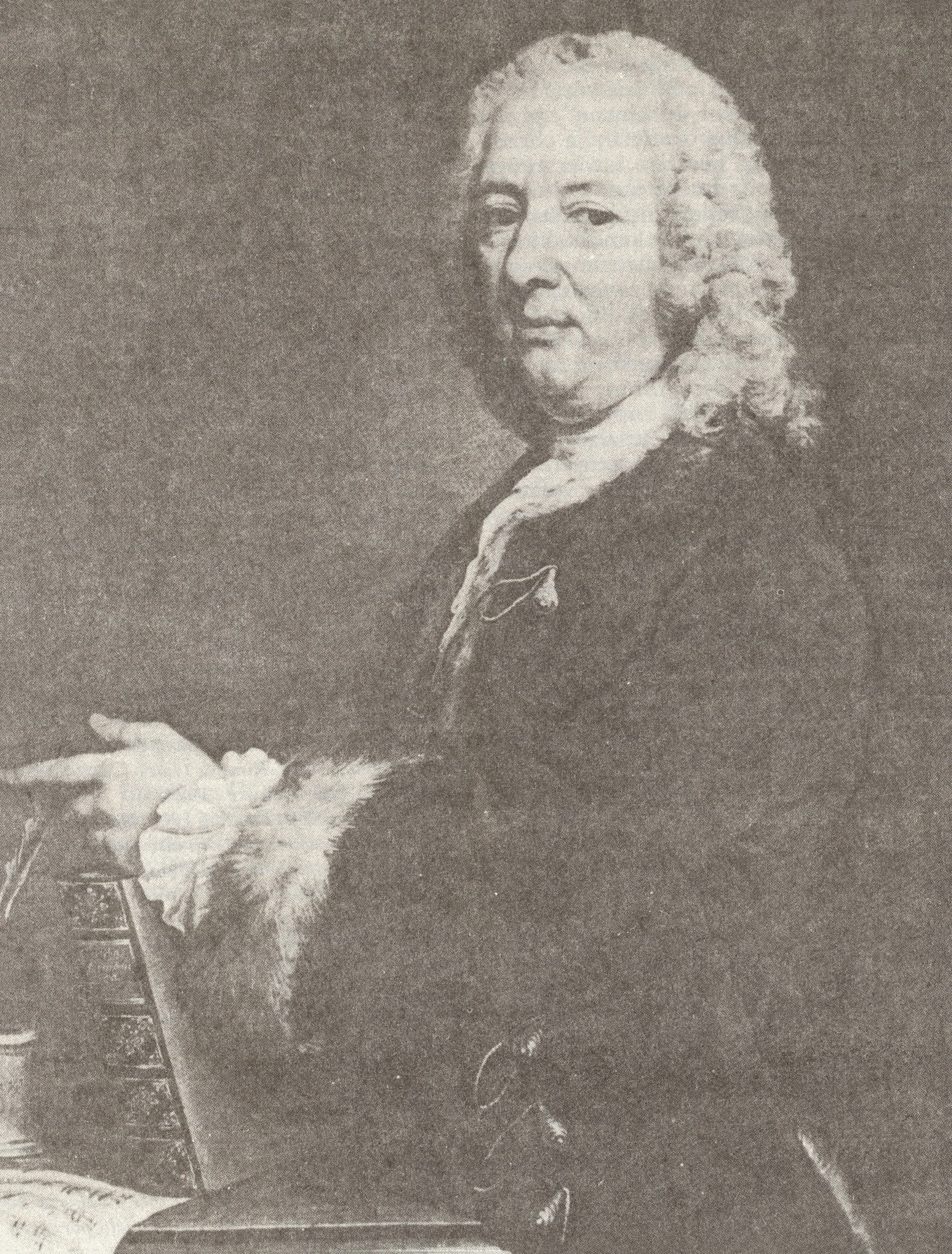
Geminiani Francesco Xaverio, baptized 5 December 1687 in Lucca, died 17 September 1762 Dublin, was an Italian violinist, composer, theorist, and teacher. He was the son of Giuliano Geminiani (†1707), a musician of the Cappella Palatina and the municipal theatre orchestra in Lucca. Initially, Geminiani studied under C. Lonati (violin) in Milan, and later with A. Corelli in Rome and A. Scarlatti in Naples, who shaped his artistic and performance style. In 1706 he returned to Lucca, where he became a violinist in the municipal theatre orchestra. In 1711 he was appointed concertmaster of the opera orchestra in Naples. However, he gained broader recognition and fame as an outstanding virtuoso only in England, where he moved in 1714. There is little information about his first years in London. It is known only that in 1715 or 1716 he performed with accompaniment by G. F. Handel at the harpsichord in the presence of King George I. Between 1731 and 1741 he gave concerts in England and Ireland. He also occasionally conducted, including performances of the pasticcio L’incostanza delusa in 1745 at the Haymarket, and Concerto Spirituale in 1749 at Drury Lane Theatre in London. His artistry won him patrons such as Baron Kilmansegge, the Countess of Orrery, the Duchesses of Marlborough and Burlington, and Frederick, Prince of Wales, as evidenced by the dedications of his works and theoretical treatise (A Treatise of Good Taste…). At the same time, Geminiani was active as a teacher; his pupils included M. Dubourg, M. Festing, Ch. Avison, R. Bremner, J. Kelway, and P. Gaviniès. A mark of the high esteem for his musical authority was the granting in 1739 of exclusive publishing rights for his works in England (for 14 years), and a similar privilege in France in 1740 (for 12 years). In connection with this, Geminiani visited Paris several times; he was probably there in 1754 for a staged performance of his work La foresta incantata at the Tuileries (published as The Inchanted Forrest). He also traveled to Italy and the Netherlands. In 1758 he attempted to publish a musical periodical, “The Harmonical Miscellany”, in which he issued his own compositions; however, only two issues appeared. In 1759 he moved to Ireland, first residing in Cootehill with Ch. Coote (later Earl of Bellamont) as a music master, and later – at the invitation of M. Dubourg – in Dublin. His last documented concert took place there on 3 March 1760. He died in 1762 and was buried in St. Andrew’s Church near College Green in Dublin.
During his lifetime, Geminiani was renowned as a virtuoso and an excellent teacher, but he is remembered primarily as the author of widely reprinted 18th-century theoretical treatises, despite the artistic value of his compositions. In these works, he addressed fundamental issues of musical performance: interpretation (Rules for Playing in a True Taste and Treatise of Good Taste…), technique (The Art of Playing on the Violin… and The Art of Playing the Guitar or Cittra…), and basso continuo realization (The Art of Accompaniment…). The last of these presents an original perspective, written from the standpoint of a soloist expressing expectations toward the accompanist at the harpsichord realizing basso continuo. He addressed compositional technique only incidentally, focusing separately on harmony in Guida Armonica…, where he provided numerous examples of modulation and figured bass formulas. These works did not gain wider recognition due to the lack of clarity in exposition. In his treatises on “good taste,” theoretical guidance is illustrated with musical examples, teaching this “skill” in a practical way. “Good Taste” and “True Taste” were regarded in the 18th century almost as technical terms, denoting the proper use of unwritten ornaments, dynamic shading, vibrato, and bowing in order to achieve appropriate expression and affect; for music, as stated in the introduction to The Art of Playing on the Violin, “ought to express the sentiments inspired by the imagination, affect the mind, and command the passions.”
Geminiani achieved an exceptional position in the history of violin playing through his treatise The Art of Playing on the Violin. It was the first manual intended for advanced professional violinists, widely used and frequently imitated by other authors. The treatise constitutes a summary of all contemporary violin knowledge, illustrated with 12 pieces and 24 examples of his own authorship; taking into account the performer’s abilities, Geminiani skillfully grades the technical difficulties. Similarly, his guitar method—The Art of Playing the Guitar or Cittra… (the cittra being a type of six-string English guitar) – contains, alongside theoretical discussion, 12 Examples (sonatas). The central premise of Geminiani’s teaching method was that mastery of technical means is only the foundation for proper musical communication, since “even in ordinary speech, different intonation gives the same word different meanings,” and “a master … can almost imprint upon the mind [of the listener] whatever impression he wishes.”
Among Italian composers active in England at the time (P. Castrucci, G. S. Carbonelli, and others), Geminiani gained the greatest recognition and authority thanks to the brilliant virtuosity of his works, his exploitation of the wide tonal and registral possibilities of instruments, and the strong expressiveness of his musical language. In his compositional art, Geminiani remained under the influence of his teacher A. Corelli; he composed primarily solo sonatas with basso continuo and concerti grossi. In his sonatas, the four-movement formal scheme (slow–fast–slow–fast) of Corelli’s sonata da chiesa predominates; individual movements are in two- or three-part forms, with imitative technique appearing in the faster sections. Harmony, closely integrated with the form of the work, is treated as a primary shaping factor; for example, the form A :||: A¹ (B) A² :|| corresponds to the harmonic scheme T :||: D (T minor) T :||, with a return to the principal key in the final section and frequent use of the Phrygian cadence. Sequences and modulations occur mainly in the middle section during the developmental working-out of thematic material. Geminiani rarely introduced stylized dances into his cycles; exceptions include the gigue from the Sonata in B-flat major for solo violin and the minuet from Concerto grosso, Op. 2 No. 1, which later became the basis for a set of variations in Favorite Minuet. The guitar sonatas from The Art of Playing the Guitar or Cittra… have more flexible formal designs; they consist of 2 to 7 movements following an A :||: B :|| scheme or an arch form. As a rule, each sonata begins – owing to its pedagogical purpose – with scalar passages in the guitar part to establish the key.
Single- and double-subject fugues introduced in the fast movements of sonatas and concerti grossi testify to the composer’s mastery of counterpoint. Geminiani, however, did not treat the fugue form schematically; rather, he expanded the range of developmental techniques (such as brilliant passagework, various types of figuration and ornamentation, motivic working, and sequences combined with numerous modulations), thereby creating in the central “development” a kind of virtuoso interlude or episode based on thematic material (e.g., Sonata Op. 1 No. 4). This approach was facilitated by his modern treatment of themes, which already contained inherent developmental potential (e.g., the first Allegro theme from Concerto grosso Op. 3 No. 6).
In the Concerti grossi, Op. 2 and Op. 3, Geminiani altered the balance between the concertino and the ripieno, incorporating the viola into the solo group; in Op. 7 he further expanded the ensemble by including wind instruments (e.g., Op. 7 No. 6 features a solo bassoon). By abandoning strict imitative writing, he loosened the connections both among the solo parts and between the concertino and the ripieno. He frequently assigned specific functions to instruments: a more active upper or middle voice carries the principal melody, the lower voices provide a strong harmonic foundation in steady motion, while the remaining parts (e.g., violas) fill in the harmony. In his sonatas, Geminiani often introduced independent musical material into the basso continuo part (e.g., the sonatas of Op. 5), which reflects the crisis of Baroque polyphony in his work.
Geminiani composed several songs modeled on English, Scottish, and Irish folk music, which were later developed into variations in Rules for Playing in a True Taste…, as well as two collections of harpsichord pieces (arrangements of violin sonatas), which testify to his skill as an arranger. Their brilliance and precision of sonority point to the influence of the Neapolitan school (especially D. Scarlatti).
As a firm opponent of the illustrative style typical of French music, Geminiani emphasized in his works an expression based on mood and affect. This led to: 1. the subordination of melody to expressive aims (e.g., strong chromaticism, as in the fugue subject of the second movement of Concerto grosso, Op. 3 No. 3); 2. varied rhythm (dotted rhythms, especially in introductory adagio or andante movements of the concerti grossi; irregular rhythmic grouping; frequent use of hemiolas, syncopations, fermatas, and tempo rubato); and 3. a harmonic language extending beyond the norms of the time, saturated with modulations, sequences, and numerous passing and auxiliary tones. This type of expressiveness was further emphasized by tempo and character indications (e.g., affettuoso, amoroso, etc.).
The essence of Geminiani’s arrangements of works by A. Corelli and his own compositions lay in their transfer to larger performing forces (e.g., concerti grossi) or to the harpsichord (Pièces de clavecin); in the former case, the musical material of the original was successively distributed among different instruments, while the accompanying texture was expanded. Geminiani also added ornaments, indicated appropriate bowings, fingering, and dynamic nuances, thereby preserving for future generations a model of Italian late Baroque performance practice. Geminiani’s violin technique derived from the Italian school of A. Corelli, but Geminiani introduced numerous innovations, setting the course for the further development of violin playing. The Art of Playing on the Violin is currently the main source of knowledge about Geminiani’s achievements as a violinist, from the manner of holding the instrument to musical expression. He likely considered the most advantageous playing position to be holding the violin under the chin (a practice still used today). He established the correct position of the left-hand fingers by recommending the simultaneous stopping of all strings; this is the so-called “Geminiani grip,” which also determined the overall hand position. Geminiani introduced new fingering for chromatic passages (a separate finger for each semitone), for shifting into higher positions (involving finger contraction and extension), as well as for sequential passages and double stops. The range he employed extended from G to a³ (seventh position on the E string).
Geminiani was renowned for his highly expressive performances, the secret of which – apart from the artist’s great musical sensitivity – lay in his perfect command of various bowing techniques, allowing him to produce every nuance and colour of tone (the expressive role of the left hand was limited mainly to vibrato). He broke with the rigid rule of the “down-bow” on the accented beat of each bar; instead, the principle became the execution of chordal arpeggios from the lowest note upward, due to the resonance of overtones. Dynamics played an important role in Geminiani’s performance practice, with dynamic markings introduced even in the basso continuo part (e.g., in the first, third, eighth, and tenth pieces of The Art of Playing on the Violin). For crescendo and diminuendo he used special signs introduced by G. A. Piani (cf. D. D. Boyden, The History of Violin Playing, pp. 512–513). It became a rule to begin long notes with a crescendo and end them with a diminuendo, accompanied by vibrato. A particularly unusual practice for the time was the use of crescendo extending beyond a single bar (e.g., in piece IX of The Art of Playing on the Violin…). Geminiani possessed a wide range of musical ornamentation, which was commonly required in performance at the time. In his theoretical treatises, presenting a table of ornaments, he described individual rhythmic-melodic figures (mordents, trills, turns, arpeggios, etc.), which performers had previously executed according to their own sense of beauty and “good taste.” Unfortunately, there are no surviving accounts of his use of tempo rubato, for which he was already known in Italy. The principles compiled and formulated by Geminiani became widely disseminated thanks to his students and through numerous reprints, and often unauthorized copies, of The Art of Playing on the Violin…, one of the most important 18th-century works of its kind, alongside the manuals of L. Mozart and L’Abbé le fils.
Literature: W. H. G. Flood Geminiani in England and Ireland, “Sammelbände der Internationalen Musikgesellschaft” XII, 1910/11; A. Betti La vita e l’arte di Francesco Geminiani, Lucca 1933 (contains a facsimile of the baptismal record, an autograph letter, and the Favorite Minuet); R. Hernried Francesco Geminiani’s Concerti grossi op. 3, “Acta Musicologica” IX, 1937; R. Hernried Francesco Geminiani’s Life and Work, “Journal of the American Musicological Society” I, 1948; A. Betti Francesco Geminiani, “Violins and Violinists” X, 1949; M. E. McArtor Francesco Geminiani. Composer and Theorist, Michigan 1951 (dissertation); D. D. Boyden Geminiani and the First Violin Tutor, “Acta Musicologica” XXXI, 1959; F. Giegling Geminiani’s Harpsichord Transcriptions, “Music and Letters” XL, 1959; D. D. Boyden A Postscript to „Geminiani and the First Violin Tutor”, “Music and Letters” XXXII, 1960; D. D. Boyden Francesco Geminiani. A Reappraisal, “Lucca rassegna del Comune” IV, 1962; Th. Dart Francesco Geminiani and The Rule of Taste, “The Consort” XIX, 1962; D. D. Boyden The History of Violin Playing from its Origins to 1761, London 1965, Polish ed. Dzieje gry skrzypcowej…, trans. H. Dunicz-Niwińska and E. Gabryś, Krakow 1980; N. Jenkins Geminiani’s „The Enchanted Forest”. A Conspectus, “Chigiana” XXIV, 1967; R. Donington Geminiani and Gremlins, “Music and Letters” LI, 1970; B. Tonazzi L’arte di suonare la chitarra o cetra di Francesco Geminiani, “Il Fronimo” I, 1972.
Writings:
Rules for Playing in a True Taste on the Violin, German Flute, Violoncello and Harpsichord particularly the Thorough Bass… Op. 8, London 1739
A Treatise of Good Taste in the Art of Musick, dedicated to Frederick, Prince of Wales, London 1749
The Art of Playing on the Violin, Containing all the Rules necessary to attain to a Perfection on that Instrument, with great variety of Compositions… Op. 9, London 1751, French trans. Paris 1752, German trans. Vienna 1785, rev. ed. entitled New and Compleat Instructions for Violin… 1790 (?) Longman, Lukey & Co.
Guida Armonica o Dizionario Armonico being a Sure Guide to Harmony and Modulation… Op. 10, London 1742 Johnson
A Supplement to the Guida Armonica, with Examples Showing it’s Use in Composition, London c. 1754 J. Johnson
The Art of Accompaniament or a new and well digested method to learn to perform the Thorough Bass on the Harpsichord… Op. 11, 2 parts, London c. 1754 J. Johnson
The Art of Playing the Guitar or Cittra, Containing Several Compositions with a Bass for the Violoncello or Harpsichord, Edinburgh 1760 R. Bremner
The Art of Playing on the Violin, facsimile ed. D. D. Boyden, London 1952
A Treatise of Good Taste in the Art of Musick, facsimile ed. R. Donington, New York 1969
Compositions:
instrumental:
Concerti grossi… C minor, C minor, D minor, D major, D minor, A major, Op. 2, dedicated to the Duchess of Marlborough, concertino: 2 violins, viola, violoncello, ripieno: 2 violins, basso continuo, London 1732 J. Walsh, revised ed. entitled Six concertos… London 1755 J. Johnson (score ed.)
Concerti grossi… D major, G minor, E minor, D minor, B-flat major, E minor, Op. 3, concertino: 2 violins, viola, violoncello; ripieno: 2 violins, basso continuo, London 1733 J. Walsh & J. Hare, revised ed. entitled Six concertos… London 1755 J. Johnson (score ed.)
Concerti grossi… D major, D minor, C major, D minor, C minor, B-flat major, Op. 7, concertino: 2 violins, viola, violoncello; ripieno: 2 violins, viola, basso continuo, London 1746
Two concertos… D major, G major, concertino: 2 violins; ripieno: tenors, violoncello, basso continuo, publ. n.d. J. Johnson
The Inchanted Forrest…, concerto grosso after canto XIII of Tasso’s Gerusalemme liberata, concertino: 2 violins, violoncello; ripieno: 2 flutes, 2 horns, 2 violins, viola, basso continuo, London 1756 J. Johnson, performed as a ballet spectacle, Paris, Tuileries 1754
Sonate a violino senza basso (12 works), Bologna 1705
Sonate… A major, D minor, E minor, D major, B-flat major, G minor, C minor, B minor, F major, E major, A minor, D minor; 2nd version as Six sonatas…, 2 parts (6 sonatas each), Op. 1, dedicated to Baron Kielmansegge, Countess Dorothy Burlington, for violin, viola and harpsichord, London 1716, revised ed. entitled Le prime sonate… 1739
Sonata in D major, for 2 violins, violoncello, harpsichord, London c. 1757 J. Johnson
Sonatas G major, E minor, G major, D major, G major, G minor, for flute or violin and harpsichord, publ. in Six solos… compos’d by Mr. Handel, sigr. Geminiani, sigr. Somis, sigr. Brivio, no. 5, London 1730 J. Walsh & J. Hare
Sonate… D major, E minor, C major, D minor, C major, D major, A major, D minor, C minor, A major, B minor, A major, Op. 4, dedicated to Countess Margarita Orrery, for violin and basso continuo, London 1739 J. Johnson; 2nd version known as Concerti grossi… dalle sonate… dell’ op. 4 (nos. 1, 11, 2, 5, 7, 9), dedicated to Frederick, Prince of Wales, concertino: 2 violins, 2 violas, violoncello; ripieno: 2 violins, basso continuo London 1743
Sonates… A major, D minor, C major, B-flat major, F major, A minor, Op. 5, dedicated to King George III, for violoncello and basso continuo, The Hague 1746, also arranged for violin and basso continuo, The Hague 1746
arrangements:
Concerti grossi… dell’ op. 5 d’A. Corelli, concertino: 2 violins, viola, violoncello; ripieno: 2 violins, basso continuo, pt. 1 (nos. 1–6 from Op. 5), London 1726 W. Smith & J. Barett, pt. 2 (nos. 7–12 from Op. 5), London 1726/27 N. Prevost
Concerti grossi… del op. 3 d’A. Corelli (sonatas nos. 1, 3, 4, 9, 10 from Op. 3 and one from Op. 1), concertino: 2 violins, viola, violoncello; ripieno: 2 violins, basso continuo, London 1735 J. Walsh
XII Solos… (12 works by F. Mancini), for violin and basso continuo, London 1727 J. Walsh & J. Hare
Geminiani’s favourite minuet… (Allegro cantabile from Concerto grosso Op. 2 No. 1 by Geminiani), for piano (harpsichord?), London, n.d., J. Longman & Co.
Pièces de clavecin… (selected sonatas from Op. 1 and Op. 4 by Geminiani), for harpsichord, London 1743 J. Johnson
The second collection of pieces for the harpsichord… (selected sonatas from Op. 1, Op. 4 and Op. 5 by Geminiani), for harpsichord, London 1762 J. Johnson
Celebrated six concertos as perform’d Mr. Cramer… (concerti grossi from Op. 2 and Op. 3 by Geminiani), for harpsichord or organ or piano, London 1797 (?) G. Goulding
further:
40 works for 4 instruments and basso continuo in “The Harmonical Miscellany” nos. 1–2, London 1758
works and musical examples in theoretical treatises
songs
many works published in 18th-century anthologies
Editions:
Concerti grossi: Op. 2 Nos. 1–6, ed. H. J. Moser in: Musik-Kränzlein, Leipzig n.d.
Concerto grosso in C minor Op. 2 No. 2, ed. P. Mies, Munich n.d.
Concerto grosso in B-flat major Op. 3 No. 5, ed. A. Schering in: Perlen alter Kammermusik, Leipzig 1918
Concerto grosso in D minor Op. 2 No. 3, ed. W. Upmeyer, Berlin 1930
Concerti grossi: Op. 3 Nos. 1–6, ed. R. Hernried, Leipzig 1935
La Follia (arrangement of Sonata Op. 5 No. 12 by A. Corelli), ed. W. Kolneder, Mainz 1961
Sonata in B-flat major for violin, ed. B. Studeny, 1911 Wunderhorn
Sonatas Op. 1 Nos. 1–12, ed. R. L. Finney, Northampton (Massachusetts) 1935, also ed. W. Kolneder, Mainz 1961
Sonatas Op. 5 nos. 1–6, ed. W. Kolneder, Leipzig 1965
12 Compositioni (from The Art of Playing on the Violin), ed. P. Brodszky, 2 vols., Budapest 1959, 1960