
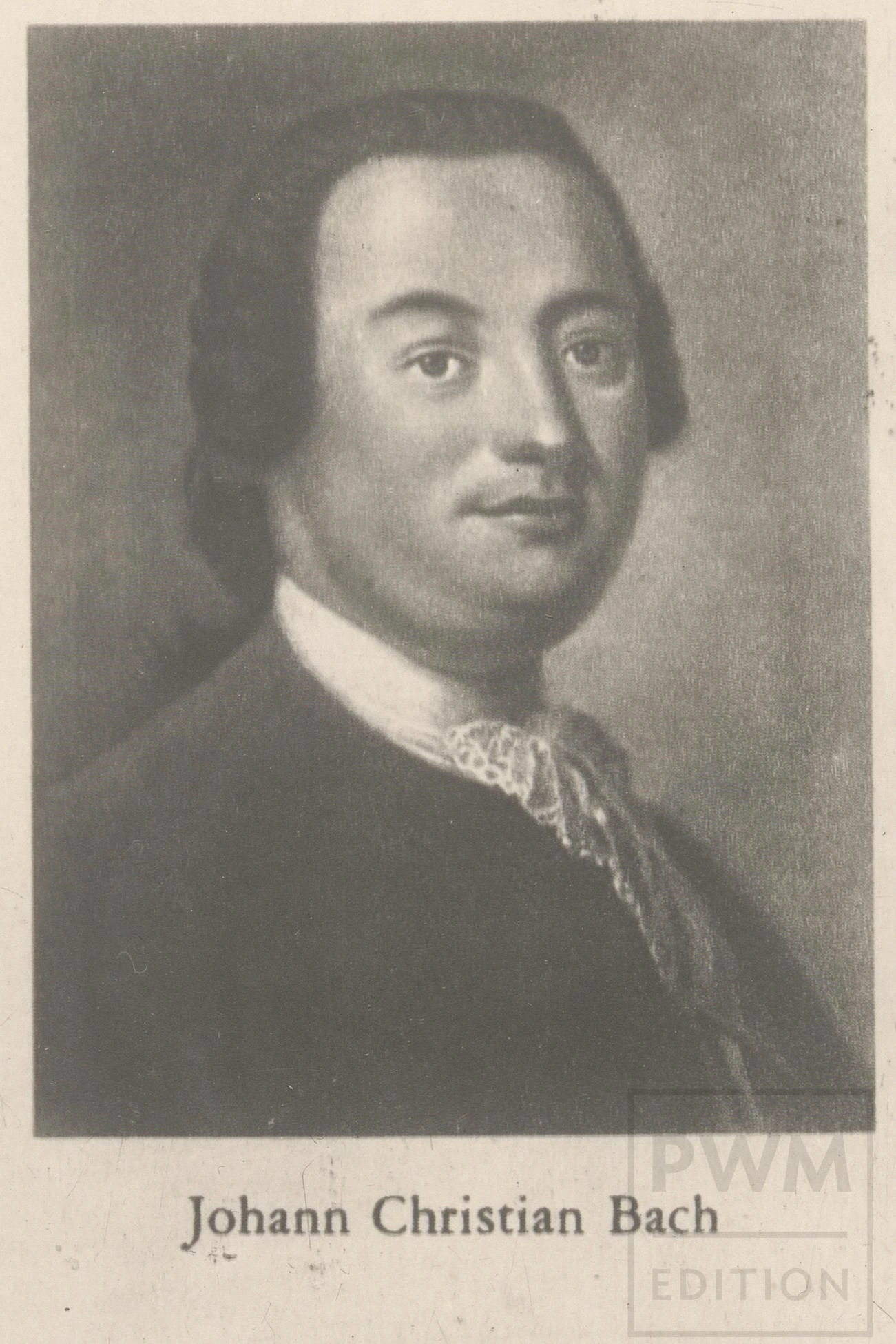
Bach, Johann Sebastian (EN)

Bach Johann Christian, *5 September 1735 Leipzig, †1 January 1782 London, the youngest son of Johann Sebastian and Anna Magdalena Wilcken, a German composer known as the Milan [or Milanese] or London Bach. He probably studied music under J. Schneider, organist at St Nicholas Church in Leipzig, and under J.C. Altnikola; in any case, his father personally supervised the course of his education. Johann Christian’s further musical education, especially in piano playing and composition, was undertaken after his father’s death by his half-brother Carl Philipp Emanuel Bach, court harpsichordist to Frederick II, King of Prussia. In Berlin, he became acquainted with C.H. Graun and J.A. Hasse, whose work introduced him to the style of Italian opera seria. His earliest compositions date from this period, including the choral ode L’Olimpe (1752 or 1753) and five harpsichord concertos. In 1756, he left for Milan, where he served for some time as the maestro di capella at the court of Count A. Litta, who enabled him to study under G.B. Martini in Bologna. After converting to Catholicism, he took up the position of organist at the Milan Cathedral in 1760. During his stay in Italy, he became interested in church music; he wrote a mass, Requiem, Magnificat in C major, Te Deum and many other sacred works. His second area of interest was opera, which was directly influenced by his acquaintance with N. Jommelli and T. Traetta. In 1761, he staged his first opera, Artaserse, in Turin, and Catone in Utica in Naples. The success of both operas brought him widespread recognition. In 1762, Johann Christian arrived in London at the invitation of C. Mattei, who was then running the Kings Theatre, where his subsequent operas, Orione and Zanaida, were staged in 1763. In 1762, he composed Six concerts pour le clavecin with variations on the theme of “God Save the King” in the finale of the last concerto; he dedicated these works to Queen Charlotte, wife of King George III. Johann Christian’s growing popularity led to his appointment as teacher to the royal children. When W. A. Mozart performed at the royal court in 1764, Bach noticed the exceptional talent of the eight-year-old and began introducing him to the secrets of musical knowledge. At that time, he himself began to intensively pursue instrumental music; he wrote symphonies, concertos, trio sonatas, and numerous harpsichord pieces. He also became interested in the pianoforte – a new instrument at the time – which was constantly being improved in terms of its technical capabilities; by giving piano concerts, he contributed to its popularity. In 1768, Johann Christian published Six sonates pour le clavecin ou le piano forte, Op. 5, three of which Mozart arranged as concertos (KV 107). From 1764, Johann Christian, together with C.F. Abel, conducted a series of concerts at Hanover Square Rooms under the name Bach-Abel Concerts; in 1765, six concerts were held, and fifteen in 1766. Although interest in the concerts waned in later years, Johann Christian remained involved until 1781. The programmes included, among other works, new compositions by both composers, often accompanied by the royal chamber orchestra. At the same time, Johann Christian’s reputation as an opera composer was growing. In 1772, the composer left for Mannheim, where he staged the opera Temistocle, which was a great success and paved the way for his subsequent works on the local stage. In 1776, Johann Christian returned to Mannheim, this time for the premiere of the opera Lucio Silla. In 1778 he came to Paris; but with Gluck at the height of his success, Johann Christian Bach’s Amadis des Gaules, staged there the following year, met with failure. Nevertheless, his stay in Paris proved fruitful, as he, the famous piano virtuoso, released with the publisher Leduc a textbook entitled Methode ou Recueil de connoissances elementaires pour le forte-piano ou clavecin, compiled in collaboration with the Italian composer P. Ricci. The second part of this publication is identical to his collection Six Progressive Lessons, 1783, published posthumously by W. Forster. At the same time, the growing fame of Sacchini, Traetta and other Italian composers in London overshadowed Johann Christian’s popularity as an opera composer. He died in obscurity; his funeral was held at the Queen’s expense in the presence of a small group of friends.
Johann Christian Bach owed his rise to fame to the successes of his first operas; yet, in the context of the thriving Neapolitan school (Jommelli, Traetta, Hasse, Pergolesi) and Gluck’s highly controversial operatic reforms, his works remained within the conventions of opera seria. In the history of music, the youngest son of Johann Sebastian Bach is remembered primarily as a composer of instrumental music: symphonies, concertos, quartets, and sonatas. E. Wellesz and F. W. Sternfeld do not hesitate to describe him as “the greatest symphonist” in England of his time, and they rank his harpsichord concertos among the leading works of eighteenth-century musical literature.
Johann Christian’s instrumental oeuvre illustrates perfectly the process of the formation of the classical style, especially the crystallisation of the architectural structure in cyclical works. It reflects the search for thematic dualism through various forms of contrast, while at the same time revealing visible traces of the Baroque style. His cyclic compositions typically feature a three-movement structure (allegro-adagio-allegro), but some concertos from Opp. 1 and 7 consist of only two movements, usually an allegro and a minuet. The harpsichord sonatas Op. 2 likewise follow a two-movement structure, while in the five harpsichord concertos composed during the composer’s Berlin period, the first movement is modelled on the structural scheme of Vivaldi’s concertos. In later concertos, contrast is achieved through the opposition of solo and tutti, as well as between solo instruments. The principles of form construction typical for the Baroque are also evident in the concertante symphonies, which are, albeit permeated with a galant melodic style. In Johann Christian’s other symphonies, the first movements are in the sonata form, although the predominance of simple, cantilena themes – contrasting primarily through phrasing and rhythmic shape – results in a lack of tension in the exposition and weakens the development. At the same time, the repetition of short motifs points to reminiscences of Baroque figuration. In the concertos composed after 1760, thematic contrast is more clearly articulated – the first theme often has the form of a syncopated melody derived from a triad arpeggios, while the second is distinguished by a more flowing, lyrical melodics. The last movements of the cycle, usually in triple metre, feature a rondo or sonata form.
In terms of tonality, Johann Christian broadens the range of modulatory relationships – especially in the development parts – and makes greater use of minor keys. In the Op. 3 symphonies, the middle movements are in written in minor, and in Symphony No. 6 of Op. 6 all movements are set in minor key, while in the finales, episodes in minor key appear before the return of the theme. Equally characteristic is his preference for homophonic texture, even in large-scale sacred works such as the Dies irae, where the polyphonic technique, used rather rarely, is limited to imitative voice entries and motivic exchange; in the choral parts, prevails the note-against-note style, while the orchestral parts abound in doublings.
The instrumentation in Johann Christian’s orchestral works is not consistent. The three symphonies (overtures) from Op. 18 are written for double orchestra. The composer wrote his sinfonie concertanti for various combinations of instruments, entrusting the concertante part to two string instruments (e.g. violin and cello in Sinfonia concertante in A major) or wind instruments (e.g. flute and oboe in Sinfonia concertante in C major). The clearly articulated three-layered texture – comprising melody, harmonic filling, and bass – indicates a strong influence of the. At the same time, however, Johann Christian’s orchestral music already shows the skeleton of a classical orchestra with a string ensemble as the basis of the sound and a double set of woodwind instruments (clarinets appear sporadically, e.g. clarinettes d’amour [“love clarinet”] trio in the overture to Temistocle) and horns. Johann Christian makes extensive use of the dynamic effects, such as crescendos and decrescendos, sharp forte-piano contrasts within brief passages.
It is precisely the distinctive sound of Johann Christian Bach’s compositions, his use of the instruments, and his rich melodic inventiveness that make his music strongly reminiscent of Classicism. It had a strong influence on Mozart’s work, who held the musical craftsmanship of the London master in high esteem, used themes from his compositions, sought inspiration in his harpsichord, chamber orchestral, and operatic compositions; as A. Einstein writes, “these works served Mozart as exercises in the concerto form, with Johann’s Christian melodies as material.” Johann Christian is also undoubtedly credited with introducing the typically Italian, melodically varied, developed cantilena to English instrumental music.
Literature: Ch. Burney A General History of Music, 4 vols., London 1776–89, ed. F. Mercer, London 1935, reprint New York 1957; H. Abert Johann Christian Bachs italienische Opern und ihr Einfluss auf Mozart, “Zeitschrift für Musikwissenschaft” I, 1918/19; H.P. Schökel Johann Christian Bach und die Instrumentalmusik seiner Zeit, Wolfenbüttel 1926; F. Tutenberg Die Sinfonik Johann Christian Bachs, Wolfenbüttel 1928; Ch.S. Terry Johann Christian Bach, London 1929, 2nd edtition 1967 (contains a thematic catalog); S. Sadie The Wind Music of Johann Christian Bach, “Music and Letters” XXXVII, 1956; K. Geiringer The Bach Family: Seven Generations of Creative Genius, New York 1954, French edition, Paris 1955, Dutch edition, Arnhem 1956, German edition expanded, Die Musikerfamilie Bach, Leben und Wirken in drei Jahrhunderten, Munich 1958, Spanish edition, Madrid 1962; P.M. Young Johann Christian Bach and His Environment, conference proceedings, Kassel 1962; H.-J. Schulze Frühe Schriftzeugnisse der beiden jungsten Bach-Sohne, “Bach-Jahrbuch” L, Leipzig 1963/64; E. Warburton Johann Christian Bach’s Operas, “Proceedings of the Royal Musical Association” XCII, 1965/66; P.M. Young Johann Christian Bach, der Englische Bach, in: Musa-Mens-Musici, commemorative book of W. Vetter, Leipzig 1970; E. Wellesz, F.W. Sternfeld The Early Symphony and The Concerto, New Oxford History of Music VII, London 1973; N. Krabbe Johann Christian Bach’s Symphonies and the Breitkopf Thematic Catalogue, in commemorative book of J.P. Larsen, ed. N. Schiørring et al., Copenhagen 1972; I.S. Baierle-Staral Die Klavierwerke von Johann Christian Bach, Vienna 1974 (with a thematic catalogue); B. Gillingham Social and Musical Matters Pertaining to Johann Christian Bachs Third Set of Keyboard Concertos, “The Music Review” XLII, 1981; D. McCulloch Mrs. Papendiek and the London Bach, “The Musical Times” CXXII, 1982; H. Gärtner Johann Christian Bach. Mozarts Freund und Lehrmeister, Munich 1989; S.W. Roe The Keyboard Music of Johann Christian Bach, New York 1989 (with a thematic catalogue)
Compositions
Instrumental:
orchestral:
Six simphonies Op. 3 (D major, C major, E-flat major, B-flat major, F major, G major), for 2 violins, 2 oboes, 2 corni da caccia (hunting horns), viola, bass, London 1765(?) published by the author
Six simphonies Op. 6 (G major, D major, E-flat major, B-flat major, E-flat major, G minor), for 2 violins, viola, bass, 2 oboes, 2 corni da caccia (hunting horns), Amsterdam ca. 1770 J.J. Hummel
Six simphonies à 8 instruments Op. 8 (E-flat major, G major, D major, F major, B-flat major, E-flat major), for 2 violins, taille, bass, 2 oboes, 2 corni da caccia (hunting horns), Amsterdam ca. 1773 S. Markordt
Trois simphonies Op. 9 (B-flat major, E-flat major, B-flat major), for 2 violins, taille & bass, 2 flutes or 2 oboes, 2 corni da caccia (hunting horns) (ad lib.), The Hague, B. Hummel
Six Grand Overtures, three for a Single, and three for a Double Orchestre Op. 18 (E-flat major, B-flat major, D major, D major, E major, D major), for violins, oboes, flutes, clarinets, French horns, tenor, bass, London ca. 1781 W. Forster
Six Favourite Ouertures in VIII Parts, for violins, oboes, French horns, basso continuo (harpsichord and cellos), London, I. Walsh
Symphonie concertante à plusieurs instruments (A major), for violino and cellos concertante, string instruments, oboes, Paris, J.G. Sieber
Symphonie concertante à plusieurs instruments (E-flat major), for violino and cellos concertante, string instruments, oboes, Paris, 1773, J.G. Sieber
Concert ou symphonie (E-flat major), for 2 obligato violin, 2 ripieni violins, 2 flutes, 2 corni da caccia (hunting horns), taille, bass, Amsterdam, Hummel
Sei sinfonia (F major, C major, F major, C major, F major, C major), for 2 clarinets, 2 corni da caccia (hunting horns), bassoon, London, Longman & Broderip
in addition, 11 sinfonie concertanti preserved in manuscripts
for solo instrument and orchestra:
Six concerts pour le clavecin Op. 1 (B-flat major, A major, F major, G major, C major, D major), London 1767 P. Welcker
Six concerts pour le clavecin Op. 7 (C major, F major, D major, B-flat major, E-flat major, G major), Amsterdam, J.J. Hummel
A Third Sett of Six Concertos for the Harpsichord or Piano Forte Op. 13 (C major, D major, F major, B-flat major, G major, E-flat major), London 1777 P. Welcker
Concerto per il claviharpsichord (E-flat major), Riga 1770 G.F. Hartknoch
Concerto II per il claviharpsichord, Riga 1772 G.F. Hartknoch
in addition, 5 Harpsichordkonzerte (B-flat major, F minor, D minor, E major, G major) manuscripts and harpsichord concertos signed “Concerto de Bach” or “De Bach” etc.
bassoon, flute and oboe concertos in manuscripts
chamber:
Six Quintettos for a Flute, Hautboy, Wolin, Tenor, and Bass Op. 11, London 1775 (?) P. Welcker
Six Quartettos for a German Flute, Wolin, Tenor and Violoncello Op. 8, London 1775 (?) P. Welcker
Four Quartettos, two for 2 Flutes, a Tenor and Violoncello, one for 2 Flutes, a Wolin and Violoncello, and one for a Flute and Hoboy, or 2 Flutes a Tenor and Violoncello Op. 19 (sic!), London 1785 (?) Preston
Six sonates pour le clavecin, accompagnées d’un violon ou flûte trav. et d’un violoncelle Op. 2 [Op. 4], London 1763 published by the author
Six trio pour deux violons et alto viola ou basse obligé, Paris, Huberty
Two Trios for 2 German Flutes, or Flute, Violin and Violoncello, London 1800 (?) Th. Monzani
Six Sonatas for the Harpsichord or Piano Forte with an Accompagnement for a Violin Op. 10, London 1775 (?) P. Welcker
Four Sonatas and two Duetts for the Piano Forte or Harpsichord with Accompaniments Op. 15, London 1779 (?) P. Welcker
Six Sonatas for the Harpsichord or Piano-Forte, with an Accompaniment for a German Flute or Violin Op. 16, London 1783 (?) J. Dale
Quatre sonatas et deux duo pour le clavecin ou piano-forte avec accompagnement de violon ou flutte Op. 18, Paris 1780 (?) de La Chevardiére
Six Sonatas for the Piano Forte or Harpsichord with an Accompaniment for a German Flute or Violin Op. 19 (sic!), London 1783 J. Cooper
Three Sonatas for the Harpsichord or Piano-Forte, with an Accompanyment for a Violin Op. 20, London, W. Campbell
Six Duetts for two Violins, London 1775 (?) Longman, Lukey & Co.
Six sonates pour le clavecin ou le piano forte Op. 5, London ca. 1770
Six Sonatas for the Harpsichord or Piano Forte Op. 17, London 1778 (?) P. Welcker
Sechs leichte Sonaten fürs Clavier oder Pianoforte, Leipzig 1785
Sonate pour le clavecin ou forte piano, qui represente la bataille de Rossbach, London 1782 (?) Jackson and Smith
Trois sonates pour clavecin Op. 21, Paris, Bonin
Sonate a quatre mains sur un clavecin, Amsterdam 1783 (?) J. Schmitt
Fuge für das Pianoforte oder die Orgel… über die Buchstaben seines Namens, Leipzig, C.F. Peters
Vocal-instrumental:
Artaserse, libretto P. Metastasio, first showing Turin 1761, pub. London, I. Walsh (overture)
Catone in Utica, libretto P. Metastasio, first showing Naples 1761
Allessandro nell’Indie, libretto P. Metastasio, first showing Naples, 20 January 1762
Orione ossia Diana vendicata, libretto G.G. Bottarelli, first showing London, 19 February 1763, pub. London 1763, I. Walsh (songs); London, I. Walsh (overture)
Zanaida, libretto P. Metastasio, first showing London, 7 May 1763, pub. London 1763, I. Walsh (songs)
Adriano in Siria, libretto P. Metastasio, first showing London, 26 January 1765, pub. London 1765 (?) P. Welcker (songs)
Carattaco, first showing Paris, 14 February 1767, pub. London 1768, P. Welcker (songs); London Longman & Broderip (overture)
Gioas, rè di Giuda, oratorium sceniczne, libretto P. Metastasio, first showing London, 22 March 1770, pub. London 1770, P. Welcker (songs and duets)
Temistocle, libretto P. Metastasio, first showing Mannheim, 5 November 1772
Lucio Silla, libretto G. de Gamerra, first showing Mannheim, 20 November 1776, pub. London ca. 1781, W. Forster (overture)
La clemenza di Scipione, libretto P. Metastasio, first showing London, 4 April 1778, pub. London 1778, P. Welcker
Amadis des Gaules, libretto de Vismes after Ph. Quinaulta, first showing Paris, 14 December 1779, pub. Paris 1780 (?) J.G. Sieber
additionally:
Requiem and Kyrie in F major, for 8 voices, for double mixed chorus, string instruments, oboes, horns, and organ, Milan 1757
Te Deum for double mixed chorus, string instruments, both, horns, trumpets, timpani, Milan 1758
Dies irae for double mixed chorus, solos, string instruments, 2 oboes, 2 horns and basso continuo, Milan 1758
Magnificat in C major for 8 voices for string instruments, trumpets, organ, Milan 1758
Italian cantatas, including: Amor vincitore 1774, Aurora
ode Thanks be to God 1761
arias and chorus parts for English comedies
arias for pasticcios
12 songs in 3 collections Favourite Songs sung at Vaux-hall, London 1765, 1767, 1775(?) J. Welcker
Scottish songs: The Broom of Cowdenknows, London 1784 (?) T. Cahusac, Lochaber, London 1785 (?) Longman & Broderip
6 Canzonette, for 2 voices, Op. 4, London 1765
6 Canzonette, for 2 voices, Op. 6, London 1766
Editions:
5 Symphonien, ed. F. Stein, «Das Erbe Deutscher Musik» XXX, Wiesbaden 1956
symphonies: B-flat major Op. 3 No. 4, ed. F. Kneusslin, Basel 1953; E-flat major Op. 9 No. 2, ed. F. Stein, London 1950
symphonies (overtures): E-flat major Op. 18 No. 1, B-flat major Op. 18 No. 2 (Lucio Silla), D major Op. 18 No. 3 (Endimione), ed. F. Stein, Leipzig 1932, 1925, 1930; D major Op. 18 No. 4, ed. A. Einstein, London 1949
overture to La clemenza di Scipione, ed. H.C.R. Landon, «Diletto musicale» XCVI, Vienna 1970
sinfonie concertanti: A major for violin, cello, and orchestra, ed. A. Einstein, London 1934, E-flat major for 2 violins and orchestra, ed. F. Stein, London ca. 1955, C major for flutes, oboes, violin, cello, ed. C.R.F. Maunder, London 1961
Sei sinfonie for 2 clarinets, 2 horns and bassoon, ed. F. Stein, 2 issues, Leipzig 1957–58
The Concerted Symphonies of Johann Christian Bach (3 symphonies) ed. J.A. White (younger), «Florida State University Studies» XXXVII, Tallahassee (Florida) 1963
harpsichord concertos: A major Op. 1 No. 2, ed. L. Stadelmann, Mainz 1935; E-flat major Op. 7 No. 5, ed. C. Döbereiner, Leipzig 1927, also H. Illy, «Musiche vocali e strumentali sacre e profani dei secoli XVII, XVIII, XIX», vol. 34, Rome 1967; F minor, ed. E. Martini, «Nagels Musik Archiv» 170, Kassel 1953; D major Op. 13 No. 2, B-flat major Op. 13 No. 4, ed. L. Landshoff, Frankfurt am Main 1955; E-flat major, ed. E. Praetorius, London ca. 1937
Bassoon Concerto in E-flat major, ed. J. Wojciechowski, Hamburg 1953
Flute Concerto in D major, ed. R. Meylan, Vienna 1958
Oboe Concerto in F major, ed. Ch.R.F. Maunder, London 1963
6 Quintette for flutes, oboes, violins, violas, cellos, and basso continuo, Op. 11, ed. R. Steglich, «Das Erbe Deutscher Musik» III, Hanower 1935, also S. Sadie, London 1962 (Nos. 1, 2, 3, 5)
4 Quartette for flutes and strings, Op. 19, ed. L. Hoffmann-Erbrecht, «Organum» III, Nos. 63, 64, 66, 68, Lippstadt 1962–64
Sonata in D major for harpsichord, violin (or flutes), and cello, Op. 2 No. 3, ed. H. Riemann, Leipzig 1903
Sonatas for violin and piano, Op. 10, ed. L. Landshoff, 2 vols, London 1938
10 Klaviersonaten, ed. L. Landshoff, Leipzig 1926
12 Konzert- und Opernarien, ed. L. Landshoff, Leipzig 1930
6 italienische Duettinen for 2 sopranos and piano, ed. E. Reichert, Wiesbaden 1958
Temistocle, eds. E.O.D. Downes and H.C.R. Landon, Vienna 1965
Magnificat C major, ed. F. van Amelsvoort, Hilversum 1960
Dies irae, ed. J. Bastian, «Accademia musicale» XX, Vienna 1972