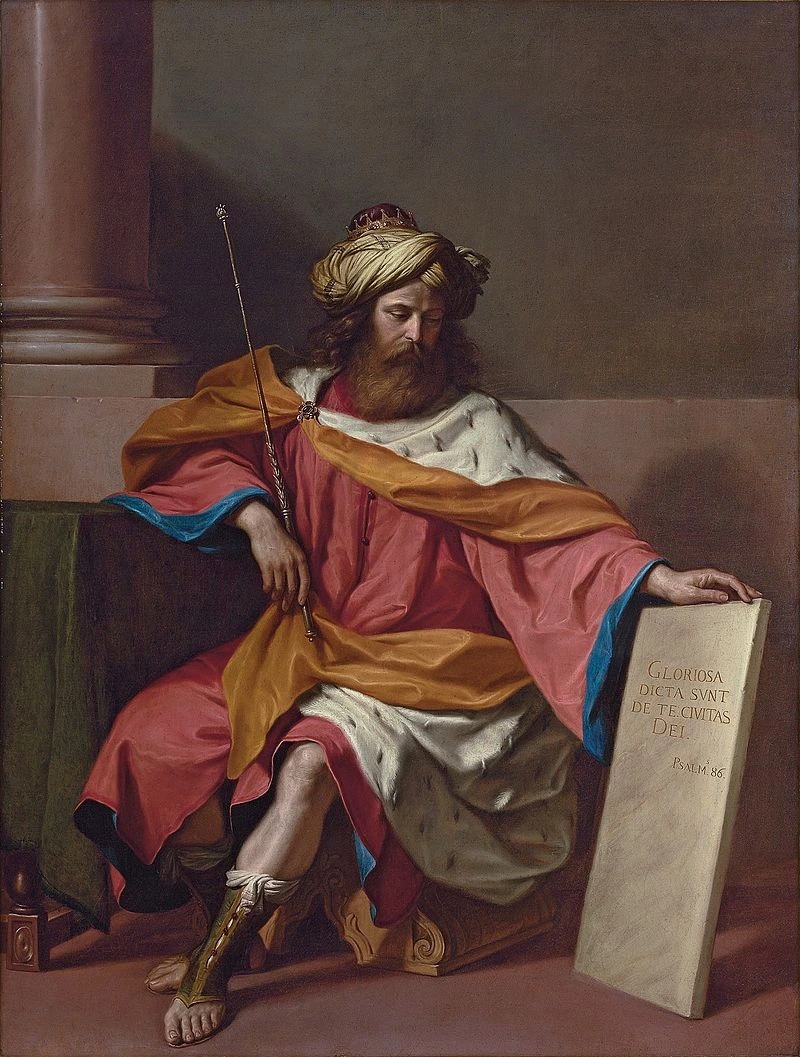
David, 11th/ 10th century BC, King of Israel, the youngest son of Jesse, he came from Bethlehem. According to the Bible (1 Kings 16:14–22), he was brought to King Saul’s court to drive away an evil spirit from him and alleviate his suffering by playing the harp. This passage has been frequently cited in musical treatises (including those by Cassiodorus, Isidore of Seville, Aurelianus Reomensis; in Poland, among others, Jerzy Liban z Legnicy, Sebastian z Felsztyna, M. Kromer) as an example of the soothing influence of music on the human soul. The Bible also provides information about the practice of music at David’s court and the instruments used at that time (2 Kings 6:4; 1 Chronicles 13:8). Hence, David was also regarded as the inventor of various musical instruments. He was often depicted with a harp, and in early Christian art with a lyre, and identified with Orpheus. The 73 songs of the Book of Psalms are considered to be David’s compositions.
The figure of David has inspired many composers. This has led to the creation of operas by G. Liverati (David oder Goliaths Tod, 1813), A. Mermet (Le roi David, 1846) and D. Milhaud (David, 1954), as well as oratorios by G. Carissimi (Historia Davidis et Jonathae), G. Bononcini (La vittoria di Davidde contro Golia, 1687), R. Keiser (Der siegende David, 1721), A. Caldara (David umiliato, 1731), G.F. Handel (Saul, 1738), I. Assmayer (Saul und David, 1848), A. Honegger (Le roi David 1921), W.A. Mozart’s cantata (Davidde penitente 1785), Josquin des Prés’ motet (Absalon, fili mi 1540), one of H. Schütz’s Symphoniae sacrae and one of J. Kuhnau’s Biblical Sonatas (1700).
Literature: H. Abert Die Musikanschauung des Mittelalters und ihre Grundlagen, Halle 1905; Z. Rozanow Muzyka w miniaturze polskiej, Krakow 1965; J. Pope King David and his Musicians in Spanish Romanesque Sculpture, in: Aspects of Medieval and Renaissance Music, Festschrift for G. Reese, New York 1966; H.J. Zingler König Davids Harfe in der abendländischen Kunst, Cologne 1968.