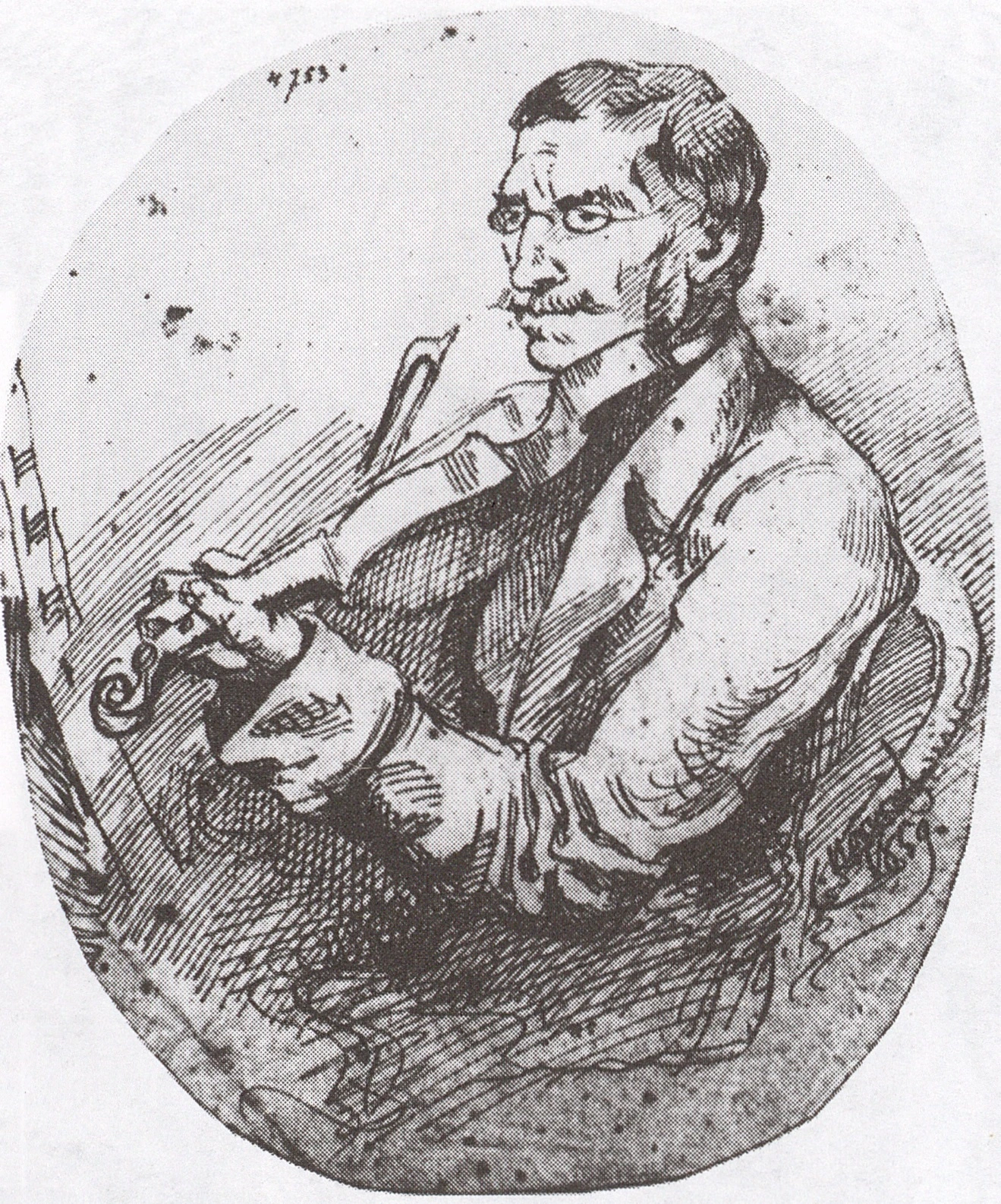
Biernacki Nikodem, *1 September 1825 Ternopil, †6 May 1892 Sanok, Polish violinist and composer. He began his musical education under the guidance of his father, then continued with the Italian Tonini, bandmaster to Count K. Przeździecki in Chornyi Ostriv in Podolia. In 1841, Biernacki played in the military orchestra in Chernivtsi, then became concertmaster in the Orchestra of Count Skarbek’s Theatre in Lviv. Soon after, he left for Leipzig to study with M. Hauptmann (piano and composition) and F. David (violin); at the same time playing in the Leipzig opera orchestra. He began his virtuoso career in 1847 in Lviv and in 1849 in Poznań, and his international career in 1851 with a concert at the Gewandhaus in Leipzig, gaining great recognition, including from R. Schumann. He gave concerts in Moscow and St. Petersburg (1853), Krakow (1856 and with M. Czartoryska in 1859), Lviv (1856, 1858, 1859, 1862), Poznań (1857, 1862, and 1870); in 1857, he also played in cities in Greater Poland (Września, Środa, Śrem, Szamotuły, Gniezno).
After returning to Poland, in 1851 (1854?)–55 he was concertmaster of the opera in Warsaw and travelled to Moscow and St Petersburg to give concerts. From 1855 to 1858, he unsuccessfully sought a licence to establish a music school in Warsaw. In 1856, he gave concerts with A. Zarzycki in the Danube countries, and in 1857 in Warsaw, Poznań and Lviv. In the autumn of 1857, he left for Paris, where he continued his studies under L. Spohr, H.W. Ernst and N.H. Reber and where he gave concerts, including one in March 1858 at the Salle Pleyel. From May 1859, he undertook virtuoso tours of Germany, Belgium, Austria, and Russia. In December 1859, he played in Lviv (again in 1862), and in 1859–60 in many cities in Podolia and Ukraine, including Zhytomyr, Kyiv, and Kharkiv. In 1862, he performed in America and became the court violinist of Ferdinand Maximilian Joseph in Mexico. From around 1864 to around 1879, he worked in Stockholm as concertmaster of King Charles XV’s orchestra. In 1879, he settled in Poznań, where he opened his own music school, worked as a teacher and gave concerts in Greater Poland. Between 1882 and 1884, he was a member of the board of the Music Society. In 1885, he was forced to leave Poznań.
In the last years of his life, he was a music teacher at the Jesuit seminary in Chyrów [now Khyriv]. He was an amateur luthier. He composed little, and most of his works remained in handwritten form. He collected folk melodies from various nations and used them in his compositions. He performed music by H. Wieniawski, L. Spohr, F. David, H.W. Ernst and fantasies on opera themes, especially by Auber and Verdi, and also played works by for a string quartet Mozart and Schubert.
In the 1850s and 1860s, he enjoyed international fame as a violinist. Poetic eulogies praising Biernacki’s playing were published in the press by Deotyma (“Tygodnik Petersburski,” 1853, no. 34, reprinted in “Nowiny,” Lviv, 1855, no. 148), K. Ujejski (“Dziennik Literacki,” Lviv, 1856, no. 33) and C.K. Norwid (“Dziennik Literacki,” 1857, no. 119).
Literature: A. Poliński Nikodem Biernacki, “Tygodnik Ilustrowany” 1892 no. 125 (obituary).
3 fantasias on Swedish songs and dances, for piano, violin, viola, and cello
String Quartet
Fantasias on the themes of Polish, Hungarian, and Romanian folk songs and dances for violin and piano
Fantasias on themes from operas, including two fantasies on themes from Gounod’s Faust for two violins and piano
5 Concerto Mazurs for violin and piano
mazurka Souvenir de Peterhof in F-sharp minor Op. 30, for violin and orchestra or violin and piano, Berlin ca. 1857 B & B and Warsaw ca. 1860, handwritten copy for violin and piano from around 1915 and lithograph by J.V. Fleck (piano version) in the National Library of Poland
Legenda, krakowiaks, polonaises, including Jan III for violin and piano
transcriptions of Chopin’s works for violin and piano
solo songs, including Pożegnanie (ed. G. Sennewald)
motets, arrangements of folk songs from Galicia.