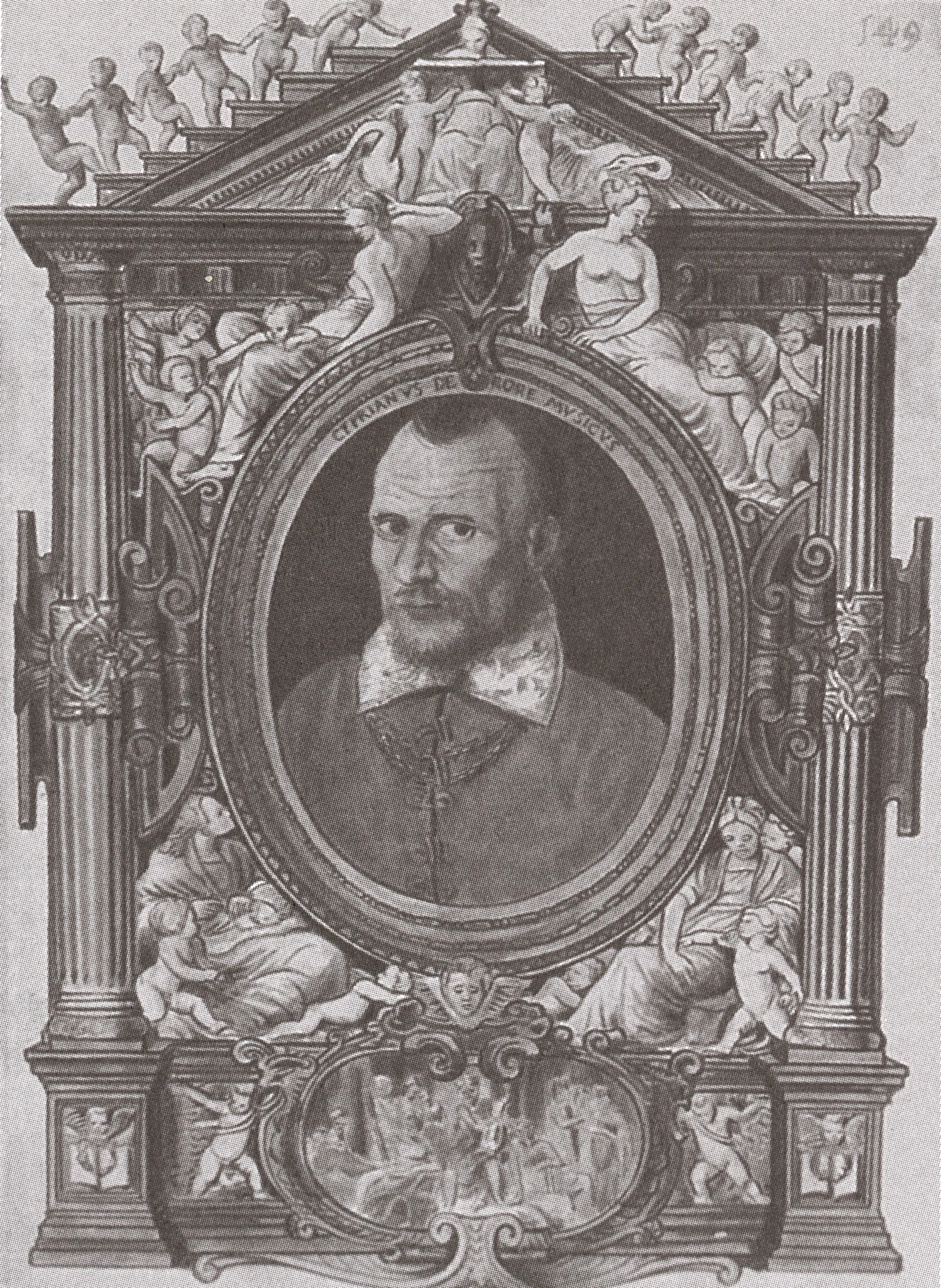
Rore, Rorus, Cipriano de, Ciprianus, Cupriaen de, *1515 or 1516 Ronse (Renaix), †between 11 and 20 September 1565 Parma, Flemish composer active in Italy. It is believed that he arrived in Italy already at the beginning of the 1530s, probably with a court of Margaret de Parma, born in the Netherlands. The assumption that he was a student of A. Willaert before 1546 is not confirmed by the sources, but R. Strozzi’s letters indicate that Rore lived in Brescia in 1542–46. In May 1546 or shortly before, he became maestro di cappella at the court of Ercole II d’Este in Ferrara. Despite an impressive number of compositions and growing fame, Rore was not properly appreciated by his employers, especially by Ercole’s successor, Alfonso II. When in 1558 and 1559, he undertook two long journeys to Flanders (visiting, among others, the Bavarian court of Duke Albrecht V) – probably due to the difficult situation of the composer’s family – his place in Ferrara was taken by Francesco della Viola, favoured by Duke Alfonso. In November 1560, Rore returned to Italy, accepting an offer to serve at the court of the Farnese family in Parma. He soon began looking for another position (his employment was considered by, among others, Duke Guglielmo Gonzaga and Duke Guidubaldo della Rovere), and finally, in 1563, he took over the directorship of the chapel of St. Mark’s Basilica in Venice, which had become vacant after the death of A. Willaert. The failures related to the reorganisation of this ensemble probably prompted him to return to Parma in 1564, where he died at the age of only 49.
Rore is one of the most outstanding creators of the 16th century. The composer’s innovative work and brilliant musicality (according to Rore’s student, L. Luzzaschi, he had a habit of composing “a mente”) were also appreciated by his contemporaries, who gave him the nickname “divino” (“divine”). Rore owes his recognition primarily to over 100 madrigals, which had a decisive influence on the development of this genre in the second half of the 16th century. This work is difficult to approach synthetically because “it was too abundant, and the composer’s development too rapid” (A. Einstein). Rore’s early madrigals (from 1542–48) are usually compared to the compositions of A. Willaert, with which they share such features as a 5-voice cast, a combination of imitative technique with declamatory texture, emphasis on the syntactic structure rather than the versification of poetry (taking into account enjambments), sparing use of strong cadences in the work (fuggir la cadenza) and a preference for the sonnet form (divided after the second quatrain), especially in the works of F. Petrarch from Canzoniere. Rore’s individuality is manifested, above all, in a more expressive treatment of the text. The choice of poetry to be developed shows the composer’s predilection for poetry with a serious and often gloomy expression. The melody is characterised by great drama, achieved through the use of a large ambitus, frequent introduction of leaps (also on small values), and short motifs separated by rests. The declamatory texture of the composition is often disrupted by introducing melismas with sophisticated rhythm, syncopation and sudden changes in rhythmic pulse (obtained, for example, by consistently combining semibrevis and minims over several bars in duple metre). Madrigals are characterised by the richness and subtlety of means used to musically interpret the text. Rore illustrated individual words and phrases using conventional means of sound painting (katabasis, imitatio tubarum, etc.), introducing – especially in the case of negative associations – voice crossing, false relation, dissonances and fauxbourdon. In some pieces (Vergine bella), there are also elements of “music for the eye,” consisting of using the convergence of text syllables with solmisation markings (e.g. the sound “g” on the word “sol”). The composer achieved the emphasis and symbolisation of the meaning of larger syntactic units by means such as the selection of modes, the use of hierarchy and the “intensity” of cadences, the introduction of clausulae peregrinae (especially Phrygian ones with negative associations), the repetition of sentences expressing the punchline of the pieces, and textural, rhythmic or even tonal contrasts (e.g. in Da le belle contrade, in which the dialogue characters use different tonal “languages”). Rore’s unconventional approach to musical form can be seen, among others, in the unusual divisions of the sonnet (1-movement without division, 2-movement with division after the first quatrain), or the pioneering development of Petrarch’s 11-movement canzone Vergine bella. The author’s collections (from 1542 and 1550) are also characterised by an original arrangement of the compositions according to tonal features (according to modes and chiavette and modes, respectively).
A clear change in Rore’s compositional technique took place between 1550 (the year of the publication of the somewhat conservative 1st book of 4-voice madrigals) and 1557 when his most innovative works were published. They feature bizarre key signatures (e.g. 1 and 2 flats in different voices), bold harmony – achieved through the use of chromaticism, numerous alternations and a freer treatment of dissonances – and expressive melodic phrases (e.g. the beginning of the 2nd movement of Mia benigna fortuna with a leap of a major sixth). The quasi-imitative technique present in the early madrigals, although not completely abandoned (canons even appear in three works), usually gives way to homorhythm, announcing the recitativo corale. Harmonic and timbral experiments appear especially in secular works with Latin text, like in the extremely chromatic Calami sonum ferentes for 4 bass voices.
Motets, both secular (except for metrical arrangements of classical and neoclassical poetry) and religious, are usually maintained in a free imitative style. Some compositions are of liturgical origin (antiphons, responsories), but the cantus firmus appears in them exceptionally (Nunc cognovi), sometimes in a paraphrased form (Pater noster) or in the form of a symbolic ostinato (“Miserere mei Deus” in Infelix ego). In compositions for more voices (6-, 7-voice), the canonic technique is sometimes used (Descendi in hortum meum). Of Rore’s five masses, three are of the “ad imitationem” type (chansons by P. Sandrin, Josquin des Pres and Rore himself), one is based on a cantus firmus (Vivat felix Hercules mass), and one uses both the parody technique and the cantus firmus (Praeter rerum seriem mass, based on Josquin des Prés’s motet). Both fixed melodies are constructed on the “soggetto cavato dalle vocali” principle and are a reference to the Missa “Hercules dux Ferrariae” by Josquin des Prés.
Rore’s compositions, especially the madrigals, were repeatedly reissued (1 book from 1550 as many as 16 times), parodied, paraphrased and subjected to intavolations. His compositional technique was admired and imitated by the greatest creators of 16th-century polyphony, such as G.P. da Palestrina and Orlando di Lasso. The innovative sound language of some of Rore’s works significantly influenced the compositions of L. Luzzaschi and C. Gesualdo da Venosa, while the expression and texture of his late madrigals (1557) attracted the attention of G.C. Monteverdi and G. Bardi, who considered him a precursor of seconda pratica. Rore’s work was also known in 16th-century Poland. The Wawel inventory of J. Jasiuczyc (1572) lists books of 4- and 5-voice madrigals and 5-voice motets by the composer, and the lost part of the tablature of Jan Fischer of Morąg contained the intavolation Era il bel viso.
Literature: U. Rossi Sei lettere di Cipriano de Rore, eon cenni biografici, Reggio Emilia 1888; J.C. Hol Cipriano de Rore, in the commemorative book of K. Nef, ed. H. Eringer et al., Zurich 1933; J. Musiol Cyprian de Rore, ein Meister der venezianischen Schule, Wrocław 1933; A. Einstein The Italian Madrigal, 3 volumes, Princeton 1949, reprint 1970; A.H. Johnson The Masses of Cipriano de Rore, “Journal of the American Musicological Society” VI, 1953; B. Meier Staatskompositionen von Cyprian de Rore, “Tijdschrift voor Nederlandse Muziekgeschiedenis” XXI/2, 1969; D. Harrán Rore and the „Madrigale cromatico”, “The Music Review” XXXIV, 1973; J.A. Owens Cipriano de Rore a Parma (1560–1565). Nuovi documenti, “Rivista Italiana di Musicologia” XI, 1976; A.H. Johnson The 1548 Editions of Cipriano de Rore’s Third Book of Madrigals, in the commemorative book of O.E. Albrecht, ed. J.W. Hill, Kassel 1980; A. Cambier De definitieve bevestiging van Cypriaan De Rore’s ronsiche afkomst uit archiefstukken te Parma en te Ronse. Een nieuwe en definitieve oplossing in verband met zijn genealogie, “Annalen geschied- en oudheidkundige kring van ronse en het tenement van inde” XXXII, 1983; J.A. Owens Music and Meaning in Cipriano de Rore’s Setting of „Donec gratus eram tibi”, “Studies in the History of Music” I, New York 1983; J.A. Owens The Milan Partbooks. Evidence of Cipriano de Rore’s Compositional Process, “Journal of the American Musicological Society” XXXVII, 1984; M.S. Lewis Rore’s Setting of Petrarch’s „Vergine bella”. A History of Its Composition and Early Transmission, “Journal of Musicology” IV, 1985/86; M. Feldman Rore’s „selva selvaggia”. The Primo libro of 1542, “Journal of the American Musicological Society” XLII, 1989; E.E. Lowinsky Calami sonum ferentes. A New Interpretation, Two Motets and Two Madrigals for the Este Family and Rore’s New Year’s Gift for Albrecht V of Bavaria, in: Music in the Culture of the Renaissance and Other Essays, ed. B.J. Blackburn, Chicago 1989; J. Haar Rore’s Setting of Ariosto, in: Essays in Musicology, in the commemorative book of A.H. Johnson, ed. L. Lockwood and E. Roesner, Filadelfia 1990; J.A. Owens Mode in the Madrigals of Cipriano de Rore, in: Altro Polo. Essays on Italian Music of the Cinquecento, ed. R. Charteris, Sydney 1990; L. Lockwood Text and Music in Rore’s Madrigal „Anchor che col partire”, in: Musical Humanism and Its Legacy, in the commemorative book of C.V. Paliski, ed. N.K. Baker and B.R. Hanning, Stuyvesant (New York), 1992; A. Lloyd Ordering and Reordering in Cipriano de Rore’s 1542 and 1550 Madrigal Books, “Muziek & Wetenschap” IV/1, 1997; H. Schick Musikalische Einheit im Madrigal von Rore bis Monteverdi. Phänomene, Formen und Entwicklungslinien, «Tübinger Beiträge zur Musikwissenschaft» XVIII, Tutzing 1998; B. Bujić „Vero modo del comporre”. Rore’s Reading of Della Casa’s „O sonno”, in: Affetti musicologici, in the commemorative book of Z.M. Szweykowski, ed. P. Poźniak, Kraków 1999; S. La Via „In tale stella presi l’esca, e gli hami”. Petrarchismo e musica all’Academia degli Elevati di Ferrara. Il sonetto „Schiet’arbusceT”di Bartolomeo Ferrino nella lettura di Cipriano de Rore, in: Album amicorum Albert Dunning, ed. G. Fornari, Brepols 2002; K. Schiltz, N. Meeùs Giunto Adrian fra l’anime beate: Une quintuple déploration sur la mort d’Adrien Willaert, “Musurgia” X, 1, 2003; Z. Dobrzańska-Fabiańska „Mia benigna fortuna – Crudele, acerba” Cipriana de Rore and „Strana armonia d’amore – In ciò sol differenti” Sigismonda d’Indii. Problem „conflicting signatures” w madrygale XVI i początku XVII w., in the commemorative book of M. Perz, ed. T. Jeż, Kraków 2003K. Schiltz „Harmonicos magis ac suaves nemo edidit unquam cantus”: Cipriano de Rores Motette Concordes adhibete animos, “Archiv für Musikwissenschaft”, LXII, 2, 2005; J.A. Owens Cipriano de Rore’s New Year’s Gift for Albrecht V of Bavaria: A New Interpretation, in: Die Münchner Hofkapelle des 16. Jahrhunderts im europäischen Kontext, ed. Th. Göllner, «Bayerische Akademie der Wissenschaften, Philosophisch-Historische Klasse: Abhandlungen» CXXVIII, München 2004; J.A. Owens A Collaboration between Cipriano de Rore and Baldissera Donato?, in: Historical Musicology: Sources, Methods, Interpretations, ed. S.A. Crist, R. Montemorra Marvin, Rochester 2004; K. Schiltz Gioseffo Zarlino and the ‘Miserere’ Tradition: A Ferrarese Connection?, “Early Music History” XXVII, 2008; C. Deutsch Pétrarque transalpin, de Cyprien de Rore à Claude Le Jeune: Recepcion, imitation et jeux de miroirs intertextuels, “Revue de Musicologie”, XCVII, 1, 2011; J.A. Owens Zarlino’s Cipriano, “Anuario musical” X, 2013; Cipriano de Rore: New Perspectives on His Life and Music, ed. J.A. Owens, K. Schiltz, Turnhout 2016; Cipriano de Rore I-II, “Journal of the Alamire Foundation” IX, 2, 2017 and X, 1, 2018.
Editions:
Cipriano de Rore. Opera omnia, ed. B. Meier, CMM XIV, vol. 1–7 Rom, vol. 1: 5-voice motets (1544, 1545, 1549), 1959; vol. 2: Madrigalia 5 vocum (1542,1544), 1963; vol. 3: Madrigalia 5 vocum (1548, 1552, 1560), 1961; vol. 4: Madrigalia 3–8 vocum (1549, 1550, 1557), 1969; vol. 5: Madrigalia 3–8 vocum [anthologies 1560–91], 1971; vol. 6: Motets (manuscripts, anthologies from 1544–69, print from 1595), 1975; vol. 7: Missae, 1966, vol. 8: Psalmi, cantica B.M.V., cantiones Gallicae etc., Neuhausen–Stuttgart 1977
Passion published by A. Schmitz win: Oberitalienische Figuralpassion, Mainz 1955
Compositions
Rore’s works were published during his lifetime, mainly in Venice, by G. Scott and A. Gardan in collections, of which only two (the earliest – I madrigali a cinque voci…, 1542, and Motetta (…) quinque vocum, 1545) contain exclusively his compositions (the third is the print Il primo libro de madrigali a quatro voci, Ferrara 1550 by G. de Buglhat and A. Hucher); the rest – even when only Rore’s name appears on the title page – also include works by other creators. These collections were usually reissued many times, often in expanded, abridged or changed form, sometimes under a new title. The numbering of the books of motets and madrigals is sometimes omitted in sources, and can also be misleading (e.g. the book of four madrigals for five voices in Scott’s edition includes only reissues from books 1 and 3, while in Gardan’s edition, it includes previously unpublished works). For these reasons, the list of compositions does not include the list of printed works, limiting itself to providing the year of the earliest publication of the work or the date of its manuscript source. After Rore’s death, two extensive collections of his motets alone were published (apart from the altered reissues of individual books): Sacrae cantiones seu motecta… (Antwerp 1573, containing 38 reissues from various books) and Sacrae cantiones… (Venice 1595, also containing six previously unpublished works) and Tutti i madrigali (…) a quatro voci… (Venice 1577, containing 35 reissues without texts, for instrumental ensemble). The manuscripts are the sole or earliest sources of several works (mainly religious). The most important of them are kept in the Bayerische Staatsbibliothek in Munich – Mus. Ms. B. from 1559 containing secular and religious motets and Mus. Ms. 9, 45, 46 from around 1560, containing masses.
The list of compositions gives the year of publication of the earliest known print or the date of the manuscript.
secular:
Alcun non può saper, madrigal for 5 voices, words by L. Ariosto, published in 1557
Alla dolce ombra, 6 parts, madrigal for 4 voices, words by F. Petrarca, published in 1550
Alma real, madrigal for 5 voices, published in 1565
Alma Susanna, madrigal for 5 voices, published in 1565
Altiero sasso, madrigal for 5 voices, words by F.M. Molza, published in 1542
Amor ben mi credevo, madrigal for 4 voices, published in 1550
Amor che t’ho fatt’io, madrigal for 5 voices, published in 1565
Amor che vedi, 2 parts, madrigal for 5 voices, words by F. Petrarca, published in 1542
Amor se così dolce, madrigal for 8 voices, published in 1557
Anchor che col partire, madrigal for 4 voices, words by A. d’Avalos (?), published in 1547
Beato mi direi, madrigal for 4 voices, published in 1557
Ben qui si mostra il ciel, madrigal for 4 voices, published in 1561
Ben si conviene, madrigal for 5 voices, published in 1542
Candido e vago fiore, madrigal for 5 voices, published in 1565
Cantai mentre ch’i arsi, madrigal for 5 voices, words by G. Brevio, published in 1542
Cantiamo lieti, 2 parts, madrigal for 5 voices, published in 1544
Chi con eterna legge, madrigal for 4 voices, published in 1548
Chi non sa, madrigal for 4 voices, published in 1557
Chi vol veder quantunque, 2 parts, madrigal for 5 voices, words by F. Petrarca, published in 1542
Come la notte, madrigal for 5 voices, words by L. Ariosto, published in 1557
Com’havran fin, madrigal for 4 voices, published in 1547
Convien ch’ovunque, madrigal for 5 voices, words by L. Ariosto, published in 1566
Da le belle contrade, madrigal for 5 voices, published in 1566
Da l’estrem’orizonte, madrigal for 5 voices, published in 1565
Da quei bei lumi, madrigal for 5 voices, words by G. Brevio, published in 1542
Datemi pace, madrigal for 4 voices, words by F. Petrarca, published in 1557
Deh, se ti strinse, madrigal for 5 voices, published in 1544
Di tempo in tempo, madrigal for 4 voices, F. Petrarca, published in 1550
Di virtù di costumi, 2 parts, madrigal for 5 voices, published in 1557
Donna ch’ornata sete, madrigal for 4 voices, published in 1550
Era il bel viso, 2 parts, madrigal for 4 voices, words by L. Ariosto, published in 1561
Far potess’io, 2 parts, madrigal for 5 voices, words by F. Petrarca, published in 1542
Felice sei, Trevigi, madrigal for 4 voices, published in 1565
Fera gentil, 2 parts, madrigal for 5 voices, published in 1565
Fontana di dolore, madrigal for 4 voices, words by F. Petrarca, published in 1557
Fu forse un tempo, 2 parts, madrigal for 5 voices, words by F. Petrarca, published in 1544
Gravi pene in amor, 2 parts, madrigal for 3 voices, words by L. Ariosto, published in 1549
Hor che l’aria, 2 parts, madrigal for 5 voices, published in 1542
Hor che’l ciel, 2 parts, madrigal for 5 voices, words by F. Petrarca, published in 1542
Il desiderio, madrigal for 4 voices, published in 1566
Il mal mi preme, 2 parts, madrigal for 5 voices, words by F. Petrarca, published in 1542
I’ mi vivea, 2 parts, madrigal for 5 voices, words by F. Petrarca, published in 1544
Io canterei d’amor, madrigal for 4 voices, words by F. Petrarca, published in 1550
Io credea che’l morire, madrigal for 4 voices, published in 1550
Ite rime dolenti, 2 parts, madrigal for 5 voices, published in 1548
La bella Greca, madrigal for 5 voices, published in 1557
La bella netta ignuda, madrigal for 4 voices, published in 1548
La giustitia immortale, madrigal for 4 voices, words by G. Cinzio, published in 1548
L’alto signor, 2 parts, madrigal for 6 voices, words by F. Petrarca, published in 1557
Lasso che mal accorto, madrigal for 5 voices, words by F. Petrarca, published in 1548
L’augel sacro di Giove, 2 parts, madrigal for 5 voices, published in 1548
La vita fugge, 2 parts, madrigal for 5 voices, words by F. Petrarca, published in 1542
L’inconstantia che seco han, madrigal for 4 voices, words by G. Cinzio, published in 1548
L’ineffabil bontà, madrigal for 5 voices, words by L. Ariosto, published in 1557
Madonn’hormai, greghesca for 4 voices, words by A. Molino, published in 1564
Mentre la prima mia novell’etade, madrigal for 4 voices, published in 1557
Mentre lumi maggior, madrigal for 5 voices, published in 1566
Mia benigna fortuna, 2 parts, madrigal for 4 voices, words by F. Petrarca, published in 1557
Ne l’aria in questi dì, madrigal for 4 voices, published in 1568
Non è ch’il duol, madrigal for 4 voices, published in 1550
Non è lasso martire, madrigal for 5 voices, words by F. Spira, published in 1566
Non gemme non fin’oro, madrigal for 4 voices, published in 1550
O dolci sguardi, 2 parts, madrigal for 5 voices, words by F. Petrarca, published in 1544
O morte, eterno fin, madrigal for 5 voices, words by G. Brevio, published in 1557
O santo fior felice, madrigal for 5 voices, published in 1566
O sonno, 2 parts, madrigal for 4 voices, words by G. della Casa, published in 1557
O voi, che sotto l’amorose insegne, 2 parts, madrigal for 5 voices, G. Guidiccioni, published in 1560
Padre del ciel, 2 parts, madrigal for 5 voices, words by F. Petrarca, published in 1544
Per mezz’i boschi, 2 parts, madrigal for 5 voices, words by F. Petrarca, published in 1542
Persequendomi amor, 2 parts, madrigal for 5 voices, words by F. Petrarca, published in 1542
Poggiand’al ciel, 2 parts, madrigal for 5 voices, published in 1542
Poi che m’invita Amore, 2 parts, madrigal for 5 voices, published in 1565
Pommi ov’il sol, madrigal for 5 voices, words by F. Petrarca, published in 1548
Qual donn’atende, 2 parts, madrigal for 5 voices, words by F. Petrarca, published in 1548
Qual’è più grand’o amore, madrigal for 4 voices, published in 1550
Qualhor rivolgo, 2 parts, madrigal for 5 voices, published in 1566
Quand’io son tutto volto, 2 parts, madrigal for 5 voices, words by F. Petrarca, published in 1542
Quand’io veggio, 2 parts, madrigal for 5 voices, published in 1548
Quand fra l’altre donne, 2 parts, madrigal for 5 voices, words by F. Petrarca, published in 1548
Quando signor lasciaste, 2 parts, madrigal for 5 voices, words by G. Cinzio, published in 1557
Quanto più m’avicino, 2 parts, madrigal for 5 voices, words by F. Petrarca, published in 1542
Quel foco che tanti anni, madrigal for 4 voices, published in 1547
Quel sempre acerbo, 2 parts, madrigal for 5 voices, words by F. Petrarca, published in 1542
Quel vago impallidir, 2 parts, madrigal for 5 voices, words by F. Petrarca, published in 1548
Quest’affanato mio doglioso core, madrigal for 5 voices, published in 1565
S’amor la viva fiamma, 2 parts, madrigal for 5 voices, published in 1548
Scarco di doglia, 2 parts, madrigal for 5 voices, published in 1548
Schiet’arbuscel, madrigal for 4 voices, words by B. Ferrino, published in 1557
Scielgan l’alme sorelle, 2 parts, madrigal for 5 voices, published in 1544
Se ben il duol, 2 parts, madrigal for 5 voices, published in 1557
Se’l mio sempre per voi, madrigal for 4 voices, published in 1550
Se voi poteste, 2 parts, madrigal for 5 voices, words by F. Petrarca, published in 1548
Sfrondate, o sacre dive, madrigal for 5 voices, published in 1544
S’honest’amor, 2 parts, madrigal for 5 voices, words by F. Petrarca, published in 1548
Signor mio caro, 2 parts, madrigal for 4 voices, words by F. Petrarca, published in 1550
S’io’l dissi mai, 2 parts, madrigal for 5 voices, published in 1544
Si traviato è ‘l folle, 2 parts, madrigal for 5 voices, words by F. Petrarca, published in 1548
Solea lontana, 2 parts, madrigal for 5 voices, words by F. Petrarca, published in 1542
Strane ruppi, 2 parts, madrigal for 5 voices, words by L. Tansillo, published in 1542
Tra più beati, 2 parts, madrigal for 5 voices, published in 1565
Tu piangi, 2 parts, madrigal for 5 voices, words by Tebaldeo, published in 1542
Tutto’l dì piango, 2 parts, madrigal for 3 voices, words by F. Petrarca, published in 1549
Un’altra volta la Germania strida, madrigal for 4 voices, published in 1557
Vaghi pensieri, madrigal for 5 voices, published in 1565
Vieni dolce Himineo, madrigal for 5 voices, published in 1570
Vergine bella, 11 parts, madrigal for 5 voices, words by F. Petrarca, parts 1–6: published in 1548, parts 7–11: published in 1552
Volgi’l tuo corso, madrigal for 5 voices, words by G.B. Pigna, published in 1557
with Latin text (for source see also motets):
Calami sonum ferentes for 4 voices, published in 1555
Concordes adhibete for 5 voices, published in 1566
Dispeream nisi sit dea for 5 voices, published in 1549
Dissimulare etiam, 3 parts, for 5–7 voices, words by Vigil, manuscript from 1559
Donec gratus eram tibi for 8 voices, words by Horacy, manuscript from 1559
Hesperiae cum laeta, 2 parts, for 5 voices, words by G. Faletti, published in 1549
Itala quae cecidit, 2 parts, for 5 voices, published in 1544
Labore primus Hercules for 5 voices, manuscript from 1559
Mirabar solito laetas for 6 voices, words by N. Stopius, manuscript from 1559
Musica dulci sono for 4 voices, published in 1565
O fortuna potens, 2 parts, for 5 voices, words by C.F. Symphosius, manuscript from 1559
O qui populos suscipis for 5 voices, words by G.B. Pigna, manuscript from 1559
O socii neque enim, 2 parts, for 5 voices, words by Virgil, published in 1566
Pulchrior italicis for 5 voices, published in 1545
Quis tuos praesul, 2 parts, for 6 voices, published in 1544
Rex Asiae et Ponti for 5 voices, published in 1565
Amour ne faict, chanson for 5 voices, published in 1570
En voz adieux, chanson for 4 voices, published in 1550
Helas, comment voules-vous, chanson for 4 voices, published in 1550
Susann’ un jour, chanson for 5 voices, published in 1570
Tout ce qu’on peut, chanson for 4 voices, published in 1557
religious:
Ad te levavi, 2 parts, motet for 5 voices, words from Psalm 122, published in 1567
Agimus tibi gratias, motet for 5 voices, published in 1583
Angustiae mihi sunt, 2 parts, motet for 5 voices, published in 1549
Ave Regina, motet for 7 voices, words from an antiphon, manuscript from 1559
Beatam me dicent (incipit of the contrafactum model: Pulchrior italicis), motet for 5 voices, published in 1595
Beati omnes, 2 parts, motet for 4 voices, words from Psalm 127, published in 1563
Beatus homo, 3 parts, motet for 5 voices, words from the Book of Proverbs, published in 1545
Beatus vir, motet for 4 voices, words from Psalm 111, published in 1554
Benedictum est nomen, 2 parts, motet for 5 voices, words from the Book of Tobit, manuscript from 1559
Benedictus Deus, motet for 5 voices, words from the Epistle to the Ephesians, published in 1544
Cantantibus organis, 2 parts, motet for 5 voices, words from the responsory, published in 1545
Caro mea, 2 parts, motet for 4 voices, words from a compilation of Evangelical texts, published in 1563
Confitebor tibi, motet for 4 voices, words from the Book of Isaiah, published in 1554
Da pacem, motet for 5 voices, words from the antiphon, manuscript from 1559
De profundis, motet for 4 voices, words from Psalm 129, published in 1554
Descendi in hortum meum, motet for 7 voices, words from the antiphon from The Song of Songs, manuscript from 1559
Dixit Dominus, motet for 4 voices, words from Psalm 109, published in 1554
Domine Deus, 3 parts, motet for 5 voices, published in 1549
Domine quis habitabit, 2 parts, motet for 5 voices, words from Psalm 14, published in 1545
Ecce odor filii mei, 2 parts, motet for 5 voices, words from the Book of Genesis, manuscript from 1559
Exaudiat me Dominus, 2 parts, motet for 5 voices, words from Psalm 19, published in 1545
Exspectans exspectavi, 2 parts, motet for 5 voices, words from Psalm 39, published in 1595
Gaude Maria virgo, 2 parts, motet for 5 voices, words from the responsory, published in 1544
Gratia vobis, 2 parts, motet for 4 voices, words from the Epistle to the Galatians and the Epistle to the Hebrews, published in 1563
Hic vir despiciens (incipit of the contrafactum model: Angustiae mihi), motet for 5 voices, manuscript
Hodie Christus natus est, motet for 6 voices, words from the antiphon, manuscript from 1559
Hodie scietis (incipit of the contrafactum model: Pulchrior italicis), motet for 5 voices, manuscript
Illuxit nunc sacra dies, motet for 5 voices, published in 1549
In convertendo, 2 parts, motet for 5 voices, words from Psalm 125, published in 1545
In die tribulationis, motet for 5 voices, published in 1544
In Domino confido, 2 parts, motet for 5 voices, words from Psalm 10, published in 1545
Infelix ego, 2 parts, motet for 6 voices, published in 1595
Iustus es Domine, motet for 5 voices, words from The Book of Tobit, published in 1595
Laudem dicite Deo, motet for 5 voices, words from the antiphon, manuscript from 1559
Levavi oculos, 2 parts, motet for 5 voices, words from Psalm 120, published in 1545
Memento Domine David, motet for 4 voices, words from Psalm 131, published in 1554
Miserere mei Deus, 3 parts, motet for 5 voices, words from Psalm 50, manuscript from ca. 1540
Miserere nostri Deus, 2 parts, motet for 4 voices, published in 1563
Mulier quae erat (incipit of the contrafactum model: Domine quis habitabit), motet for 5 voices, manuscript
Nulla scientia melior, 2 parts, motet for 5 voices, words from a responsory, published in 1544
Nunc cognovi, 2 parts, motet for 6 voices, published in 1545
O altitudo divitiarum, 2 parts, motet for 5 voices, words from the Epistle to the Romans, published in 1549
O crux benedicta, motet for 4 voices, words from a compilation of antiphons, published in 1563
O Gregori (incipit of the contrafactum model: Cantantibus organis), motet for 5 voices, manuscript
Pater noster, motet for 5 voices, words from the Gospel of Matthew, manuscript from 1559
Petre amas me (incipit of the contrafactum model: In Domino confido), motet for 5 voices, words from the Gospel of John, manuscript
Plange quasi virgo, 2 parts, motet for 5 voices, words from a responsory, published in 1545
Prudentes virgines (incipit of the contrafactum model: Exaudiat me Dominus), motet for 5 voices, manuscript
Quanti mercenarii, 2 parts, motet for 5 voices, words from the Gospel of Luke, published in 1545
Quem vidistis pastores, motet for 7 voices, words from an antiphon, manuscript from 1559
Quid gloriaris, 2 parts, motet for 5 voices, words from Psalm 51, published in 1545
Regina caeli, motet for 3 voices, words from an antiphon, published in 1551
Regnum mundi (incipit of the contrafactum model: Usquequo Domine), motet for 5 voices, manuscript
Repleatur os meum, 2 parts, motet for 5 voices, manuscript
Si ignoras te, 2 parts, motet for 5 voices, words from a combination of texts from the Song of Songs, published in 1545
Stetit Jesus, 2 parts, motet for 4 voices, text is a paraphrase from the Gospel of John, published in 1563
Sub tuum praesidium, motet for 4 voices, words from an antiphon, manuscript from ca. 1540
Sub tuum praesidium, motet for 4 voices, words from an antiphon, published in 1563
Tribularer si nescirem, 2 parts, motet for 5 voices, words from a responsory, published in 1544
Usquequo Domine, 2 parts, motet for 5 voices, words from Psalm 12, published in 1545
Vado ad eum, motet for 5 voices, words from a compilation of 2 antiphons, published in 1544
Vias tuas, 2 parts, motet for 5 voices, words from Psalms 24, 26, 142, published in 1545
masses and other liturgical works:
Missa a note negre for 5 voices, manuscript from ca. 1560
Missa “Douce mémoire” for 5 voices, published in 1566
Missa “Praeter rerum seriem” for 7 voices, manuscript from ca. 1560
Missa “Vivat felix Hercules” for 5 voices, manuscript from ca. 1560
Missa “Vous ne l’aurez pas” for 5 voices, published in 1555
Magnificat primi toni for 4 voices, manuscript
Magnificat sexti toni for 4 voices, published in 1554
Passio (…) secundum Joannem for 2–6 voices, published in 1557
other:
Et in saecula, manuscript incomplete
fragment of a work with no text, for 5 voices, manuscript from ca. 1540
Si resurrexistis, for 5 voices (lost)
Clamabat autem, motet for 5 voices, published in 1549, authorship uncertain
Virtute magna, motet for 5 voices, oba 1549, authorship uncertain
Fratres scitote, motet for 5 voices, published in 1589, authorship uncertain
Hic est panis, motet for 5 voices, published in 1595, authorship uncertain
Iubilate Deo, motet for 5 voices, published in 1595, authorship uncertain
Levate in caelum, motet for 5 voices, published in 1595, authorship uncertain
O salutaris hostia, motet for 5 voices, published in 1595, authorship uncertain
Parce mihi, motet for 5 voices, published in 1595, authorship uncertain
Salve crux pretiosa, motet for 5 voices, published in 1595, authorship uncertain
Voce mea, motet for 5 voices, published in 1595, authorship uncertain
Fulgebunt iusti, for 4 voices, 1569, authorship uncertain
Dinumerabo eos, motet for 5 voices, manuscript, authorship uncertain
Cum sublevasset oculos, motet for 4 voices, manuscript, authorship uncertain
Quae est ista, motet for 4 voices, manuscript, authorship uncertain
Sacerdos et pontifex, motet for 4 voices, manuscript, authorship uncertain
Sicut cervus, motet for 4 voices, manuscript, authorship uncertain
Sumens illud, motet for 4 voices, manuscript, authorship uncertain
Tu es Pastor motet for 4 voices, manuscript, authorship uncertain
7 canons without text, for 4– 6 voices, manuscript, authorship uncertain
Lieta vivo, madrigal, for 6 voices, published in 1591, authorship uncertain
S’eguale a la mia voglia, madrigal, for 6 voices, published in 1591, authorship uncertain
Quando lieta sperai, madrigal for 5 voices, words by E. Anguissola, published in 1549, authorship uncertain
A che con nuovo laccio, madrigal for 5 voices, published in 1549, authorship uncertain
Deh hor foss’io, madrigal for 5 voices, words by F. Petrarca, published in 1562, authorship uncertain
Volgend’al ciel, madrigal for 5 voices, published in 1562, authorship uncertain
Che giova dunque, madrigal for 5 voices, words by F. Petrarca, published in 1576, authorship uncertain
Alme gentili, madrigal for 5 voices, published in 1576, authorship uncertain
Se com’il biondo crin, madrigal for 5 voices, published in 1566, authorship uncertain
Chi vol veder tutta raccolt’, 2 parts, madrigal for 4 voices, words by G. Parabosco, published in 1565, authorship uncertain
Spesso in parte, madrigal for 4 voices, words by L. Gonzaga, published in 1565, authorship uncertain
Non mi toglia, madrigal for 4 voices, published in 1565, authorship uncertain
Ache più stral amor, 2 parts, madrigal for 4 voices, words by L. Ariosto, published in 1575, authorship uncertain
Se qual è’l mio dolore, madrigal for 4 voices, published in 1575, authorship uncertain
Mon petit cueur, chanson for 8 voices, published in 1550, authorship uncertain
Reiouyssons nous, chanson for 4 voices, published in 1545, authorship uncertain
Vous savez bien, chanson for 4 voices, published in 1552, authorship uncertain