
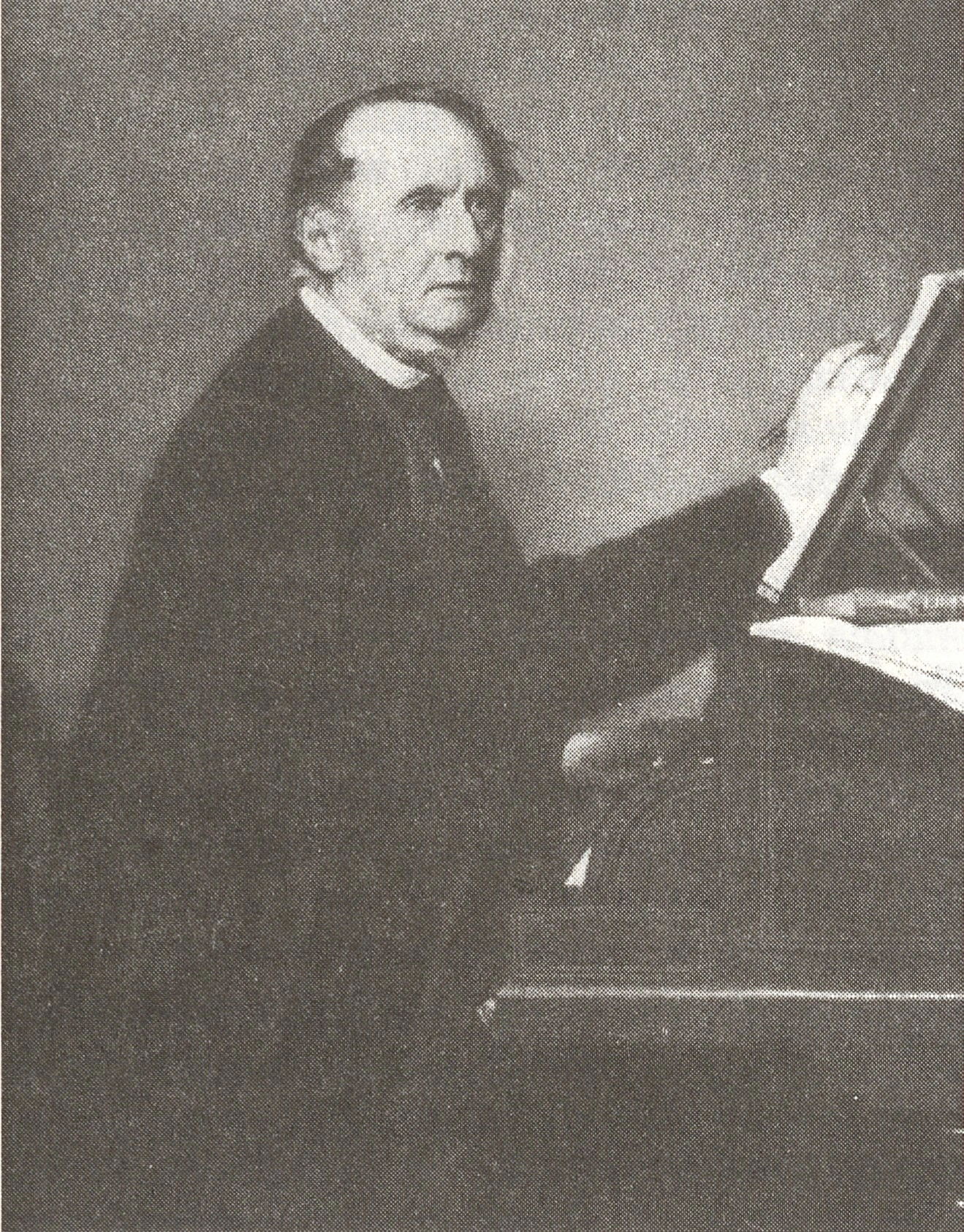
Hartmann, Emil

Hartmann Johann Peter Emilius, *14 May 1805 Copenhagen, †10 March 1900 Copenhagen, Danish composer, conductor, and organist of German descent, grandson of Johann Ernst. His father, August Wilhelm (1775–1859), was a violinist in the royal orchestra in Copenhagen and an organist, while his mother served as governess to Prince Frederik, later King of Denmark. The Hartmann household regularly hosted chamber music evenings at which works by the Viennese Classics were performed. His father, his only teacher, instructed him in violin, piano, and organ playing and took him to performances at the Royal Theatre. In accordance with his parents’ wishes, Hartmann began studying law at the University of Copenhagen in 1822 and after graduating, he became secretary to the Royal Recruitment Commission in 1828, a position he held until 1870, while simultaneously pursuing extensive musical activities.
Johann Peter Emilius maintained close relations with the Danish composers C.F.E. Weyse and D.K. Kuhlau. He was a friend of A. Bournonville, with whom he made his first public appearance as a violinist at the age of fifteen; later he composed all of his ballets to Bournonville’s librettos. In 1824 Johann Peter Emilius became organist at Garnisonkirken in Copenhagen, and from 1843 until his death he served as organist of Copenhagen Cathedral. Between 1827 and 1842 he taught at Siboni’s newly established conservatory in Copenhagen. He continued his pedagogical work at the Musikkonservatorium, which from 1866 he directed jointly with N. Gade and H.S. Paulli, teaching music theory and composition there until his death. He trained an entire generation of Danish composers. Hartmann was a co-founder of Musikforeningen (1836), the principal concert society of nineteenth-century Copenhagen, and served as its president from 1839 to 1892. Through more than fifty years of leadership, he played a major role in Copenhagen’s musical life. He was also conductor and, from 1868, president of Studentersangforeningen (the Student Choral Society), an activity that inspired him to compose numerous choral works.
Johann Peter Emilius undertook several journeys abroad. In 1836 he travelled with H.A. Marschner to Germany, Austria, France, and Switzerland, meeting many distinguished composers, including L. Spohr, who gave the first performance of Hartmann’s Symphony in G minor (Kassel 1837). In 1839, 1841, and 1843–44 he again visited Germany, where he met F. Mendelssohn, C. Wieck, R. Schumann (who reviewed his works for many years in the “Neue Zeitschrift für Musik”) and F. Liszt, through whose efforts Hartmann’s opera Liden Kirsten was staged in Weimar in 1856. In 1843 he won third prize in a piano sonata competition organized by the Norddeutscher Musikverein (Sonata, Op. 34), and in 1844 conducted his overture to the drama Hakon Jarl in Leipzig. He received the title of professor in 1849 and an honorary doctorate from the University of Copenhagen in 1874.
Many of Hartmann’s compositions remain unpublished in manuscript. Some orchestral works and cantatas, together with all of his operas and ballets, were published during his lifetime (mainly in Copenhagen in piano-vocal reductions). Alongside Niels Gade, Johann Peter Emilius Hartmann is regarded as the most important figure in nineteenth-century Danish musical life. He composed for nearly eighty years, leaving an enormous body of work encompassing almost every musical genre, with vocal-instrumental music forming the largest portion of his output. The stylistic evolution of his works mirrors the development of Danish music throughout the nineteenth century. His earliest compositions are written in the classical style of Weyse. The early operas (Ravnen, Korsarerne), as well as the Symphony in G minor, reveal some influence of Spohr. In general, however, the German composers who influenced many Danish composers of the period had relatively little effect on Hartmann, whose music possesses a distinct individual character. His artistic outlook was profoundly shaped by Danish national-romantic literature, which inspired his interest in Old Norse sagas and mythology, themes that form the basis of many of his works. Gradually his music shed its classical features and acquired a more romantic and distinctly Nordic character. A turning point is generally considered to be his music for A. Oehlenschläger’s poem Guldhornene (1832). Hartmann made extensive use of Scandinavian folk music, drawing on its rhythmic, tonal, and melodic characteristics (he employed both direct quotations of folk melodies and motives, as in the opera Liden Kirsten, and folk-inspired models for shaping his own melodic language). His late works, especially the Piano Sonata in A minor, already anticipate aspects of the style of C. Nielsen. Besides the Sonata, Hartmann’s most important works include the opera Liden Kirsten, his ballets, the overtures Hakon Jarl, Axel og Valborg, and Yrsa, and the choral work Vølves Spaadom. Hartmann’s music, though highly popular and widely performed in Denmark, remained little known beyond the country’s borders. Only a small number of his works were published in Germany, and only a few were performed there. The premieres of nearly all his compositions took place in Copenhagen.
Literature: A. Hammerich Johann Peter Emilius Hartmann. Biografiske essays, Copenhagen 1916; W. Behrend Johann Peter Emilius Hartmann, Copenhagen 1918; R. Hove Johann Peter Emilius Hartmanns Stryggekvartetter, “Musikhistorisk Arkiv” 1932; R. Hove Johann Peter Emilius Hartmann, Copenhagen 1934 (contains a catalogue of works compiled by A. Nielsen); V. Bitsch Johann Peter Emilius Hartmann, Hellerup 1055; S. Sørensen En dansk guldalder-opera (Liden Kirsten), in a celebratory publication for G. Albeck, Copenhagen 1966; J. Thornberg Johann Peter Emilius Hartmanns ouverturer, “Musik og Forksning” 1975 no. 1; L. Brix Die Klaviermusik von Johann Peter Emilius Hartmann, dissertation at the University of Göttingen, 1971; D. Fog Dansk Musikfortegnelse, Copenhagen 1979 (a catalogue of works by Danish composers published between 1750 and 1854).
Instrumentalne:
Sonata in B-flat major Op. 1, for flute or clarinet and piano, 1825
Piano Quartet in F major, Op. 2, 1823
Concert Overture in D minor, Op. 3, 1825
Deux rondeaux brillants, Op. 6, for piano, 1829
Fantasy, Op. 7, for piano, 1826
Violin Sonata in G minor, Op. 8 for violin and piano 1826
Fantasy in A minor for organ, 1826
Gejstlig Ouverture in C minor, Op. 9, 1827
Allegro di bravura og Andante, Op. 10, for piano, 1829
Symphony No. 1 in G minor, Op. 17, 1835; performed in Kassel, 1837
Quatre Caprices, Op. 18, for piano, Leipzig, 1836
Fantasy in F minor, Op. 20, for organ, pub. Leipzig, 1837
Deux pièces caractéristiques, Op. 25, for piano, pub. Leipzig, 1839
Otte Skizzer, Op. 31, for piano, pub. Hamburg, 1842
Prix-Sonate in D minor, Op. 34, for piano, pub. Leipzig, 1843
Seks Tonestykker i Sangform, Op. 37, for piano, pub. Hamburg and Copenhagen, 1843
Tre Klaverstykker, Op. 38, pub. Hamburg, 1845
Sonata in C major, Op. 39 for violin and piano 1846
Symphony No. 2 in E major, Op. 48b, 1848
Sonatina, Op. 48b, for piano, 1863
Seks Karakterystykker, Op. 50, for piano, pub. Copenhagen, 1849
String Quartet in G major, 1848, unfinished (without finale)
Trio in C major for piano, violin and cello, 1849
Piano Sonata in G minor, 1851
Concert Overture in C major, Op. 51, 1852
Études instructives, Op. 53, for piano, pub. Copenhagen, 1852
Fantasistykker, Op. 54, for piano, pub. Leipzig and Copenhagen
Piano Sonata in F major, 1854
Novelletten, Op. 55b, for piano, 1855
String Quartet in A major, c. 1855, unfinished (without finale)
Organ Sonata in G minor, Op. 58, 1855; revised version 1884; pub. Copenhagen, 1885
En Efteraarsjagt (An Autumn Hunt), Op. 63b, for orchestra, 1863
Overture, Op. 57, to Adam Oehlenschläger’s tragedy Axel og Valborg, 1856
Overture, Op. 59, to Adam Oehlenschläger’s drama Correggio, 1858
Studier og Novelletter, Op. 65, for piano, 1866
Suite in A minor, Op. 66, for violin or clarinet and piano, 1864
Piano Sonata in A minor, Op. 80, 1885
Tre Karakterstykker, Op. 81, for string orchestra, 1884
Sonata in G minor, Op. 83, for violin and piano 1886
Fantasi-Allegro for violin or clarinet and piano, 1889
Several marches for orchestra
Numerous piano miniatures
Vocal-Instrumental:
Approximately 30 cantatas, chiefly occasional works, including:
Sørgekantate over Kong Frederik den Sjette (‘Funeral Cantata for King Frederick VI’), Op. 27, for male chorus, text by H.C. Andersen, 1840
Kantate ved Universitetets Sorgfest over Christian den Ottende (‘Cantata for the University Memorial Ceremony on the Death of King Christian VIII’), Op. 47, for solo voices, chorus and orchestra, text by J.L. Heiberg, 1848
Hinsides bjergene (‘Beyond the Mountains’), for mezzo-soprano, chorus and orchestra, text by A. Munch, 1865
Foraarssang (‘Spring Song’), Op. 70, for chorus and orchestra, text by H.C. Andersen, 1871
Kantate ved Københavns Universitets Jubelfest 1879, Op. 75, for solo voices, chorus and orchestra, text by C. Ploug, 1879
more than 60 sacred and secular choral songs.
several dozen songs for solo voice, vocal ensemble, or a cappella performance, with piano or orchestral accompaniment
recitations with orchestra:
Guldhornene, Op. 11, text by A. Oehlenschläger, performed in 1832
Jurabjerget, Op. 14, text by A. Oehlenschläger, performed in 1833
Der Taucher, Op. 21, text by F. Schiller, 1837
songs for solo voice and piano:
Sechs Gesänge, Op. 13, texts by J.W. Goethe, A. Gähler and H.C. Andersen, 1832
Danske Sange, texts by S. Staffeldt and Ch. Winther, Copenhagen, 1838
Sechs Lieder, Op. 35, texts by E. Mörike, J.W.L. Gleim, W. Wackernagel and H. Heine, 1839
Seks Digte, Op. 45, texts by B.S. Ingemann, 1846
Sulamith og Salomon, Op. 52, text by B.S. Ingemann, 1850
Sechs Gesänge, Op. 55a, texts by C.F. Weisse, O. von Redwitz, J. Eichendorff, J.W. Goethe and J.N. Vogel, 1853
Polmer Spillemands Viser, Op. 56, texts by Ch. Winther, 1856
Fem Sange, Op. 63a, texts by M. Rosing and Ch. Richardt, 1866
Aandelige Sange, texts by N.F.S. Grundtvig and H.C. Sthen, 1871
Blandede Digte, texts by H. Hertz, J. Eichendorff, A. Vinet and K. Arentzen, 1873
Sange og Viser, Op. 77, texts by N.F.S. Grundtvig, B. Bjørnson and others, 1873–80
Religiöse Sange, texts by 21 authors, pub. Copenhagen and Leipzig, 1897 (comprising 89 songs composed between 1838 and 1897)
Vedbend, texts by A. Langsted, 1888–92 (nine songs)
Solen i Siljedalen, text by M. Thoresen, pub. Copenhagen, 1892
Vaarviser, text by V. Gregersen, 1896
numerous songs not included in cycles.
Stage:
operas:
Ravnen eller Broderprøven (The Raven, or The Test of Brotherhood), Op. 12, libretto by H.C. Andersen after C. Gozzi, three acts, premiered in Copenhagen 1832; revised four-act version 1865
Korsarerne (The Corsairs), Op. 16, libretto by H. Hertz, premiered in Copenhagen 1835
Liden Kirsten (Little Kirsten), Op. 44, libretto by H.C. Andersen, one act, premiered Copenhagen 1846; revised two-act version 1858
ballets (all premiered in Copenhagen):
Et Folkesagn, with N. Gade (Acts I and III), libretto by A. Bournonville, 1854
Valkyrien, Op. 62, libretto by A. Bournonville, 1861
Thrymskviden, Op. 67, libretto by A. Bournonville, 1868
Arcona, Op. 72, libretto by A. Bournonville, 1875
incidental music to approximately 16 stage works performed in Copenhagen:
A. Oehlenschläger Olaf den HelligeOp. 23, 1838
A. Oehlenschläger Knud den Store Op. 28, 1839
A. Oehlenschläger Fiskeren og hans Børn, 1840
A. Oehlenschläger Hakon Jarl Op. 40, overture 1844, entr’acte 1857
A. Oehlenschläger Yrsa Op. 78, 1883
J.L. Heiberg Syvsoverdag Op. 30, 1840, revised 1872
H.C. Andersen Maurepigen Op. 32, 1832
C. Borgaard UndineOp. 33, 1842
C.K.F. Molbech Ambrosius, 1878, Dante Op. 85, 1888
L. Holberg Kilderejsen, 1859