
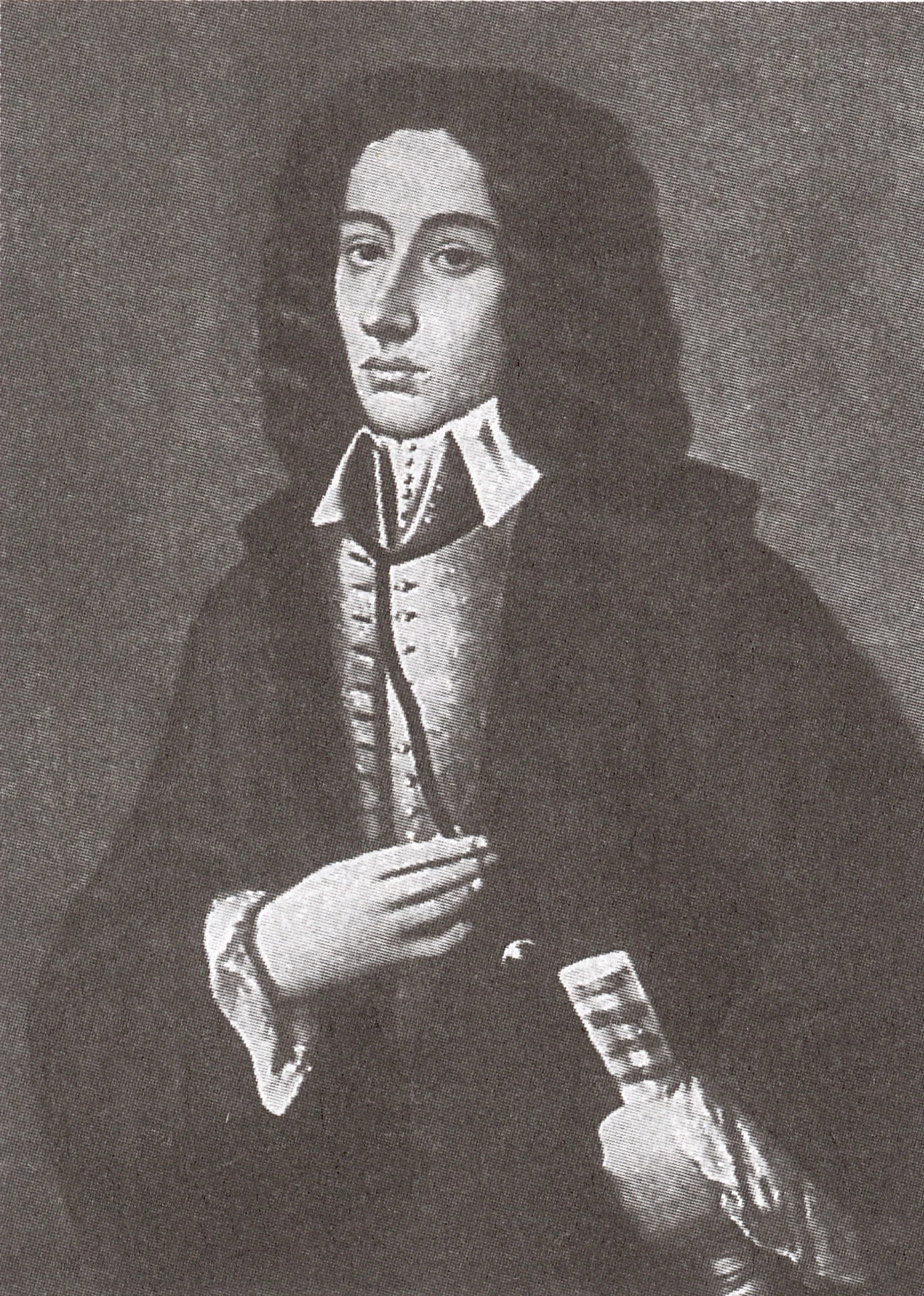
51. Motetto a due Voci, 3 Stromenti e Cont. di G. B. Pergolese. [fragment]

Pergolesi, Pergolese, Giovanni Battista, *4 January 1710 Jesi (near Ancona), †16 March 1736 Pozzuoli (near Naples), Italian composer. In his youth, Pergolesi used the surname Jesi, but later adopted the surname of his grandfather, C. Draghi, known as Pergolesi (from the name of the town of Pergola, where he came from). Pergolesi received his elementary musical training in Jesi from the local maestro di cappella, F. Santi; he also took violin lessons with F. Mondini. After 1720 (probably at the end of the summer of 1722), he enrolled at the Conservatorium dei Poveri di Gesù Cristo in Naples, where he studied composition under G. Greco (†1728), then for several months under L. Vinci, and from October 1728 under F. Durante. He earned his living and tuition fees as a member of the choir and later also as first violinist in opera performances organised by the conservatory authorities for the residents of Naples and the surrounding area (enthusiastic reviews of his violin improvisations have survived). Pergolesi’s years of study culminated in 1731 with the staging of his religious drama Li prodigi della divina grazia at the monastery of Sant’Agnello Maggiore; this was also the composer’s public debut. In the same year, Pergolesi received his first commission for an opera seria; the libretto was a new version of A. Zeno’s text for Alessandro Severo, entitled Salustia.
The opera, composed in haste and with the collaboration of the author of the intermezzo, D. Caracajus (who arranged the music for some of the recitatives), was not particularly successful. In 1732, Pergolesi was appointed maestro di cappella at the court of Prince Ferdinando Colonna Stigliano. His first musical comedy, Lo frate ‘nnamorato, with a libretto by the leading Neapolitan comedy writer G. Federico, was staged on 27 September 1732 at the Teatro dei Fiorentini in Naples and was an extraordinary success. The opera remained in the repertoire for the following season, and in 1734 it was revised and staged with a new cast.
After the tragic earthquakes that struck Naples in November and December 1732, Pergolesi composed several religious works for the festival in honour of the city’s patron, St Emidius (with the intention of protecting Naples from further tremors): a mass (presumably in D major), the introit Domine ad adjuvandum, and the psalms Dixit Dominus, Laudate pueri and Confitebor. In connection with the planned celebrations of Empress Elisabeth Christine’s birthday (28 August 1733), he received a commission for another opera seria, Il prigioniero superbo. To this opera he added the intermezzo La serva padrona, intended for two singers, to be performed between acts. The first performance of the opera and intermezzo took place on 5 September 1733. In February 1734, Pergolesi was appointed deputy to the city maestro di capella, D. Sarra, and held this position during the next festival in honour of St Emidius. In March 1734, the Neapolitan throne, which had been ruled by Austrians since 1707, was seized by Charles III de Bourbon with the support of Spanish troops. At that time, Pergolesi and Prince Ferdinand left for Rome, where his Mass in F major was performed on 16 May in the church of San Lorenzo in Lucina. The work was commissioned by the Neapolitan aristocrat Domenico Marzia IV Carata, Prince of Maddaloni, who soon employed Pergolesi as his maestro di capella.
Upon his return to Naples that same year, Pergolesi became organist to the royal chapel; he received a commission for an opera to celebrate the birthday of queen mother, Elisabetta Farnese. The opera Adriano in Siria, with a libretto by P. Metastasio, was staged together with the intermezzo La contadina astuta, now known as Livietta e Tracollo. The leading role in this performance was entrusted to one of the most outstanding castrato singers, Caffarelli. Pergolesi wrote his next opera, L’Olimpiade, to a libretto by Metastasio, on commission from the Teatro Tordinona in Rome. The work brought the composer moderate success, but was soon also staged in Perugia, Venice and Turin. The commedia musicale Il Flaminio, composed in the autumn of 1735 for the Teatro Nuovo in Naples, enjoyed greater success. At that time, Pergolesi also completed a commission for the serenade Il tempo felice, which was to be performed in Torremaggiore during the wedding celebrations of Raimondo di Sangro, Prince of Sansevero. Due to Pergolesi’s deteriorating health (he probably suffered from tuberculosis), the work was completed by N. Sabatina. At the beginning of 1736, Pergolesi arrived at the Franciscan monastery in Pozzuoli, where, while battling a terminal illness, he composed the cantata Orfeo, Stabat Mater (for the congregation at the church of Santa Maria dei Sette Dolori in Naples) and his last work, the antiphon Salve Regina; however, it is possible that the last two works were composed in reverse order. He died at the age of only 26. He was buried in Pozzuoli in the cemetery near the cathedral. In September 1890, his remains were transferred to the cathedral and buried in one of the side chapels.
Among Pergolesi’s more than 30 works, the greatest significance is attributed to the intermezzo La serva padrona, which initiated a new genre in the history of stage music – opera buffa. Pergolesi developed its most important features, both in this and in his second intermezzo, La contadina astuta. The lasting value of the intermezzos was ensured primarily by the way the characters were characterised through music, which perfectly harmonised with the stage gestures and situational comedy. Opera buffa was initially more modest in scope than opera seria (it was composed to fill the intervals between the main acts of a work), and its cast consisted of only two performers (a silent role, combined with stage service, was also permitted). Pergolesi developed the basic framework of the vocal style typical of opera buffa: fast dialogues in the form of recitativo secco, phrases with short-breath in arias and duets, expressive rhythms with a tendency towards motoric chanting, the so-called parlando buffo, the use of the comic qualities of the bass part, the use of single words separated by pauses, and at the same time he introduced a fluid, song-like melody with a sentimental tone.
In his operas, Pergolesi continued the style cultivated by Neapolitan composers, primarily A. Scarlatti. Adriano in Siria highlights the main character; Pergolesi composed this work with Caffarelli in mind, guided by his demands and vocal abilities. As a result, some of Adriano’s arias took on the character of vocal concertos. The composer rejected as many as seven of the arias written by Metastasio for the other characters, thereby disrupting the internal dramatic balance of the work. Pergolesi composed L’Olimpiade with greater independence and without pressure from performers; in this opera he abandoned excessive virtuosity in favour of highlighting the expressive qualities of the vocal lines. The vocal part, unburdened by exuberant coloratura, became more fluid and natural, and the character of the whole more intimate than in the previous opera seria. L’Olimpiade enjoyed enormous popularity in the 18th century and was highly acclaimed by critics, who saw it as the ideal opera (e.g. A. Eximeno Dell’origine e delle regole della musica, Rome 1774). In operas described as ‘commedie musicali,’ Pergolesi introduced a division of characters into serie and buffe, differentiating their musical characters. In the case of Flaminio, the result was a semiseria opera with sentimental features and buffo scenes. Pergolesi also introduced the so-called parti caricate, composed with particular care. Based on Il Flaminio and Lo frate ‘nnamorato, as well as 12 trio sonatas attributed to Pergolesi at the time, Stravinsky composed the music for the ballet Pulcinella in 1920.
Pergolesi’s Mass compositions are in the style of the late Neapolitan school (L. Leo, F. Durante), with a characteristic limitation of the number of parts to Kyrie and Gloria and a combination of counterpoint and concertante techniques (e.g. the “Christe” fugue is framed by fragments of “Kyrie” using concertante elements). Pergolesi arranged both masses (in D major and F major) in several versions: for 1, 2 and even 4 mixed choruses (in 5 parts with double soprano) and 1 or 2 string orchestras; despite increasing the number of choruses, the composer did not develop polyphony, limiting himself to antiphonal repetitions of individual sections, then juxtaposed with a tutti ensemble.
The psalm settings intended for solemn vespers belong to the genre of church cantatas for 1–3 solo voices (without recitatives), choir and orchestra. The sublimity of expression was achieved through the contrast between massive choral fragments and graceful solo parts (arias) or small ensembles, equipped with elaborate virtuoso techniques, reflecting the influence of the vocal and instrumental concerto form, but also of opera. In Pergolesi’s most famous religious work to date, Stabat Mater, the composer combined the features of a cantata and a chamber duet. The individual fragments of this 12-part composition are relatively small in size. Pergolesi did not employ the da capo arias characteristic of the Neapolitan style, nor other reprise forms; instead, he adopted the principle of setting each textual repetition in a newly varied manner. The frequent use of parallel thirds and sixths in the solo voices alongside imitative (and even occasionally fugal) passages shows a clear tendency towards simplifying the texture.
Pergolesi did not experience the benefits of fame during his lifetime. However, shortly after the composer’s untimely death, interest in his works grew significantly. Four cantatas were published in Naples (the first publication of its kind in that city). Queen Maria Amalia of Naples, recognising the greatness of Pergolesi’s talent, ordered La serva padrona and La contadina astuta to be staged in 1738. In the following years, Pergolesi’s comic operas gained popularity in other Italian cities, as well as in Germany, Austria and France, thanks to the activities of travelling theatre troupes. The second staging of La serva padrona in Paris in 1752 (the first took place in 1746) sparked a heated dispute between ‘buffonists’ and ‘anti-buffonists,’ involving, on the one hand, supporters of traditional French opera (identified with the works of Lully and Rameau) and, on the other, French enthusiasts of Italian opera buffa. Louis XV and the aristocracy supporting the king sided with the anti-buffonists. Queen Marie Leszczyńska sympathised with the buffonists, who came mainly from the encyclopaedist circle (D. Diderot, J. d’Alembert). Pergolesi’s name also became a symbol of the “progressive” views espoused by J.-J. Rousseau, who was enthusiastic about the simplicity, melodiousness and naturalness of Pergolesi’s music and held it up as a model for French composers. La serva padrona was published in 1752 in Paris in its original version, and in subsequent years in a French adaptation entitled La servante maîtresse; in 1759, an English version entitled The Favourite Songs in the Burletta La serva padrona was published in London. Stabat Mater, published in London in 1748, became the most frequently printed musical work of the 18th century and was used in various adaptations and arrangements (including J.S. Bach’s Tilge, Höchster, meine Sünden). Proponents of the galant style saw this work as the embodiment of the ideal of church music.
On the wave of Pergolesi’s popularity, he was mistakenly credited with the authorship of many compositions, including the intermezzo Il maestro di musica, the song Tre giorni son che Nina, the opera Il Temistocle, Missa Pergolesiana, Missa solemnis and Requiem, a sets of trio sonatas, two flute concertos and six Concerti armonici.
Research conducted by Professor Barry S. Brook since the 1970s at the City University of New York (CUNY) led to the correct identification of the Italian composer’s works and initiated the activities of the Pergolesi Research Centre at this university in collaboration with the Centro Studi Pergolesi (based at the University of Milan). Thanks to the efforts of both teams, a new 18-volume critical edition of Pergolesi’s authentic works was launched, supplemented by a thematic catalogue from 1977 (publication of second, revised edition has been announced) and a volume devoted to opera librettos. This project was supported by the Pergolesi Research Foundation of CUNY, and since 2009 – referred to as the National Critical Edition of the Works of G. B. Pergolesi – by the Italian Ministry of Culture and the Fondazione Pergolesi Spontini. Through the efforts of both institutions, work was begun on a new 18-volume critical edition of Pergolesi’s authentic works, supplemented by the thematic catalogue of 1977 (a second, revised edition of which has been announced) and by a volume devoted to the opera librettos. This project was supported by the Pergolesi Research Foundation of CUNY, and since 2009 – referred to as the National Critical Edition of the Works of G. B. Pergolesi – by the Italian Ministry of Culture and the Fondazione Pergolesi Spontini. The project was supported by the Pergolesi Research Foundation of CUNY, and, from 2009 – under the designation National Critical Edition of the Works of G. B. Pergolesi – by the Italian Ministry of Culture and the Fondazione Pergolesi Spontini.
Literature:
M.E. Paymer Giovanni Battista Pergolesi A Thematic Catalogue of the Opera Omnia with an Appendix Listing Omitted Compositions, New York 1977; H. Hucke Pergolesi Probleme eines Werkverzeichnisses, “Acta Musicologica” LII, 1980; F. Degrada Falsi pergolesiani. Dagli apocrifi ai ritratti, “II convegno musicale” I, 1964; F. Degrada Alcuni falsi autografi pergolesiani, “Rivista Italiana di Musicologia” I, 1966; F. Degrada False attribuzioni e falsificazioni nel catalogo delle opere di Giovanni Battista Pergolesi, in: L`attribuzione. Teoria e pratica, materials from the seminar in Ascona, 30 September–5 October 1992, eds. O. Besomi and C. Caruso, Bazylea 1994.
J.-J. Rousseau Lettre de MM. du coin du roi à MM. du coin de la reine sur la nouvelle pièce intitulée La servante maîtresse, Paris 1754; A. Eximeno y Pujades Dell`origine e delle regole della musica, Rome 1774; Marquis of Villarosa [C. de Rosa] Lettera biografica intorno alla patria ed alla vita si Giovanni Battista Pergolesi celebre compositore di musica, Naples 1831, extended 2nd ed. 1843; G. Annibaldi Alcune delle notizie più importanti intorno al Pergolesi recentemente scoperte. Il Pergolesi in Pozzuoli. Vita intima, Jesi 1890; G. Radiciotti Giovanni Battista Pergolesi Vita, opere ed influenza su l’arte, Rome 1910, revised Milan, 2nd ed. 1935, revised ed. in German Giovanni Battista Pergolesi Leben und Werk, translated by A.-E. Cherbuliez, Zurich 1954; A. Della Corte Giovanni Battista Pergolesi, Turin 1936; F. Schlitzer Giovanni Battista Pergolesi, Turin ca. 1940; Giovanni Battista Pergolesi Note e documenti, ed. S.A. Luciani, Siena 1942; Ch. Cudworth Some Notes on the Instrumental Works Attributed to Pergolesi and F. Walker Two Centuries of Pergolesi Forgeries and Misattributions, “Music and Letters” XXX, 1949; F. Walker Goldoni and Pergolesi, “The Monthly Musical Rercord” LXXX, 1950; F. Walker Pergolesi Legends, “The Monthly Musical Rercord” LXXXII, 1952; M. Margadonna Pergolesi, Milan 1961; F. Degrada Le messe di Giovanni Battista Pergolesi. Problemi di cronología e d’attribuzione, “Analecta Musicologica” III, 1966; F. Degrada Uno sconosciuto intermezzo di Giovanni Battista Pergolesi, “Collectanea Historiae Musicea” IV, Florence 1966; H. Hucke Die musikalische Vorlagen zu I. Stravinskys “Pulcinella,” in the commemorative book of H. Osthoff, eds. W. Stauder et al., Tutzing 1969; H. Hell Die neapolitanische Opernsinfonie in der ersten Hälfte des 18. Jahrhunderts. N. Porpora, L. Vinci, G. B. Pergolesi, L. Leo, N. Jommelli, Tutzing 1971; I. Mamczarz Les intermèdes comiques italiens au XVIIIe siècle, en France et en Italie, Paris 1972; La querelle des bouffons: texte des pamphlets avec introduction, commentaires et index, ed. D. Launay, 3 vols. Geneva 1973; M. E. Paymer The instrumental music attributed to Giovanni Battista Pergolesi – a study in authenticity, doctoral dissertation at the City University of New York, Ann Arbor 1977; Charles E. Troy, The comic intermezzo: A study in the history of eighteenth-century Italian opera, Ann Arbor 1980 (Studies in Musicology, 9); D. Launay La Querelle des Bouffons et ses incidences sur la musique, Kassel 1981 ; D. Monson Recitativo semplice in the opere serie of G. B. Pergolesi and his contemporaries, doctoral dissertation at Columbia University, microform, Ann Arbor (Maryland) 1983; H. E. Beckwith Giovanni Battista Pergolesi and the chamber cantata, Ann Arbor (Maryland) 1983; Pergolesi, eds. F. Degrada, R. De Simone et al., Naples 1986; B. S. Brook Stravinsky’s “Pulcinella. The “Pergolesi” Sources, in: Musiques, signes, images, commemorative book of F. Lesure, ed. J.-M. Fauquet, Geneva 1988; M.E. Paymer, H.W. Williams Giovanni Battista Pergolesi. A Guide to Research, New York 1989; S. Piacenti La fede, la storia, la scena – percorsi storici per una messa in scena del San Guglielmo d’Aquitania di G.B. Pergolesi, Rimini 2000; M. Sapio Omaggio a Pergolesi: dipingere un mito, katalog wystawy poświęconej Pergolesiemu w 2000, Naples 2003; H. E. Krehbiel Music and Manners. From Pergolesi to Beethoven, Forest Grove (Oregon) 2004; C. Bacciagaluppi Rom, Prag, Dresden. Pergolesi und die Naplesitanische Messe in Europa, doctoral dissertation at the University of Freiburg (Switzerland), Kassel 2010; L. Mattei Musica e dramma nel “dramma per musica” aspetti dell’opera seria da Pergolesi a Mozart, Bari 2012.
«Studi Pergolesiani / Pergolesi Studies», Proceedings of the International Symposium. Convegno Internazionale “,Lo Stato Attuale Degli Studi su Pergolesi,” ed. F. Degrada, vol. 1 and 2, Fiesole and New York 1986, vol. 3, Florence 1999, vol. 4, Jesi 2000, eds. C. Fertonani, C. Toscani, vol. 5, Jesi 2006; ed. C. Toscani, vol. 6, Milan 2010, ed. S. Caputo vol. 7 e-book, Berno 2013, eds. C. Bacciagaluppi, H.-G. Ottenberg, L. Zoppelli, vol. 8 Berno 2012, ed. F. Cotticelli, P. Malone, vol. 9 e-book, Berno 2015, ed. C. Bacciagaluppi, A. Fiore, vol. 10 e-book, Berno 2015, ed. C. Bacciagaluppi, M. Laterza, vol. 11 e-book 2021.
Editions:
Opera omnia di Giovanni Battista Pergolesi (C), 25 vols., ed. E Caffarelli, Rome 1939–42 (contains many works of questionable authenticity)
Giovanni Battista Pergolesi Complete Works / Edizione Nazionale delle Opere di Giovanni Battista Pergolesi (B), eds. B.S. Brook, F. Degrada, H. Hucke, C. Toscani, E. Monson et al., New York, Milan, Jesi (places and dates of publication of subsequent volumes given in brackets)
Compositions:
Stage:
Salustia, opera seria, 3 acts, libretto S. Morelli (?) after A. Zeno’s Alessandro Severo, staged in Naples, January 1732, C IX, B I (see. Ed.) (Jesi 2008)
Lo frate `nnamorato, commedia musicale, 3 acts, libretto G. Federico, staged in Naples, 27 September 1732; 2nd version staged in Naples for Carnival 1734, ed. C II, B VII (New York, Milan 1989)
Il prigioniero superbo, opera seria, 3 acts, libretto after F. Silvani’s La fede tradita e vendicata, staged in Naples, September 5, 1733, C XX, B II (Jesi 2009)
La serva padrona, 2 acts intermezzo to Il prigioniero superbo, libretto G. Federico, staged in Naples, 5 September 1733, Polish premiere in Warsaw 1774, Paris 1752, C XI/1, B V (Milan 2004, piano reduction Milan 1984)
Adriano in Siria, opera seria, 3 acts, libretto P. Metastasio, staged in Naples, 25 October 1734, C XIV, B III (New York, Milan 1986)
La contadina astuta (Livietta e Tracollo), 2 acts intermezzo do Adriano in Siria, libretto T. Mariani, staged in Naples, October 25, 1734 (in subsequent editions, the title was changed several times to: Livietta e Tracollo, Il ladro finto pazzo, Il finto pazzo, Amor fa l`uomo cieco, Il Tracolo, Livietta, La finta polacca), C XI/3, B VI (New York, Milan 1991, piano reduction Milan 1984)
L’Olimpiade, opera seria, 3 acts, libretto P. Metastasio, staged in Rome, January 1735, C XXIV, B IV (Jesi 2002)
Il Flaminio, commedia musicale, 3 acts, libretto G. Federico, staged in Naples, autumn 1735, C XII, B VIII (Jesi 2004)
Li prodigi della divina grazia nella conversione di San Guglielmo Duca d`Aquitania, dramma sacro, 3 acts, libretto I. Mancini, staged in Naples, summer 1731, C IV, B IX (Jesi 2010)
La fenice sul rogo, ovvero La morte di San Giuseppe, oratorio, 2 acts, staged in Naples (?) 1731, C I, B X (Milan 2013, piano reduction Milan 1971)
lost:
Nibbio e Nerina, 2 acts intermezzo do Salustii, libretto D. Caracajus, staged in Naples, January 1732 (untitled)
Capetà Cola, Spaviento e Giulietta, introdukcja i tańce do Lo frate `nnamorato, staged in Naples, 27 September1732 (untitled)
Vocal-instrumental:
Mass in D major for soprano, alto, one mixed chorus in five parts and orchestra, performed in Naples, 31 December (?) 1732, C XV/2, B XI; 2nd version for 2 choruses and 2 orchestras; 3rd version for soprano, alto, mixed chorus and orchestra, includes Qui tollis, Quoniam and arrangement of Cum Sancto Spiritu from Mass in F major (piano reduction Rome 1941)
Mass in F major for soprano, alto, one chorus in five parts, performed in (?) Naples, performed in (?) Rome 1734, C XVIII, B XII; 2. version for 2 mixed choruses and 2 orchestras, C VI; 3rd version for solo voices, 4 mixed choruses and 2 orchestras; 4th version with new arrangement of Kyrie (Milan 1974, 2nd edition 1998)
psalms:
Confitebor tibi, Domine for soprano, alto, one mixed chorus in five parts and orchestra, performed in (?) Naples 1732, C VIII, B XIII
Dixit Dominus for soprano, alto, for two mixed choruses in five parts and orchestra, performed in (?) Naples 1732, C VIII, B XIII
Laudate pueri Dominum for soprano, one mixed chorus in five parts and orchestra, C VIII, B XIII
antiphons:
In coelestibus regnis for alto, string ensemble and organ, C XVII/1, B XIII
Salve Regina in A minor for soprano, string ensemble and organ, C XV/1, B XV (1994)
Salve Regina in C minor for soprano, string ensemble, and organ, 1736, C XV/1, B XIV (1994)
***
Domine ad adjuvandum introit for soprano, one mixed chorus in five parts and orchestra, performed in (?) Naples 1732, C XVII/1, B XIII
Stabat Mater sequence for soprano, alto, string ensemble, and organ, 1736, published in London 1748, C XXVI, B XIV (Milan 2012)
In hac die quam decora motet for soprano, alto, tenor, bass, 2 choruses (female and male) and 2 orchestras, C XVII/1, B XV
cantatas:
Ritorno (Questo è il piano, questo è il rio) for alto, string ensemble and basso continuo, performed in 1731, CXXII, B XVI
Della città vicino for soprano, string ensemble, and basso continuo
4 Cantate da camera (…) di Giovanni Percolesi, raccolte di Gioacchino Bruno Op. 2, Naples after 1736, C X, B XVI
Lontananza („Dalsigre, ahi mia Dalsigre”) for soprano and basso continuo
L’addio (“Luce degli occhi miei”) for soprano, string ensemble, and basso continuo
Segreto tormento (“Chi non ode e chi non vede”) for soprano, string ensemble, and basso continuo
Orfeo (“Nel chiuso centro”) for soprano, string ensemble, and basso continuo
***
42 Solfeggi, for 2 voices, B XVIII
64 Solfeggi, for 3 voices, B XVIII
Solfeggio accompanied by harpsichord, B XVIII
Venerabilis barba cappucinorum. Scherzo fatto ai Cappucini di Pozzuoli for tenor and bass, 1735, B XVIII
Instrumental:
Concerto in B flat major for solo violin, 2 violins, viola and basso continuo, C XXI, B XVII (New York 1993)
Sonata in F major for organs, C XXI, B XVII (New York 1993)
Sinfonia (sonata) F major for cello and basso continuo, C XXI, B XVII (New York 1993)
Sonata in G major for violin and basso continuo, ed. Ph. Oboussier, London 1956, part 2 as Sonata in A major for harpsichord, C XXI, B XVII (New York 1993)