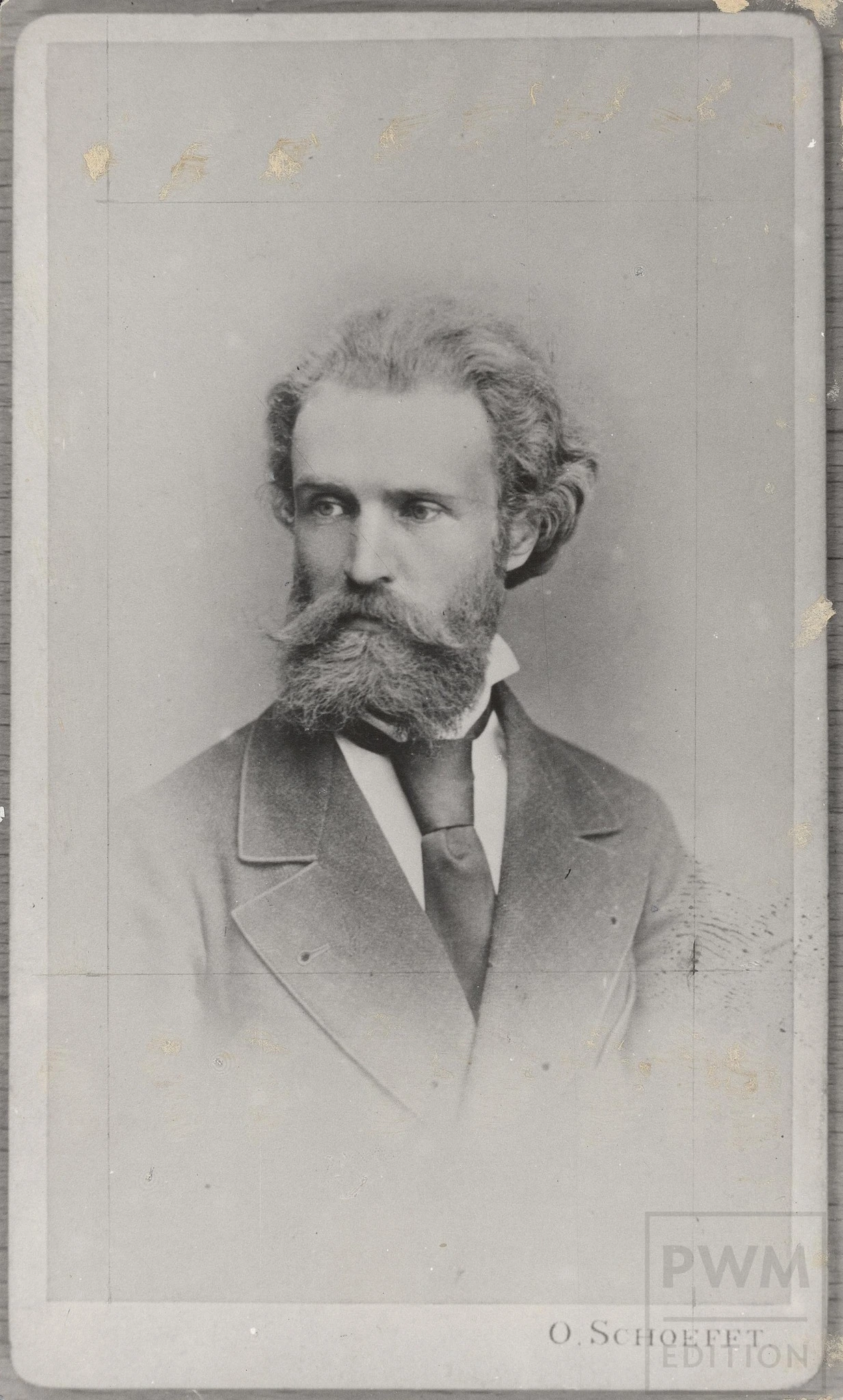
Górski Władysław, *7 June 1846 Warsaw, †7 February 1915 Lausanne, Polish violinist, teacher and composer. He initially studied the violin with K. Baranowski, and subsequently at the Music Institute under A. Kątski (violin), A. Freyer and S. Moniuszko (music theory). Whilst still a student, he was invited by H. Litolff to take part in his concert in Warsaw (March 1867). He received his diploma and first prize in July 1867, and in the autumn, he travelled to Berlin at the government’s expense to study composition with F. Kiel. He also gave successful concerts in Germany and Galicia. Upon his return to Warsaw, he performed on 14 December 1870 at the Resursa Obywatelska Palace. In 1871, Górski became a soloist at the Grand Theatre in Warsaw, and from 1876 he was a professor at the Music Institute, teaching violin and ‘ensemble music’. During these years, up until 1878, his name frequently appeared in the programmes of Warsaw concerts. On 6 October 1878, his first performance with the 18-year-old Paderewski took place at the Resursa Obywatelska Palace, marking the beginning of numerous joint concerts (until 1892) and a long-standing friendship. Górski reviewed and even made corrections to some of Paderewski’s works, including Op. 12 and 13, and the Piano Concerto, whilst Paderewski facilitated the publication of Górski’s works in Berlin; Paderewski’s handicapped son, Alfred, was later brought up in the Górski household. In the autumn of 1878, Górski and his wife (Helena née Rosen) travelled to Egypt for several months. Following the death of A. Kątski (1879), Górski took over the advanced violin class at the Music Institute and taught it until 1885, when he moved to Paris and became a member of the Lamoureux Orchestra. In February 1887, he organised a concert of Polish chamber music (works by Żeleński, Pankiewicz and Paderewski) at the Salle Pleyel in Paris. He also organised courses in chamber music performance (known as Leçons d’accompagnement) and gave concerts throughout Europe, including with Paderewski, Stojowski, N. Melba and E. Schelling (Warsaw 1902). Towards the end of his life, Górski moved to Switzerland (Montreux and Lausanne). In 1898, Helena Górska had her marriage to Górski annulled, and in 1899 she married Paderewski.
Although largely forgotten today, Górski was one of the most prominent figures in the musical life of his time. He was valued above all as a violinist; critics highlighted his musical maturity, talent and excellent technique. Górski drew on the achievements of the leading figures in modern violin playing (including Spohr and Schradieck), whilst his own playing style influenced subsequent generations of violinists. As a soloist and chamber musician, Górski performed works by Baroque and Classical composers (Bach, Corelli, Locatelli, Mozart); his regular repertoire included concertos by Beethoven, Litolff and Spohr, chamber works by Haydn, Beethoven, Schubert and Brahms, as well as pieces by Paganini and Polish composers (Paderewski, Stojowski, Wieniawski). As a music critic, Górski also championed the works of Polish composers (Rutkowski, Pankiewicz, Paderewski). The fact that his pupils were singled out for praise at the Music Institute’s recitals testifies to Górski’s teaching abilities.
Compositions:
Suite Op. 1 for violin and piano, ca. 1875, Warsaw 1882 Hoesick
Berceuse et intermezzo capriccioso Op. 3 for violin and piano, 1879, Berlin 1888 B & B
Zingarella for violin and piano, ca. 1879
Deux mazourkas Op. 2 for violin and piano, ca. 1880, Berlin 1882 B & B
Scherzo for violin and piano, ca. 1883
Introdukcja, ca. 1883
Arabioma, ca. 1883
Prelude and fugue for solo violin
Pieśń bez słów
Wariacje na temat Paganiniego
Cadenzas to Beethoven’s and Mendelssohn’s concertos and to Tartini’s Devil’s Trill Sonata
Writings:
Praktyczna szkoła na skrzypce. Zebrana z rozmaitych najcelniejszych autorów, Introductory Part: Podręcznik dla początkowej gry na skrzypcach, edited by Z. Noskowski, Warsaw 1897 Hoesick, Part 1: Szkoła dla początkujących, Warszawa 1880, 2nd edition 1897 Hoesick, 14th edition 1935 Gumiński, Part 2: Szkoła pięciu pozycji, Warsaw 1885, 2nd edition 1897 Hoesick, Part 3: Przygotowanie do etiud Kreutzera, Fiorillego i Rodego) Warsaw 1886, 2nd edition 1897 Hoesick (contains Górski\s etudes for 2 violins), Part 4: Ćwiczenia w gamach) compiled and edited by S. Barcewicz, Warsaw 1897 Hoesick
Konrad Wallenrod W. Żeleńskiego, “Echo Muzyczne, Teatralne i Artystyczne” 1885, No. 75–76
Pogawędki o stanie muzykalnym Polski w XVIII w., “Echo Muzyczne, Teatralne i Artystyczne” 1886, No. 153–168
Publiczność i muzyka, “Echo Muzyczne, Teatralne i Artystyczne” 1889, No. 275–299
Music reviews in “Echo Muzyczne”, “Echo Muzyczne, Teatralne i Artystyczne”, “Tygodnik Ilustrowany”, “Niwa”, “Słowo”
he also wrote satirical and lyrical poetry