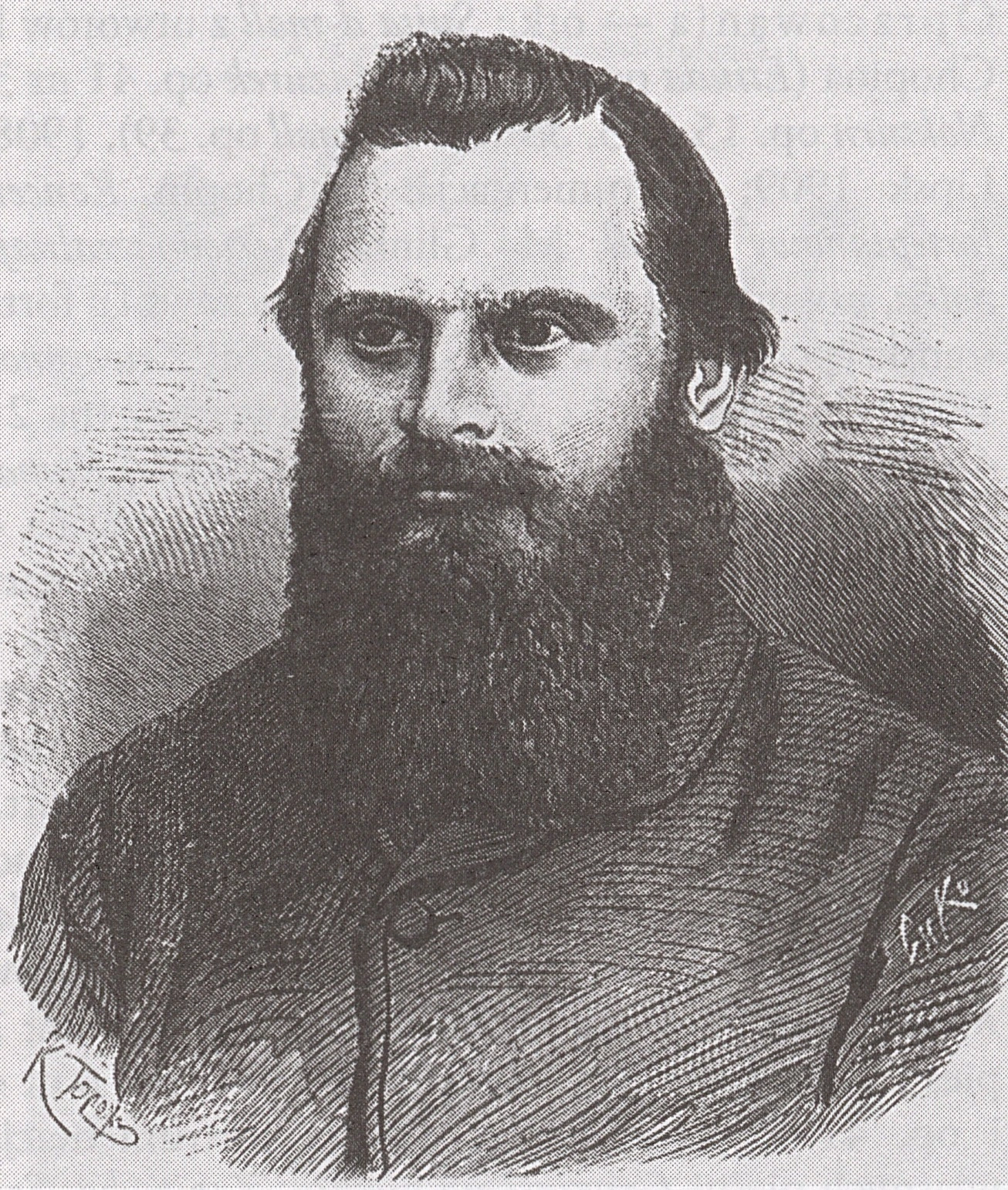
Balakirev Mily Alexeyevich, *2 January 1837 (21 December 1836) Nizhny Novgorod (present-day Gorky), †29 (16) May 1910 Saint Petersburg, Russian composer, pianist, conductor and music activist. In 1844, he began learning to play the piano under his mother’s guidance; in 1846, he took lessons from the renowned Moscow teacher A. Diubyuk, a pupil of Field.
He continued his studies with K. Eisrich in Nizhny Novgorod, where he met A. Ulybyshev in 1851. Thanks to the latter’s extensive library, he gained a thorough knowledge of music literature (including the works of Chopin and Glinka) and performed as a pianist at chamber concerts. In 1852, he conducted several public concerts, and his first compositions also date from this year. In 1853/54, he studied mathematics at the University of Kazan. At the same time, he continued to improve his piano playing through contact with Antoni Kątski, who was performing in Kazan at the time; he attributed the development of his piano technique mainly to Kątski, expressing this many years later in a letter (12 March 1907) to N. Findeizen.
In December 1855 Balakirev arrived in St Petersburg, where he became acquainted with Glinka, Dargomyzhsky, and Serov, and in 1856 he met Stasov and Moniuszko. He then formed connections with the composers who would later be associated with the group known as The Mighty Handful: he met Cui in 1856, Mussorgsky in 1857, Rimsky-Korsakov in 1861, and Borodin in 1862.
Until the end of the 1860s, Balakirev served as the leader of this group, shaping its creative ideology, promoting his friends’ works on the concert stage, and influencing their approach to musical folklore. His method of arranging folk songs, marked by deep sensitivity to tonal structure and performance practice, became a model for the Mighty Handful. This approach is evident both in his original compositions and in his Collection of Russian Folk Songs, recorded during his expedition along the Volga in 1860. Balakirev’s journeys to the Caucasus in 1862, 1863, and 1868 yielded numerous recordings of folk melodies, which represented a genuine discovery of Eastern music for the composers of the group. In 1862, together with G. Lomakin, he founded the Free Music School in St Petersburg, which he directed until 1872, devoting himself primarily to concert conducting. These concerts provided an important platform for young Russian composers while also introducing broader audiences to contemporary Western European music, particularly works by Berlioz, Liszt, and Schumann. The first of these concerts, held on 25 February 1863, marked Balakirev’s conducting debut in St Petersburg; the programme included, among other works, his Russian Overture No. 2. In 1866 and 1867, he travelled to Prague, where he prepared the premiere of Ruslan i Lyudmila (4 February 1867) and conducted a performance of Glinka’s Ivan Susanin. Between 1867 and 1869, Balakirev also conducted concerts for the Russian Musical Society, seeking to reform the institution’s conservative orientation. Dismissed from his post at the Russian Musical Society in April 1869, Balakirev found himself engaging in an unequal struggle with the institution, continuing his work at the Free Music School. However, in April 1872 the School was forced to suspend its concert activities owing to a lack of financial support. Disheartened by this failure and burdened by family difficulties following his father’s death, as well as by fears of losing his creative inspiration, Balakirev fell into depression, withdrawing from musical life and severing his close ties with the composers of the Mighty Handful. In 1872, Balakirev took employment as a railway clerk, and between 1873 and 1875 he gave piano lessons at the Mariinsky Institute in St Petersburg. From 1876 onward, he gradually returned to musical activity, assisting Rimsky-Korsakov in running the Free Music School and collaborating with him in 1877–78 on the publication of the scores of Glinka’s operas. From 1881 to 1908, he once again directed the school, and in 1882 he also resumed his activity as a conductor. After parting ways with the composers of the Mighty Handful (and eventually with Rimsky-Korsakov in 1891) and with the so-called Belyayev Circle, from 1886 onward Balakirev limited his contacts to a circle of pupils drawn mainly from the Court Kapella, which he directed between 1883 and 1894. Balakirev’s most faithful pupil and close friend was S. Lyapunov, who collaborated with him on the publication of Glinka’s works (from 1902) and Chopin’s sonatas (1908). In the final period of his life, Balakirev worked intensively, focusing chiefly on completing and revising compositions from his youth (Symphony No. 1 and the symphonic poem In Bohemia), as well as on realising earlier sketches and long-standing compositional projects (Symphony No. 2).
Balakirev’s early works were clearly influenced by Glinka and paid homage to this composer (Réminiscences de l’opéra „La vie pour le czar”). They were arrangements of Glinka’s themes (Spanish Overture, Spanish Serenade), piano transcriptions of his works (the popular Zhavoronok) or referred to his vocal style (Oboymi) and symphonic style from the Kamarinskaya fantasy (Overture on the Themes of Three Russian Songs).
By 1860, Balakirev’s individual style had become increasingly evident, appearing first in his solo songs. These works reveal a tendency toward expanded and internally differentiated forms (often recomposed), the use of strong expressive contrasts (Isstuplenije, Vvedi menya), and a drive to assimilate folk motifs, particularly those of Oriental origin. Initially, these were reminiscences of, for example, the Arab melodies from Glinka’s Ruslan and Lyudmila in Pridi ko mne, followed by attempts to evoke Eastern colour according to Romantic models (the ballad-like Pesnya Selima, the pathetically expressive Yevreyskaya melodiya). Later, in the Georgian Song (c. 1864), Balakirev developed an original method for transforming the melodic, rhythmic, and textural characteristics (especially in the piano part) of music from the Caucasus region, without relying on authentic folk material. He applied this method in his symphonic poem Tamara, dedicated to Liszt, subjecting his own folk-dance-like thematic material in the central Allegro section to elaborate variation, contrapuntal, and orchestration techniques, thereby achieving the effect of Eastern ornamentation and rich tonal colour. A continuation of this approach in piano music is the fantasy Islamey, Balakirev’s most frequently performed work (also arranged by A. Casella). In it, the composer used authentic themes: a Kabardian-Adyghe folk dance of the same name (Islamey) and a Tatar melody, which – like in Tamara – he treated variationally within the overall framework of sonata form. A particularly novel feature for the piano music of the time was the piece’s distinctive sound style, linked to an original toccata-like texture inspired by Eastern techniques for plucked and percussive instruments.
A second trend in Balakirev’s work during this period was his orchestral compositions based on Russian national themes, and occasionally on themes from other European countries. These works range from programmatic overtures, such as the Spanish Overture and the overture to Shakespeare’s King Lear, to symphonic poems like Russia and In Bohemia and reflect the influence of Romantic programmatic symphonies by composers such as Berlioz and Liszt, whose approach Balakirev was the first to introduce to Russia.
Balakirev’s late work – composed after a ten-year break in his compositional activity between 1882 and 1892 – no longer had the same impact as his works from the 1860s. The former creative vigour, freshness of invention, and innovative treatment of musical folklore gave way to a more reflective aesthetic, marked by mature deliberation in compositional technique, especially in large-scale forms (the two symphonies, the Piano Sonata in B minor), as well as by concentrated lyricism and meticulous attention to detail in solo songs (Shepot, robkoye dïkhan’ye) and piano miniatures. Whereas his earlier style had been more eclectic, it now evolved into a synthesis of Russian and Oriental elements, and to some extent Polish influences (Polonaise and Mazurka rhythms). This synthesis manifested both across genres (for example, the combination of Eastern and Russian themes in the Mazurka in F minor and E-flat minor Nos. 6 and 7) and within single works, as in Symphony No. 1 and No. 2. Despite the high artistic quality of these late compositions, his youthful works continued to resonate more widely. Performances in Paris (1889 – Overture on Themes from Three Russian Songs, 1894 – Tamara) drew the attention of French composers, including Debussy (Monsieur Croche), and, alongside the fantasy Islamey, influenced their sense of tonal colour.
Balakirev rendered invaluable service to Polish culture as the initiator of a properly understood cult of Chopin. In 1891, he visited Żelazowa Wola, and, upon discovering the dilapidated state the composer’s family home alerted the Warsaw press and advocated for its restoration and the erection of a monument to Chopin on the site. He returned in 1894, speaking at the monument’s unveiling, participating in a commemorative concert, and performing at the salons of the Grand Theatre in Warsaw on 5 October, donating the proceeds to the Chopin Scholarship Fund. In addition, Balakirev did much to promote Chopin’s music in Russia, not only as a pianist and co-founder, alongside A. and N. Rubinstein, of the Russian performance tradition, but also as a publisher of Chopin’s sonatas and the author of numerous arrangements of his works for orchestra, piano, and choir. His final initiative in this regard was to organise a centenary concert in St Petersburg on 22 February 1910, featuring J. Hofmann and S. Lyapunov, although Balakirev himself was unable to take part.
Literature:
Avtobiograficheskaya zametka (from letters to N. Findeizen), “Russkaya muzykal’naya gazeta” 1910 No. 41; Perepiska M.A. Balakireva s P.I. Chaykovskim, St Petersburg 1912; Perepiska s N. A. Rimskim-Korsakovym, “Muzykal’nyj sovremennik” I 1915/16, II 1916/17; Avtobiograficheskaya zapiska (prepared for L. Bourgault-Ducoudraya), “Sovetskoye iskusstvo” from 18 March 1938; Pisma M. A. Balakireva o Chopine, ed. A. Lapunova, “Sovetskaya Muzyka” 1949 No, 10; Balakirev’s Letters to Calvocoressi, ed. and trans. M. Montagu-Nathan, “Music & Letters” XXXV No. 4 (1954), pp. 347–360; Perepiska s N.G. Rubinshteynom i s M.P. Belyayevïm, Moscow 1956; Perepiska s notoizdatel′stvom P. Yurgenson, Moscow 1958; M. A. Balakirev and V. V. Stasov Perepiska, 2 vols., Moscow 1970, 1971; N. Findeizen M. A. Balakirev, “Russkaya muzykal’naya gazeta” 1895 No. 1; B. Kalenský Bedřich Smetana a Mílij Balakirev…, Prague 1897; P. Newmarch M. Balakireff, “Sammelbände der Internationalen Musikgesellschaft” IV, 1902, iss. 1; B. Kalenský “V Čechach”. Symfonická báseň M.A. Balakireva, “Samostatnost” 1906 No. 53; S. Kruglikov Iz dnevnika (Iz dnevnika), publ. as Kruglikov o Balakireve, “Russkoje słowo” 5 December 1910 (contains an account of Balakirev’s conversation with Moniuszko after the performance of Glinka’s Ivan Susanin – 19 February 1856); S. Lapunov M.A. Balakirev, “Ezhegodnik imperatorskikh teatrov” 1910 iss. 7, 8; G. Timofeyev M.A. Balakirev, “Russkaya mysl” 1912 No. 6, 7, K. Chernov M.A. Balakirev (po vospominaniyam i pis’mam), in: Muzykal’naya letopis’: Stat’i i materialy, vol. 3, ed. A. Rimsky-Korsakov, Leningrad 1925; V. Belaiev Olenin’s Reminiscences of Balakirev, “The Musical Quarterly” XVI No. 1 (1930), pp. 72–82; G.E.H. Abraham Balakirev’s Symphonies, “Music & Letters” XIV No. 4 (1933), pp. 355–363; M.D. Calvocoressi, G.E.H. Abraham Balakiref, in: Masters of Russian Music, London 1936, pp. 97-146; M.D. Calvocoressi Mily Balakirev, on the Centenary of His Birth, “The Musical Quarterly” XXIII No. 1 (1937), pp. 45–55; I. Niestyev M. Balakirev, “Sovetskaya muzyka” 1937 No. 7; Dokumenty związane z budową pomnika Chopina w Żelazowej Woli w r. 1894 (letters of I. J. Paderewski and M. Balakirev to the Warsaw Music Society Committee), “Chopin” 1937 No. 11; I. Niestyev Islamey M. Balakireva, “Sovetskaya muzyka” 1938 No. 3; G. Kiselyov M. A. Balakirev, Moscow 1938; M.O. Zetlin Balakirev, English translation by O. Oushakoff, “The Russian Review” IV No. 1 (1944), pp. 67–82 A. Sierov Novoe izdannye muzykal’nye sochineniya: Pesen i romansov Balakireva, in: Izbrannyye stat’i, vol. 1, Moscow 1950; A. Taube Chopin w korespondencji Bałakiriewa, “Muzyka” 1950 Nos. 7/8; A. Kandinsky Simfonicheskiye proizvedeniya Balakireva, Moscow 1950, 2nd edition 1960; G. Fedorova M. A. Balakirev, Moscow 1951; Dvadtsat’ pyat’ let russkogo iskusstva Balakireva, in: V. V. Stasov Izbrannyye sochineniya v trekh tomakh, vol. 1, Moscow 1952; A. Lyapunova Glinka i Balakirev, “Sovetskaya muzyka” 1953 No. 2; E. Gippius Sborniki russkikh narodnykh pesen M. A. Balakireva, in: M. A. Balakirev. Russkiye narodnyye pesni, Moscow 1957; D. Brown Balakirev, Tchaikovsky and Nationalism, “Music & Letters” XLII No. 3 (1961), pp. 227–241; A. Lyapunowa, E. Yazovitskaya M. A. Balakirev: Letopis’ zhizni i tvorchestva v pis’makh i dokumentakh, Moscow 1967; E. Garden Balakirev. A Critical Study of His Life and Music, New York 1967; I.F. Kunin Mily Alekseyevich Balakirev: Zhizn’ i tvorchestvo v pis’makh i dokumentakh,, Moscow 1967;E. Garden Balakirev’s Personality, “Proceedings of the Royal Musical Association” XCVI (1969-1970), pp. 43–55; E. Garden The Influence of Balakirev on Tchaikovsky, “Proceedings of the Royal Musical Association” CVII (1980–1981), pp. 86–100; G.E.H. Abraham Balakirev, Mily Alexeyevich in: The New Grove Encyclopedia of Music and Musicians, ed. S. Sadie, London 1980; E.M. Gordiejewa Kompozitory “Moguchhey kuchki”, Moscow 1985; I. Stoïanova M. de Falla et le groupe de cinq, w: M. de Falla tra la Spagna e l’Europa, “Quaderni della Rivista italiana di musicologia” XXI, 1989; G. Lomakin Avtobiograficheskiye zametki… (with annotations by V. Stasov), ed. J Goryainova, “Sovetskaya muzyka” 1991 Nos. 10 and 11; T. Malecka “Nie poj, krasawica” Puszkina w pieśniach Glinki, Bałakiriewa, Rimskiego-Korsakowa i Rachmaninowa, in: Wiersz i jego pieśniowe interpretacje, «Muzyka i liryka» III, ed. M. Tomaszewski, Krakow 1991; S. Neef Die Russische Fünf. Balakirew – Borodin – Cui – Mussorgski – Rimski-Korsakow, «musik konkret» III, Berlin 1992; J. Norris The Russian piano concerto, vol. 1, Bloomington (Indiana) 1994; D. Brown The New Grove Russian Masters I: Glinka, Borodin, Balakirev, Musorgsky, Tchaikovsky, New York 1997; B. Taylor Temporality in Nineteenth-Century Russian Music and the Notion of Development, “Music & Letters” XCIV No. 1 (2013), pp. 78–118; T. A. Zaitseva M. A. Balakirev: Put’ v budushchee, St Petersburg 2017; I.F. Kunin storiya russkoy muzyki: M. A. Balakirev, N. I. Miaskovsky, Moscow 2019; T. A. Zaitseva, Pochvala balakirevskoy biblioteke, “Opera musicologica” (quarterly of the St Petersburg Conservatory) XLI (2019 No. 3), pp. 57–89; A. Issiyeva Representing Russia’s orient : from ethnography to art song, New York 2021; G. Cjańpin M. A. Balakirev: Put’ k sozdaniyu novoy kompozitorskoy shkoly, “Filosofiya i kultura” 2022 No. 7, pp. 56–65.
Compositions:
Instrumental:
Symphony No. 1 in C major, 1864–66, 1893-97, Leipzig 1900 Zimmermann
Symphony No.2 in D minor, 1902–08, Leipzig 1909 Zimmermann
Overture on a Spanish March Theme, in D minor, 1857; 2nd version Spanish Overture, 1886, Saint Petersburg 1887 Bessel
Overture on the themes of three Russian songs, in B minor, 1857–58; 2nd version, 1881, Moscow 1882 Jurgenson
1000 let [1000 years], musical picture, in D-flat major (Second Overture on Russian Themes), 1862–64, Leipzig 1869 Zimmermann; 2nd version Ruś, symphonic poem, 1882, published 1889
Uvertyura na tri cheshkiye temï [Overture on Czech themes], F-sharp major (Czech Overture), 1866–67; 2nd version V Chechii [In Bohemia], symphonic poem, 1902–05, Leipzig 1906 Zimmermann
Tamara, symphonic poem after M. Lermontov, 1866–67, 1878–82, Moscow 1884 Jurgenson, new edition Moscow 1955 Muzgiz
Suite in B minor, 1901–09, Leipzig n.d. Zimmermann: 1. Préambule, 2. Quasi valse, 3. Tarantella (completed by S. Ljapunov)
Korol′ Lir [King Lear], music to Shakespeare’s tragedy (fragments), 1858–61, Leipzig 1903; 2nd version (entirety), 1905, published 1906
Piano concerto No. 1 in F-sharp minor, I: Allegro, 1855–56, Moscow 1952 Muzgiz
Piano Concerto No. 2 in E-flat major (completed by S. Lyapunov from the composer’s sketches and instructions, 1909), 1861–62, Leipzig 1911 Zimmermann
Grande fantaisie on Russian folksongs for piano and orchestra Op. 4, D-flat major, 1852, Moscow 1954 Muzgiz
Octet in C-minor for flute, oboe, horn, violin, viola, cello, double-bass, piano, Op. 3, 1850–56, wyd. Moskwa 1959 Muzgiz
Sérénade espagnole for piano, 1856
Grande Piano Sonata in B-flat minor (unfinished), 1856–57
Islamey, oriental fantasy for piano, 1869, Moscow n.d. Jurgenson
Piano sonata in B-flat minor, 1905, Leipzig n.d. Zimmermann
Piano Sonatina in Major, 1909
Na Volge [On the Volga] for piano 4 hands, 1868, Moscow 1948 Muzgiz
Suite for piano 4 hands, 1909: 1. Polonaise, 2. Chansonette sans paroles, 3. Scherzo
Additionally, piano works including:
3 scherzos for piano (No.1: Moscow n.d. Gutheil, Nos. 2 & 3: Leipzig n.d. Zimmermann)
7 mazurkas for piano (No.1: Moskwa n.d. Gutheil, Nos. 3 & 4: Moscow n.d. Jurgenson, Nos. 5 & 6: Leipzig n.d. Zimmermann)
3 nocturnes for piano
7 waltzes for piano (Leipzig n.d. Zimmermann)
Toccata for piano
Cradle song for piano
Novelletta for piano
Au Jardin [In the Garden], étude-idylle for piano (Moscow n.d. Jurgenson)
Polka for piano
Dumka for piano
Réminiscences de l’opéra “La vie pour le czar”, piano fantasia, 1855, completed 1899
Impromptu on the themes of 2 Chopin preludes (in E-minor and B-major) for piano 4 hands
Vocal and vocal-instrumental:
Dukhovno-muzykal’nye sochineniia i perelozheniia for choir, Moscow 1900
45 songs for voice and piano to texts by M. Lermontov, A. Pushkin, A. Koltsov, A. Fet, L. Mei, A. Khomyakov, etc., including:
Tri zabïtïkh romansa [Three Forgotten Songs],1855, n.p. 1908
20 romances 1857–64, 1858–65 Gutheil (in several issues)
10 romances 1895–96, Moscow 1896 Jurgenson
10 romances 1903–04, n.p. 1904
2 romances 1909, n.p. 1910–11
Kantata na otkrïtiye pamyatnika M.I. Glinke v Peterburge [Cantata for the unveiling of the memorial to M.I. Glinka in St Petersburg] for chorus and orchestra, 1904, performed in 1906
Arrangements
orchestral:
Suite in D minor drawn from F. Chopin’s works (Étude Op. 10 No. 6, Mazurka Op. 41 No. 3, Nocturn Op. 15 No. 3, Scherzo in C-sharp minor Op. 39) for orchestra, 1908, Leipzig 1909
Orchestration of F. Chopin’s Piano Concerto in E minor
Orchestration of M. Glinka’s Premiere Polka
arrangements of works by A. Lvov and N. Shcherbachov
transcription of works by M. Glinka for piano: the songs The Lark (Zhavoronok) (1864?, several editions) and Ne govori [Do not speak], overtures (for 2 and 4 hands) Jota Aragonesa, Noch′ v Madride [Night in Madrid], Kamarinskaya, fragment of Ruslan i Lyudmila
piano 4 hand reduction of M. Glinka’s music to N. Kukolnik’s drama Knyaz′ Kholmsky [Prince Kholmsky]
piano reductions from works by L. v. Beethoven, Romance from Piano Concerto in E-minor by F. Chopin, and Harold in Italy by H. Berlioz, Paris 1879
na głos i fortepian:
Sbornik russkikh narodnïkh pesen [Collection of Russian Folksongs] (40), arranged between 1862–66, published n.p. 1866
30 pesen russkogo naroda [30 Russian Folksongs], ca. 1890, published. n.p. 1899
Russkije narodnyje piesni [Russian Folk Songs], new edition of both collections, Moscow 1957
choral:
2 songs by M. Glinka
2 mazurkas by F. Chopin (Op. 6 No. 4 and Op. 41 No. 4)
for voice and orchestra:
orchestration of his own songs Gruzinskaya pesnya [Georgian song], Zapevka [Prologue], Son [The Dream] for voice and orchestra
orchestration of M. Glinka’s songs Nochnoy smotr [Midnight review], O deva chudnaya moya [O my beautiful maid], for voice and orchestra
orchestration of A. Dargomyzhsky’s songs Paladin [The Knight-Errant], O, deva-roza for voice and orchestra
Writings:
Issledovaniya i stat′i, ed. E.L. Frid, Leningrad 1961
Vospominaniya i pis′ma, Leningrad 1962
Editions:
Romansy i pesni, ed. G. Kiselev, Moscow 1937;
Polnoye sobraniye sochineniy dlya fortepiano, 3 vols., ed. K. Sorokin, Moscow 1951–54