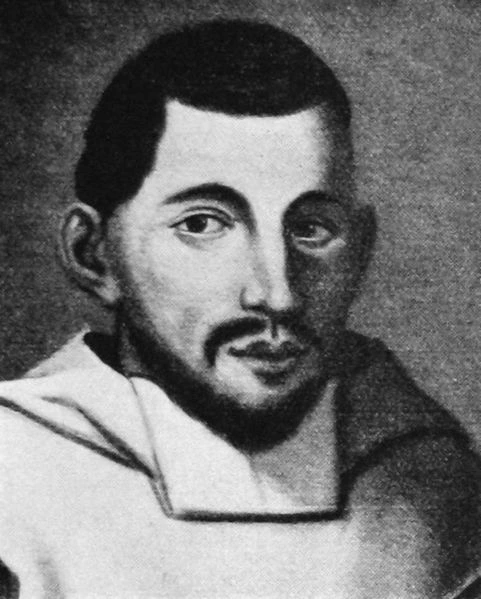
Banchieri Tommaso Adriano, known as Adriano da Bologna, pseudonym Camillo Scaligeri della Fratta and Il Dissonante, *3 September 1568 Bologna, †1634 Bologna, Italian composer, organist, music theorist, teacher, and writer. His family came from Lucca, where Banchieri may have spent his childhood and began his musical education. In 1587, he joined the Olivetan order at S. Michele in Bosco near Bologna and received the religious name Adriano, which he used continuously. In 1592, he was transferred to the monastery of SS. Bartolomeo e Ponziano in Lucca, where he studied music with G. Guami. In 1593, Banchieri was at the monastery in Siena. Between 1594 and 1600, he returned to S. Michele in Bosco, where he was organist from 1596. He later held this position: between 1600 and 1603 at the church of S. Maria in Regola in Imola, between 1604 and 1605 at S. Pietro in Gubbio (where he met G. Diruta), in 1605 at S. Elena in Venice, and in 1606 at S. Maria in Organo in Verona; in the same year, he returned to the monastery of S. Michele in Bosco, where, apart from occasional trips to Monte Oliveto Maggiore (1607) and Milan (1608), he stayed and worked until his death. In 1615, he founded the Accademia dei Floridi in Bologna, which was reorganized in 1623 and renamed the Accademia dei Filomusi, and moved to the home of G. Giacobbi, the choirmaster of the Bologna Cathedral. In 1618, the chapter of the order awarded Banchieri the honorary title of “abate” in recognition of his artistic achievements. The list of Banchieri’s works is difficult to determine; many, especially theoretical statements, were published by Banchieri as loose, small prints, often reprinted with modified or changed titles and expanded or rewritten content. Moreover, he published a large part of these loose prints in subsequent different versions of Cartella… Many of the prints of his works have been lost; a number of compositions remain in manuscript form, but it has not yet been determined whether these are copies of the prints or separate compositions. Banchieri himself left 3 lists of his works (without publication dates): in Tertio libro di nuovi pensieri ecclesiastici… (1613) and in subsequent editions of Cartella… (1614, 1615). However, these lists differ from each other and therefore do not constitute a reliable basis for a list of his works.
Banchieri is known mainly as a composer of madrigal comedies. These are works written according to the contemporary model of commedia dell’arte, both in terms of subject matter (the courtship of old men led astray by young lovers, the help of cunning servants, etc.), the number and type of characters appearing in the comedy (like O. Vecchi, he introduces new characters alongside the accepted scheme of commedia dell’arte characters), and language (individual characters use different Italian dialects). The texts sparkle with wit, and the plot creates many humorous situations; in some comedies, Banchieri also introduces Arcadian settings and characters. Musically, Banchieri remains greatly influenced by O. Vecchi, especially his L’Amfiparnaso (1597). Each of Banchieri’s comedies is a cycle of madrigals forming a dramatic plot, divided into acts and scenes; they consist of monologues and dialogues. In madrigal comedies for five voices, monologues are usually performed by the entire tutti ensemble, while dialogues, as in Vecchi’s L’Amfiparnaso, are performed by two three-voice choirs, with one of the voices remaining a common voice. However, this is not a strict rule. In madrigal comedies for three voices, the monologues are performed by three voices (sometimes even a fourth voice is added), while the dialogues are performed by two different three-voice choirs, but these choirs never combine into a full six-voice ensemble. The texture of these works is very simple, mostly homorhythmic (nota contra notam), with frequent use of illustrative and onomatopoeic effects. There are also elaborately crafted works, using imitative techniques modeled on the madrigals of the time.
Banchieri often parodies not only the style of O. Vecchi (Il studio dilettevole – a reworking of L’Amfiparnaso) or Marenzio (Barca di Venetia), but also well-known contemporary works (Palestrina’s madrigal in La pazzia senile). He also caricatures the technique of counterpoint, as for example in Festino nella sera…, where in the section entitled Contrapunto bestiale alla mente a dog, a cuckoo, a cat, and an owl sing (imitating animal voices) against a background of a pseudo-Gregorian cantus firmus in the bass with nonsensical Latin lyrics. The music also frequently assumes the character of the popular villanella, violotta, or barzelletta, etc.; in Banchieri’s works there is as yet no question of dramatic individualization of the individual parts or characters; the music is conceived above all as a jest. Banchieri’s instrumental works represent both a type similar to Gabrieli’s canzonas, as well as the canzona and the sonata in trio scoring and for organ. The latter, modest in scale, rank among the earliest organ works to bear the name “sonata.” They employ a polyphonic texture and are architecturally akin to the ricercar or to the canzona with a symmetrical sectional structure. Many of them include registration indications and notes concerning their use during specific parts of the liturgy. Banchieri’s Battaglia constitutes an early example of the alla battaglia type of piece for organ.
Banchieri’s sacred music has not been thoroughly researched. It is believed that he was the first (before Viadana) to include organ accompaniment in his Concerti ecclesiastici (1595) in the form of a partitura pro organo, in which the highest and lowest voices of the first choir were notated, bar lines were used for the first time, and verbal instructions for the organist regarding the entry of individual choirs were included. However, before Banchieri, a similar partitura pro organo can be found in Ecce beatam lucem by A. Striggio (1587) and in Motetti a otto voci by G. Croce (1594). In his early sacred works, Banchieri remained faithful to the style he had adopted from the masters of the early Venetian school. It was not until Gemelli armonici (1609) that he introduced solo voices and small ensembles into his work, while simplifying the polyphonic texture in his polyphonic works. In the field of church music, he attempted to introduce the stile moderno, but without success. In Terzo libro di nuovi pensieri ecclesiastici, he divides his works into a number of stylistic groups. Among the 1-voice concertos, he distinguishes: passagiati and accentuati – with more ornate melodies, especially at the end of the piece, affetuati – characterized by relatively varied melodies with frequent larger leaps, in ecco – with the use of echoes, in sinfonia – with introductions and ritornellos throughout the piece, performed by instruments playing basso continuo. Among the two-voice concertos, he distinguishes the following types of pieces: in dialogo, in ricercata di stile moderno, and in stile recitativo. In the latter, Banchieri attempts to apply recitative within the two-voice texture, which amounts to a parlando style of text declamation in certain sections.
Banchieri’s theoretical work was mainly written in connection with his teaching duties, which explains its character. It primarily addresses practical issues: the arrangement and harmonization of Gregorian chant – guidelines which are still relevant in today’s practice; Banchieri repeatedly addresses the practice of counterpoint in his various writings; he systematizes and provides guidelines on the use of gorgia (already systematized earlier, e.g., by Zacconi in 1592); he formulates practical guidelines for conducting. Of greatest importance is Dialogo musicale… attached to the 2nd edition of L’organo suonarino… (1611). It is the most comprehensive discussion to date of the practice of basso continuo in 2-, 3- and 4-voice music, with more detailed explanations than previous works (Viadana, Agazzari) on figured bass and the role of accidentals. Banchieri also draws attention here to the variety of basso continuo notation, distinguishing four types depending on the inclusion or omission of: 1. bar lines, 2. sharp and flat signs, 3. figures for thirds and sixths and their octave doublings, and 4. figures for consonances and dissonances. Dialogo is supplemented by Conclusioni nel suono dell’organo, in which he included many comments on organ performance practice and rules for tuning an instrumental ensemble with organs. In his views, Banchieri vacillates between prima and seconda pratica. On the one hand, he theoretically advocates new music, citing works by Gesualdo, Monteverdi, and Viadana; in Festino nella sera (1608), he declares himself in favor of progress. On the other hand, however, he treats Artusi as almost the sole authority; in Moderna pratica musicale (1613), he clearly opposes the fundamental thesis of seconda pratica on the superiority of speech over harmony, and in the preface to Saviezza giovenile (1628), he sharply attacks contemporary dramatic music for its dilettantism. In his work, although he often describes his own compositions as modern or reworks them in stile moderno (which is limited to the addition of basso continuo), he never goes beyond the principles formulated for prima pratica.
Literature: F. Vatielli Il madrigale drammatico e A. Banchieri, «Arte e vita musicale di Bologna» I, Bologna 1927; F.T. Arnold The Art of Accompaniment from a Thorough-Bass, Oxford 1931, 3rd ed. New York 1965; A. Einstein The Italian Madrigal, vol. 2, Princeton 1949; C. Delfrato Vecchio e nuovo nei madrigali di A. Banchieri and G. Vecchi L’opera didattico-teorica di A. Banchieri, in: C. Monteoerdi e il suo tempo, ed. R. Monterosso, Verona 1969; G. Vecchi Una seduta dei Filomusi a Bologna e il „Virtuoso Ritrooo Academico” di A. Banchieri (1626), “Chigiana” XXV, 1968; H.-J. Wilbert Die Messen di A. Banchieri, Mainz 1968; S. Bonta The Uses ofthe Sonata da chiesa, “Journal of the American Musicological Society” XXII, 1969; H.E. Smither The Latin Dramatic Dialogue and the Nascent Oratorio, “Journal of the American Musicological Society” XX, 1967; H.-J. Wilbert Le messe polifoniche di A. Banchieri and O. Mischiati A. Banchieri. Profilo biografico e bibliografía delle opere, in: Annuario 1965–1970 del Conservatorio di Musica G.B. Martini di Bologna, 1971; S. Dahms A. Banchieris „La pazzia senile” im Heilbrunner Steintheater, “Österreichische Musikzeitschrift” XXXII, 1977; A. Wernli Studien zum literarischen und musikalischen Werke A. Banchieris (1568–1634), «Publikationen der Schweizerischen Musikforschenden Gesellschaft» II, Bern 1981; K.G. Feilerer Wesen und Werden der italienischen Monodie um 1600, in celebratory publication for H. Beck, eds. H. Dechant and W. Sieber, Laaber 1982; K.G. Feilerer A. Banchieri und die kirchliche Orgelmusik, in: Orgel, Orgelmusik und Orgelspiel, in celebratory publication for M. Schneider, ed. Ch. Wolff, Kassel 1985; M. Farahat On the Staging of Madrigal Comedies, “Early Music History” X, 1991; G. Dahan Une dramaturgie au second degré. La comédie madrigalesque – L’exemple de la „Pazzia senile”, in: Les premiers opéras en Europe et les formes dramatiques apparentées…, proceedings of the international seminar of the Société Internationale d’Histoire Comparée du Théâtre, de l’Opéra et du Ballet, ed. I. Mamczarz, «Collection Théâtre Européen, Opéra, Ballet» II, Paris 1992; U. Wolf Et nel fine tre varíate armonie sopra il Magnificat, in: Bemerkungen zur Vertonung des Magnificats in Italien im frühen 17. Jahrhundert, “Neues musikwissenschaftliches Jahrbuch” II, 1993.
secular:
Canzoni alla francese… per sonare… in fine una battaglia a otto, & dui concerti fatti sopra Lieto godea… for 4 voices, Book 2, pub. Venice 1596 R. Amadino
La nobilissima anzi asinissima compagnia delli briganti della bastina…, pub. Vicenza 1597 B. Barezzi (published under the pseudonym Camillo Scaligeri dalia Fratta), 2nd ed. Milan 1598 P. Pacifico
Canzonette… hora prima di recreatione… for 3 voices, (probably as Book 1), pub. Venice 1597 R. Amadino, 2nd ed. 1603
La pazzia senile. Ragionamenti vaghi, et dilettevoli…, Book 2 of canzonettas for 3 voices (according to the composer, the 12th edition of this book), pub. Venice 1598 R. Amadino, 8th ed. 1621
Il studio dilettevole… con vaghi argomenti et spassevoli intermedii fioriti dall’ Amfiparnasso…, Book 3 of canzonettas for 3 voices (adaptation of L’Amfiparnaso by O. Vecchi), pub. Milan 1600 G.E Bessozzi & Co, 2nd ed. Cologne 1603
Il metamorfosi musicale…, Book 4 of canzonettas for 3 voices, Venice 1601 R. Amadino, 2nd ed. 1606
Fantasie overo Canzoni alla francese per suonare nell’organo… et altri stromenti musicali… for 4 voices, pub. Venice 1603 R. Amadino
Il zabaione musicale inventione boscareccia…, Book 1 of madrigals for 5 voices, pub. Milan 1604 S. Tini & F. Lomazzo
Barca di Venetia per Padova…, Book 2 of madrigals for 5 voices, Op. 12, pub. Venice 1605 R. Amadino, 2nd ed. 1623 (with added basso continuo)
Virtuoso ridotto tra signori, e dame, entr’il quale si concerta recitabilmente in suoni & canti una nuova comedia detta prudenza giovenile…, Book 5 of canzonettas for 3 voices, Op. 15, pub. Milan 1607 S. Tini & F. Lomazzo, 2nd ed. Venice, 1628 B. Magni (titled Saviezza giovenile)
Festino nella sera del giovedi grasso avanti cena…, Book 3 of madrigals for 3 voices, Op. 18, pub. Venice 1608 R. Amadino
Moderna armonia di canzoni alla francese… con… doi fantasie a quatro stromenti, et uno Magnificat in concerto… for 4 voices, Op. 26, pub. Venice 1612 R. Amadino
Tirsi, Fili e Clori che… cantano il 60 et ultimo libro[1] delle canzonette… (contemporary lexicons also mention 5 further books of canzonettas for 4 voices, which, according to some sources, were issued from 1595, and according to others from 1600. This appears to be a misunderstanding, since in the lists of works left by Banchieri no 4-voice canzonettas are mentioned) for 3 voices, pub. Venice 1614 R. Amadino (lost)
Vivezze di Flora e Primavera… for 5 voices and basso continuo pub. Venice 1622 B. Magni
Vilanelle… for 3 voices, pub. Venice 1623 (lost)
La sampogna musicale…, pub. Bologna 1625 G. Mascheroni (only the text surviving)
Il virtuoso ritrovo academico del dissonante… for 1–5 voices or instruments, Op. 49, pub. Venice 1626 B. Magni
La fida fanciulla, commedia esemplare con musicali intermedii…, pub. Bologna 1628 Tebaldeo, 2nd ed. 1629 (lost)
Trattenimenti da villa concertati… for 5 voices and basso continuo, pub. Venice 1630 A. Vincenti
sacred:
Concerti ecclesiastici… aggiuntovi nel primo choro la spartitura per sonare nell’organo… for 8 voices, pub. Venice 1595 G. Vincenti
Salmi… for 5 voices, pub. Venice 1598 R. Amadino
Messa solenne… dentrovi variati concerti… for 8 voices, Book 3, pub. Venice 1599 R. Amadino
Ecclesiastiche sinfonie dette canzoni in aria francese… per sonare et cantare… for 4 voices and basso continuo, Op. 16, pub. Venice 1607 R. Amadino
Gemelli armonici… for 2 voices, Op. 21, pub. Venice 1609 R. Amadino, 2nd ed. expanded Venice 1622 B. Magni
Vezzo di perle musicali… for 1–2 voices and basso continuo, Op. 23, pub. Venice 1610 R. Amadino, 2nd revised ed. Venice 1616
Salmi festivi intieri, coristi, allegri et moderni… for 4 voices and basso continuo, Op. 33, pub. Venice 1613 R. Amadino
Terzo libro di nuovi pensieri ecclesiastic… (with instructions on how to play the musical instrument invented by Banchieri, the arpichitarrone: Ordine et misure per fabricare il moderno stromento musicale arpichitarrone) for 1–2 voices and basso continuo, Op. 35, pub. Bologna 1613 G. Rossi
Due ripieni in applauso musicale… for 8 voices and instrument, pub. Bologna 1614 G. Rossi
Sacra armonia… for 4 voices and basso continuo, Op. 41, pub. Venice 1619 A. Gardano
Primo libro delle messe e motetti… for 3 voices and basso continuo, Op. 42, pub. Venice 1620 A. Vincenti
Dialoghi, concerti, sinfonie e canzoni… for 2 voices and basso continuo, Op. 48, pub. Venice 1625 A. Gardano, 2nd ed. Ingolstadt 1629
Missa a 8 super Lieto godea, MS. (Banchieri listed this piece as printed)
Missa dominicalis a 4, MS.
8 motets, MS. Surviving at the British Museum
mass, MS. Surviving at the British Museum (transcription into organ tablature)
2 motets, manuscripts surviving at the British Museum (transcription into organ tablature)
Litanie e concerti for 8 voices, pub. Venice n.d. (lost)
Salutazioni Loretane for 8 voices, pub Venice 1595 (lost)
Carta di sacre lodi for 4 voices, pub. Milan 1605 (lost)
Primi nuovi pensieri… for 2 voices and basso continuo, Venice (?, lost)
Secondi nuovi pensieri… for 2 voices and basso continuo, pub. Milan 1611 (lost)
Il quarto libro et ultimo di nuovi pensieri ecclesiastici…, ? (lost)
Messe, salmi et letanie… for 3 voices, pub Venice 1625 (lost)
Writings:
theoretical:
Cartella ovvero Regole utilissime a quelli che desiderano imparare il canto figurato…, Venice 1601, 2nd expanded ed. titled: La Cartella utile…, Venice 1610, 3 wyd. najobszerniejsze titled: Cartella musicale nel canto figurato fermo et contrapunto…, Wenecja 1614 (zawiera 12 wcześniej wydanych prac: Primo arringo musicale…, Seconda pratica e regola infallibile e facile…, Brevi e primi documenti musicali…, Duo in contrapunto…, Altri documenti musicali nel canto fermo…, Nuovo arringo musicale…, Epilogo del contrapunto…, Duo spartiti al contrapunto…, Canoni musicali a quatro voci…, Moderna pratica musicale… Op. 37, Cento variati passaggi…, Esempio di componere varie voci sopra un basso di canto fermo…), 4th revised ed. titled: La Cartellina…, Venice 1615, 5th revised ed. titled: La Banchierina…, Venice 1623
L’Organo suonarino… Op. 13, Venice 1605, 2nd ed. with Dialogo musicale del R.P.D. Adriano Banchieri Bolognese con un amico suo, che desidera suonare sicuramente sopra un basso continuo in tutta la maniera, Venice 1611, 3rd ed. 1628, 4th ed. 1638
Sul canto figurato fermo e contrapunto…, Venice (?) 1609
Conclusioni nel suono dell’organo… Op. 20, Bologna 1609, 2nd ed. in Latin Siena 1608, 3rd ed. titled Armoniche conclusioni…, Bologna 1627 (sometimes cited in certain sources as the 1st edition, Lucca 1591, but there is no documentary evidence; Banchieri himself does not list a single item published in Lucca in his catalog of works)
Cartellina del canto fermo…, Milan 1611, 2nd ed. titled: Cartellina del canto fermo gregoriano…, Bologna 1614
Fratto solutifero alli R.P. Sacerdoti per prepararsi alla celebratione della S. Messa privata e cantata…, Bologna 1614, 3rd ed. 1638
Prima parte del Primo libro al Direttorio Monastico di canto fermo…, Bologna 1615, 2nd or 3rd ed. titled: Cantarino utile a novizzi e clerici…, Bologna 1622
Lettere armoniche…, Bologna 1628, 2nd ed. titled: Lettere scritte a diversi patroni…, Bologna 1630
Il principiante fanciullo… for 2 voices, Op. 46, Venice 1622 (vocal exercices)
literary:
Discorso per fuggire l’otio estivo dove si prova che la favella Bolognese precede La Toscana di C.S. dalia Fratta, Bologna 1622
La Catlina da Budri ovvero il Furto amoroso. Commedia, Bologna 1628, and more
Editions:
La pazzia senile, «Capolavori polifonici del secolo XVI», vol. 6, Rome 1960 and in: Torchi “Acta Musicologica” IV, 2nd ed. Milan 1968
10 organ works, in: Torchi “Acta Musicologica” III, 2nd ed. Milan 1968
Festino nella sera…, «Capolavori polifonici del secolo XVI», vol. 1, Rome 1939, 2nd ed. 1956
Barca di Venetia, «Capolavori polifonici del secolo XVI», vol. 9, Rome 1969
La saviezza giovenile, Milan 1956; A. Banchieri Opera omnia, Bologna since 1963
facsimile:
Conclusioni nel suono dell’organo, “Biblioteca Musica Bononiensis” II, 24, Bologna 1968
Cartella musicale (from 1614), “Biblioteca Musica Bononiensis” II, 26, Bologna 1968
Terzo libro di nuovi pensieri, “Biblioteca Musica Bononiensis” IV, 40, Bologna 1969
Lettere armoniche (from 1628 and 1630), “Biblioteca Musica Bononiensis” V, 21, Bologna 1968
L’organo suonarino (from 1605, 1611 and 1638), Hilversum 1969
Conclusioni nel suono dell’ organo 1609, English trans. L.R. Garrett, «Translations» 13, Colorado Springs 1982
Cinque concerti sacri di A. Banchieri, wyd. E. Capaccioli, “Rivista internazionale di musica sacra” IV, 1982 (5 concerts from Ecclesiastiche sinfonie… 1607)
Il zabaione musicale, ed. P. Mecarelli, «Madrigalisti dell’Italia settentrionale» I, Florence 1987
„Vezzo di perle musicali”. Una raccolta per le monache di Santa Maria della Neve in Piacenza, ed. M.G. Genesi, Bologna, Civico Museo Bibliografico Musicale V, Piacenza 1992