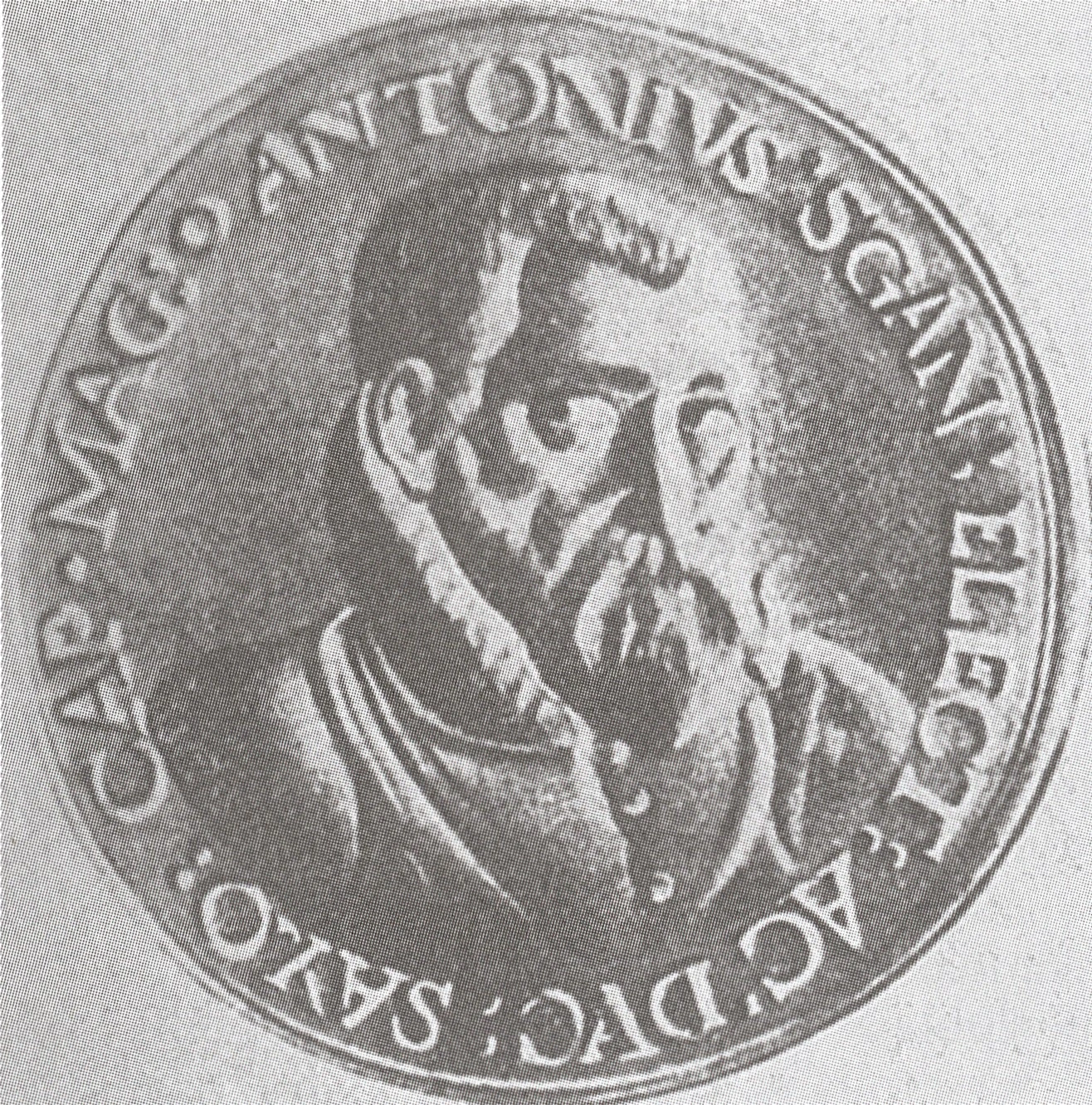
Scandello Antonio, *17 January 1517 Bergamo, †18 January 1580 Dresden, Italian composer working in Germany. He began his career in an unusual way, for he had not been trained as a choirboy; from 1530 onward, however, he played the trumpet, cornett, and possibly the trombone in the municipal ensemble of trumpeters (which also included his father, Hieronimus Scandello, †1528[?], and his brother, Angelo). Nevertheless, he may have been able to master the principles of composition in Bergamo, where distinguished composers such as Gaspar de Albertis were active. In 1547, Scandello was employed at the court of the Cardinal C. Madruzzo in Trent, where the maestro di cappella at the time was G. Contino, later the teacher of L. Marenzio. In the spring of 1549, he was recruited as an instrumentalist to the court of Maurice, Elector of Saxony in Dresden. Here he had the opportunity to perfect his craft with J. Walter, who was the court cantor until 1554. Scandello’s earliest surviving works, a 6-voice: motet (dated 1551 in the manuscript) and a mass written on the occasion of Prince Maurice’s death (1553), are already the works of a mature composer. He remained in the service of the next prince-elector, Augustus, until the end of his life, from around 1560 increasingly replacing the ailing Kapellmeister M. Le Maistre; in 1566 he became the official deputy Kapellmeister, and from 1568 Kapellmeister. He settled in Dresden, obtained citizenship of the city, converted to Lutheranism, and got married (1568); of his three sons, August (*1570, †1609) was a musician at the courts of Dresden and Wolfenbüttel.
In his Latin works, Scandello continues the Netherlandish tradition. In the memorial mass, the six-note ostinato appears throughout, presented in three hexachords; the motif, through the direction of its melodic line, illustrates the word “fell” (in battle) from the epitaphic verse quoted in the source, while at the same time it is shaped according to a specifically realized application of the soggetto cavato principle. The symbolism is also evident in Scandello’s use of chromatic combinations C-Dm-D-Bb-Eb-Cm-D in the mass Avec vous at the words “peccata”, or in the choice of 7 voices in the only Marian motet. 6 masses belong to the parody type; 2 are based on motets, 2 on chansons, and 2 on madrigals (one by V. Ruffo); probably due to the structure of the patterns, there is greater diversity of texture in these masses. Only the magnificat and the secular motet are double-choir works; in the other motets, imitation is intertwined with free polyphony.
Scandello’s Passion occupies a special place in the history of this genre. The composer was the first to employ a form practiced in northern Italy (e.g. by G. de Albertis in Bergamo) in Lutheran liturgy, by setting the text of all the characters in polyphonic form (except for the Evangelist). Thus, a set of over thirty sections, unified through the use of monody, was created, varying in length from three chords to about forty breves; homorhythmic textures predominate, though passages of free polyphony, and even occasional traces of imitation, also occur. In doing so, Scandello linked the number and register of voices to the characters, thereby distinguishing them musically. He achieved dramatic tension through recitative-style melodic line, skillful handling of pauses, and the use of chromatic chord combinations (e.g., F–A) or dissonant harmonies, such as augmented sixths. The Resurrection mystery play is constructed in a similar manner. Among Scandello’s lieder (especially religious ones, in which he often sets texts from psalms and well-known Protestant chorales), many are imitative or even directly modeled on the motet; in others, homorhythm clearly predominates. In contrast, his canzoni, most often in the typical AABCC scheme, are dominated by absolute homorhythm, often accompanied by a dialogue between groups of voices or a group with a single voice; imitation is the least common, although there are a few pieces (especially in book 2) in which it predominates. In his canzoni, Scandello most often uses texts (sometimes in the Neapolitan dialect, less often in Venetian) that had already been adapted in the years 1557–65, but he transforms their form, abandoning the verse structure (he selects verses without always ensuring their logical connection). Unlike A. Willaert and other composers from his circle, he rarely refers (in the form of parody) to the structure of musical prototypes.
Literature: O. Kade Die ältere Passionskomposition, Gütersloh 1893, repr. Hildesheim 1971 (contains numerous passion sections); O. Kade Antonius Scandellus, 1517–1580. Ein Beitrag zur Geschichte der Dresdener Hofkantorei, “Sammelbände der Internationalen Musikgesellschaft” XV, 1913–14; B. Smallman The Background of Passion Music. J.S. Bach and his Predecessors, London 1957, 2nd expanded ed. 1970; E. Schmidt Der Gottesdienst am kurfürstlichen Hofe zu Dresden, Göttingen 1961; A. Carver The Psalms of Willaert and his North Italian Contemporaries, “Acta Musicologica” XLVII, 1975; S. Köhler Musikstadt Dresden, Leipzig 1976, 3rd ed. 1981; A. Botti-Caselli “La Storia della Resurrezione”: un debito di Heinrich Schütz nei confronti di Antonio Scandello? Vitalità di un’opera radicata nella tradizione, in: H. Sch. e il suo tempo, in the volume of the International Congress in Urbino 1978, ed. G. Rostirolla, Rome 1981; G.S. Towne Gaspar de Albertis and Music at Santa Maria Maggiore in Bergamo in the Sixteenth Century, thesis, University of California, 1985; M.A. Balsano “Et a Dresda Martin diventò Ianni”. Le “canzoni napolitane” di Antonio Scandello, in: Von Isaac bis Bach. Studien zur älteren deutschen Musikgeschichte Festschrift Martin Just zum 60. Geburtstag, eds. F. Heidlberger et al., Kassel 1991; D.O. Heuchemer Italian Musicians in Dresden in the Second Half of the Sixteenth Century, with an Emphasis on the Lives and Works of Antonio Scandello and Giovanni Battista Pinello di Ghirardi, thesis, University of Cincinnati, 1997; E. Steindorf Die sächsische Staatskapelle Dresden, Berlin 1997; G. Towne Tubatori e piffari. Civic Wind-Players in Medieval and Renaissance Bergamo, “Historie Brass Society Journal” IX, 1997; R. Charteris New Connections between Eastern Europe and Works by Philips, Dowland, Marais and Others, “Chelys” XXIX, 2001; D.G. Reuning Antonius Scandellus, The Third Kantor of the Lutheran Church at the Saxon Electoral Court Chapel in Dresden. His Liturgical Music with an Emphasis on the Motets, thesis, University of Illinois at Urbana-Champaign, 2001; P. Daněk and T. Daňková Teutsche Lieder zuvor unterschiedlich, jetzund aber mit des Herrn Authoris bewilligung inn ein Opus zusammen getruckt aneb praktický průvodce konvolutem tisků AZ 38 / AK XII 17, “Musicalia” VII, 2015; S.L. Edwards Translating Sorrow: Giovanni Battista Pinello, Gentil’huomo Genovese at the Dresden Court, “The Journal of Musicology” XXXIII, 2016.
Compositions:
sacred:
5 masses for 6 voices and 3 for 5 voices (among others Missa ad aequales) most likely printed in 1558 and 1572, preserved only in manuscript, among others in Dresden, Rostock, and Berlin (collections from Wrocław)
the discant of the mass (possibly identical with the ‘ad aequales’ setting) in manuscript I.5 in the Archives of the Cracow Cathedral Chapter at Wawel
7 motets for 6–8 voices (of which 2 are in 2 parts) and a magnificat for two 4-voice choirs, preserved in manuscript anthologies from 1550–60, Dresden, and in prints from Nuremberg, 1564–90
5 motets preserved incompletely in manuscript
Newe Teutsche Liedlein…, 9 songs for 4 voices, 2 for 5 voices, and one (Latin) motet for 4 voices, Nuremberg, 1568
Nawe schöne außerlesene Geistliche Deudsche Lieder…, 19 songs for 5 voices (including 2 repeated from 1568), 2 for 6 voices, one for 7 voices, and a 2-part ‘dialogus’ for 8 voices, Dresden, 1575
Gaudij Paschalis (…) Österliche Freude der siegreichen und triumphierenden Auferstehung (…) Jesu Christi (…) von den heiligen vier Evangelisten beschrieben… for 2–5 voices, Wrocław 1612 (composition ca. 1575)
Passio. Das Leyden Unsers Herrn (…) nach dem H. Evangelisten Johannes… for 2–5 voices, Wrocław 1621 (composition before 1562)
a chorale for 6 voices, preserved in manuscript in Zwickau
works preserved incompletely in manuscript
secular:
El primo libro de le canzoni napolitane…, 24 works for 4 voices, Nuremberg 1566; 2nd edition 1572; 3rd edition 1583, book 2, containing 12 works for 4 voices and 12 for 5 voices, Munich, 1577
Nawe und lustige Weltliche Deudsche Liedlein…, 4 songs for 4 voices, 13 for 5 voices, and 3 for 6 voices, Dresden, 1570; 2nd edition 1578 and 1579 (T)
3 canzoni preserved in incomplete manuscript
panegyric motet in honor of Prince August, for two 4-voiced choirs, in anthology, Nuremberg, 1564
2 epithalamia for 5 voices, Wittenberg, 1568 and n.p. and n.d. [1574]
Editions:
transcriptions of preserved works in: D.O. Heuchemer Italian Musicians in Dresden in the Second Half of the Sixteenth Century, with an Emphasis on the Lives and Works of A. Scandello and G. B. Pinello di Ghirardi, 3rd vol., thesis, University of Cincinnati 1997
A. Scandello, Missa super epitaphium Mauritii, ed. L. Hoffmann-Erbrecht, «Das Chorwerk» LXV, Wolfenbüttel 1958
Osterrliche Freude and 2 psalms from 1568 in: K. Ameln, Ch. Mahrenholz and W. Thomas ed. Handbuch der deutschen evangelischen Kirchenmusik, Göttingen, vol. 1: Der Altargesang, part 4: Die biblischen Historien, 1974, vol. 2: Das gesungene Bibelwort, part 1: Die a-cappella-Werke, 1976