
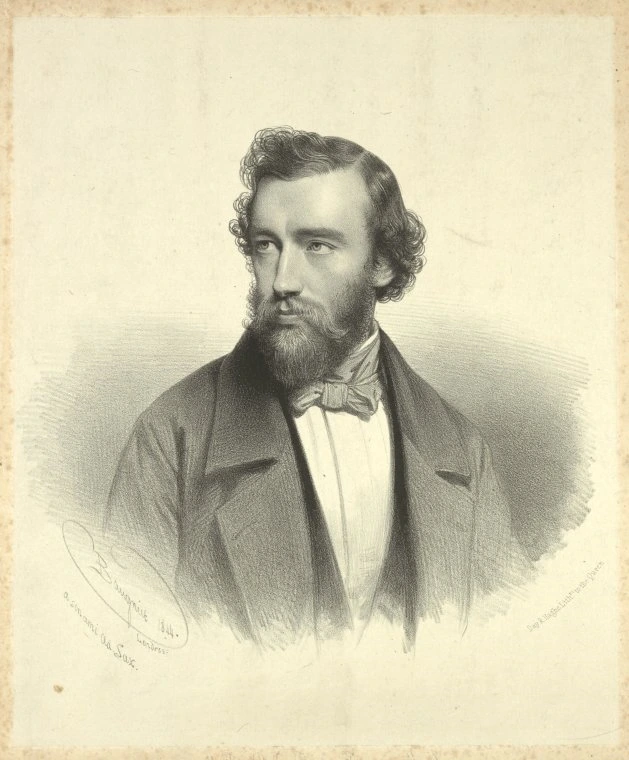
Sax, Charles Joseph

Sax Adolphe, actually Antoine Joseph, *6 November 1814 Dinant, †4 February 1894 Paris, Belgian inventor and manufacturer of wind instruments, son of Charles Joseph. He studied flute and clarinet at the Brussels Conservatory. In 1835–42, he managed his father’s factory, introducing his first innovations into production. In 1842, rejecting offers from London and St. Petersburg, he settled in Paris and, thanks to the support of H. Berlioz, F.-J. Fétis, F. Halévy, J. G. Kastner, G. Meyerbeer and G. Rossini, he developed a wide range of activities, producing excellent quality wooden and brass wind instruments. Although from the very beginning, he met with great hostility from Parisian manufacturers, he gradually increased sales and, after 1850, he launched large-scale production, producing all the parts in his own factory. In a short time, he patented his most important inventions: the saxhorn (1845), the saxo-trumpet (1845) and the saxophone (1846). In 1845, his instruments, despite the protests of 34 Parisian manufacturers, were approved by the French Ministry of War for use by military bands. In 1846, he employed 70 workers, while his biggest Parisian competitor, Pierre Louis Gautrot, employed as many as 200. In 1847, Sax received the position of conductor of “musiciens externes” at the Opéra de Paris, in 1854, the title of Builder of Musical Instruments of the Imperial Court Troops, and in 1857, he became a teacher in the newly established saxophone class at the Paris Conservatory. Despite compensation for winning lawsuits, he never regained his former position and lived on a modest pension for the rest of his life. After Adolphe’s death, the factory was run by his son Adolphe Eduard (1859–1945), and in 1928, it became the property of Henri Selmer’s company, which until 1933 produced instruments also as Sax.
Sax’s range of activity was extremely wide: he improved and designed new instruments, produced them, conducted acoustic research, was a teacher and publisher. He strove to create uniformly sounding families of brass instruments with high sound values and introduced solutions that allowed for full-scale chromatisation. His inventive genius was evident on many levels. In addition to working on entire families of aerophones (over 30 patents), he introduced or improved individual instruments, including the bass clarinet with a new system of keys and an extended scale downwards (patent 1838), which gained great recognition from Fétis, Berlioz and Meyerbeer, who was the first to use it in the opera Le prophète (1849). He also designed a saxophone (patent 1849), a six-valve trombone with 7 independent valves (patent 1859), and a special trumpet for the Paris premiere of Verdi’s Aida (1880). Throughout his career, he perfected production methods, including inventing a new method of electrogalvanising (patent 1866). He also introduced improvements to pianos, organs and percussion instruments, including building chromatic kettledrums, for which he received a gold medal in London (1851); he also experimented with the shape and size of string instruments. Combining the latest technologies with the experience of a practical musician, he remained creatively active almost until the end of his life (last patent in 1886). He was the first large-scale entrepreneur in the history of instrument construction, with great organisational talent and marketing sense. In 1843–87, he built over 40,000 instruments, achieving an annual production of 1,500 pieces. For his inventions, he received numerous medals and distinctions, including in 1851 in London, where he presented 85 instruments, and there in 1862 when he exhibited as many as 200 instruments; in 1866, he won a gold medal in Porto. He also dealt with the acoustics of concert halls and various medical devices and means. In 1858, he founded a publishing house (187 titles), which published his writings and educational materials for learning to play the saxophone and saxhorn, as well as compositions by French and Belgian composers for these and other instruments. He usually demonstrated his inventions in person or created groups that performed transcriptions for the saxophone or compositions specially commissioned by him; his cooperation with the Distin family quintet from England played a significant role in popularising the saxhorn in Europe and the United States. A major role in putting Sax’s inventions into vogue was played by contemporary composers, mainly Kastner and Berlioz, who published enthusiastic opinions in the periodical “Journal des Débats,” organised concerts allowing Sax to demonstrate new instruments, and even supported him financially. The government contract gave him a near-monopoly position in France, but he was unable to fully exploit it, driving the company into bankruptcy three times (1852, 1873 and 1877), as a result of which in 1877, his instrument collection was auctioned off (467 objects, a large part of which later went to the Museum of Musical Instruments in Brussels), as well as the factory equipment and publishing house. As a foreigner, Sax encountered great hostility from the Parisian manufacturers, who tried to eliminate him from the market, blocked the introduction of newly designed instruments to the Opéra orchestra and took over his employees. He was the target of a malicious press campaign and brutal attacks, and his competitors initiated numerous lawsuits against him, aimed at invalidating his patents. The ongoing disputes in court, sometimes initiated by Sax himself, led not only to the bankruptcy of small Parisian manufacturers but ultimately to his own bankruptcy. His greatest invention remains the saxophone, created for use in military bands, patented on 21 March 1846 and improved twice afterwards (patents 1866 and 1880). Sax’s search for an instrument with a sound similar to that of string instruments, but with the power to use it outdoors, as well as modifications to the bass clarinet and ophicleide (the saxophone was still called “Ophicleide à bec” by Berlioz), led to its construction. It caused a reorganisation of French military bands, but it did not find wide application in artistic music in Adolphe Sax’s time, despite its introduction to orchestral scores as early as 1844 (J. G. Kastner Le dernier roi de Judd), enthusiastic opinions by Berlioz and later use by Meyerbeer (1865) and Rossini (1886). Sax’s research on the aerophone bore, which enabled him to create homogeneous families of instruments, and on the mechanics of pistons and valves, was of great importance. The introduction of the saxhorn revolutionised the sound of wind ensembles, while the similar (but with a narrower bore) saxo-trumpet (patent 1845) had a short life, known today only from Kastner’s description (Manuel général de musique militaire, Paris 1848).
Literature: P. Gilson Les géniales inventions d’Adolphe Sax, Brussels 1939; L. Kochnitzky Adolphe Sax and his Saxophone, New York 1949, 21964; M. Haine Adolphe Sax (1814–1894). Sa vie, son oeuvre et ses instruments de musique, Brussels 1980; W. Horwood Adolphe Sax (1814–1894). His Life and Legacy, Baldock 1980, 2nd ed. 1983. J. Kool Das Saxophone, Leipzig 1931/R, English transl. Baldock 1987; M. Haine, I. de Kayser Catalogue des instruments Sax au Musée instrumental de Bruxelles suivi de la liste de 400 instruments Sax conservés dans les collection publiques et privées, Brussels 1979-1980; M. Haine Les licences de fabrication accordées par Adolphe Sax à ses concurrents, “Revue Belge de Musicologie”, 34–35 (1980–81); W. McBride The Early Saxophone in Patents 1838–1850 Compared, “The Galpin Society Journal” 35 (1982); H. Malou Adolphe Sax, sa vie, son oeuvre, ses instruments de musique, Brussels 1980; I. de Keyser Les Sax de Bruxelles à Paris – Historique de la firme et inventions, in: La Facture instrumentale européenne: suprématies nationales et enrichissement mutuel, Paris 1985; R. Ingham (ed.) The Cambridge Companion to the Saxophone, Cambridge, 1998; K. Ellis The Fair Sax: Women, Brass-playing and the Instrument Trade in 1860s Paris, “Journal of the Royal Musical Association” 124 (1999); D. Pituch Saksofon od A do Z, Kraków 2000; Robert S. Howe The Invention and Early Development of the Saxophone, 1840–55, “Journal of the American Musical Instrument Society” 29 (2003); I. de Keyser Adolphe Sax and the Paris Opéra, in: Brass Scholarship in Review. Proceedings of the Historic Brass Society Conference at the Cité de la Musique, Paris 1999, Hillsdale 2006; E. Mitroulia, A. Myers Adolphe Sax: Visionary or Plagiarist?, “Historic Brass Society Journal” 20 (2008); E. Mitroulia The Saxotromba: Fact or Fiction?, “Journal of the American Musical Instrument Society” 21 (2009); A. R. Rice Making and Improving the Nineteenth-Century Saxophone, “Journal of the American Musical Instrument Society” 35 (2009); S. Cottrell The Saxophone, New Haven 2013; F. Gétreau Adolphe Sax, éditeur de musique, in: Quatre siècles d’édition musicale. Mélanges offerts à Jean Gribenski, ed. J. Élart, É. Jardin, P. Taïeb. Brussels 2014; J.-P. Rorive Adolphe Sax: sa vie, son génie inventif, ses saxophones, une révolution musicale, Editions Gérard Klopp, 2014; Adolphe Sax, his influence and legacy: a bicentenary conference, “Revue Belge de Musicologie” 70 (2016) [thematic book devoted to Sax]; S. Carter Berlioz, Kastner, and Sax: Writing for and about the Early Saxhorn and Saxophone, “Historic Brass Society Journal” 30 (2018); Das Saxhorn: Adolphe Sax’ Blechblasinstrumente im Kontext ihrer Zeit, ed. A. von Steiger, D. Allenbach, M. Skamletz (Musikforschung der Hochschule der Künste Bern: Romantic Brass Symposium 3.), Edition Argus 2020; D. Samól Adolphe Sax i muzyka saksofonowa XIX wieku, Kraków 2020.
Méthode complète pour saxhorns & saxotrombas…, published in Paris 1851
Réponses aux observations soumises par M. Besson…, published in Paris 1860
De la nécessité des musiques militaires, published in Paris 1867
Salle de théâtre Sax, son but et ses avantages, published in Paris 1873
Catalogue du Musée instrumental de M. Adolphe Sax, published in Paris 1877