
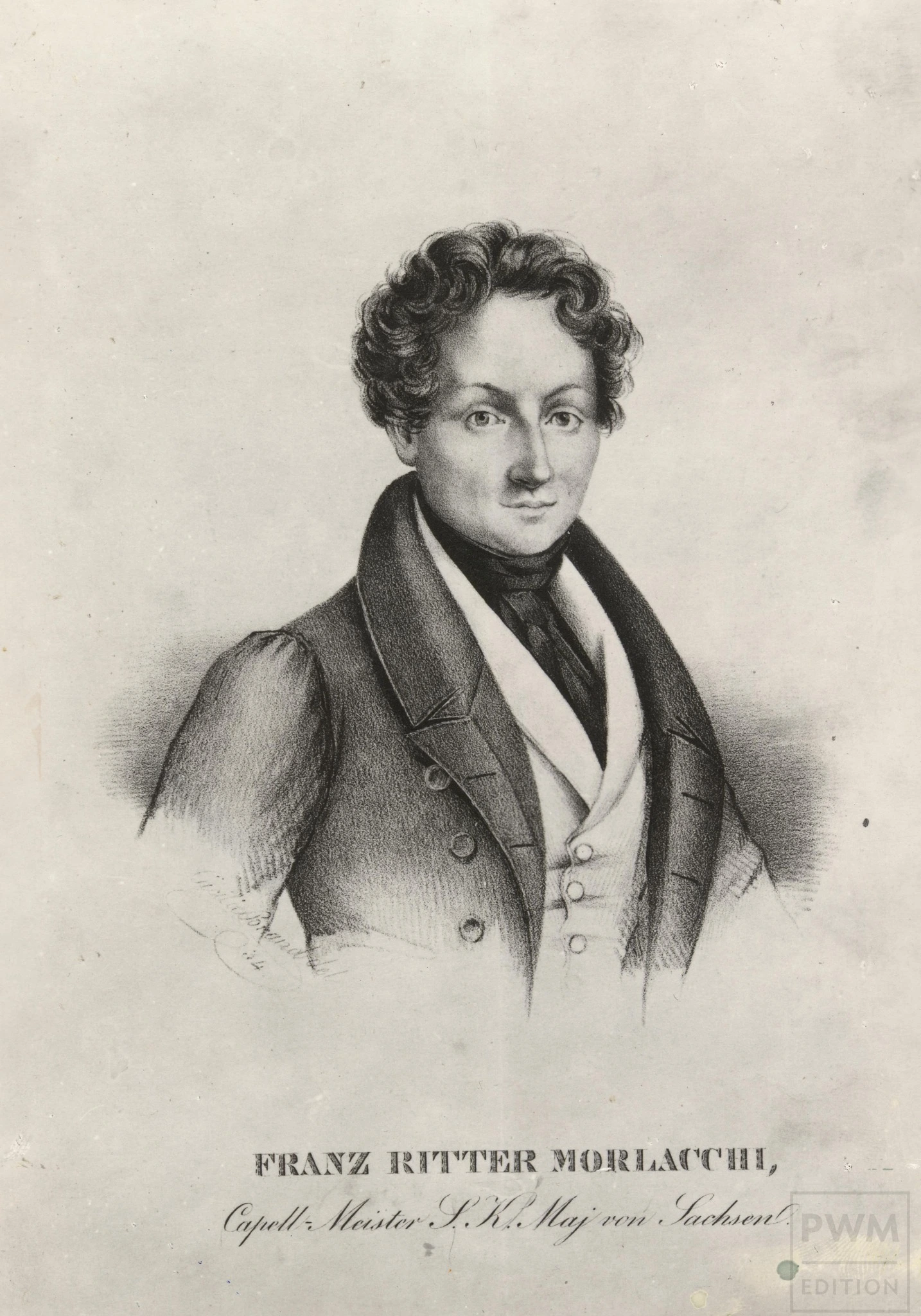
Franz Ritter Morlacchi, Capell-Meister S. K. Maj von Sachsen

Morlacchi Francesco Giuseppe Baldassare, *14 June 1784 Perugia, †28 October 1841 Innsbruck, Italian composer, and conductor. In 1803–04, he studied under N. Zingarelli in Loreto, and then under S. Mattei at the Liceo musicale in Bologna. On the occasion of Napoleon I’s coronation as King of Italy, he composed the cantata Il tempio della gloria in 1805, which was performed at the Teatro maggiore in Bologna. Soon after, as a member of the Accademia filarmonica, he wrote several more choral works: Te Deum, Pater noster, Miserere a 16, Cantata in lode della musica. He made his opera debut in 1807 with the musical farce Il poeta in campagna in Florence. Thanks to the significant success of the opera series Il Corradino (Parma, 1808), Morlacchi quickly became one of the most sought-after Italian composers, writing on commission for La Scala in Milan and the Teatro Argentina and Teatro Valle in Rome, among others. In 1810, thanks to a recommendation from the singer Maria Marcolini, for whom he composed the cantata Saffo, Morlacchi was appointed assistant conductor, and a year later he became lifelong Kapellmeister and director of the Italian Opera in Dresden. Morlacchi’s brilliant and versatile musical talent, as well as his successes in directing the theatre ensemble, quickly won him the support of the conservative court faction, and in particular the influential Minister D. Graf von Einsiedl. In addition to his own works, which enjoyed enormous success, Morlacchi staged numerous pieces from the Italian repertoire, including Rossini’s operas, as well as masterpieces of oratorio music by J.S. Bach and Händel. For ten years, he competed, at times not entirely honourably, with Weber, who from 1817 was director of the German Opera in Dresden, whose establishment Morlacchi attempted to hinder. These facts cast a shadow on Morlacchi’s contribution to German musical culture, but research by historians (e.g. Warrack, 1968) shows that the cause of the friction was mainly the spectacular reactions of the opposing factions and critics, rather than the artists themselves. Morlacchi’s prolonged stay in Dresden did not weaken his ties with his homeland, where he spent long holidays while fulfilling commissions for operas and religious works from Italian theatres and church institutions (Venice, Milan, Naples, Genoa, and Perugia). His most successful work (staged in around 40 European theatres, as well as in Mexico) and the only one whose score was published was Tebaldo e Isolina. In recognition of his achievements, Morlacchi was awarded the Order of the Golden Spur and granted numerous memberships in Italian academies and philharmonic societies, including the most prestigious one – the Accademia di Santa Cecilia in Rome, while Pope Pius VII honoured him with the title Count Palatine of the Lateran.
Morlacchi belongs to the last generation of Italian composers who dominated opera in German-speaking countries. His works, now almost completely forgotten, though once highly regarded and popular, are situated between the works of composers of the late Neapolitan school, including N. Zingarelli, and the younger generation of G. Rossini, G. Donizetti, and S. Mercadante. Morlacchi’s compositional technique initially displayed characteristics typical of late 18th-century Italian opera (elaborate vocal parts, sentimental cantilena, extensive coloratura, ornamentation, and virtuoso cadences); it was also characterised by a modest, homophonic orchestral texture, often reduced to chords in string instruments or duets in parallel thirds. In Il nuovo barbiere di Siviglia, an opera staged two years after Rossini’s Il barbiere di Siviglia, Morlacchi used an older version of the libretto, prepared by G. Petrosellini for G. Paisiello in 1782, which to a considerable extent determined the work’s somewhat unoriginal structural division, although it still contains noteworthy passages (e.g. Rosina’s aria from Act 2). In his first works composed for the Dresden stage, Morlacchi, in line with the latest trends in opera (S. Mayr, F. Paer), abandoned secco recitatives and developed ensemble scenes with the participation of the choruses and dance scenes, which sometimes lead to intensification of dramatic expression (e.g. Le Danaidi). He also attempted to characterise stage situations with particular sounds, e.g. the work of miners with the sounds of hammers and pickaxes, in which he anticipated R. Wagner’s idea; he also paid greater attention to the role of the orchestra. He introduced noisy “Kapelle alla turca” to the stage, while at the same time highlighting instruments favoured by the Romantics: the cello (Tebaldo e Isolina), the clarinet, the horn quartet and even the trombone (I Saraceni in Sicilia).
Literature: B. Brumana, G. Ciliberti, N. Guidobaldi Catalogo delle composizioni musicali di Francesco Morlacchi (1784–1841), Florence 1987; Caro suono lusinghier…: tutti i libretti di Francesco Morlacchi, ed. B. Brumana, 2 vols. Perugia 2013; Morlacchiana: nuovi autografi di Francesco Morlacchi, ed. B. Brumana, Perugia 2017; Morlacchiana 2.: il Dante in musica di Francesco Morlacchi, (facsimiles of manuscripts), ed. B. Brumana, Perugia 2021; Francesco Morlacchi: Lettere edite e inedite, ed. B. Brumana, G. Ciliberti, Lucca 2025
G.B. Rossi-Scotti Della vita e delle opere del cavaliere Francesco Morlacchi, Perugia 1860, reprint 2018; In memoriam Francesco Morlacchi, ed. W. Fischer, Innsbruck 1952; G. Ricci des Ferres-Cancani Francesco Morlacchi, un maestro italiano alla corte di Sassonia (1784–1841), Florence 1956; J. Warrack Carl Maria von Weber, London 1968; reprint Cambridge 1976, 2008; R. Sabatini Francesco Morlacchi (1784–1841), Perugia 1977; Teatro Francesco Morlacchi. Archivio: inventario, ed. M.M. Rosa Ventura, Perugia 1983; Francesco Morlacchi e la musica del suo tempo (1784–1841) – atti del Convegno internazionale di studi, Perugia 1984, Florence 1986; Die italienische Oper in Dresden von J. A. Hasse bis F. Morlacchi: wissenschaftliche Konferenz im Rahmen der Dresdner Musikfestspiele 1987, ed. S. Günther, Dresden 1987; A. Mungen Morlacchi, Weber und die Dresdner Oper, in: Die Dresdner Oper im 19. Jahrhundert, ed. M. Heinemann, H. John, Laaber 1995; G. Ciliberti ’Il Barbiere’ di Francesco Morlacchi: una «inutil precauzione» tra Paisiello e Rossini, “Nuova Rivista musicale italiana” XXIX (1995), pp. 629–652; M. Jahrmärker Die Kirchenmusik der italiener Ferdinando Paer und Francesco Morlacchi für die katholische Hofkirche: Tradition und Restauration, in: Die dresdner Kirchenmusik im 19. und 20. Jahrhundert, ed. M. Herrmann, Laaber 1998; E. Steindorf Die Konzerttätigkeit der Königlichen musikalischen Kapelle zu Dresden (1817–1858): institutionsgeschichtliche Studie, Baden-Baden 2018
Stage:
operas:
Il poeta in campagna ossia Il poeta spiantato, 1 act, staged in Florence 1807
Il Ritratto ossia La forza dell’astrazione, 1 act, libretto L. Romanelli, staged in Verona 1807
Il Corradino, 2 acts, libretto A. Sografi, staged in Parma 1808
Enone e Paride, 2 acts, staged in Livorno 1808
Oreste, 2 acts, libretto L. Bottoni, staged in Parma 1808
Rinaldo d’Asti, libretto J. Ferretti, staged in Parma 1809
Il Simoncino, 1 act, staged in Rome 1809
La principessa per ripiego, 2 acts, libretto J. Ferretti, staged in Rome 1809
Le avventure di una giornata, 2 acts, libretto L. Romanelli, staged in Milan 1809
Le Danaidi, 2 acts, libretto S. Scatizzi after Ipermestra P. Metastasia, staged in Rome 1810
Raoul di Créqui, 2 acts, libretto G. Artusi, N. Perotti, staged in Dresden 1811
La capricciosa pentita, 2 acts, libretto L. Romanelli, staged in Pavia 1812
Il nuovo barbiere di Siviglia, 4 acts, libretto G. Petrosellini and C. Sterbini, staged in Dresden 1816
La semplicetta di Pirna, 2 acts, staged in Pillnitz (near Dresden) 1817
Boadicea, 2 acts, libretto G.B. Bordese, staged in Naples 1818
Gianni di Parigi, 2 acts, libretto F. Romani, staged in Milan 1818
Donna Aurora ossia Il romanzo all’improvviso, 2 acts, libretto F. Romani, staged in Dresden 1820
Tebaldo e Isolina, 2 acts, libretto G. Rossi, staged in Venice 1822
La gioventù di Enrico V, 2 acts, libretto F. Romani, staged in Dresden 1823
Ilda d’Avenello, 2 acts, libretto G. Rossi, staged in Venice 1824
I Saraceni in Sicilia ossia Eufemia da Messina, libretto F. Romani, staged in Venice 1828, titled Il rinnegato, staged in Dresden 1832
Il Colombo, 2 acts, libretto F. Romani, staged in Genua 1828
Don Desiderio ovvero Il disperato per eccesso di buon cuore, 2 acts, libretto B. Morelli, staged in Dresden 1829
Vocal-instrumental:
oratorios:
Gli angeli esultanti al sepolcro 1803
Oratorio della Passione, text by P. Metastasio, 1811
Isacco, text by P. Metastasio, 1817
La morte di Abele, text by P. Metastasio, 1821
others:
13 masses
Messa da Requiem for 4 voices a cappella 1818
Messa da Requiem for solo voices, choir and orchestra 1827
offertories
Pater noster
Salve Regina
Magnificat
Miserere a 16
Te Deum
vespers
cantatas, including Il tempio della gloria 1805, Cantata in lode della musica, Saffo 1809
solo songs
Instrumental:
Symphony “La Tempesta”
String quartet
piano pieces
Sonate per organo, published by W. van de Pol, Bergamo 2007