
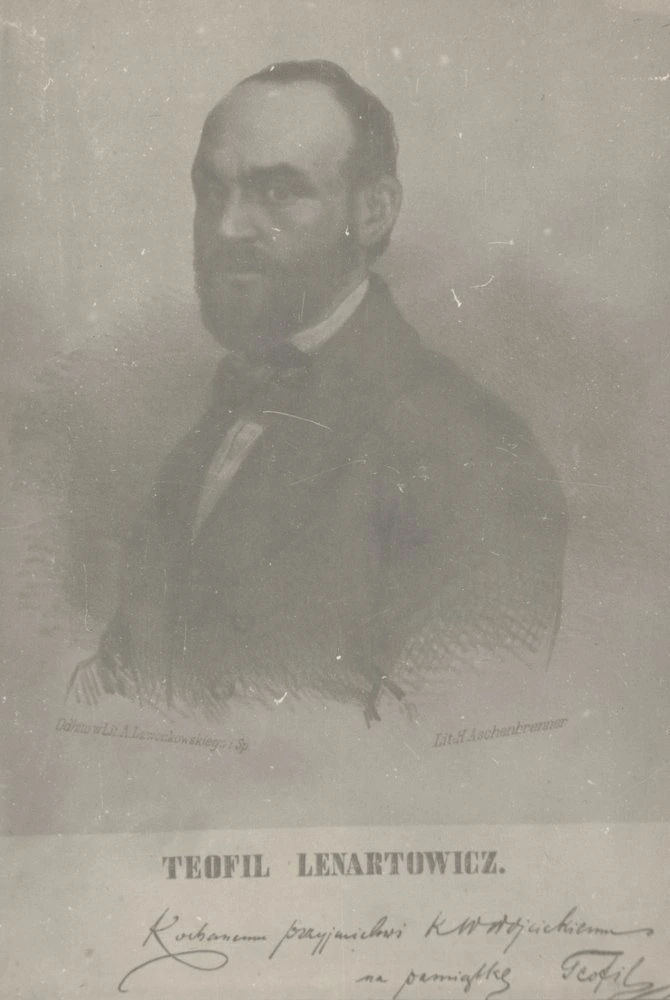
Teofil Lenartowicz.

Lenartowicz Teofil, *27 February 1822 Warsaw, †3 February 1893 Florence (buried at Skałka in Kraków), a Polish poet of the late Romantic period, referred to by his contemporaries and posterity as the “lyrist of Masovia”. The son of an impoverished nobleman, he was raised in the Masovian countryside, educated in Warsaw, and made his debut as a poet there. Associated with Warsaw’s bohemian community, he was friends with I. Komorowski, R. Zmorski, and O. Kolberg, with whom he travelled around Masovia. His participation in patriotic conspiracies forced him to leave Warsaw several times for fear of arrest. He spent the second half of his life in exile, working in Brussels (1851), Paris (1852–55), Rome (1856–60) and Florence (from 1860), where he eventually settled. Between 1879 and 1882, he lectured in the history of Slavic literatures in Bologna and worked as a sculptor (his artwork can still be seen in Italy, and some won awards at international exhibitions). He was friends with J.I. Kraszewski and M. Konopnicka.
Lenartowicz’s works are marked by a strong patriotic fervour and an unwavering adherence to the ideals of independence, free from any traces of chauvinism or Wallenrodism, as well as by a deep sensitivity to the plight of common people. He made attempts at the epic genre (e.g. the poem Wanda 1873) and drama (the dramatic monologue Tyrteusz 1848), but the nature of his talent made him a lyric poet par excellence. The titles of his collections are highly revealing – Polska ziemia w obrazkach [Polish Land in Pictures] (1848), Lirenka [Little Lyre] (1855), Nowa lirenka [New Little Lyre] (1859), Echa nadwiślańskie [Echos of the Vistula] (1872), Rytmy narodowe [National Rhythms] (1881) – as well as some of his individual poems: Mazur, Ballada [Ballad], Serenada [Serenade], Karpacki dudarz [Carpathian Piper], Pieśń ukraińska [Ukranian Song], Stabat Mater, Salve Regina, Z pieśni ludu [From the Song of the People]. Lenartowicz emerged as a “painter” of the poetic landscape of the Polish countryside and a chronicler of the everyday life in this “small world”. Brought up on folk songs [“pieśni gminne”], the historical songs of Niemcewicz and the songs of Ossian, he achieved an exceptionally high degree of song-like expression in his own work. Listening closely to Lenartowicz’s lyric poetry allows one to discover not only countless literal and allusive quotes from folk songs and national songs (from Święty Boże and Jeszcze Polska to Pani pana zabiła i Tam na błoniu), but at the same time identify melodic intonations of reminiscent of song and rhythmic gestures rooted in dance. Some of the lyric poems are direct paraphrases of well-known songs (Rży koniczek mój bułany, Hej, tam na górze, Czy mnie matka porodziła…, and others), while most are stylisations in a folk idiom, remarkably close to authentic examples, frequently returning to the realm of common folk song, as in Kalina, Dwie zorze, or Złoty kubek. Lenartowicz’s poetic expression is characterised by “simplicity, conciseness, discreet lyricism, and focus” (J. Nowakowski); subjectivism is often kept in check, and “tenderness” and nostalgia rarely turn into sentimentality. There is an absence of gloomy, convoluted, or obscure tones.
Lenartowicz’s lyric poetry is written predominantly in syllabic-accentual verse, but in a natural and free manner – highly varied and rarely fully isometric. He uses many verse forms typical of folk songs in his lyric poetry: 4-syllable (Skrzy łuczywo), 5-syllable (Hej, koło młyna), 6-syllable (Przyjaciel prawdziwy), 1-syllable (Idzie sobie pacholę), 8-syllable (Grajże grajku, będziesz w niebie), 10-syllable (Rosła kalina z liściem szerokim) and 12-syllable (Po szerokim polu modra Wisła płynie) verses. He also uses longer poems constructed in specific composite patterns, such as the 13-syllable 5 + 5 + 3 verse (Oj, zakukały trzy zazuleńki w gaiku). Lenartowicz most often uses 7-syllable, and especially 8-syllable verses; according to K. W. Zawodziński, during the period between the uprisings there existed a “quasi-obligatory custom in national manners and education” of using this meter as the standard for insurgent and national songs. The classic 11-syllable verse (5 + 6), typical of the high style, appears in Lenartowicz’s work only in epic-reflective, non-melodic texts. The metres vary depending on the nature of the content; the trochaic metre predominates, but iambic, amphibrachic and even anapaestic metres are also frequently used, freely and subject to the overarching melody of the verse.
Composers reached for Lenartowicz’s lyric poems almost immediately after their publication. I. Komorowski, who was particularly close to the poet composed 13 songs, including the famous Kalina; the elegy Pamięci Ignacego Komorowskiego (In memory of Ignacy Komorowski) is the poet’s tribute to the prematurely deceased composer. Some of the songs by S. Moniuszko (Dwie zorze, Maciek), W. Troszel (Grajek, Skrzypki), W. Żeleński (Jaskółka) and Z. Noskowski (Pożegnanie) gained considerable popularity. Solo songs to Lenartowicz’s words were also written by W. Studziński, I.F. Dobrzyński, E. Kania, A. Zarzycki, A. Teichman, M. Zawadzki, E. Pankiewicz, W. Rzepko, J. Gall, F. Nowowiejski and F. Maklakiewicz, among others. Several choral songs were also composed by W. Rzepko (Lipo zielona), W. Maliszewski (Bitwa racławicka) and M. Świerzyński (Jagoda). W. Lutosławski used the poet’s words in the children’s cantata Słomkowy łańcuszek (1951), W. Rudziński in the cantata Chłopska droga (1952), and Z. Mycielski composed the cantata Nowy lirnik mazowiecki (1955) to P. Hertz’s paraphrases of Lenartowicz’s words. In 1895, a “picture of rural life in one act” entitled Król Pasterzy (King of Shepherds), with music by O. Kolberg, was staged in Warsaw to Lenartowicz’s words. The work has been performed in contemporary times: in 2004 at the Collegium Nobilium of Warsaw Theatre Academy, in 2014 in Krakow on the occasion of the “Kolberg Year” celebrations (the score and parts were published on the Kolberg Institute website) and in 2022 in Krościenko nad Dunajcem.
Literature: J. Sikorski “Pieśni ludu polskiego” przez Oskara Kolberga, “Gazeta Codzienna” 1856, no. 219; J. Kasprowicz Lirnik mazowiecki, Lviv 1893; M. Wysłouchowa O życiu Teofila Lenartowicza i jego piosenkach, Lviv 1893; H. Orsza Teofil Lenartowicz. Lirnik mazowiecki i jego pieśni, Łódź 1899; J. Kasprowicz Liryka Teofila Lenartowicza, “Pamiętnik Literacki” 1905 no. 2/3; W. Gomulicki Trzy “Kaliny”: L., Komorowskiego i Święcickiego, “Tygodnik Ilustrowany” 1907 no. 43; H. Bigeleisen Lirnik mazowiecki, Krakow 1913; Z. Szmydtowa Mazowsze w poezji Lenartowicza, “Ziemia” 1934; K.W. Zawodziński Studia z wersyfikacji polskiej, Wrocław 1954; J. Nowakowski Wstęp, in: T. Lenartowicz Wybór poezji, Wrocław 2nd edition 1956, 4th edition 1972; W. Poźniak Pieśń solowa po Moniuszce, in: Z dziejów polskiej kultury muzycznej, vol. 2, ed. A. Nowak-Romanowicz, Krakow 1966; W. Poźniak, Elementy ludowe w profesjonalnej muzyce II połowy XIX wieku, “Muzyka” 1967; J. Nowakowski Teofil Lenartowicz: a ślad po mnie pieśń złota…, Warsaw 1973; D.B. Kacnelson Z dziejów polskiej pieśni powstańczej XIX wieku. Folklor powstania styczniowego, Wrocław-Warszawa-Kraków-Gdańsk 1974; J. Nowakowski Teofil Lenartowicz 1822–1893, in: Literatura krajowa w okresie romantyzmu 1831–1863, vol. 2, ed. M. Janion et al., Krakow 1988; A. Borkowska-Rychlewska Uwagi o muzyce w “Kronice włoskiej” Teofila Lenartowicza. Od źródeł tradycji europejskiej ku estetyce i filozofii wieku XIX, “Wiek XIX. Rocznik Towarzystwa Literackiego im. Adama Mickiewicza” 2018, R. XI (LIII).
Poezje, 2 vols., Poznań 1863
Poezje, 2 vols., Lviv 1895
Poesie polacche di Teofilo Lenartowicz recate in versi italiani da Ettore Marcucci, Florence 1871
Wybór poezji, ed. J. Nowakowski, Wrocław 2nd edition 1956, 4th edition 1972