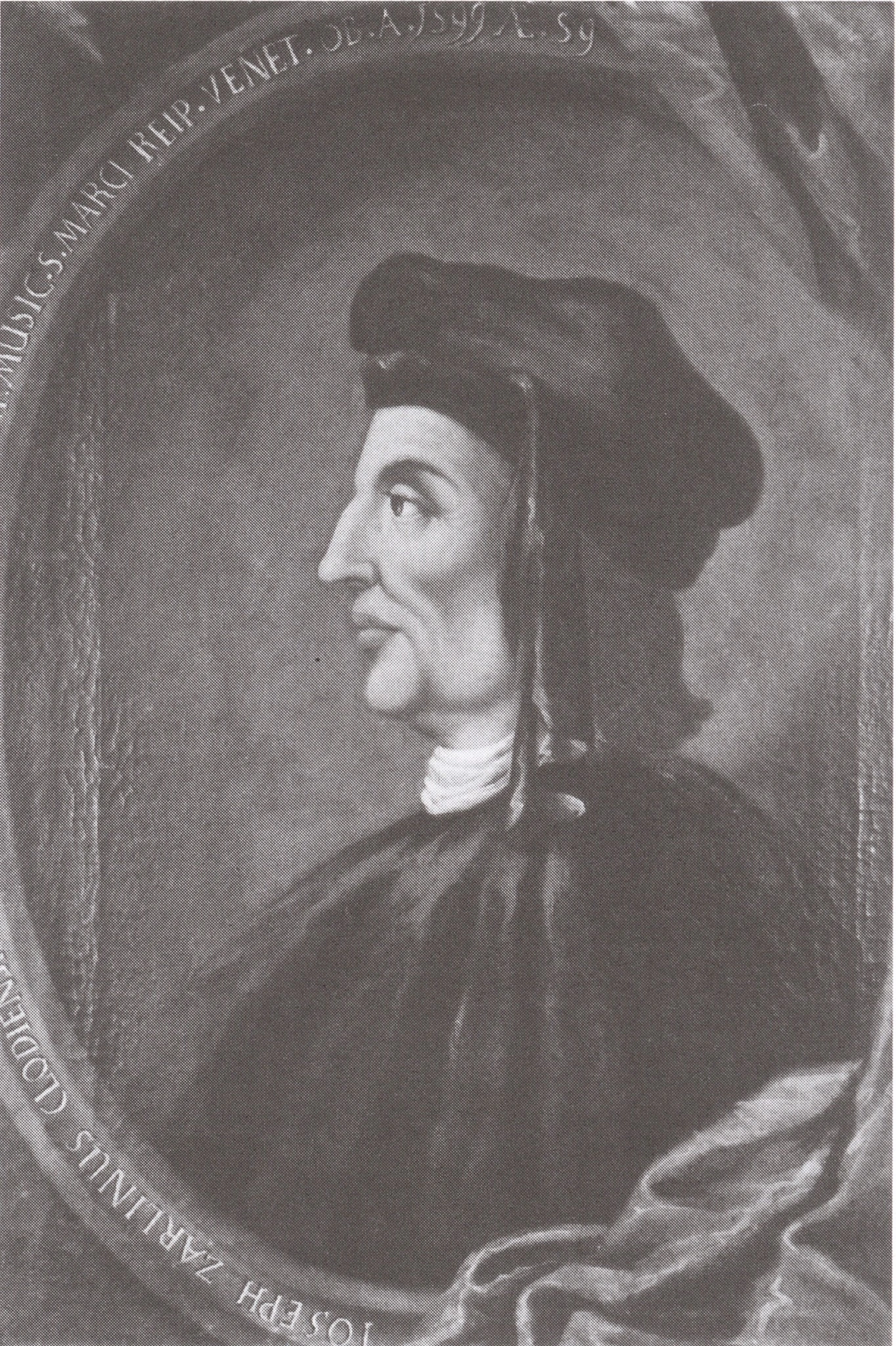
Zarlino Gioseffo, Zarlinus Clodiensis, *probably 31 January 1517 Chioggia, †4 February 1590 Venice, Italian music theorist and composer, Ordo Fratrum Minorum. Much biographical information about Zarlino was provided by B. Baldi, including his date of birth, 31 January 1519 (in the new style, 1520), claiming that he derived it directly from the composer. Zarlino began his studies of grammar, arithmetic, geometry and music under the Franciscans in Chioggia; he probably also studied under M.-A. Cavazzoni, who was an organist in that city in 1536–37. He began his musical career as a singer (1536–39) and later as an organist (1539–40) in the cathedral in Chioggia, simultaneously obtaining minor orders (1537), the diaconate (1539) and holy orders (probably 1540). He arrived in Venice in 1541, where – as he states in Dimostrationi harmoniche – he became a student of A. Willaert and also studied philosophy, logic, Greek and Hebrew, achieving a significant position in the Accademia Venetiana della Fama, which operated in the years 1557–61. He served as a guest at the Scuola Grande Santa Maria della Carità in Venice in 1558–65, and also maintained contacts with the d’Este court in Ferrara. Although he enjoyed great authority, and his compositions were published as early as 1548 and 1549, he did not hold any important musical position. Only after C. de Rore resigned did he become maestro di cappella in the Basilica of San Marco in Venice on 5 July 1565. Valued not only for his musical competence but also for his organisational talent and good relations with musicians, he held this prestigious (and highly paid) position until the end of his life, overseeing the musical setting of services and celebrations in the basilica, composing and educating students who included G.M. Artusi, G. Croce, G. Diruta, V. Galilei and C. Merulo. He was also a canon in the church of S. Severo in Venice from 1565, and in 1584, after two years of trying, he became a canon of the cathedral in Chioggia. He was a highly respected figure in Venetian musical and scientific life, amassing a rich library (over a thousand items by the end of his life), maintaining contacts with mathematicians (he was friends with G. Moletto), philologists (among others, he persuaded A. Gogava to translate the treatises of Ptolemy and Aristoxenus into Latin) and other scholars (a dozen or so of his letters have survived).
Zarlino’s major work, Le istitutioni harmoniche…, brought him great recognition and fame. He is the first author to give a systematic exposition of all the musical knowledge of the time, both theoretical (musica speculativa) and practical (musica pratica), which, according to him, constitute two indispensable and inseparable pillars of a composer’s education. In Parts 1 and 2, he treats music as a domain of the quadrivium, hence his considerations are highly speculative. In an attempt to rationalise the universe of sound, he discusses in detail the cosmological theories, numerical proportions, and interval and scale structures. Developing the concepts of B. Ramos de Pareja, F. Gaffurius, G. Spatar, and especially L. Fogliano, he points out the limitations of the Pythagorean system, with its difficult to accept third (and sixth) consonances, and justifies the usefulness of the Ptolemaic diatonic-syntonic system (diatónico syntono). The basis of his speculations is numero senario – a series creating the number six (1:2:3:4:5:6), which is an extension of the Pythagorean tetractys (1:2:3:4). He considers this first perfect number, rich in symbolic meanings, in which the sum of the first three components is equal to their product (1+2+3 = 1x2x3), as a criterion allowing for the inclusion of individual intervals in the group of consonances. The division of the string into six parts allows for the creation of an octave (2:1), a fifth (3:2), a fourth (4:3), a major third (5:4), a minor third (6:5) a major sixth (5:3), and a minor sixth (8:5), which does not fit in the senario – by combining a fourth and a minor third. Zarlino connects the different chords in their structure with their different expressive character: triads with a major third at the base are “lively and joyful” (vive et allegre), and with a minor third – “sad or longing” (mesto overo lánguido). This results in the division of all modes into two categories, dictated by the size of the third built on the finalis (which led H. Riemann, in 1880, to the erroneous theory that Zarlino was the forerunner of the dualistic concept of major-minor). Zarlino justifies the advantage of the major third over the minor by the superiority of the harmonic division of the fifth (15:12:10), as a result of which the major third is below the minor (e.g. C-E-G), over the arithmetic division (6:5:4), with the minor third below the major (e.g. A-C-E). Zarlino’s views were developed by J. Lippius (1612), who named triads (trias). Although Zarlino’s diatonic-syntonic system was soon met with harsh criticism from the mathematician G.B. Benedetti (in letters to C. de Rore from around 1563 and in the treatise Diversarum speculationum liber, 1585) and V. Galilei (Dialogo, 1581 and Discorso, 1589), Zarlino consistently maintained his theories in Sopplimenti musicali…. Moreover, his system did not work in keyboard music, and the proposal for a new temperament (Istitutioni…, part 2) was not accepted due to the difficulties in tuning the instruments.
Parts 3 and 4, devoted exclusively to musica prattica and containing almost 200 examples or references to contemporary compositions, address key issues of musical creativity, for which the works of A. Willaert are a permanent point of reference. Part 3 found the widest reception, in which Zarlino compares the rules of 2-, 3- and 4-voice counterpoint, illustrating them with his own 2-voice examples or tables, and discusses constructions with a larger number of voices, including the polychoral technique, postulating the maintenance of the proper intervals between the bass voices of the individual choirs (unison, octave or third). He discusses double counterpoint and types of imitation, among which he distinguishes the concepts of fugue (response in the root, fourth, fifth and octave) and imitatione (response in other intervals), then dividing them into two types: legata (canon) and sciolta (free imitation). In the use of consonances and dissonances, the guiding principle for him is variety (rhetorical varieras), and as a permanent starting point he takes the verbal text, which – in order to ensure the work’s impact on the listener – should be properly integrated with the music. Zarlino therefore places emphasis on adapting appropriate pauses and hierarchically ordered cadences (which are equivalent to punctuation) to the syntactic structure of the text, while pointing out the possibility of “escaping from cadence” (fuggir la cadenza). He also undertakes an analysis of the phenomenon of metre in the context of the ancient concept of nomos, emphasising the importance of regular harmonic rhythm with consonances on even and dissonances on odd units of tactus.
In Part 4, referring (but without citing a source) to H. Glareanus’s Dodecahordon (1547), Zarlino discusses in detail the 12 ancient Greek tonalities, and then the Renaissance modes (tuoni), rejecting, however, their ancient names as having nothing in common with the modern system. He illustrates the use of individual modes with numerous examples and the titles of over 70 compositions, mainly by A. Willaert (32 pieces) as well as C. de Rore, J. Mouton, L. Hellinck, Lupus, Jacquet de Mantua, C. de Morales, P. Verdelot, N. Gombert, Josquin des Prés, P. de La Rue and his own. Starting with the revised edition of Istitutioni… in 1573, Zarlino replaces – following Dimostrationi… – the traditional order of modi (from d) with a new arrangement, recognising c as the first. He justifies this new, “natural order of modi” both by the “naturalness” of the major third, the superiority of harmonic division over arithmetic division and the arrangement of sounds in the hexachord (from ut), as well as its conformity with the ancient Greek system (in which the intervals between the Doric, Phrygian and Lydian tetrachords were each a whole tone). The final chapters of the treatise concern the rational shaping of the connections between music and verbal text, which Zarlino understands in two ways: as the conformity of music with the meaning of the text and as the proper correlation of sounds with its syntax and prosody. According to Zarlino, the composer should respect the principle of decorum, similarly to the poet, adapting all elements of the work to the chosen theme, and when correlating sounds with words, he should reproduce grammatically correct accentuation, “so that no barbarism is heard in the pronunciation of words.” Zarlino attaches great importance to the prosody of the text, compiling a decalogue of rules (largely taken from G. Lanfranc, 1533) for connecting syllables with sounds, while using traditional quantitative terminology (which would later be revised by G. Stoquerus in De musica from ca. 1570, P. Luchini, ca. 1590, and S. Calvisius, 1592).
Istitutioni…, despite many borrowings that are most often passed over in silence, constitute a highly original and rich testimony to late Renaissance musical reflection. They (especially part 3) had a huge influence on all later musical theory and teaching and established the prima pratica style. The Zarlino’s path was followed in Italy by G.M. Artusi, O. Tigrini, P. Pontio, S. Cerreto, A. Banchieri and others, in France by M. Mersenne and J.P. Rameau, and in Austria by J.J. Fux. Zarlino’s intention was to translate Istitutioni… into Latin, to ensure the widest possible reception. Although he did not do this, the treatise was widely known, as evidenced by two handwritten French translations and a partial (now lost) translation by J.P. Sweelinck (Composition Regeln), copied by his German students. The Dutch translation is mentioned by Andreas Werckmeister in his 1702 treatise Harmologia Musica. In the Netherlands, the 1588–89 edition of Zarlino’s treatises was available to the composer and organist of St. Peter’s Church in Leyden, Cornelis Schuyt (1557–1616). Istitutioni… was studied in detail by the organist Abraham Verheyen of Nijmegen (d. 1619), who left a number of underlined words and text fragments in his copy. Netherlandish music theorists also had access to Zarlino’s treatises: Andries de Paep (ca. 1551/52–81), Johannes van der Elst (ca. 1598–1670), Joan Albert Ban (1597–1644), and the mathematician Simon Stevin (1548–1620).
Zarlino’s next two treatises are mostly an extension and refinement of the problems previously presented. The highly speculative Dimostrationi…, in the form of five dialogues (ragionamenti) given in 1562 at the house of A. Willaert (with the participation of the host himself, C. Merula, Francesco Della Viola and an imaginary Desiderio), are not much later than the Istitutioni… and are mainly devoted to the connections between music, mathematics and philosophy. Sopplimenti…, dedicated to Pope Sixtus V, are largely a response to the criticism of F. de Salinas (De musica…, 1577) and V. Galilei (Dialogo…, 1581). They contain (mainly in book 8) numerous references to the Istitutioni…, especially in the area of mimetic theory, which gains a fuller formulation, supported by an in-depth reading of Aristotle’s Poetics, which Zarlino was still only slightly familiar with when writing the Istitutioni…. The fragments corresponding to the Istitutioni… also discuss the concept of melopeia, taken from Cleonides, in which Zarlino sees the embodiment of the inseparable bond between poetry and music (as he announced in Dimostrationi…, he intended to give the title Melopeo over Musico perfetto to his next treatise, which, however, was probably never written). In a way characteristic of the Renaissance, Zarlino tries to reconcile in Sopplimenti… the ancient concept of poetry and music with the Judaic tradition, devoting considerable attention to the issues of accentuation and syntax of the Hebrew language, which he discusses based on the writings of contemporary Hebraists – J. Reuchlin and S. Münster. Distinguishing three types of accents: grammatical, rhetorical and musical, he considers (unlike in the Institutioni…) rhetorical accent as superior to grammatical accent.
Zarlino’s concepts grow out of the climate of late Renaissance humanism and the atmosphere of Venetian scientific and literary life. Emphasising the importance of all seven liberal arts, in which the perfetto musico (derived from Cicero’s ideal of the oratore perfetto) should be educated, Zarlino draws inspiration from various trends in the theory of rhetoric and poetry: Platonic (The State and Ion), Horatian (Ars poetica) and Aristotelian (Poetics). He refers both to the Platonic topos of the poet bard, expressing the conviction (like G. Spataro and P. Aaron before him) of the participation of the divine element in the creative process (furor poeticus), and to the Horatian principle of appropriateness (decorum) and the Aristotelian doctrine of mimesis. Referring to Plato’s formula proclaiming the primacy of logos, he strongly emphasises (like J. Sadoleto earlier, 1533) that music (melody) is indeed a close union of speech (oratione), harmony and rhythm (numero), but the primary element is always speech, which should be followed by harmony and rhythm.
Zarlino’s ideas largely prepared the ground for stylistic changes at the end of the 16th century (V. Galilei and Florentine Camerata), even though, as an admirer of polyphony of his time, he was far from radical postulates of its reform. In Zarlino’s opinion, the music of his time, with its previously unknown harmonic richness, had reached the peak of perfection, and its impact could be ensured by close fusion with the text and apt selection of means. As a supporter of diatonicism, he combated the use of chromatic and enharmonic genders, putting the strongest criticism in the mouth of A. Willaert, who in Dimostrationi… compares the experiments of the “chromatics” to the actions of Herostratus. This unfavourable position was undoubtedly a reaction to the views formulated by N. Vicentino (1555). However, in describing all three genres in Istitutioni… (part 2), Zarlino includes a diagram of a harpsichord (made for him by Domenico da Pesaro, 1548) with divided keys, which makes it possible to obtain 24 notes (the illustration incorrectly shows 19 keys). According to Zarlino, diatonic intervals, both vertical and horizontal, have a different emotional character, and therefore their selection should be determined by the affective quality of the words and their phonic values: words meaning “roughness, hardness, cruelty, bitterness” should be combined with chords having a major third at their base, and words meaning “crying, pain, mourning, sighs, tears” – a minor third. Zarlino also attempts to explain the ethical and therapeutic impact of music on entirely rational grounds, explaining – in reference to Ficino’s theory of spiritus – the affective stimulation of listeners by physiological processes, a concept that would later be developed by Descartes and A. Kircher.
Zarlino’s extensive legacy of over 1,000 pages, allows him to be considered one of the most outstanding modern theoreticians of music. Combining ideas derived from Greco-Roman antiquity with the Judeo-Christian tradition, he appears as a comprehensively educated humanist with a profound knowledge of both the classical past and contemporary music theory and compositional practice. However, his idealism did not allow him to go beyond the work of A. Willaert, whom he called the “new Pythagoras,” nor to admit, despite the criticism of G.B. Benedetti and V. Galilei, that the syntonic-diatonic tuning based on the senario was incapable of serving polyphonic music. The range of texts he used: musical, mathematical, philosophical, astrological, theological, historical and poetic, testifies to Zarlino’s erudition and broad intellectual horizons. The numerous references to mathematics resulted in B. Baldi devoting a separate biography to him, while G. Biancani (De mathematicarum natura dissertatio…, Bologna 1615) recommended that students of mathematics study his writings. Although Zarlino was obliged as the chapel master of the Basilica of San Marco to enrich its repertoire with new compositions, he did not care about publishing them, which is probably why few of his works have survived. His motets, maintained in a rather conservative style (three of them are two-text), are characterised by dense counterpoint and numerous canons, while at the same time revealing a desire for precise reproduction of syntax and natural rhythm of speech. Madrigals are somewhat more modern, with simpler counterpoint and a stronger emphasis on the semantic values of the text.
Literature: B. Baldi Cronica de’ matematici overo epitome delle vite loro (based on a manuscript from ca. 1595), Urbino 1707, entitled Vite inedite di matematici italiani, ed. E. Narducci, “Bolletino di Bibliografia e Storia delle Scienze Matematiche e Fisiche” XIX, 1886; G.B. Benedetti Diversarum speculationum mathematicarum et physicorum liber, Turin 1585; V. Galilei Discorso intorno all’opere di Messer Gioseffo Zarlino da Chioggia, Florence 1589, facsimile ed., Milan 1933; G.M. Artusi Impresa del molto Rev. M. Gioseffo Zarlino da Chioggia (…) dichiarata, Bologna 1604; G. Ravagnan Elogio di Gioseffo Zarlino di Cristoforo Sabbadino, Venice 1819; F. Caffi Della vita e delle opere del prete Gioseffo Zarlino, Venice 1836; H. Riemann Zarlino als harmonischer Dualist, “Monatschefte für Musikgeschichte” XII, 1880; M. Brenet Deux traductions inédites des „Institutions Harmoniques” de Zarlino, “L’année musicale” I, 1911; H. Zenek Zarlino’s „Istitutioni harmoniche” als Quelle zur Musikanschauung der italienischen Renaissance, “Zeitschrift für Musikwisseschaft” XII, 1929–30; G.F. Malipiero L’armonioso labirinto. Da Zarlino a padre Martini (1558–1774), Milan 1946; C. Dahlhaus War Zarlino Dualist?, “Die Musikforschung” X, 1957; R.W Wienpahl Zarlino, the Senario, and Tonality, “Journal of the American Musicological Society” XII, 1959; G.A. Marco Zarlino’s Rules of Counterpoint in the Light of Modern Pedagogy, MR XXII, 1961; R. Flury Gioseffo Zarlino als Komponist, Winterthur 1962; E. Fubini L’estetica musicale…, 2 volumes, Turin 1964, 1976, Polish ed. as Historia estetyki muzycznej, transl. Z. Skowron, Kraków 1997; R. Monterosso L’estetica di Gioseffo Zarlino, “Chigiana” XXIV, new English series IV, 1967; R. Crocker Perché Zarlino diede una nuova numerazione ai modi?, “Rivista Italiana di Musicologia” III, 1968, English transl. in: R. Crocker Studies in Medieval Music Theory and the Early Sequence, Aidershot 1997; J. Haar Zarlino’s Definition of Fugue and Imitation, “Journal of the American Musicological Society” XXIV, 1971; D.P. Walker Some Aspects of the Musical Theory of Vincenzo Galilei and Galileo Galilei, in: Studies in Musical Science in the Late Renaissance, London 1978; C.V. Palisca Humanism in Italian Renaissance Musical Thought, New Haven (Connecticut) 1985; M.S. Lewis Zarlino’s Theories of Text Underlay as Illustrated in His Motet Book of 1549, “Notes” XLII, 1985/86; P. Walker From Renaissance „Fuga ” to Baroque Fugue. The Role of the „Sweelinck’s Theory Manuscripts”, “Schütz-Jahrbuch” VII–VIII, 1985–86; I. Palumbo-Fossati La casa veneziana di Gioseffo Zarlino nel testamento e nell’inventario dei beni del grande teorico musicale, “Nuova Rivista Musicale Italiana” XX, 1986; D. Harrán Word-Tone Relations in Musical Thought. From Antiquity to the Seventeenth Century, Stuttgart 1986; P. Barbieri Acustica, accordatura e temperamento nell’Illuminismo veneto, Rome 1987; E. Fubini Zarlino, Venezia e la musica strumentale, in: Andrea Gabrieli e il suo tempo, ed. F. Degrada, Florence 1987; K. Berger Musica ficta. Theories of Accidental Inflections in Vocal Polyphony from Marchetto da Padova to Gioseffo Zarlino, Cambridge 1987; D. Harrán In Search of Harmony. Hebrew and Humanist Elements in Sixteenth-Century Musical Thought, Stuttgart 1988; R. Airoldi La teoria del temperamento dell’età di Gioseffo Zarlino, ed. E.E Barassi, Cremona 1989; M. Fend Zarlinos Versuch einer Axiomatisierung der Musiktheorie in den „Dimostrationi harmoniche” (1571), “Musiktheorie” IV, 1989; L. Fico Zarlino. Consonanza e dissonanza nelle „Istitutioni harmoniche”, Bari 1989; F. Rempp Elementar- und Satzlehre von Tinctoris bis Zarlino, in: Italienische Musiktheorie im 16. und 17. Jahrhundert. Antikrezeption und Satzlehre, «Geschichte der Musiktheorie» VII, Darmstadt 1989; J. Lester Between Modes and Keys, Stuyvesant 1989; P. Sanvito Le sperimentazioni nelle scienze quadriviali di alcuni epistolari Zarliniani inediti, “Studi musicali” XIX, 1990; Z.M. Szweykowski Między kunsztem a ekspresją, part 1: Florencja, Kraków 1992; A.E. Moyer Musica scientia. Musical Scholarship in the Italian Renaissance, Ithaca 1992; P. Gozza Desiderio di natione lombardo da Pavia e la teoria musicale del Rinascimento, “II Saggiatore musicale” I, 1994; C.V. Palisca Studies in the History of Italian Music and Music Theory, Oxford 1994; B.V. Rivera Theory Ruled by Practice. Zarlino’s Reversal of the Classical System of Proportions, “Indiana Theory Review” XVI, 1995; R. Wieczorek ,,Ut cantus consonet verbis”. Związki muzyki ze słowem we włoskiej refleksji muzycznej XVI wieku, Poznań 1995; I. Fenlon Gioseffo Zarlino and the Accademia Venetiana della Fama, w: Italian Academies of the Sixteenth Century, ed. D.S. Chambers and F. Quivigier, London 1995, reprint in: I. Fenlon Music and Culture in Late Renaissance Italy, Oxford 2002; M. Lindley Zarlino’s 2/7-Comma Meantone Temperament, w: Music in Performance and Society, commemorative book of R. Jackson, ed. M. Cole and J. Koegel, Warren (Michigan) 1997; R. Edwards Setting the Tone at San Marco. Gioseffo Zarlino amidst Doge, Procuratori and Cappella Personnel, w: La Cappella musicale di San Marco nell’eta moderna, ed. F. Passadore and F. Rossi, Venice 1998; R. Schäfertöns Recepcja Zarlina w północnej Europie. „Composition Regeln” J.P. Sweelincka, “Muzyka” 1998 no. 2; C.C. Judd Reading Renaissance Music Theory. Hearing with the Eyes, Cambridge 2000; F. Wiering The Language of the Modes. Studies in the History of Polyphonic Modality, New York 2001; J. Moreno Musical Representations, Subjects, and Objects. The Construction of Musical Thought in Zarlino, Descartes, Rameau, and Weber, Bloomington 2004; S. Dado „Siccome lo disse Zarlino”. La Renaissance dans l’historiographie musicale du Settecento, in: La Renaissance et sa musique au XIXe siècle, ed. P. Vendrix, Tours 2004; K. Schiltz Gioseffo Zarlino and the „Miserere” Tradition. A Ferrarese Connection?, “Early Music History” XXVII, 2008; K. Berger Potęga smaku. Teoria sztuki, Gdańsk 2008. J. Herdman Zarlinian Modality in Claude Le Jeune’s Dodecacorde, “Musicological Explorations” 2009, vol. 10; T. R. McKinney Adrian Willaert and the Theory of Interval Affect, New York 2010; C. C. Judd, To Discourse Learnedly and Compose Beautifully: Thoughts on Gioseffo Zarlino, Theory, and Practice, “Music Theory Online” (2013) vol. 19, no. 3; H. van der Linden Gioseffo Zarlino in the Low Countries: A Copy of His Complete Works Owned by the Organist Abraham Verheyen (†1619), “Quaerendo” 2014, vol. 44, no. 4; N. Baragwanath Giovanni Battista De Vecchis and the Theory of Melodic Accent from Zarlino to Zingarelli, “Music & Letters” 2014, vol. 95, no. 2; T. R. McKinney A Rule Made to Be Broken: On Zarlino, Vicentino, Willaert and Parallel Congruent Imperfect Consonances, “Early Music” 2014, vol. 42, no. 2; N. Sukljan Zarlino’s Harpsichord: A Contribution to the (Pre)History of Equal Temperament, “Muzikoloski Zbornik” 2018, vol. 54, no. 1; R. Lüttin Verfahren der Modusdarstellung in Gioseffo Zarlinos Musici Quinque Vocum Moduli, “Zeitschrift Der Gesellschaft Für Musiktheorie” 2022, vol. 19, no. 1; A. Chemotti, K. Schiltz Deep Mourning in Cinquecento Venice: Gioseffo Zarlino’s Lectiones pro Mortuis, “Journal of the American Musicological Society” 2020, vol. 73, no. 3; D. Collins Some Disturbance to the Ear when the Voices Enter: Invertible Canons at the Octave in Motets by Zarlino and Willaert, “Journal of the Alamire Foundation” (2022) no. 14/2.
Compositions:
Musici quinque vocum moduli…,18 5-voice pieces and one 7-voice, published in Venice 1549
Modulationes sex vocum…, 12 pieces and a revised version of a 7-voice motet, published in Venice 1566
1 piece in the book of 5-voice motets and in the book of 6-voice motets, published by G. Scott, published in Venice 1549 (6-voice ones reprinted in a new version an author’s print, published in Venice 1566) and in the 3rd book of 5-voice motets C. de Rore et al., published in Venice 1549
3 pieces for 4 low voices in: Motetta (…) de Rore et aliorum (…) cum tribus lectionibus pro mortuis Josepho Zarlino auctore, published in Venice 1563
one 5-voice motet in the collection from 1567 (preserved A)
moreover, a few motets preserved in manuscripts
13 madrigals, usually in 2 parts, in printed collections:
5-voice ones in: Di Cipriano Rore et di altri (…) il terzo libro di madrigali…, published in Venice 1548 (1), I dolci et harmoniosi concenti, book 1, published in Venice 1562 (5, including one religious), book 2, published in Venice 1562 (1), Di Hettor Vidue (…) e d’altri…, published in Venice 1566 (1), Corona della morte…, published in Venice 1568 (1), I dolci frutti…, published in Venice 1570 (1)
4-voice in: Terzo libro del desiderio…, published in Venice 1567 (3)
lost:
music for theatre plays, including Il trionfo di Christo (on the occasion of the victory over the Turkish at Lepanto in 1571) and Proteo pastor del mare (on the occasion of the visit to Venice of Henry Valois in 1574)
mentioned in Istitutioni… 2 masses and 3-choir Magnificat
Works:
about music:
Le istitutioni harmoniche (…) nelle quali oltra le materie appartenenti alla música, si trovano dichiarati molti luoghi di poeti, d’historici, et di filosofi…, published in Venice 1558, 2nd ed. 1561, 3rd ed. 1562, 4th ed. 1572, revised 5th ed. 1573 also in: De tutte 1’opere del (…) Zarlino…, vol. 1 and 2, published in Venice 1589, published together with Dimostrationi harmoniche (…) nelle quali realmente si trattano le cose della musica… as Istitutioni et dimostrationi di musica…, published in Venice 1602
Dimostrationi harmoniche (…) nelle quali realmente si trattano le cose della musica…, published in Venice 1571, 2nd ed. 1573, also in: De tutte 1’opere del (…) Zarlino…, vol. 1 and 2, published in Venice 1589, published together with Le istitutioni harmoniche (…) nelle quali oltra le materie appartenenti alla música, si trovano dichiarati molti luoghi di poeti, d’historici, et di filosofi… as Istitutioni et dimostrationi di musica…, published in Venice 1602
Sopplimenti musicali (…) nei quali si dichiarano moite cose contenute ne i due primi volumi, delle Istitutioni et Dimostrationi; per essere State mal’intese da molti; et si risponde insieme alle loro calonnie…, in: De tutte l’opere…, vol. 3, published in Venice 1588, mentioned in Sopplimenti Latin treatise De re musica (25 books, quoted also as De utraque musica) not preserved (was owned by G.M. Artusi, who prepared it for printing)
other:
Discorso (…) intorno il vero anno, et il vero giorno, nel quale fu crucifisso N.S. Giesu Christo redentor del mondo, published in Venice 1579, also in: De tutte l’opere…, vol. 4, published in Venice 1589
Informatione (…) intorno la origine della congregatione de i reverendi frati capuccini, published in Venice 1579, also in: De tutte l’opere…, vol. 4, published in Venice 1589
De vera anni forma, sive de recta eius emendatione, published in Venice 1580, also in: De tutte l’opere…, vol. 4, published in Venice 1589
Trattato della patientia…, dedicated to Eleonora d’Este, published in Venice 1583, also in: De tutte l’opere…, vol. 4, published in Venice 1589
De vera…, commissioned by Pope Gregory XIII, in Italian entitled Resolutioni di alcuni dubii sopra la correttione delldnno di Giulio Cesare…, published in Venice 1583
Editions:
all 3 treatises from 1558–89, facsimile and transcriptions in: Zarlino. Music Treatises, ed. F. Wiering, CD-ROM, «Thesaurus Musicarum Italicarum» I, Utrecht 1997, 2nd ed. 2000
Le istitutioni… (1558), facsimile ed., New York 1965, also transcription of a text and facsimile of tables and score examples, ed. A. Giger, «Saggi Musicali Italiani. A Database for Texts on Music Theory and Aesthetics»
Le istitutioni… (1558), part 3, English transl. entitled The Art of Counterpoint. Part Three of „Le istitutioni harmoniche”, transl. G.A. Marco and C.V. Palisca, New Haven (Connecticut) 1968, reprint 1976 and 1983, part 4, English transl. entitled On the Modes. Part Four of „Le istitutioni harmoniche”, transl. V. Cohen, New Haven (Connecticut) 1983 (includes an introduction by C.V. Paliski)
Le istitutioni… (1561), facsimile ed., «Biblioteca Musica Bononiensis» II/39, Bologna 1999 (includes introductions by I. Fenlona and P. Da Col and a list of edition variants from 1589)
Le istitutioni… (1573), facsimile ed., Ridgewood (New Jersey) 1966, parts 1–2, German transl. entitled Theorie des Tonsystems. Das erste und zweite Buch der „Lstitutioni harmoniche” von Gioseffo Zarlino, transl. M. Fend, Frankfurt am Main 1989
Dimostrationi… (1571), facsimile ed., New York 1965 and Ridgewood (New Jersey) 1966
Sopplimenti…, facsimile ed., Ridgewood (New Jersey) 1966 and New York 1979
compositions:
Gioseffo Zarlino. Drei Motetten und ein geistliches Madrigal zu 4–6 Stimmen, ed. R. Flury, «Das Chorwerk» LXXVII, Wolfenbüttel 1959
Joseffo Zarlino. Nove madrigali a cinque voci, tratti da varie raccolte, ed. S. Cisilino, «Collana di Musiche Veneziane Inedite o Rare» III, Venice 1963
Gioseffo Zarlino. Motets from 1549, ed. C.C. Judd, vol. 1: Motets Based on the Songs of Songs (contains 8 pieces from the author’s print and 2 from collective ones 1549), vol. 2: Selected Motets from „Musici quinque vocum moduli” (Venice, 1549) (includes the remaining 11 pieces from the author’s print), «Recent Researches in the Music of the Renaissance» CXLV and CXLIX, Middleton (Wisconsin) 2006 and 2007