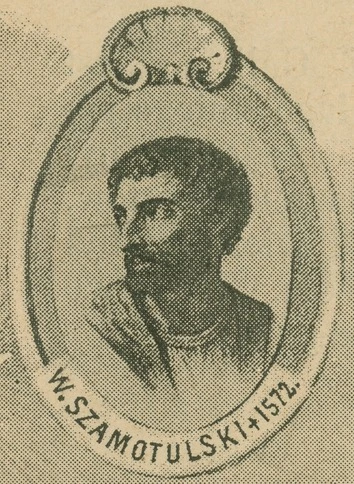
Wacław of Szamotuły, Venceslas, Venceslaus, a Schamotuli, Samotulinus, Schamotulinus, Samotulius, Scamotulinus Vencislaus, V. S., W. S. (polonised versions: Szamotulczyk, Szamotulski introduced by authors in the 19th c. and in the 1st ed. of the 20th c.), *between 1520 and 1525 Szamotuły or the surrounding area, †ca. 1560, Polish composer. According to Sz. Starowolski, Wacław of Szamotuły “devoted to liberal arts from childhood, first in Poznań (…) [at the Lubrański Academy], later in Kraków at the Głogów Gymnasium, (…) he diligently applied himself to Greek and Roman literature, and soon at the Jagiellonian University he mastered the philosophy of Aristotle, achieving the title of master” (the Polish translation here and below according to A. and Z.M. Szweykowski, the translation by J. Starnawski raises some doubts in the fragment devoted to Wacław of Szamotuły). Confirmation of this last piece of information could not be found in the documents of the Kraków Academy; however, among those matriculated in 1538, there is “Wacław of Szamotuły, son of Adam,” which most probably concerns the composer. From the printing of Wacław of Szamotuły’s poem on the death of Queen Elizabeth (1545), we know that he had been “for a long time” the secretary of Hieronim Chodkiewicz, castellan of Trakai and member of the Royal Council of Lithuania. On 6 May 1547, he was accepted in Vilnius to the royal court of Sigismund Augustus, where he worked until around 1555 as a composer. His remuneration is described as very good by J. Prus, and as moderate by E. Głuszcz-Zwolińska, but he also received additional sums, e.g. in 1554 an amount equal to an annual salary (50 florins “for the effort of composing”), or in 1555 due to illness – 20 florins. The date of Wacław of Szamotuły’s employment at the court of the Vilnius voivode Mikołaj Radziwiłł, the patron of Calvinism in Lithuania, to whom he dedicated the above-mentioned printing of the poem as early as 1545, is unknown; this employment is confirmed only on the title page of J. Zaremba’s hymnal (1558). At the mentioned courts, Wacław of Szamotuły must have had contact with many outstanding figures of cultural life; we certainly know about his friendship with A. Trzecieski the Younger, who wrote a poem praising the composer, included in Łazarz’s print of his Lamentationes, and an elegy on his death. It was on the basis of the elegy, which indicates that it was written immediately after this event in Pińczów (where the poet stayed in 1560–61), that A. and Z.M. Szweykowski established the approximate year of Wacław of Szamotuły’s death; the author of the poem also mentions that Wacław of Szamotuły died only 10 months after the wedding, at the age of 34. Therefore, the information on the composer’s death (at the age of 43) in 1572, repeated in earlier literature after Sz. Starowolski, and even A. Chybiński’s shift to 1568 turned out to be out of date. Based on the text of this elegy, it is assumed that Wacław of Szamotuły died in Pińczów.
Wacław of Szamotuły is considered the most outstanding Polish composer of the 16th century, both because of his great talent and education in this field. Given his flawless and comprehensive mastery of the craft, the lack of any information about his studies abroad is surprising. Published in 1553 by the Kraków publishing house of Łazarz Andrysowic, Quatuor parium vocum Lamentationes Hieremiae Prophetae (…) Quibus adiunctae sunt Exclamationes passionum is the most extensive preserved composition published in print in 16th-century Poland and the largest editorial initiative until the appearance of Melodia na psałterz polski by Mikołaj Gomółka (1580). Two voice books have survived in their entirety (cantus in Regensburg, tenor in Munich), but the Andrysowic print discovered in Gniezno in 2016 with fragments of the missing alto and bass allows for the recovery of over a hundred bars from both lost books. As the title suggests, Lamentationes were intended – unlike Exclamationes Passionum – for an ensemble of “equal” voices (a voce pari), in this case for male voices, which is confirmed by the set of clefs (alto clef for cantus, tenor clef for altus). However, this did not necessarily mean that Wacław of Szamotuły was guided by the male cast of the Wawel Rorantist Ensemble; it could rather have resulted from the 16th-century tradition of arranging lamentations in a low register of voices. The tenor book contains a lengthy Latin poem (Carmen nuncupatorium) dedicated to King Sigismund II Augustus, written by the composer himself, describing the suffering of Christian nations under Turkish tyranny. Explaining the genesis and gloomy nature of his work, Wacław of Szamotuły gives a shocking description of the Turkish invasion of Hungary and warns of a similar fate for the inhabitants of Moldavia – a buffer state bordering Poland and Turkey, at that time completely immersed in chaos. Since Sigismund II Augustus tried to rebuild his influence there, Wacław’s poem can be treated as an extension of diplomacy – as an appeal for loyalty to the Polish king.
In the entire, fragmentarily preserved work of Wacław of Szamotuły, there is a counterpoint consistent with the norms of the mid-16th century. Both printed motets are imitated, consisting almost exclusively of thematic phrases, subtly contrasted to avoid monotony. The third is based on an even-note, sometimes ornamented cantus firmus moving from the tenor to the cantus and back, and in the doxology also to the bass. The lamentations and partly the passions are based on the plainchant melody. The former consist of a series of three lessons for all three last days of Holy Week. An analogous selection of verses and lamentation tones has not been found so far, but they are close to the sets preserved in the Wawel manuscripts from the 15th century (including the Archive of the Kraków Cathedral Chapter, manuscripts 59, 240 and 58), and in the lessons for Good Friday they are also close to the tones specified by E.C. Cramer as Spanish. The individual lessons are works of considerable size, from 148 to 235 breves (bars), in which 3 or 4 verses are developed together with the Hebrew letters that begin them – with one exception; each lesson ends with the phrase “Hierusalem, convertere…” set to different music, and the first one from the first day begins (similarly to the Wawel manuscripts!) with the phrase “Et factum est…”. The line of none of the preserved voices (except for the tenor in most letters) gives the impression of a cantus firmus, but both – with an imitative, homorhythmic texture, or with free polyphony – are imbued with the melody of lamenting tones. After the end of each lesson on the first day, the place (Crac.) and the date, most probably of the completion of the composition, are given in the tenor: 17 Mar. 1552, 26 Mar. 1552 and 5 Apr[li]s 1552. Similarly, but in both voice books, the place (Crac.) and date are given at the end of each passion: 26 Feb. 1551, 10 Mar. 1551 and 10 Mar. 1550 (!). The passions develop all (with the exception of Jesus) oratio recta utterances of individual figures and the crowd, respectively from the gospels according to St. Matthew, Mark and Luke. As a result, these are collections of separate sections, numbering from 3 to 41 breves, only exceptionally following each other, and basically intended to intertwine the plainchant of the evangelist and Jesus. Here too, the melody is permeated with formulas of the passion tone, but none of the voices has the features of a cantus firmus; the dramatic texts allowed the composer to construct phrases with expression emphasized by rhythm or melodic leaps. The number of sections in subsequent passions varies depending on the gospel; in the first, there are 41 of them (with a total size of 342 breves), in the second – 30 (243 breves), in the third – 29 (248 breves).
The songs of Wacław of Szamotuły are characterised by their deliberate simplicity, but they do show some variation in terms of length (8–41 breves, always an arrangement of the first of the verses) and texture. In Psalm I, the composer placed in the tenor as a cantus firmus a melody in dance triplet known from earlier Czech, Polish and German sources and arranged it almost nota contra notam; in Christe…, he introduced as a cantus firmus a hymn melody in the cantus, partly in longer values, partly rhythmised and ornamented, and counterpointed it with voices of considerable rhythmic independence, similarly to what he did in the Pieśń o narodzeniu with the melody of the old carol Dies est laetitiae placed in the tenor in long values; in the similarly constructed Modlitwa…, he probably composed the tenor melody himself, which later gained an independent existence in one-voice cantionals, similarly to the tenor of Psalm XIV, C of Psalm LXXXV and both of these voices from the Powszednia spowiedź; however, none of the voices stands out in the chord-conceived and metrically interesting Psalm CXVI.
Obtaining a beautiful sound through the intricate combination of voices is one of the aspects of Wacław of Szamotuły’s artistry, but in addition, his works, regardless of genre, reflect the conviction of composers of the era that the music they create should be a commentary on the text they accompany, should enhance not only its expression but also its meaning, and in the case of a religious text, it can also be a personal prayer that is difficult to grasp for the listener. As a result, we observe literal illustrations of individual words: a change of texture giving the impression of acceleration at “accelera” (make haste, hasten) in In te, Domine…, the silence of the cantus throughout the rather long section of the lamentation to the text “Niech siedzi (…) w milczeniu,” a completely unique triple measure disturbing the metre in the exclamation to the words “Podburza lud,” an octave jump upwards in the most audible voice at “a na górze” in Psalm XIV, or a less literal association of “darkness” with the low register of all the voices in Modlitwa…, and “light” with the transition to a brighter register in Christe…. In addition to these typical procedures, there is also a more sophisticated introduction of the symbolism of the melody and most of all – the symbolism of numbers. Melody quotes, reinforcing the meaning of words by associating them with the original text accompanying a given melody, can be seen in both printed motets. In In te, Domine…, the words “(In iustitia tua) libera me” are accompanied by a musical phrase taken from the beginning of the sequence “(Lauda Sion) Salvatorem” in such a way that the melody falling on the word “Zbawiciel” [Saviour] falls on “wybaw mnie” [save me], and this association must have been perceptible to many listeners. Ego sum… begins with a phrase used in two variants by Clemens non Papa in motets with “pastoral themes”: Pastores quidnam vidistis and Erravi sicut ovis (“I wandered as a sheep”); and this association is legible and, at the same time, it testifies to Wacław of Szamotuły’s excellent orientation in the work of a not much older master. The symbolism of numbers occurs in In te, Domine…, in which not only the two parts, despite the significant difference in the length of the text, maintain the proportion considered to be the most perfect 1:1, but each lasts 77 breves (this is emphasised by an unusual notational solution: the longa is introduced in the 1st part not as the last note, but as the penultimate one, which makes its duration measurable), and this number was considered a symbol of forgiveness of sins, which corresponds perfectly with the content of the psalm. M. Perz also detected a symbolic triple occurrence of three melic mottos in the Powszednia spowiedź, in the text of which there is mention of the Holy Trinity. This is particularly astonishing because it was difficult to expect such a complicated polyphonic structure in a song that is seemingly one of the simplest, with an almost strictly homorhythmic texture. The above-mentioned procedures in the field of number symbolism explain Starowolski’s previously difficult-to-interpret opinion, according to which Wacław of Szamotuły “so fond of proportions from mathematical studies that he arranged musical sounds and meters according to them, and in both he did not follow the common taste so much that his contemporaries in Poland generally did not understand him.” In fact, 77 breves are impossible for any listener to count; this is esotericism understandable in principle only to the composer and the Addressee of the prayer.
Literature: J. Zaremba Pieśni chwa[ł boskich], Brest 1558, facsimile and transcription of fragments published by B. Brzezińska and A. Kawecka, «Monumenta Musicae in Polonia», ed. J. Morawski, series B, «Collectanea Musicae Artis» 1989; A. Trzecieski De obitu Venceslai Samotulini, musicorum in Regno Poloniae Principis. Threnodia, in: Silvarum liber primus, Kraków 1568, Polish ed. and transl. J. Krókowski, in: A. Trzecieski Dzieła wszystkie, vol. 1: Carmina. Wiersze łacińskie, «Biblioteka Pisarzów Polskich» series B, no. VIII, Wrocław 1958; Sz. Starowolski Scriptorum polonicorum hekatontas, Frankfurt am Main 1625, Venice 2nd ed. 1627, transl. J. Starnawski entitled Setnik pisarzów polskich, Kraków 1970; J.D. Janocki Ianociana, vol. 1, Warsaw 1776; H. Przybylski Wacław z Szamotuł, Szamotuły 1935; A. Chybiński Wacław z Szamotuł, “Kwartalnik Muzyczny” 1948; Z.M. Szweykowski Kultura wokalna XVI-wiecznej Polski, Kraków 1957; A. and Z.M. Szweykowscy Wacław z Szamotuł – renesansowy muzyk i poeta. Szkic biograficzny, “Muzyka” 1964 no. 1–2; R. Mazurkiewicz O melodiach kancjonałów Jana Seklucjana z 1547 i 1559 roku, Kraków 1967; J. Prus Muzyka na Wawelu, «Kraków Dawniej i Dziś» XIX, Kraków 1975; E.C. Cramer Some Observations Concerning the Lamentations and Passions of W. z Szamotuł, “Journal of the Canadian Association of University Schools of Music” V, 1975; E.C. Cramer Związki z muzyką hiszpańską w „Lamentacjach” Wacława z Szamotuł, “Muzyka” 1979 no. 3; P. Poźniak Symbolika liczb w twórczości Wacława z Szamotuł i Mikołaja Zieleńskiego, in: Muzykologia krakowska 1911–1986, ed. E. Dziębowska, Kraków 1987, English version entitled The Symbolism of Numbers in the Works by W. of Szamotuły and M. Zieleński, “Polish Art Studies” no. 11, 1990; E. Głuszcz-Zwolińska Muzyka nadworna ostatnich Jagiellonów, Kraków 1988; E.C. Cramer Nowe spojrzenie na styl muzyczny Wacława z Szamotuł, “Muzyka” 1991 no. 2 (contains a complete compilation of the two voices of lamentation); T.M.M. Czepiel Music at the Royal Court and Chapel in Poland, c. 1543–1600, «Outstanding Dissertations in Music from British Universities», New York 1996; J. Kubieniec Lamentacje chorałowe w krakowskich rękopisach liturgicznych od XII do XVIII wieku, “Muzyka” 1999 no. 1; P. Poźniak Repertuar polskiej muzyki wokalnej w epoce Renesansu, Kraków 1999; M. Perz Sekrety pieśni Wacława z Szamotuł „Ach mój niebieski Panie”, in: Anabasis, commemorative book of K. Pisarkowa, ed. I. Bobrowski, Kraków 2003; Polska pieśń wielogłosowa XVI i początku XVII wieku, ed. P. Poźniak, W. Walecki, 2 volumes (Nuty i komentarze, Teksty pieśni), «Monumenta Musicae in Polonia», Kraków–Warsaw 2004; J. Łukaszewski, W. Wydra Fragmenty „Kota z Lwem” Mikołaja Reja i innych druków z XVI w. odnalezione, Poznań 2016; R.J. Wieczorek, M. Wysocki „Lamentationes” Wacława z Szamotuł: fragmenty brakujących głosów odnalezione w Gnieźnie, “Muzyka” 62, 2017 no. 2; M. Szelest Nowo odkryte fragmenty „Lamentationes” Wacława z Szamotuł: przyczynek do odczytania źródła, “Muzyka” 63, 2018 no.1; Sub Ursae. Under the Northern Sky. Complete Works of the Polish Renaissance Master Wacław z Szamotuł (Venceslaus Schamotulinus), Raumklang 2018, RK 3801 (CD recording containing the premiere recording of the reconstructed Lamentationes by Wacław of Szamotuły); R.J. Wieczorek Music and patronage in light of letters of dedication: Wacław of Szamotuły, Valentin Bakfark and King Sigismund II Augustus, “Muzyka” 68, 2023 no. 1.
Compositions:
motets:
In te, Domine, speravi, motet for 4 voices, in: Tomus quartus psalmorum selectorum…, published in Nuremberg 1554 J. Berg and U. Neuber
Ego sum pastor bonus, hallelujah verse, motet for 4 voices, in: Thesauri musici tomus quintus, et ultimus…, published in Nuremberg 1564 J. Berg and U. Neuber (two exact copies from ca. 1570, Stuttgart, Württembergische Landesbibliothek, manuscript Musica folio I 8 and Regensburg, Bischöfliche Zentralbibliothek, manuscript A.R. 849–952)
Nunc scio vere, organ intavolation of the antiphon and doxology of the introit in a lost manuscript from the 16th century called the “Small Warsaw Tablature” (also “Castle” and “Poliński”) photocopies preserved
Quatuor parium vocum Lamentationes Hieremiae Prophetae (…) Quibus adiunctae sunt Exclamationes passionum. Tristium tomus primus, published in Kraków 1553 Ł. Andrysowic (preserved C and T)
songs:
Modlitwa, gdy dziatki spać idą (incipit of the text: “Już sie zmierzka”), song for 4 voices, words by A. Trzecieski the Younger, published in Kraków no year [1550–56] Ł. Andrysowic, lost (the lost editions have been preserved in the form of excerpts published by K.W. Wójcicki, Warsaw 1843; and by K. and U. Przyborowska, Warsaw 1880; and also in the Boczkowski’s copy, manuscript between 1820 and 1827)
Powszednia spowiedź (“Ach, moj niebieski Panie”), song for 4 voices, words by A. Trzecieski the Younger, published in Kraków no year [1550–56] Ł. Andrysowic, lost (the lost editions have been preserved in the form of excerpts published by K.W. Wójcicki, Warsaw 1843; and by K. and U. Przyborowska, Warsaw 1880; and also in the Boczkowski’s copy, manuscript between 1820 and 1827)
Psalm pierwszy… (“Błogosławiony człowiek”), in: Pieśń przy pogrzebie…, song for 4 voices, words by A. Trzecieski the Younger, published in Kraków no year [1550–56] Ł. Andrysowic; 2nd ed. Kraków [after 1557] M. Siebeneicher
Psalm XIV… (“I któż będzie przemieszkawał”), song for 4 voices, words by A. Trzecieski the Younger, published in Kraków no year [1550–56] Ł. Andrysowic, lost (the lost editions have been preserved in the form of excerpts published by K.W. Wójcicki, Warsaw 1843; and by K. and U. Przyborowska, Warsaw 1880; and also in the Boczkowski’s copy, manuscript between 1820 and 1827)
Christe, qui lux est et dies. Po polsku (“Kryste, dniu naszej światłości”) song for 4 voices, words by M. Rej, published in Kraków no year [1550–56] Ł. Andrysowic, lost (the lost editions have been preserved in the form of excerpts published by K.W. Wójcicki, Warsaw 1843; and by K. and U. Przyborowska, Warsaw 1880; and also in the Boczkowski’s copy, manuscript between 1820 and 1827)
Psalm Dawidow LXXXV… (“Nakłoń, Panie, ku mnie”), song for 4 voices, words by M. Rej, published in Kraków no year [1550–56] Ł. Andrysowic; 2nd ed. (preserved without a title page) probably Kraków M. Siebeneicher, music reprinted also as Pieśń a prośba człowieka krześcijańskiego… (“Ja, na Twoje święte obietnice”), lost (the lost editions have been preserved in the form of excerpts published by K.W. Wójcicki, Warsaw 1843; and by K. and U. Przyborowska, Warsaw 1880; and also in the Boczkowski’s copy, manuscript between 1820 and 1827); 2nd ed. Kraków [1564?] M. Siebeneicher
Pieśń o narodzeniu Pańskim (“Pochwalmyż wszytcy społem”), song for 4 voices, words by I. Il. (unidentified initials), published in Kraków no year [1550–56] Ł. Andrysowic; 2nd ed. Kraków 1558 M. Siebeneicher
Psalm Dawidow CXVI… (“Alleluja. Chwalcie Pana Boga”), song for 4 voices, anonymous words (wrongly attributed to M. Rej), published in Kraków no year [1550–56] Ł. Andrysowic, lost (the lost editions have been preserved in the form of excerpts published by K.W. Wójcicki, Warsaw 1843; and by K. and U. Przyborowska, Warsaw 1880; and also in the Boczkowski’s copy, manuscript between 1820 and 1827); 2nd ed. Kraków 1558 M. Siebeneicher, there also a reprint of music in 1567 as Dekalog więtszy (“Chrześcijanie posłuchajcie”)
lost (listed in the musical inventory of the royal chapel from 1572):
offitia… for 6 voices
offitia w pargaminie… for 4 voices
mass… for 8 voices
exclamacie drugie… for 5 voices (listed also Exclamacie i lamentacie… for 4 voices were probably identical to those printed in 1553)
works attributed to Wacław of Szamotuły:
J. Seklucjan in: Pieśni chrześcijańskie (1559) put the initials “W. S.” next to two single-voice songs (he omitted them in the tenor of Modlitwa, gdy dziatki spać idą), of which at least one (to words by Trzecieski the Younger, “Panu Bogu wszechmocnemu”) is not the work of Wacław of z Szamotuły – both this melody ans the melody to lyrics “Quod sumus utilibus” are most probably a translation of the tenors of the polyphonic song by Wacław of Szamotuły from the lost part of J. Zaremba’s hymnal
T. Czepiel assumes that Wacław of Szamotuły is the author of the mass for 4–6 voices based on the motet In te, Domine, two voices and fragments of two more have been preserved in the Archives of the Kraków Cathedral Chapter on Wawel Hill (manuscripts Kk I.4 and Kk I.110). This hypothesis cannot be confirmed or denied, but in any case, the mass is not the work of – as was previously believed – Fabrycy of Żywiec
Poems:
In funere (…) D. Elizabethae (…) Regis Poloniae (…) Coniugis (…) Carmen lugubre, published in Kraków 1545 widow of Unglerow
Latin recommendation poem in: M. Bielski Kronika wszytkiego świata, published in Kraków 1551 widow of Wietorow
Ad Serenissimum (…) Sigismundum Augustum (…) Carmen nuncupatorium in a tenor book Lamentationes… (1553)
lost, described by J.D. Janocki:
In nuptiis (…) Ioannis, Hungariae Regis (…) et (…) Isabellae (…) Sigismundi Primi Poloniae Regis filiae poema gratulatorium…, published in Kraków 1539 widow of Unglerow
In nativitate (…) Ioannis Sigismundi, principis Ungariae (…) poema gratulatorium, published in Kraków 1540 widow of Unglerow
In nuptiis (…) Sigismundi secundi Augusti et (…) Elisabethae (…) poema gratulatorium…, published in Kraków 1543 widow of Unglerow
moreover, Janocki mentions a poem Pieśń o małżeństwie Królewny Izabelli, with initials “sW’, published in Kraków 1539 H. Wietor
Editions:
Wacław z Szamotuł, In te, Domine, speravi, ed. M. Szczepańska, «Wydawnictwo Dawnej Muzyki Polskiej» book 9, 1930, revised, introduction by Z.M. Szweykowski 2nd ed. 1964, 4th ed. 1977
Ego sum pastor bonus, ed. Z.M. Szweykowski in: Muzyka w dawnym Krakowie, ed. Z.M. Szweykowski, Kraków 1964
Psalm LXXXV, published by Z.M. Szweykowski in: Muzyka w dawnym Krakowie, ed. Z.M. Szweykowski, Kraków 1964
Nunc scio vere (revocalization), published by M. Perz in: Muzyka staropolska, ed. H. Feicht, Kraków 1966
7 pieces in: Wacław z Szamotuł, Pieśni, published by Z.M. Szweykowski, «Wydawnictwo Dawnej Muzyki Polskiej» book 28, revised 1956 (introduction contains single-voice songs attributed to Wacław of Szamotuły), 1972, ed. T. Maciejewski, Warsaw 1993, ed. W. Sołtysik, Warsaw 1995
reprint of 3 motets and (published by Z.M. Szweykowski) 3 songs in «Musica Antiqua Polonica» – Renesans, ed. P. Poźniak, book 1, 1993 and book 3, 1994
5 songs in: Śpiewnik Staropolski, by P. Poźniak and W. Wałecki, books 2 and 4, Kraków1996
8 songs in: Polska pieśń wielogłosowa XVI i początku XVII wieku, vol. 2, by P. Poźniak, transcription and arrangement of old Polish texts by W. Wałecki, «Monumenta Musicae in Polonia», ed. J. Morawski, series B, «Collectanea Musicae Artis» 2004 (includes a detailed description of sources)
Carmen nuncupatorium z lamentacji in: A. Chybiński Ze studiów nad polską muzyką wokalną wielogłosową w XVI stuleciu, “Przegląd Muzyczny” III, 1910 (also comments on works by Wacław of Szamotuły) and in: Z. Jachimecki Wpływy włoskie w muzyce polskiej, Kraków 1911