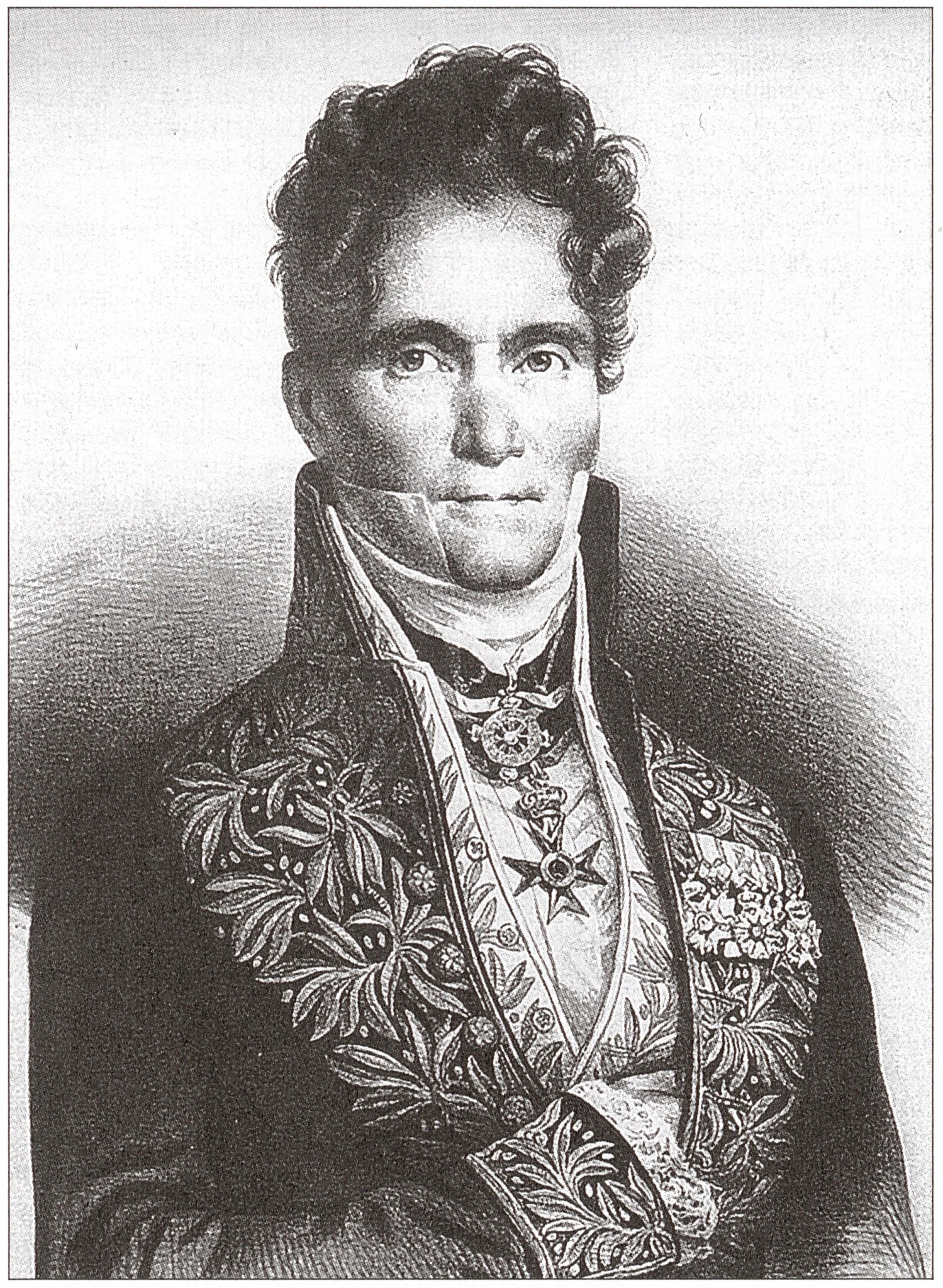
Spontini Gaspare Luigi Pacifico, born 14 November 1774 in Maiolati (now Maiolati Spontini, near Iesi), died 24 January 1851 in Maiolati, Italian composer and conductor. He came from a family of craftsmen and farmers. From 1793, he studied at the Conservatorio di Santa Maria della Pietà dei Turchini in Naples, where he was probably a pupil of N. Sala and G. Tritta; during his studies, he composed his first opera buffa works. By the end of 1802, when Spontini left for Paris, at least 12 of his operas had been staged in Italy (in Naples, Venice, Florence, Rome, and Palermo), but they only sporadically gained recognition. In Paris, the composer initially taught singing, but by 1804 he was already presenting his operas; the revised version of La finta filosofa, staged at the Théâtre Italien, was well received, while the staging of La petite maison – Spontini’s first opera in French (at the Opéra-Comique) – was a failure. Despite anti-Italian sentiments related to the political situation in France, Spontini staged his next opera, Milton, in the same year, followed by Julie ou Le pot de fleurs in 1805. The further course of the composer’s career was determined by the patronage of Empress Josephine (since 1805 Spontini used the title “compositeur particulier de la chambre”), who was involved in the preparations for the staging of his new works. The 1807 premiere of La vestale, a tragédie lyrique staged at the Opéra de Paris, was a groundbreaking success. This success was measured by the imperial court’s commission for an opera celebrating Napoleon’s Spanish campaign. Spontini realized this in the form of an opera about the Spanish conquistador Hernán Cortés and his conquest of the Aztec empire; Emperor Napoleon Bonaparte and his brother Hieronymus, King of Westphalia, were present at the premiere in 1809. Although the opera Fernand Cortez was soon removed from the repertoire, Spontini, as the creator of La Vestale, was considered one of the leading opera composers and continued to strengthen his position; in 1810, he became music director of the Théâtre de l’impératrice (formerly the Théâtre Italien), where he mainly staged operas by W.A. Mozart and D. Cimarosa. In 1811, he married Marie-Cathérine-Céleste Erard, daughter of piano maker J.-B. Erard. He celebrated the return of the Bourbons with the opera Pélage ou Le roi et la paix; his collaboration on the ballet opera Les dieux rivaux, written for the wedding of the heir to the throne (1816), was of great prestige, as was the success of the new version of Fernand Cortez (dedicated to King Louis XVIII) and the adaptation of A. Salieri’s Les Danaïdes (1817). In November 1817, Spontini obtained French citizenship, and in May 1818, the king granted him a permanent pension. Despite this, the composer’s position in Paris gradually deteriorated; he struggled to get his opera Olympia (1819) staged. At that time, Spontini’s contacts with the Berlin court were revived. As early as 1814, king Frederick William III of Prussia offered him an official position at his court, and in 1818 he accepted Spontini’s hymn to the glory of Prussia, Preussischer Volksgesang, which was performed annually between 1818 and 1840 on the occasion of the monarch’s birthday. Unfavorable reviews after the premiere of Olympia were the direct reason for Spontini’s departure from the French capital and his appointment in 1820 as director of music at the court in Berlin. Spontini enjoyed the support of the king and the sympathy of some intellectuals (including the Mendelssohn family and E.T.A. Hoffmann), but he also experienced hostility from local critics, who were opposed to the employment of a foreigner in such an important position. In addition, there were conflicts between Spontini and the administrative director of the Königliche Opernhaus, K. von Brühl, concerning the scope of their respective competences. Over the next few years, Spontini staged three of his operas: La vestale, Fernand Cortez, and Olimpia, after subjecting them to a thorough revision. None of his subsequent works, written in Berlin (Nurmahal in 1822, Alcidor in 1825, Agnes von Hohenstaufen in 1827), achieved any great success, despite being staged as part of court wedding celebrations. Spontini continued to be disliked by critics, especially the influential reviewer L. Rellstab. After the king’s death (1840), a sharp conflict arose between Spontini and Brühl’s successor, W. von Redern, as a result of which Spontini lost his job and was even unjustly accused and sentenced to nine months in prison (the sentence was overturned on appeal).
In 1842, the composer left Berlin and attempted to revive his career in Paris, but without significant results. He attributed his lack of success to the intrigues of Meyerbeer, who was enjoying great triumphs in Paris at the time, but did not take into account the fact that his own style had become outdated. After several years spent alternately in Paris and traveling, he returned to Italy in September 1850 and lived until his death in his hometown, where he founded a school for girls (1841) and a hospital (1843); in 1939, in recognition of his achievements, the town was renamed Maiolati Spontini. The composer was honored by his contemporaries with Italian, French, German, and Vatican orders.
Spontini was one of the most outstanding opera composers in France in the first two decades of the 19th century; his opera La Vestale gained international fame. In his works written in Paris – La Vestale, Fernand Cortez, and Olympia – the composer developed the model of tragédie lyrique, established in the 1770s by Gluck. He combined a solemn declamatory style with features typical of Italian opera (influenced by G. Paisiello, D. Cimarosa, L. Cherubini, and above all Mozart), while enriching the lyrics with epic elements. The character of his operas reflects the spirit of the times, the moods and dynamics of the Napoleonic era; Spontini, recognized as a court composer, became a musical voice of Napoleonic power (the musical Empire style). The pursuit of monumentalism, pathos, and triumphalism was particularly strong in the original version of Fernand Cortez, but starting with La Vestale, the composer showed a penchant for hymns and marches. The dotted rhythms and sforzatos on the weak parts of the bar often give the impression of mannerism, but they undoubtedly contributed to enhancing the dramatic qualities of Spontini’s operas in comparison with the typical Neapolitan opera of the turn of the century. The dotted rhythms and sforzatos on the weak parts of the bar often seem mannered, but they undoubtedly contributed to enhancing the dramatic qualities of Spontini’s operas in comparison with typical Neapolitan opera at the turn of the century. In the second, revised version of Fernand Cortez, the libretto was adapted to the political situation after Napoleon’s fall. In subsequent versions, the composer reinforced the dramatic crescendo effect in Act II and used reminiscent motifs that musically link the finale with Act I. To emphasize the dramatic nature of the staged events, Spontini often employed dynamic contrasts, achieved by opposing vocal ensembles, using da lontano effects (sounds coming from a distance), particularly inventive in Fernand Cortez, or by employing a specially expanded instrumental ensemble, which he significantly enlarged (quadruple woodwinds, 3 trombones, 6 trumpets, percussion enriched with military instruments and anvils). It became the rule to build up dramatic tension as the finale approached, which also served as the climax of the act and took the form of an ensemble tableau ending, in the manner of opera buffa, with a stretta (e.g. in Act II of La Vestale, which H. Berlioz described in Les soirées de l’orchestre as a “crescendo colossal”). However, the ceremony presented in the final scene is often not connected to the opera’s plot; it primarily serves a spectacular, visual purpose. The art of constructing grand ensemble scenes was developed by Spontini in Olympia and Agnes von Hohenstaufen. He also sought to create lavish stage settings for his operas (e.g., 17 horses in Fernand Cortez, 3 elephants in Olympia), and tried to use elements borrowed from other theatrical arts, such as ballet (Nurmahal, Alcidor, 2 ballet scenes in La Vestale lasting a total of about 30 minutes). In this way, he raised the social prestige of opera as a genre, while also becoming a precursor of the grand opéra style. In the solo parts of Spontini’s operas, the prevailing form consists of relatively short arias with a clear and distinctive motivic design, preceded by a récitatif obligé resembling an arioso (a technique Spontini had already employed in his early operas composed in Italy). Some arias are an integral part of larger ensemble scenes (e.g., Julia’s aria from the finale of Act III of La vestale). Longer vocal monologues, assigned only to the main characters, consist of contrasting sections separated by dialogue (for example, Julia’s monologue from Act II of La Vestale is made up of two arias: the lyrical and cantabile Toi que j’implore and the highly dramatic Impitoyables Dieux).
The rise of Romantic opera brought an end to Spontini’s achievements and fame. However, its composers (especially Meyerbeer, Berlioz, and Wagner) did not escape Spontini’s influence (in aspects such as the structure of ensemble scenes, the role of choruses, march rhythms, sound and spatial effects, and the splendor of stage productions). Berlioz and Wagner spoke highly of Spontini’s work in their writings, especially his orchestration technique. Spontini’s work also occupies a permanent place in the history of conducting. Spontini introduced and consistently developed an authoritarian style of conducting, based on systematic work and strict discipline, which guaranteed a high level of opera ensembles. He was also one of the first conductors to use a baton.
Literature:
Documenti spontiniani inediti, ed. A. Belardinelli, 2 vol., Florence 1955;
F. Schlitzet Frammenti biografiici di Gaspare Spontini con lettere inediteand Circostanze della vita di Gaspare Spontini con lettere inedite, «Quaderni dell’Accademia Chigiana» XXXIII and XXXVII, Siena 1955, 1958; Epistolario familiare e documenti vari dal 1774 al 1851 diGaspare Spontini, ed. G. Gaetti, Maiolati Spontini 1974; A. Vander Linden Notes de Madame Gaspare Spontini sur la vie et l’oeuvre de son mari, “Revue belge de musiocologie” XXVIII–XXX, 1974–76; Céleste Erard, dolce sposa di Gaspare Spontini. Epistolario, ed. G. Gaetti, Maiolati Spontini 1978; Briefwechsel Gaspare Spontini. Bd. 1, (1804-1820), eds. Ch. Mundt-Espin, V. von Pechstaedt, Göttingen 2013;
E. Morelli La musica vocale da camera di Gaspare Spontini: catalogo tematico, Lucca 2013;
L. Rellstab Über mein Verhältnis als Kritiker zu Herrn Spontini als Componisten und Generalmusikdirektor in Berlin, Leipzig 1827; H. Berlioz Spontini. Esquisse biographique, in: Les soirées de l’orchestre, Paris 1852; R. Wagner Erinnerungen an Spontini, in: Gesammelte Schriften, vol. 3, Leipzig 1872; C. Bouvet Spontini, Paris 1930; K. Schubert Spontinis italienische Schule, in: Sammlung musikwissenschaftlicher Abhandlungen, vol. 4, Strasbourg 1932; G. Abraham The Best of Spontini, “Music & Letters” XXIII issue 2 (1942) pp. 163–171; A. Ghislanzoni Gaspare Spontini.Studio storico-critico, Rome 1951; P. Fragapane Spontini, Bologna 1954, 2nd ed. 1983; H. Engel Wagner und Spontini, “Archiv für Musikwissenschaft” XII, issue 2, (1955) pp. 167–177; F. Schützer “La finta filosofa” diGaspare Spontini, Naples 1957; P. Fragapane Arie per soprano tratte dalle opere di Gaspare Spontini, Florence 1978; A. Bricchi Spontini e la riforma della musica di chiesa, lesi 1986; A. Mungen Musiktheater als Historienbild. Gaspare Spontini’s “Agnes von Hohenstaufen” als Beitrag zur deutschen Oper, Tutzing 1997; M. Jira E. T. A. Hoffmanns deutsche Übersetzung von Gasparo Spontinis Oper “Olimpia”, “Archiv für Musikwissenschaft“ LIX issue 3, (2002) pp. 186–209; G. Castellani Intrigues politiques et rivalités artistiques: Le Théâtre Italien de Paris entre Empire et Restauration, “Revue de Musicologie” XC issue 2 (2004), pp. 231–252; A. Everett Josephine’s composer: the life times and works of Gaspare Pacifico Luigi Spontini (1774–1851), Bloomington 2013; Spontini und die Oper im Zeitalter Napoleons, ed. D. Altenburg, series «Musik und Theater» vol. 11, Sinzig 2015; P. Barbier Gaspare Spontini, Paris 2017; E. Papanikolaou Spontini and the City: Bach and Musical Politics in Berlin, “The German Quarterly” XCI issue 4, (2018), pp. 389–399; Reminiscences of Spontini in: Richard Wagner’s Writings on Conducting, English translation Ch. Walton, Rochester (New York) 2021; L. Benedos, P. Rizzi Sulle tracce di Gaspare Spontini: profilo di un compositore europeo dalla scrittura, 1774–1851, Ancona 2023;
Studi spontiniani, proceedings of international congresses devoted to Spontini: in Iesi, Maiolati Spontini, Fabriano, Ancona 1951, in Florence 1954 and in Maiolati Spontini 1983; F. Kolb, A. Lattanzio Gaspare Spontini. The Berlin years, proceedings of two conferences on Spontini in 2015 and 2019, Lucca 2023.
Compositions
Dramatic:
operas:
Teseo riconosciuto, 2-act opera, libretto by C. Giotti, premiered in Florence 22 May 1798
Milton, fait historique, 1-act opera, libretto by E. de Jouy and A.M. Dieulafoy, premiered in Paris 27 November 1804
La vestale, tragédie lyrique, 3-act opera, libretto by E. de Jouy after J.J. Winckelmann, premiered in Paris 15 December 1807
Fernand Cortez ou La conquête du Mexique, 3-act opera, libretto by E. de Jouy and J.A. d’Esmenard after A. Piron, premiered in Paris 28 November 1809, 2nd version, libretto revised by. E. de Jouy, premiered in Paris 28 May 1817, 3rd version titled Ferdinand Cortez oder Die Eroberung von Mexiko, libretto revised by M.-E. Théaulon de Lambert, translated by J.C. May, premiered in Berlin 6 April 1824, 4th version, libretto revised by K. von Lichtenstein, premiered in Berlin 26 February 1832, music lost
Pélage ou Le roi et la paix, 2-act opera, libretto by E. de Jouy, premiered in Paris 23 August 1814
Les dieux rivaux ou Les fêtes de Cythère, opera-ballet composed with R. Kreutzer, L.-L. Loiseau de Persuis and H.-M. Berton, 1-act, libretto by A.M. Dieulafoy and C. Briffaut, premiered in Paris 21 June 1816
Olimpie, tragédie lyrique 3-act opera, libretto by A.M. Dieulafoy and C. Briffaut after Wolter, premiered in Paris 22 December 1819, 2nd version titled Olimpia, libretto revised and translated by E.T.A. Hoffmann, premiered in Berlin 14 May 1821, 3rd version titled Olimpie, premiered in Paris 28 February 1826
Nurmahal oder Das Rosenfest von Kaschmir (Lalla Rûkh version), 2-act opera, libretto by C.A. Herklotz after T. Moore’s Lalla Rookh, premiered in Berlin 27 May 1822
Alcidor, 3-act opera, libretto by M. Théaulon de Lambert after M. Rochon de Chabannes, translated by C.A. Herklotz, premiered in Berlin 23 May 1825
Agnes von Hohenstaufen, lyrical drama, 2-acts, libretto by E. Raupach, premiered in Berlin 28 May 1827 (only Act 1), 2nd version, 3-act, libretto by E. Raupach, premiered in Berlin 12 June 1829, 3rd version, libretto revised by K. von Lichtenstein, premiered in Berlin 6 December 1837
comic operas:
Li puntigli delle donne, farsetta, 2-acts, premiered in Rome 1796
Adelina Senese ossia L’amore segreto, 2-acts, libretto by G. Bertati, premiered in Venice 10 October 1797
Heroísmo ridicolo, farsa, 1-act, libretto by D. Piccinni, premiered in Naples 1798
La finta filosofa (expanded version of L’eroismo radicolo), 2-actss, libretto by D. Piccinni (?), premiered in Naples 1799, 2nd version, 3-acts, premiered in Paris 11 February 1804
La fuga in maschera, 2-acts, libretto by G. Palomba, premiered in Naples 1800
La petite maison, 3-acts, libretto by A.M. Dieulafoy and N. Gersaint, premiered in Paris 12 May 1804
Julie ou Le pot de fleurs, composed with E. Fay, 1-act, libretto by A.G. Jars, premiered in Paris 12 March 1805
Laila Rûkh, festspiel, libretto by S.H. Spiker after T. Moore’s Lalla Rookh, premiered in Berlin 27 January 1821
lost:
Il finto pittore, premiered in Rome (?) 1797/78
Gli Elisi delusi, melodramma buffo, 2-acts, libretto by M. Monti, premiered in Palermo 28 August 1800
I quadri parlanti, melodramma buffo, premiered in Palermo 1800
Gli amanti in cimento ossia Il geloso audace, 2-acts, libretto by G. Bertati (?), premiered in Rome 3 November 1801
Le metamorfosi di Pasquale ossia Tutto è illusione nel mondo, farsa, 1-act, libretto by G. Foppa, premiered in Venice 1802
vaudevilles as well as individual arias, duets, and instrumental parts, included in operas by other composers, such as the Grand Bacchanale for orchestra in Les Danaïdes by A. Salieri, performed in Paris 22 October 1817.
Instrumental:
for orchestra:
Notturno, performed in Naples 1795
4 Fackeltänze (for Prussian royal weddings), 1822, 1823, 1825, 1829, Berlin n.d., also arranged for piano, Berlin n.d.
for military orchestra:
Geschwindmarsch, published in: Sammlung von Märchen für türkische Musik zum bestimmen Gebrauch der königlichen preussischen Armée, Berlin n.d.
Ballo marziale
Les charmes d’une fête, divertimento for piano, Vienna n.d.
***
vocal-instrumental works, including ariettas, romances, and canzonettas for 1 or 2 solo voices with piano or harp
choral works, both sacred and ceremonial
Work:
Ristretto di eserciziper apprendere la maniera di cantare, MS. Bibliothèque Nationale, Paris