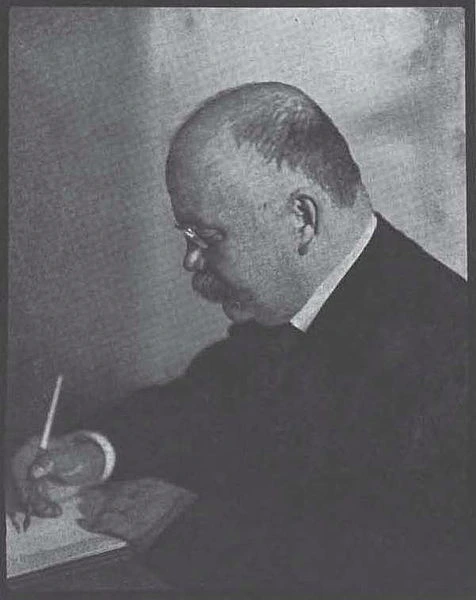
Louis Rudolf, *30 January 1870 Schwetzingen, †15 November 1914 Munich, German music theorist. He studied music and philosophy in Geneva (1889–91) and Vienna (1891–93), where he obtained his doctorate in 1894 with his thesis Der Widerspruch in der Musik. He studied composition with F. Klose and conducting with F. Mottl. In 1894–95, he completed an internship as a bandmaster with F. Mottl in Karlsruhe. He then worked as theatre orchestra director in Landshut and Lübeck; in 1897, he settled in Munich, where he worked as a music teacher and music writer, and from 1900 as a music critic for the “Münchner Neueste Nachrichten.”
Louis’ artistic tastes and interests were influenced by his studies with F. Klos, a friend and admirer of Bruckner’s music, and with F. Mottl, a promoter of Wagner’s works. Louis viewed the aesthetic concepts and works of Brahms and Reger with reserve, while embracing with enthusiasm the creative ideas of Wagner, Liszt, and Bruckner. Among Louis’s works, his monograph on Bruckner deserves special attention. It is the first extensive study of the composer’s life and work based on primary sources, containing both aesthetic and philosophical reflections as well as harmonic, contrapuntal and formal analysis. The appendix contains documents from Bruckner’s life, his correspondence, music reviews published in the Viennese press, as well as musical examples from his symphonies. Louis also held Berlioz’s music in high regard, devoting a historical and analytical study to him. He was also interested in the work of contemporary German composers (especially H. Pfitzner and F. Klose), which he discussed in his book Die deutsche Musik der Gegenwart.
The frequently reprinted textbook Harmonielehre (written with L. Thuille) had a major influence on subsequent generations of music students. In this work, the authors combine the Viennese scale degree theory of Sechter with Riemann’s concept of harmonic functions, although they do not adopt his functional notation. They promote a harmonic monism, based on the theory of degrees, while also taking into account the principles of figured bass. Criticism of Riemann’s dualistic theory of functional harmony for ignoring “empirical reality” and theoretical speculation provoked musicological discussions. Harmonielehre is divided into two parts: the first concerns diatonicism, the second – chromaticism and enharmonics. The appendix contains examples from music literature concerning chromaticism and enharmonics (from Mozart to Wagner and R. Strauss), information about church tonalities and so-called exotic harmony, which, according to the authors, is the result of, among other things, the harmonisation of folk melodies (musical examples are taken from works by Berlioz, Chopin and Grieg) and manifested primarily in the works of French composers (Saint-Saëns, Debussy). Louis also compiled an abridged version of this harmony textbook, Grundriss des Harmonielehre (reprinted many times), as well as a tutorial entitled Schlüssel für Harmonielehre and a collection of exercises and tasks for learning harmony, Aufgaben für den Unterricht in der Harmonielehre, containing, among other things, exercises in figured bass realisation and taking into account the formal concept of sentences and periods. The examples are taken from the works of 62 composers, from J.S. Bach to Wagner, including 100 secular melodies, 64 Protestant church songs and 17 melodies from Gregorian chant. Among Louis’s few compositions, his symphonic poem Proteus (1903).
Literature: H. Riemann Eine neue Harmonielehre, „Süddeutsche Monatshefte” IV, 1907 no. 1, comment by Louis, ibid., reply by H. Riemann, ibid. no. 2; M. Schillings Besprechung der Harmonielehre von Rudolf Louis und Ludwig Thuille, “Die Musik” XXIII, 1906/7; R. Wustmann Rezension R. Louis “Deutsche Musik der Gegenwart,” “Propyläen” XX, 1909; P. Bekker Rudolf Louis: Die deutsche Musik der Gegenwart, “Die Musik”, XXII, 1909; G. Capellen Die deutsche Neu-Exotik und die Kritik. Streitschrift gegen Dr. Rudolf Louis, “Neue Musik Zeitung”, 1911 (414–417), https://archive.org/details/NeueMusikZeitung32Jg1911/page/n597/mode/2up; E. Istel Nachruf auf Rudolf Louis, “Die Musik” XIV, 1914/15; R. I. Schwartz An annotated English translation of Harmonielehre of Rudolf Louis and Ludwig Thuille, (doctoral dissertation) Washington 1982; R. Falck Emancipation of the dissonance (by R. Louis), “Journal of the Arnold Schoenberg Institute”, I, 1982; H. Borgdorf Rudolf Louis en Ludwig Thuille “Harmonielehre” 1907, in: L. P. Grijp, P. Scheepers (ed.), Van Aristoxenos tot Stockhausen, Groningen 1990; A. Jarzębska Dzieje myśli o muzyce, Krakow 2002; L. Holtmeier Von der Musiktheorie zum Tonsatz: Zur Geschichte eines geschichtslosen Faches, “Zeitschrift der Gesellschaft für Musiktheorie” I, 2003; S. Boussahel Harmonielehre de R. Louis et L. Thuille: Un traité à l’écoute de son temps, in: L’harmonie post-romantique: Analyse et esthétique, Paris 2007; J. Brandes Ludwig Thuille und die Münchner Schule: Kompositionslehre in München am Ende des 19. Jahrhunderts und die “Harmonielehre,” (doctoral dissertation, Hochschule für Musik, Freiburg), Hofheim 2018; D. Hofmann Ludwig Thuille und die Münchner Schule: Kompositionslehre in München am Ende des 19. Jahrhunderts und die “Harmonielehre,” “Die Musikforschung,” III, 2019.
Der Widerspruch in der Musik, Leipzig 1893, reprint Wiesbaden 1972
R. Wagner als Musikästhetiker, Leipzig 1897
Die Weltanschauung R. Wagners, Leipzig 1898, reprint Hamburg 2012, Norderstedt 2016
Franz Liszt, Berlin 1900, reprint Hamburg 2012, Kraichtal 2014
L. Thuille, „Neue Musik-Zeitung,” XXIV, 1903
H. Berlioz, Leipzig 1904, reprint Barsinghausen 2013
H. Pfitzner. Die Rose vom Liebesgarten. Eine Streitschrift, Munich 1904
Friedrich Klose und seine symphonische Dichtung “Das Leben ein Traum,” Munich 1905
A. Bruckner, Munich 1905, ed. P. Ehlers 2nd edition, 1918, 3rd edition 1921, reprint Hamburg 2012
Harmonielehre, with L. Thuillem, Stuttgart 1907, 2nd edition 1908, new edition by W. Courvoisier et al. 10th edition 1933, reprint Hamburg 2012; English version Washington 1982, https://archive.org/details/harmonielehre00loui/page/n5/mode/2up
Grundriss des Harmonielehre, Stuttgart 1908, 2nd ed. 1914, 10th ed. 1933
Die deutsche Musik der Gegenwart, Munich 1909, 3rd ed. 1912, reprint (from 1909) Hamburg 2012, Kraichtal 2014
Hans Pfitzner. Biographie sowie vollst. Verz. seiner Werke, Leipzig 1909
Aufgaben für den Unterricht in der Harmonielehre, Stuttgart 1911, Munich 4th ed. 1913, Stuttgart 10th ed. 1933
Schlüssel für Harmonielehre von Louis und Thuille. Lösungen der in dem Louis-Thuilleschen Harmonielehrbuche und in dem dazu gehörigen Louisschen Aufgabenbuche enthaltenen Übungsaufgaben, wyd. Stuttgart 1912, 2nd ed. 1920, reprint 1930
Das Lied von der Erde, in: Mahler and his world. Part IV: Mahler’s German-language critics, translation and editing K. Painter, B. Varwig, Princeton 2002