
[Afisz dotyczący dwóch oper Alberta Lortzinga]

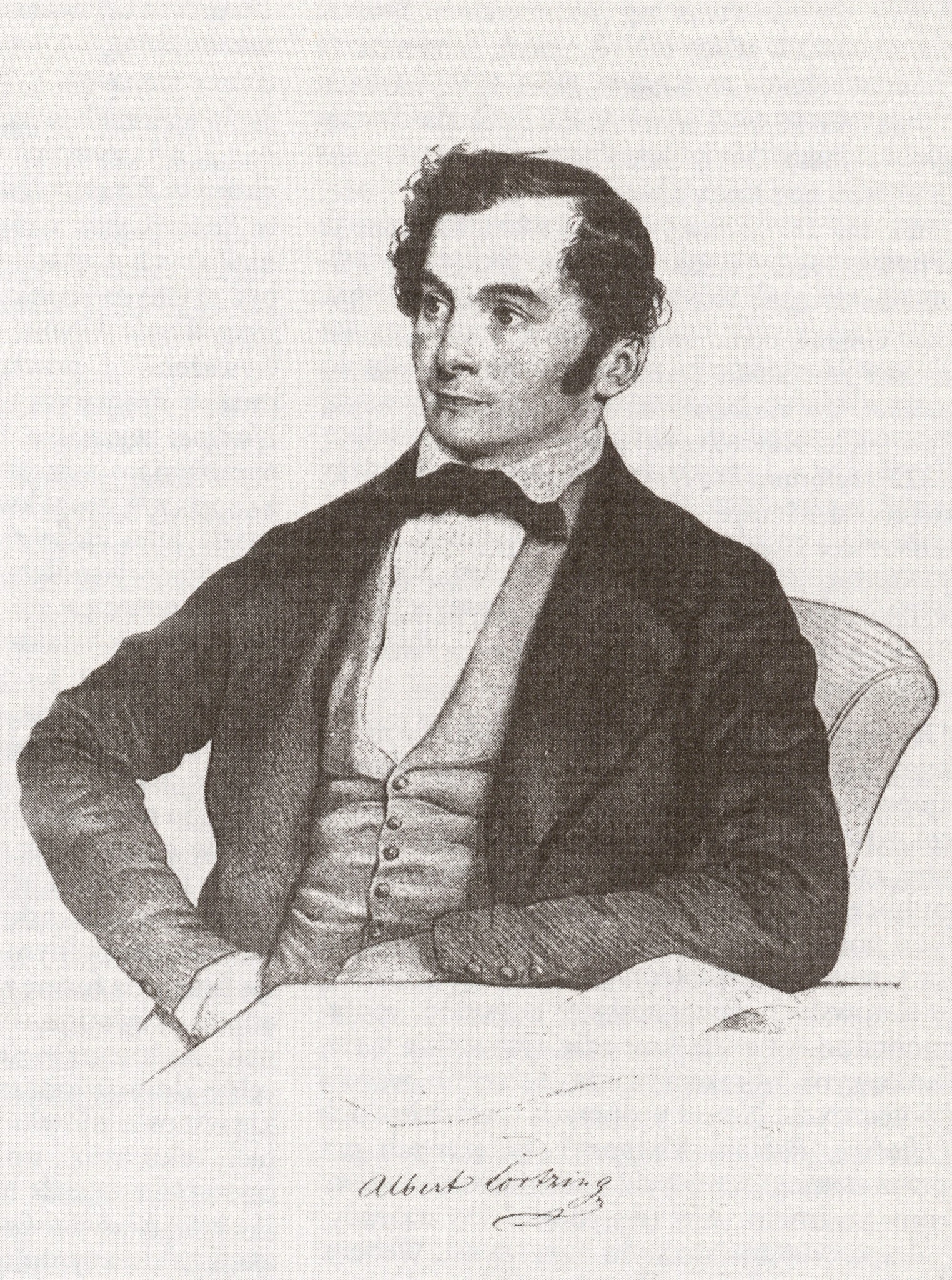
Lortzing Gustav Albert, *23 October 1801 Berlin, †21 January 1851 Berlin, German composer. He came from a merchant family, which, however, was no stranger to artistic interests. Lortzing’s mother, Sophie Charlotte Seidel, came from the French de la Gard family. From an early age, Lortzing was educated in playing various instruments (piano, violin, cello) as well as in theory and composition (his first teacher was C.F. Rungenhagen). In early childhood he was also exposed to theatrical life through his parents’ involvement in the amateur productions of the Urania theatre association. Lortzing’s social status changed when his parents, threatened with bankruptcy, sold their merchant company in 1812, and became actors at the theatre in Wrocław. His mother, usually cast in the role of a soubrette, also sang in the opera. From then on, Lortzing became self-taught, learning from J.G. Albrechtsberger’s textbook, playing in the opera orchestra, and sometimes being entrusted with children’s roles. Over the course of several years, the Lortzing family travelled throughout Germany, from 1817 with J. Derossi’s travelling theatre. Rosina Ahles, an actress, whom Lortzing married in 1823 and with whom he had 11 children, was also associated with this troupe. Four members of the Lortzing family often performed together in the same production – for instance in J.F. Jünger’s Komödie aus dem Stegreif, a play that Lortzing later used when writing the libretto for his last opera, Die Opernprobe (The Opera Rehearsal), or in the first German staging of Shakespeare’s Romeo und Julia, translated by Schlegel.
In 1824, Lortzing composed his first singspiel, Ali Pascha von Janina. In 1826, the composer and his wife were employed at the court theatre in Detmold, where he performed as an actor, opera singer (tenor) and cellist in the orchestra, and also composed music for plays and singspiele, including an adaptation of J.A. Hiller’s singspiel Die Jagd, Der Pole und sein Kind (The Pole and His Child) and the singspiel Szenen aus Mozarts Leben (Scenes from Mozart’s Life). In 1833, the Lortzings joined the Stadttheater ensemble in Leipzig, where two years later Lortzing achieved great success with his first opera Die beiden Schützen (The Two Riflemen), which was soon also staged in Berlin, Munich, and Prague. This was followed by further operas: Zar und Zimmermann (Tsar and Carpenter), performed to great acclaim in Berlin in 1839, Caramo, Hans Sachs, and Der Wildschütz (The Poacher).
Lortzing was also increasingly entrusted with conducting duties, until finally, in 1844, he was appointed Kapellmeister, and the first work he presented to the public was Mozart’s Don Giovanni. During his stay in Leipzig, he became friends with P.J. Düringer (Lortzing’s first biographer). Of the personalities of Leipzig’s musical life, Lortzing only met H. Marschner, but did not establish closer contacts with Mendelssohn, Schumann, or Wagner. In the second half of the 1840s, Lortzing’s professional life, although no less active, brought him more failures than successes. In 1845, while Lortzing was busy staging Undine in Magdeburg and then in Hamburg, he was dismissed from his position as conductor at the theatre in Leipzig, which plunged the Lortzing family into poverty. The difficult financial situation was not improved by an invitation to the Theater an der Wien, where the composer presented his opera Der Waffenschmied (The Armourer) in 1846, as both critics and the public reacted unfavorably to the work, showing little acceptance of its typically German humor. During the Spring of Nations, Lortzing wrote several songs on topical subject, as well as the revolutionary opera Regina, but no theatre staged this work during the composer’s lifetime. Lortzing’s efforts to obtain the position of Kapellmeister in Dresden after Wagner and in Berlin after the late O. Niccolai were unsuccessful as well. In 1849, Lortzing received an offer from the new director of the Stadttheater in Leipzig to stage a new opera, Rolands Knappen. However, the success of this performance only brought him the position of second conductor, which Lortzing did not accept. Forced by financial difficulties, he returned to acting, which was already a burdensome activity for him at that time. In mid-1850, he briefly took up a not very lucrative position as bandmaster at the Friedrich-Wilhelmstädt-Theater in Berlin, which specialised in staging farces and light comedies with music. The composer managed to stage two of his operas at that time: The Poacher and The Two Riflemen. Lortzing’s last work, The Opera Rehearsal, was premiered in Frankfurt am Main on 20 January 1851, in the absence of the seriously ill composer, who died the following day in poverty and bitterness.
Lortzing’s many years of stage experience as an actor, singer, instrumentalist, conductor, director, and librettist was fundamental to his creative work. Lortzing composed his works in such a way as to satisfy the expectations and tastes of a wide audience. Romantic aesthetics had little influence on his artistic attitude; Lortzing was a proponent of Biedermeier aesthetics, favouring cheerful, sentimental, and intimate situation comedies with an idyllic picture of the life of the lower social classes. Even in his fairy-tale operas (Undine, Rolands Knappen), which were linked to German Romanticism through their fantastical and fairy-tale elements, he did not decide to make any radical references to the musical and dramatic style of Weber, Spohr or the young Wagner. He wrote the texts for his stage works himself, often adapting French librettos or plays by popular German authors, such as A. Kotzebue, and did not shy away from plots that had already been explored many times before (e.g. the story of Tsar Peter the Great had been taken up before him by Grétry, Donizetti, Adam, Flotow and others). The exception is the three-act opera Regina, with an original libretto by Lortzing, composed in 1848 under the influence of the events of the Spring of Nations in German cities. For the first time in the history of opera as a stage genre, the action takes place in a working-class environment; the narrative begins with a factory strike and reaches its climax in an act of terrorism by the protest leader. The slogans of freedom and demands for equal civil rights put forward by the opera’s characters meant that none of the theatres in the post-revolutionary, re-regime reality decided to stage Lortzing’s subversive opera. It was not until 1998 that the opera was staged for the first time in its original version, without any interference to soften the political and social message of the work, in Gelsenkirchen (directed by Peter Konwitschny).
Lortzing is considered the most outstanding representative of comic opera in Germany in the first half of the 19th century. He also wrote music for plays and singspiele. In Ali Pascha von Janina, he referred to the “alla turca” fashion that had been popular for several decades, including Mozart’s The Abduction from the Seraglio (scenography, Turkish march). Even more strongly associated with the author of Don Giovanni was the singspiel Scenes from Mozart’s Life, with Mozart and Salieri as the main characters. Lortzing composed this work from fragments of Mozart’s piano and vocal-instrumental pieces, adding only the overture himself. An expression of pro-Polish sympathies, quite common among the German intelligentsia after the fall of the November Uprising, was the singspiel Der Pole und sein Kind, which quoted the melody of the Polish national anthem. The protagonist of this work is a Polish emigrant – a wanderer who earns his living by singing. Here, Lortzing borrowed from D. Auber’s Fra Diavolo and F.A. Boieldieu’s La Dame Blanche; the censors soon banned the work.
Lortzing composed comic opera in the French style as a number opera with spoken dialogue serving as interludes, moments of respite for the listener, as the composer focused on the sung passages. As a seasoned connoisseur of the performing arts, he sought to diversify the traditional architectural scheme of opera, for example by beginning the work with a choral or ensemble-choral scene with great visual and acoustic qualities (e.g. the engagement ceremony scene with the choir in The Poacher, the ensemble scene in the smithy in The Armourer, the carpenters’ choir in Tsar and Carpenter). In some ensemble scenes, Lortzing seems to be a worthy heir to Mozart, especially his The Marriage of Figaro, due to the excellent balance and connection between the musical and dramatic moments (e.g. the quintet from Act 1 of Undine: Undine’s confession – recitativo accompagnato, the listeners’ account – larghetto, a cappella, pp; the second quintet from Act 2 of The Poacher, known as “Billardszene”: the situational comedy perfectly harmonises with the musical form – the billiards game returns in the form of a rondo, and Baculus’s chorale-like part ties the whole thing together like a cf.). Another strong point of Lortzing’s operas are the stage characters, dynamic and striking not only vocally but also in terms of acting, e.g. the character of Baculus from The Poacher. Also interesting, due to the rare combination of voices before Wagner, is the male sextet from Act 2 of the opera Tsar and Carpenter, which begins with a longer passage without orchestral accompaniment. Lortzing usually shaped the verses of his sentimental solo numbers in a form that is straightforward but subtly sophisticated (romanza, Lied, arietta, cavatina, barcarolle). However, the integrity of a solo number is sometimes disrupted for dramatic purposes by short spoken or recitative interludes in the musical flow, e.g. in Maria’s arietta from Act 1 of Tsar and Carpenter or in the Baron’s cavatina in Act 2 of The Poacher; this leads to the action being split into two simultaneous planes.
Lortzing also entered the history of music as a master of musical comedy, both in its satirical-parodic (though less frequent) and its humorous forms. The former is closely connected with the devices developed in Italian opera buffa: parlando buffo (fast vocal figuration in equal rhythmic values, non-legato), melismas in low-register voices, the discrepancy between the seriousness of the vocal voice and the scherzando-like orchestral part, motifs imitating laughter, frequent use of grace notes, as well as registers and timbres evoking comic connotations, for example, a bassoon in low-register staccato (see van Bette’s aria Oh, ich bin klug und weise in the opera Tsar and Carpenter). The composer achieved the humorous effects that occur in every Lortzing opera through unexpected associations or by breaking listening habits, e.g. homorhythm of voices in extreme registers, imitation of emotions by instrumental means (e.g. accelerated pulse expressed by horn sounds), mixing spoken and sung conventions, showing musical performance on stage at the rehearsal stage (Scene 1 in The Opera Rehearsal, choir rehearsal in Tsar and Carpenter, Baculus’ ABCD song, etc.). Lortzing used a slightly different set of means in his fairy-tale opera Undine, in which he drew on the literary motif of the rusalka, a favourite of 19th-century composers. Unlike E.T.A. Hoffmann’s opera, which Lortzing probably did not know, and Weber’s fairy-tale operas, the romantic theme did not inspire Lortzing to expand his colouristic resources and emphasise the mood of the plot, but rather to intensify the dramatic and pathetic element through: recitative accompagnato (Kühleborn’s part), references to the tradition of the grand aria form (Hugo’s aria from Act 2), Undine’s dramatic arioso in place of a sentimental arietta, the reinforcement of the sound with trombones and tuba, dynamic contrasts, and rapid tremolos on the string instruments. Lortzing’s work, perhaps not particularly ambitious or innovative, but full of charm and mastery in its genre, managed to exert a certain influence even on the work of R. Wagner; the librettos of the operas Hans Sachs and The Armourer became models for Die Meistersinger von Nürnberg (The Master-Singers of Nuremberg).
Literature:
P.J. Düringer Albert Lortzing. Sein Leben und Wirken, Leipzig 1851; H. Wittmann Lortzing. Musiker-Biegraphien, Leipzig ca. 1907; G.R. Kruse Albert Lortzing. Leben und Werk, Leipzig 1914, Wiesbaden 2nd edition 1947; J. Schwermann Albert Lortzings Bühnentexte, Wattenscheid 1914; K. Blessinger Lortzing und komische Oper, Augsburg 1921; H. Laue Die Operndichtung Lortzings. Quellen und Umwelt. Verhältnis zur Romantik und zu Wagner, Bonn 1932 (doctoral dissertation); H. Killer Albert Lortzing, Potsdam 1938; E. Sanders “Oberon” and “Zar und Zimmermann”, “The Musical Quarterly” XL, 1954; H. Burgmüller Die Musen darben. Ein Lebensbild Albert Lortzings, Berlin 1956; H. Walch-Moser Zar und Zimmermann von Albert Lortzing, Berlin 1961; A. Goebel Die deutsche Spieloper bei Lortzing, Nicolai und Flotow – ein Beitrag zur Geschichte und Ästhetik der Gattung im Zeitraum von 1835 bis 1850, Cologne 1975; R. Rosengard Subotnik Lortzing and the German Romantics: A Dialectical Assessment, “The Musical Quarterly” LXII, no. 2 (1976), pp. 241–246; J. Schläder Undine auf dem Musiktheater. Zur Entwicklungsgeschichte der deutschen Spieloper, Bonn 1979; H.C. Worbs Albert Lortzing in Selbstzeugnissen und Bilddokumenten, Reinbeck 1980; K. Pahlen Zar und Zimmermann, Munich 1981; I. Capelle Albert Lortzing und das norddeutsche Singspiel: Zu Lortzings Bearbeitung von Johann Adam Hillers Singspiel “Die Jagd“ (1829/1830), “Die Musikforschung“ XXXIX, book 2, (1986), pp. 123–138; O. Hafner Ferdinand Raimund, Gustav Albert Lortzing, Richard Wagner: Verborgene Beziehungen und Spuren, “Studia Musicologica Academiae Scientiarum Hungaricae“, XXXII, book 1 (1990), pp. 235–240; H. Schirmag Albert Lortzing: Glanz und Elend eines Künstlerlebens, Berlin 1982, reprint 1995; I. Capelle “Spieloper” — ein Gattungsbegriff? Zur Verwendung des Terminus, vornehmlich bei Albert Lortzing, “Die Musikforschung” XLVIII, book 3 (1995), pp. 251–257; H. Hoffmann Albert Lortzing. Libretto eines Komponisten, Düsseldorf 1987; P. Fischer Vormärz und Zeitbürgertum. Gustav Albert Lortzings Operntexte, Stuttgart 1997; W. Dietrichkeit Gustav Albert Lortzing. Schauspieler, Sänger, Komponist, Kapellmeister: eine Biographie, Springe (nearby Hanover) 2000; J. Lodemann Lortzing. Leben und Werk des dichtenden, komponierenden und singenden Publikumslieblings, Familienvaters und komisch tragischen Spielopernweltmeisters aus Berlin, Göttingen 2000; J. Lodemann Oper – O reiner Unsinn – Albert Lortzing, Opernmacher, Freiberg am Neckar 2005; E. M. Schnelle “Dann bricht der Freiheit Morgen an”. Die Opern Albert Lortzings in ihrem verfassungsgeschichtlichen Kontext, Leipzig 2013; Th. Schipperges Lortzing und Leipzig. Musikleben zwischen Öffentlichkeit, Bürgerlichkeit und Privatheit, Hildesheim 2014; J. Oberheide Lortzings Jubel-Kantate. Die Geschichte einer verloren geglaubten Partitur, Leipzig 2014.
Compositions
The year and place refer to the premiere or first performance, if not stated otherwise.
Lortzing’s works were published – unless otherwise indicated – in Leipzig in piano-vocal score form, usually less than a year after their premieres.
Unless otherwise stated, the librettos were written by Lortzing himself.
Stage:
comic operas:
Die beiden Schützen, 3 acts, after G. Cords: Die beiden Grenadiere, Leipzig, 20 February 1837
Zar und Zimmermann oder Die zwei Peter, 3 acts, after C.C. Römers Der Bürgermeister von Saardamm, Leipzig, 22 October 1837, score publ. Leipzig 1900
Caramo, oder Das Fischerstechen, 3 acts, after A. Vilain de Saint-Hilaire and P. Duport: Cosimo, Leipzig, 20 September 1839, Leipzig 1847
Hans Sachs, 3 acts, after L.F. Deinhardstein, Leipzig, 23 June 1840
Casanova, 3 acts, after A. Lebrun: Casanova im Fort St. André, Leipzig, 31 December 1841, unpublished
Der Wildschütz, oder Die Stimme der Natur, 3 acts, after A. Kotzebue: Der Rehbock, Leipzig, 31 December 1842, score publ. Leipzig, 1928
Der Waffenschmied, 3 acts, after F.W. v. Ziegler: Liebhaber und Nebenbuhler in einer Person, Vienna, 30 May 1846, score publ. Leipzig, 1922
Zum Grossadmiral, 3 acts, after Heinrich des Fünften Jugendjahre, A.W. Iffland, Leipzig, 13 December 1847
Die Opernprobe, oder Die vornehmen Dilettanten, 1-aktowa, after J.F. Jünger: Die Komödie aus dem Stegreif, Frankfurt am Main, 20 January 1851, Frankfurt am Main, 20 January 1851, score publ. Leipzig 1899
arrangement of J.A. Hiller’s opera Die Jagd, 3 acts, libretto C.W Weisse, Osnabrück, 20 November 1830
other operas:
Die Schatzkammer des Ynka, tragedy, libretto R. Blum, unperformed, only Festmarsch (Festive march) preserved
Undine, 4-act fairy opera, after F. de la Motte-Fouqué, Magdeburg, 21 April 1845, score publ. Leipzig 1925
Regina, 3-act rescue opera, edited and arranged by A. L’Arronge titled Regina, oder Die Marodeure, Berlin 21 March 1899, Gelsenkirchen, 14 March 1998, unpublished in the original
Rolands Knappen, oder Das ersehnte Glück, 3-act fairy opera, libretto G. Meisinger and K. Haffer after G.A. Musäus, Leipzig, 25 May 1849, only the libretto has been published, Leipzig, n.d.
singspiele (all one-act and unpublished):
Ali Pascha von Janina, oder Die Franzosen in Albanien, Münster, 1 February 1828, Leipzig 1900
Der Pole und sein Kind, oder Der Feldwebel vom IV Regiment, Osnabrück, 11 October 1832, Regensburg 1835
Weihnachtsabend, Münster, 21 December 1832
Andreas Hofer after K. Immermann: Trauerspiel in Tyrol, arrangement E.N. Rezniček, Mainz, 14 April 1887
Szenen aus Mozarts Leben, 1832, arranged by A. Bankwitz, Berlin 1933, unperformed
music for theatre plays:
A. Kotzebue Der Schutzgeist, Freiburg im Breisgau, before 1820, lost
C. Crabbe Don Juan und Faust, Detmold, 29 March 1829
T. Hell Yelva oder Die Stumme, after E. Scribe, Pyrmont, 30 June 1830, only the overture preserved
J.K. Böhm Vier Wochen in Ischl, Vienna 1849
O. Stotz Eine Berliner Grisette, Berlin, 16 June 1850
R. Gottschall Ferdinand von Schill, Berlin, 20 November 1850
Instrumental and vocal-instrumental:
Andante maestoso con variazioni for horn and orchestra, 1820
Dich preist, Allmächtiger, anthem for solo voices, chorus and orchestra, 1822
Die Himmelfahrt Jesu Christi, oratorium, text by K. Rosenthal, Münster, 15 November 1828
Kantate (zur Säkularfeier der Loge Minerva zu den drei Palmen), text by L. Mothes, Leipzig, 20 March 1841
Das Lied vom 9. Regiment for baritone solo, chorus and orchestra, 1851
other minor vocal works
piano pieces (polonaises, waltzes) and violin pieces