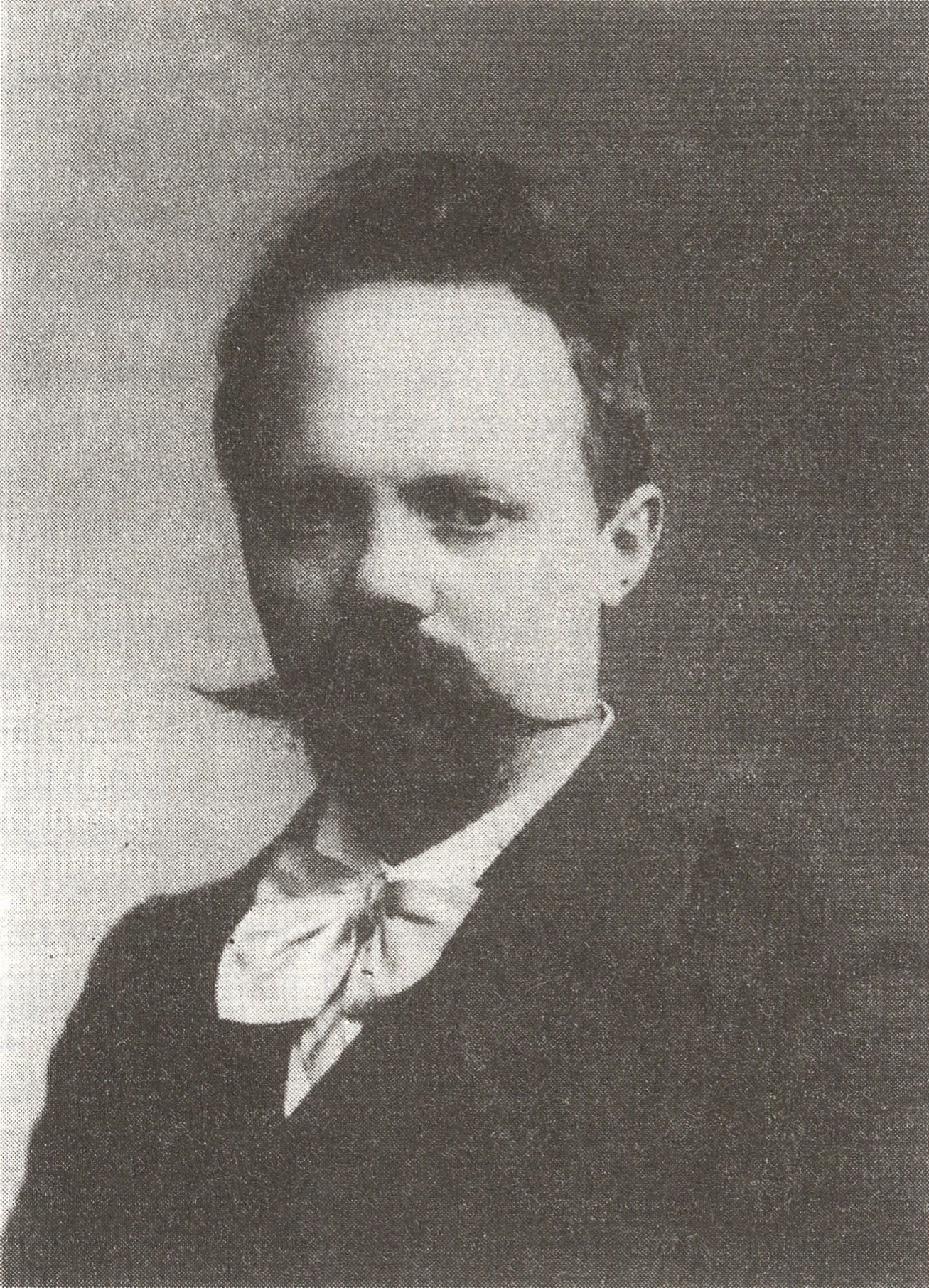
Humperdinck Engelbert, *1 September 1854, Siegburg, †27 September 1921, Neustrelitz, German composer and pedagogue. Humperdinck’s father, Gustav, was a secondary school teacher, while his sister Adelheid and her husband Hermann Wette were involved in literary work. At the age of 7, Humperdinck began learning to play the piano; he made his first independent attempts at composition between the ages of 12 and 14 (the Harziperes opera and Perla and Claudine von Villabella singspiele). From 1869, he attended secondary school in Paderborn, sang in the cathedral choir, and joined the city’s music society. During his school years, he wrote several compositions to sacred texts (the scores of these works were destroyed in a fire in 1874). In 1872, Humperdinck began studying architecture, but quickly changed his plans and enrolled at the conservatory in Cologne, where he studied harmony and composition (under F. Hiller, among others), as well as piano, organ, and cello. Shortly after graduating, in 1876, Humperdinck received a scholarship from the city of Frankfurt am Main, so in 1877–79 he furthered his education under F. Lachner (composition) and J. Rheinberger (counterpoint) at the Königliche Musikschule in Munich; two of Humperdinck’s ballads, Die Wallfahrt nach Kevelaar and Das Glück von Edenhall, as well as his Humoresque for orchestra, were performed at school concerts. In 1877, Humperdinck became a member of the Wagnerian society of young musicians, Orden vom Gral; a major artistic experience for him was the Munich premiere of The Ring of the Nibelung. In 1879, the composer won first prize awarded by the F. Mendelssohn Foundation in Berlin, and then left for Italy. During his stay in Rome, where he met G. Sgambati, Humperdinck composed music for Aristophanes’ play The Frogs.
In May 1880, Humperdinck stayed for several weeks in Naples, where he met R. Wagner in person. This acquaintance eventually developed into a close friendship and, on Humperdinck’s part, sincere devotion. In 1881–82, he lived in Bayreuth, became part of Wagner’s inner circle (meeting F. Liszt, among others) and copied the score of Parsifal; at the master’s request, he added several fragments to it, filling the time needed to change the scenery between scenes in Act III. In 1881, he received another award – the G. Meyerbeer Prize, awarded in Berlin. In the summer of 1882, he traveled with his parents to Rome and then to Paris, where, thanks to letters of recommendation from Wagner, he entered the circles of musicians associated with the Cercle St-Simon. There he met E. Chabrier, C. Lamoureux, and V. d’Indy, among others. Soon, however, he was summoned by Wagner to Venice to conduct his Jugendsinfonie, which Wagner ultimately conducted himself. Humperdinck also failed to obtain a teaching position at the Liceo Marcello in Venice. In January 1883, he returned to Paris, and a month later he left for Spain, from where he also made a trip to Tangier (North Africa), where he had the opportunity to experience Arabic music. In the summer of 1883, he returned to his family, who had meanwhile moved to Xanten. At that time, he fulfilled a commission from Marguerite Pelouze of Chenonceaux (Turaine) to transcribe excerpts from Parsifal for string orchestra and two pianos. In November 1883, he took up the position of second conductor at the theater in Cologne, but this did not satisfy his artistic ambitions; after a month, he broke his contract with the theater and began searching for more independent conducting work. After a short stay in Bayreuth and Munich in the spring of 1884, he returned to Cologne, where a new version of his ballad Das Glück von Edenhall was performed under the baton of F. Wüllner. In the same year, he composed the orchestral suite Die maurische Rhapsodie, reminiscent of Humperdinck’s stay in Africa. In February 1885, Humperdinck was hired by the industrialist A. Krupp as a private musician and advisor; but he soon resigned from this position and in the fall of 1885 accepted Wüllner’s offer to become a teacher of theory and composition at the conservatory in Barcelona; at that time, he wrote a textbook on harmony in Spanish. The ignorance of the subjects he taught in the local music community, the lack of interest in German music (Bach, Beethoven, etc.), and health problems led to Humperdinck’s early return (July 1886) to Germany, where he then worked for several years as a teacher at the conservatory in Cologne. In addition, in the winter of 1887–88, he took over the music criticism section of the “Bonner Zeitung”. In 1888, the Schott publishing house entrusted him with the position of editor, and he moved to Mainz. At that time, he prepared J.S. Bach’s Das wohltemperierte Klavier and Auber’s Le cheval de bronze for publication, and recommended the songs of H. Wolf, with whom he was friends at the time, for publication. In 1890, Humperdinck settled for several years in Frankfurt am Main as a teacher at the local conservatory and opera critic for the “Frankfurter Zeitung”; at the same time, he was a private music teacher. In 1892, he married Hedwig Taxer.
In 1893 he completed an operatic adaptation of the singspiel Hänsel und Gretel, which he had previously composed for the children of his sister, Adelheid Wette (to a libretto by her). Three conductors soon became interested in the new score: R. Strauss (Weimar), F. Mottl (Karlsruhe), and H. Levi (Munich). The world premiere took place on 23 December 1893, in Weimar at the Hoftheater as part of an afternoon performance, with premieres in Munich and Karlsruhe following shortly after. The work was an immediate success. Within the first year of its existence, it was staged by over 50 theaters, which can be considered a sensation in the history of opera. In 1894, Humperdinck became interested in the play Königskinder by Elsa Bernstein-Porges (pseudonym Ernst Rosmer), the daughter of H. Porges, a music writer and ardent supporter of Wagner. Humperdinck adapted the play into a melodrama in its first version, and its premiere took place on 23 January 1897, in Munich. Humperdinck’s successes in the field of opera allowed him to buy a house in Boppart, a small town on the Rhine, where he did not, however, live permanently. In 1900, he became a professor of composition at the Akademie der Künste in Berlin.
Humperdinck’s next two operas were written in Berlin: the fairy-tale opera Dornröschen and the comic opera Die Heirat wider Willen. In 1905, Humperdinck began collaborating with M. Reinhardt, for whom he wrote music for plays staged at the Deutsches Theater in Berlin. In 1910, he received an honorary doctorate from the University of Berlin and the position of dean at the Berlin Musikhochschule. At that time, Humperdinck recomposed Königskinder, which premiered on 28 October 1910, at the Metropolitan Opera House in New York and brought the composer another great success. In December 1911, Humperdinck traveled to London for the premiere of K. Vollmöller’s pantomime Das Wunder, directed by Reinhardt. Humperdinck’s stay in England marked the beginning of a health crisis, which culminated in a stroke and slight paralysis. However, this did not prevent the composer from returning to work. In 1914, he was awarded membership of the Accademia di Santa Cecilia in Rome. He retired in 1920. He died in 1921 of pneumonia, following a second stroke.
Among German opera composers active at the end of the 19th century under the influence of Wagner’s ideology and artistic achievements, Humperdinck stands out because, unlike other composers (F. Weingartner, H. Zöllner, A. Bungert, A. Klughardt, H. Huber, M. Zemper) – he knew how to give the Bayreuth master’s models a new form. This applies first of all to the themes of Humperdinck’s works, which took up the attempts begun in the 1880s by A. Ritter (Der faule Hans 1885, Wem die Krone 1890) and continued by E. d’Albert (Der Rubin 1893) to revive the German fairy-tale, modelled on the Brothers Grimm, for traditional German opera culture. Hänsel und Gretel, with its simplicity, poeticism, delight in nature, clarity of moral message, good-natured humor, and sensitivity to the child’s psyche, is a counterproposal to the dark and complicated world of myths in Wagner’s works. Humperdinck’s first opera is also often contrasted with the so-called verismo operas of Mascagni and Leoncavallo, which enjoyed great success throughout Europe in the early 1890s, shocking audiences with the brutality of their final scenes and the vividness of their theatrical effects. An important innovation in Humperdinck’s musical language is the combination of the simplicity characteristic of folk songs with Wagner’s achievements in orchestral texture and instrumentation. Initially, this combination was considered (by Hanslick, Riemann, and Niemann) to be a mechanical combination of incompatible elements, and Humperdinck’s opera was underappreciated, despite its constant presence in the opera repertoire. More recent research (Kuhlmann) has shown that it should rather be considered a masterful synthesis, taking into account two circumstances. Firstly, Humperdinck was far from weaving folk songs in crudo into the fabric of the opera (as suggested by A. Einstein in Das neue Musiklexikon 1926); only in Suse, liebe Suse and Ein Männlein steht im Walde (i.e. in the so-called Hagebuttelied) did he use authentic popular children’s songs. The rest, i.e. the song of the broom maker, the duet Griessgram hinaus, the dance duet from Scene I, Hansel and Gretel’s evening prayer, the waltz at the gingerbread house, and the march of the gingerbread children, are the composer’s own inventions and are not limited in their form to simple strophic structure and elementary harmonic means. Simple melodic ideas, typical of folk music, usually based on triadic or scalar progressions, became a starting point for Humperdinck to build larger wholes using thematic work, frequent key changes (often omitting the modulation process, as in the Sandman’s song) and variations in repetitions. Secondly, the sound effect of Humperdinck’s polyphony is different from that of Wagner, because the instrumental melodic lines, running simultaneously with the vocal melody, only appear to function as counterpoint. This phenomenon is due to the type of melody used by Humperdinck throughout the opera, as described above, and to the relatively simple rhythm of the individual voices. As a result, the counterpoint does not distract the listener’s attention, does not hinder children’s reception, and is more important for the vertical than the linear aspect of the work (cf. Knusperwalz, Scene II, Act II). In other respects, as well, the analogies to Wagner’s music are often merely external in nature (for example, the prelude to Scene II, The Witches’ Ride, may evoke associations with the prelude to Act III of Wagner’s Die Walküre, the so-called Ride of the Valkyries). Humperdinck shows a much stronger tendency towards symmetry than Wagner, both in the layout of the entire work (the children’s prayer as the axis) and in the individual scenes, and the return to more or less closed song forms is more indicative of a kinship with Weber and Schubert than with Wagner. Wagner’s leitmotif technique has also undergone significant changes. Humperdinck uses it, but more discreetly and less dogmatically than the creator of The Ring of the Nibelung. The leitmotifs are generally associated with specific stage situations (e.g., the prayer motif, the spell motif, the gingerbread house motif) and undergo various types of transformations, which in turn modify the content they designate (e.g., Knusperwalz transforms from children’s games into a symbol of evil). The thematic material in Humperdinck’s opera serves a dramaturgical function, reflecting the essence of the drama (cf. the similarities and contrasts between the prayer and spell motifs).
In the first version of Königskinder, Humperdinck referred to the tradition of melodrama (Rousseau, Benda, Neefe, Mozart, Lesueur, Cherubini, Weber), with the significant difference that the melodeclamation unfolds against the background of the orchestral part, and not – as in the older type of melodrama – alternately with the orchestra, and that it becomes the primary means of expression. The spoken word is of secondary importance in this work, and Humperdinck used conventional singing only in those places where the stage situation clearly required it. According to Humperdinck, the use of melodrama technique was a consequence of the widespread pursuit of stage realism in opera at the time (W. Humperdinck Engelbert Humperdinck). However, the result has more in common with the poetics of expressionism than realism. Humperdinck specified melodramatic declamation using a notation invented specifically for this purpose (so called Sprechnoten – asterisks instead of noteheads) to determine the rhythm, accentuation, and pitch, although strict accuracy is not advisable when performing such notation; it is important to maintain approximately the noted relationships between the sounds. Later experimenters in the field of melodrama took up Humperdinck’s ideas (M. Schillings Das Hexenlied, A. Schönberg Gurrelieder and Pierrot lunaire, L. Thuille Lobetanz). In the opera version of Königskinder, Humperdinck significantly shortened the text and simplified the plot somewhat. The basic stylistic features developed in Hänsel und Gretel have been retained here, except that the musical and dramatic structure is no longer as clear and classically simple as in Humperdinck’s first opera. Moreover, this fairy tale, contrary to appearances, is not addressed to children, even though children are its titular protagonists. It speaks of the tragic fate of individuals striving for idealized goals and of the common people, who fail to recognize true values. Humperdinck’s primary focus appears to lie in bringing out a lyrical and elegiac mood, although humorous scenes are not absent here either.
In the music for theatrical works, one can observe Humperdinck’s consistent departure from the popular 19th-century type of interlude music, loosely connected to the dramatic action, as well as from music serving merely as a stage prop (dances, songs), toward music that helps create mood and dramatic tension and is subordinated to the overall directorial concept.
Humperdinck’s extensive song output occupies a relatively minor place in his oeuvre. In these works, he assimilated the technical achievements of Schubert and Schumann to only a limited extent (beyond two choral ballads), employing the simplest formal structures and elementary harmonic means. His cycles of songs for children, in particular, are in a folk-popular style and are not particularly difficult to perform. After 1897, Humperdinck also worked on arrangements of authentic folk melodies, e.g. in Dideldumdei and Bunte Welt. For many years, Humperdinck’s compositional work was accompanied by his activity in the field of music criticism. He supported many young, talented composers, including A. Schillings, H. Pfitzner, and above all H. Wolf. He also gained recognition as a teacher of composition. His students included S. Wagner, L. Blech, and O. Fried.
Literature: Thematisch-systematisches Verzeichnis der musikalischen Werke Engelbert Humperdincks, ed. H.-J. Irmen, Cologne 2014; Engelbert Humperdinck. Briefe und Tagebücher, vol. 1 (1863–80), ed. H.-J. Irmen, Cologne 1975; A. Mahler Gustav Mahler. Erinnerungen und Briefe, Amsterdam 1940 (includes Humperdinck’s letters); H.-J. Irmen Die Odyssee des Engelbert Humperdinck. Eine biographische Dokumentation, Kall 1975; Engelbert Humperdinck in seinen persönlichen Beziehungen zu Richard Wagner – Cosima Wagner – Siegfried Wagner dargestellt am Briefwechsel und anderen Aufzeichnungen, vols. 1–3, ed. Eva Humperdinck, Koblenz 1994–1999; Eva Humperdinck Der unbekannte Engelbert Humperdinck im Spiegel des Briefwechsels mit seinen Zeitgenossen: Richard Strauss, Hugo Wolf, Gustav Mahler, Eugen d’Albert, Hans Pfitzner, Philipp Wolfrum, Ermanno Wolf-Ferrari, Wilhelm Kienzl, Leo Blech, Max v. Schillings und anderen, Mainz 2004.
E. Hanslick Hänsel und Gretel, in: Fünf Jahre Musik (1891–1895), in: Die Moderne Oper, vol. 7, Berlin 1896; A. Seidl Hänsel und Gretel, in: Wagneriana, vol. 3, Berlin 1902; R. Batka Engelbert Humperdinck, “Die Musik” VIII, 1908/09; A. Friedenthal Humperdinck als Komponist der Shakespeare-Dramen, “Deutsche Tonkünstlerzeitung” IX, 1911; W. Niemann Die Musik seit Richard Wagner, Berlin 1913; O. Besch Engelbert Humperdinck, Leipzig 1914, repr. Whitefish (Montana) 2010; E. Istel German Opera since Richard Wagner, “Musical Quarterly” vol. I, iss. 2, (1915), pp. 260–290; M. Friedländer Engelbert Humperdinck als Beethoven-Forscher, “Die Musik” XVIII, 1919, separate ed. Stuttgart 1926; F. Brusa „Haensel e Gretel“ di Engelbert Humperdinck, Milan 1925; H. Kuhlmann Stil und Form in der Musik von Humperdincks Oper „Hänsel und Gretel”, Borna 1930; L. Kirsten Motivik und Form in der Musik zu Engelbert Humperdincks Oper Königskinder, 1942 (a dissertation at the University of Jena); J. Zingel Wagner und Humperdinck in ihren persönlichen Beziehungen, “Die Musikwoche” IV, 1944; G. Schweizer Der Humperdinck-Nachlass in Frankfurt am Main, “Neue Zeitschrift für Musik” IV, 1950; K.W. Püllen Die Schauspielmusiken Humperdincks, 1951 (a dissertation at the University of Cologne); E. Thamm Der Bestand der lyrischen Werke Engelbert Humperdincks, 1951 (a dissertation at the University of Mainz); W. Humperdinck Aus der Entstehungszeit der „Königskinder”, “Zeitschrift für Musik” CXV, 1954; W. Humperdinck Engelbert Humperdinck: Das Leben meines Vaters, Frankfurt am Main 1965, 2nd ed. Koblenz 1993, reprint 2000; D. Short Engelbert Humperdinck: the authorised biography, London 1972; Engelbert Humperdinck als Kompositionsschüler Josef Rheinbergers, ed. H.-J. Irmen, Cologne 1974; Eva Humperdinck, J. Nickel Engelbert Humperdinck zum 70. Todestag, Siegburg 1992; “Königskinder“. Briefe und Dokumente zur Entstehungs- und Wirkungsgeschichte der zweiten und größeren Märchenoper von Engelbert Humperdinck, ed. Eva Humperdinck, Koblenz 1993, 2nd ed. 2003; D. Leong Humperdinck and Wagner: Metric States, Symmetries, and Systems, “Journal of Music Theory” LI iss. 2 (2007), pp. 211–243; S. Birn Die Stiefmutter / Mutter und die Hexe in „Hänsel und Gretel“ – Eine Untersuchung, Munich 2010; Ch. Heimbucher Engelbert Humperdinck als Musikkritiker, Hamburg 2015; Die Musikreferate von Engelbert Humperdinck, ed. E. Goebel, Hamburg 2015; Engelbert Humperdinck: ein biografisch-musikalisches Lesebuch, eds. T. Michalak, Ch. Ubber, Ahlen 2017; W. Melton, J. Mauceri Humperdinck: a Life of the Composer of „Hänsel und Gretel”, London 2020; M. Corvin Märchenerzähler und Visionär der Komponist Engelbert Humperdinck – sein Leben, seine Werke, Mainz 2021; Hokuspokus Hexenschuss: Engelbert Humperdinck nach 100 Jahren – catalogue of the anniversary exhibition in Siegburg, eds. T. Michalak, Ch. Ubber, vol. 1 Lohmar 2021, vol. 2 Lohmar 2023; Kaiserwette (r) Engelbert Humperdinck in seiner Zeit, ed. M. Henke, conference proceedings, Siegen 2022.
Parsifal-Skizzen. Persönliche Erinnerungen an R. Wagner und die erste Aufführung des Bühnenweihfestspieles, “Die Zeit”, Vienna 1907, separate ed. Siegburg 1949
Die Zeitlose. Modernes Traummärchen, Siegburger Kindheitserinnerungen, Siegburg 1948
editions:
Sang und Klang fürs Kinderherz. Eine Sammlung der schönsten Kinderlieder, Berlin 1909, numerous editions, last in Braunschweig 1975
Deutsches Kinderliederbuch, Gotha n.d.