
Kiedy śnię [partytura]

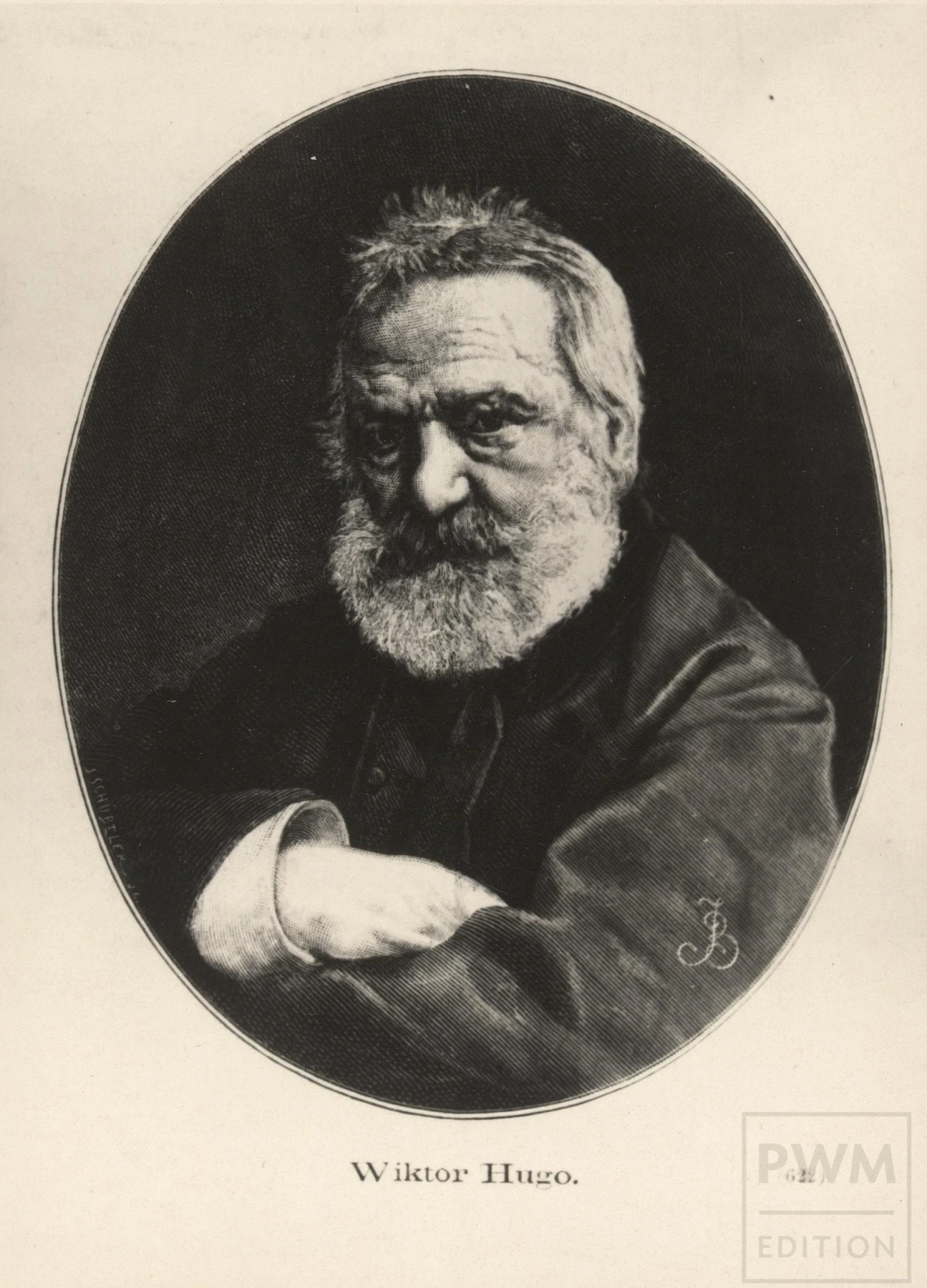
Hugo Victor, *26 February 1802 Besançon, †22 May 1885 Paris, poet, dramatist, novelist, and public figure, a leading figure of French Romanticism. With the exception of his childhood years spent in southern Europe (Corsica, Naples, Madrid) within the sphere of Napoleonic conquests and influence (while his father pursued a military career), and part of his later life (1851–71) spent in voluntary exile (Belgium, England) as a republican protest against the new empire, throughout his life Hugo was associated with Paris, which became the forum for his astonishingly versatile and spectacular activity (member of the Academy, Peer of France, deputy). As a poet, he made his debut in the 1820s with series of early Romantic odes, ballads, and orientales (Middle Eastern tales), in which convention was replaced by truth of expression and imagination, and classical beauty by what is characteristic. In numerous collections from the 1830s and 1840s (including Songs of Twilight 1835, Beams and Shadows 1840), the Romantic miniature of pure lyricism comes to the fore, “written with soul and heart”; intimate and elegiac expressions intertwine with heroism and pathos. In the heterogeneous works of later years (numerous volumes of The Legend of the Ages 1854–83), epic elements with existential and metaphysical accents prevail. As a prose writer, Hugo gained fame through The Hunchback of Notre-Dame (1831) and Les Misérables (1862), works that established the canon of the Romantic novel, appealing to a broad audience through ethical sensitivity and exalted expression. Hugo achieved his greatest fame and significance as a creator of Romantic theatre, a codifier of the genre (Romantic drama), which, under the influence of opera, combined the sublime with the grotesque, taking in the 19th century the place of the classical pair of genres: tragedy and comedy. The staging of the first two of Hugo’s nine dramas (Cromwell 1827, Hernani 1830) became a manifestation of the Romantic movement; Hugo saw its guiding idea in the category of freedom.
Hugo’s work testifies to the highest degree of engagement with the issues of his time; its thematic diversity can be reduced to the problem of the human condition in historical and social, existential and transcendent dimensions (the fight between good and evil, the annihilation of evil through love, the movement toward light). The constitutive features of Hugo’s style: vitality, freedom, exuberance, excess, violence, suddenness, power, bravura, tempo, the use of bold metaphor, striking contrast, rhetorical emphasis alongside lyrical subtlety, extreme antithesis or exaggerated hyperbole, persistent refrain-like structures, and sudden shifts of expression – were taken up and developed (also in music) mainly by post-Romantic and modernist generations, and rejected by Impressionists and Neoclassicists. Hugo’s verse, masterful in versification and remarkable for its diversity of solutions (heterosyllabism, heterometry, heterostrophic forms), is based on the opposition between an initial order (the alexandrine, the Sapphic stanza) and expressive flexibility (freedom of the caesura, frequent enjambment, variability of modulation brought about by the abundance of interrogations and exclamations).
Although the majority of Hugo’s work is phonetically self-sufficient (sonorité éclatante), his presence in the history of 19th-century music, particularly French music, became significant. Approximately 1,000 songs were composed to his texts; one may distinguish successive phases of interest: Berlioz and H. Mompou (1830s), Liszt and Wagner (1840s), Gounod and Lalo (1850s), Bizet and Fauré (1860s), Franck, Massenet, and d’Indy (1870s and later); two composers, H. Reber and Saint-Saëns, set Hugo’s texts to music throughout their lives. It was on Hugo’s texts that the transition in French song took place from the sentimental and early Romantic romance to the Romantic mélodie, the counterpart of the German Lied. Cantatas to Hugo’s epic-lyric texts were composed by Berlioz, Hérold, Saint-Saëns, Fauré, Franck, and d’Indy. Hugo’s dramas and novels became the basis for several operas of a new style (sometimes composed to the poet’s own libretti), especially by Italian composers such as Donizetti, Verdi, and Ponchielli. Hugo’s epic themes were adopted as programs for piano works and symphonic poems by Liszt and C. Franck.
Literature: V. Guille Victor Hugo et son oeuvre, Paris 1950; J.B. Barrère Victor Hugo. L’homme et l’oeuvre, Paris 1959, Polish trans. J. Parvi, Warsaw 1968; A. Jullien Les drames de Victor Hugo et la musique, “Revue et Gazette Musicale de Paris” 1872; P. Glachant Victor Hugo et la musique, “La Revue Musicale” 1902; “La Revue Musicale” – special issue, 1935 no. 9/10; L. Guichard La musique et les lettres au temps du romantisme, Paris 1955; E. Appia Victor Hugo et la musique in: De Palestrina à Bartok, Paris 1965; F. Weil Victor Hugo et Richard Wagner, Bern 1926; A. Laster Berlioz et Victor Hugo, “Revue de Musicologie” 1977 no. 1/2; R. Turner A Comparison of Two Set of Liszt-Hugo Songs, “American Liszt-Society Journal” 1979 no. 5 ; J.A. Delaire Histoire de la romance, Paris 1845; P. Scudo Esquisse d’une histoire de la romance, Paris 1856; F. Noske La mélodie française de Berlioz à Duparc, Paris 1954.
From poetic collections:
Odes (1819–28):
La lyre et la harpe — C. Saint-Saëns, cantata 1879.
Ballades (1823–28):
La fiancée du timbalier — C. Saint-Saëns, cantata 1887; Les deux archers — H. Mompou 1834; Madelaine — H. Reber c. 1849; A un passant — H. Reber c. 1879; La chasse du burgrave — C. Saint-Saëns, dramatic scene c. 1854; Le pas d’armes du roi Jean — C. Saint-Saëns 1852, 1864.
Orientales (1829):
La captive — H. Berlioz 1832, H. Reber c. 1837, H. Mompou 1841; La sultane favorite — H. Mompou 1834; Sara la baigneuse — H. Berlioz, cantata 1834, H. Mompou 1834, V. Massé c. 1864; L’attente — R. Wagner 1840, C. Saint-Saëns c. 1855, V. d’Indy c. 1874; Vœu — H. Reber c. 1850, G. Bizet c. 1867; Les djinns — G. Fauré, cantata 1875, C. Franck, symphonic poem 1884; Les adieux de l’hôtesse arabe — G. Bizet 1866; Mazeppa — F. Liszt, piano fantasy 1840, piano étude 1851, symphonic poem 1851; Rêverie — C. Saint-Saëns 1851; Extase — R. Wagner c. 1840, C. Saint-Saëns c. 1860.
Les feuilles d’automne (1831):
Ce qu’on entend sur la montagne — G. Franck, symphonic poem c. 1846, unpublished; F. Liszt, symphonic poem 1848; A une femme — F. Liszt 1844, 1860, V. Massé c. 1869; Soleil couchant — J. Massenet 1912.
Les chants du crépuscule (1835):
Hymne — F. Hérold, cantata 1831, J. Chailley 1954; En attendant que le vent — H. Reber c. 1858; L’aurore — G. Fauré c. 1865; Nouvelle chanson — F. Liszt 1844, 1860, H. Reber c. 1845, C. Franck c. 1857, G. Fauré c. 1865, J. Massenet 1869, J. Gall c. 1900, C. Saint-Saëns c. 1915; Autre chanson — G. Donizetti, A. Dargomyzhsky 1836, S. Moniuszko c. 1839, C. Gounod c. 1855, E. Lalo 1855, M. Sokolowski 1901; Puisque j’ai mis ma lèvre — C. Franck 1872; La pauvre fleur disait au papillon — H. Reber c. 1847, G. Fauré c. 1865; Envoi — C. Franck 1872; Mai — G. Fauré c. 1865; A Louis B. — C. Saint-Saëns c. 1855.
Les voix intérieures (1837):
Puisqu’ici bas toute âme — E. Lalo 1855, G. Fauré, duet c. 1870; Soirée en mer — C. Saint-Saëns 1862; Après une lecture de Dante — F. Liszt, piano fantasy 1840; La tombe et la rose — R. Wagner c. 1840, F. Liszt 1844.
Les rayons et les ombres (1840):
Guitare — H. Mompou 1840, F. Liszt 1844, H. Reber c. 1845, C. Saint-Saëns 1851, G. Bizet 1866, J. Massenet 1886; Autre guitare — F. Liszt 1842, E. Lalo 1855, 1894; Oh! quand je dors — F. Liszt 1843, 1859, E. Lalo 1855, 1894, G. Bizet c. 1867; Tristesse d’Olympio — V. Massé c. 1860; Dieu qui sourit — K. Dargomyzhsky 1846, E. Lalo 1855, V. Massé c. 1874.
Les châtiments (1853):
L’art et le peuple — V. d’Indy 1894; C’est la nuit — J. Massenet 1914; Le chant de ceux qui s’en vont sur mer — C. Saint-Saëns c. 1860.
Les contemplations (1830–56):
La coccinelle — G. Bizet 1868, C. Saint-Saëns 1868; Vieille chanson du jeune temps — H. Reber c. 1858; Chanson — H. Reber 1869, C. Saint-Saëns 1870; Les femmes — J. Massenet 1908; Viens! — C. Saint-Saëns, duet 1855, 1885, A. Caplet 1901; Après l’hiver — G. Bizet 1866; Écrit au bas d’un Crucifix — J.B. Faure c. 1880; O souvenir! — E. Lalo 1870.
L’art d’être grand-père (1877):
Le matin — C. Saint-Saëns c. 1864; Patrie — C. Franck, cantata 1871; Chanson de grand-père — H. Reber c. 1878, C. Saint-Saëns 1902; Chanson d’ancêtre — C. Saint-Saëns 1902.
La légende des siècles (1854–83):
La chanson des aventuriers de la mer — V. d’Indy, cantata 1870; Les pauvres gens — P. Gilson, opera Zeevolk 1904; Italie — L. Mancinelli, opera Isora di Provenza 1884.
From dramatic works:
Cromwell (1827):
La chanson de fou — H. Mompou 1835, G. Bizet 1868.
Marion de Lorme (1829):
A. Ponchielli, opera 1885.
Hernani (1830):
V. Bellini, dramatic scenes 1831, G. Verdi, opera 1844, V.A. Duvernoy, overture 1890.
Le roi s’amuse (1832):
G. Verdi, opera Rigoletto 1851, L. Delibes, scenic fragments 1882.
Lucrèce Borgia (1833):
G. Donizetti, opera 1833.
Marie Tudor (1833):
H. Berlioz, serenade; F. Liszt, serenade 1849; C. Gounod, serenade 1855; M. Balfe, opera The Armourer of Nantes 1863; R. Wagner-Régeny, opera Der Günstling 1935.
Angelo (1835):
S. Mercadante, opera Il giuramento 1837; C. Cui, opera 1876; A. Ponchielli, opera La Gioconda 1876; W. Krogulski, serenade 1900.
Ruy Blas (1838):
F. Mendelssohn, overture 1839; S. Moniuszko, serenade 1840; J.M. Poniatowski, opera 1843; C. Saint-Saëns, serenade 1868; F. Marchetti, opera 1869; J.B. Weckerlin, serenade c. 1875; L. Delibes, serenade 1879.
Les burgraves (1843):
I.F. Dobrzyński, incidental music 1860; L. Sachs, opera 1924.
From prose fiction
Notre-Dame de Paris (1831) as libretto Esmeralda (1836):
L. Bertin, opera 1836; A. Mazzucato, opera 1838; A. Dargomyzhsky, piano fantasy 1838, opera 1847; C. Pugni, ballet 1844; J.M. Poniatowski, opera 1847; F. Campagna, opera 1862; W. Fry, opera 1864; A.G. Thomas, opera 1883; J. Massenet, opera Le jongleur de Notre-Dame 1902; F. Schmidt, opera 1914.
Les misérables (1862):
S. Duniecki, melodrama 1864; A. Wormser, piano elegy c. 1900; A. Honegger, film music 1934; C.M. Schönberg, musical 1986.
L’homme qui rit (1869):
A. Pedrollo, opera 1920