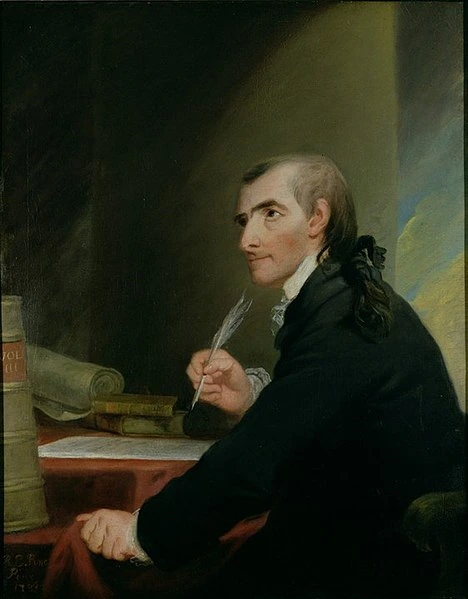
Hopkinson Francis, *21 September 1737 Philadelphia, †9 May 1791 Philadelphia, American lawyer, politician, musician, and writer. After graduating in 1757 from the College of Philadelphia (now the University of Pennsylvania), he began practicing law in Philadelphia in 1761, where he worked until the end of his life, playing an active role in the nation’s political affairs. As a delegate to the Continental Congress, belonging to Thomas Jefferson’s radical faction, he signed the United States Declaration of Independence in 1776. From 1779, he served as a judge (and as a federal judge from 1789 to 1791).
Hopkinson – a man of many talents – actively participated in Philadelphia’s cultural life. He wrote patriotic poems, essays, and satires; he composed musical works, earning the title of the first American composer of secular music. He is known for his drawings and numerous inventions and improvements, including a bell instrument called the bellarmonica, a new method of tuning the harpsichord, and the addition of a keyboard to Benjamin Franklin’s glass harmonica. He developed an interest in music at an early age. He began learning to play the harpsichord in 1754, and in the 1760s and 1770s he participated in concerts, often performing with professional musicians from Europe (the repertoire typically included works by Corelli, Geminiani, Galuppi, Handel, and others). In addition, he occasionally substituted for the organist at Christ Church, and around 1770 he taught psalmody there. In connection with this, he compiled two collections of psalms for the Protestant church: The Psalms of David… and Collection of Psalm Tunes. He composed mainly vocal-instrumental music (solo and choral) based on English models, often with his own lyrics. His song My Days Have Been So Wondrous Free (from 1759) is considered the earliest (surviving) American secular composition.
Literature: O. G. Sonneck F. Hopkinson (1737–1791). The First American Composer, “Sammelbände der Internationalen Musikgesellschaft” V, 1903/04, and F. Hopkinson and J. Lyon, Washington 1905, reprint New York 1967; G.E. Hastings The Life and Works of F. Hopkinson, Chicago 1926; O. Albrecht F. Hopkinson, Musician, Poet and Patriot, Philadelphia 1934, 3rd ed. 1938.
Compositions:
My Days Have Been So Wondrous Free, Solo vocal piece with harpsichord, Philadelphia 1759
Seven Songs, solo songs, lyrics by the composer, Philadelphia 1788
Give Me Thy Heart As I Give Mine, solo song, Philadelphia 1789
Ode from Ossian’s Poems, solo song, Baltimore, ca. 1790
A Toast, solo song, Philadelphia 1799
An Exercise Containing a Dialogue and an Ode, choral song, Philadelphia 1761
numerous occasional pieces
compilations:
Collection of Psalm Tunes, Philadelphia 1763
The Psalms of David (…) for the Use of the Reformed Protestant Dutch Church, New York 1767
a collection of songs and anthems (including 6 pieces by Hopkinson), MS at the Library of Congress in Philadelphia
Editions:
12 songs, ed. H.V. Milligan, in: The First American Composer oraz Colonial Love Lyrics, Boston 1918, 1919
Ode from Ossian’s Poem, ed. C. Deis, New York 1920
Seven Songs, facsimile edition, Philadelphia 1954