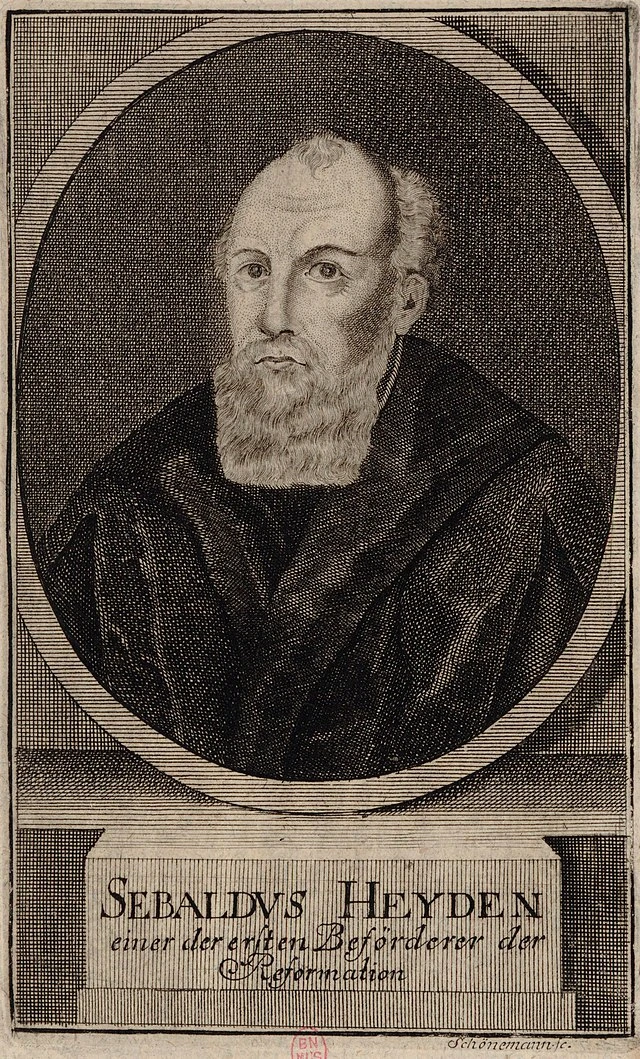
Heyden, Haiden, Sebald, *8 December 1499 Bruck (near Erlangen), †9 July 1561 Nuremberg, German writer, music theorist, and probably composer. He came from a middle-class family that settled in Nuremberg around 1500. Heyden received his early education at St. Lorenz School, where he was a pupil of Cochlaeus. In 1513, he began his studies at the University of Ingolstadt, where he obtained his master’s degree in 1519. He then taught for a short time in Knittelfeld, Bruck an der Mur and Loeben, before returning to Nuremberg, where he spent the rest of his life. He was cantor at the Spitalkirche, rector of the school associated with this church from 1521, and rector of the St. Sebald school in 1525. Heyden gained wide renown as a teacher, scholar, and musician.
Heyden’s treatises, dedicated to the Nuremberg patrician and city councillor Hieronymus Baumgarten, deal with the subject of “musica practica”, and the author’s achievements in this field are mainly related to teaching methodology. Already in Musicae stoicheiosis, Heyden departed from the traditional two-part organisation resulting from the division of musica practica into “musica plana” and “musica mensuralis”, arguing that issues of melody, hitherto closely related to the teaching of cantus planus (musical scale, hexachordal system, solmization rules, interval theory and church mode system), should be explained in conjunction with elements of mensural singing; Heyden thus definitively separated the theory of “musica plana” from its natural foundation in liturgical music. He also introduced a new element into the teaching of solmization by distinguishing two fundamental types of cantus: durus, encompassing melodies that do not contain the pitch b molle, and mollis, to which he assigned melodies that do include this pitch. This innovation, which in practice amounted to a reduction in the number of mutations, was an expression of the tendency prevalent in the first half of the 16th century to simplify the rules of solmization based on the hexachordal system. Heyden also sought to simplify complex mensural notation. The close connection between Heyden’s theoretical concepts and musical practice is particularly evident in De arte canendi. Book 1 is devoted to the problems of melody and elements of mensural notation, while Book 2 presents in detail the issue of rhythm in the context of polyphony and is richly illustrated with examples taken from contemporary compositions (including those by Josquin des Prés, Ghiselin and Ockeghem). Heyden was highly regarded by later theorists, including Glarean.
Heyden was also involved in literary and compositional work related to the Reformation. He provided a new text for the Salve Regina antiphon, which was to be sung in this form in the Reichstag in Nuremberg. He is credited with writing 8 hymn texts, and he probably also composed the melodies for two of them (Gott, du Hirt Israels, merk auf and Herr Gott, dein Namen ruf’n wir an), since these melodies only appear in sources in connection with his texts. The literary and musical traditions of the Heyden family were continued by his son Hans (c. 1536–1613), an instrument maker, organist and writer, and his grandson Hans Christoph (c. 1572–1617), a composer, organist, and poet.
Literature: H. Bellermann Die Mensuralnoten und Taktzeichen des 15. und 16. Jahrhunderts, Berlin 1958, 4th ed. 1963; J. Zahn Die Melodien der deutschen evangelischen Kirchenlieder, Gütersloh 1889–1893; E. Praetorius Die Mensuraltheorie des Franchinus Gafurius und der folgenden Zeit bis zur Mitte des 16. Jahrhunderts, «Publikationen der Internationalen Musikgesellschaft, Beihefte» II, Leipzig 1905, reprint Wiesbaden 1970; H. Riemann Geschichte der Musiktheorie im IX–XIX Jahrhundert, Berlin 2nd edition 1921; K.G. Fellerer Die Deklamationsrhythmik in der vokalen Polyphonie des 16. Jahrhunderts, Düsseldorf 1928; J. Moser Die evangelische Kirchenmusik in Deutschland, Berlin 1954; A. Kosel S. Heyden (1499–1561), Würzburg 1940; W. Apel The Notation of Polyphonic Music 900–1600, Cambridge (Massachusetts) 1942, Greman translation Leipzig 1962; C. Sachs Rhythm and Tempo, New York 1953; C. Dahlhaus Die Termini Dur und Moll, “Archiv für Musikwissenschaft” XII 1955; C.A. Miller S. Heyden’s “De arte canendi”. Background and Contents, “Musica Disciplina” XXIV, 1970; G.G. Allaire: Peculiar Signatures in 14th, 15th, and 16th-Century Sources, “Journal of the Canadian Association of University Schools of Music” 7, 1977; E. Weber Contribution à l’hymnologie comparée. La mélodie du Psaume LXVIII “Que Dieu se montre seulement” et du choral “O Mensch bewein dein Sünde gross” au XVIe siècle, “Etudes Grégorienne” XVIII, 1979; E. Witkowska-Zaremba Ars musica w krakowskich traktatach muzycznych XVI wieku, Krakow 1986; A.M. Busse Berger Mensuration and Proportion Signs. Origin and Evolution, Oxford 1993; A. Blachly Mensura versus tactus, in: Quellen und Studien zur Musiktheorie des Mittelalters, III, ed. M. Bernhard, “Veröffentlichungen der Musikhistorischen Kommission”, vol. 15, Munich 2001; M. Ham A sense of proportion: The performance of sesquialtera ca. 1515–ca. 1565, “Musica disciplina” 56, 2011.
Works:
Musicae stoicheiosis, Nuremberg 1532 (earlier edition titled Rudimenta, or Institutiones musices, Nuremberg 1529 – lost)
Musicae id est artis canendi libri duo, Nuremberg 1537, expanded edition titled De arte canendi, ac vero signorum in cantibus usu, libri duo, Nuremberg 1540
Editions:
De arte canendi, ac vero signorum in cantibus usu, libri duo, facs. 1969; English translation C.A. Miller, «Musicological Studies and Documents» XXVI, 1972