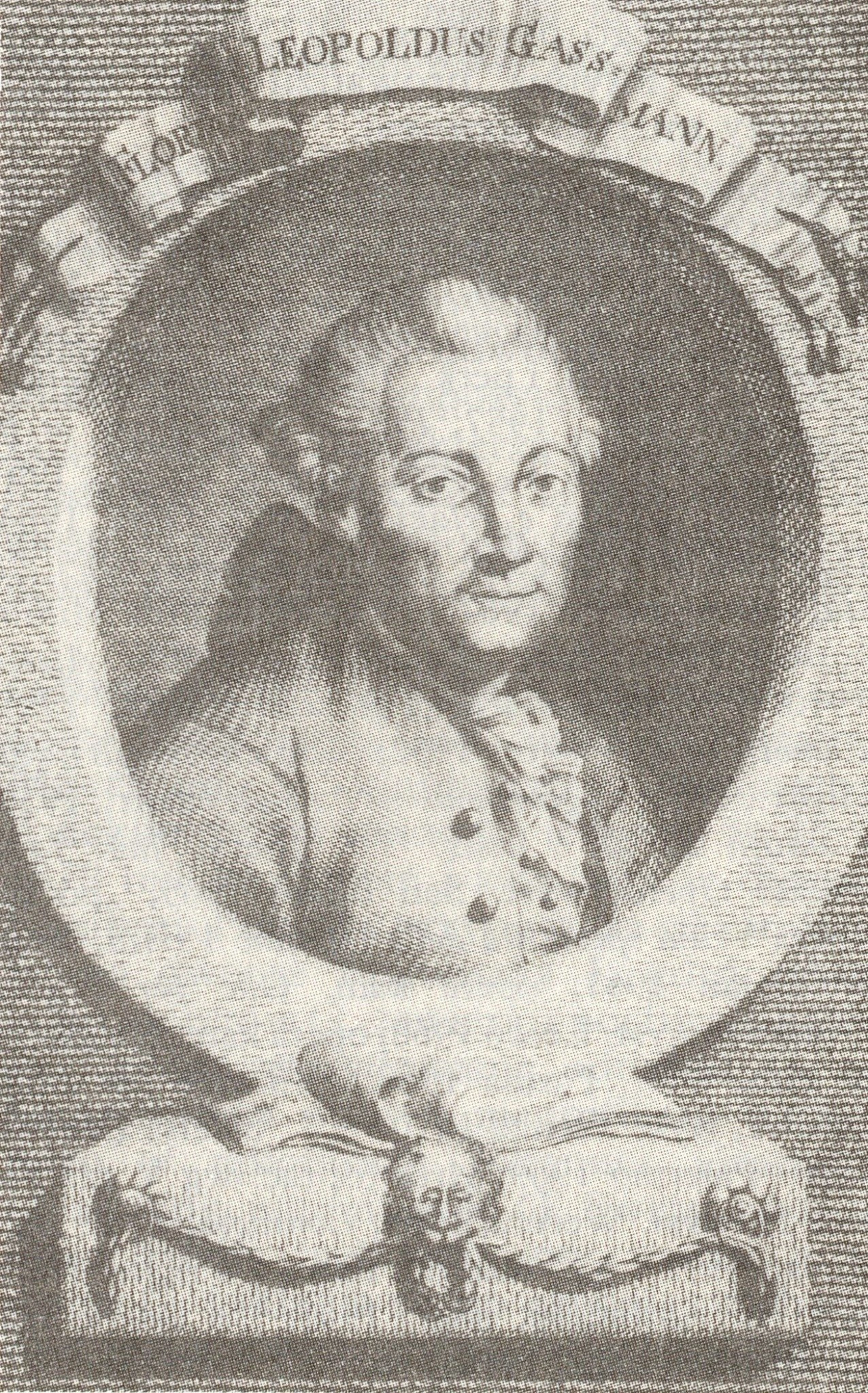
Gassmann Florian Leopold, *3 May 1729 Brüx (Most, Czech Republic), †21 January 1774 Vienna, Czech composer. He studied music (singing, violin, and harp) in his hometown with J. Vobořil. At the age of 12, against his father’s will, he left his family home and traveled to Italy, wanting to become a musician. He probably studied in Bologna with Padre Martini, and later stayed in Venice at the home of Count Leonardo Veneri (or Senator Leonardo Venier). In 1757, he staged the opera Merope at the Teatro S. Moisè. The success of this and subsequent Venetian operas by Gassmann led to his appointment in 1763 (replacing Ch.W. Gluck) as ballet composer at the imperial court in Vienna. In 1764, he was awarded the title of Hof- und Kammercompositor. At the turn of 1765 and 1766, Gassmann stayed in Venice, and in 1769/70 in Rome, staging his operas there. In the summer of 1770, on the occasion of the meeting between Emperor Joseph II and King Frederick II of Prussia in Mährisch-Neustadt, Gassmann composed the opera La contessina. The work was appreciated by Frederick II, who tried to recruit the composer to the Berlin court. In 1771, Gassmann founded the Tonkünstler-Sozietät in Vienna, and his oratorio La Betulia liberata was performed in 1772 during one of the Society’s first public concerts. In 1772, after the death of G. Reutter, he became the imperial court Kapellmeister. A. Salieri was Gassmann’s pupil; he had been under his tutelage in Vienna since 1766. Gassmann’s two daughters, Maria Anna (married name Fux) and Therese (married name Rosenbaum), studied music with Salieri and became opera singers.
Gassmann is one of the most important precursors of Viennese classicism. He gained popularity as a composer of dramatic music. His operas were staged not only in Italy and Vienna, but also in Lisbon, Copenhagen, and Warsaw, where Italian singers performed Gli uccellatori (1765), L’amore artigiano (1774) and Il viaggiatore ridicolo (1775), German singers performed Die Liebe unter den Handwerksleuten (translated of L’amore artigiano, 1782), and Polish singers performed Miłostki rzemieślnicze (L’amore artigiano, translated by W. Bogusławski, 1787). Opera buffa predominates in Gassmann’s dramatic works. The composer skillfully combined Italian-style melodies with German song elements. He gave an important role to the orchestra, following the style of Viennese instrumental music (developed motivic work and filled middle voices). Gassmann’s greatest achievement in the field of opera buffa is La contessina, in which the musical characteristics accurately contrast the noble and bourgeois milieus. In the choral parts and orchestral accompaniment of the opera Amore e Psiche, Gassmann referred to the achievements of C.W. Gluck.
Symphonies were also an important area of Gassmann’s work, about half of which are in four movements, e.g. the Symphony in A-flat major, which is an example of solid compositional craftsmanship and demonstrates an excellent mastery of polyphony. Within this genre, Gassmann eagerly experimented with, among other things, the form of individual movements and the tonal plan.
Gassmann’s polyphonic training (probably acquired from Padre Martini) found its fullest expression in his church compositions, in which, alongside traditional late Baroque counterpoint, there is a tendency towards heightened expression typical of Classical composers. Gassmann’s church music was highly regarded by J. Haydn and W.A. Mozart.
Literature: J. Sonnleithner Biographische Skizze über Florian Leopold Gassman, “Wiener Theateralmanach” 1795; G. Donath Florian Leopold Gassman als Opernkomponist, “Studien zur Musikwissenschaft” II, 1914; F. Kosch Florian Leopold Gassman als Kirchenkomponist, “Studien zur Musikwissenschaft” XIV, 1927; F. van Rossum La contessina, “Mens en melodie” XXVI, 1971; E.R. Meyer The Oboe Quartets of Florian Leopold Gassman, “The Music Review” XXXIV, 1973; G.R. Hill A Thematic Catalog of the Instrumental Music of Florian Leopold Gassman, Hackensack (New Jersey) 1976; A. Żórawska-Witkowska Muzyka na dworze i w teatrze Stanisława Augusta, Warsaw 1995; K. Dichtl F. L. Gaßmann und seine Zeit – Neue Forschungsergebnisse, in: Die Oper in Böhmen, Mähren und Sudetenschlesien («Veröffentlichungen des sudetendeutschen Musikinstituts» 4), Regensburg 1996; H. Kainer Anmerkungen zur Lebensgeschichte von Florian Leopold Gassmann, “Die Musikforschung” 65/4, 2012; M. Lorenz Antonio Salieri’s Early Years in Vienna, 2013 (http://michaelorenz.blogspot.com/2013/03/antonio-salieris-early-years-in-vienna.html).
Editions (a selection):
Stabat Mater, Agnus Dei and Dona nobis, Mainz 1837
La contessina, ed. R. Haas, «Denkmäler der Tonkunst in Österreich» XXI, 1914
Symphony in B minor, ed. K. Geiringer, Vienna 1934
Missa in C major, Requiem (fragm.), Veni Creator, Regina coeli, Viderunt omnes, Tui sunt coeli, Stabat Mater, ed. F. Kosch, «Denkmäler der Tonkunst in Österreich» XLV, 1938
Divertimento à tre, ed. E. Schenk, Vienna 1954
String quartet, ed. K. Šolc, Prague 1957
Symphony in A-flat major, ed. L. Somfai, Budapest 1970
Divertimento in G major for flute, violin, and cello, ed. F. Nagel, Wolfenbüttel 1977
3 fugues for string quartet, ed. M. Klement, «Musica viva historica» XXVII, 1971
7 symphonies, ed. G.R. Hill, «The Symphony 1720–1840» B, 10, New York, London 1981
2 string trios, ed. W. Sawodny, «Hortus Musicus» 247, Kassel, Basel 1988
String quartets E, C, D, eds. G. Acciai, M. Boschini, A. Pachovsky, «Diletto musicale» 1316, 1317, 1318, Vienna 2000
Ballet Le triomphe de l’amour, eds. C. Croll, T. Hauschka, Kassel, Basel 2016
6 trio sonatas, wyd. H. Albrecht, «Organum» III nos. 45, 48, 51, 53, 55, 58
Compositions:
Instrumental:
8 string quintets Op. 2, Paris 1772
ca. 30 symphonies
ca. 30 opera overtures
flute concerto
6 orchestral minuets
10 wind quintets
ca. 40 quartets, including 4 collections 6 quartets each, n.d. Paris, Amsterdam and Vienna
26 fugues for string quartet
ca. 40 trios and duets for string instruments
Vocal-instrumental:
La Betulia liberata, oratorio, text by P. Metastasio, Vienna 1772
2 secular cantatas, arias and other vocal works
5 masses, Requiem, Stabat Mater, graduals, offertories, motets, hymns, antiphons, and other sacred works
Stage:
operas:
Merope, libr. A. Zeno, staged in Venice 1757
Issipile, libr. P. Metastasio, staged in Venice 1758
Gli uccellatori and Filosofia ed amore, libr. C. Goldoni, staged in Venice 1759 and 1760
Catone in Utica, libr. P. Metastasio, staged in Venice 1761
Un pazzo ne fa cento, libr. G. Foppa (?), staged in Venice 1762
L’Olimpiade, libr. P. Metastasio, staged in Vienna 1764
Il trionfo d’amore, libr. P. Metastasio, staged in Vienna 1765
Achille in Sciro, libr. P. Metastasio, staged in Venice 1766
Il viaggiatore ridicolo, libr. C. Goldoni, staged in Vienna 1766
L’amore artigiano, libr. C. Goldoni, staged in Vienna 1767
Amore e Psiche, libr. M. Coltellini, staged in Vienna 1767
La notte critica, libr. C. Goldoni, staged in Vienna 1768
L’opera seria, libr. R. de Calzabigi, staged in Vienna 1769
Ezio, libr. P. Metastasio, staged in Rome 1770
La contessina, libr. M. Coltellini after C. Goldoni, staged in Mährisch-Neustadt 1770
Il filosofo inamorato, libr. M. Coltellini after C. Goldoni, staged in Vienna 1771
Le pescatrici, libr. C. Goldoni, staged in Vienna 1771
Don Quischott von Mancia, libr. G. B. Lorenzi, staged in Vienna 1771
I rovinati, libr. G. Boccherini, staged in Vienna 1772
La casa di campagna, libr. G. Boccherini, staged in Vienna 1773
***
3 ballets