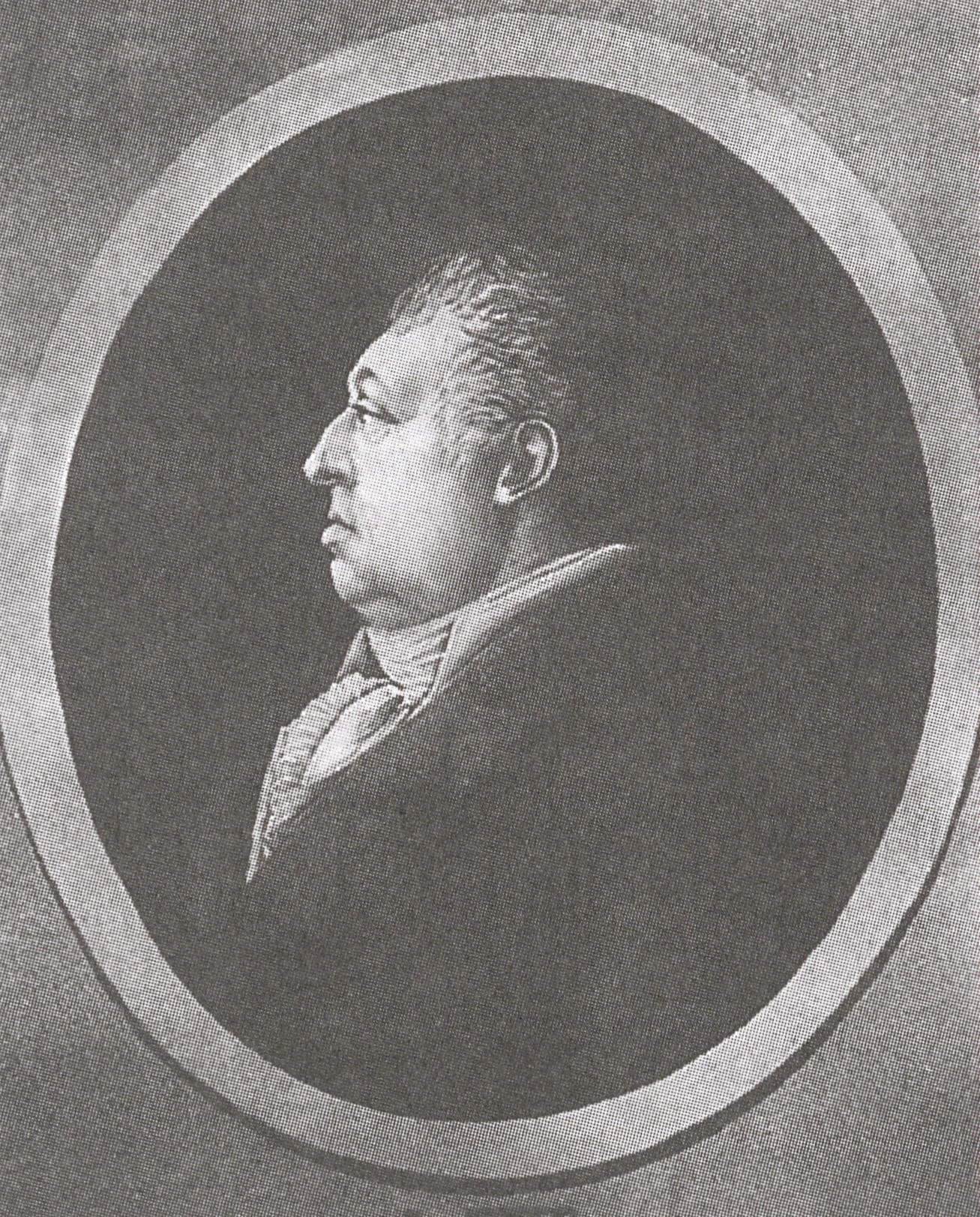
Dussek, Dusík, Dussik, Jan Ladislav, Johann Ludwig, baptised as Václav Jan, *12 February 1760 Čáslav, †20 March 1812 St Germain-en-Laye (near Paris), son of Jan Josef, Czech composer and pianist.
He initially received musical education from his mother (Veronika, née Štěbetová, a harpist) and father, and later he studied under L. Spinar at the Jesuit gymnasium in Jihlava in Moravia. For a time, he also studied at the Jesuit gymnasium in Kutná Hora, where he also played the organ; later he moved to Prague (1776–1778), where he completed his secondary education and studied for one semester at the local university.
In 1779, he travelled with Count Männer to the Netherlands. There he worked as an organist in Malines (1779) and Bergen-op-Zoom (from 1780), gave piano concerts in Malines and Amsterdam, and from 1783 in The Hague he became a piano teacher in the house of William V, Prince of Orange, Governor of the Netherlands. He then left for Hamburg, where he befriended C.Ph.E. Bach and also gave concerts in Kassel.
In March 1783, he probably performed in Warsaw, and then stayed at the court of Prince Karol Radziwiłł in Nieśwież. There, he became close to Prince Karol’s sister-in-law, Princess Zofia of Thurn und Taxis, and ran with her to Tilsit on 17 January 1784. He then embarked on a successful concert tour, playing the piano and glass harmonica in Berlin (1784), Mainz (1785), St Petersburg and Paris (1786) and various Italian cities (1787–88).
In 1788, he returned to Paris, but after the outbreak of the revolution, he settled in London in 1790. There, he performed as a soloist in Salomon’s concert series and was also a popular and highly regarded piano teacher. In 1792, he married Sophia Giustina Corri, daughter of Italian composer Domenico Corri, with whom he founded a music publishing company in 1797. After the company went bankrupt in 1799, Dussek was forced to flee from his creditors to Hamburg. He performed again in Germany and in Prague in 1802; between 1803 and 1806, he stayed at the court of Louis Ferdinand, Prince of Prussia. After the prince’s death, he worked briefly at the court of Prince von Isenburg, and from 1807 until his death he was a music teacher and concert organiser at the court of Prince Talleyrand in Paris.
Dussek’s wife, Sophia Giustina (1 May 1775 Edinburgh – after 1828?), was a singer, pianist and harpist; she also composed several pieces for piano and harp. The couple had a daughter, Olivia (29 September 1801 London – 1847 London), married name Buckley, who was a pianist, harpist and organist, composer (piano pieces, harp pieces and songs).
Alongside J.B. Cramer and M. Clementi, Dussek was one of the most outstanding pianists of his time. He possessed dazzling technique and was renowned for his precise use of the pedal. At his urging, Broadwood introduced modernisations to his instruments. As a composer, he focused almost exclusively on the composition of piano works. Dussek’s works, written in Classical forms, display stylistic features typical of Romanticism, anticipating the works of Weber, Chopin and Schumann, among others. J. Haydn held Dussek’s talent in high regard.
Literature: Z. Zouhar J.L. Dusík, 1760–1960, Brno 1960 (bibliography); H.A. Craw A Bibliography and Thematical Catalogue of the Works of J.L. Dusík (1760–1812), dissertation, University of Southern California, 1964; K. Bartoszewicz Radziwiłłowie, Warsaw after 1927; K. Krafka Romantické prvky v klavímích sonatách J.L. Dusík, dissertation, Brno University 1950; V.J. Sýkora J.L. Dusík, der älteste Vorgänger Chopins, in: The Book of the First International Musicological Congress, devoted to the Works of F. Chopin 16th–22nd February 1960, ed. Z. Lissa, Warsaw 1963; S.V. Klíma Dusík in England, “Music and Letters” XLI, 1960; L. Schiffer J.L. Dusík Seine Sonaten und seine Konzerte, Munich 1914, reprint New York 1973; M. Tarantová V.J. Tomášek a J.L. Dusík, “Zprávy Bertramky” LIII, 1968; D. Sandlin Romantic Elements in the Piano Sonatas of J.L. Dusík (1760–1812), dissertation, University of Miami, Coral Gables 1974; L. Palazzolo Il tocco cantale. J.L. Dusík, compositore e virtuoso tra Mozart e Clementi, Lukka 1992; J.B. Weidensal Notes on J.L. Dusík and Mrs. Dusík (Sophia Corri). A Review of Contemporary Sources, “American Harp Journal” XIV, 1993; A. Żórawska-Witkowska Muzyka na dworze i w teatrze Stanisława Augusta, Warsaw 1995; A. Gerhard J.L. Dusík Le retour à Paris. Eine Klaviersonate zwischen Aufklärung und Romantik, “Archiv für Musikwissenschaft” LIII, 1996; A. Davison The Iconography of en Émigré Musician: Henri-Pierre Danloux’s 1795 Portrait of Jan Ladislav Dussek, “Early Music” 2009 vol. 37 No. 2; Jan Ladislav Dussek (1760–1812). A Bohemian Composer ‘en voyage’ through Europe, ed. R. Illiano, R.H. Stewart-MacDonald, Bologna 2012; G. Gostelow Dussek and the moderator; or, how to play the piano with both feet, “Early Music” 2014 vol. 42 No. 3.
Compositions
Instrumental:
piano pieces:
concertos:
B-flat major, ca. 1779, lost
3 concertos Op. 1, before 1783: C major, E-flat major, G major
E-flat major Op. 3, Paris 1787
E-flat major Op. 15, London 1789
F major Op. 14, ca. 1791
F major Op. 17, Paris 1792
B-flat major Op. 22, London 1793
F major Op. 27, London 1794
C major Op. 29, London 1795
C major Op. 30, London 1795
The Grand Military Concerto B-flat major Op. 40, London 1798
F major, London ca. 1798
G minor Op. 49, Paris 1801
double concerto in B-flat major Op. 63, Leipzig 1805–1807
E-flat major Op. 70, Leipzig 1810
approx. 40 sonatas: Op. 5 No. 3, Op. 9, Op. 10 Nos. 1–3, Op. 14 Nos. 1–3, Op. 18 No. 2, Op. 24, Op. 25 No. 2, Op. 31 No. 2, Op. 35 Nos. 1–3, Op. 39 Nos. 1–3, Op. 43, Op. 44, Op. 45 Nos. 1–3, Op. 45, Op. 47 Nos. 1–2, Op. 61, Op. 64, Op. 69 No. 3, Op. 75, Op. 77
numerous rondos and variations
program pieces, including La Consolation
6 preludes
Fantasia and Fugue in F minor
Leçons progressives Op. 32 Nos. 1–12
2 English arias
sonatas for four-hands: Op. 33, Op. 48, C major (without Op.), Op. 67 Nos. 1–3
Fugues for four-hands Op. 64 Nos. 1–3
sonata for 2 pianos
2 duos for 2 pianos
chamber:
over 20 piano trios
Piano Quintet in F minor Op. 41, Paris 1799
Piano Quartet in E-flat major Op. 56, London 1803
3 String Quartets: G major, B-flat major, E-flat major Op. 60, London 1806
2 sonatas for violin, cello and harp
Notturno for violin, horn and piano
approx. 60 sonatas for flute and piano
6 waltzes for violin or flute and piano
In addition, he composed 6 concertos for harp (3 of which are lost), 6 sonatinas for harp, and 2 stage works (The Captive of Spilberg, 1798; Pizarro, 1799), Missa solemnis (ca. 1811), canons for 3 and 4 voices, several songs, a serenade and an overture for orchestra
He wrote also Instructions on the Art of Playing the Piano Forte or Harpsichord, London 1796, French edition Méthode pour le piano forte, Paris 1799, German edition Pianoforte Schule, Leipzig 1802
Editions:
Oeuvres de J.L. Dussek, Leipzig 1813–17, revised edition 1976
J.L. Dussek Selected Piano Works, ed. H.A. Craw, Madison (Wisconsin) 1977
3 preludes for piano, «Musica Antiqua Bohemica» XX, 1954
12 Progressive Lessons Op. 16 for piano, «Musica Antiqua Bohemica» XXI, 1954
6 sonatinas for harp, «Musica Antiqua Bohemica» XXII, 1954, 2nd edition 1965
sonatas for violin and piano, «Musica Antiqua Bohemica» XLI, 1959
sonatas for keyboard instruments, «Musica Antiqua Bohemica» XLVI, LIII, LIX, LXVIII, 1960, 1961, 1962, 1963
Notturno concertante Op. 68 for violin, horn and piano, ed. Ch.D.S. Field, Kassel 1972
J.L. Dussek. Selected Piano Works, 3 vols., ed. H.A. Craw, «Recent Researches in the Music of the Nineteenth and Early Twentieth Centuries», 2 vols., Madison (Wisconsin) 1979
Haydn, Dussek, and Contemporaries, ed. N. Temperley, New York 1985