
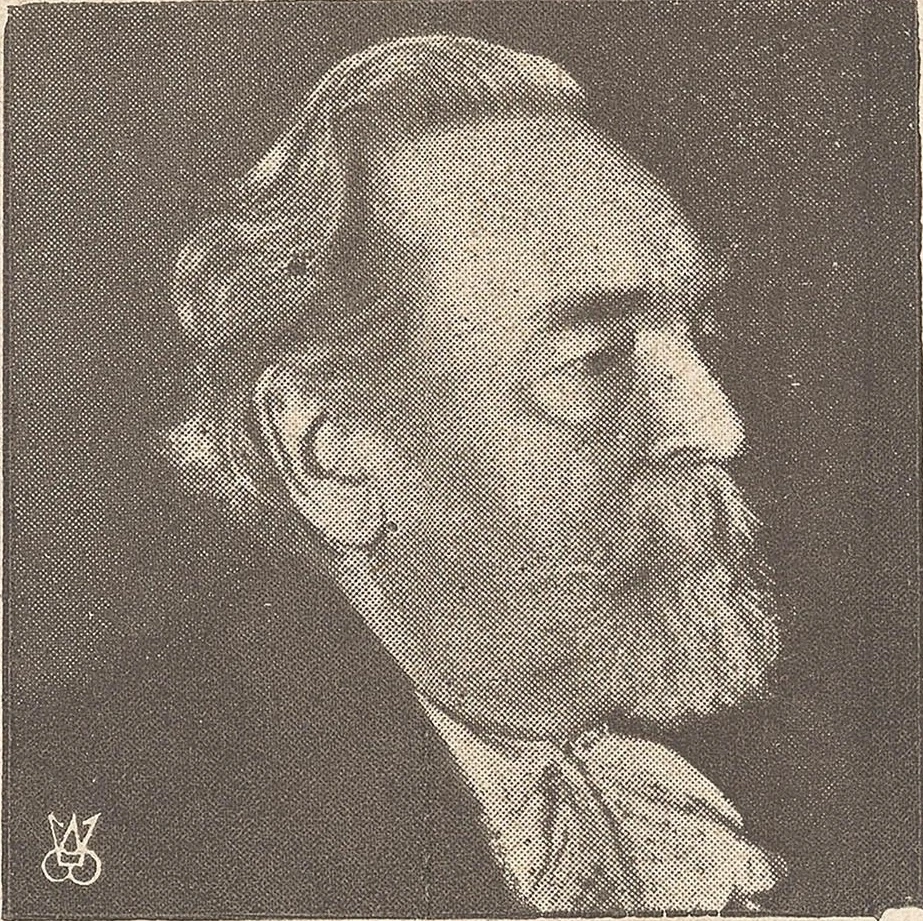
Grupa wybitnych muzyków polskich. Mało znana fotografia z archiwum Zjednoczenia.

Domaniewski Bolesław Marian, *16 July 1857 Gronówek (near Sieradz), †11 September 1925 Warsaw, Polish teacher, pianist, and composer. He initially studied music at home. In 1871–74 he studied in Warsaw with R. Lorer and then with J. Wieniawski. From 1874 he gave concerts in central and northern Russia, and from 1878 he began studies at the St. Petersburg Conservatory with L. Brassin, A. Cross (piano), W. Ch. Bernhard (harmony and counterpoint), A. Rubinstein, A. Lyadov, and N. Solovyov; in 1882 he graduated with a gold medal. He performed concerts in Russia, including under the baton of A. Rubinstein and in a chamber trio with L. Auer and K. Davydov. He also appeared in Poland, France (1889), and Italy. For a time he taught piano in Astrakhan. In 1890–1900 he was professor of the highest piano class at the Conservatory in Krakow; he also gave private singing lessons. During this period, he gave concerts in Krakow, Lviv, and Warsaw. In April 1900 he moved to Warsaw; in 1902 he became director of the Warsaw Music Society school (renamed in 1919 the Fryderyk Chopin Higher School of Music) and simultaneously head of the piano class. Together with others he worked toward the legal recognition of the Union of Musicians of the Kingdom of Poland (1900). On 31 December 1905 he became musical director of the Warsaw Music Society. He continued to perform in concerts, including at the Town Hall and at the Warsaw Philharmonic (in the 1903/04, 1907/08, and 1909/10 seasons). He also lectured at concerts organized by the Music Society in Kraków, where he participated; in 1895 he gave talks on J. S. Bach and J. Haydn, and in 1896 on R. Schumann. In Warsaw he lectured on his own piano teaching method. He was also active as a publicist. In 1905–07 he edited the illustrated biweekly literary-musical magazine “Lutnista”, and also wrote for “Echo Muzyczne, “Teatralne i Artystyczne”, “Nowości Muzyczne”, and “Kurier Codzienny”. His piano method Vademecum pour pianistes modernes (Leipzig 1897 B & H), later repeatedly published by Gebethner i Wolff and after World War II by PWM (Kraków 1962), became particularly important in piano pedagogy.
In the history of Polish musical culture, Domaniewski is remembered as an outstanding teacher, pianist, and organizer of musical life. His students included F. Szopski, J. Gawroński, J. Łada, K. Czop-Umlauf, J. Loria, K. Krzyształowicz, A. Marek, J. Tołkacz, W. Raczkowski, K. Miketta, R. Werner, B. Kon, and A. Kagan. His playing was characterized by excellent command of piano technique and a wide dynamic range. His repertoire included works by J. S. Bach, Beethoven, Chopin, Schubert, Mendelssohn, Schumann, Tchaikovsky, Rubinstein, Saint-Saëns, K. Tausig, W. Żeleński, and his own compositions, though he was above all a brilliant performer of Liszt’s virtuoso works.
Literature: J. Reiss Almanach muzyczny Krakowa 1780–1914, vol. 1, Krakow 1939; J. Sierpiński Bolesław Domaniewski, (1857–1925), “Ruch Muzyczny” 1965 no. 1; A. Spóz Warszawskie Towarzystwo Muzyczne 1871–1971, Warsaw 1971.
for piano:
Etude
Gawot
mazurkas
Souvenir de Caucase
Romance
Krakowiak
***
variations, an unfinished concerto, and others – in manuscript