
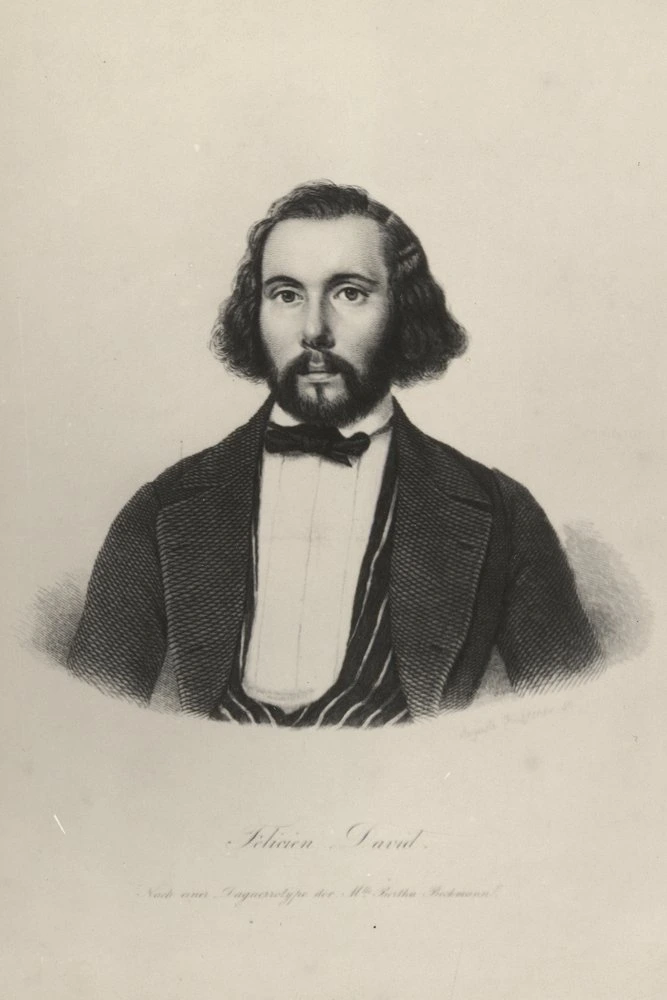
Félicien David

David Félicien César, *13 April 1810 Cadenet (Vaucluse), †29 August 1876 St. Germain-en-Laye, French composer. In 1818 he became a chorister at the church of St-Sauveur in Aix-en-Provence, where he began his musical studies under Abbé Michel and M. Roux; his earliest compositions from this period include motets, hymns, and a string quartet. From 1830 he studied at the Paris Conservatory under L. F. É. Millault, then under F.-J. Fétis (counterpoint and fugue) and F. Benoist (organ), while privately studying harmony under N. H. Reber. In 1831, influenced by B. P. Enfantin, he joined the Saint-Simonist circle, composing a substantial number of male-chorus songs for the brotherhood. In 1833, as one of the “apostles” of the “New Christianity” movement, he undertook a two-year journey to the Middle East, which profoundly shaped the direction of his work. By 1836 he published in Paris the piano cycle Mélodies orientales, and then began work on the symphonic-ode Le désert, whose successful Paris premiere in 1844 consolidated David’s growing fame as a symphonist and revealed his predilection for oratorio and operatic composition. In 1845, David traveled to Germany (where he met Mendelssohn and Meyerbeer), Austria, Hungary, and northern Italy. Many oratorios and operas created between 1847–61 were generally well received; however, it was the comic opera Lalla-Roukh (1862) that brought him enormous success. His standing in the French musical scene is evidenced by the royal court granting him an annual pension in 1860, the Legion of Honour in 1862, and the Académie des Beaux-Arts award for his operatic work. In 1869 he received, succeeding Berlioz, a seat at the Institut de France. Toward the end of his life, he returned to the Saint-Simonist movement, dying as one of its members.
David’s musical style grows out of early Romantic French traditions; at its core lie a strong differentiation of musical narrative and a moderately intense degree of vocalization, an important role of coloristic elements, a predominance of illustrativeness over programmatic treatment in non-classical genres, and a marked directness of emotion, bordering on naïveté of expression. His interest in Oriental music modified his narrative style (melismatic lines, specific scales) and inspired explorations in orchestral color and harmony, as seen in the opera Lalla-Roukh. In the “Oriental” strand of David’s output is also the symphonic-ode Le désert, whose three parts are divided into illustrative scenes (sandstorm, prayer to Allah, caravan passage, muezzin’s call). In his vocal-orchestral works, David achieves dramatic unity through symphonically conceived structures with consistently developed motifs, including highly innovative features, such as a narrator’s part in Le désert.
David was one of the leading figures of the first phase of French Romanticism, alongside Berlioz, though today his music is mainly of historical interest. While admired for his symphonic and monumental vocal-orchestral works, their impact was short-lived in a French musical landscape dominated by opera. Modern scholars (e.g., R. Dumesnil) recognize David as a precursor to Western fascination with Oriental music, later seen in the works of Delibes, Saint-Saëns, Debussy, Roussel, and Messiaen.
Literature: S. Saint-Etienne Biographie de Félicien David, Marseille 1845; E. de Mirecourt Félicien David, Brussels 1854, 3rd ed. 1869; A. Azevedo Félicien David. Coup d’oeil sur sa vie et son oeuvre, Paris 1863; C. Saint-Saëns Harmonie et melodie, Paris 1885, 91923; R. Brancour Félicien David, Paris 1909; R. Dumesnil La musique romantique française, Paris 1944; T Gouin Félicien David, le pere de l’exotisme musical, “Musica” XCIX, 1962; P. Gradenwitz Félicien David (1810–1876) and French Romantic Orientalism, “The Musical Quarterly” LXII 1976; B.R. Schueneman The Search for the Minor Composers. The Case of Félicien David, “Music Reference Services Quarterly” III, 1995; M. Ladjili La musique arabe chez les compositeurs français du XIXe siècle saisis d’exotisme (1844–1914), “International Review of the Aesthetics and Sociology of Music” XXVI, 1995; J.-P. Bartoli La musique Française et l’Orient. A propos du Désert de Félicien David, «Revue Internationale de Musique Française» VI, ed. H. Champion, Paris 1982; D.V. Hagan Félicien David, 1810-1876. A Composer et a Cause, Syracuse (NY) 1985; R. P. Locke Music, Musicians, and the Saint-Simonians, Chicago-London 1986; J.-P. Bartoli A propos de deux ouvrages sur Félicien David et les Saint-Simoniens. Une lettre inédite de David, “Revue de Musicologie” LXXV, 1988; R. P. Locke Félicien David, compositeur saint-simonien et orientalisant, in: «Les Saint-Simoniens et l’Orient. Vers la modernite», ed. M. Morsy, Aix-en-Provence 1990; J.-P. Bartoli L’évolution des procédés exotiques de Félicien David à Saint-Saëns ou comment s’est ponctuée la musique orientale en France au XIXe siècle, “Revue Belge de Musicologie” LI, 1997; R.P. Locke The French Symphony. David, Gounod et Bizet to Saint-Saëns, Franck, et their Followers, in: «The Nineteenth-Century Symphony», ed. D. K. Holoman, New York 1997.
Instrumental:
Symphony in F major, 1837
Symphony in E major, 1838
Nonet in F major for brass instruments, 1839
Nonet in C minor for brass instruments, 1839
Solo in E major for clarinet and orchestra, ca. 1840
Symphony in E-flat major, 1841
Le quatre saisons — 24 miniatures for string quintet in 4 books, 1845–46
Symphony in D minor, 1849
6 esquisses symphoniques for piano, 1856
numerous piano works, including Mélodies orientales — 22 miniatures in 7 books, 1836
4 string quartets
3 piano trios
12 mélodies for violin or cello and piano
waltzes, mazurkas for piano
Vocal and vocal-instrumental:
Le désert, symphonic ode for tenor, narrator, men’s choir, women’s choir ad libitum and orchestra, text A. Colin, 1844
Moise au Sinai, oratorio, text S. Saint-Etienne, after B.P. Enfantin, 1846
Christoph Colomb, symphonic ode, text J. Mery, C. Chaubet and S. Saint-Etienne, 1847
L’Eden, mystery, text J. Méry, 1847
more than 60 solo songs, 1836–66 (some also in an orchestral version)
works for choir a cappella
approximately 30 songs for men’s choir and piano for the use of the Saint-Simonist brotherhood, among others in the collections Ménilmontant, chant religieux, and La ruche harmonieuse
6 motets religieux with organ accompaniment
choral works with orchestra
Stage:
La perle du Brésil, opera, libretto J. Gabriel and S. Saint-Etienne, staged in Paris 1851, 2nd version 1859–61
Herculanum, opera, libretto J. Méry and T. Hadot, staged in Paris 1859
Lalla-Roukh, opera, libretto H. Lucas, M. Carré after T. Moore, staged in Paris 1862
La captive, opera, 1860–64, libretto M. Carré, not staged
Le saphir, opera, libretto M. Carré, T. Hadot and A. de Leuven after Shakespeare, staged in Paris 1865