
[Richard i Cosima Wagner oraz Hans von Bülow trzymający partyturę Tristana i Izoldy na Maximilianstrasse w Monachium]

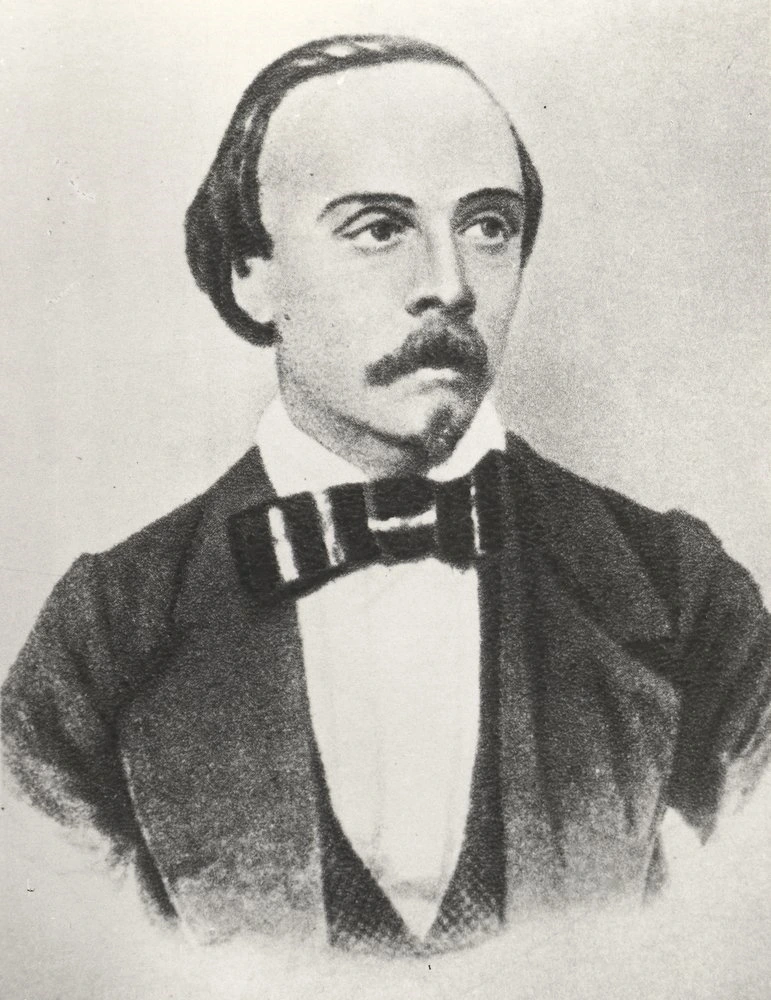
Bülow Hans Guido von, baron, *8 January 1830 Dresden, †12 February 1894 Cairo, German conductor, pianist, composer, music writer and teacher. He initially studied piano with F. Wieck and music theory with M. Eberwein in Dresden. In 1846, after moving with his parents to Stuttgart, he performed at a concert of the court theatre orchestra, performing J.J. Raff’s Fantasia and F. Mendelssohn’s Piano Concerto in D minor. In 1848, he studied law at the University of Leipzig and counterpoint under M. Hauptmann; from 1850, he continued his law studies in Berlin, where he also began writing in the spirit of R. Wagner’s ideas, collaborating with the democratic magazine “Abendpost.” The world premiere of Wagner’s Lohengrin in Weimar on 28 August 1850, conducted by F. Liszt, had an extremely strong influence on Bülow (in 1842 he heard Wagner’s Rienzi during its premiere in Dresden) and determined his choice of a career in music. In the autumn of 1850, persuaded by Wagner, he left for Zurich, where he performed as a Kapellmeister at the municipal theatre; he also conducted the theatre orchestra in St. Gallen. He then moved to Weimar to study piano with Liszt and also took up composition. In 1851, part of his music for Shakespeare’s Julius Caesar was performed, and in 1852 his Lieder, Op. 1, were published. He also collaborated with the “Neue Zeitschrift für Musik.” In 1853, he began concert tours in Germany, Austria, France, and Hungary. In 1855, he took over the position of piano teacher at the Stern Conservatory in Berlin, succeeding Th. Kullak. He also performed as a conductor at the Berlin Gesellschaft der Musikfreunde. In 1857, he married Liszt’s daughter, Cosima. In 1863, he was awarded an honorary doctorate by the University of Jena. In 1864, King Ludwig II appointed him to Munich as court pianist; in 1867, he was appointed Hofkapellmeister and director of the reorganised Royal Music School (Königliche Musikschule). Bülow conducted the world premieres of Wagner’s operas: Tristan und Isolde (10 June 1865) and Die Meistersinger von Nürnberg (21 June 1868). The following year, he separated from his wife Cosima, who began a relationship with Wagner. Bülow moved to Florence, and from 1872 he resumed his concert tours, performing in Russia, Poland (1872, 1874), England and America (1875, 1876), where he gave 139 concerts. From 1877 to 1879 he was Hofkapellmeister in Hanover, but resigned from the post following disputes with the tenor A. Schott. In 1878 he directed a music festival in Glasgow. From 1880 to 1885 he was Hofmusikdirektor in Meiningen at the court of George II, Duke of Saxe-Meiningen. He turned the court orchestra into an excellent ensemble, with which he undertook concert tours and performed works by Beethoven and Brahms, among others, to great acclaim. In 1882, he married the actress Maria Schanzer (who later distinguished herself as his biographer and the editor of his literary estate). In 1885, he conducted in Berlin, St Petersburg and Warsaw (three concerts); he taught at the Ralf Conservatory in Frankfurt am Main and at the Klindworth-Musikschule [now Klindworth-Scharwenka Conservatory] in Berlin. In 1887, he moved to Hamburg, where he had already been conducting “subscription concerts” since 1886, whilst also serving as conductor of the Berliner Philharmoniker. In 1889 and 1890, he toured America, enjoying great success. In 1894, he travelled to Egypt, where he died shortly afterwards.
Bülow was a unique figure in 19th-century German culture, an artist of rare versatility and extraordinary personality. He possessed excellent piano and conducting technique, and had a phenomenal memory. He conducted without a score, elevated the art of baton conducting to a level of virtuosity, and established (after Liszt) the model for the modern interpretation of musical works. He was guided by the ideal of precisely conveying the work’s expression; he analysed the minutest details of a piece, yet his performances gave the impression of spontaneity. He attached great importance to phrasing, which inspired Riemann to develop the science of musical phrasing (Phrasierungslehre). He conducted the first performances of works by Wagner and R. Strauss, but above all he was one of the most outstanding performers and popularisers of the works of Beethoven, and later Brahms. His piano repertoire included, alongside works by Beethoven – whose late piano sonatas he played masterfully – compositions by Bach, Brahms and Chopin. However, Bülow’s touch was criticised as “dry and unpleasant” (Paderewski), and thus unsuitable for the interpretation of Romantic music. During his concerts, he would occasionally give lectures on interpretation.
His compositions, particularly the symphonic works Des Sängers Fluch and Nirwana, as well as his virtuoso piano pieces, show the influence of Liszt’s work. Bülow edited many works of classical and Romantic music for publication, including Beethoven’s sonatas from Op. 53 onwards, études by Chopin and Cramer, a selection of sonatas by C.Ph. Bach, and others.
Currently, two international Hans von Bülow competitions take place in Meiningen – a piano competition (since 2012) and a conducting competition (since 2021).
Literature: Hans von Bülow. Briefe und Schriften, ed. M. v. Bülow, 8 vols. Leipzig 1896–1908, Briefwechsel zwischen Liszt und H. v. Bülow, ed. La Mara, Leipzig 1898, French edition Leipzig and Paris 1899; F. Nietzsche Briefwechsel mit Hans von Bülow und anderen, ed. E. Förster-Nietzsche and P. Gast, Leipzig 1905; Richard Wagners Briefe an Hans von Bülow, ed. D. Thode, Jena 1916; Briefwechsel H. v. Bülow und R. Strauss, ed. W. Schuh and F. Trenner, “Strauss Jahrbuch” 1954, English translation A. Gishford, London 1955
A. Steiner Hans von Bülow, Zurich 1906; H. Reimann Hans von Bülow. Sein Leben und Wirken, vol. 1, Berlin 1909; F. Munter Hans von Bülow und Beethoven, “Neues Beethoven Jahrbuch” VII, 1937; M. v. Millenkowich-Morold Dreigestim Wagner, Liszt und Bülow, Leipzig 1940; K. Huschke Hans von Bülow als Klavierpadagoge, Horb 1948; A. Vander Linden Une querelle d’artistes au siecle dernier, “Schweizerische Musikzeitung und Sängerblatt” XCIX, 1959; L. Bronarski Hans Bülow i muzyka Chopina, in: L. Bronarski Szkice Chopinowskie, French translation A. Szweykowska, Krakow 1961; W.M. Freitag An Annotated Biography of Hans von Bülow in the Harvard College Library, “Harvard Library Bulletin” XV, 1967; H.C. Schonberg The Great Conductors, Londyn 1968, German edition Die grossen Dirigenten, Bern 1970; B. Baselt Friedrich Chrysander und Hans von Bülow, “Händel Jahrbuch” XV/XVI, 1969/70
R.A. Lott A continous trance Hans von Bülow’s Tour of America, “Journal of Musicology” 12, 1994; P. Jost Chronologischer Überblick über die zu Lebzeiten veröffentlichen Kompositionen Hans von Bülow’s, in: Beiträge zum Kolloquium: Hans von Bülow – Leben, Wirken und Vermächtnis: veranstaltet von der Abteilung Musikgeschichte der Staatliche Museen Meiningen am 6. und 7. Mai 1994 im Rahmen der Meininger Landesmusiktage zum 100. Todestag Hans von Bülows, ed. H. Müller, Meiningen 1994; M. Bobéth Petr Ill’ič Čajkovskij und Hans von Bülow, in: Čajkovskijs Homosexualität und sein Tod – Legenden und Wirklichkeit, ed. Th. Kohlhase, “Čajkovskij-Studien” 3, Mainz 1998.
Instrumental:
orchestral:
Ouverture héroïque and Marche des impériaux to Shakespeare’s tragedy Julius Caesar, Op. 10a and 10b, 1860
Des Sängers Fluch, ballad based on a poem by L. Uhland, Op. 16, 1863
Nirwana. Symphonisches Stimmungsbild Op. 20, 1866
Vier Charakterstücke Op. 23, 1873
Nirwana. Orchester Fantasie in Ouvertürenform Op. 20, 1881
piano:
Mazurka-Impromptu Op. 4
Invitation à la Polka. Morceau de salon Op. 6
Rêverie fantastique Op. 7
Ballade Op. 11
Chant polonais Op. 12
Mazurka-Fantaisie Op. 13 (instrumented by Liszt)
Elfenjagd. Impromptu Op. 14
Valses caracteristiques Op. 18
Tarantella Op. 19
Il Carnovale di Milano. Ballabili e Intermezzi Op. 21
Au sortir du bal. Valse-Caprice Op. 24
Lacerta. Impromptu Op. 27
virtuoso paraphrases on opera themes:
Iphigenia in Aulis by Ch.W. Gluck
Tristan and Isolde, Ouverture for Meistersingers von Nürnberg and a paraphrase of the Quintet from Act 3 of this opera by R. Wagner
Ouverture Faust and Konzertstück by C.M. von Weber
Vocal-intrumental:
cycles of solo songs
Two Romances Op. 26
Il Carnevale di Milano